By Javacia Harris Bowser | For the Birmingham Times
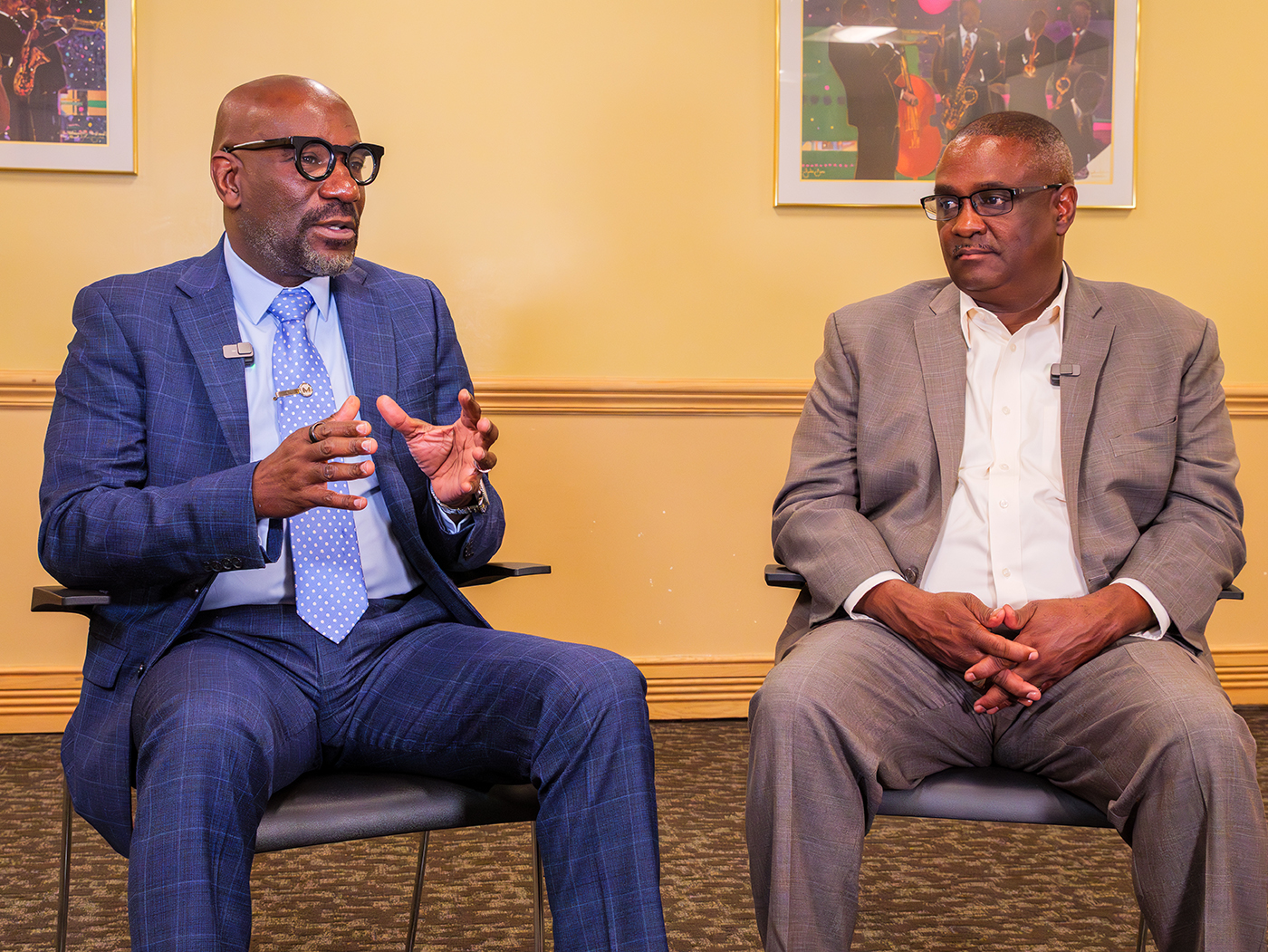
Whenever crises hit Birmingham City Schools (BCS) Superintendent Mark Sullivan, Ed.D., and Jefferson County Schools (JEFFCOED) Superintendent Walter Gonsoulin, Ed.D., both say they are uniquely equipped to deal with them in part because of their military training.
Sullivan, who served in the U.S. Navy Reserve for 24 years, and Gonsoulin, who served in the National Guard, were both deployed during the U.S.’s involvement in the Gulf War in Iraq. Gonsoulin was deployed in 1990. Sullivan, who was deployed twice but did not see combat, also worked stateside in military hospitals in 1990 and again in 2003.
In November 2019, Gonsoulin was named superintendent for JEFFCOED, becoming the first African American to serve in the role. Just a few months later, education systems across the country would be faced with the unprecedented challenges of navigating the COVID-19 pandemic in 2020. Meanwhile, Mark Sullivan was named interim superintendent for BCS in May 2020, at the height of the global health crisis, and by August of that year the school board officially appointed him to lead the district.
Under Sullivan’s leadership, BCS provided students with the technology, meals, and instruction they needed to keep learning. And for both Sullivan and Gonsoulin, communication was key. Gonsoulin, for example, gave teachers and students the guidance and reassurance they needed through videos and virtual listening tours.
During a recent conversation with The Birmingham Times, Sullivan and Gonsoulin reflected on how the military helped prepare them for their current roles and how camaraderie helped them cope with the pressures of the pandemic.
The first day of the 2025–2026 school year for both Jefferson County and Birmingham is Thursday, August 7.
Gonsoulin: The military, for me, provided stability, structure, guidance, discipline. It made me do things I never thought I was able to do. I’ll never forget reading the requirements to pass basic training. We had to walk 12 miles with all the equipment and everything on us. I was like, “Who walks 12 miles?” That’s what I was thinking at the time, but [the military] slowly developed me as a person to push beyond my own boundaries and taught me that I could do more than I think I can. I believe that has carried over into every other part of my life. So, when presented with an issue [or] an initiative … and people say, “Hey, we’ve never done this before” — well, that’s how I started off [in basic training for the National Guard]. I had never heard of anybody walking 12 miles. And guess what? I walked 12 miles and still had energy left.
Sullivan: That’s what I was going to say. [The military] prepares you for things you would not ordinarily think you would be able to do. … I would not be sitting here as superintendent if it were not for the U.S. Navy. In the military, they are constantly training. The reason they always train is because when something actually happens, it becomes automatic for you. It’s like muscle memory. It’s the same thing in education. Oftentimes, we just want to provide professional development one time, and teachers should have it. But you have to provide ongoing training and professional development, so it becomes muscle memory. Then, when you are in a very stressful situation, you just follow your training. It teaches you to calm your mind when you see a crisis happening. The slower you are able to think, the better decisions you make. When people make rash decisions, they tend to make the wrong decisions.
The military helped Gonsoulin and Sullivan prepare for careers in education, first as classroom teachers and eventually as district leaders who had to navigate the COVID-19 pandemic in 2020 and beyond. Here’s how they handled it.
Gonsoulin: We had to have someone to lean on, that colleague, that confidant, when no one else understands what you’re doing. You can’t go home and explain it to your spouse, but the people that are involved in it understand the pressure. COVID was very unique in that it was ever-changing. If you think you were ahead of it at 8 o’clock in the morning, by 4 o’clock that afternoon you’re behind it. So, having colleagues like Dr. Sullivan and other superintendents to be able to call on and say, “Hey, look, I’m going through this” or “What are you going to do about this?” — that was key. It was a space where I could be vulnerable, as well, because sometimes situations would come up and there was no play in the playbook to deal with it.
Sullivan: Walter would always say, “Plan for 14 days out.” The pandemic taught us to be very agile, to be able to lean on each other. Because I took things 14 days at a time, it also taught us that we can’t be so rigid in our expectations, that when something is not exactly the way it should be, when it’s not working, well, let’s just figure it out. … If everybody works as a team, then you’ll see positive results.