By Shauna Stuart | For The Birmingham Times
Tayari Jones thinks “Kin” is her most Southern book.
Jones’ “Kin” tour includes conversations about the novel with renowned female authors. The tour kicked off in February with a book launch helmed by her Spelman creative writing professor, Pearl Cleage.
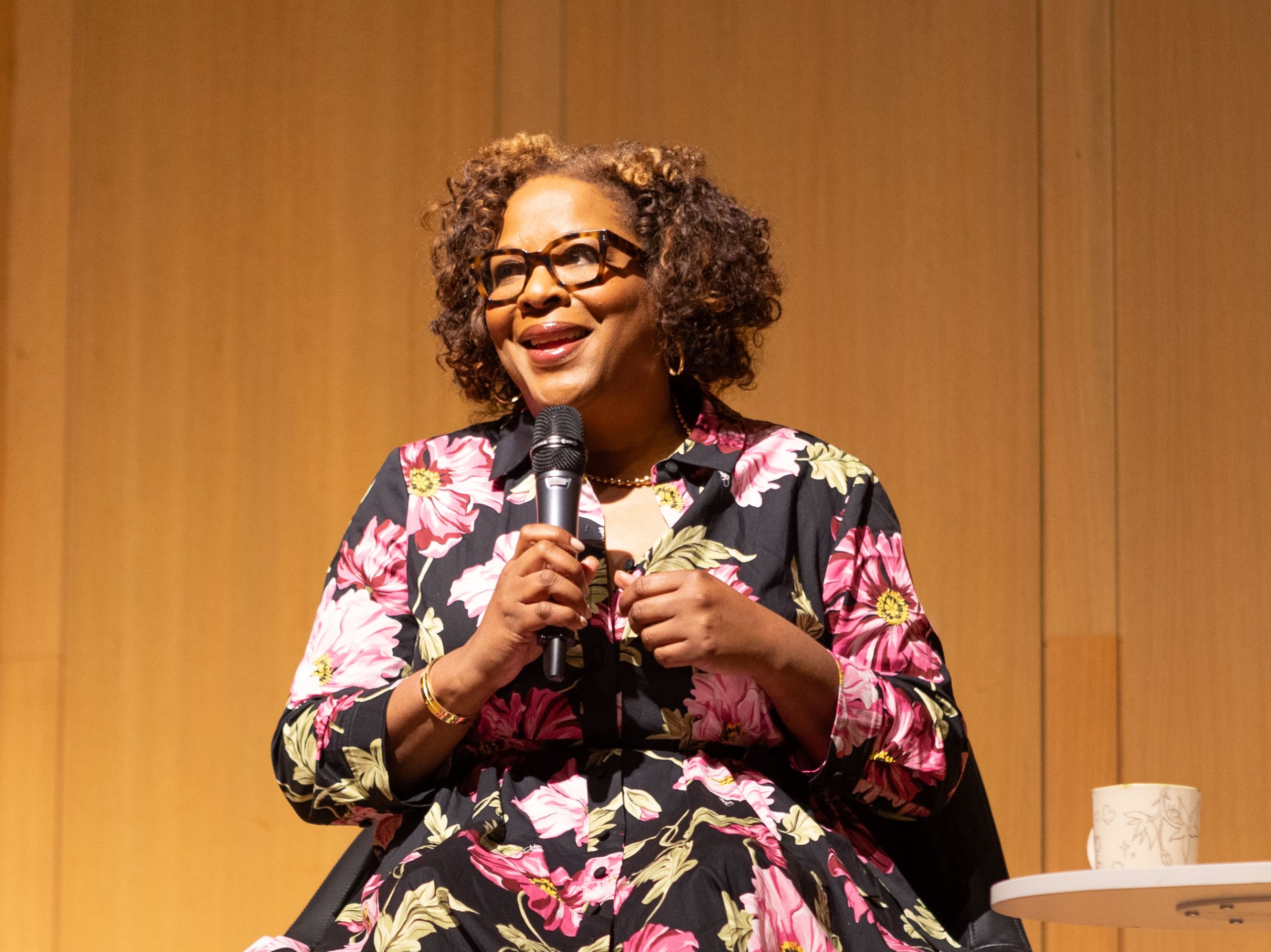
Sunday, the day after a stop at the New Orleans Festival of Books with Birmingham native Imani Perry, Jones brought the tour to Birmingham for the third edition of ArtLit hosted by the Birmingham Museum of Art and Thank You Books. Seated in the packed-out museum auditorium during a conversation with journalist, and The Birmingham Times editor, Javacia Harris Bowser, Jones talked about her decision to move back to the South.
Jones’ fifth novel, an Oprah’s Book Club pick released in February, tells the story of Vernice and Annie, two lifelong “cradle” friends from the fictional town of Honeysuckle, Louisiana. Set in the 1950s and 1960s in Louisiana, Georgia, and Memphis, the novel follows the lives of both girls, who are motherless – Vernice’s mother was killed by her father, and Annie’s mother abandoned her and left Honeysuckle for Memphis when she was a child.
After high school, the two girls take different paths. Vernice, raised by her aunt, leaves Honeysuckle to attend Spelman College in Atlanta, settling into a community of friends and mentors and a world of social mobility. Annie, raised by her grandmother, leaves Honeysuckle for Memphis to find her mother, embarking on a journey of both adventure and peril.
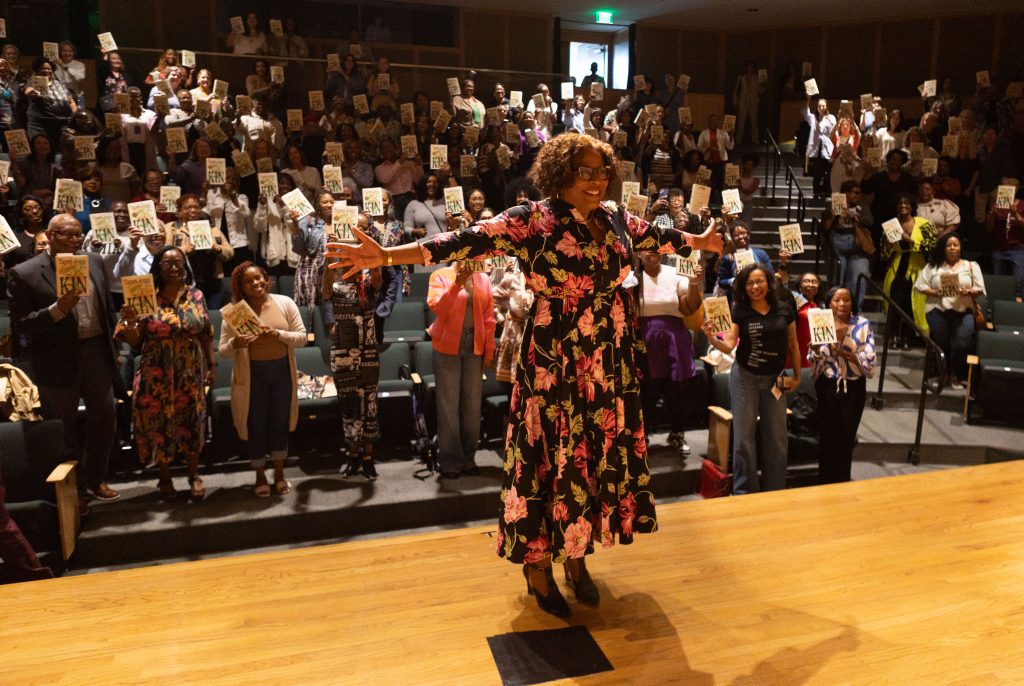
Jones, an Atlanta native, was living in New York when she was writing her acclaimed 2018 novel “An American Marriage,” a New York Times Bestseller also chosen for Oprah’s Book Club and selected for Barack Obama’s 2018 Summer Reading List. One day, she was sitting in a popular Brooklyn coffee shop and looked around at other famous writers.
“And I thought, we’re all having the same breakfast. It’s only a matter of time before we start writing the same story,” said Jones.
Writers move to New York to be near publishers and immerse themselves in the city’s flourishing literary scene.
“But I wanted to come home so that I could be a Southern writer writing from the South,” said Jones. “[Up there] they think the South is just a place of African-American misery. They think that’s just what we do. Just get up in the morning and be miserable. When I lived in New York, people would act like I came to Brooklyn on the Underground Railroad,” Jones said as the auditorium erupted into laughter.
“[Kin] is super Southern, and I think it’s because I was home and I didn’t have anything to prove to anyone,” Jones continued. “I had no allegiance to any agenda other than the truth.”
Back home in Georgia, Jones felt grounded in Southern spaces as she worked on “Kin.” She did research, looking through vintage Sears catalogues, and drew on her family’s legacy of attending Historically Black Colleges and Universities. Her father was expelled from Southern University for participating in sit-ins during the height of the Civil Rights Movement. Decades later, both of her parents became professors at Clark College. Jones attended Spelman College and studied creative writing under Pearl Cleage. The friendships Jones developed at Spelman would become some of the greatest resources of her life.
The result of those years of work was “Kin,” a novel about the fullness of Black womanhood in the South and the complexities of motherhood, friendship, and class. But above all, Jones says “Kin” is an examination of family.
“Your birth family, that’s the luck of the draw. But your chosen family – your friends – those are relationships. We are constantly renewing our vows with our friends. There’s so much agency in it and so much choice,” said Jones. “You can tell so much about a person by whom they choose to be their next of kin.”
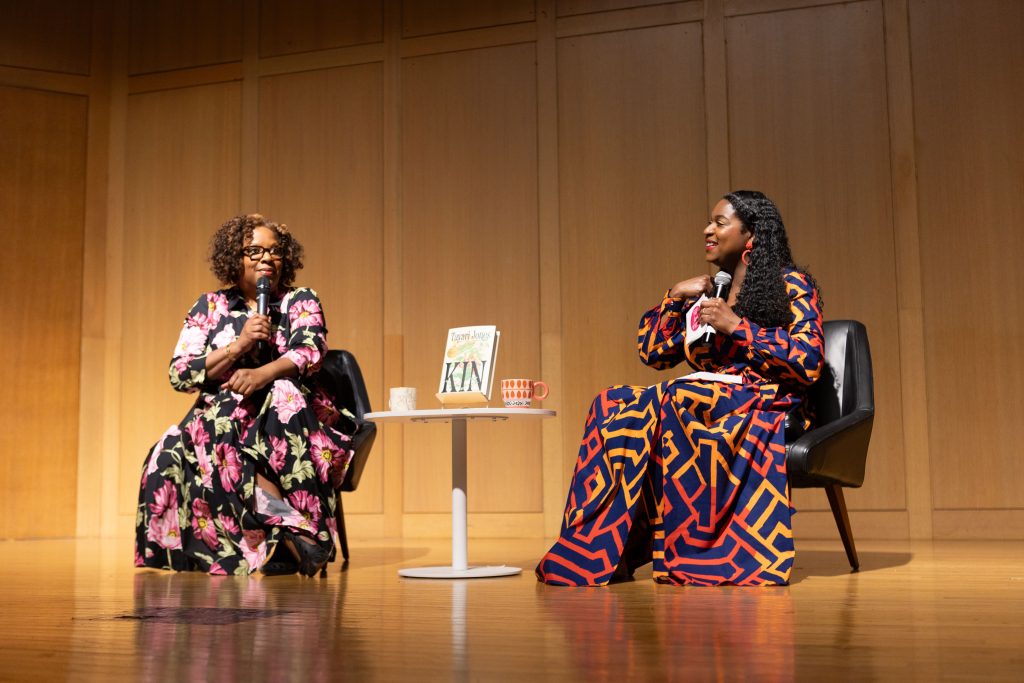
During the nearly 40-minute conversation, Jones and Bowser discussed the origin of “Kin” and writing in the South before opening the dialogue to the audience for questions.
Here are some highlights of the conversation, edited for clarity:
Javacia Harris Bowser: I understand that you originally wanted to write a different book, but it wasn’t really working out. So, tell us a little bit about that, and then how did the story of Annie and Niecy come to you?
Tayari Jones: It’s true. This wasn’t the book that I had agreed to write, and the other book, the book that I didn’t write, it was my idea. It’s not like somebody said to me, you should write a book about this. I thought I wanted to write a book about my hometown of Atlanta and all the ways that it’s changing. I moved back home to find it a really different city. And so, I wanted to write about what does that mean when your hometown has become, while not unrecognizable, different? And also, I wanted to turn the camera on myself and ask, is it possible to gentrify your own hometown?… So, I was trying to work on a novel to explore that, but for whatever reason, it didn’t catch fire. It felt like I was working with a hammer and nails, and I was making noise when I should have been making music.
I worked on it for a couple of years and it wasn’t happening. And finally, I just started trying to write with paper and the pencil… just writing the thoughts that came to me, and that’s when I found these two girls, Annie and Niecy, they’re both motherless. They’re living in the South in the fifties, and I thought, that’s strange. I don’t write the past. I’m very committed to writing the story of my own generation. But there they were, and I thought, well, maybe this is the backstory. Maybe my real story is about these women’s children. But after I was about 150 pages in, I had to accept that this was the story that I was writing. Usually when I try to write, I think of what is the story I’m trying to tell? But for this one, I had to say, what is this story trying to tell me?
Bowser: You’ve said before that you’re very committed to writing “the now.” You feel like that’s your responsibility, especially as a Black artist. So even though this book is set in the fifties and the sixties, what about “the now” do you feel that “Kin” is still depicting, particularly about motherhood, Black womanhood and friendship?
Jones: At the core of the story is friendship. Annie and Niecy have been best friends since they were little children. But as you get older, life takes us in different directions. One of the most difficult things in a friendship to overcome is when one person gets married because that other person is living an entirely different type of life now. [There’s a saying that goes] “When I was a child, I did childish things and now I’ve put aside my childish ways.” Your best friend from childhood can be seen as a childish thing to be put away and that’s something people still deal with. [Niecy] has to struggle with how to maintain her own life, her own identity, while she’s married. So that was something from “the now” and also I was thinking about we’re [currently] in the now, but the way things are going in this country, they’re trying to take us back to “the then.” And so looking at the ways people were struggling, dealing with segregation and just the lack of opportunities, in some ways felt like a cautionary tale from the past, like a bell that was ringing that we would be wise to hear.
Bowser: You talk about Aunt Irene, who is child-free, and when we see Niecy and Annie grow up, they have very different lives. And so one of the things I feel this book does, in addition to talking about motherhood and friendship, is examine all the different ways to be a woman. What did you feel like you wanted this book to say, or what questions did you want this book to ask about what it means to be a woman, particularly a Black woman in the South?
Jones: In the 50s and late 60s, opportunities are opening up and people are in a situation where they’re more able to choose what kind of life they want instead of merely dealing with the hands they are dealt. We have lots of women. We have, of course, Niecy, who is able to go to college. She goes to Spelman College. She has never really heard of rich Black people in her small town. And so she’s learning about this whole different world from that experience. And then we have Annie, who goes on this wild goose chase and she meets a woman who runs a sharecropping whorehouse. That is a certain kind of independence, but it’s an independence at the expense of others. Niecy’s mother-in-law is a Black woman who is just committed to the idea of being a 1950s housewife because, for her, that represents a kind of freedom that she’s not a maid, she has her own home. But when Niecy comes to live with her, she kind of feels like, as a maid, you clean someone else’s home, but if you’re doing the same thing in your own home, are you a maid at home? So all of these questions that people are asking and just trying to figure out the way forward. But also, one thing in writing this, I realized how I was born in 1970, so all my life I have lived in a world where people have access to safe, reliable contraception.
When you write about the fifties, people constantly thought about getting pregnant. Everybody had it on their mind because before people had access to birth control, girl, people were out there just rolling the dice. In that, I realized how much that shaped the culture.
Bowser: What similarities do you see between “Kin” and “An American Marriage?”
Jones: One of the things I like to do in all my writing is ask hard questions. “An American Marriage” is a story about a woman whose husband has been wrongfully convicted. Everyone expects the story to be about a woman’s brave fight to free her man. And it’s not. That wasn’t interesting to me. That story has already been told. The sacrifice chronicles are not that interesting to me. I want to see what are the real consequences of women’s agency. And that is a question that I think is also asked in “Kin”– what happens to people who don’t follow the rules? I like to write about people who challenge the rules. However, I think in everything I’ve written, some of the rules are rules for good reason. So I can’t just say, if there’s a rule, you should break it because it exists. It’s about testing these boundaries and seeing which ones serve us and which ones don’t.
(Question from the audience) With the two characters Niecy and Annie, they both visit each other, but during their separation, they also gained an additional sister type. Can you expound upon how they helped out in a different way?
Jones: Just like in real life, when you separate from your bestie, you make new friends that serve your life in different ways. I’m really interested in documenting and modeling healthy friendships because if you look at TV these days, you would think that Black women cannot be friends. I mean, Bravo has made a multimillion-dollar industry pretending that women hate each other even. And it makes you feel like even in your own life, if you have good friends… you’re some kind of exception – even though you’re not – because that’s how media gets in your head. And so, hopefully, I think with this book I’m modeling, not in an idealized way of friendship, because people have their struggles, but you can have more than one friend. Your friends can be friends with each other, and it can also, at the same time, be very, very complicated.