By Javacia Harris Bowser | The Birmingham Times
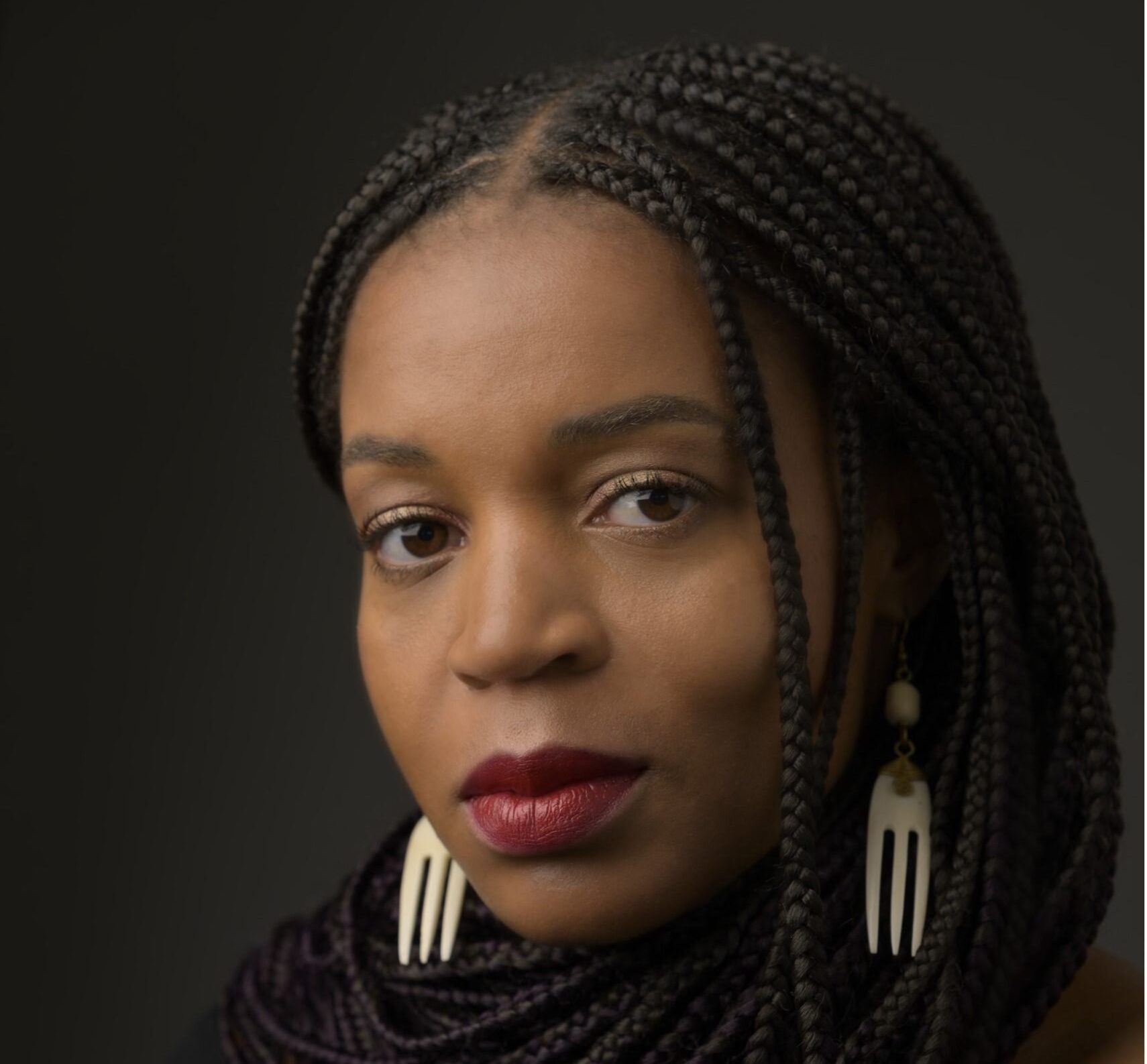
“I feel like I came from the ocean,” Birmingham-based poet Kwoya Fagin Maples says when asked about the inspiration for her newest poetry collection, Long Eye.
Long Eye is described as “a sea-bound collection that channels the mythic, defiant voice of a Black Mermaid.” In the poems, Maples explores the power and divinity of being a Black woman, a mother, a thinker, a protector, and a creator. Readers meet sea creatures that serve as guides for survival, resistance and transformation and witness the beauty of Black familial bonds that thrive even in societies structured against them.
Maples says Long Eye is also autobiographical.
Her first book, Mend, is a collection of persona poetry written from the perspective of the enslaved women that J. Marion Sims, who is celebrated as the “father of modern gynecology,” experimented upon to achieve his surgical breakthroughs. Published in 2018 by University Press of Kentucky, Mend was a finalist for the 2019 Hurston/Wright Legacy Award for Poetry.
For Long Eye, Maples gets personal. She said with this book, she was ready to finally allow herself to be known.
“I feel like it’s been the time to do that, but I haven’t had the bravery, haven’t had the courage to do that,” Maples confessed. “But I feel like all of the people that I’m in community with, other poets, other writers, the organizations I’m a part of nationally, everyone has been making that risk.”
Maples admits that in the past she’s used poetry to “hide within plain sight.” She would say the things she longed to communicate but never explicitly.
“When I was writing this book, I was still struggling with being more forthcoming,” she said of Long Eye. But when revising the poems that make up the collection, Maples made sure that each work was truthful and clear.
“My life was made.”
Born in Charleston, South Carolina, Maples first came to Alabama in to attend the University of Alabama, where she earned a Bachelor of Science in Human Environmental Sciences in 2005 and a Master of Fine Arts (MFA) in Creative Writing in 2008. She then moved to Birmingham with her husband Marcus. She worked as an adjunct instructor at several colleges before joining the creative writing faculty at the Alabama School of Fine Arts in 2013. Currently, Maples is an Assistant Professor of Creative Writing in the MFA program for Creative Writing at the University of Alabama, where she’s worked since 2020.
Maples shared that her love for poetry was first inspired by Maya Angelou when she was 13 years old.
“I had finished all of Maya Angelou’s autobiographical books, all of her memoirs, and in my school library, I had always seen her poetry collection, and I thought, ‘I’m never reading that,’” Maples said.
But after finishing Angelou’s memoirs, Maples was eager to read more of Angelou’s work. So, she decided to give the poetry collection a try.
“Begrudgingly, I took it home and read it,” Maples said. “And then, my life was made.”
A Fish Out of Water
Maples was born and raised in Charleston, South Carolina, but she’s lived in Birmingham since 2008. However, neither place feels completely like home.
“I feel like I came from the ocean,” she said. “I always played in the ocean my whole life,” she said. “So even when I couldn’t swim, I was never afraid of the ocean, and I would still go out as far as I could. I always had a very friendly relationship with water.”
As an adult, her relationship with water intensified.
“I started feeling that more strongly when I knew that it was renewing me to go to the ocean,” she said. “I just started noticing the difference in how I felt when I was at the ocean.”
Maples often feels like a fish out of water, as if she doesn’t fully belong anywhere on land.
“Not necessarily belonging in Alabama, even though I’ve been here a long time, because I’m not from here,” she explained. “And then even when I go home to Charleston, not necessarily feeling I belong because all of my friends have grown up and they have families that I haven’t been around to witness. Even my family will tease me and say, ‘You’re from Alabama now.’”
Maples began work on Long Eye seaside.
“I started writing the first poems at the Dauphin Island Sea lab,” she explained. “I was their first artist in residence, and I was able to talk to scientists who were doing research there. So, I started doing research and gathering ideas.”
She decided to continue her practice of writing by the water.
“Sometimes waves would be coming up to my feet as I was writing,” she said. She revised her work at the ocean too.
Maples said the collection was inspired in part by stories of Mami Wata, a water spirit of West African folklore. But she explains that the Black mermaid who appears in the collection is not Mami Wata. In fact, she is nameless.
“She doesn’t want to be pinned down with anything,” Maples said. “She wants to be absolutely free, and she also doesn’t want the burden of a name, she doesn’t want the burden of that identity, of being a Mami Wata, where you have to help everyone you encounter. And if you think about it, it’s like the plight of the Black woman.”
On Motherhood
Maples and her husband Marcus, a Birmingham-based attorney, stay busy with their three daughters — Maya, 11, and 13-year-old twins Eden and Vivienne.
“Motherhood has informed my work,” Maples said. “It’s added texture to my work.”
Because balancing poetry and parenting requires intentional time management, Maples said motherhood has given her work structure. But she added that it also offers a source of accountability.
“It’s given me a push to be productive and get stuff done, to get writing done and finish the projects that I’m working on,” she said. “My kids will ask me about what I’m doing. They’ll say, ‘Have you finished this?’ It has given me strength to carry out the things that are inside me.”
Cheating on Poetry
When she’s not writing, teaching, or spending time with family, Maples said she likes to “cheat on” poetry with woodworking. Her specialty is designing and building unique, custom bookcases.
“Sometimes I’m tired of caring about poetry,” Maples said. “That’s why I say I cheat on it.”
That said, Maples acknowledged that woodworking does indirectly support her poetry practice.
“It helps me build confidence for writing,” she said. “I don’t struggle with my confidence as a woodworker, because I’m a beginner, and I know I’m a beginner, so I know that they’re going to be things that I’m not good at yet. With woodworking I don’t have to be great at it, I can just enjoy it.”
Maples said woodworking is also more immediately gratifying.
“I can say today I completed the frame for a bookshelf, and everyone can see it versus I’m 10 poems into my book,” Maples said. “That doesn’t mean anything to anyone, and it’s not something I’m going to feel great about either, because I know that’s not anywhere close to being done.”
“Poetry is all around us.”
Always a teacher, Maples offered a practical tip for people who have trouble understanding poetry.
“If you feel like you can’t access a poem at all, just look for the words that are at the end of the lines,” she said. “Read all of those words and think about what kinds of words those are. And then also look at the verbs. The verbs in a poem will guide you through the poem, as far as the feeling and the tone of the poem.”
And for people who think poetry isn’t for them, Maples asserts that “Poetry is all around us. From nursery rhymes when we’re little — which are the first poems that we hear.”
Poetry is in music and even in visual art, she added.
“It’s a part of our lives,” she said, “regardless of whether or not we realize it.”
Learn more at kwoyafaginmaples.com.