Home Blog Page 1208

Obama: More Must Be Done to Close Pay Gap
0

Associated Press

ows_14541141013476

WASHINGTON (AP) — President Barack Obama sought to showcase progress on his watch on closing the pay gap for women while keeping up the pressure on business, Congress and individuals to tackle an issue he said was still far from being solved.

Marking the seventh anniversary of signing the Lilly Ledbetter Fair Pay Act, Obama said more must be done to get women into high-paying jobs, including those in science, technology, math and engineering. In recent years, the pay disparity has narrowed slightly, but a woman in the U.S. still makes 79 cents to a man’s dollar, the White House said.

“This will be a long haul,” Obama said.

Working to ferret out abuses of equal pay laws, Obama announced that his administration will expand its collection of data from businesses about what they pay.

In 2014 Obama directed the Labor Department to collect data from federal contractors about what they pay employees, sorted by gender, race and ethnicity. The revised proposal will cover all businesses with 100 or more employees, regardless of whether they contract with the government.

The Equal Employment Opportunity Commission will collect the data, which the government will use to help identify companies that should be investigated for failing to pay workers fairly, officials said. The first reports from companies will be due in September 2017. The administration estimated that compliance will cost less than $400 per employer the first year and a few hundred dollars per year after that.

Obama, as he often does, invoked his own two daughters to argue that no American parent should have to accept their daughters having less opportunity than their sons. He also called on businesses to ensure women aren’t penalized for starting a family and says men have responsibility for parenting, too.

“Guys, we’re responsible for the family thing, too,” Obama said. “They’re already doing more work than we are in getting that thing going.”

The president reissued his call to Congress to pass further legislation giving more tools to women to fight pay disparities. Republicans have been skeptical about the legislation out of concern it could encourage frivolous lawsuits, and some Republicans criticized Obama on Friday for sidestepping Congress with the data collection effort.

“The way to make meaningful, lasting progress on equal pay for women isn’t unilateral presidential action,” said Sen. Deb Fischer, R-Neb.

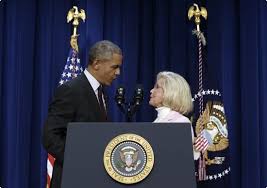
caption: President Barack Obama acknowledges the introduction by women’s rights activist Lilly Ledbetter, Friday, Jan. 29, at the White House in Washington during a ceremony marking the 7th anniversary of the signing of the Lilly Ledbetter Fair Pay Act.

Associated Press

WASHINGTON (AP) — President Barack Obama sought to showcase progress on his watch on closing the pay gap for women while keeping up the pressure on business, Congress and individuals to tackle an issue he said was still far from being solved.

Marking the seventh anniversary of signing the Lilly Ledbetter Fair Pay Act, Obama said more must be done to get women into high-paying jobs, including those in science, technology, math and engineering. In recent years, the pay disparity has narrowed slightly, but a woman in the U.S. still makes 79 cents to a man’s dollar, the White House said.

“This will be a long haul,” Obama said.

Working to ferret out abuses of equal pay laws, Obama announced that his administration will expand its collection of data from businesses about what they pay.

In 2014 Obama directed the Labor Department to collect data from federal contractors about what they pay employees, sorted by gender, race and ethnicity. The revised proposal will cover all businesses with 100 or more employees, regardless of whether they contract with the government.

The Equal Employment Opportunity Commission will collect the data, which the government will use to help identify companies that should be investigated for failing to pay workers fairly, officials said. The first reports from companies will be due in September 2017. The administration estimated that compliance will cost less than $400 per employer the first year and a few hundred dollars per year after that.

Obama, as he often does, invoked his own two daughters to argue that no American parent should have to accept their daughters having less opportunity than their sons. He also called on businesses to ensure women aren’t penalized for starting a family and says men have responsibility for parenting, too.

“Guys, we’re responsible for the family thing, too,” Obama said. “They’re already doing more work than we are in getting that thing going.”

The president reissued his call to Congress to pass further legislation giving more tools to women to fight pay disparities. Republicans have been skeptical about the legislation out of concern it could encourage frivolous lawsuits, and some Republicans criticized Obama on Friday for sidestepping Congress with the data collection effort.

“The way to make meaningful, lasting progress on equal pay for women isn’t unilateral presidential action,” said Sen. Deb Fischer, R-Neb.

caption: President Barack Obama acknowledges the introduction by women’s rights activist Lilly Ledbetter, Friday, Jan. 29, at the White House in Washington during a ceremony marking the 7th anniversary of the signing of the Lilly Ledbetter Fair Pay Act.

What is True Natural Kinky Hair?

0

Health and Beauty
by Pete Stone

The answer to this question depends on your lifestyle because your hairstyle is representative of your lifestyle.
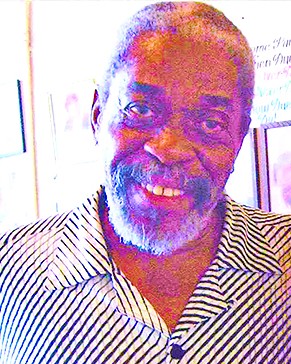
Many of you take a one size fits all approach to true natural kinky hairstyles and that’s wrong. The word kinky means very curly or closely twisted hair texture which is the general quality and feel of your hair such as coarse, medium, or fine in the diameter of each hair strand. True natural kinky hair has not been processed with any hair relaxer that will change the internal structure of kinky hair. If you have true natural kinky hair it must be conditioned daily with leave-in-conditioner in spray form. You can buy it or make your own. The conditioning of kinky hair on a daily basis is the chief component to keeping it strong and healthy. All you need is a spray application bottle that you can purchase at any beauty supply store and any brand of leave-in conditioner.
If you have specific oils that you are using with good results you can mix your own leave-in: 1 part conditioner, 1 part water. Use the same 1 part to 1 part mix for your oils. If you wear braids, locks, or free flowing natural hairstyles you must spray every day for good results.
Now I am not asking you to believe this because I said it. I am asking you to study to show your own self-approval.

Contact me at: (205) 243-8644.

The Way I See It: Want a Long Term Solution to Youth Violence? Enforce Truancy Laws

0

By Hollis Wormsby

Hollis Wormsby

We all see the end res ult of youth left to discard efforts at a proper education, and wander our community without direction or supervision.  Each time a horrific crime is committed by a youth we all go into a tizzy about what  can be done to reduce youth crime, and then a week later we move on without having taking any action.  There is no simple answer to how to address crimes committed by 16-20 year olds who have essentially not been raised and who do not share the values of most of the community, but there may and probably are ways to address producing fewer of these individuals in the future.

Let’s begin with enforcing truancy laws and providing adequate resources to make enforcement real.  One of the biggest challenges to this community and to urban communities across America is children being born into homes not willing and or able to provide adequate supervision and educational support.  We know this, but I am not aware of any solution that is being implemented.  But two steps that will help will be holding parents more accountable and implementing consequences that are meaningful for failing to adequately raise and supervise your children, and secondly to increase the number of truant officers to whatever number we need to adequately patrol our communities and ensure that no child has the opportunity to ignore their responsibility to get an adequate education, and that there are programs in place to address and support children who are not getting adequate educational support at home.  There is a role for the government in this, but there is also a role for every church and non-profit that claims to care about the community.

Another thing we need to do is to stop giving bad parenting a pass.  I think that parenting classes should be required for folks who are receiving public benefits and their children are not making adequate progress in school.  We are often told it is because in many cases they do not know better, then we must require that they learn better.

Finally I believe that every child should be given a chance and as many resources to help ensure a successful transition from youth to adulthood as possible.  But when you are 16 and terrorizing the neighborhood with a gun, and denying the rest of the community the right to the peaceful and quiet enjoyment of what they worked for, then I don’t think we need to be looking at you as a child or a youthful offender.  I think given what is going on in our community, until we get this madness under control, when you attack someone with a gun, when you enter someone’s home without their position, then you have done a man’s crime and you deserve a man’s punishment.  Or at least that is the way I see it.

Hollis Wormsby has served as a featured columnist for the Birmingham Times for more than 20 years.  He is the former host of Talkback on 98.7 KISS FM, and the current host of Real Talk at 3:00 on Saturday afternoons on 610  am, where you will find informed discussion and an opportunity to discuss issues of importance to the African American community here in Birmingham.  You can also pick up Real Talk on the World Wide Web by going to: www.610wagg.com and clicking on the Listen Live button.

What’s Happening at Talladega Superspeedway and in Motorsports with Gwen DeRu!

0

AP359133277606

Photo:  Timothy Peters celebrates in Talladega Superspeedway’s Gatorade Victory Lane during last fall’s fred’s 250 Powered by Coca-Cola. The 2016 fred’s 250 Powered by Coca-Cola, set for October 22, will be part of the new NASCAR Camping World Truck Series (NCWTS) Chase format, similar to the Chase for the NASCAR Sprint Cup. The fred’s 250 Powered by Coca-Cola will be the third and final race of the Round of Eight in which the field of eligible drivers for the title will be reduced from eight to six. The NCWTS will also feature a “Caution Clock” in 2016.  Like the NCWTS, the NASCAR XFINITY Series will also use a seven-race Chase to decide its championship.


Talladega Superspeedway’s Fred’s 250 Powered by Coca-Cola Race Part of New NASCAR Camping World Truck Series Chase Format; NASCAR XFINITY Series Also to See Changes That Resemble Chase for the NASCAR Sprint Cup

Seven-Race Chase Formats, New NCWTS Caution Clock to be Implemented in 2016

For the last two years, Talladega Superspeedway’s fall NASCAR Sprint Cup Series race has been the critical final transfer event in the Round of 12 for the Chase for the NASCAR Sprint Cup, where four drivers are eliminated from title contention at the checkered flag. Now, NASCAR’s Most Competitive track will be the site of yet another vital cut-off race – this time for the new title format in the NASCAR Camping World Truck Series.

After the success the NASCAR Sprint Cup Series has enjoyed since 2014 with the Chase for the NASCAR Sprint Cup, NASCAR announced today the implementation of a playoff system in both the NASCAR Camping World Truck Series and the NASCAR XFINITY Series. It will each feature a seven-race Chase to decide its respective championships starting in 2016. All three series will conclude the Chase with a Championship 4 race at Homestead-Miami Speedway to crown a champion.

Talladega Superspeedway’s fred’s 250 Powered by Coca-Cola, set for Saturday, October 22, will serve as the third and final race in the Round of Eight for the NASCAR Camping World Truck Series Chase in which the field of title contenders will be reduced from eight to six at the race’s conclusion. Sunday’s Alabama 500, set for October 23, will continue to be the final race in the Contender Round of 12 in the Chase for the NASCAR Sprint Cup in which the field of 12 drivers will be trimmed to eight at the checkered flag.

In addition to the format change, a “Caution Clock” will be utilized in the fred’s 250 Powered by Coca-Cola, as well as in all other NASCAR Camping World Truck Series events (except for Eldora Speedway) in 2016. The clock will be set to 20 minutes and triggered at the start of each green-flag run during race events. When the clock counts down to zero, a caution flag then will be displayed and no beneficiary will be awarded. A caution occurring before time expires resets the clock when the subsequent green flag is displayed and the first truck a lap down will be the beneficiary.

The caution clock will be turned off with 20 laps to go at all events in the series, with the exception of Canadian Tire Motorsport Park and Pocono Raceway, where the clock will be turned off with 10 laps remaining.

The new format in the NASCAR XFINITY Series will mean the Talladega 300 (April 30) race winner will be all but guaranteed an entry into the NASCAR XFINITY Series Chase, provided the driver is in the top 30 in points and has attempted to qualify for each race in 2016. Drivers who win two Dash 4 Cash bonuses are also all but guaranteed a Chase berth.

In addition to the Talladega 300, the spring weekend at Talladega will consist of the International Motorsports Hall of Fame 200 ARCA Racing Series Presented by Menards event on Friday, April 29, and the GEICO 500 NASCAR Sprint Cup Series race on Sunday, May 1. The winner of the GEICO 500 is all but guaranteed a spot in the Chase for the NASCAR Sprint Cup.

For information on tickets to Talladega Superspeedway events, call 1-877-Go2-DEGA or visit www.talladegasuperspeedway.com.

Many Pay Tribute to the Life of Washington Book III

0

By Barnett Wright

Times staff

More than 1,500 people including Birmingham Mayor William Bell; former Gov. Jim Folsom; close friends; former classmates and foot soldiers attended a memorial service last week for Washington Booker III.

Booker, a decorated veteran, foot soldier, political activist, and family man, touched the lives of people from the grass roots level to carpeted offices of the Alabama statehouse.

He died on January 20.

“At the end of the day he always had that smile,” Bell said. “He always believed in the least in our community trying to get them involved . . . from the day I first met him to the day he died Booker has always been about the average man and the average woman, to make sure they got their just dues.”

Booker’s daughter, Keresten, talked about what it was like “to grow up in Bookerland.”

“Growing up we had a lot of fun . . . he had no problem getting on the floor and playing Barbie house,” she said. “I got to see him as a whole person. My dad was awesome. He was silly. I’m proud to be his child and I’m proud to look like him.”

She encouraged friends and family to not mourn for her father. “Don’t wallow in your sadness,” she said. “He’s okay.”

Birmingham attorney Charlie Waldrep told lighthearted stories about being called “Mr. Charlie” by Booker and how some whites in the audience might not get what the term meant in the African-American community.

“I have grieved for Book like he was a member of the family,” Waldrep said.

Booker attended Ullman High School and joined the U.S. Marine Corps in 1967 where he was a decorated veteran. He joined the civil rights movement at age 14 and remained in the movement until his death on January 20, 2016, which was his birthday. Booker was born in 1949.

The service was held Jan. 30, 2016 at Sixth Avenue Baptist Church and officiated by Rev. John Cantelow, III.

Is The Republican Lottery Bill Really Just An Attempt To Kill The Lottery?

0

By Rep. Craig Ford

There’s no doubt that momentum for the lottery is building in Alabama. A public opinion poll, paid for by the House and Senate Republican Caucuses, found that 62 percent of likely Republican Primary voters support the lottery, and 59 percent even support expanding gambling in Alabama.

These strong numbers show why two Republican state legislators, Rep. Alan Harper and Sen. Jim McClendon, recently put out their own lottery bill.

At first, this would seem like an encouraging turn of events. Finally, after decades of Republican legislators fighting the lottery, there seems to be enough support from both parties to actually let the people vote.

But what if the real goal isn’t to pass a lottery, but to kill it?

If the lottery fails a statewide vote, we won’t get to vote on it again in our lifetimes. This is a one-shot deal. If the people of Alabama reject the lottery again, Republican legislators will say, “We let the people vote and they voted it down. It’s time to move on.”

That’s why the lottery we put in front of the people this November has to be a proposal the people can actually support. And that’s where the Harper-McClendon bill has a problem.

When the lottery failed in 1999, it was because the bill was complicated and included too much pork spending. The people voted that lottery down even though they elected Don Seigelman governor on a platform of passing a lottery, and even though numerous polls showed overwhelming support for a lottery. They voted it down because the bill was wasteful, and because they simply didn’t trust the legislature.

Now look at the bill proposed by Rep. Harper and Sen. McClendon. Their bill has no specifics in it. It doesn’t say how the lottery will be run or how the proceeds will be spent.

Will the money be used for education? Will it be used for prisons and Medicaid? We don’t know.

What they have proposed is a “blank check lottery.” They want you to give the government the authority to create the lottery, and then trust the government to figure out all the details later on.

And therein lies the problem.

These same legislators who are now asking you to trust the government with the lottery money have spent the last three-and-a-half decades telling us that we can’t trust the government.

Have they flip-flopped on their most basic political beliefs? I don’t think so.

Look at their history on gambling. Not only have they spent the last twenty years fighting the lottery and gambling, they spent $9 million of the taxpayers’ money doing it!

Are these legislators completely reversing themselves on the lottery after that many years and all that money? Or is this lottery proposal actually a “poison pill bill?”

When a legislator wants to kill a piece of legislation, sometimes they will attach what’s called a “poison pill” to the bill. What that means is that they add a provision to the bill that makes it so bad, other legislators can’t vote for it no matter how much they like the rest of the bill.

I can’t help but wonder if that is the real intent of this proposed lottery bill: put a bill out there that is so bad people can’t vote for it, and the lottery will be dead for a generation.

They know that the people of Alabama aren’t going to trust the government with a blank check. I’ve spoken with voters all over Alabama, and almost every single one of them has told me they will only support a lottery if the money goes to education.

So if you want to kill the lottery once and for all, the Harper-McClendon bill is the way to do it.

The people of Alabama deserve the right to vote on the lottery, but they should be allowed to vote on something they can support. That’s why I am proposing two bills: the first would just be a lottery where the money would be used for scholarships to two-year and four-year colleges and universities in Alabama. The second bill would be similar to the comprehensive gambling bill offered last year by Sen. Del Marsh (R-Anniston), and would allow for casinos and the lottery.

I want to put both options out there and let the people decide once and for all: do we want a lottery, do we want a lottery and expanded gaming, or do we want neither? Legislators shouldn’t be afraid of democracy. They should let the people vote, and let them vote on something they can actually support.

Rep. Craig Ford is a Democrat from Alabama and the Minority Leader in the Alabama House of Representatives.

Strategic Moves For a Rich Retirement

0

The Rich family finds the right balance between retirement savings and education costs

Wealth for Life principles

Staff and Wire Reports

“Should I borrow from my retirement savings to help pay my children’s college tuition?” It’s a question posed often to financial planners. And their response is a consistent, “No.” There are many reasons why. The older you are, the more difficult it is to replace the money you have saved, especially in an era of layoffs and job uncertainty. And, there is no way to make up for the power of compound interest on your savings, which Albert Einstein called “the eighth wonder of the world.”

Still, that doesn’t make it the right way to do it.

Reginald and Kim Rich, 57 and 55, of Bowie, Maryland, put three sons and a daughter through private schools and then college with a combination of luck, scholarships, and loans. He is a recently retired firefighter and EMT. She is a nurse, and is several years away from retirement.

Though the financial path through college was different for each of their children, Reginald and Kim never once thought about touching their retirement savings. As a result, they have in excess of $400,000 in separate 401(k) savings plans, in addition to Reginald’s pension and non-retirement savings.

“I was always told if you want to be comfortable (in retirement), do not touch it,” Reginald says. “Once we retired, we wanted to still live comfortably,” says Kim. Their four children range in age from 22 to 36. The youngest, their only daughter, recently graduated from theUniversity of Maryland, meaning all four children are now college graduates.

When Reginald joined the fire department in Alexandria, Virginia, he contributed enough to his 401(k) to get the full employer match.

“A lot of the information I got came from the advisers at the fire department. They said to put away money. If you can’t put in the max, do something. That’s what got me going,” he says.

Kim’s story is similar. She worked at Kaiser, which had financial advisers talk to staff. She too listened.

The toughest time was when they were paying private school tuition for the two younger children while at the same time paying college tuition for the two older ones. At the time they were earning about $60,000 each, per year.

Their oldest child attended Bowie State University, financed with a partial scholarship and Parent PLUS loans. He graduated 10 years ago and is now a mail carrier and music teacher.

Their second son received a partial athletic scholarship to play basketball at Lee University in Tennessee, but it increased to a full scholarship for his last two years. He is now a scientist doing stem cell research.

“We could not afford it with two in college and two in private schools,” says Kim. “We had to pay the remaining out-of-pocket. And we had to do a Parent PLUS loan.”

“Their third son, now 25, received a partial scholarship. The couple took out another loan, which they were able to pay off while he was still in college. And the rest they paid out-of-pocket. “We sacrificed,” says Kim. “It was hard.” He now plays professional football in the Arena Football League and is a sports trainer.

Their daughter, who recently earned a bachelor’s degree in nutrition and food science from theUniversity of Maryland, was not awarded a scholarship. They again had to take out loans, but hope to have them paid off in three to five years, with the help ofDaphne Wright, their financial adviser.

Wright, founder of Wright Financial Services in Alexandria, says you should virtually never use retirement savings to pay tuition. “You can take out a loan for college tuition, but you can’t take out a loan for retirement,” she says.

The couple said even though they took out loans as needed, they discouraged their children from taking out student loans.

“I had to work, work, work,” says Reginald. “I worked part-time jobs and created businesses. I did a little bit of everything. I had a partner who was in the computer supply business. I did things to generate cash. I worked part time doing deliveries for a graphics company. The fire department offered a lot of overtime. I took advantage of that.”

Exotic vacations, they just couldn’t do. “We would have to drive 17 or 18 hours to Florida,” says Reginald. “Back then we were young and we had a timeshare. That timeshare took us everywhere. Then we’d have mini-vacations. I tried to make sure we were able to vacation once a season.”

Kim says if they could do it again, “I wish we would have done a little better saving for education. My advice is to do that along with retirement.”

HOW THEY DID IT

• Start early. Reginald and Kim began saving for retirement early and stayed on track. Each contributed enough to their respective 401(k)s to get the full employer match.

• Seek advice. Both took advantage of employer-sponsored financial planners. They listened to the advice and did not waver from their quest to retire in comfort.

• A little luck never hurts. When it came time for the children to go to college, Reginald and Kim were lucky enough that the first three were awarded at least partial scholarships.

• Determination and sacrifice are key. They were determined that their children not bear the burden of student loans. They were just as determined to not touch their retirement savings. They took out loans themselves and paid the rest out-of-pocket. That meant sacrifice for a family of six, but they are now looking forward to their goal of a “comfortable retirement.”

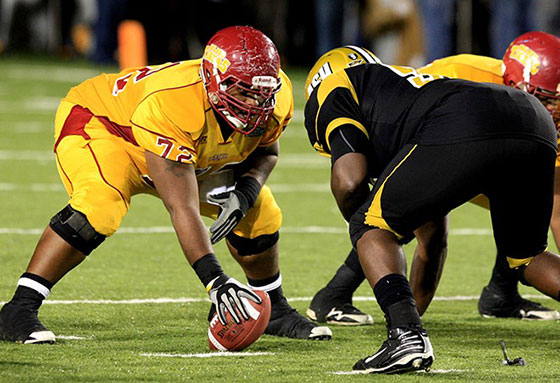
Tuskegee University’s 2016 Football Schedule Announced

0

Staff reports

The Tuskegee University athletic department released the 2016 football schedule today, a schedule that features three homes games and three neutral site games.

The Golden Tigers will open the season on the road against Clark Atlanta on September 3.

The Golden Tigers will face another SIAC opponent in week two , facing another SIAC opponent in Albany State in the third annual Whitewater Classic held in Phenix City on September 10.

Tuskegee will face a familiar opponent in week three of the season, but for the first time since 1996. The Golden Tigers will hit the road to face FCS-member Florida A&M University, a former SIAC opponent on September 17.

The Golden Tigers will make their first appearance at Cleve L. Abbott Memorial Alumni against Lane College in their SIAC West Division opener. The game will be the first of back-to-back home games for Tuskegee, kicking off on September 24. Tuskegee remains at home, the following week, facing UNC-Pembroke in non-conference action on October 1.

The final neutral site game will take place in Columbus, Ga. At A.J. McClung Memorial Alumni Stadium when the Golden Tigers face Morehouse College on October 8.

Following a bye week on October 15 – the week usually reserved for Stillman College – the Golden Tigers finish off the season with three consecutive conference games.

The Golden Tigers will celebrate their 92nd annual homecoming on October 22 against SIAC West Division foe Kentucky State University, before hitting the road for their final two regular season contests of the season.

Tuskegee travels north to face a pair of SIAC West Division opponents beginning with Central State University on October 29, and closing out the regular season on the road against Miles College November 5.

Kickoff times will be announced at a later date.

Keeping an Eye on Safety

0

By Samuetta Hill Drew


National Burn Awareness Week is always the first week of February. Scalds due to cooking liquids, grease, and food, along with tap water and steam were responsible for 46 percent of all burns in 2012. Over 450,000 burn injuries occur yearly which require medical attention. The vast majority of scald burns happen in the home with the kitchen and bathroom being the two most common places of occurrences. Very young children and the elderly are the most frequent victims of scalding injuries. Eighty percent of all burns for children under the age of 8 are caused by scalding injuries. From 2007 – 2013, the number of burn center admissions due to scald burns increased from 29.8 percent to 33.7 percent. Let’s review some safety tips which can possibly help reverse this trend.

Burn Precaution Safety Tips:


  • Cool a burn immediately by placing the burn area under cold running water for about 10-15 minutes and call 911 if the burn is serious.
  • Create a “No Child Zone” in your kitchen when you are cooking or serving hot foods or beverages.
  • Use the back burners and turn the pot handles inward so children won’t be able to pull them down. Children like to reach so we have to help keep them safe.
  • Keep hot food and beverages away from the edge of a table or counter. If you have small children, you may want to avoid using tablecloths, runners and/or placemats.
  • Use oven mitts when cooking and handling hot food or drinks. This includes taking food items out of the microwave as well as a conventional stove.
  • Always supervise children in the kitchen and dining areas.
  • It is recommended that you set your water heater at 120 degrees F/48 degrees C, just below the medium setting or the manufacturer’s suggested setting.
  • Make it a practice to run your hand through the bath water to test it for hot spots. Run some additional cold water, if needed to make sure the water temperature is not too hot to cause a burn.  
  • NEVER hold a child while carrying a hot beverage in your hand or while cooking. Find a safe place visible to you in the kitchen to place your child. You may want to consider a high chair.
  • Use a travel mug with a tight fit when traveling in your vehicle and drinking a hot beverage.


Let’s Keep an Eye on Safety this week by helping decrease the number of possible burn injuries, especially by the young and the elderly.


The Economics of Water

0

JAMES CLINGMAN

By James Clingman

via George Curry Media

“Water, water, everywhere, and not a drop to drink.”

-Rime of the Ancient Mariner by Samuel Taylor Coleridge

I can hear the backroom discussion now: “We can save money if we stop taking our drinking water from Lake Huron and start using water from the Flint River instead.”  Those may not be the exact words, but the leaders of Flint, Mich., including the two recent emergency managers, City Council, the EPA, and the governor, have caused a catastrophe.

Money is the common theme among the perpetrators in Flint; it is always lurking in the shadows of the many problems facing Black and poor people.  Now, in a city that is nearly 60 percent Black and has a 40 percent-plus poverty rate, money trumps life again. Money trumps the long-term effects on more than 8,000 children, many of whom will grow up suffering from the physical, cognitive, and emotional illnesses caused by lead poisoning.  As one person said, “Everybody in the city has been poisoned, everybody.”

Sophia A. McClennen wrote, on Salon.com, “The story of Flint is the story of what happens when profits are more important than people. What Michael Moore captured in his movie, “Roger and Me,” was a clear prelude to what is happening [in Flint] today. First, Flint residents lost their jobs. Twenty-five years later they have lost their water and their health. There are ten dead…from Legionnaire’s disease in Flint and countless others with serious illnesses from contaminated water.”

Politicians are playing games with this emergency, and trying to garner votes from it.  Remember Rahm Emmanuel’s quote?  “You never let a serious crisis go to waste. And what I mean by that is it’s an opportunity to do things you think you could not do before.”  Where is the “opportunity” in this crisis?  Was the slow response to this crisis really just an opportunity to get more money?

This is far from being about what political party is in charge. Some folks are blaming the Republican governor and some are blaming the city council, on which the Democrats hold a 7-1 majority. But so what? The damage is done; the important question is: “Now what?”

Many people have marshalled their forces to assist the people of Flint, first, by bringing water.  The feds have granted a measly $5 million to help but President Obama, who went to nearby Detroit but did not go to Flint, denied the request by the governor to declare the situation a “major disaster,” which under law applies to natural disasters and “certain other situations.”  Isn’t this a “certain other situation?” Isn’t it just as important as getting water to Katrina victims and providing healthcare for Flint’s citizens?

It would be great to see our doctors, psychologists, attorneys, scientists, engineers, and technical personnel lend their talents to help, like we do in other countries. In light of this terrible situation, Flint is in need of all the services, assistance, contributions, and prayers that we can muster. By the way, so are the folks in Ft. Walton Beach, Fla., where the citizens are suffering from all sorts of diseases and untimely deaths because of the still lingering effects of the BP oil spill.

The lawsuits will come and the money from the taxpayers’ coffers will flow, money that could have been used to prevent the problem in the first place. The long-term health ramifications of lead poisoning are irreversible but sometimes manageable if the funds to do so are available.  The state of Michigan, as it deals with myriad financial issues, will now have to pay billions for its neglect and lack of concern for poor people.

Beginning with Idlewild in 1912, Michigan has had issues with Black/White relationships, social/environmental justice, and economic progress, which provides a context from which to view Michigan’s current predicament, Detroit and its recent economic woes notwithstanding.

In Benton Harbor, with a 90 percent Black population, Edward Pinkney was imprisoned for fighting for social and economic justice, another example of money trumping what is right. The NAACP abandoned brother Pinkney and opted, by its silence and lack of advocacy on his behalf, chose the path of least resistance, and who knows what they received from the Whirlpool Corporation in return for their silence? Once again, as it has throughout the nation, the NAACP manipulated the local election to get rid of Pinkney as president. He went to prison and Whirlpool got an NAACP award.

Three of the five great lakes – Michigan, Huron, and Erie -virtually surround Michigan. For folks in Flint to have to drink water from the Flint River in order to save money is reprehensible.  “Water, water, everywhere, and not a drop to drink.”   To all of you “civil rights” advocates:  What could be a greater “civil right” than having clean water to drink?

Jim Clingman, founder of the Greater Cincinnati African American Chamber of Commerce, is the nation’s most prolific writer on economic empowerment for Black people. He can be reached through his website, blackonomics.com. He is the author of  Black Dollars Matter: Teach Your Dollars How to Make More Sense, which is available through his website; professionalpublishinghouse.com and Amazon Kindle eBooks.