Home Blog Page 1347

3 Retirement Essentials Every Boomer 
Should Follow for the New Year

0

RetirementBy Carl Edwards, MBA, ChFC®
Wow, what an amazing market ride over the last few years!  Running on tracks laid by an unprecedented Federal Reserve monetary easing program, the market has once again run to new all-time highs and appears to still have some steam. Or does it?
While no one really knows the answer to this, it is important to remember history as a guide, and to think about the future — your future.  It wasn’t all that long ago that the world’s financial system was shaken to its core, leaving many retirees running for shelter from the Ebola-like symptoms displayed by world financial systems.  Fear over which institution or country would next display the almost certain deadly symptoms ran rampant.
I am certainly not echoing the calls of the past and screaming it’s time to get your guns and gold. I am, however, pointing out to consumers the recent and vivid reminders of the importance to get back to the basics with your financial planning this New Year.  If we fail to remember the past, we repeat it. You have worked too hard preparing for this time in your life.
Let’s review three vital elements you should implement in your retirement plan this New Year.
•  Get your annual financial check-up.  How can we possibly forget to do this? Annual check-ups are the number one preventative care tool at our disposal. While many individuals should be meeting more regularly with their financial advisor, everyone should have at least the minimum of an annual visit.  Problems creep up and this is often the best way to catch them before it is too late.
•  Don’t forget to diversify. Are you working with a broker who always wants to sell you mutual funds full of stocks and bonds?  Does your annuity guy think every dime you have should be stuffed into insurance products? The reality is they are probably both wrong. Find an advisor this year who knows the benefits of each of these products, but who also knows the value of how they work together. Diversification is important and it may include each of these products along with other assets such as individual stocks and bonds, Certificates of Deposit (structured and fixed), Business Development Companies, Real Estate Investment Trusts, precious metals, and numerous other investments.
•  Rebalance, Rebalance, Rebalance. With the great equity run up we have encountered since the lows of March 2009, it is vital to remember that we must continue to evaluate our investment portfolios. While equity portfolios have risen significantly since that time, other areas of our portfolio may not have fared so well, leaving our risk levels in need of adjustment. It is often a good idea to capture some of those hard-earned gains. You never know — the next major pullback could be just around the corner. Be prudent, not greedy!

How to Live Like Your Ego is Not Your Amigo

0

EgoCertified life coach explains how to circumnavigate your own worst enemy
Human beings are capable of a rich inner life that, sadly, seems to elude so many, says dating and life coach Deborah Downey.
“I doubt that most of us fully realize just how much worry, doubt and fear we experience on a daily basis; it seems to me that acknowledging this default setting and finding an alternative for well-being should be among our top priorities,” says Downey, author of “What Are You Worried About!” (http://www.coachdeborahdowney.com/).
“Too often, we are inclined toward trying to be something that, upon closer inspection, isn’t what we actually want. Much of this can be attributed to our egos, which persistently tug at our motivations.”
Women who think they have to be married and men who are afraid of revealing their true feelings are just two examples of ego-driven ideas that lead us away from personal fulfillment, she says.
Downey, who found romance and happiness later in life despite living with multiple sclerosis for 25 years, says we can have a more worry-free existence. She explains a few ideas for overriding your ego’s default settings.
•  “I strive for imperfection and I’m always a winner.” 
“Most people laugh when I say this,” she says, because society is forever challenging us to compete and compare ourselves with others to assess our own value. Striving for imperfection is a reminder that we don’t have to drive ourselves crazy with unattainable goals.
“I notice most of us have hidden rules that we carry from childhood that really don’t help us as adults,” she says. “There isn’t any way to be perfect for myself or for any other person who has ever lived. To strive for something unattainable is to strive for failure. Ultimately, allowing for you to be who you are is, I find, liberating and more conducive to overall success in life.”
•  A lesson from Spanx founder and self-made billionaire Sara Blakely … Once upon a time Blakely was just another struggling entrepreneur. In addition to her blockbuster underwear product and her drive, she was armed with a profound idea inherited from her father, an advocate of acclaimed life coach Wayne Dyer. The idea: Don’t be afraid to fail big, because it means you put the effort forth on something that you care about, even though the effort was outside of your comfort zone.
“Appreciating one’s daily and weekly failures is not a means of encouraging it; rather, it’s a way of learning from failure and developing thicker skin so that you aren’t paralyzed into future inactivity due to fear of failure or the unknown,” she says.
•  “We no longer pursue the tormentor.”
 “When my mentor coach first said this to me over the phone, I asked her to repeat it three times,” Downey says.
Tormentors are all-knowing, all-controlling, arrogant to the 10th degree, super-demanding and impossible to please. Because her parents always demanded the best and never praised Downey as a child, she sought love from sociopaths and narcissists as an adult.
“The clarity of how I brought so much pain into my life by pursuing tormentors was mind-blowing,” she says. “Of course, one’s own ego can play the very same role.”
About Deborah Downey
 Deborah Downey’s experience spans 25 years of recovery in various 12-step programs around the country. Holding certifications as a professional life coach and as a chemical dependency counselor, Downey has dealt with addiction in its various forms, both as the child of alcoholic parents and as a confidant for others. In her self-help book, “What Are You Worried About!” (http://www.coachdeborahdowney.com), Downey, who has multiple sclerosis, details a proactive approach to training one’s mind to think positive.

Wig Chateau Launches Kickstarter Campaign to Develop Chic Display Stands

0

GARFIELD HEIGHTS, Ohio/PRNewswire/ — After investing two years in product development, Wig Display Systems, LLC, plans to launch a Kickstarter campaign in early 2015 to fund its debut product line, Wig Chateau. The startup company aims to reach its funding goal within 45 days of embarking on the funding campaign.
The patented wig stand system organizes and displays hairpieces for easy selection, grooming and proper ventilation. Catering to high-end wig wearers, the stylish stands are configurable for 4, 8 or 12 arms and available in three contemporary color options, including Glamour Girl Gold, Charisma Chrome and Throwing Shade Pink. An attractive wall sconce that holds a single wig is also available. Wig Chateau’s clever slogan, “You gave them a name. Now give them a home!” plays upon the tradition of women giving wigs monikers that express their unique personalities.
“I searched the market and found nothing that met my wig storage needs and was also aesthetically pleasing and stylish,” Wig Chateau’s President and CEO Tanesha Daniels explains. “From the outset, I knew the product had to be functional and accentuate the decor of a room. We were not going to create a wig-on-a-stick product.”
Wig Chateau aims to solve a real problem on the market: a lack of storage products specifically designed for fashionably displaying beloved wigs. After women spend thousands of dollars, the wigs are typically tucked away in boxes, stuffed in bags or hung on the back of doorknobs.
“I want to encourage wearers to take greater interest and care in the storage and display of their wig investments,” Daniels says. “After evaluating many designs based on beauty, functionality, structural integrity and manufacturability, we have achieved the perfect balance of form and function.”
For more information about Wig Chateau, visit www.wigchateau.com or call (216) 635-9648. The pre-launch video and company story are available on Prefundia.

5 Tips for New Year’s Resolutions in 2015

0

ResolutionsDoctor tells you how to beat the odds
If you’re one of the millions of Americans who will make a promise to improve yourself this New Year, there’s bad news: You’re 92 percent likely to fail in sticking to your resolutions, says a recent study from the University of Scranton’s Journal of Clinical Psychology.
About 45 percent of Americans make resolutions. Ranking at the top is losing weight, and staying fit and healthy ranks No. 5.
“Of course, those statistics represent the average – you don’t have to be average!” says Dr. Virender Sodhi, founder of the Ayurvedic and Naturopathic Medical Clinic, (ayurvedicscience.com), which provides complementary and alternative medicine.
“There are plenty of things individuals can do to improve their odds of success if they resolve to become healthier and fitter.”
Dr. Sodhi, author of the new guide, “Ayurvedic Herbs: The Comprehensive Resource for Ayurvedic Healing Solutions,” (www.ayush.com) believes we can move much closer to a world of disease-free societies by following the laws of Mother Nature. Individual commitment to health via New Year’s resolutions is one path to take us there. Dr. Sodhi offers five tips for staying true to your goals.
•  Get away from the instant-gratification mentality and avoid unrealistic goals. Don’t expect to go from zero to 60 – 60 being your ideal body image – in just a few months, especially if you have little background in training. Unfortunately, most who have resolutions like losing plenty of weight and quitting smoking are used to easy snack foods and quick rewards. Health is a long-term labor of love; commit to the love and wait for results.
•  Establish good habits! People make resolutions because they know they’re important, but they’re hard. With each passing week, more people drop their promises for self-improvement. You’ll want to set the right goals; if you want to lose 100 pounds, focus on the first 10, and then the next. Make sure to establish new and good habits – it takes about 28 days to stick. Once you train your mind with good habits, achieving your goals becomes much easier.
•  What you should expect from your “labor of love.” Frequency, intensity and time – these are the three investments you’ll need for losing weight or gaining muscle. As a general rule, exercise at least 30 minutes three to four times a week. Make sure to start with the appropriate intensity for your health; too little intensity and you’ll see little if any results, but too much and you’ll be prone to quit. Don’t think that it’s always better to exercise for a longer duration. What matters is quality. Increase time and intensity once you comfortably meet goals.
•  Solidify the gains with persistent positive reinforcement. Learn to reward yourself in a new way by paying attention to the gains in your body. Notice the improvement in stress levels, breathing, energy, sex life, mood and overall strength. While these improvements are wide-ranging and palpable, they increase over time and can be subtle. Don’t let these improvements occur without a personal recognition of your accomplishments.
•  Embrace supplemental support. Of course, all health efforts are connected to your overall well-being. When you make the investment to eat more vegetables, you’re reinforcing your commitment to exercise. Consider practices such as yoga and meditation, which will feed your health kick and provide unexpected benefits. Additionally, supplements such as kelp, green tea extract, Commiphora mukul (Guggul) and Bauhinia variegata (Kachnar) can yield even more health benefits. And, spices such as garlic, onion, black pepper, ginger, cinnamon, long pepper, and cayenne pepper all have important thermogenic properties, which stimulates metabolism.

From a Young Person’s Perspective

0

John PittsBy John Pitts
One quote that will always be branded within my subconscious is that, “A true leader is not judged by how he leads while present, but in absence.” The civil rights era was a time compact of stentorian leaders with one of the most well-known Black leaders being Martin Luther King, Jr. His majestic style of leadership sparked effective nonviolent movements across the south, but sadly his time was ended prematurely.
I prelude with this to say lately around the United States, there have been many wrongful deaths of African American males from Trayvon Martin to Mike Brown. Social media has been enthralled in the current events with the trending topic #blacklivesmatter. In addition to the social media trending topic, the Black Lives Matter protest on Highway 280 and the River Chase Galleria was an emotionally appealing sight to see. Not only for the hope of a better future for the lives lost in the past, but because history repeats itself.
Flashback to more than 50 years ago students of schools around Birmingham had the same peaceful protest strategy, but were met with grown men wielding fire hoses and ferocious attack dogs. Why I said history will repeat itself is because it was a point in time where there was worse racism than my generation could envision. Seeing the success of a peaceful protest this past week not only gave me hope as a young Black male in a period of time where we are being targeted, but as a young leader seeing how the best leaders, such as Martin Luther King Jr., lead in absence.

Is There More to See in Your Family Tree?

0

Find out if glaucoma runs in your family

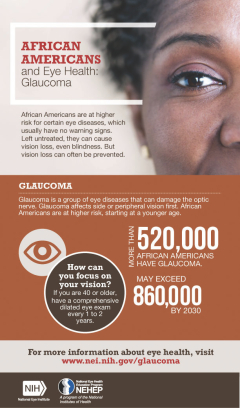
It may be easy to see that beauty is deeply rooted in your family tree. But some things that are passed down from generation to generation are not as easily seen – like glaucoma, an eye disease that runs in families and often has no warning signs.
Glaucoma is a group of diseases that damages the eye’s optic nerve, which carries visual signals to the brain. It can lead to vision loss or blindness if left untreated. Primary open-angle glaucoma is the most common form of this disease. Quite often, by the time people are diagnosed with glaucoma they have already begun to notice changes in their side, or peripheral, vision. It’s important not to wait until you notice vision problems to see your eye care professional.
“Studies show that at least half of all persons with glaucoma don’t know they have this potentially blinding eye disease,” said National Eye Institute (NEI) director Dr. Paul Sieving. “The good news is that glaucoma can be detected in its early stages through a comprehensive dilated eye exam.”
People with a family history of glaucoma, African Americans age 40 and older, and everyone age 60 and older are at higher risk and should get a comprehensive dilated eye exam every one to two years.
A comprehensive dilated eye exam is a procedure in which an eye care professional places drops in your eyes to dilate (or widen) the pupil to examine the back of your eyes and your optic nerve for signs of disease. This exam may help save your sight because when glaucoma is detected early, it can be controlled through medications or surgery.
Keep the vision of your beautiful family in your future. To learn more about glaucoma, visit www.nei.nih.gov/glaucoma or call NEI at 301– 496 – 5248. A low-cost exam may be available to you through Medicare. For more information, call 1–800–MEDICARE or visit www.medicare.gov.

Health Insurance and Mental Health Services

0

Health and Mental ServicesQ: How does the Affordable Care Act help people with mental health issues?
Answer: The Affordable Care Act provides one of the largest expansions of mental health and substance use disorder coverage in a generation, by requiring that most individual and small employer health insurance plans, including all plans offered through the Health Insurance Marketplace cover mental health and substance use disorder services. Also required are rehabilitative and habilitative services that can help support people with behavioral health challenges. These new protections build on the Mental Health Parity and Addiction Equity Act of 2008 (MHPAEA) provisions to expand mental health and substance use disorder benefits and federal parity protections to an estimated 62 million Americans.
Because of the law, most health plans must now cover preventive services, like depression screening for adults and behavioral assessments for children, at no additional cost. And, as of 2014, most plans cannot deny you coverage or charge you more due to pre-existing health conditions, including mental illnesses.
Q: Does the Affordable Care Act require insurance plans to cover mental health benefits?
Answer: As of 2014, most individual and small group health insurance plans, including plans sold on the Marketplace are required to cover mental health and substance use disorder services. Medicaid Alternative Benefit Plans also must cover mental health and substance use disorder services. These plans must have coverage of essential health benefits, which include 10 categories of benefits as defined under the health care law. One of those categories is mental health and substance use disorder services. Another is rehabilitative and habilitative services. Additionally, these plans must comply with mental health and substance use parity requirements, as set forth in MHPAEA, meaning coverage for mental health and substance abuse services generally cannot be more restrictive than coverage for medical and surgical services.
Q: How do I find out if my health insurance plan is supposed to be covering mental health or substance use disorder services in parity with medical and surgical benefits? What do I do if I think my plan is not meeting parity requirements?
Answer: In general, for those in large employer plans, if mental health or substance use disorder services are offered, they are subject to the parity protections required under MHPAEA. And, as of 2014, for most small employer and individual plans, mental health and substance use disorder services must meet MHPAEA requirements.
If you have questions about your insurance plan, we recommend you first look at your plan’s enrollment materials, or any other information you have on the plan, to see what the coverage levels are for all benefits. Because of the Affordable Care Act, health insurers are required to provide you with an easy-to-understand summary about your benefits including mental health benefits, which should make it easier to see what your coverage is. More information also may be available with your state Consumer Assistance Program (CAP).
Q: Does Medicaid cover mental health or substance use disorder services?
Answer: All state Medicaid programs provide some mental health services and some offer substance use disorder services to beneficiaries, and Children’s Health Insurance Program (CHIP) beneficiaries receive a full service array. These services often include counseling, therapy, medication management, social work services, peer supports, and substance use disorder treatment. While states determine which of these services to cover for adults, Medicaid and CHIP requires that children enrolled in Medicaid receive a wide range of medically necessary services, including mental health services. In addition, coverage for the new Medicaid adult expansion populations is required to include essential health benefits, including mental health and substance use disorder benefits, and must meet mental health and substance abuse parity requirements under MHPAEA in the same manner as health plans. For additional information on Medicaid and mental health and substance use disorder services, visit: http://www.medicaid.gov/Medicaid-CHIP-Program-Information/By-Topics/Benefits/Mental-Health-Services.html.
Q: Does Medicare cover mental health or substance use disorder services?
Answer: Yes, Medicare covers a wide range of mental health services.
Medicare Part A (Hospital Insurance) covers inpatient mental health care services you get in a hospital. Part A covers your room, meals, nursing care, and other related services and supplies.
Medicare Part B (Medical Insurance) helps cover mental health services that you would generally get outside of a hospital, including visits with a psychiatrist or other doctor, visits with a clinical psychologist or clinical social worker, and lab tests ordered by your doctor.
Medicare Part D (Prescription Drug) helps cover drugs you may need to treat a mental health condition. Each Part D plan has its own list of covered drugs, known as formulary. Learn more about which plans cover various drugs.
If you get your Medicare benefits through a Medicare Advantage Plan (like an HMO or PPO) or other Medicare health plan, check your plan’s membership materials or call the plan for details about how to get your mental health benefits.
If you get your Medicare benefits through traditional Medicare (not a Medicare Advantage plan) and want more information, visit Medicare & Your Mental Health Benefits. To see if a particular test, item or service is covered, please visit the Medicare Coverage Database.
Q. What can I do if I think I need mental health or substance use disorder services for myself or family members?
Here are three steps you can take right now:
1.    Learn more about how you, your friends, and your family can obtain health insurance coverage provided by Medicaid or CHIP or the Health Insurance Marketplaces by visiting HealthCare.gov.
2.    Share this infographic with your friends, family, and colleagues so more people know about the mental health benefits accessible under the Affordable Care Act.
3.    Find out more about how the law is expanding coverage of mental health and substance use disorder benefits and federal parity protections: http://aspe.hhs.gov/health/reports/2013/mental/rb mental.cfm.
Q: What is the Health Insurance Marketplace?
The Health Insurance Marketplace is designed to make buying health coverage easier and more affordable. The Marketplace allows individuals to compare health plans, get answers to questions, find out if they are eligible for tax credits to help pay for private insurance or health programs like the Children’s Health Insurance Program (CHIP), and enroll in a health plan that meets their needs. The Marketplace Can Help You:
•    Look for and compare private health plans.
•    Get answers to questions about your health coverage options.
•    Get reduced costs, if you’re eligible.
•    Enroll in a health plan that meets your needs.

Ivary “Jean” King

0


You will be missed!!OBITIvary Jean King


Innovators Beware: Dangerous Intersection Ahead


0

InnovatorsBy: Neal Thornberry, Ph.D.
Innovation is not for the faint of heart, as Galileo learned when he said that the Earth revolved around the sun. He was scorned, threatened with death and eventually put under lifetime house arrest.
Innovators are not always welcome guests even within their own organizations, and their challenges are heightened by a dangerous organizational intersection: where Complexity meets Wackiness. The more complex an organization, the more difficult it is for the innovator to figure out where to go with a good idea and how to weave it through the organization to implementation and eventually value creation.
Growing organizations cannot avoid complexity. They add processes and people, divisions and specialists. Since we can now measure almost everything, they often believe if one measurement captured in a report is good, then more are better.
One company, with whom I worked, learned that its sales people were losing a month of selling each year because of the time spent filling out reports required by the finance department. This example of complexity gone awry drove the organization into Wackiness – sacrificing revenues for reports.
There are many other examples of Wackiness getting in the way of innovation – and examples of stealth innovators circumnavigating them. One of my favorites is the tale of Jim Repp, head of Jeep design at the old Daimler Chrysler Corp.
Jim knew that many Jeep lovers spent thousands of dollars upgrading their Wranglers for serious off-roading. This gave him the great idea for a mass-produced Jeep with all the upgrades built in at half the cost. When he shared his idea with marketing, they said there was no market for that type of vehicle and besides, you’re an engineer, not a marketer.
Undeterred, Jim and a small band of innovators I call Innovation Judo masters built a secret prototype. They took it out on the Rubicon Trail in California for off-road trials and invited the senior executives to watch. Jim’s prototype outperformed the other Wranglers and, as crowds gathered around it, the executives saw their enthusiasm. They immediately authorized production of what is now a best-selling icon, the Jeep Wrangler Rubicon.
Fortunately for Chrysler and other companies, there are a few passionate innovators like Jim who won’t let go of their idea no matter what. They’ve developed a special set of skills (I call them Innovation Judo) that allow them to bypass those blocks.
They are:
•  Discipline
•  Leverage
•  Speed
•  Openings
•  Circling
•  Unbalancing
•  Redirection
The Jim Repp story illustrates the application of several of these principles. The discipline to plan for building a secret prototype; leverage in getting senior executives to support his idea; utilizing the opening at the Rubicon Trail; and then using the surprise (a tactic of unbalancing) of a Jeep that looked like all the other jeeps on the trail but outperformed them.
Since it takes so long to correct the dangers at the Complexity/Wackiness intersection, identifying and supporting a few Innovation Judo Masters can go a long way in overcoming some of the most difficult barriers to innovation.

Keeping an Eye on Safety

0

Samuetta DrewBy Samuetta Hill Drew

Watching people’s habits has been very interesting over the years as it relates to their health and safety. These two topics are ones you would believe people would pay very close attention to since their sheer existence is directly linked to both. Unfortunately, this is not the case. People seemingly go through life as if they are invincible and neither of these topics will ever adversely impact them personally. Their voices will concede that health and safety are very important, but their actions or lack thereof reflect their general attitude. Many Americans continue to purchase and eat fatty foods and rarely, if ever, exercise. They also rarely practice and/or discuss safety measures with their family relative to situational safety. Since this is the beginning of a new year, I think it’s important for all of us to readjust and strengthen our practices and attitudes about both topics. During the month of January, I will offer some suggestions about how you can begin implementing some needed changes this New Year as it relates to safety.  For this week though, I feel it’s important to review some New Year celebration safety measures.

•    Practice safety measures when using fireworks especially around children. Where fireworks are fun and exciting they can also cause physical damage to hands, eyes, as well as other parts of the body.  They also, unfortunately, have the potential to cause fires, if not used properly.
•    Make sure you do not drink and drive if your celebration involves alcohol during the New Year season. This is common especially around the various 4-F gatherings (food, fun, family, and friends). Therefore, have a designated driver before the actual event.  We want people of legal age to have fun, but drink responsibly.
•    When unsure of an event location, do not text and drive. If you need to contact your host for direction clarity or use your telephone or car navigation system, please pull over in a safe, well-lit location and text your message to your host or enter your destination information.
•    Make sure you follow the manufacturer’s instructions for using a deep fryer, if applicable, in the preparation of food items such as fried turkey, fish, chicken,etc. They also have the potential to cause a fire, if not used properly.

To all my readers, I want to wish you an awesome New Year and let’s work together in 2015 to Keep an Eye on Safety!