Home Blog Page 1413

What’s Happening at Talladega Superspeedway and in motorsports with Gwen DeRu!


0
          Gwen DeRu
Gwen DeRu

TALLADEGAPhoto Darrell Wallace Credit Steve Helber

MOBILE NATIVE DARRELL WALLACE WINS AGAIN!
Carrying a special paint scheme and the No. 34 in honor of 2015 NASCAR Hall of Fame inductee Wendell Scott, Darrell Wallace Jr. wrestled the lead away from Johnny Sauter with 13 laps to go and held on to win Saturday’s NASCAR Camping World Truck Series Kroger 200 at sun-splashed Martinsville Speedway.  Wallace, who also wore a throwback fire suit as a tribute to Scott, scored his fourth career truck win at the same track where he notched his first career victory in this race one year ago.
With that victory last October, Wallace — whose nickname is “Bubba” — became the first African-American driver to win a NASCAR national touring series race since Scott won at Jacksonville Speedway on Dec. 1, 1963.  With Scott’s whole family in attendance on Saturday, 21-year-old Wallace celebrated an emotional triumph at the .526-mile short track located about a half hour away from the late driver’s hometown of Danville, Va.
The NASCAR pioneer (Wendell Scott) will be posthumously inducted into the NASCAR Hall of Fame in January. (Some taken from www.foxsports.com and www.dailyprogress.com)

TALLADEGA 4-WIDE NOTES (Weekend – October 25-26)
NASCAR Sprint Cup Series:
•       Non-Chase for the NASCAR Sprint Cup driver Dale Earnhardt Jr. claimed his first victory at Martinsville Sunday in the initial race of the Eliminator Round for the Chase for the NASCAR Sprint Cup, beating runner-up and teammate – Jeff Gordon.
•       Ryan Newman came in third, followed by Tony Stewart in fourth and Joey Logano in fifth.
•       Gordon led 130 laps, taking the top spot in the NASCAR Sprint Cup standings. The top five are separated by only seven points (Newman, Logano, Matt Kenseth & Denny Hamlin).  Carl Edwards trails by 20 points followed by Talladega Superspeedway’s GEICO 500 winner Brad Keselowski (-31) and Kevin Harvick (-33).
•       Only two races remain in the Eliminator Round for the Chase for the NASCAR Sprint Cup. It continues Sunday at Texas Motor Speedway. The top eight drivers in the Chase field will be trimmed to four after the final race of the Eliminator Round at Phoenix International Raceway (Nov. 9).
NASCAR Camping World Truck Series:
•        Darrell Wallace, Jr., from Mobile, AL, won at Martinsville Saturday, his second triumph at the .526-mile track.
•        Timothy Peters was runner-up followed by Matt Crafton, Erik Jones, and Ryan Blaney.
•        Crafton leads in the Truck standings over Blaney by 18 points with Wallace, Jr., third (-22).
NASCAR Nationwide Series:
•        Chase Elliot remains the leader in the Nationwide standings over Regan Smith by 42 points. Only three races are left in the 2014 season.
The next events for NASCAR’s top three series will be held at Texas Motor Speedway – the NASCAR Sprint Cup Series Sunday, November 2nd at 2 p.m. CT on ESPN; the NASCAR Nationwide Series Saturday, November 1st on ESPN2 at 6:30 p.m. CT; and the NASCAR Camping World Truck Series Friday, October 31st on FOX Sports 1 at 7:30 p.m. CT.
NASCAR returns back for the traditional May weekend in 2015, May 1-3. NASCAR’s Most Competitive Track (record 88 lead changes in 188 laps), with the circuit’s steepest banking (33 degrees) and longest distance (2.66 miles), is also the most fun and fan-friendly, offering up hundreds of acres of free camping, amazing kids ticket prices and special offers for military members and college students. Talladega Superspeedway is NASCAR’s “Party Capital” thanks to the track’s infamous infield and world renowned Talladega Blvd. The historic venue has always worked hard to enhance the fan experience in every way and now features the most comfortable seats in motorsports, large video viewing boards (a new initiative planned for future implementation at all ISC tracks) lining the frontstretch and endless activities for fans throughout its event weekends. Log on to www.talladegasuperspeedway.com or call 877-Go2-DEGA for more information. This is more than a race, this is Talladega!

Hornet Duo Sweeps SWAC Weekly Honors  

0

Alabama State MONTGOMERY – For the second time this month, Alabama State’s duo of Bryont Brown and Paige Rankine have swept the Southwestern Athletic Conference Student-Athletes of the Week honors, for their performances this past weekend at the Crimson Classic  held in Tuscaloosa, Ala.
 Rankine, a junior from McDonough, Ga. placed 28th overall at the meet  finishing in a time of 18:11.17 in the 5K race.    
 Brown, a sophomore from Montgomery, Ala. led the Hornets this week with a strong performance completing the 8K course in a time of 28:21.95. 
 This marks each athlete’s second SWAC Cross Country Runner of the week honor this season.

Hornets, Bulldogs in Magic City Classic

0

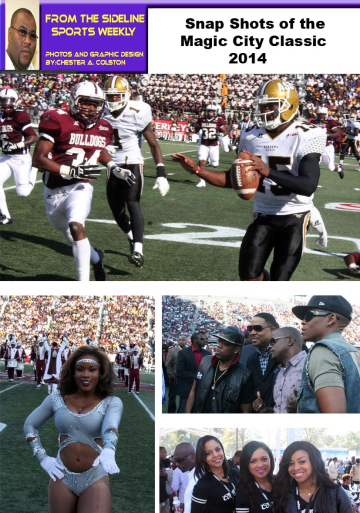
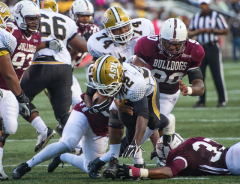
Cyrus scores at MCC BIRMINGHAM, Ala. – Malcolm Cyrus rushed for 148 yards and a touchdown and Daniel Duhart threw for 267 yards and ran for three touchdowns, but it was not enough as the Hornets dropped a 37-36 shootout to Alabama A&M in the 73rd State Farm Magic City Classic.
After falling behind with 2:26 seconds left in the game, the Hornets (4-4, 3-3 SWAC) still had a chance to win the game as they moved to ball to the AAMU 13 yard line only to see Preston Clark’s 30 yard field sail wide left with 12 seconds left and the Bulldogs escaped with the win.
“Being a part of this game is a great atmosphere and it’s always a pleasure to play in it and obviously you want to win it, but I commend Alabama A&M for the grit they competed with us today and they got the victory,” Head Coach Reggie Barlow said.  “I commend our guys, and although we didn’t win I saw passion and guys really playing and trying to make plays.
ASU finished the game with 504 total yards and held AAMU (3-5, 2-3 SWAC) to 469, but it was mistakes that kept the Hornets on the short end.  Two touchdowns were called back due to penalties with the final one coming with 44 seconds left in the game when Cyrus scored from 15 yards out which looked like the go-ahead score, but the points were taken off the board due to a holding penalty.
The high point of the game was Cyrus becoming the 11th player in ASU history to surpass the 1,000 yards in a single season mark. He entered the game with 912 yards and his 148 yards now has him at 1,060 yards.  The rush to put him over the mark was a 19-yard run in the third quarter.
Cyrus’ lone touchdown came in the third quarter with 49 seconds left in the third quarter and pushed the Hornets’ lead to 33-21, only to see the Bulldogs come back from a two-score deficit.  In fact AAMU came from a two-score deficit twice in the second half to complete the comeback win.
The Hornets dominated the first half on their way to building a 20-7 lead to go into the locker room at the half.  The lead could have been even greater except for several ASU mistakes.
One ASU scoring pass was called back due to a penalty and Duhart had two passes intercepted in the end zone.  On top of that the Hornets had an extra point blocked and missed a field goal, but ASU’s defense held strong.
Duhart scored twice in the opening quarter rushing in from three yards out on the Hornets opening possession and again on a one yard run with less than a minute left in the quarter.
After the Bulldogs took advantage of a long kick return they were able to score a touchdown on a Harvey Harris two yard run to cut the lead to 13-7.
ASU took advantage of an AAMU miscue when the Bulldogs had a high snap on a punt and DeMario Bell was able to pick up the loose ball and get into the end zone to put the Hornets up 20-7.
The Hornets had 243 yards of offense in the opening half with Malcolm Cyrus gaining 58 and Duhart passing for 164 yards.  The Hornets’ defense made it hard on the Bulldogs, holding them to only 46 yards rushing and 141 total yards.
“All of the losses are frustrating and even more so because it’s the Magic City Classic and it means so much to so many people,” Barlow said. “I’ve been around football long enough to know a lot of times a loss has to do more with the other team than it does with yourself.  We will go back and watch the film and re-evaluate our guys and try to move away from it.  Obviously it’s a tough loss for us.”
Next week ASU will be back on the road when they travel to Baton Rouge, La., to face Southern at 6 p.m.

2014 Santa Fe Sport FWD 2.4

0

Cheryl Santa Feby Cheryl Eldridge

The  2014  Hyundai Santa Fe Sport is one of a kind. My frost white tester was classy and stylish and places you in the mind of a Mercedes compact SUV.
The 2014 Hyundai Santa Fe Sport is a strong competitor among five-passenger crossover SUVs and should definitely be considered alongside the established competition.
There is a spacious and thoughtfully designed interior; lots of standard and optional features for the money and a lengthy warranty.
The Santa Fe Sport has lower fuel economy than that of rivals with 20 mpg in the city and 27 on the highway with a sticker price with added features which totaled $33,500.
The Hyundai Santa Fe Sport receives a few extra standard and optional features for 2014, including a blind-spot monitoring system which I enjoyed. I was always alerted with a light and sound on the  rearview windows when cars were approaching.
The 2014 Santa Fe Sport has a lot going for it. This five-passenger crossover is sharply styled and offers plenty of standard and optional features. It also has a pleasantly roomy and quiet interior, and accelerates and handles well enough to satisfy most buyers’ performance expectations. But considering how heated the competition is among small and midsize crossover SUVs for 2014, a vehicle almost has to be this good just to measure up to the pack.
This is a small crossover SUV with seating for five. It’s available in base and 2.0 Turbo trims. Standard features for the base model include 17-inch alloy wheels; a rear spoiler; LED headlight accents; tinted rear windows; keyless entry; cruise control; a trip computer; full power accessories; air-conditioning; a tilt-and-telescoping steering wheel; cloth upholstery; 40/20/40-split folding rear seats; Bluetooth phone and audio connectivity; Hyundai’s BlueLink telematics system; and a six-speaker audio system with a CD player, satellite radio and USB/iPod integration.
Optional is the Popular Equipment package, which adds automatic headlights, foglights, heated mirrors, roof rack rails, a leather-wrapped steering wheel, heated front seats, a 4.3-inch touchscreen for audio control, a rearview camera and an eight-way power-adjustable driver seat (with four-way power lumbar support). The Premium Equipment package can be added to this and includes keyless ignition/entry, leather upholstery, a power-adjustable passenger seat, sliding 60/40-split rear seats (with remote folding latches in the cargo area), dual-zone automatic climate control, upgraded gauges, a color trip computer, an auto-dimming rearview mirror, rear window sunshades and a blind-spot monitoring system.
The Sport 2.0T comes with all of the above, along with a more powerful turbocharged engine, 18-inch wheels and a tow package.
The Technology package is available for both base Premium and 2.0T models and adds larger wheels (19-inch for the 2.0T and 18-inch for base Premium Equipment package models), xenon headlights, rear parking sensors, a panoramic sunroof, a heated steering wheel, driver memory settings, ventilated front seats, heated rear seats, a navigation system with an 8-inch touchscreen, an upgraded audio system for the base Premium model and a 12-speaker Infinity surround-sound system for the 2.0T.
Powering the base 2014 Hyundai Santa Fe Sport is a 2.4-liter four-cylinder engine that produces 190 horsepower and 181 pound-feet of torque. Front-wheel drive is standard, and all-wheel drive is optional. The only available transmission is a six-speed automatic. Fuel economy estimates are decent, with an EPA-estimated 23 mpg in combined driving (20 city/27 highway) for front-wheel drive. With all-wheel drive, fuel economy drops to 21 mpg combined (19 city/25 highway). Most competitors have slightly better fuel economy ratings.
My tester, The Santa Fe Sport 2.0T, has a turbocharged 2.0-liter engine that increases output to 264 hp and 269 lb-ft of torque. Fuel economy drops only slightly, with an EPA-estimated 22 mpg combined (19 city/27 highway) for the front-drive 2.0T and 21 mpg (18 city/24 highway) for all-wheel drive.
On the Safety side, features for the 2014 Hyundai Santa Fe Sport include antilock disc brakes, traction and stability control, front seat side airbags, side curtain airbags, front seat active head restraints and hill hold and descent control. Also standard is BlueLink, Hyundai’s emergency telematics system, which offers roadside assistance, crash response, remote door lock control and monitoring features for parents with teenage drivers (speed, geo-fencing and curfew limits). A rearview camera and blind-spot monitoring system are optional on the base model and standard on the 2.0T.
In government crash testing, the Santa Fe Sport earned a top five-star rating for overall crash protection, with five stars for total frontal-impact safety and five stars for side-impact safety. The Insurance Institute for Highway Safety hasn’t tested the Santa Fe Sport, but the larger, three-row Santa Fe earned a top “Good” rating in moderate-overlap frontal-offset, side-impact and roof strength tests. It also earned a top rating for its head restraint/seat design for whiplash protection in rear impacts.
The 2014 Hyundai Santa Fe Sport has one of the nicer cabins in the small-to-midsize crossover SUV class. This is thanks in no small part to the cabin’s outstanding materials quality, thoughtful placement of controls and overall spaciousness. As we’ve come to expect from Hyundai, the Santa Fe’s cockpit could serve as a benchmark for elegant simplicity in the segment. Switchgear is well-organized and legible, while the touchscreen menus and functions are as intuitive as it gets.
The front seats are pretty comfortable for longer drives, with enough adjustments to accommodate drivers of all sizes. Second-row passengers will also find the quarters to their liking, with a wide range of recline angle and plenty of head- and legroom for the average adult, even with the optional panoramic sunroof.
Many crossover shoppers pay close attention to cargo capacity, and the Sport boasts a healthy 35.4 cubic feet of cargo behind the rear seats. The second-row seats fold flat to accept 71.5 cubes, which is right up there with the capacity offered by the Honda CR-V and Toyota RAV4.
Until next week, drive safe and buckle up,  and don’t text and drive, it’s the law.

International Profile:  The Cultural Melting Pot of ASU Soccer

0

ASU  TRIO Asking the simple question of “Where are you from?” around an Alabama State University athletics team and it’s likely the answer may surprise you and lead to an interesting conversation within minutes.
The ASU athletics program has continued its’ recent tradition of upholding a diversified student body that stretches worldwide and creates a global presence when it relates to roster makeup.
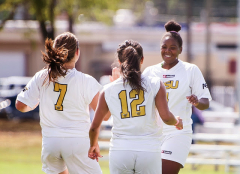
Among the most diverse of the 18 programs is the ASU women’s soccer team. The Lady Hornets’ 22-player roster has a unique distinctiveness to it, blending culture, ideas, language and backgrounds into one unit on the soccer field.
There is representation from 10 states, three countries outside of the U.S with a fourth player who was stationed with her family in Germany.
There’s Iita Pienimaki from Finland, Sabina Claesson from Sweden, and Shelbi Vienna-Hallam from Australia. Ally Murphy lived in Germany for a short time as well.
Six other players are from California, three players are from Georgia, two from Alaska and there’s one representative each from North Carolina, Kentucky, Texas, Tennessee, Nevada, Washington and Alabama.
So, it begs the question: What’s creating the interest to travel so far away from home to attend Alabama State?
The answer differs depending upon who you ask, but there seems to be an advantage within the structure of an American university if a student-athlete is attempting to juggle both academics and athletics.
Pienimaki said that if she stayed in her home country of Finland, then it would have been much more likely that she would have stopped playing soccer and would have focused on just pursuing a psychology degree.
“Taking on student loans is pretty uncommon,” said Pienimaki, who began learning Finish, Swedish and English by the time she was a third-grade student. “In Finland, I would have had to pick up a full-time job while in college. I’d have to pay rent so I’d have to cover that.”
Claesson, whose first language is Swedish, said the experience to play competitive soccer while gaining a top education and learning more about the English language were big factors in her decision.
Vienna-Hallam was also interested in America’s system of balancing work in the classroom with play on the soccer field.
“It’s almost like you had to pick between getting a degree and playing top competitive soccer [in Australia],” Vienna-Hallam said. “It’s been great here to learn about different cultures and hear about their experiences and how they grew up. You can get an understanding of the rest of the world.”
With over 400 student-athletes at ASU, the student-body population hails from 15 countries around the world.
“There are a lot of international players here,” said Lady Hornets’ eighth-year soccer coach Jodie Smith. “This has been a steady trend for a while, and not just in soccer here. It’s been pretty consistent since I’ve been here. I’ve had German players and another Australian player and a Canadian player in the past.”
Coach Smith added that the learning curve for international players on his teams has been smooth.
“The easiest thing is that you don’t really have to worry about them academically in the classroom,” Smith said. “Their maturity level tends to be higher. You do worry about them culturally and worry about them fitting in.  But, our team does a nice job of doing things off the field together. They have team functions and team outings.”
The closeness of the team seems to be another difference between American and foreign universities.
“The team was the main reason why I stayed after the first year,” Pienimaki said. “There’s such close contact. We see each other for several hours every day so we develop some kind of relationship. You notice that school spirit is really important here too. Networking is another big thing [that can be helpful.]”
Even certain school functions and gatherings can be a cultural shock in some capacity to some.
“There are definitely differences in the culture, “Vienna-Hallam said. “We didn’t have things like coronations of Presidents and ‘Miss’ contests for every dorm. Everyone is so connected here. There’s a lots of involvement. We don’t have anything like sororities [in Australia]. When you come here and realize how many things are actually going on, you think ‘Wow.’”
As for differences from American culture, the international players from ASU would like to inform America of a few things.
For one, other countries use “post code” and don’t refer to “zip codes” in mailing addresses.
“Someone asked me for a zip code and I didn’t know what that was,” Vienna-Hallam said. “We call it a post code.”
While shagging balls might make sense for an American as a person who retrieves the ball on the sidelines, it doesn’t have that same meaning in other countries.
“We just call them ball boys or ball girls,” Pienimaki said.
Claesson shook her head in agreement.
“Yeah.  We just call them ball boys,” Claesson said.
And, instead of saying that a soccer player is controlling the ball, a foreign player might say “kill the ball.”
“Kuoleta. It means to kill the ball,” Pienimaki said. “We say that we bring our foot down the ball and stop it.”
While it is a learning experience for everybody involved on the team, it’s comforting to know that when carrying a passport post-graduation, fellow ASU alum may be just around the corner.
“I think it’s cool that players are from pretty much all over the country,” Pienimaki said. “Players on other teams are from the Dominican, Serbia and Britain too. It’s not only our team. It’s the whole athletic program that is really diverse. When I go back home, I’ll have Facebook friends from all over. I’ll always have somewhere to go. If others ever come to Finland, they can call me up. I think it opens your eyes to different things. People also realize that their country’s way of doing something may or may not be the best way to do things.”
Learn terms in Finnish, Swedish and Australian
Penny or pre-game jersey:
“Bib” in Australian  “Liivi” in Finnish.  “Väst” in Swedish.
Game jersey:
“Strip” in Australia. “Pelipaita” in Finish. “Match-tröja” in Swedish.
Hornets:
“Ampiainen” in Finnish. “Getting” in Swedish.

The Christian Way

0

The Christianway

2014 Lexus 460 F Sport

0

Lexus LS 460 F SPORTBy Frank S. Washington

DETROIT – Lexus has turned the corner. That might sound strange since the Japanese brand has been amongst the best-selling luxury brands for years. But that was because of its utility vehicles which accounted for more than half its sales.
Although Lexus sedans are quality built vehicles, renowned for their smooth quiet rides and a dealer network that is second to none in terms of customer satisfaction, the automaker’s cars were, well; boring. Not anymore.
Lexus has energized its designers and they have come up with an aggressive face called the spindle grille for all Lexus vehicles and they have redesigned the interior of all their cars, dumping the center stack in the process.
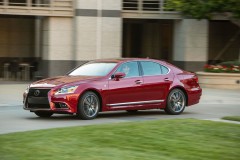
To put some verve into the brand they’ve also added an F Sport trim line. And that’s what we got to test drive, the 2014 Lexus LS 460 F Sport. It was an intriguing full-size sedan.
The Lexus flagship was powered by a direct fuel injected 4.8-liter V8 that made 386 horsepower and 367 pound-feet of torque. Mated to an eight speed automatic transmission, the car was as smooth and quiet as any Lexus we’ve ever test driven. But it was also fun to drive, and that characteristic is new to the full-size Lexus sedan.
What added the fun to the Lexus LS 460 was the F Sport Package as Lexus called it. The appearance package included 19-inch split 10 spoke alloy wheels, a sport tuned and lowered adaptive variable air suspension, stabilizer bars and shock absorbers, Brembo brakes with six-piston calipers in the front and 14.8-inch ventilated limited slip rear differential in the rear.
Coupled with the air suspension, the LS 460 F Sport had five ride settings that ranged from Eco, Normal and Sport to Comfort and Sport +. Select one of these settings and the air suspension would stiffen dampening appropriately and the steering ratio would change. We spent most of the time in Sport +.
The car was quick; we had the rear-wheel-drive LS 460 F Sport and it could get from a standstill to 60 mph in a fairly swift 5.4 seconds. And it was reasonably maneuverable. Our test vehicle had a turning radius of 36 ft. It was nimble too. Lane changes on the expressways here were snappy and the car could step away from traffic with just a touch on the gas pedal.
Inside, the interior had an F Sport motif. The heated and cooled front seats were bolstered, comfortable, perforated with white inside the holes (don’t ask us how they did it) and they were black leather as was the rest of the interior. The steering wheel and the front headrests were embossed with the F Sport emblem but it was in black and hard to see on the headrests. The rear seat headrest should have been embossed too but they weren’t.
There was a black Alcantara headliner, aluminum pedals, paddle shifters and the F Sport motif continued on the exterior with front and lower bumper inserts and there were LED fog lights.
The dash was wide, gone was the center stack replaced by a 12.3-inch high resolution information screen that was controlled with a controller (read mouse) that was conveniently placed within the driver’s grasp. We still think the control toggle could use a bit more torque. But even when touch is adjusted setting the control should only be done when sitting still and with some patience. It is an information system and it is a process to learn.
Still, the interior look was clean, we weren’t looking at a blizzard of buttons and the car was sumptuous even though the sport motif featured aluminum trim patterned to look like to carbon fiber.
The 2014 Lexus LS 460 F Sport had an EPA rating of 16 mpg in the city, 24 mpg on the highway and 19 mpg combine. After six days, the mileage readout said we had averaged 20 mpg; that wasn’t bad.
Our test vehicle was chock full of equipment in addition to the F Sport package. It had blind spot alert, adaptive LED head lights, a Mark Levinson 19-speaker audio system, a pre collision system, adaptive cruise control and a power open and close trunk.
The base price for our test car was $72,140. Add on options including the $8,350 F Sport Package as well as the freight charge and as tested this 2014 Lexus LS 460 F Sport’s sticker was $88,080.

Frank S. Washington is editor of  AboutThatCar.com.

lady Hornets looking to extend winning streak against MVSU

0

Lady HornetsPushing hard down the finish line, the Alabama State women’s soccer team found a new way to win in their previous match on the road against Southern University with a 2-0 triumph in Baton Rouge, La, at A.W. Mumford Stadium last Sunday.

The Lady Hornets (7-9 overall, 4-3 SWAC) were lifted by a pair of seniors.  The powerful leg of Alexandria Cannon and the focused shot from Iita Pienimaki did the trick as each scored and Kylee Hathaway picked up her fifth shutout in another huge conference victory.

ASU now turns its attention to a weekend home stand that begins on Friday at 7 p.m. against SWAC opponent Mississippi Valley State.  Alabama State defeated the Devilettes 2-1 in last year’s lone meeting between the schools on the strength of a two-goal effort from Ariela Lewis.  Twin sister Aaliyah Lewis assisted on one of those scores in what ended up being the difference.

Both ASU and MVSU are situated toward the middle of the conference standings with the Lady Hornets currently sitting in fifth place and the Devilettes holding up in seventh place.

The Devilettes (2-9-3 overall, 2-2-3 SWAC) are coming off two dominating performances with back-to-back 5-1 wins versus Arkansas Pine-Bluff and Grambling State.

“We are playing a Valley team that is starting to have a little success so it is going to be a difficult game for us,” said ASU coach Jodie Smith. “They have a new coach [N. Fabio Boateng] this season.  They’ve changed some of their alignments and are playing to their strengths.”

Scarborough, Ontario native Nykosi Simmons has been striking the ball very well of late, with four goals and four assists in her last three matches.  Simmons leads the team with seven goals on 32 shots.  Freshman Heather Craddock has also given the Devilettes a shot in the arm with nine of her 10 points coming in the last three matches.  Senior midfielder Hailey Beekman in third in line for scoring with three goals and two assists.

The Lady Hornets, winners of four straight, have collected multiple goals in each of the last five matches.  Aaliyah Lewis leads ASU with 12 goals and six assists while Shelbi Vienna-Hallam is second on the team with 13 points (three goals, seven assists).

“We are starting to find our rhythm,” coach Smith said. “We’ve played really well at home [3-1 this season].  We’re not making the mental mistakes that we were making earlier in the year.  You want all your players involved in the game and we are starting to have a lot of players making positive contributions.”

Live tweets with updates during the match can be found on https://twitter.com/ASUBUZZ.  Live stats can be followed on http://www.sidearmstats.com/alasu/wsoc/

From the Sidelines

0

FROM THE SIDELINE classic 2014 weekend