A familiar part of Birmingham’s history is looking to forge a new path with an ambitious plan to further embed itself in the Magic City’s recreational and cultural landscape.
Sloss Furnaces will begin fundraising next year for a $12 million project that would connect the landmark with the city’s trail system, add a few attractions, and allow it to host more events.
Sloss Furnaces operated from 1882 to 1970 and was once the largest manufacturer of pig iron in the world.
Executive Director David Arias said the furnaces, which has been a historical landmark since the early 80s, helped to make Birmingham the industrial powerhouse it once was.
“What we want to do is bring more people in to tell that story,” Arias said. “We want to give people space to breath, to recreate, to be with their friends, in a part of the city where people haven’t had the space to spread out.”
About nine months of planning went into the proposed project. Studio A, KPS Group, Schoel Engineering and Allaway Consulting are all involved in the project’s conception. Its goal — to integrate the furnaces more fully into a part of town that has seen an increased amount of development, and to connect it more fully to the city’s trail system.
Currently, Sloss Furnaces, located on First Avenue at 32nd Street North, is owned by the City of Birmingham and supported by the Sloss Furnaces Foundation. Admission to Sloss is free, with self-guided tours available and more extensive tours for a small fee. It also plays host to many events, from concerts to food festivals.
But the furnaces only take up about half of the 32-acre property. And many of the proposed improvements would update or open up certain facets of the property that are currently not being enjoyed by the public.
“One of the changes we wanted to see is in answer to the question, how do we engage the community in a way that’s meaningful to them,” Arias said. “We wanted to explore more of what Sloss could become, and explore what made sense for our site.”
A revamp of the overall plan for the park would change the entrance point, and the flow around its aspects. (Provided)
One directive — nothing over the top: take what’s already existing at the site and expand on what Sloss already does well.
A revamp of the overall plan for the park would change the entrance point, and the flow around its aspects.
Included in the plan are play areas for both smaller and older children, a new refreshment area, a climbing element, a maze in the former water reservoir, expanded green spaces and new restrooms.
At least one kilometer of trails could host runs completely on the property, as well as allow walking and training space for runners.
The furnace No. 2 Hoist Tower would be transformed into a vantage point for visitors, giving a chance to catch the sunset, or the city skyline. And the train platform would be remade into an elevated boardwalk.
Sloss Furnaces is also home to the largest metal casting program in the world, its Metal Arts classroom. It accommodates summer youth programs and school tours. The improvements would add an indoor space for finishing and fabrication attached to Shed No. 2 on the northside of the property.
Visitors would also have a new play attraction — railway pump handcars on a half-mile loop that would circulate the property.
But the plan would leave alone a green space on the property that is used for everything from parking to recreation.
Sloss Furnaces has a yearly budget of about $600,000 provided by the city, in addition to funds from the metal arts program and fundraising.
“It can be a place to play, but also to take time to learn,” Arias said.
An audience member holds a sign at a meeting of the Alabama Educational Television Commission on Tuesday, Nov. 18, 2025, in Birmingham. (AP Photo/Kim Chandler)
Facing a public backlash, the commission that oversees Alabama Public Television on Tuesday voted to continue paying its contract with PBS, rejecting an effort — at least for now — to be the first state to cut ties with the broadcast giant because of politics and federal budget cuts.
The Alabama Educational Television Commission voted without dissent to honor the contract with PBS that runs until July. The commission also voted to create a committee to explore the direction of Alabama Public Television. A motion to give the required 180-day nonrenewal notice, the first step to cutting ties with PBS, failed for lack of a second.
The decision means PBS programming, which includes programs such as “Sesame Street,” “Daniel Tiger’s Neighborhood,” “Antiques Roadshow” and “PBS NewsHour” will remain on the state channel at least for the immediate future.
Two commission members last month had floated the idea of severing ties with PBS, citing federal budget cuts to public broadcasting and accusations by President Donald Trump and other conservatives of bias in news programs. The possibility of dropping PBS prompted a backlash from Alabama public television viewers and donors.
Carrying signs reading “Save PBS” and “Elmo Says Don’t Be Mean To Alabama Children,” a crowd of more than 150 gathered inside and outside the Tuesday meeting to express support for PBS. A few people wore Cookie Monster outfits or shirts with Big Bird. Many shared stories of what PBS has meant for their families.
Diana Isom, a 28-year-old substitute teacher, said PBS programs have made a difference for her autistic son who initially had difficulty speaking and walking but now is at kindergarten level while still in preschool. The children at the autism clinic her son attends watch PBS programs each day, she said.
“Kids benefit so much, especially autistic kids, from PBS … We need PBS,” she said. She added that it
One audience member held a sign reading, “Elmo is not the enemy of the people,” an apparent reference to comments by a commissioner last month that, “PBS has made themselves the enemy of what I stand with.”
The Corporation for Public Broadcasting provides about $2.8 million for Alabama Public Television, although the money goes to a foundation and is not directly used to purchase PBS programming. The money is going away because of federal budget cuts. Alabama Public Television pays about $2.2 million to purchase PBS programming.
Alabama Public Television Executive Director Wayne Reid said it would cost an estimated $3.5 million annually to replace the programs and digital support they currently receive from PBS at the cost of $2.2 million. He said dropping PBS would also likely cause the number of memberships, which provides substantial support, to plummet.
“I think it’s clear from a very strong presentation by the executive director that not continuing with PBS would essentially be the death spiral of APT as we know it,” audience member Michael Sznajderman told the commission.
Alabama Gov. Kay Ivey on Monday had urged the commission to pause the decision until it has studied Alabamians’ opinions on the matter.
Commission member Les Barnett proposed giving PBS the 180-day renewal notice required by the contract. He said that would give the state options if they decided to go in another direction after the study is completed. The motion failed without a second. Barnett had been one of the commissioners who had suggested separating from PBS.
The action Tuesday continues the immediate relationship with PBS, although the commission could come back at a later time and act to sever ties.
“Today was kind of an indication they aren’t interested in going that direction,” Ferris Stephens, the chairman of the commission, said after the meeting.
Pete Conroy, a commission member who has been in favor of keeping PBS programming, said he believes the strong turnout and personal stories help sway the commission. But he cautioned that the issue could resurface.
“It will require vigilance. It’s not settled. I think there was a course correction,” Conroy said.
BY JE’DON HOLLOWAY-TALLEY | Special to the Birmingham Times
MARIANNA AND DERRICK GRAY II
Live: Pelham
Married: Sept. 13, 2014
Met: September 2011, at a wedding at Woodlawn Park AOH Church, formally on Green Springs Highway. Derrick sang at the wedding, and Marianna attended with a mutual friend who introduced them. “The funny thing is there are several people who take ownership of introducing us, but I remember it being my friend LaTasha Archie, who introduced us after the wedding,” said Marianna.
“LaTasha introduced us and I was just like ‘girl, I ain’t paying him no attention’, but Derrick has these eyes … these hazel brown eyes were mesmerizing, and even though I wasn’t trying to pay him any attention, the eyes, along with his smile drew me in,” Marianna laughed.
“The first thing that I can remember is Marinna’s smile. She has pretty white teeth, and these dimples on the left side of her smile and that’s what caught me,” Derrick said, “and we struck up a conversation, but we didn’t exchange numbers.”
As months passed, the two crossed paths at church events because their churches were affiliated. However, a year later at another church event, they exchanged numbers and set a date for November.
First date: November 2012, at Applebee’s in Five Point West. “I was broke back then… Let’s just say I was in between blessings and I ain’t have nothing but $40 dollars in my pocket, but she didn’t know it,” Derrick laughed, “and I was praying she wanted to go for the two for $20 special.”
Derrick’s quiet prayer was answered. Marianna ordered wings from the special.
“I was nervous on the first date. And usually I can tear some wings up, but I only ate like two wings, and Derrick was like ‘you’re not going to eat your food’, and I said, ‘no, I’m not that hungry. But when I got home I tore them wings up,” Marianna laughed.
“The conversation was flowing and I got the chance to really know her and found out that we knew some of the same people, and that made me feel good.” Derrick said. “We talked about similarities that we had and I walked away feeling like this may go somewhere. I was apprehensive and trying to play it cool at the same time, but I was excited to see where it might go.”
The turn: Early 2013. Derrick said he doesn’t recall a conversation that defined their relationship, “it just flowed into it. Marianna started visiting me more at the house, and I would visit at hers, and it just ended up happening.”
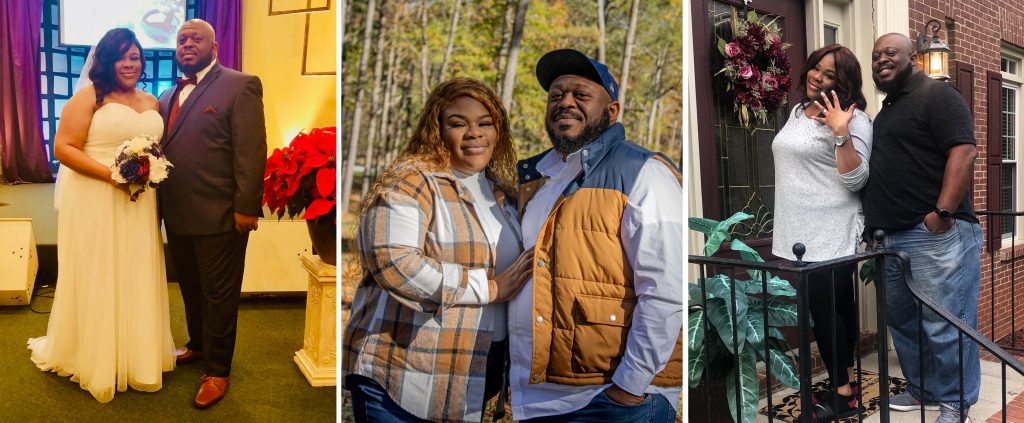
Marianna and Derrick Gray met in 2011 at a wedding in Woodlawn. The couple married in 2014, and have three children. (Provided Photos)
The proposal: Marianna’s birthday, Nov. 1, 2013, at Vestavia Hills Sibyl Temple. Marianna thought she was getting dolled up for a simple birthday dinner, but Derrick had other plans.
“He blindfolded me when I got in the car, and we rode around the city for some time. He was trying to give everyone time to get there…,” Marianna recalled. “And when we got there, I remember having to walk up all these stairs, and when I finally got to the top of the stairs, I took the blindfold off and I was surrounded by all my family and friends. [People] from Huntsville, and Georgia even came up to support.”
As Marianna tried to regain her bearings and take in the sea of faces, Derrick slipped behind her and got down on one knee. “Finally, I was like ‘where is Derrick?’ And everybody said, ‘turn around, and he was there on one knee,’” said Marianna.
“Her friend, Mekeyshia Walton, helped me plan the whole day. We had the outfit picked out, she went and got her hair, nails, and lashes done, the whole nine. And when I got to her and we got in the car, I took out my blindfold, and she was like ‘what you doing?’ I guess she didn’t trust nobody from Ensley,” Derrick laughed. “When [I got her up the stairs] and she turned around to me, I had the ring box open and I gave her my ‘lil mack daddy’ spiel. I said, ‘I appreciate you, and I love you, and I want to spend the rest of my life with you. Will you marry me?’ And since it was so cold outside, and I told her she had to say ‘yes’ because the cold had my knees hurting,” he laughed. “She said ‘yes’ and she’s been saying ‘yes’ ever since.”
Derrick reserved a large party room at the Olive Garden in Hoover for everyone to celebrate and have dinner together after the proposal.
The wedding: At New Jerusalem AOH Church of God, in Center Point, officiated by Marianna’s uncle, Bishop Lawrence Williams from Washington. Their colors were purple, gray, and white.
Most memorable for the bride was being serenaded by her groom. “Instead of [saying traditional vows], Derrick actually composed a song, and put his promises and commitments in it,” Marianna said. “The song is called ‘For Eternity’. This was a surprise, I did not know he was going to do that. And of course, I was already nervous and emotional, but now I’m crying and shaking, I was all over the place. That moment was very special to me because I had never heard of anyone writing their vows in a song and singing them.”
The groom shares a similar memory. “I remember being nervous the night before and practicing the song with my boy Rod. I was asking him how he thought it would go … And [when it came time to sing the song] I was so nervous my voice cracked, and there was one tear that came down my eye while I was singing to my bride,” Derrick said. “It was special, and seeing her reaction to the song was incredible.”
The couple took a honeymoon cruise to Cozumel, Mexico. Derrick said, “We were young, dumb, and full of energy. We decided we would drive all the way to Miami the day after our wedding to catch the cruise out of Florida. And we almost missed the ship because we parked at the wrong loading dock,” Derrick laughed. Needless to say, “we haven’t driven that far since. Now we know to just catch the flight,” Marianna said. “We were so tired that we went straight to sleep when we got on the boat and didn’t wake up till about 4 a.m. the next morning, hungry, and in the middle of the sea,” Derrick added.
Words of wisdom: “Continue to date, and share laughter,” Marianna said.
“I say to keep it ‘hot’, and hot is an acronym for keeping ‘honest, open, and transparent,’” Derrick said. “Being honest with each other is critical, and building a safe space where you all can be open; we call it our ‘gray-space’. It’s a play on our name, but it’s an area where we disengage our emotions and can be open with each other without hurting the other’s feelings or making them upset. It’s like, can you accept this honesty, or do we have to keep walking on eggshells? People lose a lot of trust in relationships due to not being transparent, and it’s critical for a lasting healthy relationship. And as long as she keeps it ‘hot’, I’m a keep on dating her.” Derrick laughed.
“You killed that, babe,” Marianna laughed, and added, “I second all that.”
Happily ever after: The Grays attend Joyful News Family Church in Pinson, where Derrick serves as a staff pastor, and Marianna on the intercessory ministry. They have three children: Derrick (Tre) lll, 9, Yanis, 7, Niyah, 4.
Marianna, 33, is a Fairfield native, and Hoover High School grad. She attended The University of Alabama at Birmingham [UAB], where she studied psychology, and works in the health care field.
Derrick, 38, is an Ensley native, and Jackson Olin High School grad. He attended Miles College, where he earned a dual bachelor’s degree in business administration and accounting and works for the City of Birmingham as the budget officer.
“You Had Me at Hello’’ highlights married couples and the love that binds them. If you would like to be considered for a future “Hello’’ column, or know someone, please send nominations to Barnett Wright bwright@birminghamtimes.com. Include the couple’s name, contact number(s) and what makes their love story unique.
MONTGOMERY — Alabama Gov. Kay Ivey on Monday urged the board that oversees Alabama Public Television to delay any decision on severing ties with PBS until it has studied Alabamians’ opinions on the matter and developed a plan for what comes next.
The Republican governor sent a letter to the Alabama Educational Television Commission ahead of a Nov. 18 meeting in which commissioners were expected to discuss disaffiliation.
Gov. Kay Ivey
Some commission members had pushed the idea of dropping PBS due to federal budget cuts, President Donald Trump’s dislike of public broadcasting and accusations of bias against NPR and PBS news programs from him and other conservatives. A decision to separate from PBS would mean Alabama Public Television would no longer air PBS programs, including “Sesame Street,” “Daniel Tiger’s Neighborhood,” “Antiques Roadshow” and “PBS NewsHour.”
“While I’m sympathetic to the concerns that may be prompting this proposal, such a sweeping, immediate action, especially if taken unilaterally by the executive branch, should be undertaken only after a thorough planning process and only with a thorough understanding of public opinion,” Ivey wrote.
Ivey asked the commission to conduct an extended survey of Alabama voters “to ensure their voices are heard.” She said the commission should also develop a separation plan that “should be available for public review for a considerable length of time before any vote is taken.”
The idea of dropping PBS arose at the October commission meeting. Alabama Public Television Executive Director Wayne Reid said some commissioners asked him to research the possibility and ramifications of ending the contract with PBS.
Commissioners were divided at an Oct. 28 meeting, according to the Alabama Reflector and al.com.
“I just, I don’t want to fund it, PBS has made themselves the enemy of what I stand with, and so I do not like them, and I don’t follow the philosophy of feeding the beast,” commission member Les Barnett said during the meeting, according to the Alabama Reflector.
Alabama Public Television pays about $2.2 million yearly for PBS programming.
The governor said it is imperative that APT programming “align with Alabama values,” but said the decision should be made in “collaboration among stakeholders.”
The possibility of dropping PBS prompted a backlash from Alabama public television viewers and donors. Petitions and posts were shared across social media, urging people to “Save PBS for Alabama Children” and “Don’t let Alabama send Elmo packing.”
The Fairfield Alabama Housing Authority (FAHA) manages 298 public housing units across two communities: Demetrius Newton Gardens and Mattie Gill Jackson Gardens.
fairfieldha.org
The Fairfield Alabama Housing Authority (FAHA) is has announced the appointment of Julius D. Howard as its new Executive Director. With a distinguished career spanning multiple housing authorities across Alabama, Mr. Howard brings a wealth of experience, visionary leadership, and a deep commitment to community service.
Julius Howard, executive director, The Fairfield Alabama Housing Authority
Howard began his career at the Housing Authority of the Birmingham District, serving as an Occupancy Specialist and Asset Manager. His journey continued through impactful leadership roles, including Chief Operating Officer at the Selma Housing Authority, where he oversaw more than 500 public housing units and over 1,000 Housing Choice Vouchers. He also served as Director of Property and Asset Management at the Bessemer Housing Authority, leading day-to-day operations for a portfolio of 708 public housing units.
A native of Birmingham, Alabama, Howard is a graduate of Stillman College with a bachelor of arts in mass communications and holds a Master of Public Administration from the University of Alabama at Birmingham. He further enhanced his leadership credentials by completing the Executive Director Education Program through PHADA/Rutgers University in 2021.
Howard is known for his people-first approach, believing that success in public housing begins with recruiting top talent and equipping teams with the tools and training needed to thrive. He is passionate about meeting residents where they are, fostering personal growth, and promoting pathways to self-sufficiency.
“I consider myself a servant for the people,” said Howard. “My goal is to bring people together, provide quality services, and make a meaningful difference in the lives of our residents.”
Outside of his professional life, Howard is a family man, married to Tracey Howard with whom he shares three adult children. He remains actively engaged in community initiatives and is committed to lending his time and talents wherever they are needed.
In a statement, Howard said, “I am honored to serve as the new Executive Director of the Fairfield Alabama Housing Authority (FAHA). It is with great enthusiasm and a deep sense of responsibility that I step into this role, committed to advancing our mission of providing safe, affordable, and quality housing for the residents of Fairfield.
As winter looms on the horizon, so do viruses and bacteria prepared to usher in annual colds and flu. The immune system is the first line of defense against these types of viral infections and illnesses. Two University of Alabama at Birmingham professors offer tips to build and protect the immune system before cold and flu season fully arrives.
What is the immune system?
From birth, the human body begins learning how to protect itself from environmental threats. The immune system is the body’s internal network working to combat foreign pathogens to maintain good health. This consists of cells, internal organs and even the skin of the body itself.
The immune system is built through the overcoming of previous illness and the receipt of vaccines. These forms train the immune system to block and defend against future encounters with the pathogen that has already been introduced to the body. However, there are multiple ways to protect the immune system before viruses and bacteria can infiltrate.
(Jody Potter, UAB)
Wash hands consistently
Handwashing is one of the most efficient ways to prevent the entrance of bacteria, viruses or allergens into the body.
“Throughout the day, our hands often go to our mouth, eyes and nose,” Russell said. “The more we can keep our hands washed and cleaned, the more we can protect ourselves from things that can be on our hands.”
Eat a nutritious diet
Eating a diet that is full of fresh fruits and vegetables is an important step in protecting the immune system.
“The nutrients that exist in whole foods act synergistically,” Cohen said. “Fruits, vegetables and a colorful plate in general can work to strengthen your immune system.”
Cohen says there are certainly specific nutrients that dietitians emphasize to make sure the immune function is optimized.
“Vitamin C is pretty abundant in fruits and vegetables and works as a natural immune support,” Cohen said.
Foods rich in vitamins C and D serve as efficient immune boosters and supporters. These include:
citrus fruits
kiwi
berries
bell peppers
fatty fish
milk
egg yolks
mushrooms
A diet that is predominantly made up of processed foods has a significant decrease in the nutrient intake that helps improve the immune system. Shelf-stabilized foods have had many of the immune supportive benefits significantly decreased. This loss in nutritional attributes makes whole foods greater sources of immune system support.
“Generally speaking, a colorful plate is a great framework to have,” Cohen said.
Exercise regularly
Maintaining an active lifestyle is an important element in the effective regulation of the immune system. Russell says getting an age-appropriate amount of exercise can help provide additional support for your body’s immune system. “For most adults, this translates to about 30 minutes of aerobic exercise for five days a week,” he said.
Get enough sleep
Adequate rest is an essential piece of the body’s ability to defend against infection. During sleep cycles, the body works to replenish and repair itself. This can take the form of healing from any exposures during the day and improving the immune system itself.
Are supplements sufficient?
While social media and modern trends encourage and promote many different forms of immune support in the form of supplements, doctors say there is no pill that can completely replace the benefits of a strategic, well-balanced diet.
“Unfortunately, we do not have much strong scientific data that supports that supplements are going to be more beneficial than a well-rounded and healthy diet,” Russell said. “While supplements are beneficial for individuals depending on their lifestyle or diagnosed deficiencies, nutrients through whole foods are always going to be the preferred approach and suggestion for initial immune support.”
Dan Williams is the new President and CEO of the Greater Birmingham Convention and Visitors Bureau. (Provided)
By Don Rhodes II | For The Birmingham Times
Since taking the reins as President and CEO of the Greater Birmingham Convention & Visitors Bureau this summer, Dan Williams has been driven by one aspiration: “I want our destination to be the standard,” he told the Birmingham Times.
“I want us to be the organization that’s looked to positively in the destination, marketing, organization (DMO) space — but I also want us to be looked at locally as a people-first organization.”
Williams’ move to Birmingham was not all business; his ties to Alabama can be traced back decades via family ties.
“My uncle [Ray Greene] coached at Alabama A&M in Huntsville, Alabama, for eight years [from 1979–1983 and 1986–1990] and in between that time he also was offensive coordinator at Alabama State for one year in Montgomery, Alabama,” Williams said. “As a kid, I’d spend my summers with him and my aunt and cousins in Huntsville. I’d come to the Magic City Classic, so I have roots here.”’
Williams got a chance to enjoy this year’s Magic City Classic, which he said was a showcase for the City of Birmingham and the Historically Black College and Universities (HBCUs) experience. “Our organization looks forward to having a larger presence at the Classic for the foreseeable future,” he said.
After more than 35 years away, Williams returned to Birmingham in 2024 when the National Coalition of Black Meeting Professionals held an event in the Magic City. “I got here and said, ‘My God, Birmingham has grown. It’s a cool city — diverse, vibrant, beautiful,’” he recalled. “When the opportunity came up, it all fell into place. I wanted to lead the next phase of tourism in Birmingham.”
That all became a reality when he was contacted by the search firm Searchwide regarding the Birmingham job and went through the interview process. “The rest is history,” he said.
The reception he’s received from taking the leadership role on June 16 has been amazing, said the CEO. “I’ve been welcomed with open arms by my staff and the community. I’m extremely excited about all of the great things we can do here.”
Williams credits his family, particularly his uncle, with molding his leadership style. “He didn’t lead with fear — he led with compassion,” he said. “If I ever got to lead my own organization, I promised myself I wouldn’t be the CEO sitting in an ivory tower. I’d be one with my people.
“It’s about my people — making sure they’re taken care of, empowered, and have a sense of place within this organization. The better off our people are, the better they’ll be at promoting this community.”
Leading with Empathy
The COVID-19 pandemic also reshaped his approach to leadership. “It became less about numbers and more about how people are doing mentally,” he said. “Checking in on people, asking, ‘Are you okay?’ That empathetic approach means everything.”
Williams’ vision for tourism in Birmingham includes education, alignment, and storytelling. “We have to do a better job of educating people on what our organization does,” he said. “Tourism brings jobs and dollars to our community, but many don’t realize how it impacts them.
“A strong tourism economy means jobs for our people, support for local businesses, and tax revenue that helps improve schools, roads, and public services,” he said. “It also helps preserve our culture from historic sites to local art and gives young folks a path into careers in hospitality, the arts, and entrepreneurship.”
Last year, Williams pointed out that tourism in Greater Birmingham generated a record $2.57 billion in economic impact, supported 51,887 jobs, and contributed $302 million in state and local tax revenue.
He also wants to connect Birmingham’s many efforts. “Everyone’s doing great work, but in silos,” Williams said. “We need to be conveners. We’ve got to come together city, county, corporate, education to understand each other’s pain points and work toward the greater good.”
Redefining The City Through Tourism
GBCVB President Dan Williams wants Birmingham to be recognized nationwide. (Provided)
While Birmingham’s Civil Rights history is foundational, Williams insists that it’s time for people to share how the city has evolved as he found during his visit since being away. “The Civil Rights history here changed the world,” he said. “It will never be forgotten but we’ve got to show how Birmingham has progressed. This city is innovative, dynamic, and forward thinking.”
Williams also acknowledges how deeply personal that progress feels. “My dad still hasn’t come down here from Akron, Ohio, because of what he remembers from traveling through the South as a young man,” the CEO said. “But I tell him, ‘It’s not like that anymore.’ Birmingham has moved forward in such a beautiful way.”
The leadership motto for Williams, who joined the agency with over 25 years of experience in tourism and hospitality, is simple: “Everyone belongs in the room … “Ideas can come from anyone — interns, staff, executives. My job is to remove barriers and empower people to make decisions. We’ll make mistakes, but we’ll correct them together.”
Looking ahead, Williams wants Birmingham to be recognized nationwide. “I want people talking about how innovative and progressive this community is,” he said. “Birmingham is a place where you have a voice, where you can grow.”
“Often, we see our relatives working in hospitality doing tough, front-line jobs, and we don’t see the leadership side,” he said. “But there are executives, vice presidents, and marketing strategists who look like us. We want to open that world up.”
The GBCVB is already working with local schools to make that vision real. “We have four interns from [Birmingham’s] Wenonah High School, and in January we’ll start with Miles College students,” Williams said. “We’re opening our doors to show them what hospitality truly means and how it can be a phenomenal career.”
But in the end, his message was clear: “Tourism drives this community,” Williams said. “When we empower our people, educate our residents, and align our efforts Birmingham doesn’t just meet the standard. We become the standard.”
Rotimi Kukoyi, a Hoover High School graduate, was named one of 32 students to the American Rhodes Scholar Class of 2026. (File)
By Barnett Wright | The Birmingham Times
Hoover High School graduate Rotimi Kukoyi, now at University of North Carolina at Chapel Hill, has been named one of 32 students to the American Rhodes Scholar Class of 2026.
Kukoyi was selected from a pool of 965 candidates who had been nominated by their colleges and universities. He will commence his studies at Oxford in October.
“My first reaction was absolute disbelief,” Kukoyi said in a text message late Sunday. “I never could have imagined being selected for the world’s oldest and most prestigious postgraduate award. In so many ways, I feel incredibly lucky for the opportunities and blessings that have brought me here.”
He continued: “My second reaction was pure excitement: for the doors this will open, for the community I’ll be joining, and for the ways this experience will deepen my journey and commitment to transforming our healthcare system.”
Kukoyi has said his education in the Birmingham metro area provided him with a solid foundation.
“I’m very interested in public health and Birmingham has some of the South’s best public health infrastructure,” Kukoyi told The Birmingham Times in April. “You have UAB Hospital, I did research with UAB surgery when I was in high school; the public health department in Jefferson County is great and having that proximity to all those resources prepared me in terms of getting guidance from people, getting inspiration and encouragement.”
Kukoyi, is also a past winner of the prestigious Finley award in Hoover, which is given each year to the senior from each Hoover high school and one faculty member from throughout the school system who best demonstrates the character of former Berry High School coach Bob Finley, who was known for his outstanding character.
A senior at the University of North Carolina, Chapel Hill (UNC-CH), Kukoyi majors in Health Policy and Management. As an intern in the North Carolina Department of Health and Human Services, he developed policies to advance value-based care for residents across the state.
While a summer intern in Nigeria, he designed and built digital tools to support the implementation of better health care decision-making and has worked with the UNC Student Health Action Coalition to help provide free health services to uninsured and underinsured state residents.
He was elected senior class president and also recently completed his first marathon. At Oxford, Olurotimi will pursue the M.Sc. in Health Improvement and Evaluation and the M.Sc. in Evidence-Based Social Intervention and Policy Evaluation.
Nearly 2,800 students began the application process, and 965 candidates received formal endorsements from their colleges and universities. The endorsed applicants represented more than 264 different institutions.
This spring, Kukoyi pointed to the “positive relationships” he developed in the metro area for his academic success.
“My resume might look like I’m doing these things alone but behind each bullet point, behind every achievement, it’s a village, it’s my family, it’s my friends, it’s my professors, who are opening doors for me,” he said, “ … nothing happens in a silo. It’s all community and really investing in the right relationships and showing gratitude for their investment in you.”
Among this year’s Rhodes Scholars-elect are:
Three student body presidents, including Rotimi, and two local public officials
An aspiring physician who helped build an eye bank in Ukraine
A paralympic athlete who is also a bioengineer and advocate for athletes with disabilities
An aeronautical engineer fluent in four languages who plays piano, guitar, and drums
An international affairs scholar who paints portraits and competes in triathlons
More than 2,100 American Rhodes Scholars are living today in communities across the United States and around the world.
Established in 1902 through the will of Cecil Rhodes, the Rhodes Scholarship is the oldest and one of the most recognized international academic awards. The Scholarship provides full financial support for two to three years of study at Oxford and may extend to a fourth year, depending on the degree program.
Operation Warm and volunteers from Diversified Energy distributed new coats and gloves to students at Tuggle Elementary School. (BCS)
Birmingham City Schools
Nonprofit organization Operation Warm and volunteers from Diversified Energy distributed new coats and gloves to students at Tuggle Elementary School last week.
More than 400 coats were available for students, with volunteers helping the students with fitting.
Operation Warm’s mission has always been focused on the whole child. Their tagline, ‘more than a coat’, means that coats and shoes provide children with not just physical warmth, but also emotional warmth, the confidence to socialize and succeed, and hope for a brighter future.
Over the past 26 years, these gifts have become a bridge between families in need and the organization’s partners offering access to critical resources.
Operation Warm’s Guiding Principals
Warmth: Operation Warm creates brand-new, high-quality coats and athletic-style shoes for children in need, offering both physical and emotional warmth.
Confidence: The gift of a brand-new coat or pair of shoes empowers children by sparking self-confidence in a way that second-hand clothing cannot. This gift can help students attend school, socialize with their peers and play outside with pride.
Hope: Many families living in poverty struggle to afford necessities like food, housing, clothing and child care. The gift of a brand-new coat or pair of shoes offers hope to both children and their parents, reminding them their community cares about their well-being and future.
Operation Warm and volunteers from Diversified Energy distributed new coats and gloves to students at Tuggle Elementary School. (BCS)
The city hosted a meeting to give neighbors an update on the Community Choice Neighborhood Initiative on Wednesday at Legion Field. The project is expected to revitalize three neighborhoods — College Hills, Smithfield and Graymont. The project will plant more trees, create dedicated bike lanes, give people the opportunity to own homes and create funding for people to renovate their homes and businesses.
Adrienne Pearson, president of the College Hills neighborhood association. (Barnett Wright, The Birmingham Times)
“We’re learning more about it,” Pearson said. “I would like it to go faster as far as the process — the advancements on it — but it’s an exciting time. We as residents have to do our due diligence, and I would like to see more residents being involved, and that’s all across the board. That’s all across Birmingham … Everybody needs to put on their tennis shoes and have that passion and just go full force.”
Cory Stallworth with the city told WVTM 13 that staff are taking their time to be intentional. He said there’s a lot of behind the scenes work like engineering, architecture and finances that make the project move forward.
“We also want to ensure that people have opportunities for housing, whether that is rental, whether that is home ownership,” he said. “We also want to make sure that our youth and that our families have a safe place to thrive. A lot of times blight may bring issues to people with that. We want to make sure that that we remove all of the obstacles—all of the barriers—that may hinder folks from having thriving and healthy neighborhoods and healthy families.”
Residents like Ratashia Boykin are looking forward to the difference the federal money will make in her Smithfield community.
“It’s going to help so many of our neighbors, and I think it will build pride,” Boykin said. “I think anytime things become beautiful people start to feel a little joyous and maybe that will help a little bit. We need to feel a little more joy right now. It’s dismal, but we have to do it ourselves too, and with this help, I think it’ll get done.”
The city said it expects to break ground on phase one of the project this spring. That’s the redevelopment of the former Jefferson County Committee for Economic Opportunity building.
Phase two of the project is already in development and construction is expected to begin in 2027. That will be a multi-family housing development near A.H. Parker High School.