By Barnett Wright | The Birmingham Times
The Birmingham City Council on Tuesday approved $6 million for construction on the historic Ramsay McCormack Building in Ensley in hopes of finally bringing the long-delayed project to completion.
As far back as February 2019, city officials called for proposals to redevelop the building and properties in Ensley’s historic business district. In recent years, developers have faced delays due to the COVID pandemic, supply chain, increased construction costs and interest rate changes.
Despite the delays and some community opposition, city leaders said Tuesday they remained committed to the project.
The $6 million includes a $2 million initial cash payment, a $3 million forgivable loan contingent on project completion, and an optional $1 million loan repayable over 10 years at the Treasury rate. The overall project is estimated to cost about $20 million, with the developers required to contribute their own funds
Birmingham City Council President Darrell O’Quinn said the money is crucial bringing the building online.
“This is part of the [funding] that is required to make the development happen. There is some additional funds that the developer will have to come up with to get to the almost $20 million price tag that is going to be required to actually get the project done. The city of Birmingham is just doing its part to as part of making the project happen,” said O’Quinn.
Rick Journey, Director of Communications, for the City of Birmingham, said, “We are fully committed to investing in the Ensley community. A key part of that investment involves the completion of the Ramsay McCormack Building site. The resources approved today supports that commitment for developers to go vertical on the property.”
The city also approved an amended Redevelopment Agreement on the property “to ensure the project’s successful completion and mitigate risk … structured to significantly protect the city’s investment, providing incentives tied to concrete milestones.”
The developer is expected to commence vertical construction within 120 days of the new amended and restated redevelopment agreement.
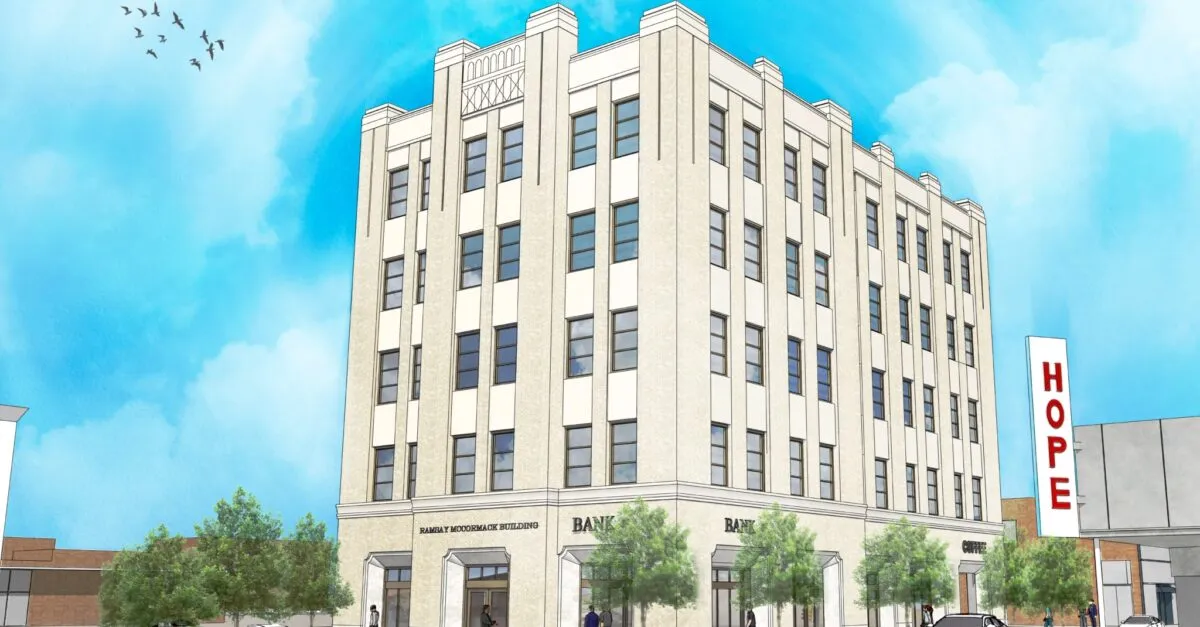
The city will lease approximately 6,000 square feet in the new building — five stories as opposed to 10 for the demolished edifice — for a police sub-station and city services related to economic and community development.
Still, not everyone was in favor. Ensley business owner Brian Rice said he strongly opposes the agreement.
“For the last three or four years, we have looked at a gravel lot where the basement was filled in, and there has been no explanation as to why they are not developing this property with the first $4 million,” which went towards demolishing the building in 2021, said Rice.
Some of the money could have been invested in the developers, business owners, and merchants in the community, he added. “Ensley could be a thriving community if our city supported us … we’ve seen all this money going to the Ramsay-McCormack and nothing going to us.”
As recently as last week Rice said he sent an email requesting the council to take the item off its consent agenda and allow a public hearing for more than a dozen Ensley residents. “And they ignored all of us … We should’ve had a chance to speak before they voted on it, but they did not give us owners a chance to speak in advance,” he said.
Journey, of the Mayor’s office, said, “the city’s commitment has never wavered concerning this project. Today’s investment supports efforts to get this development across the finish line.”
The building at Avenue E and 19th Street was named after investment partners Erskine Ramsay and Carr McCormack of the Ramsay-McCormack Development Co.
The building housed the Bank of Ensley on the ground floor, as well as the developer’s offices and local offices for U.S. Steel for several years. Despite a renovation in 1970, the closure of U.S. Steel’s Ensley Works left much of the tower vacant and the building’s doors were closed in 1979.
The city has owned the building since 1983, when U.S. Steel sold it for $1. It was listed on the National Register of Historic Places in 1984 but has been empty since 1986.
Share this:
- Click to email a link to a friend (Opens in new window) Email
- Click to print (Opens in new window) Print
- Click to share on Facebook (Opens in new window) Facebook
- Click to share on X (Opens in new window) X
- Click to share on Pinterest (Opens in new window) Pinterest
- Click to share on LinkedIn (Opens in new window) LinkedIn
- Click to share on Reddit (Opens in new window) Reddit
- Click to share on WhatsApp (Opens in new window) WhatsApp