
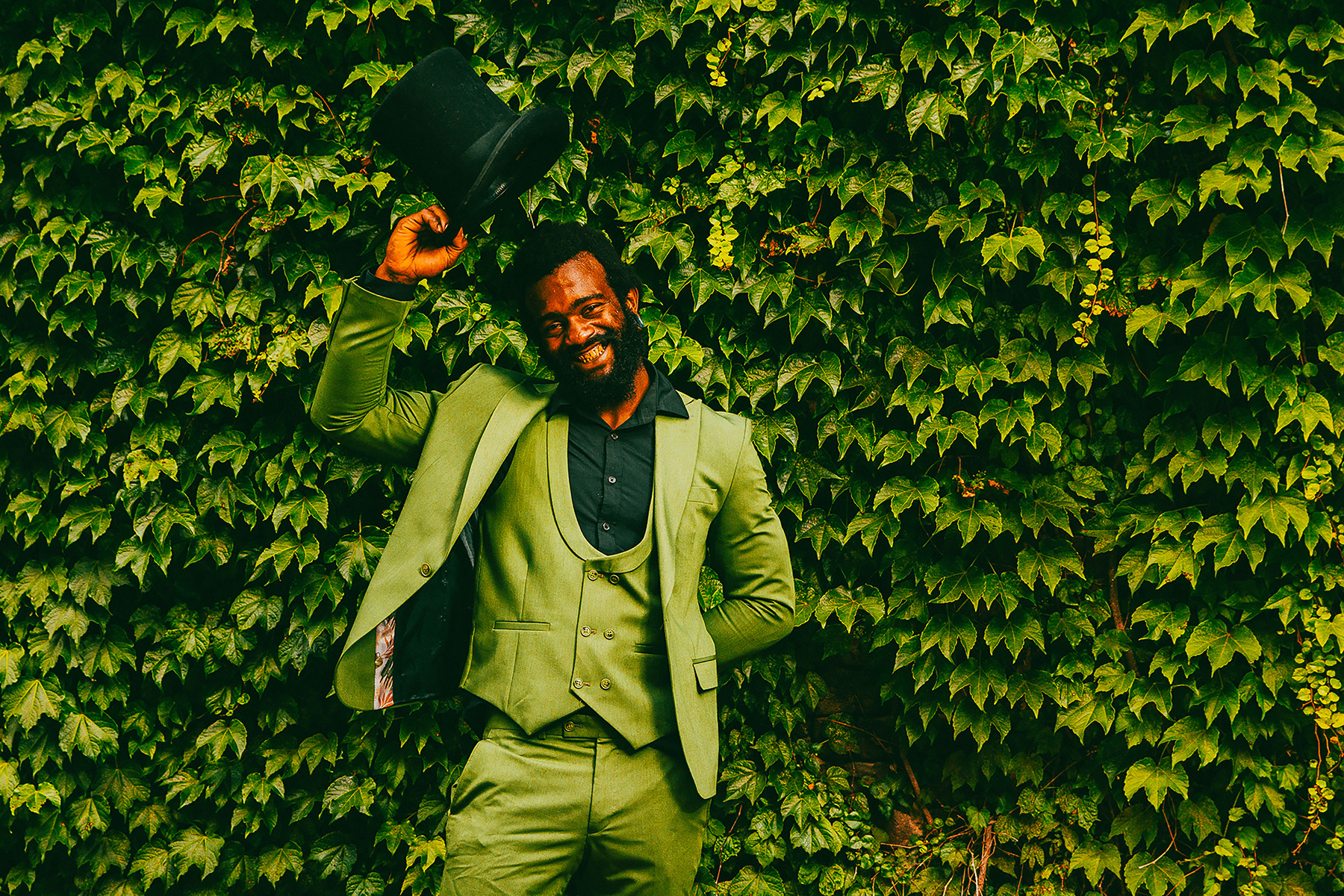
By Ameera Steward | For The Birmingham Times
Thirty-three-year-old Dewon Moton was born in Buffalo, New York, and grew up in Pinson, Alabama. His life often didn’t have much structure, so he “needed a coping skill,” he said.
“I got a pencil and paper and found out I could draw, [which gave me] the ability to re-create different worlds,” he said. “I could literally draw myself into my new existence. … I’m a big believer in if I could draw it, I create it, and I live it. I feel like that’s the key: to be able to visualize something and bring it into existence.”
Moton has been using art to express himself ever since.
As for his style, his mom, Shonda Moton, was a fashionable diva, and she sparked his interest in fashion.
“As a straight male, it was … conflicting,” he said. “I could be more like her because that was my role model at the time. Or, [I could be more like] what a man [traditionally] looks like. I feel like I’m a blend of the two, still being able to dress out and [be] comfortable. … [I’m] comfortable in myself no matter what I’m wearing.”
For the past three months, The Birmingham Times interviewed some of the area’s leading fashion designers and tastemakers about the cultural and historical examination of Black style.
Moton is a “very avid thrift shopper,” he said.
“I just simply found out that all the great stuff is in the women’s section,” he explained. “It has everything—all the patterns, all the lace, all the colors, all the textures. Things from the women’s section fit really well; they are just tailored way better.”
Moton believes wearing women’s clothes is a physical interpretation of how clothes can be art because of their fit, flow, patterns, and colors. His favorite women’s pieces are lace shirts and bell-bottom pants.
“Sensory wise, people love to feel, to touch, to see how things are made. … I feel like textured clothes make you more interesting. … And, I mean, it kind of works for me because I’m an artist and I can get away with that. [People] expect me to be weird anyway, so I kind of use it to my advantage—without a doubt.”
Moton graduated from E.B. Erwin High School (now Center Point High School) in Birmingham in 2010 and went on to earn a degree in graphic design from the Art Institute of Pennsylvania in 2013.
Despite having a degree and a passion for his craft, Moton didn’t realize that being an artist could be a lucrative career. In 2010, he was commissioned to paint his first mural on Commerce Street in Dallas, Texas—and then he brought his talents back to Birmingham.
“I got my first opportunity to do a mural downtown and realized the money was 10 times better [than anything else I had done], so I’ve been a full-time muralist for the past seven to eight years,” said Moton, who works under the name Dewon Moton Arts.
You can follow Dewon Moton on Instagram: @dewonmotonart.
Q&A
The Birmingham Times (BT): Why is dressing well important as a Black man?
Dewon Moton (DM): “Because it’s having a platform to be able to show that we are not exactly what people think we are. … I am a straight Black male, but some of my clothes, people don’t consider them clothing a straight man would wear. … But [fashion allows] you to be what you want.”
BT: What is your process when getting dressed for the day?
DM: “Color matching. … My pants have to match my shoes. And I’m crazy about a crop top. … Color theory is a thing [for me], for sure. I just graduated from a business class [in which] they were talking about [elevating your business], and one of the topics was colors and how emotions are tied to [them]. I thought that was cool because it’s like science.
[Moton along with other artists applied for the City of Birmingham Community Arts Grant Program through Create Birmingham. As part of the grant, the artists received business development training, including classes held at the University of Alabama at Birmingham (UAB).]
“You can make people react with just what you wear. It could be a loud red that [attracts] very sharp attention. Wear soft blues, and it’ll seem like more of a calm vibe. … The demeanor changes with the outfit. … [For instance], when you see a businessman, his attire is set to [appeal to] a specific demographic.”
BT: Any advice for young Black men who wish to dress well?
DM: “Judgment is inevitable, so be aware. … Know how to carry yourself and speak for yourself, so you can be comfortable regardless of what people see … or what people say.”