By Alaina Bookman | abookman@al.com
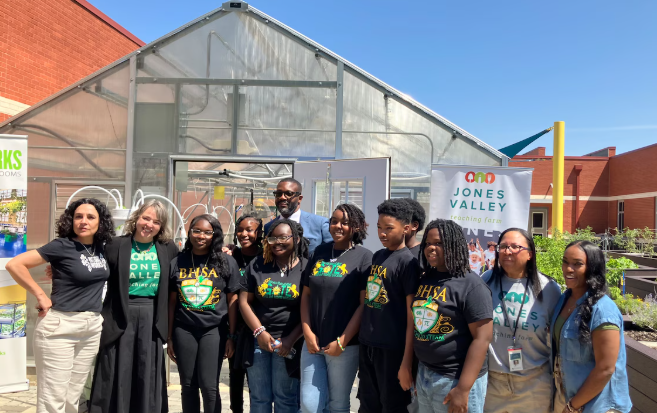
Bursts of pinks, oranges and all shades of green greet the buzzing bees and students of Birmingham’s Bush Hills STEAM Academy.
Bush students are among those from eight Birmingham schools using brand new hydroponic farming technology in their science classrooms. In a partnership between Jones Valley Teaching Farm, New York Sun Works, Birmingham City Schools, and the city of Birmingham, the farms will produce up to 4,000 pounds of fresh produce annually, which will stay in the community, and give students opportunities for hands-on learning.
“There’s this really unique thing that happens when young people are in charge of something and they have agency…They’re caring and nurturing for something as small as a seed, but the output of that is something bigger,” Amanda Storey, executive director of Jones Valley Teaching Farm, said.
Hydroponic farms grow plants without soil, instead using water with all the nutrients the plants need.
This method allows for year-round crops, from summer cucumbers and tomatoes to fall sweet potatoes and herbs, even in urban settings.
The magic starts in an on-campus greenhouse, where students raise up tiny seeds and watch them flourish into veggies.
Experts say hydroponic farms can help to address food insecurity.
Over 70 percent of Birmingham residents lack access to affordable, fresh food, according to the city.
Kierra Norris, a Bush Hills STEAM Academy student, said she lives in a food desert, where there is no easy access to grocery stores near her home.
Fellow student DeAndre Hall said that, “When I first saw this in the greenhouse, I thought about how helpful it could be and how many lives it could change … I kept thinking about the food deserts and how many people it could help in them.”
Manuela Zamora, executive director of New York Sun Works, has helped build hydroponic farms in city schools for 15 years.
She said the farms help students understand that they can grow nutritious food anywhere.
“They are farming in the classroom and understanding the science behind it, making connections and having a hands-on approach to learning and being engaged in a project,” Zamora said.
“They also start to question like, ‘Why don’t we have access, regular access, to these types of fresh vegetables’…That leads to civic engagement and advocating for what they should have access to.”
Founded in 2002, Jones Valley Teaching Farm, a Birmingham nonprofit, uses food as a foundation for learning, turning Birmingham kids into skilled urban farmers.
Jones Valley already has eight traditional teaching farms on elementary, middle and high school campuses in the city.
The hydroponic farm initiative represents an expansion that will help nearly 4,000 students from Bush Hills STEAM Academy, Central Park Elementary School, Charles A. Brown Elementary School, Wylam K-8 School, Minor Elementary, Green Acres Middle School, South Hampton K-8 School and Jackson Olin High School.
“We’ve had a long history of seeing how this is a game changer for kids when you’re allowed to be outdoors, or indoors but surrounded by living things. It just makes you see what your world is made of,” Storey said.