By Javacia Harris Bowser | The Birmingham Times
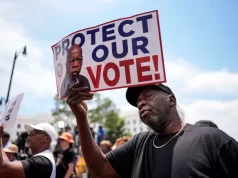
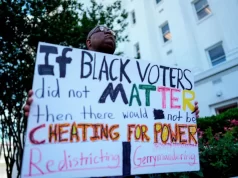
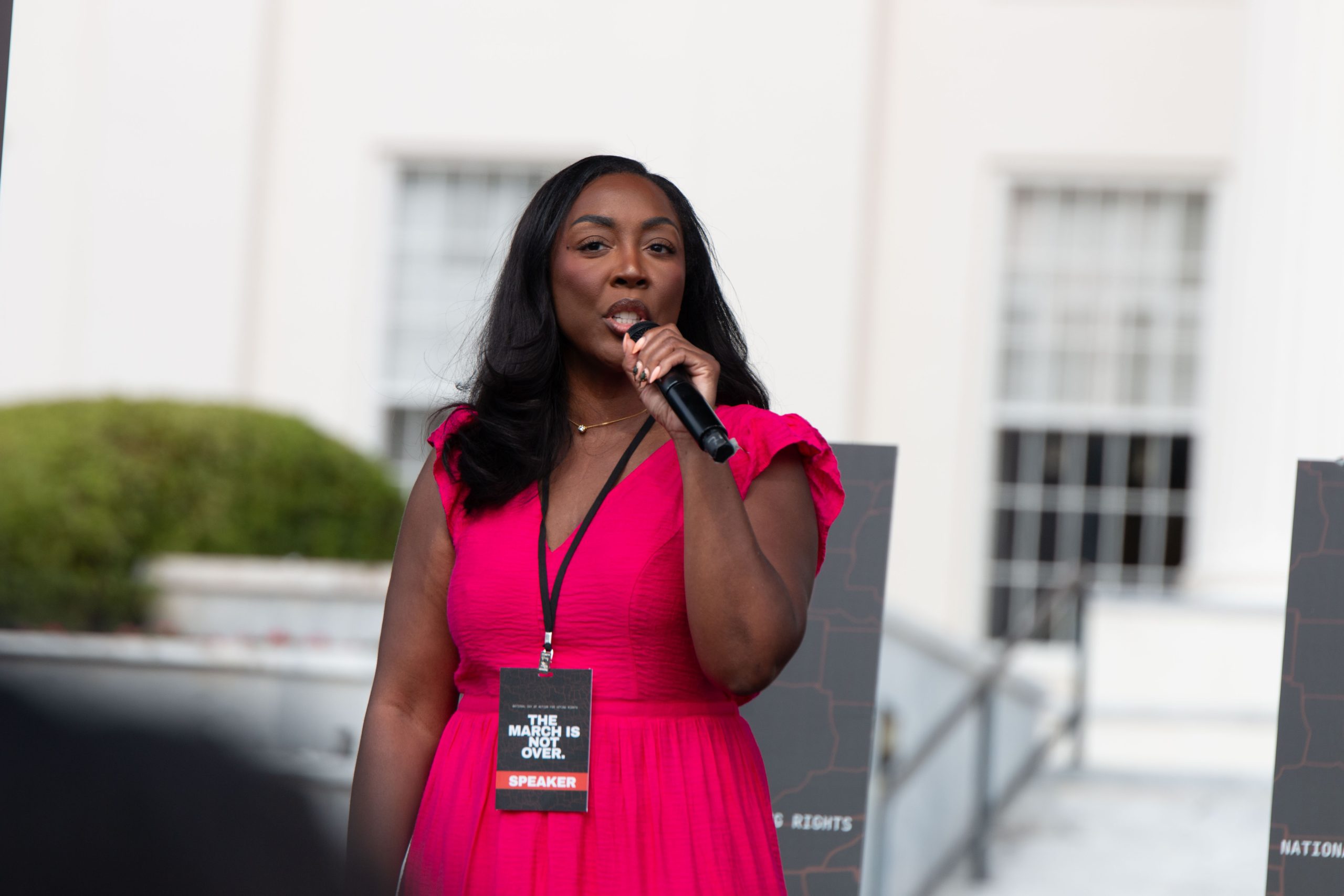
Grounded. That’s how Rebekah Caruthers, CEO and president of Fair Elections Center, said she felt after taking part in the “All Roads Lead to the South” Day of Action on Saturday. The day, organized to ignite a new voting rights movement as conservative states work to dismantle congressional districts that helped secure Black political representation, began with a march across the iconic Edmund Pettus Bridge in Selma, Alabama. Participants then made their way to Montgomery, Alabama, for a nearly five-hour-long rally in front of the Alabama Capitol that drew thousands.
“Starting at Selma at Tabernacle Baptist Church was a great moment for those of us who lead civil rights organizations to be grounded and really think about the historical significance of the work,” she told The Birmingham Times. “Then to see the activism in Montgomery at the rally at the Capitol and understanding that there are a lot of people ready, willing, and able to join in the fight, that was truly remarkable.”
Fair Elections Center is a national, nonpartisan voting rights and election reform nonprofit organization based in Washington, D.C. Saturday also gave Caruthers the chance to walk with activists who’ve been down this road before, fighting for the Voting Rights Act of 1965.
“I’m thinking about some of the foot soldiers that I had a few moments to talk to and understanding the gravity that was written all over their face, the pain, the hope, the triumph, but also the feeling of ‘We’re here again,’” Caruthers said. “To hear them talk about their experiences, and to understand how important it is for the rest of us to stand shoulder to shoulder with them, arm in arm, and not only fight this fight but to finish this fight.”
Pay Attention
Saturday’s march and rally were sparked in part by the recent Louisiana v. Callais ruling that further weakened the Voting Rights Act, which had already been limited by a 2013 decision and others. The rulings opened the door for stricter voter ID laws, registration limits, reduced early voting, and polling place changes, including in states once required to get federal approval before changing voting laws because of histories of discrimination against Black voters.
In Alabama, Republicans moved swiftly after the Louisiana ruling to shift the state’s districts. In 2023, a federal court redrew Alabama’s 2nd Congressional District after finding the state intentionally diluted the voting power of Black residents, who make up about 27% of the population. The court directed the state to have an additional district where Black voters are a majority or near-majority. But the Louisiana decision clears the way for Alabama to adopt a new map that could help Republicans reclaim the seat. While the case is still being litigated, Alabama plans to hold special primaries Aug. 11 under the new map.
Caruthers stressed that such tactics could have a ripple effect.
“What I want people to pay attention to is, we’re going to see southern legislatures next year, if not later this year, and the subsequent years start redrawing state house boundaries, redrawing state senate boundaries, and then they’re going to start messing at the county and municipal level,” she said.
Freedom Summer
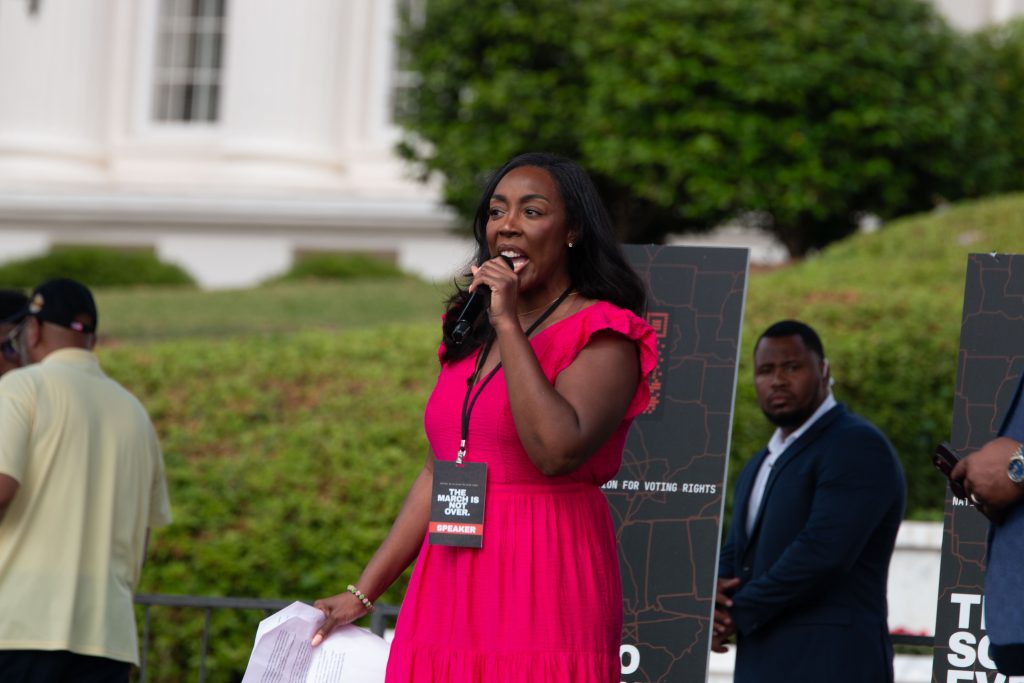
Caruthers was one of the dozens of activists, elected officials, and organization leaders who addressed the crowd at Saturday’s rally. A message declared repeatedly from the stage was that Saturday’s march and rally were just the beginning.
Caruthers said Saturday’s demonstration was a kickoff for “Freedom Summer” (a nod to the June 1964 campaign launched by activists to register as many Black voters as possible in the state of Mississippi), which will then lead into “Freedom Fall.”
“Freedom Summer, going into Freedom Fall, going through the Election Day, plus the day after the Election Day, we’re going to be doing a set of actions to make sure that people understand what’s happening in this country, because not just the South,” Caruthers said. “A lot of people think, oh, this is just a southern problem.” But Caruthers says other states, such as New Hampshire, Utah, and South Dakota, are also facing restrictions on voting rights.
“The only way to ensure Black political power right now is for Black people to register to vote in overwhelming numbers, and to show up in overwhelming numbers,” Caruthers said.
She believes that even in the face of redistricting, Black voters can move the needle in statewide elections.
“You can’t gerrymander an entire state,” she said. “Anyone who’s eligible to vote and is registered to vote within that state boundary, they’re able to have an impact.”
But voting, she said, isn’t enough.
“People need to understand voting is only one step,” she said. “Once people are in office, you have to hold them accountable.”
Mobilizing Young Voters
Another message repeated on Saturday was the need for unity.
“We know that the attacks on Black voters in this country have an outsized impact on every single group in this country,” Caruthers said. “So, we are calling for all allied organizations to lend their voice to support the right of Black folks in this country to have the right to vote.”
Though based in Washington, D.C., Fair Elections Center does work across the country, including in Alabama. One focus of the organization is mobilizing students at Historically Black Colleges and Universities (HBCUs).
“It’s not that young people aren’t interested, it’s not that young people aren’t active, it’s just that young people need quality information,” Caruthers said.
“Our democracy is far from perfect, but we are committed to building the future that we need, the future that we deserve, and the future that further generations after us want to take part in.”
A Third Reconstruction
As Caruthers fights for the future, she is rooted in the past. From the stage on Saturday, she shared the story of one of her ancestors who was born into slavery but eventually went on to found a town in Texas. This happened, she said, in part because of rights and opportunities he gained during Reconstruction, the post-Civil War period focused on rebuilding the South, reuniting the nation, and establishing legal and civil rights for newly freed African Americans. Eventually, many of these rights were stripped away and not restored until after the Civil Rights Act of 1964 and the Voting Rights Act of 1965.
Caruthers refuses to let history repeat itself.
“We’re not going to take 87 years to get our rights back,” she told the crowd on Saturday. “This time, we have some heavenly witnesses. We have ancestor John Lewis and ancestor Jesse Jackson. They are looking down on us as we get ready for this third Reconstruction, as we prepare for this fight. This time, we’re going to finish that fight that our ancestors started.”
Follow allroadsleadtothesouth.com to be notified about future events. To learn more about Fair Elections Center, fairelectionscenter.org.