Home Blog Page 466

Smart Talking: People Who Are Bilingual Have Brains That Stay Young Longer


0

A man with a golden shovel on top of a large white brain marble sculpure by Jan Fabre, 'Anthropology of a Planet' is pictured during the The Brain exhibition at Bundeskunsthalle on January 31, 2022 in Bonn, Germany. (Photo by Andreas Rentz/Getty Images)


By Michael Leidig

The ability to keep the brain fit by speaking more than one language could be one of the best ways to stop brain ageing, according to new research by boffins in the UK and Russia.


The research comes at a time where advances in medical technology mean people can live longer than ever, but the consequences of that mean the brain can not always keep pace with the physical health of the body.

The number of cases of dementia and other neurodegenerative diseases is growing as the population ages, and there is increasing research into how this process can be tackled.

Researchers from HSE University, Moscow, and Northumbria University, Newcastle upon Tyne, have found that bilingualism can slow down and mitigate the course of age-related changes in the human brain. The study was published in Frontiers in Psychology.

The impact of age on the human brain includes the fact that overall information-processing speed decreases, short-term and episodic memory deteriorate, and control over language skills, executive, and visuospatial functions decline.

This process is called ‘cognitive ageing’. At the neuronal level, it manifests itself through anatomical changes in the grey and white matter in specific brain regions.

Anatomical drawing of a man’s brain and cerebral nerves. (Photo by Hulton Archive/Getty Images)

However, the speed at which ageing occurs varies and depends on a person’s cognitive reserve – which is the brain’s ability to cope with the effects of age-related brain damage and maintain optimal performance.

This reserve is built up over the course of a person’s life, as the brain strengthens neural networks in response to various external stimuli.

The more complex the neural networks are, the greater a person’s cognitive reserve is and the milder any age-related changes will be.

It is already proven that cognitive reserve is influenced by physical exercise, nutrition, career, leisure habits, level of education, socio-economic status, and several other factors.

The team of scientists that investigated the effect of bilingualism on older people’s brain functioning and how it relates to other aspects of cognitive reserve conducted an experiment with 63 adults aged 60 or above.

The participants were healthy and had no history of psychiatric or neurodegenerative impairments. The participation requirements for the study included at least partial knowledge of a second language (‘bilingualism’ in this case referring to the ability to speak two languages, no matter how fluently).

Before the experiment, all of the participants took a questionnaire that investigated their cognitive reserve (including questions about the participants’ marital status, level of education, profession, social relationships, sports activities, etc.)

The participants also had to indicate how long they had known a second language, how often and where they used it, and how fluent they were in this language.

The participants were presented with a ‘flanker task’, which is traditionally used to measure inhibitory executive control.

In the task, participants were shown a row of five arrows, with the central ‘target’ arrow the key stimulus.

The arrows to either side of the central arrow (the ‘flankers’) could point in the same direction as the key stimulus (congruent), the opposite direction (incongruent), or they could be replaced by other objects (such as squares).

The participants were asked to indicate the direction of the central target, and to do so as quickly as possible.

In an incongruent situation (when the target and side arrows point in different directions), it is usually more difficult for a person to concentrate and give the correct answer.

However, bilingualism showed a facilitatory effect on the task. The longer people had studied a second language and the more fluent they were, the better they performed in the experiment.

It is worth noting that the level of subjects’ language skills played a greater role than the length of time they had been learning a second language.

Nicole Briggs looks at a real human brain being displayed as part of new exhibition at the @Bristol attraction on March 8, 2011 in Bristol, England. (Photo by Matt Cardy/Getty Images)

The researchers explained this result by noting that bilingual speakers constantly face similar conflicts in daily life, in which they must make choices and switch between two linguistic systems.

Federico Gallo, Junior Research Fellow at the HSE University Institute of Cognitive Neuroscience, said: “Unlike other factors that shape cognitive reserve, bilingualism is unique in that it is constantly present in our lives. We can take up and give up physical exercise, go on one diet or another, or change jobs, but language remains with us all the time.

“We communicate, watch movies, and read books, and the language centres are constantly working in our mind. We witnessed an interesting phenomenon in this experiment: with a high level of language proficiency, the correlation between successful conflict resolution and other components of cognitive reserve disappeared. This suggests that bilingualism’s benefits on cognitive reserve might be stronger than those of other known factors.”

Proficiency in two or more languages improves brain functioning in healthy people, and it is also a defence against neurodegenerative disorders, such as dementia, Alzheimer’s, Parkinson’s disease, or strokes.

In another article published in Frontiers in Human Neuroscience, Federico Gallo and his colleagues provided an overview of the latest research on bilingualism and ageing.

The data suggest that active bilinguals are diagnosed with neurodegenerative diseases five to seven years later than monolinguals.

Scientists believe that bilingualism improves not only the executive functioning of the brain, but also episodic, working and semantic memory, and even increases overall fluid intelligence.

Federico Gallo added: “There are no really effective drugs available today to prevent or slow down brain ageing. It takes enormous financial resources to develop pharmaceutical treatments. Therefore, finding and researching alternative, non-drug ways to slow down cognitive ageing should become a priority in science. In the long term, we plan to study how the benefits of bilingualism on ageing may vary with different language pairs.”

Recommended from our partners


The post Smart Talking: People Who Are Bilingual Have Brains That Stay Young Longer appeared first on Zenger News.


Less Is More: Netafim Is Turning Floods Into Drips Worldwide, Increasing Farming Yields 

0

Drop by drop, precision irrigation saves water and increases yield. (Netafim)


By Abigail Klein Leichman

Food, water, land.


Global trends indicate these survival basics are in jeopardy and will become scarce in the not-so-distant future.

“If assumptions about population growth come true, we will need to feed about 10 billion people 30 years from today,” says Gaby Miodownik, CEO of Netafim, the kibbutz-based company driving mass adoption of smart irrigation as a key piece of sustainability.

“We all know the challenges in terms of water and arable land. We will not have more water or more land in the future,” Miodownik said. “We could make more land available through deforestation, but we would pay a big price in negative impacts on climate change.”

Gabriel Miodownik is CEO of Netafim. His company has pioneered technologies for sustainable agriculture. (Netafim)

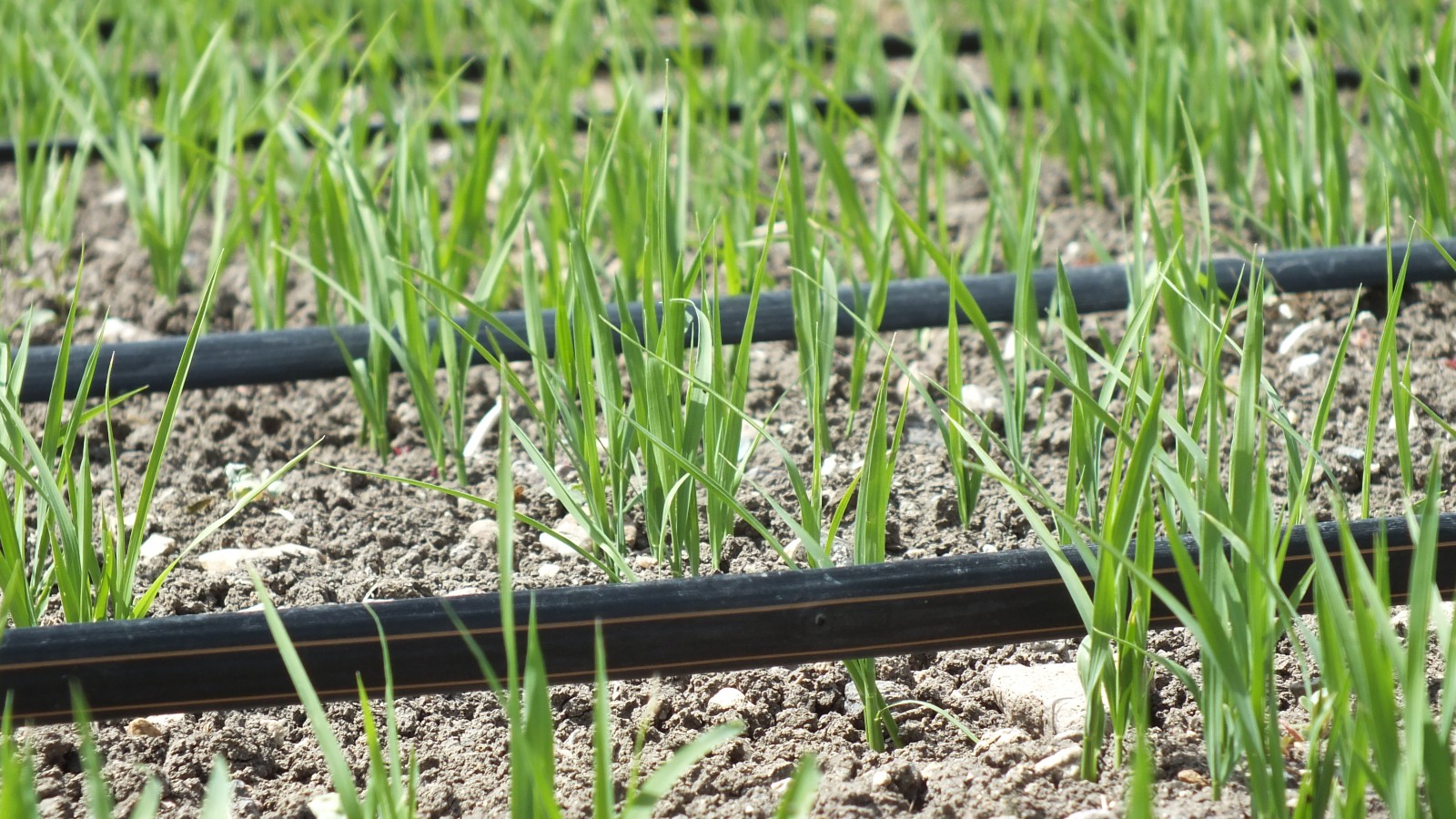
Netafim’s founders invented the method of embedding drippers in irrigation hoses to deliver measured doses of water and nutrients to crops at precise times and places. A leading irrigation company, it claimed $1.1 billion in sales in 100-plus countries in 2021. Through subsidiaries in about 40 countries and distributors in many more, Netafim has irrigated over 24 million acres.

But Netafim and other precision-irrigation companies have barely scratched the surface. Some 75% of Israel’s crops are drip-irrigated compared to only 5 percent globally, according to a report from Start-Up Nation Central.

“Agriculture today is not being done sustainably,” says Miodownik. “Most water for agriculture is being used in the most inefficient way, by flooding the fields.”

In February, Miodownik delivered a keynote speech at the Dubai Expo on the agricultural challenges facing the region and the world and how precision irrigation can help save water and land.

“We believe that two powers — human will and technology — can increase control and eventually help our farming be more sustainable and more efficient,” he says.

More and more countries are utilizing Israeli agricultural technologies as droughts and other extreme weather conditions affect every part of the world.

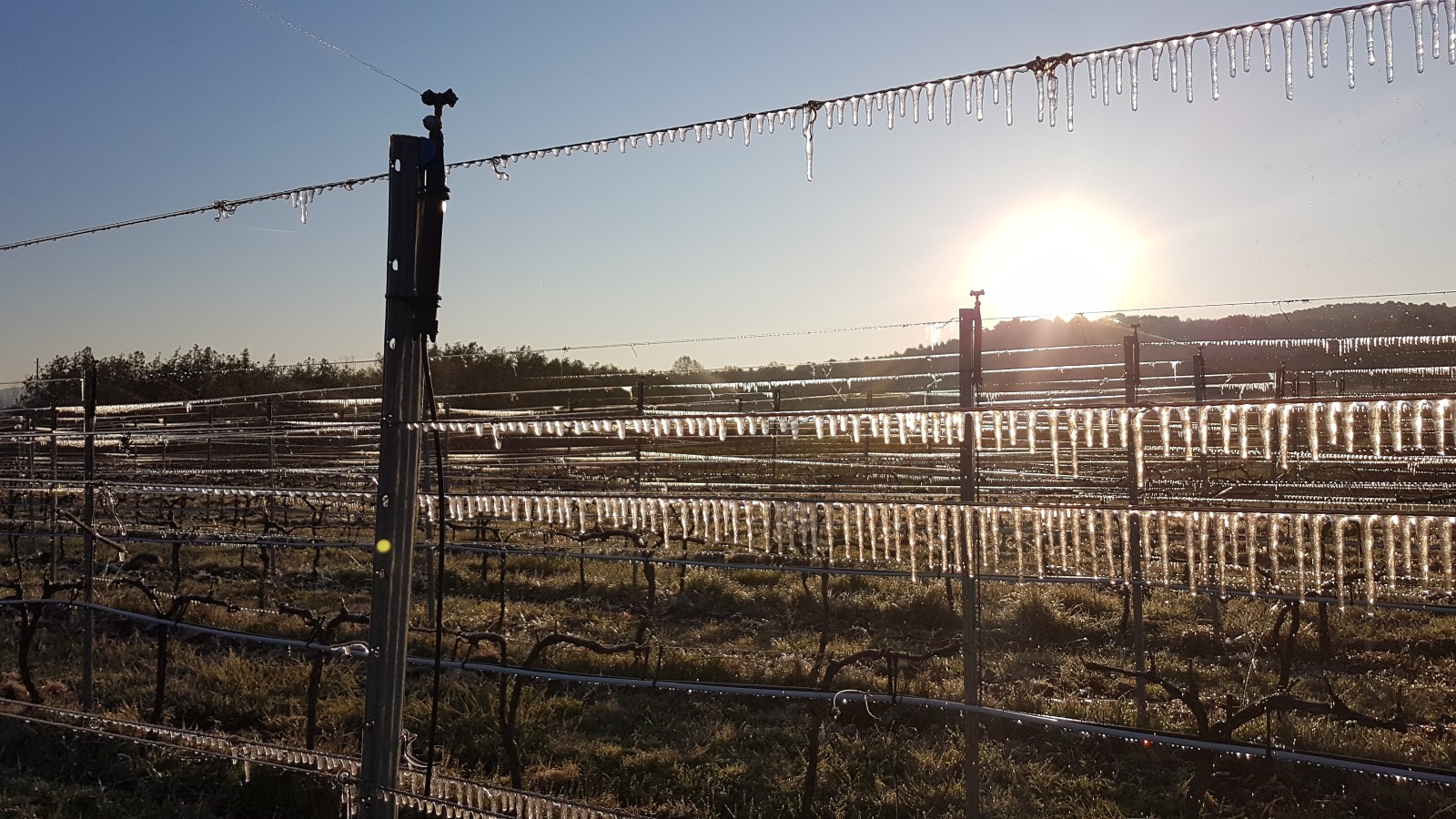
A Netafim sprinkler technology protects a vineyard in France from frost damage. (Netafim)

Start-Up Nation Central counts more than 400 Israeli ag-tech companies using sensors, AI, drones, satellite images, genetic engineering and more to help farmers control processes from seeding to harvest.

Miodownik credits this to seven decades of brilliant Israeli solutions. Most of Israel’s land mass is unsuitable for farming, and adequate water supply is a constant concern. Yet this small Middle Eastern country produces 95 percent of its fresh produce and exports produce as well.

More yield from less land

Transitioning from flood to drip irrigation can save huge amounts of water. Netafim is advancing this goal by tailoring drip irrigation for rice paddies that have been watered by flooding. Rice cultivation uses up to 40 percent of the world’s freshwater; Netafim’s rice paddy solution reduces water usage by 70 percent.

Irrigated rice fields in Turkey. (Netafim)

“We are trying to enter more crop categories that will greatly increase our impact on sustainability and food production,” says Miodownik.

Another issue is the overuse of crop protection products, such as herbicides harmful to the soil and the planet, not to mention human health. Precision irrigation minimizes the use of these products.

A less obvious problem is the practice of monoculture — growing the same crops in the same field year after year. Eventually, the depleted soil will not support them, and the farmer is forced to acquire more land.

Drip irrigation is one of various strategies and technologies that can increase yield from the land the farmer already has, says Miodownik.

Baby citrus trees irrigated by Netafim technology in Western Cape, South Africa. (Netafim)

Miodownik offers the example of farmers in Brazil.

“Until a few years ago, Brazilian farmers depended on rainfall and/or flood irrigation. When they wanted to grow more grains, they needed to buy more land. Now they understand they can simply invest in irrigation technology and get more food from the same land while reducing their water and fertilizer footprint.”

Carbon footprint

Smart irrigation reduces a carbon footprint, too. “In the past, if you bought an avocado in Europe, it was coming from the Americas,” Miodownik says.

“Today, with our type of technology, you can grow avocados very well in Israel or Morocco or Spain” —or even India.  “You don’t need to ship thousands of tons of avocados across the ocean.”

Greenhouse or indoor farming — another area Netafim supports — also cuts a carbon footprint because food can be grown close to retailers, on demand.

This flower and tomato greenhouse in Vietnam is fed by Netafim smart irrigation. (Netafim)

Netafim is developing cooperative models with other irrigation companies to help farmers monetize carbon credits. “This will incentivize them to invest in our type of technologies,” Miodownik explains.

Carbon emissions also will be reduced by decreasing plastic consumption at Netafim’s 17 factories — 14 of which are outside of Israel. This is significant, because in 2017, Netafim was acquired by Orbia, one of the world’s largest producers of plastic pipes and fittings.

“We are now collecting old drip lines from farmers and processing them in our own recycling factory and reusing them,” says Miodownik.

“We started this in California a few years ago, and now are developing it in Mexico and in Europe. It’s a new way of being more sustainable — not just through saving water and producing more food but also in terms of waste.”

The affordability hurdle

However, stark reality is that ag-tech solutions are too expensive for the world’s 450 million small-holder farmers.

Netafim is among many Israeli ag-tech companies inventing more affordable products and business models to fill this need. (SupPlant plans to tackle this problem with a sensor-less approach.)

Netafim is reengineering its systems to make them cheaper and simpler to install and use. The company is piloting innovative cooperative programs for farmers lacking the money to invest in precision irrigation.

“We are trying to replicate a successful model we have in India called ‘community irrigation.’ Together with local governments in southern India, we gather thousands of small farmers and implement a big project that involves both water infrastructure and in-field irrigation,” says Miodownik.

“At the end of the day, each farmer is irrigating his acre or two, and getting a few years of agronomic and technical support from our people in the field.”

Netafim also introduced “irrigation as a service.” Rather than having to lay out large capital expenditures, farmers pay a monthly fee to have Netafim install and operate the systems.

“This also overcomes the fear of new technology, which in many places is the main barrier we have,” says Miodownik. “We operate it for them on a small pilot basis, so they can see it works.”

Another Netafim model is helping governments create new agricultural areas.

“The government of Rwanda saw a need for high-level agriculture in a particular area where there was no water,” says Miodownik. “So we created the infrastructure and brought water from another site. The next phase will be to bring international investors to invest in high-tech agriculture in that region to serve the local or export markets. The residents also benefit because it improves their livelihood.”

Netafim’s Chief Sustainability Officer, John Farner, is one of nine corporate leaders worldwide invited to join the UN’s CEO Water Mandate Steering Committee addressing water challenges with advanced water sustainability solutions.

Securing food supply in the Gulf

The Netafim CEO says his keynote in Dubai was well-received, as the United Arab Emirates has a keen interest in Israeli technologies that can reduce the country’s dependence on imported food.

“Since the peace agreements were signed, we’ve had a warm welcome from a lot of companies there,” says Miodownik.

“We are supporting these companies in terms of their needs in the UAE, but also in farming activities outside the country that are supporting their food security needs.”

Netafim even relocated its vice president in charge of Africa and the Middle East from Israel to Dubai last year.

“We hope soon the Saudis will become part of this mission of helping more and more farmers around the world to grow more food with less resources.”

Produced in association with ISRAEL21c.

Recommended from our partners


The post Less Is More: Netafim Is Turning Floods Into Drips Worldwide, Increasing Farming Yields  appeared first on Zenger News.

Non-Profit Named to Run County-Wide Violence Intervention Program

0

By Ryan Michaels

The Birmingham Times

Together Again: Derrick James Will Be In Errol Spence’s Corner For Title Bout

0

“Errol never went to formal therapy — boxing was therapy, and I was his therapist,” said trainer Derrick James (left) of Errol Spence (right), who was gravely injured in a car accident in October 2019. (Premier Boxing Champions)


By Lem Satterfield

Derrick James didn’t mince words describing what it felt like to have a hernia.


“Imagine being kicked in the balls all day long. I tore a muscle. It created a hernia. You could see it. Like bubbling up under the skin,” said James of an injury he suffered in summer 2020.

“The hernia is your intestines pushing through the skin. Over time, more and more of your intestines will push through. It was like getting kicked in the testicles all day long with no way to stop it.”

At the time, James was training Jermell Charlo (34-1-1, 18 KOs) to retain his WBC junior middleweight title and dethrone hard-punching IBF/WBA titleholder Jeison Rosario via a three-knockdown, sixth-round stoppage that September.

Trainer Derrick James (right) “is a big brother” and “a teacher,” said Errol Spence (left), who will defend his IBF and WBC titles against WBA counterpart Yordenis Ugas on April 16. (Premier Boxing Champions)

James endured to guide his pair of unified champions through one-sided victories, as Errol Spence (27-0, 21 KOs) defended his IBF and WBC titles by unanimous decision victory over Danny Garcia in December 2020.

Spence vanquished Garcia after being hospitalized in critical condition in October 2019, after he had been ejected from his Ferrari, which flipped several times in a crash.

“Back in 2020, Errol was coming off a car accident, and I was going through that pulled hernia tear even through the Jermell Charlo camp. Jermell had an amazing performance to become a unified champion, but I had one day off between camps before I had to focus on Errol’s fight with Danny Garcia,” James said. “I used that day to fly back to Dallas, going right from Jermell’s camp into Errol’s camp,”

“When it comes to Errol, being knocked out by a punch takes six to eight months to a year to recover from that blow. But Errol’s punch was concrete cement. Errol never went to formal therapy — boxing was therapy, and I was his therapist. The first part of the camp was painful from a physical and mental perspective. For Errol to be able to block out what had happened and remember the man and the fighter he used to be before the accident, that was extremely difficult.”

Spence wound up dominating Garcia, winning 116-112 and 117-111 twice against a counter-puncher who entered their bout at 36-2 (21 KOs).

“Errol performed a miracle, but there was never a point where I doubted him,” James said. “The Garcia fight was on Saturday, Dec. 5, and I got the surgery the following on Tuesday. That’s the cost of striving for greatness.”

‘A Big Brother’ 

James says he has been “in phenomenal condition” since his corrective procedure.

He is again prepping Spence, this time for a unification bout on April 16 at AT&T Stadium with WBA counterpart Yordenis Ugas (27-4, 12 KOs), a 2008 Olympic bronze medalist who defeated eight-division title winner Manny Pacquiao (62-8-2, 39 KOs) in August by unanimous decision.

“Derrick has meant a lot,” Spence says “He’s been there for me. I see Derrick as a big brother. He’s a guy I can ask questions about as a boxer because he was a former boxer. He knows what it’s like to be making weight or training for a fight or being buzzed or getting hit with a good shot. Regardless of what it is, he has that experience,” Spence said.

“He’s helping me through the process of coming back, especially after the car accident, making sure that I didn’t try to push myself too hard and that I eased my way back into it. He’s basically talking to me about different things like being focused. He’s definitely been a huge inspiration during my comeback because he’s my coach, and I feel like he’s more than a coach. He’s a teacher more than anything.”

James, Black Trainers ‘Not Getting Their Respect’

James’ achievements, including guiding Charlo and Spence in 2020, earned him a nomination for the Eddie Futch Trainer of the Year Award in the Boxing Writers’ Association of America’s voting.

But James was denied in January 2021 when the BWAA named Teofimo Lopez Sr., whose son, Teofimo Jr., dethroned three-belt lightweight champion Vasyl Lomachenko, the award winner. Teofimo Jr. won the Sugar Ray Robinson Award for Fighter Of The Year.

Derrick James overcame a hernia while training Jermell Charlo (left) to retain his WBC junior middleweight title and dethrone hard-punching IBF/WBA titleholder Jeison Rosario (right) via a three-knockdown, sixth-round stoppage in September 2020. (Premier Boxing Champions)

“I was told by [a BWAA official] that ‘what Teofimo Lopez Sr. did was more significant than what you did.’ So, what the Lopezes did one time for one title was better than what I did two times with two unified champions?” James said.

,“Teofimo didn’t do it after having a car accident and almost dying or overcoming severe injuries like Errol and I had to do to get our win. It can’t be a popularity contest because I have two, very popular fighters.”

While Charlo and Spence continued to excel, Lopez (16-1, 12 KOs) lost in his first title defense in November to George Kambosos (20–0, 10 KOs), who floored the fighter known as “The Takeover” in the first round of his split-decision victory in New York.

“In the end, I just tell myself, ‘You’re not going to win this award, and it’s okay,’” James said. “But how good do I have to be to get it?”

Since 2001, three black men have been selected for the Futch award, the last in 2011 being former Andre Ward corner man Virgil Hunter. Bernard Hopkins’ mentor, Bouie Fisher, was named in 2001, followed by Buddy McGirt in 2002.

“The fact that Derrick James is consistently considered among the best trainers in the business, but he’s never won [BWAA] Trainer Of the Year is pretty disappointing,” said Calvin Watkins of the Dallas Morning News, who will be ringside for the Spence-Ugas fight.

“I don’t know if someone not voting for Derrick is racist or not, but I will say that it is interesting that he never has won it. I have to question why he has never won it. That’s a legitimate question,” Watkins said.

James was among the nominees for trainer of the year in 2020 along with SugarHill Steward, the trainer of WBC heavyweight champion Tyson Fury. But there were no black trainers on the list of candidates from 2021 during the annual selection meeting of the BWAA in February.

“There are a lot of fantastic trainers out there who are African American,” Watkins said. “But for some reason, they’re not getting their respect.”

After Spence, James will guide Charlo into a May 14 rematch with unbeaten WBO champion Brian Castano in Los Angeles, a bout that was postponed from March 19 after Castano suffered a torn right biceps muscle during training camp.

“Iron Man” battled Castano (17-0-2, 12 KOs) to a draw in July 2021 at the AT&T Stadium in Arlington, Texas, with all four 154-pound titles on the line for the second time in the history of the division and the sport of boxing

“Castano and Ugas are hungry fighters who want to accomplish the American dream, so these could be the most difficult fights in the careers of Jermell Charlo and Errol Spence,” said James. “But we’ll see what happens to their hunger when Jermell and Errol get into their rhythm, figure them out and begin to capitalize on their opportunities.”

Trainer Derrick James (left) will guide IBF/WBA/ WBC junior middleweight champion Jermell Charlo (seated) into a May 14 rematch with unbeaten WBO counterpart Brian Castano in Los Angeles.  (Premier Boxing Champions)

“I turned 50 years old in January. My health is great. I’m running five days a week every morning. I’m in tip-top shape, the best shape of my life since I was a fighter myself,” James said. “I’m performing at the highest level, lifting weights, doing pushups and everything I need to prepare these two champions. In the end, I see both Jermell and Errol winning impressively because I’m ready to help Errol Spence and Jermell Charlo to get ready for the performance of their lives.”

Edited by Matthew B. Hall and Richard Pretorius

Recommended from our partners


The post Together Again: Derrick James Will Be In Errol Spence’s Corner For Title Bout appeared first on Zenger News.

Adorable Moment Wife Announces Pregnancy During Husband’s Jam Session

0

This is the adorable moment a wife joined her husband’s jam session and took over the microphone to reveal she was PREGNANT. (SWNS) 


By Ellis Wylam

This is the adorable moment a wife joined her husband’s jam session and took over the microphone – to reveal she was PREGNANT.


Elise Myers, 33, announced her secret to husband Justin Myers, 36, at their home as he played guitar.

She took the microphone and began singing about ‘a little something’ she just had to tell him, a few lines later revealing that they’re expecting a baby!

The video ends with Elise pulling a few positive pregnancy tests out of her pocket to show Justin, who is equally excited and bewildered at the news.

Elise, a former nursing assistant turned stay-at-home mum, described how she came up with the creative idea to surprise her husband Justin, who is a registered nurse.

“It was a very spur-of-the-moment thing,” said Elise, from Little Rock, Arkansas, USA.

“Justin was just jamming in his music room and I really wanted his attention. As soon as I found out I was pregnant I wanted to tell him!”

Elise recruited the help of her friend Elizabeth, who held the camera as she put her idea into motion.

This is the adorable moment a wife joined her husband’s jam session and took over the microphone to reveal she was PREGNANT. (SWNS)

She added: “I thought it would be great to sing along with him whilst revealing I was pregnant.

“Elizabeth started recording as I went into where he was playing and tried to come out with it!”

She emphasized that Justin’s ecstatic reaction exceeded all of her expectations.

Elise said: “It was everything I expected and more! I was expecting him to be really happy and excited, which he absolutely was.”

She was encouraged by family and friends to create an account on the social media app TikTok and post the video.

The online response to her surprise has been overwhelmingly positive and has encouraged others to discuss similar fun ideas.

Elise added: “The reaction from people all over the world has been wonderful. I’ve received some amazing comments and feedback.

This is the adorable moment a wife joined her husband’s jam session and took over the microphone to reveal she was PREGNANT. (SWNS)

“I think my video has shown people that it’s fun to be spontaneous and important to be yourself.

“Don’t be nervous or scared to tell the love of your life that you’re having a baby because you could get the best reaction ever, just like mine!”

Little Rock where she lives is the capital of Arkansas located on the south bank of the Arkansas River. The city derived its name from a rock formation along the river, named the “Little Rock” by the French explorer Jean-Baptiste Bénard de la Harpe in 1722.

Recommended from our partners


The post Adorable Moment Wife Announces Pregnancy During Husband’s Jam Session appeared first on Zenger News.

Smartphone Photos Could Be ‘Transformed’ After Scientists Invent A ‘Tiny Wide Lens Camera’

0

A person scans and downloads an app to start the process of converting their physical driver license to an official digital version to be stored on a mobile phone at a Harmons Grocery store on August 4, 2021 in Salt Lake City, Utah. Utah is the first state in the nation to start to convert and offer digital driver licenses on mobile devices. (Photo by George Frey/Getty Images)


By Anamarija Brnjarchevska

Smartphone photos could be transformed following the development of a tiny wide lens camera.


The camera’s miniature metalens can capture more than 120 degrees of scenery, say scientists.

Wide-angle photography creates stunning, high-quality images by capturing large amounts of visual information.

But it typically requires bulky and heavy lenses to view objects which would otherwise be out of frame.

Now researchers in China have designed a 0.3-centimeter (0.1-inch) thick camera using so-called metamaterials, which are engineered to have special properties.

Professor Tao Li, of Nanjing University, said: “To create an extremely compact wide-angle camera, we used an array of metalenses that each capture certain parts of the wide-angle scene.

“The images are then stitched together to create a wide-angle image without any degradation in image quality.”

Smartphone photos could be ‘transformed’ after scientists invent a ‘tiny wide lens camera’. (Simon Galloway/Zenger)

Lenses made from metamaterials have been tested before, but they usually suffer from poor image quality and other drawbacks.

To overcome that, the researchers used an array of metalenses, each designed to focus on different illumination angles.

This way, each lens captures part of the wide-angle object or scene before they are stitched together with a computer to create the full image.

Professor Li added: “Thanks to the flexible design of the metasurfaces, the focusing and imaging performance of each lens can be optimized independently.

“This gives rise to a high-quality final wide-angle image after a stitching process.

“What’s more, the array can be manufactured using just one layer of material, which helps keep cost down.”

Smartphone photos could be ‘transformed’ after scientists invent a ‘tiny wide lens camera’. (Simon Galloway/Zenger)

To test their new lens, the researchers made a special type of camera, known as a planar, measuring around 1cm by 1cm by 0.3cm.

Two projectors were then used to illuminate a curved screen with the words “Nanjing University”, which was placed 15 centimeters (5.9 inches) away from the device.

The camera produced an image that revealed every letter clearly and had a viewing angle larger than 120 degrees.

This was three times larger than pictures taken with a traditional metalens, the researchers say.

They are now looking to improve the image quality with further research on the metalens.

Once perfected, the array could be mass-produced to reduce the cost of each device.

The findings were published in the journal Optica.

Recommended from our partners


The post Smartphone Photos Could Be ‘Transformed’ After Scientists Invent A ‘Tiny Wide Lens Camera’ appeared first on Zenger News.

Solar So Good: New Tech Means Solar Power Could Be Stored For 18 Years

0

The researchers behind an energy system that makes it possible to capture solar energy, store it for up to eighteen years and release it when and where it is needed have now taken the system a step further. After previously demonstrating how the energy can be extracted as heat, they have now succeeded in getting the system to produce electricity, by connecting it to a thermoelectric generator. Eventually, the research – developed at Chalmers University of Technology, Sweden – could lead to self-charging electronics using stored solar energy on demand.  (Chalmers University of Technology, Daniel Spacek, neuroncollective.com/Zenger)


By Martin M Barillas

A radical new system to generate energy on demand from solar power no matter what the weather has been hailed a radical breakthrough by Swedish scientists.


Users will be able to power up gadgets and even their homes with stored solar energy in an emissions-free, carbon-neutral closed loop.

And solar power could be stored for up to 18 years before it is released on demand.

Researcher Kasper Moth-Poulsen explained: “This is a radically new way of generating electricity from solar energy.

“It means that we can use solar energy to produce electricity regardless of weather, time of day, season, or geographical location.”

Moth-Poulsen, who co-authored a paper in Cell Reports Physical Science, added: “It is a closed system that can operate without causing carbon dioxide emissions.”

The paper describes a new technology that takes the molecular solar thermal energy storage (MOST) systems developed at Chalmers University of Technology, in Gothenburg, in 2017, a step further.

MOST uses a unique, shape-shifting molecule of nitrogen, carbon, and hydrogen that is changed by sunlight into an energy-rich isomer, which consists of the same atoms albeit rearranged.

This energy can be stored for 18 years and, when released by a catalyst, turned into heat while the unique molecule reverts to its original state.

The solar reflectors at the PS10 solar tower plants sits at Sanlucar la Mayor outside Seville on April 24, 2007 in Seville, Spain. (Photo by Denis Doyle/Getty Images)

Solar power systems and storage, even with recent refinements, are expensive and use a lot of space.

Also, night-time and cloudy days cut or limit solar panels’ efficiency.

To produce electricity with the new technology, the authors essentially sent Swedish sunshine around the globe to China for conversion.

Collaborating with Chinese co-authors Tao Li and Zhiyu Hu, the researchers released the energy stored by MOST, converting it into electricity on demand with a tiny thermoelectric generator developed in Shanghai.

Co-author Zhihang Wang said: “The generator is an ultra-thin chip that could be integrated into electronics such as headphones, smart watches and telephones.

An employee works to install new solar panels at the Kalyon Energy’s Karapinar Solar Power Plant on December 02, 2021 in Karapinar, Turkey. (Photo by Chris McGrath/Getty Images)

“So far, we have only generated small amounts of electricity, but the new results show that the concept really works.”

According to the co-authors, this means homes and electronics could become powered with renewable, emissions-free energy day or night, thanks to MOST and the micrometer-thin thermoelectric generator.

Stating that the researchers are streamlining the system, Moth-Poulsen said that they need to increase the heat and electricity extracted.

He said: “Even if the energy system is based on simple basic materials, it needs to be adapted to be sufficiently cost-effective to produce, and thus possible to launch more broadly.”

Recommended from our partners


The post Solar So Good: New Tech Means Solar Power Could Be Stored For 18 Years appeared first on Zenger News.

The Average Female Gen Xer Hasn’t Worn Her Natural Hair Color Since 2019

0

A woman with artistically coloured hair stands in Manchester city centre on November 24, 2021 in Manchester, England. (Photo by Christopher Furlong/Getty Images)


By Ellis Wylam

The average female Gen Xer hasn’t worn her natural hair color since 2019, new research suggests.


A poll of 2,000 women ages 42-57 revealed that half (49%) have spent between two to six years dying their hair a different color than what they were born with.

In fact, one in three (32%) said they aren’t even sure what their natural color is anymore.

Another one-third (32%) of respondents in relationships aren’t sure that their partner knows their real hair color, either.

Conducted by OnePoll on behalf of Better Natured, the survey also found that 46% are confident that nobody knows they dye their hair.

Given the average respondent has sported about five different hair colors in her lifetime, it’s no surprise that two-thirds started coloring their hair before the age of 30.

A model is seen backstage ahead of the Pam Hogg show at Fashion Scout during London Fashion Week Spring/Summer collections 2017 on September 16, 2016 in London, United Kingdom.

Even so, 58% agreed that they dyed their hair more when they were younger than they do now.

One-third of women surveyed would even consider an unconventional color, with purple (41%), pink (38%) and blue (35%) ranking the highest.

Six in 10 respondents have noticed more young people sporting unique hair colors than older adults, and another almost six in 10 (58%) admitted to changing their own hair more when they were younger, too.

Conventional or not, 74% are more likely to keep a hair color if they get complimented on it. Similarly, 71% admitted that a hair change boosts their confidence.

When looking for a change, Gen-X women are more likely to trust their hairdresser than anyone else (40%). However, they don’t trust their friends any more than they trust opinions on social media, at 26% vs. 25% respectively.

“We’re not surprised that a new hair color can help boost women’s confidence — dyeing your hair is an easy way to change your style and express yourself,” said Jennifer Lauroesch, Director of Marketing for Better Natured. “Whether at home or in a salon, we’ve seen women become more knowledgeable about ingredients in their hair color over recent years. Because of this, we understand the importance of transparency when it comes to ingredients.

A girl with green-tinted hair talks with friends at a cafe at London Fashion Week at Somerset House on February 18, 2011 in London, England. (Photo by Peter Macdiarmid/Getty Images)

Four in 10 respondents have used dye to cover their gray hairs or maintain their natural color.

But not all, per one respondent. “[My] gray is coming in very nicely,” she wrote. “I might add color for fun but it has nothing to do with gray. I’d want a color to ADD to my current colors, not cover them.”

Four in 10 (43%) even started embracing their grays more during the pandemic.

The pandemic also changed where people dye their hair. Sixty-one percent also said they are more likely to do so at home now than they were prior to the onset of the pandemic, with 40% saying an at-home dye job if their usual.

Even so, 28% usually visit a salon.

Regardless of color or location, two in 10 (21%) would consider a new hair color as a way to embrace their age.

“Whether women are keeping their natural color — gray or otherwise — or switching it up with a bold color, it’s important to love your hair and love your hair color,” said Lauroesch. “There can be an element of anxiety in dyeing your hair, especially when it’s a new color, which is why virtual try on tools like ours can be so important. We wanted to take the guesswork of how a hair color shade would look on you, before you even made a purchase.”

WHY DO WOMEN CHOOSE NEW HAIR COLORS?

Recommended from our partners

  • To keep themselves looking young – 28%
  • To express themselves – 28%
  • Boredom – 21%
  • It was recommended by a spouse or partner – 21%
  • To embrace their age – 21%
  • Their hairdresser suggested it – 20%


The post The Average Female Gen Xer Hasn’t Worn Her Natural Hair Color Since 2019 appeared first on Zenger News.

Latest Research: As5holes Have Different Places In Peoples Lives But Are Almost Always Middle Aged Men

0

A building at the University of Georgia, in Athens, USA, where the study was done.  (Zenger)


By Darko Manevski

The person most likely to be a total “a*shole” is middle-aged and male, according to a new study.


The team from the University of Georgia asked almost 400 people to think of the “biggest a*shole” in their lives to assess the traits that people associate with the term.

The results published in “Collabra: Psychology” suggests that the “biggest a*sholes” in many people’s lives had different roles, and included romantic partners, coworkers, bosses, family members, and friends, but that what most of them had in common was that they were largely all middle-aged men.

Interestingly, they also concluded that the profile for target “a*sholes” was similar to expert profiles of psychopathic, antisocial, and narcissistic personality disorders.

But the researchers were keen to point out that the similarities do not necessarily mean the a*shole in one’s life has a personality disorder per se.

After identifying the “biggest a*shole” in their lives, participants were asked to describe how close they were to that person, what kind of relationship they have with that person and the extent to which the term fit them. The respondents were then asked to describe the top three behaviors that made that person an “a*shole.”

A building at the University of Georgia, in Athens, USA, where the study was done. (Zenger)

For each of those behaviors, participants rated agreement with follow-up questions: “Do you think that person knows their behavior bothers people? Do you think that person cares that their behavior bothers people? And do you think that person could change their behavior if they really wanted to?”

Most of the participants believed the jerks in their lives were aware that their behavior bothered people but just did not care enough to change.

Brinkley Sharpe, the lead author of the study and a doctoral student in the Franklin College of Arts and Sciences, said: “People didn’t really have very much trouble figuring out who the ‘biggest a*shole’ in their life was.

“On average, participants didn’t think that they were very close to these individuals, which makes sense because these people are being described as having pretty aversive behaviors.”

But about one out of three of the “biggest a*sholes” were people currently in participants’ lives, including co-workers, friends and even current romantic partners.

Sharpe added: “It’s interesting to me that the behaviors people were keying in on sort of run the gamut.

“When we talk about personality, the a*shole was described as somebody who is not agreeable and is angry.

“When we talk about behaviors, the a*shole was not necessarily being antagonistic toward people, but they just didn’t really care about what others were thinking or how they were perceived by others.”

These people often appeared to struggle with regulating their anger, were irresponsible and held bigoted views.

A building at the University of Georgia, in Athens, USA, where the study was done. (Zenger)

Responses ranged from seemingly trivial complaints, things like ‘this person put household decorations away incorrectly’, to more severe criticism.

Sharpe said: “Some of the responses were pretty violent.

“We had a couple where the individual had done something that was frankly criminal.”

Others were more a sign of the times, with participants complaining that the person had not been wearing a face mask during the coronavirus pandemic or had voted for Donald Trump.

He continued: “There’s clearly a lot of variation in how people use this word I think the implication of the study is that insults matter. We do mean certain things by using them or we associate them with certain characteristics.”

The study was co-authored by Courtland Hyatt, a recent doctoral graduate from the UGA clinical psychology program, now a postdoctoral fellow at VA Puget Sound; Donald Lynam, professor of psychological sciences at Purdue University; and Joshua Miller, professor of psychology and chair of the clinical program at UGA.

Recommended from our partners


The post Latest Research: As5holes Have Different Places In Peoples Lives But Are Almost Always Middle Aged Men appeared first on Zenger News.