Home Blog Page 491

Gas Prices Rising: How You Can Improve Fuel Economy During The Winter


0

The Russia–Ukraine conflict, the growing national demand for gas as spring approaches and a switch to the costlier summer gas, could all send gas prices to a national average of $4 a gallon by April. (Justin Sullivan/Getty Images)


By John Murphy

For the third straight week, U.S. gas demand has risen, contributing to gas prices reaching an eight-year high. During an appearance on AccuWeather Prime, Patrick De Haan of GasBuddy said multiple factors, including the Russia-Ukraine conflict, the growing national demand for gas as spring approaches and a switch to the costlier “summer gas,” could all send gas prices to a national average of $4 a gallon by April.


This has led to many motorists trying to find ways they can save at the pump in these final weeks of winter. Thankfully, a lot can be done to help improve fuel efficiency in your vehicle, especially during the winter months.

During the winter, gas milage decreases for many regions, especially those that experience very cold weather. A car’s gas mileage at 20 degrees Fahrenheit is 15-24 percent lower than the same vehicle’s mileage at 77 degrees and drops even more sharply in hybrid cars. A hybrid vehicle’s fuel economy can drop between 30 and 34 percent under the same conditions described above.

Electric vehicles suffer the largest mileage drop in cold weather, even though they are the most economically friendly. An electric vehicle’s mileage plummets 39 to 41 percent when operating in 77-degree weather versus 20-degree weather.

In gas and hybrid cars, the cold weather results in decreased fuel economy because the cold causes the engine to take longer to reach fuel-efficient temperatures. The cold also causes an increase in drag, the air to be denser and an increase in the friction between the engine and transmission from colder engine oil.

One way to help prevent these cold-weather consequences from affecting a vehicle is by parking it in a warmer place such as the garage. For those who don’t have access to a garage, there are still plenty of ways to help save on fuel.

Conserving idling will also help improve fuel economy. In the winter, idling the vehicle in the morning is tempting to warm up the vehicle before getting in. However, doing so can cause your fuel economy to take a dip, especially when idling for longer periods of time.

An important winter driving tip can also help with fuel economy — driving gently. Doing this will help allow the engine to warm up faster, and gentler driving will help with navigating through snowy and icy conditions safely.

CLICK HERE FOR THE FREE ACCUWEATHER APP

Another way to help save on fuel is simply by planning out future trips, and combining multiple trips into one. Doing this will save both fuel and time.

A lot can be done to help improve fuel efficiency in your vehicle, especially during the winter months. (Michael Ciaglo/Getty Images)

Also, consider a car’s oil recommendations. Different car manufacturers may have specific oil recommendations for winter that will also help increase a car’s mileage. This oil is formulated specifically for colder weather and can give a car that extra boost to get farther on less money.

While the winter months and colder weather bring worse fuel efficiency, summer has its own way of causing increases at the pump. During the summer, more Americans are filling their tanks due and increasing demand.

“Gasoline prices are starting to rebound as temperatures warm up so Americans filling their tanks more often, combined with the transition to summer gasoline and refinery maintenance could likely boost the national average,” said De Haan, who is the head of petroleum analysis at GasBuddy.

So-called “winter gasoline” has a higher Reid vapor pressure, which means it evaporates and ignites more easily in colder air. When fuel companies begin rolling out “summer gas” blends, which are costlier to produce, the added cost manifests in higher prices at the pump during the warmer months, according to GasBuddy.

Some of these tips for winter can also be utilized during the summer months to continue help saving on gas year-round, especially with record gas prices a looming possibility.

“The previous all-time record was $4.10 a gallon back in 2008, so it stands possible that indeed the national average could breach that all-time record high in May or potentially June,” said De Haan.

For the latest weather news, check back on AccuWeather.comWatch the AccuWeather Network on DIRECTVFrontierSpectrumfuboTVPhilo and Verizon Fios. AccuWeather Now is now available on your preferred streaming platform. 

Produced in association with AccuWeather.com.

Recommended from our partners


The post Gas Prices Rising: How You Can Improve Fuel Economy During The Winter appeared first on Zenger News.


Novel Non-Surgical Solutions For Aortic Valve Stenosis

0

A device that repairs the heart's aortic valve without replacing it with a prosthetic valve is currently in human trials. (Karolina Grabowska/Pexels)


By Abigail Klein Leichman

The heart has four valves that keep blood flowing in and out — the mitral, tricuspid, pulmonary and aortic valves. Every valve has flaps called “leaflets” that open and close during each heartbeat.


The aortic valve is the main valve through which blood is pumped to the body. When it does not open completely, usually due to calcification, this narrowing is a serious condition called aortic valve stenosis that can damage the heart.

Aortic stenosis mainly affects people over age 75, but also can affect younger adults. Sometimes, children are born with this condition.

Aortic stenosis is usually treated by replacing the valve with a prosthetic valve. This can be implanted surgically or, more commonly today, via a minimally invasive transcatheter aortic valve replacement (TAVR).

But either way, the artificial valve will degrade over the course of several years and need replacing. Wouldn’t it make more sense to treat the calcification first, delaying the need for a prosthetic valve?

That was the novel notion behind the founding of Rehovot-based Pi-Cardia in 2009.

Pi-Cardia cofounder and CEO Erez Golan. (Courtesy of Pi-Cardia)

“We saw that calcium grows into the leaflets and slowly begins to hinder their motion or mobility,” said cofounder and CEO Erez Golan.

“The main idea behind Pi-Cardia is to repair the aortic valve without replacing it with a prosthetic valve. This is a very new and unique approach.”

Pi-Cardia’s first product, Leaflex, accomplishes that by breaking up (“scoring”) calcification anywhere along the aortic valve leaflets.

This procedure, which restores flexibility and functionality, is done through a catheter without opening the chest.

The device is currently in human clinical trials across Europe, supported by a $27 million funding round in April 2020 led by European life sciences venture capital firm Sofinnova Partners.

In July 2020, Pi-Cardia signed a deal with China’s Venus Medtech, a strategic investor, to further test its products for eventual introduction into the Chinese market.

“With large numbers of lower income aortic stenosis patients in China, the Leaflex technology could provide treatment possibilities to an otherwise overlooked and undertreated sector,” said Runlin Gao of Fuwai Hospital Chinese Academy of Medical Sciences and the National Center for Cardiovascular Diseases.

Compassionate use

Pi-Cardia cofounder and Executive Director Eyal Kolka. (Courtesy of Pi-Cardia)

Erez Golan and cofounder Eyal Kolka are physicists who had worked together for years, first in defense-sector R&D and then in a series of medical device companies.

TopSpin Medical, their first joint startup founded in 1999, developed a miniaturized MRI camera on the tip of a catheter. ClearCut Medical, another joint venture, developed a portable MRI for detecting the margins of a tumor during breast cancer surgery.

At Pi-Cardia, their first priority was to develop Leaflex for aortic stenosis patients who did not yet have a prosthetic valve. (The name of the company uses the mathematical constant “pi” to allude to the goal of achieving a circular opening of the valve.)

Then they began working on a solution for patients who already have a prosthetic valve and need a new one.

Today, most second valve replacements are TAVRs. The TAVR market, currently estimated at $5 billion, is predicted to double over the next few years as this catheter-based procedure is preferred over open surgery, particularly for younger patients.

The problem is that the leaflets of the existing prosthetic valve can get trapped during a TAVR procedure. This may lead to coronary artery obstruction and can be life-threatening.

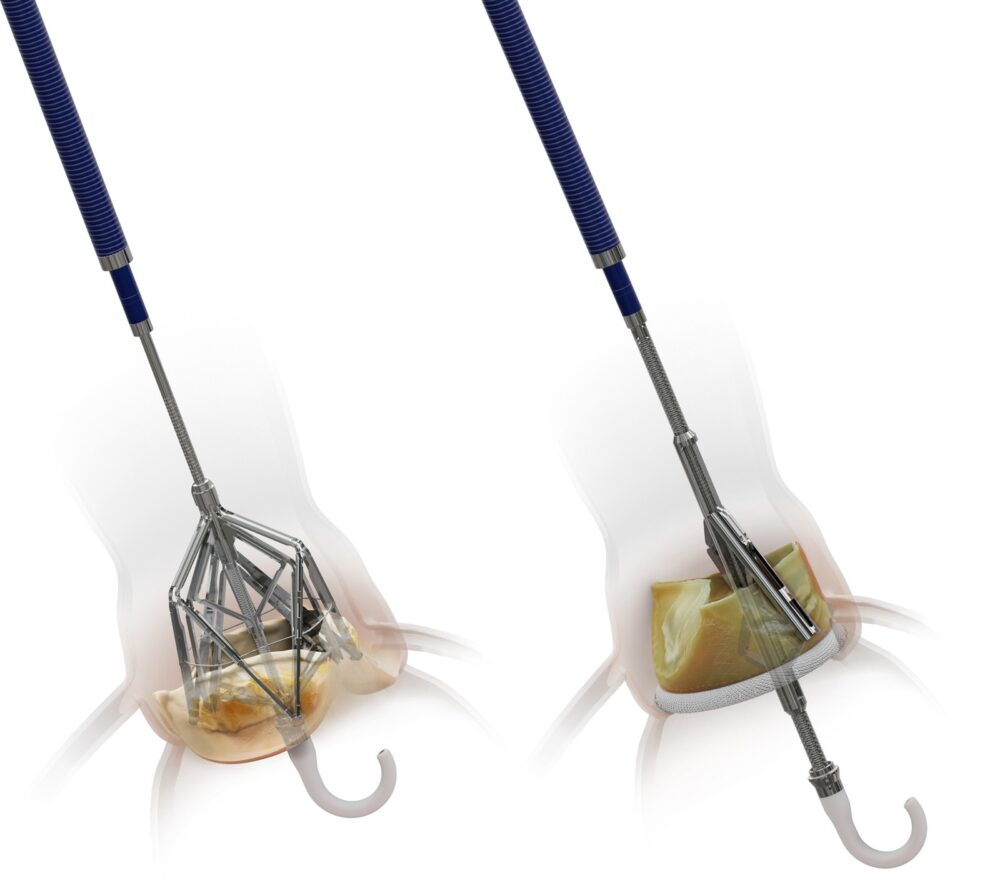
The Leaflex device, left, scores calcification in the aortic valve. The ShortCut device, right, splits the leaflets of a previous prosthetic aortic valve to ensure safer placement of a new one. (Courtesy of Pi-Cardia)

Enter Pi-Cardia’s second product, ShortCut.

“ShortCut splits the leaflets of the previous surgical valve so the blood can flow through the coronaries once the second prosthetic device is put in,” Golan explains.

As with Leaflex, the minimally invasive ShortCut procedure requires no open-heart surgery.

Although it does not yet have regulatory approval, ShortCut already has saved high-risk patients in five “compassionate use” cases during 2021. Three were performed in Berlin and two in Jerusalem’s Shaare Zedek Medical Center.

“We were able to successfully treat three patients with degenerated valves who were at risk of coronary obstruction after TAVR with the ShortCut device,” said Dr. Jörg Kempfert of the German Heart Center Berlin.

“We were able to effectively split the target leaflets in all patients within just a few minutes, allowing for safe implantation of both self-expandable and balloon-expandable TAVR valves.”

Dr. Ulrich Gerckens, who oversaw these cases in Berlin, said, “Lifetime management in aortic stenosis is critical, especially as we treat younger patients. Therefore, a simple dedicated tool to prevent coronary obstruction that can easily be utilized across all TAVR centers is greatly needed in the field.”

A European clinical trial of ShortCut is beginning, said Golan.

“As the number of patients with aortic stenosis continues to grow, both Shortcut and Leaflex may offer important new treatment options for both physicians and patients,” Golan said.

Produced in association with ISRAEL21c.

Recommended from our partners


The post Novel Non-Surgical Solutions For Aortic Valve Stenosis appeared first on Zenger News.

Novel Hyperthermic Treatment Offers Hope For Stage 4 Metastatic Cancer

0

The New Phase “Sarah” system for treating metastatic tumors. (Courtesy of New Phase)


By Brian Blum

It’s one of the most heart-wrenching moments in medicine and in life. The doctor informs a patient that his or her stage 4 cancer has metastasized all over the body and nothing more can be done except to write a referral for hospice care.


But what if there was a way to shrink those stage 4 tumors by half? It wouldn’t make the cancer go away, but would transform it from a likely death sentence to a “chronic illness” with treatments required every few months.

That’s what Petah Tikva-based New Phase hopes to do by applying electromagnetic hyperthermia to treat inoperable tumors. Hyperthermia is when the body is heated up.

It’s been known for some time that cancerous cells don’t like heat. They die when the temperature hits about 45 degrees Celsius (114 Fahrenheit). Non-cancerous cells on the other hand, can survive temperatures up to 55C/131F.

That’s because tumor cells have a disorganized vascular structure which, unlike normal cells, has difficulty dissipating heat.

New Phase injects specially created iron oxide nanoparticles by IV. The nanoparticles are embedded within a phase change material (which releases or absorbs energy to provide heat or cooling) and coated with polyethylene glycol (a compound derived from petroleum).

New Phase cofounder and CEO Ofer Shalev. (Courtesy of New Phase)

They locate the tumors through a process known as EPR — “enhanced permeability and retention,” explains Ofer Shalev, who cofounded New Phase with Dr. Rafi Hof.

“Tumor cells feed off of blood capillaries, where there is a lot of leakage,” Shalev tells ISRAEL21c. “We use this to ‘leak’ into the cancer cells. This is the permeability of EPR.”

Selective destruction

Four hours after receiving the nanoparticle injection, the patient lies on a bed inside an RF machine that uses an electromagnetic induction system to generate non-ionizing radiation.

This radiation heats the nanoparticles to a maximum of 50 degrees Celsius by changing the polarity of their iron oxide core. Patients undergoing New Phase treatment wear a special blanket to cool themselves down.

The patient lies on a bed inside an RF machine for the electromagnetic treatment. (Courtesy of New Phase)

Stage 4 metastasized cancer is particularly insidious because many of the “micro-metastases” cannot be identified even microscopically. That makes it impossible to surgically remove these kinds of tumors. But New Phase’s nanoparticles can find them.

And even if not all the tumors are destroyed, the treatment turns a stage 4 cancer into something more akin to stage 2 — for which many more treatment options are available.

“Even reducing a cancerous mass by 30 percent to 50 percent is a huge achievement,” Shalev points out.

If some nanoparticles find their way into healthy cells, those cells can survive. “This is how we selectively destroy only the cancer cells,” Shalev says.

When there’s nothing else to offer

Why not use New Phase’s technology for earlier stages of cancer?

“We can,” Shalev says, “but we wanted to start with Stage 4 cancers, where there’s nothing else to offer. In Israel, 11,000 patients die every year from cancer. In the U.S., it’s more than 600,000 — and the number is increasing by 5,000 people a year. So even dealing with just that subset of patients is a lot of work.”

Shalev and his partner previously worked together at ReDent-Nova, which develops dental devices and instruments to treat root canals. They named New Phase’s technology “Sarah” after Hof’s mother, who passed way from lung cancer.

“We want patients to survive until [a ripe old] age and to die from reasons other than cancer,” Shalev says.

New Phase has so far been tested with mice, pigs and rabbits and with “a few human patients” at a hospital in Nahariya in northern Israel. These Phase I clinical studies started with a fairly low dose.

“With every cohort, we will add more and more doses,” Shalev says.

Efficacy results are not in yet. “But we know from MRI scans that the nanoparticles reached their targets,” Shalev says.

Systemic approach

The nanoparticles are developed by New Phase in a “clean room” near Karmiel. The lab is run by three female Druze chemists from a nearby village.

New Phase is not the only company that is using hyperthermia to kill cancer cells. “But we are the only ones using it for systemic treatment,” Shalev tells ISRAEL21c.

“Others inject nanoparticles into a specific tumor to treat it locally. We don’t care where the micro-metastases are located. They will retain our nanoparticles and, later on, will be destroyed by the hyperthermia.”

Another Israeli startup, AlphaTau, is using alpha radiation to kill tumors. This approach, too, is highly local, targeting specific tumors.

New Phase’s nanoparticle treatment won’t be available until at least late 2024 or early 2025. That’s how long it takes to conduct all the clinical studies.

But the good news is that the approval process will be faster than if it was a drug, because the US Food and Drug Administration has agreed to categorize New Phase’s treatment as a class 3 medical device.

Multicultural team

New Phase’s scientific advisory board includes Prof. Dan Peer, director of the Laboratory of Precision NanoMedicine at Tel Aviv University; Dr. Glenwood Goss, chair of the Thoracic Oncology Site Committee and a professor of medicine at the University of Ottawa; and Dr. Arnold Cyjon, former deputy head of oncology at Shamir Medical Center in Israel.

In late 2021, the company added Prof. Zeev Rotstein, the former head of Hadassah and Sheba Medical Centers in Jerusalem and Tel Aviv, respectively. Rotstein is an active adviser and has good relationships with American hospitals, Shalev notes.

Founded in 2013, New Phase has raised $25 million to date (much of it from the family office of serial entrepreneur Aharon Lukach) and employs a multidisciplinary team of 30 engineers, biologists and chemists.

Shalev is proud that the company has a 50-50 mix of men and women. Starting off in the NextGen Technologies incubator in Nazareth has also meant the company employs both Jewish and Arab Israelis.

New Phase’s technology will, in part, “catch up” patients suffering from solid tumor cancers with their blood cancer counterparts, where immunotherapy has already transformed many conditions, such as lymphoma, into “chronic cancers.”

Produced in association with ISRAEL21c.

Recommended from our partners


The post Novel Hyperthermic Treatment Offers Hope For Stage 4 Metastatic Cancer appeared first on Zenger News.

Popular K&J’s Elegant Pastries to open location in downtown Birmingham

0
Kristal Bryant, K & J’s Elegant Pastries, Designer Chef and Birmingham Mayor Randall L. Woodfin. (Instagram)

By Cecilia Wood

bhamnow.com

How One Man Sparked An ‘Evolution And Revolution’ In Meteorology

0

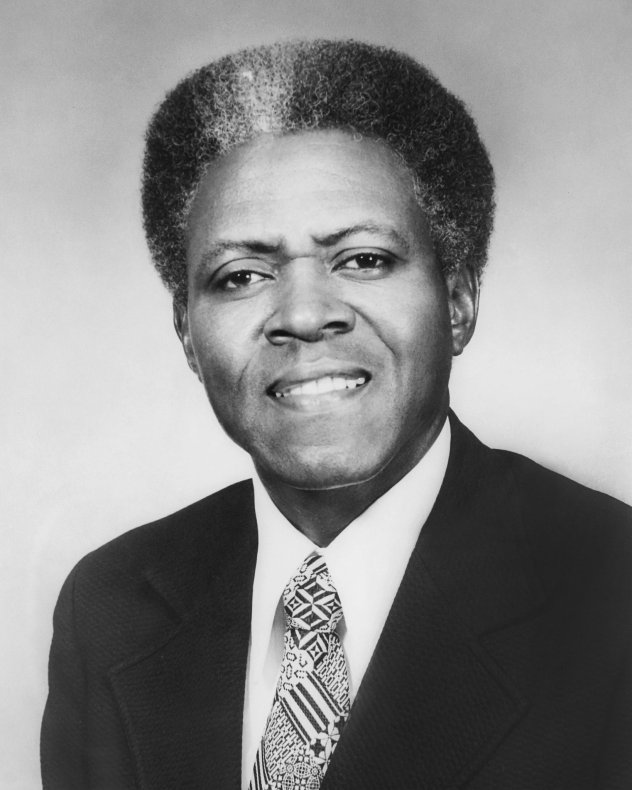
Jackson State University is recognized as a cutting-edge institution, and that began when John A. Peoples Jr. launched its meteorology department in 1975. The rigorous program has paved the way for hundreds of black meteorologists and continues to shape the next generation of weather forecasters. (H.T. Sampson Library JSU Archives & Special Collections)


By Monica Danielle

Jackson State University is one of the largest historically black colleges and universities in the United States. Today, the university is recognized for incorporating technology and cutting-edge research into every aspect of its curriculum. That all began with its renowned meteorology department.


The rigorous program has paved the way for hundreds of Black meteorologists and continues to shape the next generation of weather forecasters, but the fight to bring the curriculum to the school started with one man who is known as the pioneer of the JSU meteorology program.

At age 95, John A. Peoples Jr.’s life is an incredible story of hard work and tenacity that spans violent racism, segregation and the Civil Rights movement, which ultimately achieved the most important breakthrough in equal-rights legislation for African Americans since the Reconstruction period.

Peoples, proud of his rich academic career, served as the sixth president of Jackson State University and was the only student at the college to have ascended to that position. After graduating first in his class in 1950, he moved to Chicago to work on a doctor of philosophy degree. He became a teacher and principal before being called back to his home state of Mississippi for a professorship at JSU. He told AccuWeather that, at first, he was reluctant to return.

At age 95, John A. Peoples Jr.’s life is an incredible story of hard work and tenacity that spans violent racism, segregation and the Civil Rights movement. (H.T. Sampson Library JSU Archives & Special Collections)

“At that time, things were pretty bad in Mississippi … It was not a great place to go, you know,” he said, shaking his head slowly as he recalled the violence unfolding in parts of the southern U.S. at the time. “They were burning churches and killing people. All kinds of crazy things going on.” But, he explained, that’s what made him decide to go home. “That’s a place to go because they need me there.”

Peoples was appointed president of what was then called Jackson College for Negro Teachers in 1967 and began what he called a “crusade” to enhance the school’s curriculum and to ensure JSU became a competitive institution creating scholars capable of getting jobs anywhere.

“I would say we had evolution and a revolution to bring Jackson State to where it is now. It was not easy because there was opposition to changing Jackson State from being a third-rate teachers college to a modern university.”

The school dates back to 1877 in Natchez, Mississippi. Founded by The Baptist Society as Natchez Seminary, JSU was originally created as a religious school “for the moral, religious and intellectual improvement of Christian leaders of the colored people of Mississippi and the neighboring states,” according to the university.

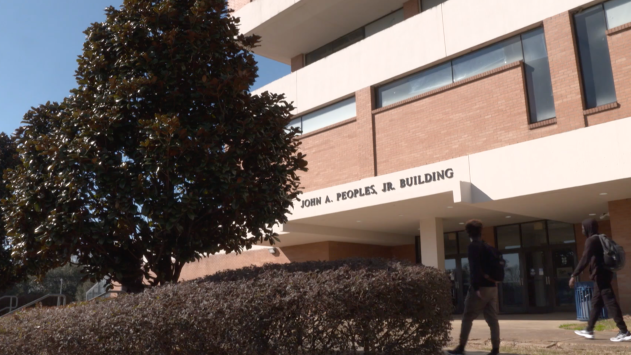
The John A. Peoples Jr. Building on the Jackson State University campus in 2022. Throughout his tenure as president, Peoples said, he faced racism in the form of opposition to his efforts to bring new programs to the school. (via AccuWeather.com)

A few years later, the school was moved to Jackson where it developed into a full state university. In 1934, at the height of the Great Depression, The Baptist Society withdrew financial support and the school became a state-supported institution known as the Mississippi Negro Training School.

“It was typical to call Black schools training schools,” Peoples explained. “As a matter of fact, my high school was Oktibbeha County Training School. The ‘training’ meant Blacks could be trained like animals but could not be taught. So there were a lot of training schools.”

Three years after returning to the state to become a math professor, Peoples was named vice president then president in 1967 when the university was known as Jackson State College.

Throughout his tenure as president, Peoples said, he faced racism in the form of opposition to his efforts to bring new programs to the school.

“It got to be controversial,” he recalled. “When I went before the college boards, they’d say, ‘What do you want, Dr. Peoples?’ I’d say ‘I want the same thing y’all white folks got.’” He paused and chuckled mischievously. “I didn’t say it like that, of course. But it was my crusade to enhance Jackson State’s curriculum.”

He explained that the Mississippi State College Board, better known as Institutions of Higher Learning (IHL), refused to provide him with additional funds for the programs he proposed. So Peoples worked hard to identify other sources for funding. In one case documented by Black Agenda Report, he partnered with a local convent to hire nuns with Ph.D.s to teach classes, allowing those programs to receive accreditation. The school’s renowned meteorology program came into existence in much the same way.

When the Mississippi State College Board, better known as Institutions of Higher Learning, refused to provide additional funds for the programs proposed by John A. Peoples Jr., he worked hard to identify other sources for funding. (H.T. Sampson Library JSU Archives & Special Collections)

“I proposed meteorology and they didn’t oppose because they figured I could never do it,” Peoples told AccuWeather. He went to a meteorology unit at the Jackson airport and asked them for help starting the program and credits the National Oceanic and Atmospheric Administration (NOAA) with getting the Jackson State meteorology department off the ground by sending a full-time professor to the school and paying the salary for that position.

In 1975, a year after the school was renamed Jackson State University, it became the first HBCU to offer a bachelor of science degree in meteorology and the only one to do so until 2008.

The program was a game-changer. One out of every four Black meteorologists in the United States has a degree from Jackson State, Associate Professor Loren White, who has taught meteorology at the university for more than 23 years, told AccuWeather’s Emmy Victor.

“In general, the culture has always been that HBCUs were known for their influence in law schools and in medicine and some of the classic areas to influence your communities,” White continued. “And the sciences had not been seen in that, at least Earth Science, in particular.”

The rigorous four-year program, which includes science and math courses, has graduated more than 1,000 students, many of whom have gone on to forecast weather across the U.S.

During Peoples’ 17-year tenure as president, the university experienced dramatic growth unparalleled by any period in its history. The academic program developed from the baccalaureate up to the doctoral level. According to Black Agenda Report, 80% of what is now known as JSU was developed under Peoples, including the School of Liberal Studies, the School of Education, the School of Science and Technology, the School of Business and Economics and the Graduate School. Eleven new buildings were erected during Peoples’ tenure, the number of faculty tripled and student enrollment grew from 2,200 to 7,800.

“Jackson State is now a major, comprehensive university. But it wasn’t easy to fight the fight against the powers that be,” Peoples said, reflecting on the journey.

Despite all the hard work and the impressive list of accomplishments, Peoples, who retired in 1984, remains modest about his role in transforming Jackson State into what it is today.

“I can feel proud that I was part of it,” he nodded, a reminiscent twinkle in his eye. “But I wasn’t all of it. There were a lot of other people who helped to move it ahead.”

Reporting by Emmy Victor.

For the latest weather news check back on AccuWeather.comWatch the AccuWeather Network on DIRECTVFrontierSpectrumfuboTVPhilo, and Verizon Fios. AccuWeather Now is now available on your preferred streaming platform. 

Produced in association with AccuWeather.com.

Edited by Kristen Butler

Recommended from our partners


The post How One Man Sparked An ‘Evolution And Revolution’ In Meteorology appeared first on Zenger News.

Wormwood Extract Shows Promise For A Longer Lifespan

0

Researchers at Louisiana State University fed extracts of redstem wormwood (Artemisia scoparia), which is used in traditional Chinese medicine, to roundworms, which fattened and thrived. (Mokkie/CC By-SA 3.0)


By Martin M Barillas

A new study shows that a common natural plant extract may lead to greater metabolic health and longer lifespans.


Researchers at Louisiana State University fed the leaves of Artemisia scoparia — a species of wormwood common in Asia and Europe — to roundworms or Caenorhabditis elegans, microscopic whip-like nematode organisms that feed on rotting organic matter. Even though they do not resemble human beings, roundworms are often used as a model organism to study neural development in animals and metabolic diseases.

“The reason this study made so much sense to do in worms is because worms live for only about three weeks, so in a month or two, we had definite results,” said Bhaswati Ghosh, a Louisiana State University student and lead author of the study published in the Journals of Gerontology.

He and his co-authors believe the results of their experiments could be replicated in human beings, building on work done by LSU Professor Jacqueline Stephens on the metabolic health of mice.

Stephens and LSU colleague Adam Bohnert led research teams that fed a wormwood extract in various doses to roundworms. Those fed the largest and second-largest dosages showed nearly immediate improvement in their metabolic health, living up to 40 percent longer than the control group. The treated worms grew fatter and moved slower because of their greater body mass.

However, they were also more resilient, healthier overall and endured stress more easily. The Artemisia scoparia doses aided the worms in converting unhealthy fat into healthy fat stores.

A study conducted at Louisiana State University showed that roundworms, when dosed with extracts of wormwood (Artemisia scoparia, fattened and lived longer than untreated roundworms. (Bhaswati Ghosh, LSU)

“Usually people think of fat as ‘bad,’ but in these cases, it seems good and actually pro-longevity,” Bohnert said. “Artemisia scoparia could have some exciting potential as a dietary supplement.”

Worms that fed on Artemisia scoparia as they reached adulthood lived the longest, about 40 percent longer than untreated worms. But worms treated for the first time in middle age also showed improvement, living about 20 percent longer than untreated worms.

“Also, the simple fact that an organism is short, fat and slow-moving does not necessarily qualify it as in poor health,” Ghosh said. Of these observable traits, Ghosh said that they should be “considered in the full context of other parameters, including lifespan.”

The researchers found not only that Artemisia scoparia can transform aging and increase lifespan, its use also establishes a link between fat regulation, metabolic health and longevity. Artemsia scoparia may activate pathways in the body that facilitate longer lifespans by stimulating the genes involved.

“Until recently, it wasn’t really known how aging could be modified through diet or how core metabolic signaling pathways influence longevity,” Bohnert said. “What we’ve been able to show is that a natural extract can come in and influence these pathways in much the same way a genetic mutation would.”

Aging, according to the study, may become controllable. “We know age is the primary risk factor for many diseases, such as cancer and cardiovascular disease, but if you think of aging as a treatable disease, you can actually treat many diseases at once,” Ghosh said.

According to a study in the Journal of Ethnopharmacology, practitioners of Chinese traditional medicine use Artemisia scoparia in “a wide range of pharmaceutical activities, such as anticancer, anti-inflammatory, antibacterial, liver protection, antiatherogenic, antiviral as well as neuroprotective functions.”

However, the authors of the LSU study cautioned that there is not yet any recommendation for human use of Artemisia scoparia as a supplement or on what safe or effective dosages would be. They examined the effects of several related plant extracts and saw that only Artemsia scoparia produced positive effects on fat regulation and lifespan.

The authors added that Grand wormwood, Artemisia absinthium, which is used in the alcoholic beverage known as absinthe, was not included in the study. That form of wormwood is moderately poisonous.

Edited by Richard Pretorius and Kristen Butler

Recommended from our partners


The post Wormwood Extract Shows Promise For A Longer Lifespan appeared first on Zenger News.

Killed in War, Bill Terry Jr. Was First Black Buried in Birmingham’s Elmwood Cemetery

0
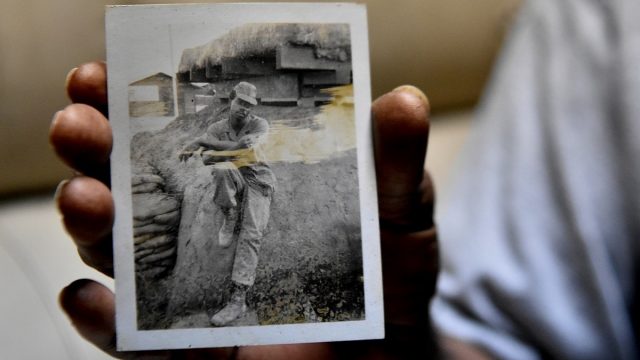
Charlie Woodruff of Childersburg holds a photo of Bill Terry Jr. in Vietnam. Woodruff served with Terry and was present when he was killed in a firefight with the Viet Cong on July 3, 1969. (Solomon Crenshaw Jr. / Alabama NewsCenter)

By Solomon Crenshaw Jr.

Alabama NewsCenter