A business that makes popular chocolate confections named after Mozart has gone sour.
Salzburg Schokolade, the manufacturer of Mozartkugel, has filed for bankruptcy.
The maker of the popular candy, described by retailer Mirabell as “a marzipan center, surrounded by layers of dark and light praline cream, coated in finest rich dark chocolate,” cites losses dating back five years.
The company has liabilities of around 27.29 million euros, ($30.9 million) at the liquidation value, of which unsecured are around 17.69 million euros ($20 million), the filing states, and assets of around 23.35 million euros ($26.4 million), of which free assets are around 13.75 million euros ($15.5 million), according to the filing.
There are around 614 creditors, the press release states, and around 140 affected employees.
“The causes of insolvency are primarily due to the loss of a major order in 2016 and a significant decline in sales due to the corona pandemic in 2020. The forecast for the continued existence of the company is initially negative,” a press release on the bankruptcy filing states.
“The debtor’s company dates back to 1897 and is a traditional confectionery manufacturer with a wide range of confectionery products. It is particularly known for the famous ‘Real Salzburg Mozart Ball by Mirabell,’ which is produced exclusively for Mondelez,” the bankruptcy filing states.
“In addition to fine praline specialties, the product range also includes the Austrian confectionery icon Bobby Riegel. Other well-known brands are: Salzburg Confiserie, Maria Theresia Taler, Schokotaler.com (webshop), Nordpol special products for bakers.
“By contrast, the debtor’s wholly owned subsidiary, Salzburg Schokolade CZ sro, located in the Czech Republic / Plana, has not yet been affected by the bankruptcy in question,” according to the press release.
Mozartkugel manufacturer Salzburg Schokolade, based in Salzburg, Austria, cites losses dating to 2016. (Furst Mozartkugeln/Zenger)
Though Mozartkugeln are made by many companies, in different forms, the company that is filling for bankruptcy is the only one legally allowed to sell them under the Mozart name, which is copyrighted.
The chocolates, made by confectioners such as Salzburg Schokolade in Salzburg, Austria, are popular with tourists and are widely available in shops in Vienna and at the country’s airports.
The liquidation lawyer is named as Johannes Hirtzberger, appointed in Salzburg. “The articles of the reporting day were set on Dec. 13, 2021 at 12:30 p.m. at the LG Salzburg, and the articles of the examination day on Feb. 7, 2022 at 9:30 a.m.,” the press release states.
The restructuring of the debtor company will have to be examined separately, the filing states.
The company was founded in Salzburg in 1897 under the name Rajsigl-Suesswarenfabrik. It moved to Groedig in 1956.
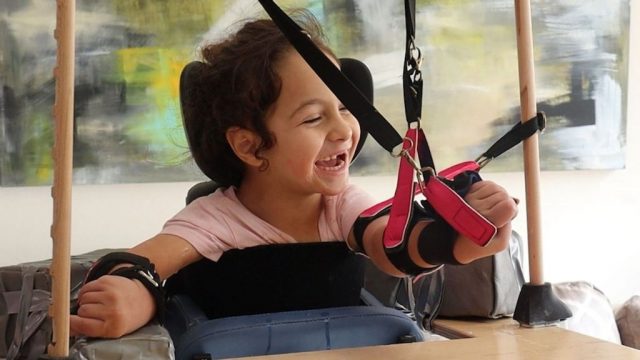
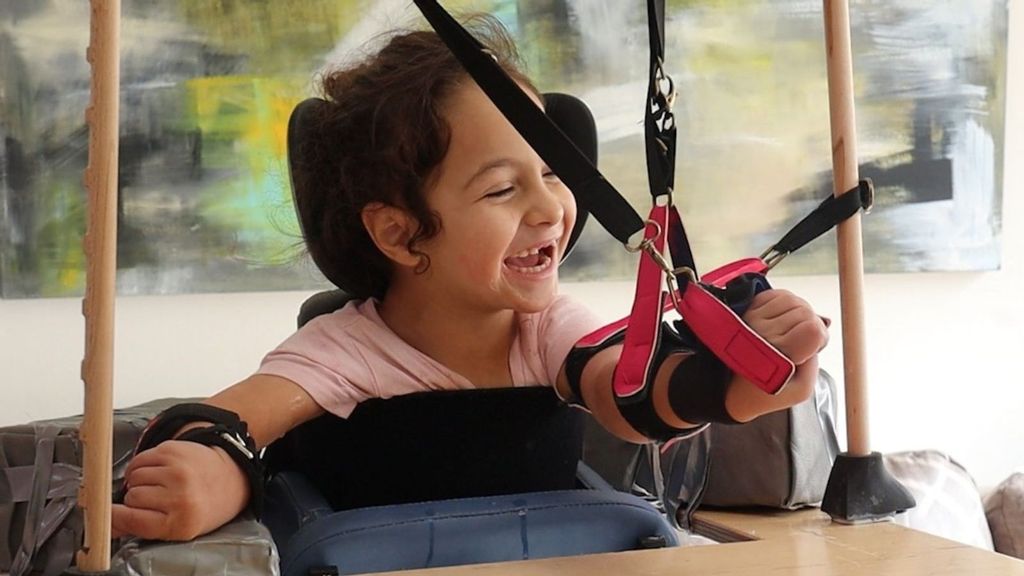
Five-year-old Shani loves drawing and playing, but she has disabilities that make these typical childhood activities difficult.
A team of volunteer makers called “Drawing Dreams” created a 3D-printed hand support enabling her to draw, play and eat independently. It worked so well that Shani’s special-ed kindergarten in Israel has ordered a few more.
Shani with her team of innovators. (Courtesy of Tikkun Olam Makers)
This was one award-winning device devised at the recent Global Innovation Challenge, where 50 teams from 15 countries competed to address real, everyday challenges of people with disabilities as posed by the need-knowers themselves.
“First of all, you have to identify problems that are authentic challenges faced by these vulnerable populations, explains Gidi Grinstein, founder and president of Tikkun Olam Makers (TOM), the nonprofit behind the challenge.
“TOM will only design a prothesis in response to a need of a person who is an amputee, who has a problem that does not have an affordable market or government solution. Such people are experts on their needs, so we call them ‘need-knowers.’ Only after we have a need-knower, we launch the innovation program.”
Each need-knower is teamed up with a voluntary group of programmers, designers, engineers and care professionals to find a workable solution.
And not only does the need-knower get to enjoy the fruit of this joint labor, but the design also gets uploaded onto the TOM library to be easily and accessibly reconstructed by anyone, anywhere.
“Our vision is to create the world’s biggest library of open-source free solutions for neglected problems of people living with disabilities, the elderly or poor people,” Grinstein says.
“Our vision is not just to create this library of solutions but also have them distributed to millions of users all over the world through 3D printers and maker spaces.”
Matching capabilities to needs
TOM addresses a systemic problem in Israel and other societies, says Grinstein.
“When I served in the government of Israel, I saw that dramatic gap between the tremendous capabilities of Israel in research and development of defense solutions and the weakness of the tools for creating and disseminating solutions for acute needs of vulnerable populations that cannot afford the solutions that they need,” he said.
Gidi Grinstein of Tikkun Olam Makers. (Courtesy of TOM)
“The vision was to create a platform that will generate hundreds and then thousands of inventions and innovations that are extremely accessible and radically affordable,” he says.
“And then very quickly we realized that the challenge we’re looking at is not only an Israeli challenge but a global challenge, and the approach that we created offers a systemic solution to a systemic problem. Our vision was to create the Bell Labs of assistive technologies.”
As a result, Grinstein — a serial social entrepreneur — relocated TOM from Israel to the United States and globalized the platform.
This is how TOM came to showcase some of its latest creations in the U.S. Pavilion at the Dubai Expo.
“From the beginning, TOM was designed to also serve as a platform to allow people to collaborate across political, religious and national lines,” Grinstein says.
“The signing of the Abraham Accords created a historic opportunity to increase collaboration between Muslims, Jews and Christians across the Middle East. I went to Dubai and began to build our relationships there and also in Abu Dhabi and Bahrain.”
Award winners
In addition to the Drawing Dreams team from Israel, two other teams in the TOM Global Innovation Challenge were chosen to receive $5,000 each for their designs.
Bower models the adaptive portable toilet designed for his needs. (Courtesy of Tikkun Olam Makers)
The “One-2-Go” team from the United States built a portable adaptive toilet seat for a 16-year-old boy with disabilities, enabling him to use the restroom more independently while traveling. It is adaptable to almost any toilet, and is strong, light and durable.
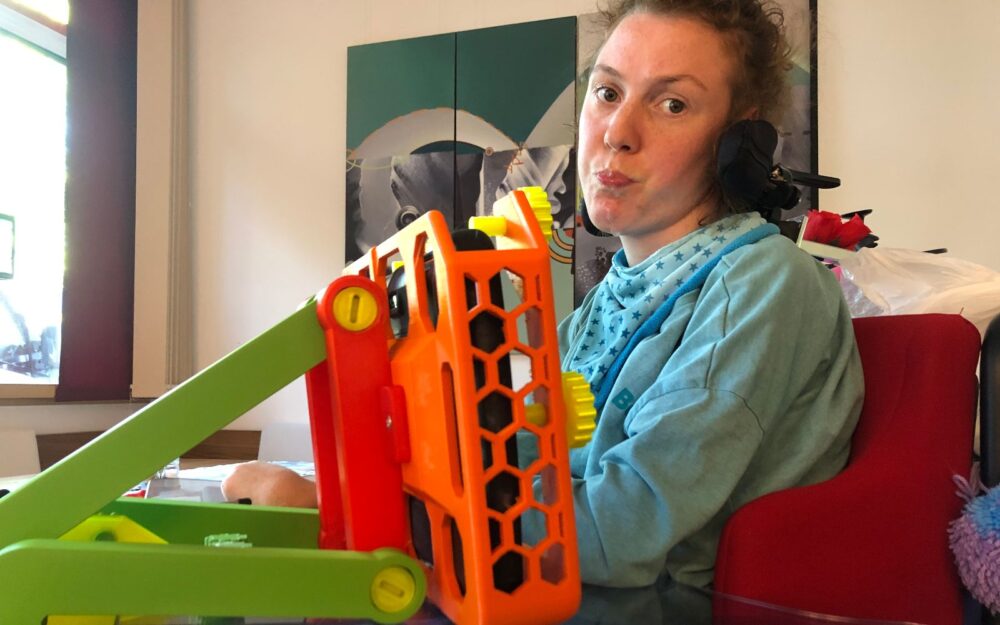
The third grand winner, the “Physiotherapy Talker Mount” team from Germany and Spain, addressed an issue raised by a woman who wanted to use a “talker tablet” while controlling her wheelchair without assistance. The 3D-printed frame and electronic mechanism lifts and lowers the talker attached to her wheelchair table, accomplishing the desired goal.
Franziska with the 3D-printed frame and electronic mechanism that can lift and lower the talker tablet attached to her wheelchair table. (Courtesy of Tikkun Olam Makers)
Makeathons vs. innovation challenges
None of the 50 teams in the 10-week challenge came face-to-face with one another. This, Grinstein notes, is rather unusual for TOM maker events.
“TOM was launched as a partnership with the Schusterman Foundation in July 2014. But we designed the vision of TOM in 2012 and began experimenting with its implementation later that year, until we launched the project a year and a half later,” he explains.
“Until COVID, our primary mode of operation was ‘makeathons,’ which are innovation marathons where peers came together with need-knowers to form teams that compete in a large space for 60 intense hours over three days to create a working prototype.”
Between 2014 and 2020, TOM communities around the world held more than 100 makeathons. Meanwhile, developer groups began meeting over extended periods of time to create prototypes for their need-knowers.
The pandemic ignited a pivot to innovation challenges that don’t require people to come together in the same space.
“We did two local innovation challenges including at University of Michigan and at Georgia Tech, and then took the plunge into the deep end with the Global Innovation Challenge,” says Grinstein.
The most recent challenge event was “three times bigger than the biggest makeathon that we ever had, at a third of the cost,” he said.
“It’s just incredible, the response and the ability to have 50 new ideas and multiple new inventions coming from all over the world,” he adds.
“But while the cost of creating a prototype decreased by 80 percent, we also paid a price in terms of community building. Makeathons build our communities. Innovation challenges do not.”
The next challenge
The next TOM challenge in January will involve 100 teams from the Abraham Accords countries.
“We like the idea of doubling our operation each year,” says Grinstein.
“We try to build both the demand side of unmet needs and the supply side of world-class talent. And as we have more and more solutions ready to be distributed on our website, we’re also building the distribution system and will soon invite maker spaces and people who have 3D printers to join our movement by onboarding themselves unto our website.”
If you own a 3D printer and want to volunteer its excess capacities, TOM will connect you with need-knowers in your area.
“We envision thousands of distribution points, so that every person will be within a short drive from the solution that they need,” Grinstein said.
A team of scientists reports they have discovered a new form of biological reproduction and have applied it to create the world’s first self-replicating living robots.
The team previously built the world’s first living robots, called Xenobots, named after the African clawed frog Xenopus laevis whose cells were used to build them. Now, by giving the Xenobots a new shape, researchers have found they can replicate.
“With the right design — they will spontaneously self-replicate,” said Joshua Bongard, a computer scientist and robotics expert at the University of Vermont.
The original Xenobots were spheres made up of about 3,000 cells. “These can make children but then the system normally dies out after that,” said Sam Kriegman, a post-doctoral researcher at Tufts’ Allen Center and Harvard University’s Wyss Institute for Biologically Inspired Engineering.
Researchers used an artificial intelligence program working on the Deep Green supercomputer cluster at UVM’s Vermont Advanced Computing Core, and an evolutionary algorithm was able to test billions of body shapes.
They found that C-shaped Xenobots resembling Pac-Man can swim and gather hundreds of single cells together and assemble “baby” Xenobots in their “mouth.” In just days, these new Xenobots resemble their parents and can swim. Never observed before, these new copies then seek out cells to build copies of themselves, and so on for multiple generations.
On the left is the design discovered by the AI computational search method in a simulation that was used to design the living Xenobot. On the right is the deployed physical organism, built completely from biological tissue (frog skin (green) and heart muscle (red)). (Sam Kriegman)
“It’s very non-intuitive. It looks very simple, but it’s not something a human engineer would come up with. Why one tiny mouth? Why not five?” said Kriegman, lead author of the study published in the Proceedings of the National Academy of Sciences,
Co-author Michael Levin said the embryonic cells “have the genome of a frog, but freed from becoming tadpoles, they use their collective intelligence … to do something astounding.”
“These are frog cells replicating in a way that is very different from how frogs do it. No animal or plant known to science replicates in this way,” said Kriegman.
While similar replication has been recorded at the molecular level, it had never been seen before at the scale of whole cells or organisms.
“People have thought for quite a long time that we’ve worked out all the ways that life can reproduce or replicate. But this is something that’s never been observed before,” said co-author Douglas Blackiston, the senior scientist at Tufts University who assembled the Xenobot “parents” and developed the biological portion of the new study.
Millimeter-sized Xenobots move in an aquatic environment, seeking out other cells for replication, leaving trails in their wake. (Douglas Blackiston)
Regarding concerns over negative consequences, Bongard said Xenobots “are not what keep me awake at night.”
Xenobots use energy from stored protein and fat and eventually degrade within a week, turning into dead skin cells. With each round of replication, smaller Xenobots are produced. When there are fewer than 50 cells, they lose the ability to swim and replicate.
They may even help with future pandemics, pollution and climate change. Bongard said scientists can now study how self-replicating systems work and how they can be controlled.
A Xenobot may also pick up and carry objects, such as microplastics dispersed in the ocean. By assembling the floating detritus into a mass, the microplastics can be more easily removed.
Researchers also say Xenobots may lead to medical advances. “If we can develop technologies, learning from Xenobots, where we can quickly tell the AI, ‘We need a biological tool that does X and Y and suppresses Z,’ that could be very beneficial. Today, that takes an exceedingly long time,” said Bongard.
Regenerative medicine is an area that could benefit. “If we knew how to tell collections of cells to do what we wanted them to do,” said Levin, “that’s the solution to traumatic injury, birth defects, cancer and aging.”
“All of these different problems are here because we don’t know how to predict and control what groups of cells are going to build. Xenobots are a new platform for teaching us,” said Levin.
The origin of water, which covers 70 percent of the Earth’s surface, has long eluded mankind, but scientists may have discovered that the sun is the unheralded source.
Waves of charged particles from the sun, known as solar wind, changed the chemical composition of rocky grains of dust to produce water, according to a study published in the journal Nature Astronomy.
“The solar winds are streams of mostly hydrogen and helium ions which flow constantly from the sun out into space,” study co-author Luke Daly of the University of Glasgow said. Water is made up of hydrogen and oxygen. Ions are atoms that are electrically charged, due to having too many or too few electrons.
Daly said that when hydrogen ions hit airless asteroids or dust particles in space, they penetrate a few tens of nanometers below the surface and change their chemical composition. This “space weathering” from the hydrogen ions eventually ejects enough oxygen atoms from the rock to create water molecules, the combination of two hydrogens and one oxygen.
An image of the Itokawa near-Earth asteroid, which crosses Earth’s orbit around the sun and due to its low density is believed to be a rubble pile rather than a solid mass. Discovered in 1998, it was the first asteroid to be studied by the Japanese sample return mission, Itayabusa, in 2005. (NASA)
Some scientists had theorized that C-type asteroids, which carry water, may have brought it to Earth about 4.6 billion years ago. Previously, scientists tested pieces of C-type water-rich meteorites — asteroids that have fallen to Earth — to determine whether the ratio of hydrogen and deuterium matched terrestrial water. A match could have led to a conclusion that C-type meteorites were the source of water on Earth.
While the water in some meteorites did match Earth’s water, most did not. The lighter isotopic composition of Earth’s water differs from those meteorites. Some water on the Earth, the scientists concluded, must have come from an unaccounted source elsewhere in the solar system.
“Crucially, this solar wind-derived water produced by the early solar system is isotopically light. That strongly suggests that fine-grained dust, buffeted by the solar wind and drawn into the forming Earth billions of years ago, could be the source of the missing reservoir of the planet’s water,” Daly said.
Using an analytical process known as atom probe tomography, the international research team looked at fragments of an S-type asteroid, known as Itokawa, which orbits closer to the sun than C-type asteroids. Their samples were collected by the Japanese space probe Hayabusa and returned to Earth in 2010.
Scientists measured the atomic structure of the dust particles one atom at a time, detecting individual water molecules. They showed that much of the water on Itokawa was produced on the dust grains just below their surface by space weathering.
Early in the formation of Earth, the surrounding space was quite dusty, allowing solar wind-borne particles to produce water beneath the surface of dust grains. The dust and C-type asteroids fell to Earth and covered much of its surface with water. According to Phil Bland of Curtin University, an asteroid such as Itokawa may have produced as much as 20 liters of water for every cubic meter of rock.
“By showing for the first time that water is produced in-situ on the surface of an asteroid, our study builds on the accumulating body of evidence that the interaction of the solar wind with oxygen-rich dust grains does indeed produce water,” Professor John Bradley, of the University of Hawai‘i at Mānoa, Honolulu, said.
This graphic shows positively charged particles in solar wind streaming from the sun and striking an asteroid, producing water that would shower down on the Earth. (University of Glasgow)
How astronauts would get sufficient water, without carrying supplies, is one of the barriers of future space exploration, the researchers said.
The discovery has relevance for missions to deep space, given that water may be found in space-weathered surfaces and could be manufactured by future astronauts to keep them alive on arid planets.
“We think it’s reasonable to assume that the same space weathering process which created the water on Itokawa will have occurred to one degree or another on many airless worlds like the moon or the asteroid Vesta,” study co-author Hope Ishii said.
Regarding NASA’s project to establish a permanent moon base, Daly said that “If the lunar surface has a similar water reservoir sourced by the solar wind this research uncovered on Itokawa, it would represent an enormous and valuable resource to aid in achieving that goal.”
There may be finally some good news for U.S. motorists as gasoline supply catches up with demand just as the Omicron variant of the coronavirus is hammering commodity prices, analysts said.
On Tuesday, motor club AAA listed a national average retail price of $3.39 for a gallon of regular unleaded gasoline. That’s only a fraction of a percent lower than a month ago, but prices remain heavily skewed by the $4.70 per gallon average in California. Oklahoma has the lowest state average in the nation at $2.96 per gallon.
Matthew Kohlman, an associate director for refined products pricing at S&P Global Platts, said gasoline supply is catching up with demand, and with the new Omicron variant of the novel coronavirus that causes COVID-19 causing global shockwaves, prices may be in for a decline.
“The trend is showing up not only in crude oil but in the wholesale parts of the supply chain where gasoline is sold in lots of 25,000 barrels, and where prices have dropped 15 percent to 20 percent for gasoline over the month,” he explained. “But prices have plateaued at the pump, the final destination of a supply chain that still needs tanker trucks and drivers and other struggling logistical factors beyond the overall oil market price.”
Crude oil prices account for most of what consumers see at the pump in recent trends in commodity prices would suggest relief is in sight. (U.S. Energy Information Administration)
Crude oil prices have been hammered since the high-profile variant made headlines last week. Brent, the global benchmark for the price of oil, is down some 16 percent since Friday to trade in the upper $60 per barrel range. Brent closed the trading day November 9 at $84.78 per barrel, the recent high.
The high gasoline prices have been a growing concern for a White House concerned about slumping poll numbers for President Joseph R. Biden Jr. and broad inflationary pressures.
There won’t be another reading of consumer prices until December, but the federal government reported the price of all consumer goods increased more than 6.2 percent the 12-month period ending in October.
For gasoline, that figure is closer to 50 percent. And to discount the toll the pandemic took on the U.S. economy last year, it was late 2014 — seven years ago — that retail gasoline prices were this high.
Retail gas prices are at a seven-year high, but they’ve been higher, federal data show. (U.S. Energy Information Administration)
Despite concerns from the White House, consumer demand doesn’t seem to be impacted by prices at the pump. Denton Cinquegrana, the chief oil analyst at the Oil Price Information Service, said he’s still waiting to see all the holiday travel demand figures show up on his desk.
“But up to the 20th, it was moving higher at a solid grip,” he said.
Prices would normally move lower as the onset of winter pushes more people indoors, but so far this winter has been mild. Meanwhile, some of the blending components that go into making gasoline are also expensive, so the winter formulation of gasoline that’s normally cheaper to produce isn’t living up to its track record.
Patrick DeHaan, the senior petroleum analyst at GasBuddy, told Zenger from Chicago that gasoline demand is obviously better than last year and close to pre-pandemic fears. But with Omicron unraveling gains on broader markets, there’s a clear path to lower prices at the pump.
“The Chicago spot gasoline price is now at its lowest level since March, so that tells you where we’re headed,” he said.
SANTIAGO, Chile — Chile is considered a country with a solid democracy and a population that takes to the streets to demand rights, but social and economic differences between men and women are still prevalent.
Chilean women work less in paid employment compared with other Latin American countries and tend to spend more time taking care of children and doing household chores, according to the Organisation for Co-operation and Economic Development.
Like much of Latin America, Chile has not managed to lessen the gap to achieve a more equal society. The country tops the charts in backwardness, says Carolina Carrera, a psychologist with the Andrés Bello University in Chile.
“Today, the situation is critical. According to a study of 17 countries by the [Organisation for Co-operation and Economic Development] that talks about the increase in female employment in all participating nations, Chile lags the most in indicators such as women’s participation in the workforce, female unemployment, the wage gap. The country is going backward, because of the [wage] pandemic over the last 10 years,” she said.
“Social inequality in Chile is huge,” said the psychologist Carolina Carrera. (Courtesy of Carolina Carrera)
Carrera says there is a wage gap between men and women that affects retirement and poverty among older women.
“In 2020, female employment numbers decreased by 44.4 percent; the percentage lowered Latin America’s average. [Chile] also has more than 40 percent of women as one-parent heads of household, where poverty levels go up alarmingly,” she said.
In Chile, conditions for loans are more favorable for men than for women. (Luciano Nagel/Zenger)
More than 2.1 million Chileans live in poverty, and extreme poverty increased to 4.3 percent, more than 800,000 people, says the Chilean government. The country has a population of about 19.45 million.
Carrera also says Chilean society lags significantly when it comes to civil union rights for same-sex couples.
“The civil union agreement was legislated to allow for both same-sex unions and heterosexual couples, which regulates shared assets, but not parentage, for example. The institution of marriage is allowed for a few, since LGTBI+ couples cannot take part. There is the issue of lesbians who are mothers and only one of them has maternal rights and the other doesn’t, and they are not a priority in the adoption system,” she said.
Consumer credit
In the economic arena, women pay more than men, especially when they take out credit.
The different interest rates for men and women are mainly the result of bank risk profiles, says Alejandro Urzúa, an economic analyst from Andrés Bello University.
Sofía Olave is a teacher who has seen inequality in interest rates when asking for credit to buy a home. (Luciano Nagel/Zenger)
Sofía Olave, 27, a teacher in Comuna de Molina, felt discriminated against when she tried to buy a home. When she received the quote from her real estate agent, the interest rates were very high.
“If my husband were the one buying the property, the rates would be lower. I can’t buy property alone in my name; I need a cosigner or somebody to help with the rent, even though I’m able to pay, which would mean that my property would also be in someone else’s name. I think that’s unfair,” she said.
“In Chile, women’s workforce conditions are more fragile than for men, and [women] earn less for the same labor, which is key to obtaining less favorable credit conditions, interest rates and amounts requested,” Urzúa told Zenger.
Urzúa also says Chilean women are better payers and are more responsible with payments than men, with lower debt percentages and less credit delinquency.
“But unfortunately, during a credit assessment, that is not taken as a factor,” he said.
Alejandro Urzúa is an economic analyst at Andrés Bello University in Chile. (Courtesy of Alejandro Urzúa)
In Chile women earn on average 20.4 percent less than men, says the Fundación SOL researcher Andrea Sato Jabre.
“There is a wage discrimination. On average and not controlling for visible factors, the wage gap between men and women is 140.962 Chilean pesos ($177) a month. In other words, the average income women can earn is 79.6 percent of the income men earn,” she said.
The gaps tend to be smaller in the public sector, mainly because the positions there have set salaries. Still, the highest positions are almost all filled by men, says Sato.
Translated by Melanie Slone; edited by Melanie Slone and Kristen Butler
As December lights, eggnog, and sugar cookies have become synonymous with this time of the year, one man is rapidly establishing himself with the holiday season on the small screen, actor Jaime Callica.
In the last few years, Christmas movies have been a refuge for family-friendly entertainment and have grown quite the following in that time. Hallmark Channel and Lifetime Network have been at the forefront of December entertainment with enough content to create their own streaming service.
Canadian-born Callica appears in several films this holiday season, including Lifetime’s “Merry Liddle Christmas Baby,” with singer/actress Kelly Rowland.
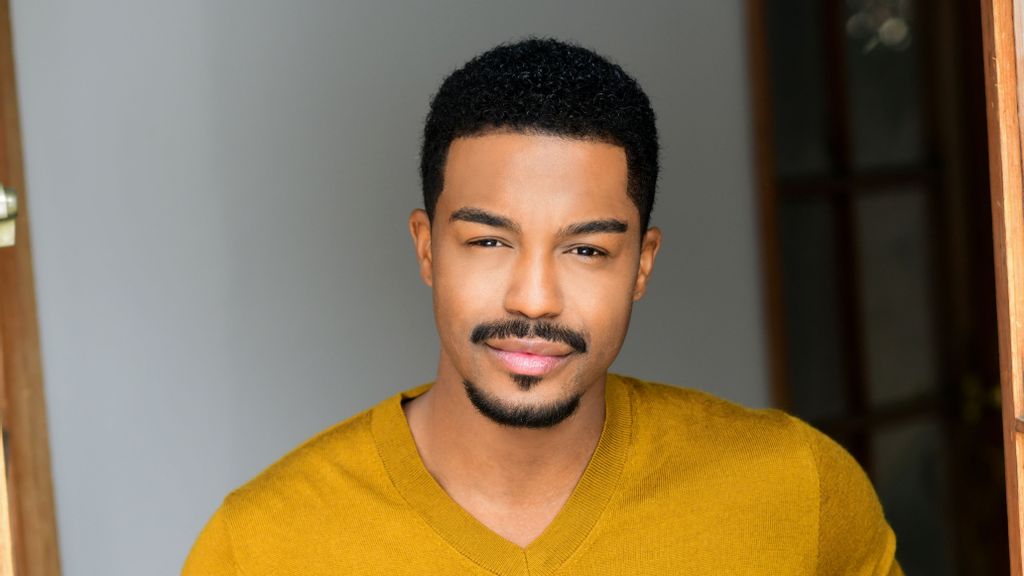
The new “king of Christmas” says, “I love it. I’m the person that if you watch anything that I’m in, and I can get a moniker or title or such, who doesn’t love Christmas?” (Russell Baer.)
Callica’s resume in the last few years has some in the industry labeling him “the new king of Christmas” — a label Callica is happy to accept.
“I love it,” he told Zenger. “I’m the person that if you watch anything that I’m in, and I can get a moniker or title or such, who doesn’t love Christmas?
“Christmas is a phenomenal time for most people, so if they are calling me the king of Christmas, I’m taking it.”
Callica’s workload could also earn him another moniker: the hardest working man in showbiz. Despite the lockdowns and working between the United States and Canada, Callica has enjoyed a frantic work pace that keeps him motivated even if those close to him think he is overworked.
“In 2021, Since my second Disney Plus movie, entitled ‘Under Wraps,’ the longest gap I’ve had off was two weeks. I’ve gone from job to job, which is such a blessing, and I feel so fortunate because the reality is, especially during COVID, I know a lot of actors who haven’t worked at all.”
Callica has no plans on letting up anytime soon.
“I like to keep my foot on the pedal because I’d like to get to the realm where I am doing big blockbuster theatrical movies. But I never want to abandon TV movies and TV shows.
“I like to work. I feel more alive when I’m on set”
Callica’s busy schedule was years in the making. Getting the recognition he receives today was anything but easy. It wasn’t that long ago that the actor was struggling to find a job despite putting in the time to earn one.
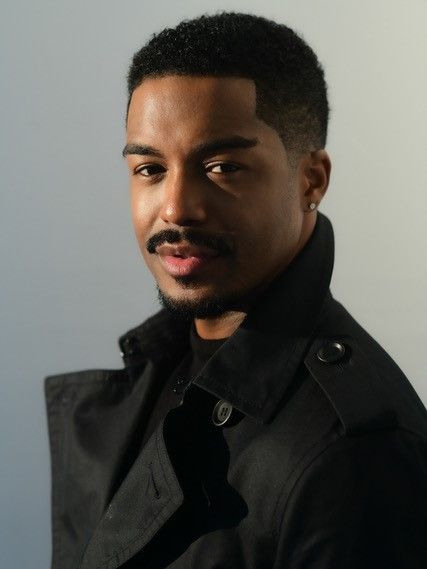
Jaime Callica now feels like he is exactly where he needs to be at this point in his career. (Russell Baer)
“Between 2013 and 2016, I had booked about four jobs, and at one time I went more than a year between bookings despite auditioning four to six times a week. The prayer was, please Lord get me another job.” Callica said.
Coming from the Christian faith, being a recognizable figure during the holiday season means a lot to Callica for a number of reasons. Giving nontraditional families a window into life for the ideal family unit is an important aspect of the roles he portrays.
Callica, an only child, was raised by a single mother. While he is extremely close to his mother and maintains a strong bond with his friends, the importance of providing nontraditional families with the escape of the perfect holiday is not lost on him.
“One of the things that I really enjoy is replying to fans on my Instagram, and I get a lot of questions about these issues from people who tell me that their mom passed away when they were young, and they never had a female role model growing up.
“I get a lot of messages from people who say that it’s [movies] their windows into something that either they never experienced or lost due to some measure of tragedy, and it gives them a lot of joy to be able to watch these movies, and Christmas movies are pretty wholesome,” Callica said.
Traditionally, Christmas movies have appealed to more conservative households, industry insiders say, but networks such as Hallmark want to expand their outreach.
George Zaralidis, vice president of communications for Crown Media Family Networks (the parent company of Hallmark), said: “Diversity and inclusion is a top priority for us, and we look forward to making some exciting programming announcements in the coming months. We are committed to creating a Hallmark experience where everyone feels welcome.”
Lifetime, BET and OWN networks have made an effort to produce more Christmas content for black families starring majority black casts. Callica has performed in a few of these shows, and says he has noticed a greater appreciation from black audiences who are becoming bigger fans of the genre.
“I am definitely seeing a huge uptick in support from the black community because studios are finally giving content that is more representative, but there is still a long way to go.
“Black family content might make up about 2 percent of the slate, not including a network like BET, but if you look at a network like Hallmark or Lifetime, we aren’t where we should be in 2021. But they are making an effort, and their viewership is starting to reflect that.
“So, a lot of people who didn’t watch before because they didn’t see content that was reflective of them are watching now, and I can feel [it] because I get the messages. I see the Tweets and I read the DMs, so it is nice that we are making movies now with people that look like us and have similar experiences.”
Callica now feels like he is exactly where he needs to be at this point in his career. While many actors are tempted by the idea of working behind the scenes as producer or director, Callica loves being in front of a camera and has no plans to give that up, considering how long it has taken to reach this point.
“I’m really happy with where I am right now. I love acting. There is no part of me that wants to split the focus of that right now. There is still room for me to get better as an actor, there are a lot of networks that I have yet to work for and people I have yet to work with.”
In addition to “Merry Liddle Christmas Baby,” which was released on Nov. 27, Callica can be seen in “A Chestnut Family Christmas,” which airs on OWN on Nov. 30, and “A Christmas Proposal,” which releases on CBS on Dec. 12.
It is not by chance that 40 percent of all private cyber investments in the world are invested in Israeli companies, and that a third of the world’s unicorn cyber companies — private startups worth at least $1 billion — are Israeli.
“Cybermania: How Israel Became a Global Powerhouse in an Arena That Shapes the Future of Mankind” gives an expert view of how Israel became a leading country in the field and among the first to recognize the size and importance of the cyber revolution.
“Today, cyber accounts for 15 percent of Israeli high-tech exports, which is about half of the total exports of the State of Israel, and it will only grow,” lead author Prof. Eviatar Matania said.
“These are amazing numbers, but they do not show the whole picture. After all, there are metrics that cannot be measured, such as defense capabilities. Within a decade, Israel has become a very significant player in the new cybersecurity and cybereconomy arena.”
Matania is founding head and former director general of the Israel National Cyber Directorate, a member of Tel Aviv University’s Blavatnik Interdisciplinary Cyber Research Center and head of TAU’s International MA programs in cyber-politics and government and in security studies. He is also an adjunct professor at Oxford University’s Blavatnik School of Government.
Matania’s coauthor, Amir Rapaport, founded Israel Defense magazine and its global Cybertech conferences that began in 2014.
“Today, cyber accounts for 15 percent of Israeli high-tech exports, which is about half of the total exports of the State of Israel, and it will only grow.”
Matania said although Israel leads in various indices of technology and security, it’s always in relative terms — per capita or by relative size — except when it comes to cyber.
“For example, Israel is strong in academic publications per capita, or in the percentage of national expenditure on research and development. But when looking at absolute numbers, it is clear that other countries like the U.S. and China overshadow us by a considerable margin in absolute investment in research and development,” he said.
“In cyber, on the other hand, Israel is a global powerhouse in absolute numbers: 40 percent of all private investments in the world in cyber reach Israel, and every third unicorn company is Israeli. It’s a unique phenomenon.”
The beginning of Israel’s journey to a cyber-power was a visit to an elite military intelligence unite by then Prime Minister Benjamin Netanyahu, who initiated a comprehensive national cybersecurity plan with its foundations in academia and industry. (Amir Levy/Getty Images)
The book from Kinneret-Zmora-Dvir Publishers, soon to be published in English, is based on Matania’s experience as head of the National Cyber Directorate and later as director of the National Cyber Security Authority in the Prime Minister’s Office from 2012 until 2018.
“The tipping point of Israel’s journey to become a cyber-power was a visit by then Prime Minister Benjamin Netanyahu to Unit 8200 in 2010,” said Matania, referring to an elite military intelligence squadron.
“Netanyahu was astonished by what he heard from the soldiers. He understood that the new world of cyber posed an extraordinary risk to Israel, as the country would be vulnerable to attacks from anywhere in the world. At the same time, he was able to see the cyber opportunity for a small country like Israel, which specializes in both technology and security, to take the initiative.”
National cybersecurity structure
Matania said the visit to 8200 led Netanyahu to initiate a comprehensive national cybersecurity plan with its foundations in academia and industry.
The architect of this plan was Maj. Gen. (Res.) Prof. Yitzhak Ben-Israel, then head of the National Council for Research and Development and now head of Tel Aviv University’s Blavatnik Interdisciplinary Cyber Research Center.
Six cyber research centers have been established at Israeli universities. (Sean Gallup/Getty Images)
According to Matania, Netanyahu wanted Israel to be one of the five leading cyber powers in the world. But the result was even better than that.
“The national cyber system that I headed was the first of its kind in the world, reporting directly to the prime minister,” said Matania.
“There was an in-depth government understanding that it was not enough to wait for the free market to do its thing. Large budgets were invested in academia and industry and in building dedicated cyber defense capabilities.”
Six cyber research centers were established at Israeli universities, and the government invested heavily in cyber startups, many of them founded by IDF veterans parlaying their cyber expertise into private ventures.
“That’s how Israel got the jump on the whole world,” said Matania.
“The British were the second in the world, by the way, and that was only because the then British Ambassador to Israel, Matthew Gould, studied the structure and the Israeli strategy – and then returned to London and was appointed chief of cyber in the UK Cabinet.”
Matania added that Israel’s cyber capabilities help leverage its political achievements.
“When Israel signs a cyber-defense alliance with Cyprus and Greece, it does not necessarily need Cyprus or Greece to upgrade its cyber defense – but in return we get payback in other areas,” he explained.
“Israel has become synonymous with cyber — so much so, that today we are relying on cyber in the international arena.”