Fish and other species are migrating to deeper waters in the Mediterranean Sea as climate change heats up surface water, threatening both conservation efforts and the fishing industry, according to a new study.
Experts at Tel Aviv University looked at the effect of warming waters on hundreds of species in the Mediterranean Sea. They analyzed data collected on 236 species in trawling surveys, in which a boat drags a net to collect species, and catch depth is recorded. They found that dozens of different fish, mollusks and crustaceans are migrating deeper as they flee warming temperatures.
“It should be remembered that the Mediterranean was hot in the first place, and now we are reaching the limit of many species’ capacity,” said Professor Jonathan Belmaker. “Moreover, the temperature range in the Mediterranean is extreme — cold in the northwest and very hot in the southeast. Both of these factors make the Mediterranean an ideal test case for species’ adaptation to global warming.”
The study, led by PhD student Shahar Chaikin under the supervision of Belmaker, revealed that species are deepening their minimum depth limits in parallel with warming water temperatures, from the west to the east Mediterranean.
Sea life across the Mediterranean migrated an average of 180 feet, a range of about 6 degrees Celsius (11 F), according to the study, published in the journal Global Ecology and Biogeography.
The change was not the same for all species, with cold-water species deepening more than warm-water ones.
Fish, mollusks and crustaceans in the Mediterranean Sea have migrated to deeper waters to escape rising temperatures, according to a new study. (Shahar Chaikin/Zenger)
“The minimum depths for species in the Mediterranean are getting deeper, while the maximum depths remain stable,” Chaikin said.”The deepening effect was found to be more significant among cold-water species. In contrast, there are species that function within a narrow temperature range and at a certain depth that deepen much less, probably because they cannot survive in deeper water.”
The researchers say the migration is likely to have a damaging effect on conservation efforts and on the fishing industry.
Temperature-driven migration has been documented before, in the Arctic where narwhals have been forced into the open ocean due to warming fjords. But researchers say the warming process is especially pronounced in the Mediterranean, where the average water temperature has been rising by one degree Celsius (1.8 F) every 30 years and is accelerating.
A fish peaks out from behind some rocks in the Mediterranean Sea. (Shahar Chaikin/Zenger)
According to the researchers, the study shows that by looking at the traits of species, their reaction to the increasing temperatures can be predicted. This could be valuable knowledge for future conservation programs.
Conservation plans will have to account for species living in deeper than usual waters and marine reserves will need to be defined to provide shelter for species that have migrated, he said.
The fishing industry will also need to adapt with more focus placed on deeper waters. This will force boats to sail further into the ocean and burn more fuel. Belmaker warned that despite the ability of species to adapt to warmer waters, there is a limit, and the limit is the seabed.
“We are already seeing deep-sea fish like cod whose numbers are declining, probably because they had nowhere deeper to go,” he said.
Researchers have developed a new therapy using “dancing molecules,” where a single injection can reverse paralysis caused by severe spinal cord injuries.
Scientists at Northwestern University have found that mice injected with the innovative treatment regained their ability to walk after only four weeks. Video showed how a once-paralyzed mouse could use its legs again after receiving the treatment.
Samuel Stupp, director of the Simpson Querrey Institute at Northwestern University, said the research group aimed to find a therapy that prevented paralysis after major trauma or disease. Their findings were published in the journal Science.
“For decades, this has remained a major challenge for scientists because our body’s central nervous system, which includes the brain and spinal cord, does not have any significant capacity to repair itself after injury or after the onset of a degenerative disease,” said Stupp.
The group intends to apply for federal Food and Drug Administration approval to test the therapy in human patients.
The breakthrough therapy sends bioactive signals that enable spinal cord cells to regenerate and repair. This was seen in five key areas: the severed extensions of neurons, called axons, regenerated; more motor neurons survived; scar tissue was significantly diminished; the insulating layer of axons, or myelin, which supports the efficient transmission of electrical signals, was renewed around cells; and blood vessels began delivering nutrients to cells at the place of injury.
Axons send signals between the brain and nervous system much like cables distribute electrical energy. When axons are cut or damaged, patients may suffer paralysis and/or loss of feeling. Renewing the connections improves body/brain transmissions.
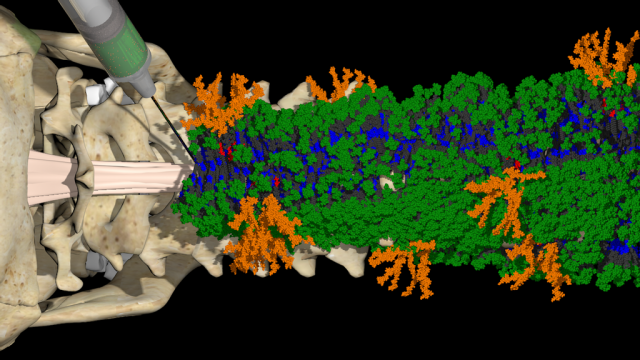
Longitudinal spinal cord section treated with the most bioactive therapeutic scaffold, captured 12 weeks after injury. Blood vessels (red) regenerated within the lesion. Laminin is stained in green and cells are stained in blue. (Samuel I. Stupp Laboratory/Northwestern University)
Nearly 300,000 people in the United States live with a spinal cord injury, according to the National Spinal Cord Injury Statistical Center. Therapy options are limited, and their lives are difficult. Fewer than 3 percent of those with complete injury ever recover basic physical function, and 30 percent experience rehospitalization at least once during any given year.
Costs for care per patient can reach millions of dollars over a lifetime, while life expectancy is significantly lower than for people without spinal cord injuries. The situation has not improved since the 1980s.
Dancing molecules
The secret to the therapy lies in tuning the motion of molecules, so they can find and engage with cellular receptors, which are constantly in motion. The liquid therapeutic becomes a gel once injected, transforming into a network of nanofibers mimicking the extracellular matrix of the spinal cord. The synthetics communicate with the receiving cells by matching the matrix structure, imitating the movement of biological molecules with “bioactive scaffolds,” and incorporating signals for receptors.
“Receptors in neurons and other cells constantly move around,” Stupp said, noting that the key innovation is the control of the “collective motion of more than 100,000 molecules within our nanofibers. By making the molecules move, ‘dance’ or even leap temporarily out of these structures, known as supramolecular polymers, they are able to connect more effectively with receptors.”
Once the therapeutic materials do their job, they biodegrade into cell nutrients within three months and completely disappear without noticeable side effects. This is the first time the collective motion of molecules has been controlled by changing a chemical structure to increase a therapy’s efficacy. The fine-tuning of the molecules’ motion within the nanofiber network made cells more responsive to the therapy in paralyzed mice. Formulations of this therapy during in vitro tests with human cells also showed better performance, increased bioactivity and cellular signaling.
Longitudinal spinal cord section treated with the most bioactive therapeutic scaffold. Regenerated axons (red) regrew within the lesion. (Samuel I. Stupp Laboratory/Northwestern University)
One injection is followed by two signals
Following the injection, the moving molecules connect with receptors and initiate two signals that rejuvenate the spinal cord. One of them triggers the axons. The other improves the neurons’ chances of survival by stimulating other cell types to proliferate.
Blood vessels, which feed neurons and other cells, grow back, while myelin rebuilds around axons and reduces the scarring of glial cells, which protect and provide oxygen to neurons.
Co-author Zaida Álvarez said the natural proteins mimicked by the signals are expensive to produce. She said the synthetic signals the team developed, however “are short, modified peptides that — when bonded together by the thousands — will survive for weeks to deliver bioactivity.”
“The end result is a therapy that is less expensive to produce and lasts much longer,” Álvarez said.
Hope for regeneration following major trauma
Noting the lack of adequate therapies, Stupp said he wanted to “make a difference [in] the outcomes of spinal cord injury.” He said the new approach could also address “neurodegenerative diseases and stroke,” including ALS, Parkinson’s and Alzheimer’s disease. The essential discovery of the study, according to Stupp, is that “controlling the motion of molecular assemblies to enhance cell signaling [can] be applied universally across biomedical targets.”
Frank E. Adams, Jr., chief executive officer, poses at the A.G. Gaston Boys & Girls Club in Birmingham, Ala., on Friday, July 12, 2017. (Mark Almond/preps@al.com)
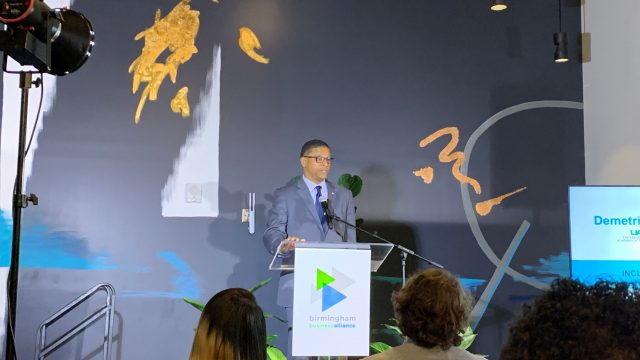
Marcus Lundy during the launch of a new program to support small businesses in Birmingham, at Michael’s Restaurant on Wednesday, Nov. 10. (Ryan Michaels, The Birmingham Times)
Mixed martial arts can turn the best of friends into the fiercest of enemies if they meet in a cage. That scenario could take place in the finals of Combate Global’s “USA vs. Mexico” eight-man lightweight tournament tonight.
Enrique “Baby Bull” Gonzalez (9–4) originally from Laredo, Texas, is part of the four-man U.S. contingent, while Hugo “The Hooligan” Flores (9–3) of Guadalajara, Mexico, will fight for Mexico. Both train at Valle Flow Striking Academy outside Chicago and both are coached by Mike Valle. They are training partners, roommates and good friends.
“Couldn’t have better company,” Gonzalez wrote on his Facebook page under a photo of him, Flores and MMA fighter Ignacio “La Jaula” Bahamondes departing Chicago’s O’Hare Airport on their way to tonight’s bouts in Miami, Florida.
Hugo “The Hooligan” Flores left Mexico last October and moved to Chicago to pursue an MMA career. He will fight in tonight’s eight-man showdown in Miami. (Courtesy Valle Flow Striking)
The Combate Global tournament format conceived by UFC co-founder and Combate Global CEO Campbell McLaren has the four U.S. fighters paired against each other in two one-round, 5-minute fights. The winners face each other in another one-round, 5-minute semifinal to decide who represents the U.S. in the finals scheduled for three 5-minute rounds. Same for the Mexico side, presenting the possibility of Gonzalez and Flores meeting in the title match.
“It makes it very interesting for us,” Piera Valle, Mike Valle’s wife and Gonzalez’s manager told Zenger. “We were thinking, ‘How is this going to work?”
The first order of business was to get the fighters to accept the possibility. The potential of fighting a friend isn’t a foreign concept in combat sports, especially if they compete in the same weight division on the professional level. Business is business.
“They have trained together every single day,” Valle said. “So the best possible scenario is that they fight each other in the finale because that means they both win.”
The contingency plan is that if both of his fighters reach the finals, Mike Valle will go from coach to a very conflicted spectator. Instead of selecting one fighter over the other, Mike Valle will leave the two fighters on their own with only someone to give them water between rounds. Bahamondes, who has fought for Combate, will be one of two water boys.
“We’ve made it very clear that when they make it to the finale there’s no coaching whatsoever,” Piera Valle said. “It would be an unfair advantage for the person that would be coached by Mike. So it’s no coaching, just water.”
Gonzalez didn’t want to forecast the potential finale, saying he was focused mainly on his own game. “May the best man win,” he told Zenger.
Enrique “Baby Bull” Gonzalez will represent the USA tonight in an eight-man Combate Global tournament in Miami. (Combate Global)
Still, it poses an intriguing ending to what could be the biggest night of each fighter’s life. Their journey is typical of those of many young men and women who want to attempt a professional career in MMA.
Gonzalez left his hometown of Laredo after graduating from high school in 2015 and moved to Chicago to train at Valle’s gym. Mike Valle and Enrique’s father were friends, and the younger Gonzalez had shown promise, having studied karate, boxing, jiu-jitsu and other forms of martial arts.
Flores made his way there from Guadalajara and has been in Chicago for about a year. It’s a dedicated lifestyle where dreams are big and opportunities to get noticed can be few.
“We sponsor athletes from all over the world and give them the opportunity to train with us and stay rent-free to see if they have promise,” Piera Valle said. “People are starting to understand that these athletes train all day long, and live a clean lifestyle. The sport is more legitimate and competitive than it was even three or four years ago.”
Gonzalez has been at this for six years and still shows plenty of potential. “He is very athletic, and is able to pick things up very quickly,” Valle said. “He has the will. When he’s on point, he’s unbeatable. He has a very bright future in front of him.”
Flores arrived in Chicago last October after leaving his friends and family in Mexico. “I’m happy with the decision I made a year ago, and I don’t regret it for a second,” he wrote on the Valle Flow Striking Facebook page. “I’m excited. For so long I waited on having opportunities that are now coming and even more so to know that I’m in the right place to develop and overcome every challenge.”
Gonzalez sees this tournament as a chance to prove he can contend for a title and have a long and successful career in MMA. “I’m focused on this,” Gonzalez told Zenger. “I want to make the company proud and get a couple of bucks out of them.”
Gonzalez and Flores must get past the first two rounds to reach the finals. The concept of a one-round, 5-minute fight is far different from the normal three-round fight, those involved say.
“What’s interesting about this is that anything can happen in one round,” Valle said. “Over three rounds, the person with the highest skill set is normally going to wind up the winner. But when it’s one round, anything can happen. And having to fight three times is a mental challenge that not a lot of people can endure. The mental game matters more in this type of competition.”
Live coverage on Paramount Plus begins with a preshow at 9:30 p.m. ET with live action beginning at 10 p.m. ET. Univision’s broadcast begins at 11 p.m. ET. The show will also air in Mexico on TUDN MEX beginning at 10 p.m. local time.
New York — In 2018, CBD-infused products sales totaled $1.9 billion, according to research by Colorado-based BDS Analytics in partnership with Arcview Market Research. That number is forecasted to grow to a whopping $20 billion by 2024, spurred by greater accessibility and an ongoing introduction of new products.
Setting the stage for that explosive growth was the 2018 Farm Bill, which legalized industrial hemp cultivation for products manufactured with cannabis sativa plants containing less than 0.3 percent THC, the main psychoactive compound in cannabis. As a result, the active compound in hemp, CBD (cannabidiol) has infiltrated the beauty, health, and food markets. While THC and CBD are both natural compounds found in plants of the cannabis genus, the latter does not produce a “high” or euphoric sensation for users only seeking to alleviate pain or anxiety.
Casco Bay Hemp product lines (Lisa Chau)
Evidence of the expected rapid growth in the CBD product category was on display at the White Label World Expo New York, an online retail sourcing show held earlier this fall at the Javits Convention Center.
There, Andre Addison explained that his Canaboxx invention is a CBD products vending machine, known as a “dispensary in a box.”
“The technology automates the way consumers purchase CBD products much the same way banks integrated ATMs as a system for convenience,” said Addison, the company’s owner and president. “Additionally, the Covid pandemic has created a greater need for no-contact sales and social distancing.” He imagines a world where such vending machines will be on every street corner once all 50 states have deregulated marijuana usage.
Canaboxx President Andre Addison explains how his vending machine works. (Lisa Chau)
Meanwhile, Milkweed Cannabis Confections’ Will Fleming is focusing on the top end of the spectrum, with edibles for luxury clients.
“The vast majority of cannabis edibles in the market today are commodity products: mediocre quality, mediocre ingredients, lackluster flavors,” said Fleming, the company’s director of sales and operations. “Milkweed Cannabis Confections is the brain-child of former New York City pastry chef Andrew LeStourgeon, whose mission is to bring luxury cannabis edibles to the market… utilizing local and high-quality ingredients, creating unique and compelling flavor profiles, and executing all of this at a top-tier level.” His team imagines a world where their products are widely enjoyed at upscale weddings.
Carolindica CEO and Founder Chris Karazin launched his company in 2019 as a craft CBD manufacturer, specializing in tinctures and vape cartridges. Over time, he branched out into a variety of other product types, including gummies, capsules, topicals and candy.
“Like tectonic plates, being involved at this time in the hemp industry means we get to fill in the huge cracks that develop as the industry shifts, flowing like lava to adapt to the emerging niches,” Karazin said. “Currently, the market for pure CBD products is extremely saturated, so the industry is trending towards working with the more unique hemp compounds in order to expand the benefit offerings and stay ahead of the curve.”
Milkweed Cannabis Confections (Lisa Chau)
Carolindica segments itself by working with just about anything they can extract from the hemp plant, including CBD, but also CBG, CBC, CBN and Delta 8 THC. Each of these compounds has different properties. For instance, CBN is the most sedative and provides the best benefits for sleeping, while Delta 8 offers the most recreational value to consumers.
By blending these cannabinoids together with terpenes, the company creates formulations that target specific issues like sleeping difficulties, pain and anxiety, while blending the lines between recreational enjoyment and pure medicinal value. There are well over 100 cannabinoids in the hemp plant, and the industry can only work with a tiny percentage of them currently. Karazin fully believes that the future of this industry will revolve unique compounds focused on both the medicinal and recreational values offered by the hemp plant.
Deborah and her son Stephon Morton entered the industry in 2019, by launching four major products: Mor-Hemp CBD coconut oil, “Ladi Mary” smokable CBD Flower, and TUSK Hemp-infused Vodka and Rum. As a new liquor brand, they’ve found it difficult to partner with distributors in major states because the company cannot provide a proven track record of consistent profits.
Moreover, their family-owned business Mor-Hemp has faced challenges getting grants for minority farmers to purchase farming equipment, supplies and facilities needed to effectively expand. For example, they applied for a grant for disadvantaged farmers in Halifax County, Virginia.
“We submitted all the proper paperwork and patiently awaited the outcome. After months of no pertinent feedback or information, we did our due diligence of communicating with the office. Only when we reached out were we informed that the agency was changing directors and our paperwork suddenly went missing, and we were not awarded the grant,” Deborah Morton said.
In 2018, CBD-infused products sales totaled $1.9 billion. (Michael M. Santiago/Getty Images)
As explosive as the growth of the CBD has been in recent years, there are still many unknowns and hurdles to overcome. Trojan Horse Cannabis Founder and CEO Christopher Fontes currently serves on the Government Affairs Committee for the National Industrial Hemp Council. He says the next big trend for the industry is the realization that Delta-9 THC is a legal product, so long as it is hemp-derived from a Farm Bill-approved program and remains below the federal threshold of 0.3 percent Delta-9 THC by dry weight. If that happens, attempts to create THC alternatives like D8, D10 and THCp will start to slow down or disappear.
More and more manufacturers are realizing that FD&C [Federal Food, Drug, and Cosmetic Act] regulations will treat their products like dietary supplements regarding safety and truth-in-labeling, Fontes said. “The industry fully expects hemp-derived ingestibles to be regulated as a dietary supplement at some point by the Food and Drug Administration. Doing so creates a regulatory framework of consumer safety, and is welcomed by the good actors in the industry. This could also have significant impacts on the hemp supply chain.”
Recent laws legalizing commercial hemp farming have led to an explosive growth in the CBD industry. However, the marketplace is still is its infancy as many obstacles and unknowns remain.
Minority farmers need grants, and a stigma still remains— some studies have shown that CBD “users were frequently labeled as irresponsible and unreliable ‘potheads’ by a variety of people including employers, colleagues, and even healthcare providers”. Consumers are increasingly interested in the benefits of CBD, but quality control and safety need to be addressed and regulated quickly.
A shoe that wearers with disabilities can slip on and off, hands-free, a water-saving device for home use, a specific-position football helmet — and the COVID-19 vaccines — are just a few of TIME magazine’s “Best Inventions of 2021.”
The list names 100 “inventions that are making the world better, smarter and a bit more fun.” The inventions fall into 26 categories, from Accessibility to Wellness, and has special mentions for dozens of others.
Among those listed are Nike GO FlyEase, which people with disabilities can easily slip on and off without using their ha; Adobe Super Resolution, part of its Lightroom and Photoshop software, which uses machine learning to boost an image’s resolution up to four times its original pixel count; MTA Live Subway Map app, New York City’s digital subway map; Google Maps Live View; LEGO’s PET Plastic Recycled bricks; the Volleback jacket, which kills viruses; L’Oreal’s Water Saver, a device that attaches to sinks and has three slots for normal shampoos, conditioners and treatment, which are distributed directly into the water stream; Purrble, an interactive emotional management toy for children; and Vicis’ 02 Trench football helmendst, designed to reduce weight without compromising performance and adopted by the NFL.
The list also includes the first Armenian artificial intelligence-based Robin the Robot.
In June 2021 The LEGO Group unveiled a prototype LEGO brick that uses recycled PET plastic from discarded bottles. (The LEGO Group)
Four Israeli firms made the list. ElectReon, Supplant, OrCam Read and Percepto AIM.
ElectReon invented an in-road wireless electric vehicle charging technology for commercial, public and passenger vehicles. The charging infrastructure wirelessly charges EVs on the road when they’re in motion or at rest.
SupPlant uses sensors to monitor crops’ temperature and moisture, providing highly accurate instructions for farmers in 14 countries to maximize yields.
OrCam Read is a first-of-its-kind handheld device with a smart camera that seamlessly reads text from any printed surface or digital screen. It’s intended for people with mild low vision, reading fatigue, reading difficulties including dyslexia, and for anyone who consumes large amounts of text.
Percepto Autonomous Inspection and Monitoring (AIM) software solution for industrial sites employs drones and robots to automate inspections, emergency response and security. From data capture to AI-powered insights and reports, Percepto AIM is used by Fortune 500 companies around the world. The 2022 AIM upgrade will be unveiled Nov. 17 and features AI-powered analytics for specific sectors such as solar, mining, energy, and oil and gas.
To assemble the 2021 list, TIME solicited nominations from its editors and correspondents around the world, as well as through an online application process. TIME then evaluated each contender on factors including originality, creativity, efficacy, ambition and impact.
“The result is a list of 100 groundbreaking inventions — including vaccines for COVID-19 and malaria, an emotional support robot for hospitalized children, an environmentally friendly dye for jeans and a brand new pasta shape — that are changing how we live, work, play and think about what’s possible,” TIME said.
Astronomers believe that a near-Earth asteroid is a long-lost fragment that broke off the moon, according to a new study.
The asteroid known as Kamo`oalewa is a quasi-satellite: a subcategory of asteroids that orbit the sun but stay near our planet. Discovered in 2016 by the Pan-STARRS telescope in Hawaii, Kamo`oalewa is about 150 to 190 feet in diameter and most closely approaches the Earth at approximately 9 million miles. It bears a name taken from native Hawaiian creation myths and alludes to an offspring that travels alone.
In a paper published in the journal Nature, University of Arizona graduate student Ben Sharkey and his team determined that the asteroid’s spectrum, or pattern of reflected light, matches the rocks brought back to Earth by NASA’s Apollo missions to the moon.
From Earth, Kamo`oalewa can only be observed during April because of its orbit. Because it is small, only one of the largest telescopes on Earth can see it. A research team can spot it from the Large Binocular Telescope on Mount Graham in southern Arizona, which is managed by the University of Arizona.
The Large Binocular Telescope, managed by the University of Arizona, consists of a set of two identical 28-foot mirrors, side by side and operating on a common, steerable mount. Located in southeastern Arizona’s Pinaleño Mountains, the telescope is part of the Mount Graham International Observatory. (Courtesy University of Arizona)
Kamo`oalewa is about 4 million times fainter than the faintest star the human eye can see in a dark sky. The tremendous power of the twin telescopes of the Large Binocular Telescope to gather light made the observations possible.
While the reflected light suggests a lunar origin for Kamo`oalewa, the researchers are not certain how it broke away from the moon. There are no other asteroids known to have come from the moon.
“I looked through every near-Earth asteroid spectrum we had access to, and nothing matched,” said Sharkey. Astronomers have previously theorized that the asteroid may have formed from material thrown into orbit by a meteorite strike on the lunar surface.
A bright, young ray impact crater blasted in the eroded wall of the partly buried crater Hedin on the lunar surface. The unnamed crater, just over a mile across, is too small to see from Earth with unaided eyes. The Lunar Reconnaissance Orbiter Camera imaged this crater on Nov. 3, 2018. (NASA/GSFC/Arizona State University)
University of Arizona Professor Vishnu Reddy and Sharkey searched for an explanation for Kamo`oalewa for years. “We doubted ourselves to death,” said study co-author Reddy. Having started the hunt in 2016 and after missing an opportunity to observe the asteroid in April 2020 due to a COVID-19 shutdown, the astronomers got a glimpse of the puzzle in April this year.
“This spring, we got much-needed follow-up observations and went, ‘Wow it is real,’” Sharkey said. “It’s easier to explain with the moon than other ideas.”
Kamo`oalewa’s orbit is similar to Earth’s, but has a little tilt. According to study co-author Renu Malhotra, its orbit is not typical of other near-Earth asteroids. “It is very unlikely that a garden-variety near-Earth asteroid would spontaneously move into a quasi-satellite orbit like Kamo`oalewa’s,” she said.
“It will not remain in this particular orbit for very long, only about 300 years in the future, and we estimate that it arrived in this orbit about 500 years ago,” said Malhotra, a professor of planetary science who led orbit analysis for the study. Her team is conducting further investigation of Kamo`oalewa’s mysterious origins.
Latinos in the United States are performing economically far beyond expectations, contradicting long-held stereotypes.
That’s according to the 2021 State Latino GDP Report, which reveals their GDP in 2018 amounted to $2.6 trillion. If Latinos were an independent nation, they would rank eighth in the world, with a GDP higher than Italy, South Korea or Brazil.
Dr. David Hayes-Bautista, co-author of the study and director of the Center for the Study of Latino Health and Culture at UCLA, says the report debunks the idea that Latinos come to the United States to commit crimes or live on public assistance. “We are not lazy or criminal, we come to work, and these figures prove it,” he said.
The U.S. Latino GDP grew 21 percent faster than India and 30 percent faster than China. In California, the statistics are just as staggering. In 2018, the state’s Latino GDP was $706.6 billion, higher than Ohio’s total economic output.
Latinos are an enormous source of economic vitality because of their hard work, family values and solid health profile, Dr. Hayes-Bautista says.
His new report offers estimates of the economic contribution of Latinos in Arizona, California, Florida, Illinois, New Jersey, New Mexico, New York and Texas, states where nearly three-quarters of the country’s Latino population live.
An essential component of the great economic performance of Latinos is consumption — $1.36 trillion in 2018 alone in those eight states.
From 2010 to 2018, real consumption in this group grew 135 percent faster than non-Latinos, primarily due to population growth and strong participation in the labor market.
Between 2010 and 2018, in California, the non-Latino population grew 3 percent, while Latinos increased 13 percent. Growth was driven by a high fertility rate, not migration, Dr. Hayes-Bautista says.
The report also highlights that from 2010 to 2018, the educational level of Latinos grew 2.5 times faster than that of non-Latinos in the state. In that same period, Latinos’ labor force participation averaged 4.6 percentage points higher than that of non-Latinos.
In addition, Latinos in California have a longer life expectancy than non-Latino whites, too — 83.6 years compared to 80.8. Dr. Hayes-Bautista says credits their health habits.
Still, the pandemic represented a special challenge.
“In the case of the pandemic, Latinos were very affected because they did not have the same access to COVID-19 vaccines as other groups, and they could not be confined to their homes because many are essential workers,” he said.