By Sym Posey | The Birmingham Times
In another step to address the number of people living without shelter, the City of Birmingham, in partnership with One Roof, a leading homelessness advocacy organization on Monday hosted a symposium that drew over 25 different service providers that included faith leaders, nonprofits, local businesses, civic partners, and public-sector leaders.
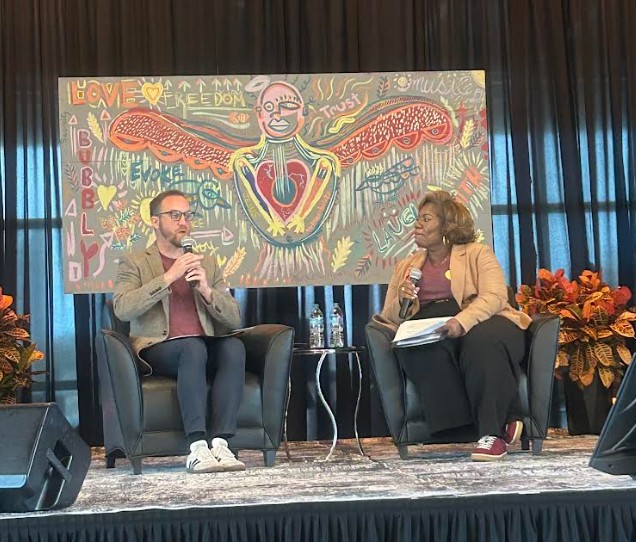
Billed by officials as the “first-of-its-kind”, “The State of Homelessness: Redefining Community” was held at Regions Field and designed to focus on responses to Birmingham’s homelessness challenges and to create a path forward.
“Today is about redefining our community,” said Birmingham mayor Randall Woodfin. “Community is a group of neighbors, friends, it’s colleagues. Community is not just to support our home, but our own … our own includes our homeless, our unhoused population.”
The gathering comes amid the City of Birmingham’s recent commitment of $1.5 million to strengthen housing and homelessness services and part of an effort to align the city with a Continuum of Care’s (CoC) coordinated system— a network to respond homelessness.
One Roof, which conducts the annual Point-in-Time Count used to estimate the region’s homeless population, reported earlier this year that Birmingham and surrounding counties continue to face persistent challenges, including rising housing costs, limited shelter space, and increased demand for mental health and substance-use services. The 2024 count found more than 900 people experiencing homelessness across Central Alabama.
“The whole purpose of this event is to unify our community,” said One Roof executive director, Gordon Sullivan. “This just marks the beginning. This is our starting point.”
The city of Birmingham and local organizations have made various efforts to aid in homelessness relief.
Earlier this year the city agreed to pay $1.2 million for the construction of micro-shelters downtown. And Jimmie Hale Mission plans to build a $4.4 million emergency shelter.
The symposium featured remarks from Woodfin, city officials, and community leaders, as well as service providers who work directly with families and individuals experiencing homelessness.
“Every resident deserves safe, stable housing,” said Alanah Melton, the city’s director of unhoused strategy. “This symposium is about mobilizing our collective power—government, businesses, faith communities, nonprofits, and neighbors—to ensure we meet that responsibility.”
One of the biggest misconceptions is that people “choose” to be homeless, Sullivan said. “In reality, that’s rarely true,” he said. “When we recently surveyed individuals living in encampments, the overwhelming majority told us they want stable housing. Yes, a small number may choose to remain unhoused, but most people are simply navigating barriers, like high rents, health issues or lack of support. The truth is, people want housing, and our community has the power to make that possible.”
The plan to reduce homelessness includes six goals:
- Offer preventative services to avert homelessness.
- Reduce the chronically unsheltered population by 40%, about 200 people, by December 2026.
- Reduce the number and intensity of encampments.
- Reduce the number of youth experiencing homelessness to net zero.
- Develop a sustainable shelter framework to support residents during extreme weather conditions.
- Provide housing insecure residents with access to permanent supportive housing.
To complete these goals, the city and partner organizations plan to implement 12 strategies:
- Provide proactive and accessible early intervention; estimated cost: $1.5 million.
- Assist with the creation of 350 additional beds for emergency and transitional housing; estimated cost: $3.5 million.
- Implement the Built for Zero Plan; estimated cost: $210,00.
- Create a self-sustaining model for operating warming and cooling stations; estimated cost: $250,000.
- Establish regular communication with state and county leaders for coordination of funding, policies and resources; estimated cost: $0.
- Update, create and support the city of Birmingham’s policies and ordinances; estimated cost: $0.
- Reinforce and enhance the city’s existing relationship with the Continuum of Care; estimated cost: $0.
- Reduce homelessness for justice-impacted individuals; estimated cost: $200,00
- Provide resources to reduce opioid overdoses; estimated cost: $1.5 million.
- Address mental health and discharge-related issues; estimated cost: $620,000.
- Utilize a by-name list and case conferencing to more effectively address the individual needs of unsheltered residents; estimated cost: $215,000.
- Address the shortage of affordable permanent supportive housing; estimated cost: to be determined.
To read the full plan, click here