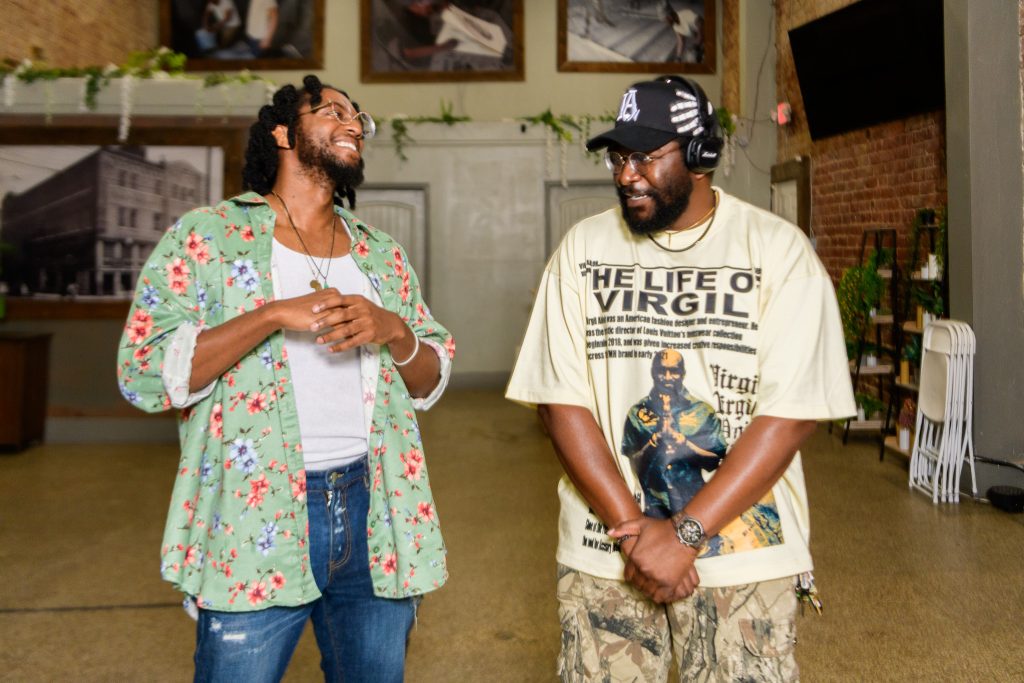
Richard Arrington, Jr. Blvd is going from a one-way street to a two-way street. (Nathan Watson / Bham Now)
birminghamal.gov
The City of Birmingham’s Department of Transportation plans to convert Richard Arrington Jr. Boulevard South through the historic Five Points South district from a one-way street to a two-way street. The conversion will extend from Highland Avenue South to University Boulevard.
This strategic infrastructure improvement is designed to strengthen connectivity within the district, making it easier for residents, visitors, and businesses to navigate the area. In addition to improving traffic flow, the project will enhance safety for motorists, cyclists, and pedestrians by creating more intuitive travel patterns and increasing overall visibility along the corridor.
The conversion is scheduled for the weekend of March 7-8. During the implementation, rolling closures will begin at Highland Avenue South and proceed block by block toward University Boulevard. Traffic control personnel and clear signage will guide drivers safely through the area during the transition.
During the rolling closures, all driveways, parking areas, and properties along the affected blocks will remain accessible to property owners, employees, and visitors at all times. The City is committed to maintaining access while ensuring the safety of the public and work crews.
Motorists are encouraged to use caution, follow posted signage, and allow additional travel time while the conversion is underway. For updates and additional information, please visit the City of Birmingham’s official website or contact the Department of Transportation.
Darrell O’Quinn
According to Darrell O’Quinn, City Council President and Chair of the Birmingham City Council Transportation Committee, one-way streets started in the 1950s to support motorists traveling out of the city to the suburbs.
“In recent times, both our city and cities all over the country have realized that that [one way streets] are harmful to the fabric of our community and our small businesses. What were otherwise slow-moving streets were turned into fast moving thoroughfares catering to people who were just looking to get in and out of the city.
In 2018, Birmingham adopted a Complete Streets ordinance—a policy that redesigns city streets to accommodate not only the movement of vehicular traffic, but pedestrians, bicyclists and public transit users.
A decision regarding a new AI factory and data center project, set to go along Lakeshore Parkway in Birmingham, is temporarily on hold after neighbors raised concerns to city leaders.
Nebius is planning to build its facility at the old Regions Operations Center off Lakeshore Parkway. The company also has plans to build a substation that will be used to provide the massive amount of power the AI factory needs in order to run.
The public hearing by Birmingham’s Zoning Board of Adjustment, Thursday, was attended by many neighbors who say they don’t want to live near an AI factory or data center, citing concerns about how much power it will use, how loud it will be and how close it is to neighbors.
“Their site where they’re building is in the neighborhood, not in the industrial part,” one concerned resident voiced. “It’s in the corporate part for offices. It wasn’t put there for industry, it was for offices and now they want to tear down the offices and put in industry. We don’t want them in the neighborhood.”
Another concern was brought up by the Greater Birmingham Humane Society. Those with the organization say they might have to redesign their new planned facility if this is approved because they’ll have to protect the animals in the outdoor yard. They add this project is also spooking donors of the project because there are so many questions that remain.
“I am truly not even sure this campus is even going to happen anymore,” Allison Black Cornelius, GBHS’ Chief Executive Officer, said. “I’m watching it vaporize before my eyes. I’m just asking for time. I’d like to meet with them.”
Because there were still so many questions from neighbors and city leaders, they postponed any vote Thursday. The board is set to discuss the utility substation again in three weeks.
What’s happening in Alabama’s data center boom?
There are 31 data centers in the state, with the majority in Central Alabama, according to our Get the Facts Data Team. Dozens more sit in the Northeast, Georgia and Texas. Some facilities are already operating; others are still planned or under construction, including Project Marvel in Bessemer and Nebius AI Factory in Birmingham.
What’s the difference between a data center and an AI factory?
IBM describes a data center as a building housing infrastructure to run, deliver, store and manage applications and services.
NVIDIA says an AI factory is not like a traditional data center for general-purpose computing but is built for the entire AI lifecycle.
John Sutter with Nebius said, “In the grand scheme of things, these are both data centers, but this is not where your iCloud photos are.”
The AI company, Nebius, already owns a 75-acre parcel off Lakeshore Parkway that used to be Regions Operations Center. The clearing work has already begun as the company waits for the permits to start construction on what they call an AI factory.
Artificial intelligence involves a lot of data. The proposed AI factory would use 300 MW of power, enough to power tens of thousands of homes. But Nebius has plans to build a substation and switchyard so Alabama Power customers will not be impacted.
Sutter said, “Alabama Power has said that this will not increase or have any effect on rates. And we ensure that we pay our full cost of power.”
Ryan Anderson, Southern Environmental Law Center
Ryan Anderson is an attorney with Southern Environmental Law Center. She said, “They’re going to need that power to come from a power plant, whether that’s a plant miller or a new methane-fired power plant, we don’t know. So just constructing a new substation next to the facility does not address the concerns about its power consumption.”
Anderson is concerned about the power draw and water consumption these AI factories and data centers demand. But Sutter said Nebius wants to partner with Birmingham and address any environmental concerns or worries residents may have. He said the factory will benefit the community, especially its schools. “There will be tens of millions of dollars annually in tax revenue associated with this facility. There’ll be hundreds of construction jobs associated with this facility. It’s about $88 million is what the city and the county schools will receive off this project.”
Anderson countered, “Communities shouldn’t have to choose between clean air and clean water and having a robust education system and a thriving economy. So, if that’s the choice that people are being asked to make, I think it’s an unfair one.”
UAB Hospital has once again earned international recognition, securing a place as Alabama’s top-ranked hospital on Newsweek’s prestigious list of the World’s Best Hospitals 2026.
Out of more than 400 hospitals evaluated this year in the U.S., UAB was ranked No. 59.
This annual ranking, presented in collaboration with Statista Inc., a leading global data and business intelligence platform, highlights top-performing hospitals across various medical specialties.
UAB was also awarded as a leader in patient experience.
“UAB’s continued recognition as one of the nation’s top health care destinations reflects the outstanding work our faculty and staff deliver every day,” said Dawn Bulgarella, CEO of UAB Health System. “This honor, grounded in rigorous hospital quality metrics, the expertise of medical professionals and the voices of our patients, underscores the strength of our care. Combined with our leading research and innovative therapies, these results reaffirm UAB as the destination of choice in Alabama, across the Southeast and beyond.”
The UAB Health System, the largest health system in the state, continues to expand its reach and impact across the state, now operating as a nearly $7.5 billion enterprise with 133 locations serving all 67 counties in Alabama and beyond. In November 2024, UAB Health System acquired St. Vincent’s Hospitals, increasing its total bed count to 3,173. The system now includes UAB Hospital, UAB St. Vincent’s, UAB Medical West, Baptist Health in Montgomery, UAB Hospital- Callahan Eye, and all associated sites of care of the owned and affiliated entities.
With a workforce of more than 30,000 physicians, health care professionals and staff, UAB Health System provides care to some of Alabama’s most critically ill patients and serves almost 1.4 million unique patients. UAB promotes sustainable rural health care throughout the state by supporting associate hospitals of the UAB Health System, like Russell Medical Center, Whitfield Regional Hospital and John Paul Jones Hospital.
This year, four key data sources were used to determine the winner: hospital quality metrics, recommendations from medical experts—including doctors, hospital managers and other healthcare professionals—results from patient surveys, and findings from the Statista PROMs Implementation Survey.
The full list of honorees was released February 25 and is available on Newsweek’s website.
The Self-Care Mastermind series at Birmingham Public Library is held on the first Tuesday of each month and covers topics including diet. (Adobe Stock)
By Roy L. Williams | Birmingham Public Library
As weight-loss drugs surge in popularity (and cost) across the country, many women are searching for sustainable, affordable ways to improve their health in 2026. March is Women’s History Month, and the Birmingham Public Library (BPL) is encouraging women to make self-care a priority by taking advantage of its free self-care workshop series.
On Tuesday, March 3, 2026, from 5:30 to 6:30 p.m., BPL will host:
Self-Care Mastermind: Community Edition
Topic: “Mindful Eating: What’s Eating You?”
Location: Central Library, First Floor
2100 Park Place, Birmingham, AL 35203
Cost: Free and open to the public
The March session will focus specifically on healthy eating habits and nutrition, helping participants recognize the signs of emotional and mindless eating while learning practical strategies to build healthier relationships with food.
“Mindful eating encourages participants to slow down and reflect on how they nourish themselves,” said C.J Wade, Self-Care Mastermind instructor. “Instead of letting stress or emotions dictate choices, attendees will learn tools to support long-term wellness.”
The Self-Care Mastermind series is held on the first Tuesday of each month and covers topics including diet, exercise, meditation, relaxation, journaling, and stress management.
The program is led by Christina (C.J.) Wade, a Birmingham-based licensed massage therapist and certified health coach who provides practical, accessible guidance in a supportive community setting.
Women are especially encouraged to attend during Women’s History Month as part of a renewed commitment to mental, emotional, and physical well-being for the remainder of 2026.
For more information, click on the calendar on the Birmingham Public Library website www.cobpl.org. Follow BPL on social media at BPL (Facebook and X) or BPLpics on Instagram.
The City of Birmingham said it will not move forward with plans to open a daytime “Urban Oasis” for people experiencing homelessness at 1312 First Ave. N.
Earlier this week, the Birmingham City Council approved the $168,000 purchase of the lot for the proposed project, which was expected to include restrooms, lockers and a dog park.
On Friday, a city spokesperson sent a statement to CBS 42 that reads:
“After further discussions with the property owner and business owners in the Switch District, we have decided to pursue a different location for the proposed Urban Oasis.
Our priority is to create a safe, service-connected daytime space that gives our unhoused neighbors access to restrooms, secure storage, shade, and direct connections to housing support, mental health care, and addiction treatment.
We also have a responsibility to listen, collaborate, and make sure we are choosing the right site to meet the need while being a good neighbor.
We are actively working to identify an alternative property and will share an update as soon as a new location is selected.
We remain committed to bringing this project to fruition and to continuing the broader work already underway to expand affordable housing, strengthen outreach and service coordination, and support residents through crises with real, lasting solutions.”
A 1930 view of the Lyric Theatre at 18th Street and 3rd Avenue North. (Photograph From The Birmingham News Photograph Collection At The Birmingham Public Library Archives)
Compiled by The Birmingham Times
As we bring Black History Month to a close here’s a look at some historic Birmingham milestones since the city’s founding.
1871—City of Birmingham founded; now the state’s most populous city, Birmingham was established at the crossing of two rail lines near one of the world’s richest mineral deposits.
1885—Birmingham Barons baseball team originally established as Birmingham Coal Barons.
1902—Woodward Building, construction completed on the first of four steel-frame skyscrapers that would make up Birmingham’s “Heaviest Corner on Earth.”
The Tuggle Institute, a boarding school for African American children in Birmingham Alabama, pictured in 1906. (Public Domain)
1903 —Social worker Carrie A. Tuggle opens the Tuggle Institute and School, the first orphan home in Alabama for African American boys. The Institute operated until Tuggle’s death on Nov. 5, 1924, and was later renamed Tuggle Elementary School in 1936.
1904 —Vulcan Statue, the world’s largest cast-iron statue, created as Birmingham’s entry in the St. Louis World’s Fair, was sculpted by Giuseppe Moretti.
1914—Birmingham’s Lyric Theatre was established as one of the first in the South where Black and white audiences could see the same show for the same price, though Black sat in an isolated section with inferior accommodations
1918—Birmingham College and Southern University merged to establish Birmingham-Southern College.
1925—The Pittsburgh of the South, Birmingham, is the largest cast iron and steel producer in the Southern U.S.
The Slossfield Community Center campus included a health clinic, a maternity ward, a recreational center, and an education building. The complex was built between 1936 and 1939 by ACIPCO (American Cast Iron Pipe Company). (National Archives Record Group 69-N)
1939—Slossfield Health Clinic, located in a neighborhood surrounding ACIPCO’s plant, considered one of Birmingham’s most blighted, opens.
1941—The Sisters of Charity of Nazareth (SCN) assume responsibility for a small health clinic in the predominantly African American community of Ensley near Birmingham, Alabama. The clinic later becomes Holy Family Hospital.
1941—World War II. The demand for steel during the war brought Birmingham out of the Great Depression.
1948—Slossfield’s medical center closes in 1948 after World War II. The rest of the Slossfield Community Center campus closed in 1954.
1951—Birmingham Museum of Art, currently home to one of the finest collections in the Southeast, with extensive holdings from around the globe dating from ancient to modern times, opens.
1954—A.G. Gaston Motel founded by entrepreneur and activist A.G. Gaston to provide higher-class service to Black visitors.
The Rev. Fred L. Shuttlesworth and other local Black ministers established the Alabama Christian Movement for Human Rights (ACMHR) during a mass meeting at Birmingham’s Sardis Baptist Church. (File)
1956—The home of Birmingham minister and Civil Rights leader Fred Shuttlesworth is bombed. Although the structure is severely damaged, Shuttlesworth emerges uninjured.
During a mass meeting at Birmingham’s Sardis Baptist Church, Shuttlesworth and other local Black ministers establish the Alabama Christian Movement for Human Rights (ACMHR). Founded in response to the State of Alabama’s eight-year ban on the NAACP, ACMHR was central to the civil rights movement in Birmingham.
The Freedom Riders arrive at the Greyhound bus terminal in Montgomery, where they are attacked by an angry mob. The Freedom Ride, an integrated bus trip from Washington, D.C., through the Deep South, was formed to test the 1960 Supreme Court decision prohibiting segregation in bus and train terminal facilities.
1963—After previously establishing the ACMHR and the Southern Christian Leadership Conference (SCLC), Shuttlesworth invites Rev. Martin Luther King, Jr. to Birmingham to lead what becomes the Birmingham Campaign for Desegregation. King writes Letter From Birmingham Jail.
Sixteenth Street Baptist Church was bombed, killing four young girls in an attack against the Civil Rights Movement and humanity.
1966—Oscar Adams Jr. becomes the first African American to join the Birmingham Bar Association.
1968—Arthur Shores was appointed to the Birmingham City Council, making him the first African American to serve as a councilman.
1970—The Sisters of Charity of Nazareth (SCNs) transfer ownership of Holy Family Hospital to a local non-profit organization, which was renamed Community Hospital. By 1986, the facility was sold and operated as Medical Park West until its closing in 1988. The facility would briefly reopen in 1989 as Community Hospital with 22 beds, only to close it down for good soon thereafter.
1974—J. Richmond Pearson and U.W. Clemon were the first African Americans elected to the Alabama State Senate since Reconstruction.
1980—Oscar Adams Jr. was appointed to the Alabama Supreme Court, making him the first African American justice to hold that office.
1984—J. Mason Davis becomes the first African American president of the Birmingham Bar Association. He is also the first minority adjunct professor at The University of Alabama School of Law, serving from 1972 to 1997.
1986—Reuben Davis and Chris McNair were elected to the County Commission, the first district by district election, and are the first African Americans to serve on the commission.
1991—Carole Smitherman appointed to become the first African American woman to serve as a circuit court judge in Alabama
The Birmingham Civil Rights Institute. (File)
1992—Birmingham Civil Rights Institute opens its doors at Kelly Ingram Park in the Civil Rights District.
1993—Alabama Jazz Hall of Fame opens.
2002—Shelia Smoot elected first Black female Jefferson County Commissioner.
2003—Helen Shores Lee becomes the first African American woman to serve as a judge on the Jefferson County Circuit Court.
2005—Condoleezza Rice, a Birmingham native, is named U.S. Secretary of State.
2008-11—Jefferson County and creditors attempt to reach a settlement of the $3.14 billion sewer debt, but any deal would need to erase $1 billion or more of that debt.
2009—Carole Smitherman becomes Birmingham’s first African American female mayor.
2011—A massive storm in April, causing numerous powerful tornadoes, rips through the southeastern United States, killing 250 people in Alabama, including 20 people in Jefferson County communities of Pleasant Grove (10), Concord (6), Cahaba Heights (1), Pratt City (1), Forestdale (1), and McDonald Chapel (1).
In 2012 the Jefferson County Commission voted 3-2 to close the inpatient care unit and emergency room at Cooper Green Mercy Hospital. (File)
2012—Cooper Green Mercy Hospital downsized. The Jefferson County Commission votes 3-2 to close the inpatient care unit and emergency room at Cooper Green following weeks of debate and protests from community leaders who have begged the county to continue operating the facility for the sick and poor.
2016—Lynneice Washington elected District Attorney for the Bessemer Cutoff, the first African American DA in the state of Alabama.
2016—Theo Lawson was named the first African American Jefferson County attorney.
2016—Representative Terri Sewell introduces legislation leading to Birmingham Civil Rights National Monument designation by presidential proclamation one year later.
2017—John Henry joins the Jefferson County Commission Finance Department and becomes the county’s first Black chief financial officer.
2017—Danny Carr and Mark Pettway were elected the county’s first Black district attorney and first Black sheriff, respectively.
2019—Walter Gonsoulin was named the first permanent African American superintendent of the Jefferson County School System
2020—Felicia Rucker-Sumerlin was named the first female Deputy Chief in the 200-year history of the Jefferson County Sheriff’s Office.
2020—Elisabeth French becomes the first woman selected to serve as Presiding Judge in Jefferson County’s 200-year history. She will oversee the 10th Judicial Circuit, the largest in Alabama’s Judicial System.
2022—Dr. Adolphus Jackson of Birmingham is elected President of the Alabama Dental Association, the first African American to serve as president of the state Association.
2022—Birmingham Mayor Randall Woodfin issues a proclamation declaring March 18 Reverend Fred Shuttlesworth Day, the 100th anniversary of the leader’s birth.
2024—Myrna Carter Jackson, a Birmingham civic leader and Foot Soldier who participated in marches, sit-ins, demonstrations, and other Civil Rights activities, dies. She was 82.
2025—Judge Carole Smitherman retires after 50 years in law and politics in Birmingham, including being the first Black woman hired as a deputy district attorney in Jefferson County and becoming the city’s first Black woman municipal and circuit court judge.
For decades, Bishop Calvin Woods Sr., was one of Birmingham’s leading voices for equality. (File)
Source: The Birmingham Times, 1963: How The Birmingham Civil Rights Movement Changed America and the World; City of Birmingham Public Library; Associated Press; blackpast.org; Politics and Welfare in Birmingham, 1900–1975.
Lawmakers passed a bill last week and named it after Huntsville businessman and cancer survivor David McElhaney and AL.com columnist Roy S. Johnson, pictured. (Provided)
Gov. Kay Ivey has signed into law a bill to require insurance companies to cover prostate cancer screening at no cost for men who are at high risk of the disease.
The bill was sponsored by Sen. Steve Livingston, R-Scottsboro, and Rep. Jeremy Gray, D-Opelika. The amendment to rename the bill was brought forth by state Rep. Juandalynn Givan, D-Birmingham.
Lawmakers passed the bill last week and named it after Huntsville businessman and cancer survivor David McElhaney and AL.com columnist Roy S. Johnson.
Johnson reported that one in eight men will be diagnosed with the disease in their lifetime, according to the American Cancer Society. One in six Black men will get such news.
“I was diagnosed with prostate cancer in July and, well, it pretty much took command of my days. And nights,” Johnson wrote earlier this month.
“Now, more than six months after my diagnosis, I almost forget I have cancer, that I’m a member of the fraternity of one in eight men who’ll be diagnosed with the disease in their lifetime, one in six Black men.”
Prostate cancer is highly treatable and early detection is critical.
Screening procedures covered under the bill include, at a minimum, a prostate-specific antigen (PSA) blood test and a digital rectal examination.
Insurers are required to cover screening for men over 50 at no cost.
Men over 40 who are at high risk are also covered at no-cost.
The bill spells out the criteria that define high risk:
Black men of any age.
Men who have a father, brother, or son who have been diagnosed with prostate cancer, died of prostate cancer, or received a cancer diagnosis associated with a higher risk of prostate cancer.
Carry a genetic marker known to be associated with an increased risk of prostate cancer.
The law takes effect Oct. 1.
One in eight men will be diagnosed with the prostate caner in their lifetime, according to the American Cancer Society. One in six Black men will get such news. (Adobe Stock)
The City is accepting applications for the 2026 ACE class. Participants will be prepared to act, serve, and lead by gaining direct exposure to city operations, leadership, and engagement opportunities. (City of Birmingham)
birminghamal.gov
The City of Birmingham is offering opportunities for residents to connect directly with local government through its Academy of Civic Engagement, also called ACE.
Since 2019, this city-wide leadership initiative has aimed to empower residents with a deeper understanding of how municipal government works — and how they can serve and lead within their communities. More than 1,400 residents have participated, going on to become neighborhood leaders and active participants in the development of their community.
The City is accepting applications for the 2026 ACE class. Participants will be prepared to act, serve, and lead by gaining direct exposure to city operations, leadership, and engagement opportunities. Classes begin April 9.
In addition, the city has launched a special version of ACE called CODE ACE, focused on code enforcement and public works. It is designed to help residents better understand city services, ask questions, and learn how to take an active role in keeping their neighborhoods strong.
CODE ACE launches Thursday, March 5, and will take place each Thursday that month, providing residents with direct access to city leaders and departments responsible for maintaining safe, vibrant neighborhoods. Each session will be held from 5:30 to 6:30 p.m. at the Birmingham Public Library, Central Branch (Downtown), offering clear, practical information and opportunities for engagement.
CODE ACE Session Schedule:
March 5 – Property Maintenance (Housing & Environmental Code Enforcement)
March 12 – Zoning Compliance
March 19 – Department of Public Works (trees, trash, brush, and more)
March 26 – SeeClickFix resident reporting platform
Newly constructed Holy Family Hospital, 1901 19th Street Ensley, Birmingham, AL 35218, 1954. (Birmingham, Ala., Public Library Archives)
By Sym Posey | The Birmingham Times
(Black History Month Special)
For decades, Holy Family Hospital stood in Ensley as far more than a medical facility. For Birmingham’s Black residents—particularly during segregation—it was a place of dignity, access, and compassion at a time when those things were routinely denied elsewhere.
“It was really the only hospital for Black people,” recalled Circuit Court Judge Tamara Harris Johnson, whose family history is deeply tied to the hospital. “When my family moved back to Birmingham (in 1961 from St. Louis, Missouri), it was the hospital.”
Circuit Court Judge Tamara Harris Johnson (File)
Founded through the collective efforts of Black physicians, Catholic nuns, and community supporters, Holy Family Hospital emerged to meet a critical need. Among those involved in its early financing and leadership was Harris Johnson’s grandfather, Samuel Francis Harris, M.D., who, according to a family-held newspaper article, helped fund the hospital, served as its first president, and delivered the hospital’s first baby.
Long before Birmingham became well-known for its excellent medical facilities, primarily centered around the University of Alabama at Birmingham (UAB) Health System, with UAB Hospital consistently ranked as Alabama’s best and a leading academic medical center nationally, there were hospitals and medical centers that focused on African Americans due to segregation.
One was the Holy Family. Another was the Slossfield Community Center campus, which once included a health clinic, maternity ward, recreational center, and education building. The complex was built between 1936 and 1939 by ACIPCO (American Cast Iron Pipe Company), with public funding, as an extension of its health program for workers and their families.
In the 1930s, Slossfield was a neighborhood surrounding ACIPCO’s plant where thousands of African Americans lived in shotgun houses without plumbing on dirt streets. Even during the Great Depression, this area was considered one of Birmingham’s most blighted, where 10 babies died out of every 100 born.
The health clinic opened on July 1, 1939, and provided obstetrics and prenatal care by house calls or in-office visits. The facility also provided tuberculosis treatment, dental care, general pediatrics, and venereal disease detection by Jefferson County staff. The health clinic served as a training center for graduate students and provided public health education. The Slossfield Community Center served 50,000 Black citizens in one of the poorest neighborhoods in the Southeast.
Due to the high demand for maternity services, Holy Family Hospital gradually shifted its focus primarily to maternity care. Between 1946 and 1950, Holy Family Hospital conducted over 1,500 deliveries, with most of them attended by African American doctors. (Birmingham, Ala., Public Library Archives)
Holy Family Hospital
During segregation, even when Black doctors were granted privileges at white hospitals, their patients were often subjected to degrading treatment, said Harris Johnson. She recalled that her father, Samuel Elliott Harris, M.D., an OB-GYN and one of only two Black obstetricians practicing locally at the time, refused to admit patients anywhere but Holy Family.
“At the time, Black patients could be admitted (at other hospitals), but they would be placed in the basement, where the pipes were leaking on them,” she said. “So, he wouldn’t even admit any of his patients to other hospitals.”
In 1941, the Sisters of Charity of Nazareth (SCN) assumed responsibility for a small health clinic in the predominantly African American community of Ensley near Birmingham, Alabama. The clinic was the only place to obtain health care for most residents, as it was practically unheard of for African Americans to gain admittance to the hospitals in Birmingham. When African Americans did receive health care, they were usually treated in the basement to avoid mixing with the white patients. Local doctors, both Black and white, provided services along with SCN, lay nurses, and volunteer interns. In addition to providing much-needed health services, the SCNs also desired to provide African American doctors the opportunity to use their knowledge and skills to serve their community.
Holy Family Hospital served as a professional home for many of Birmingham’s Black physicians, including obstetricians, pediatricians, and surgeons, whose children still live and work in the city today. Harris Johnson named doctors such as Dr. Herschel Hamilton, Dr. Tyree Bearfield Pendleton and others whose practices helped sustain the hospital and serve generations of families.
But what distinguished Holy Family most was its philosophy of care.
“It was very family-oriented,” she said. “It was not stuffy like you would think most hospitals are. It was really like a family hospital—seriously.”
The clinic soon became overcrowded and needed expansion. Options were few and building materials were scarce due to the outbreak of World War II. The Sisters, with the help of a local construction expert, devised a plan to move and join three small houses together to create a larger facility.
The new structure provided a 12-bed ward, a chapel, a dispensary, offices, and a kitchen. The clinic also assumed a new name: ‘Holy Family Hospital.’ The demand for maternity services was so great that Sisters eventually limited the hospital to those services. Between 1946 and 1950, there were over 1500 deliveries, mostly attended by African American doctors.
Care was often provided regardless of a patient’s ability to pay. According to Harris Johnson, Black doctors at Holy Family rarely turned anyone away.
“I’m not aware that they turned anybody around because they didn’t have the money,” she said. “It was sort of like an IOU—‘Well, when you get it, you pay.’”
She recalled accompanying her father and grandfather on home deliveries, where payment might come not in cash, but in food.
“A lot of the Black doctors were getting paid with fried chicken, pies—whatever people could pay them with,” she said. “The doctors would just take it because they believed people should have dignity.”
Years later, while serving as a city attorney, she was approached by strangers who shared stories of her father delivering their children when they could not afford medical care.
“They told me they couldn’t pay him,” she said. “But they said if I ever needed anything, just let them know—and they meant it.”
That ethic of mutual care, she believes, defined Holy Family Hospital.
“It wasn’t a unique story,” she said. “That was exhibited among many of the physicians here.”
Despite its profound impact, the hospital’s closure left a painful void—and, she says, a troubling silence around its legacy.
“They’ve just let history die,” she said. “And then people started rewriting it in their own way.”
She expressed particular concern over recent claims circulating on social media that businessman and civil rights figure A.G. Gaston—her uncle by marriage—helped fund Holy Family Hospital with unlawful lottery money.
“He certainly would not have risked his reputation,” she said. “And when my family moved back here, I never heard that he had contributed one dime toward Holy Family Hospital.”
Today, she is unaware of any formal efforts to preserve the hospital’s history, which troubles her deeply.
“It was really a shame that it closed,” she said. “I don’t see why it couldn’t have stayed open along with the other hospitals.”
Workers inside laundry room of Holy Family Hospital in Ensley. (Birmingham, Ala., Public Library Archives)
Closure
As integration became more common and the Civil Rights Act of 1964 was passed, the need for a separate African American hospital diminished. In response to these changing circumstances, in 1970, the Sisters of Charity of Nazareth (SCNs) transferred ownership of Holy Family Hospital to a local non-profit organization, which was renamed Community Hospital.
The SCNs were known for their commitment to health care and social justice, and for their history of serving underserved communities. In 1941, the SCNs had accepted the invitation and assumed responsibility for a small health clinic in Ensley. This clinic was a vital resource for the community, as it was often the only place where African Americans could access healthcare during a time when racial segregation and discrimination were rampant.
By 1986, the facility was sold and operated as Medical Park West until its closing in 1988. The facility would reopen briefly in 1989 as Community Hospital with 22 beds, only to close for good soon thereafter.
The Slossfield Community Center campus included a health clinic, a maternity ward, a recreational center, and an education building. The complex was built between 1936 and 1939 by ACIPCO (American Cast Iron Pipe Company). (National Archives Record Group 69-N)
Slossfield Community Center
The Slossfield Community Center campus included a health clinic, a maternity ward, a recreational center, and an education building. The complex was built between 1936 and 1939 by ACIPCO (American Cast Iron Pipe Company), with public funding, as an extension of its health program for workers and their families. The Art Deco-style, solid concrete buildings were designed by E. B. Van Keuren and constructed by the Works Progress Administration.
In the 1930s, Slossfield was a neighborhood surrounding ACIPCO’s plant where thousands of African Americans lived in shotgun houses without plumbing on dirt streets. Even during the Great Depression, this area was considered one of Birmingham’s most blighted, where 10 babies died out of every 100 born.
The complex was located between 19th and 20th Streets and between 25th Avenue North and 25th Court North in the Slossfield community between North Birmingham and ACIPCO-Finley. The site, which formerly housed Birmingham’s municipal stables, was donated in exchange for the cost of relocating the stables. It now abuts the right-of-way for I-65, just north of the Finley Boulevard exit.
The health clinic, which opened on July 1, 1939 and expanded in 1941 from 28 to 39 rooms, was built and staffed with assistance from the Jefferson County Board of Health, the Jefferson County Anti-Tuberculosis Association (through its Birmingham Health Association, a subsidiary serving the black community), the Julius Rosenwald Fund, the Alabama State Department of Health, and the Children’s Bureau.
The health clinic opened on July 1, 1939. In an early form of universal health care, patients had to demonstrate an inability to afford private health care. The clinic provided obstetrics and prenatal care by house call or in-office visits. The facility also provided tuberculosis treatment, dental care, general pediatrics, and venereal disease detection by Jefferson County staff. The health clinic served as a training center for graduate students and provided public health education.
The neighborhood lacked significant maternity care. For almost a decade, Dr. Thomas Boulware worked at Slossfield’s 12-bed clinic dedicated to providing better prenatal care for mothers and their babies.
Within the first three years, the stillbirth rate, and neonatal deaths at Slossfield were cut in half. Boulware also trained Black physicians, including Dr. Robert Stewart, who became Alabama’s first Black OB/GYN practitioner. Dr. Boulware retired in 1977 after delivering 21,000 babies over a 48-year career.
Closure
Slossfield’s medical center was closed in 1948 after World War II. The rest of the Slossfield Community Center campus closed in 1954. The recreational center and education building were sporadically used until the late 1970s, mainly as storage for the Birmingham City school system. The Slossfield Community Center was placed on the National Register of Historic Places on May 29, 2008. After sitting abandoned for over 30 years, the Salvation Army had expressed interest in the Slossfield Community Center.
The Slossfield Community Center was added to the National Trust of Historic Places in May of 2008. It was purchased in 2018 by The Salvation Army, with plans to use it once again as a core community center.
1 of 9
Scenes from the abandoned Slossfield Community Center campus health clinic in 2016. (ABANDONEDSOUTHEAST.COM)
Booker T. Washington K-8 School dedicated a newly-installed historic marker commemorating the school as one of the first two brick school buildings for Black children in Birmingham. (Birmingham City School)
Birmingham City Schools
Booker T. Washington Elementary School in Birmingham marked a historic day with the unveiling of a new monument that details the school’s history.
The marker is now located next to the front doors of the school, which was first established in 1909 before moving to its current building a hundred years later.
The school is named after Booker T. Washington, a man born enslaved who went on to establish Tuskegee University.
As part of the unveiling, the school held a special ceremony involving students and staff, alongside a reading of the new marker.
Booker T. Washington K-8 School dedicated a newly-installed historic marker. (Birmingham City School)
Absenteeism Down Across BCS
Over the past two years, Birmingham City Schools has reduced chronic absenteeism by nearly 50%, down to 14% this year versus 29% in 2023.
Under Dr. Mark Sullivan’s leadership, Birmingham City Schools has made a dent in chronic absenteeism. (File)
Superintendent Dr. Mark Sullivan talked about the improvements on attendance as well as the on-going Winter Intersession.
“Kids can’t learn if they’re not in school, and I think part of the reason why we’ve seen great improvements academically in our system is because we are making sure that our kids are in school,” said Sullivan.
The trend in decreasing chronic absenteeism is also reflected in attendance for Winter Intersession, with approximately 6,000 out of more than 20,000 enroll students showing up for the optional school period.