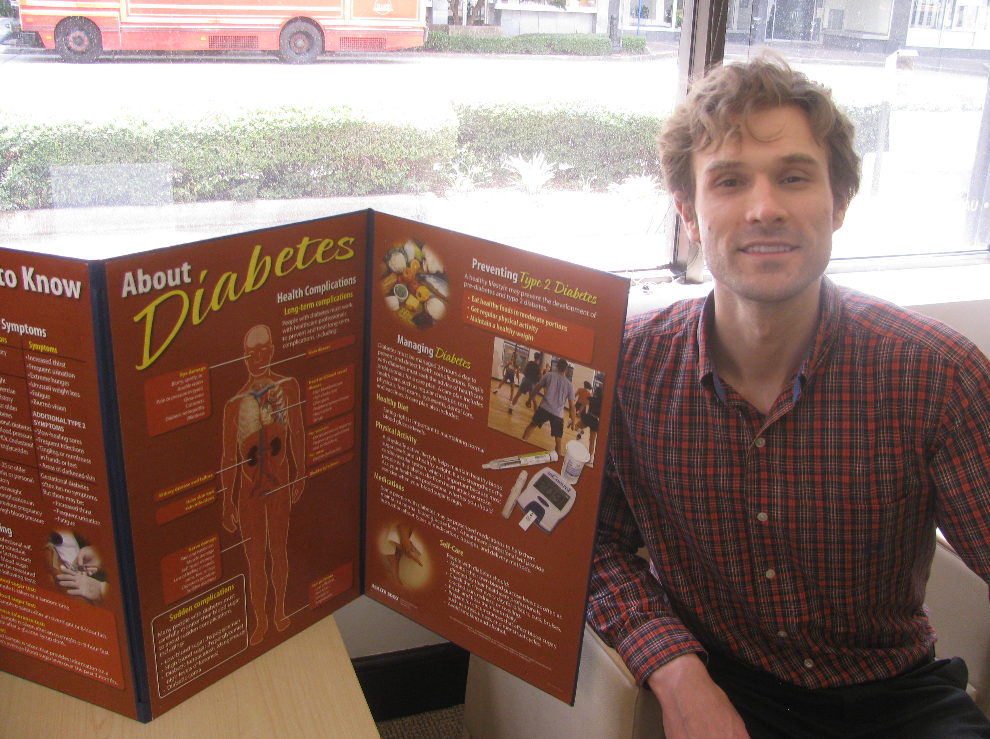
A high percentage of visitors to the UAB Health Smart Center in downtown Birmingham are afflicted with diabetes and/or high blood pressure—problems that can lead to kidney and heart ailments, said Adam Britt, a dietitian and operations chief of the wellness center. But there are ways to take control of such issues, he added.
The Health Smart Center takes a preventive approach in a state where nearly 32 percent of residents are considered obese and 22 percent of adults smoke.
“An ounce of prevention is worth a pound of cure,” Britt said. “If you can develop lifestyle changes on the front side, you can avoid problems” like diabetes, high blood pressure, and kidney failure.
The University of Alabama at Birmingham (UAB) center’s comprehensive preventive evaluations focus on body fat percentage, blood pressure, cholesterol panels, and diabetes screening. Afterward, results are discussed with a nurse, nutritionist, and exercise specialist to set goals and track progress. Additional screenings are provided throughout the year for dental, vision, and respiratory issues.
“Some people who come in are already trying to improve their lives,” said Britt, who added that Health Smart services are free of charge.
The center accepts walk-in clients, but most patients make appointments. Services include health-risk assessments, as well as nutritional counseling to help clients improve their eating habits. Evaluations are also conducted to help clients learn the components of an effective fitness program, according to Health Smart literature.
One of the major illnesses among Health Smart participants is diabetes, which according to the American Diabetes Association (ADA) and the Centers for Disease Control and Prevention (CDC), is growing at an epidemic rate in the U.S. Nearly 30 million Americans are dealing with diabetes and its consequences, which can include heart disease, stroke, amputation, end-stage kidney disease, blindness—and even death.
More than 610,000 Alabamians have diabetes, according to an ADA report. Here are some tips to help you and your loved ones manage the illness:
Follow your food plan. Know what, when, and how much you eat; all affect blood-sugar levels.
Maintain a healthy weight. Keep off extra pounds by carefully following a food plan and getting plenty of exercise every day.
Get regular physical activity. Being more active helps lower blood sugar and burn extra calories. Try 30 to 60 minutes of light aerobic exercise like walking every day. Talk with your doctor before starting a new exercise plan.
Check blood-sugar levels. Your health-care provider will show you how to use a meter to check your levels.
Reduce heart disease risks. People with diabetes are more likely to develop heart disease and have a heart attack or stroke. Talk to your doctor about quitting smoking, controlling blood pressure, and lowering cholesterol.
Be mindful of overall health. People with diabetes can get sick quickly and often. Infections are common, particularly in the gums and feet. It is recommended that you brush and floss your teeth daily. Also, check your feet daily for cuts, blisters, or any sign of infection.
Take your meds. If you are prescribed insulin, diabetes pills, or other medication, take it exactly the way your health-care provider tells you.
Work with your health-care team. Let all your physicians know if your blood sugar is too high. Have your blood and urine checked. Get eye, feet, and dental exams. Have your blood pressure checked regularly.
UAB HealthSmart is located at 301 20th Street North and can be contacted at www.uab.edu/healthsmart and UABHealthSmart@uabmc.edu. The contact number is 205.996.2304.
UAB's kidney program has performed more living donor transplants than any other program in the United States since 1987.
By Tyler Greer
UAB News
UAB’s kidney program has performed more living donor transplants than any other program in the United States since 1987.
New Living Donor Navigator Program tailored to African-Americans aims to reduce number of patients awaiting transplant.
In a first-of-its-kind national event focused on increasing organ donation, the White House announced in June at the Organ Donation Summit that the University of Alabama at Birmingham Division of Transplantation will be part of two national efforts to increase access to organ transplants and reduce the number of patients awaiting kidney transplantation.
The endeavors, designed specifically to increase the number of living donor kidney transplants, will tailor a Live Donor Champion model for African-Americans and teach patients in need of transplant how to set up their Facebook page in the way that best tells their story to increase their chances of finding a living kidney donor.
“The institutional commitment UAB has made to the Division of Transplantation and the Comprehensive Transplant Institute and the ingenious work of our transplant team have cemented our transplant program as one of the best in the nation,” said Selwyn Vickers, M.D., senior vice present for Medicine and dean of UAB’s School of Medicine.
“We have the ability to provide opportunities for lifesaving treatments beyond standard clinical techniques and have the infrastructure in place to properly educate and inform patients to give them opportunities for transplant that they may not have had just a few years ago,” he said. “We are excited to support the White House transplantation efforts, and we will continue our mission to provide the best care in the world for our citizens right here in Alabama while at the same time striving to have an impact on health care across the country.”
The programs
The Live Donor Champion model for African-Americans is part of a comprehensive program to teach patients how to leverage their personal connections and social networks to raise awareness about the need for organ donors and to help identify potential live donor candidates. The UAB program will be known as the Living Donor Navigator Program, according to Michael Hanaway, M.D., surgical director of the Kidney Transplant Program, and Jayme Locke M.D., director of the Incompatible Kidney Transplant Program.
“African-Americans face a significantly higher incidence of end stage renal disease and disproportionately low rates of live donor transplantation, so the need in this community is real and vital,” said Locke, who will oversee the UAB program. “The Living Donor Navigator Program, which has been tested at Johns Hopkins University and other places, is associated with an over fivefold increase in identification of potential live donor candidates. We are excited to launch this program at UAB and hope we will see the same type of impact in the communities we serve.”
The Living Donor Navigator Program will help patients identify someone in their family who can be a Living Donor Champion. The person they identify will be trained by UAB on the donation process and how to approach potential donors for their loved one in need. Johns Hopkins University, Northwestern University and UAB will all lead different initiatives within the Live Donor Champion model.
In the second program, UAB will be part of a collaborative effort with Johns Hopkins University designed to help patients in need of live donor transplants leverage their social networks to find potential living kidney donors. The program will teach transplant patients how to use a specially designed Facebook app to share their story. The hope is that this will help those in need have a better opportunity to find a living donor. Locke, the co-principal investigator, says UAB patients in need of kidney transplants will begin participating in both programs by the end of the year.
“The UAB Department of Surgery is nationally and internationally known as one of the best departments in the country with strong clinical programs and a long history of making important contributions to the field, and this opportunity to support White House efforts to increase living transplant donation raises that bar even further,” said Herbert Chen, M.D., chair of the Department of Surgery and surgeon-in-chief at UAB Hospital. “This is an incredible opportunity for the people of Alabama and throughout the Southeast who are in need of a transplant. We are excited for what these programs can potentially do for them.”
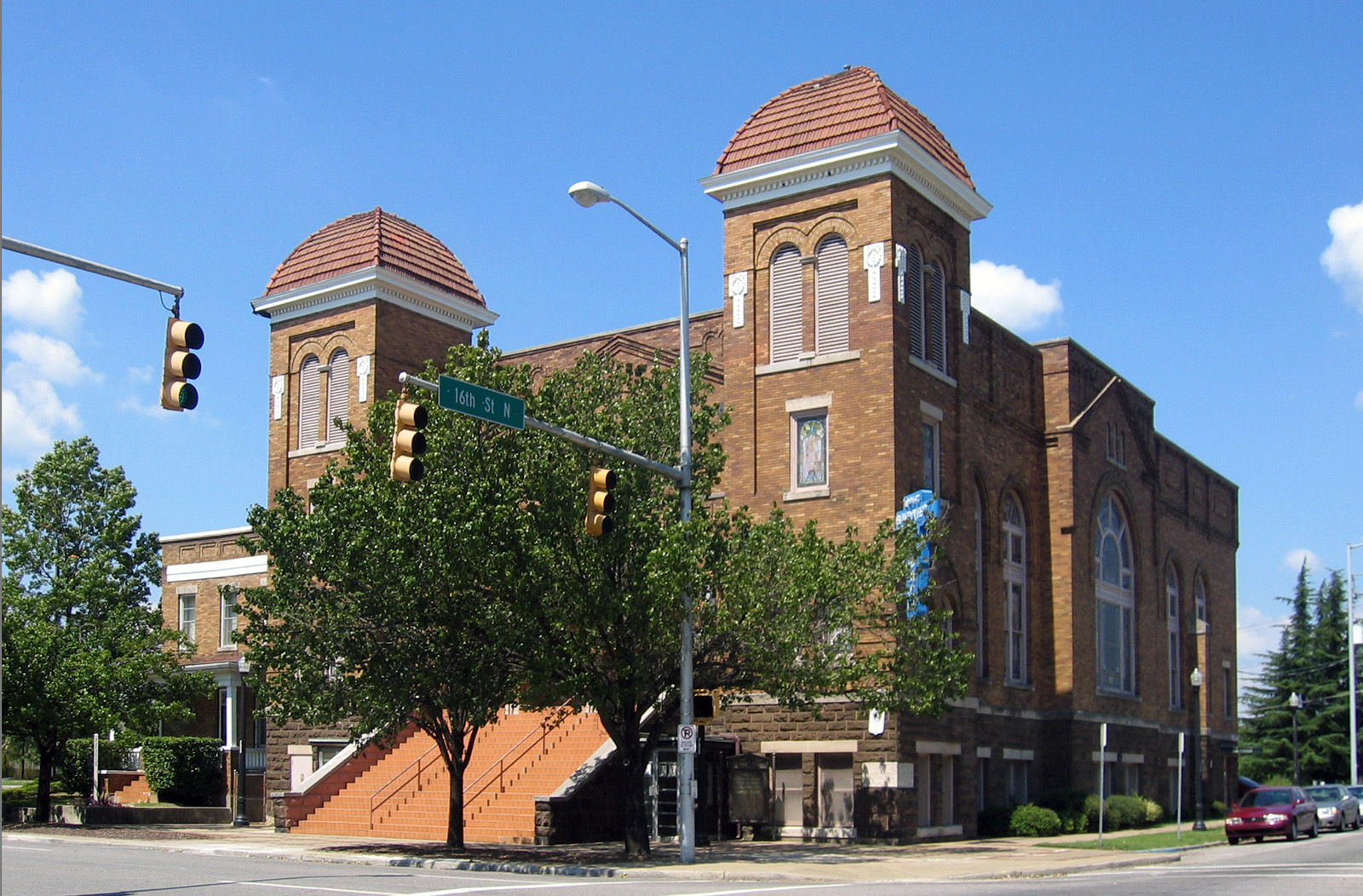
The Sixteenth Street Baptist was organized in 1873 as the First Colored Baptist Church of Birmingham. Throughout its history, Sixteenth - which became known as "Everybody's Church" - was used as a meeting place, social center, and lecture hall for black citizens. (Wikimedia Commons)
Mayor William Bell announced Tuesday that Birmingham and other locations throughout the state of Alabama and the Southeast are in line to become world heritage sites.
Other sites designated include popular attractions such as the Grand Canyon, Great Smoky Mountains, Mammoth Cave, Yellowstone, Everglades and Yosemite national parks, among others.
The sites in Birmingham under consideration are Bethel Baptist Church and the 16th Street Baptist Church, where a press conference was held Tuesday to discuss the project.
“All of these sites, while they’re not located here in Birmingham, or the state of Alabama, are important to tell the real story of what happened to make the changes here in the South that was necessary,” Bell said.
More than a dozen landmarks are under consideration including Dexter Avenue King Memorial Baptist Church in Montgomery; Edmund Pettus Bridge in Selma; Foster Auditorium in Tuscaloosa, Ala.; the Tuskegee Airmen National Historic Site in Tuskegee; Martin Luther King Jr. National Historic Site, Atlanta, Ga.; Medgar Evers House, Jackson, Miss.; National Civil Rights Museum at the Lorraine Motel, Memphis, Tenn.
The airfield in Tuskegee where black pilots broke the racial barrier during World War II is the earliest site proposed for consideration through the United Nations Educational, Scientific, Cultural Organization (UNESCO) and other organizations in Birmingham. The sites go through an election process and are voted on by several committees to see which will be included.
Attracting visitors from around the world to Birmingham will give them the opportunity to create dialogue to help solve some of the problems that exists in the world today, Bell said.
“As a child I grew up in here in the city and I can recall people saying that Birmingham would never change,” he said. “I recall them saying that it would always be division; there would always be racial conflict. By having world heritage designations, it would give us that opportunity to bring people here to share the history.”
Lee Sentell, the state tourism director, said how it important was it was to attract people from other countries to see civil rights sites. Sentell discussed the importance of the 16th Street Baptist church and how it is known all over the world as ground zero from what happened more than 50 years ago.
“This sanctuary is a sacred place, and we hope to expand the interest in not what only happened in this church, but places that Dr. King went, that Fred Shuttlesworth went to, that Ralph Abernathy went to; it’s a great program that’s gonna pay off throughout the state, certainly throughout Birmingham,” he said.
Bell said that the plan was to initially have locations in Birmingham and the state of Alabama, but UNESCO saw the significance of telling the full story of the civil rights movement; incorporating other locations to be a part of the heritage trail.
“Yes we can tell the individual story of Birmingham but we want people to get a larger view as to what really happened and how we got to where we are today,” said the mayor.
Superintendent Dr. Kelley Castlin-Gacutan this week gave an overview of the Birmingham City Schools system. (Ariel Worthy/The Birmingham Times).
Ariel Worthy
Birmingham Times Staff
Superintendent Dr. Kelley Castlin-Gacutan this week gave an overview of the Birmingham City Schools system. (Ariel Worthy/The Birmingham Times).
It has been a year since Dr. Kelley Castlin-Gacutan accepted the position as superintendent of Birmingham City Schools.
On Tuesday, Gacutan and chief financial officer Sharon Roberts talked about the state of the Birmingham City Schools.
Giving an overview of ACT test scores from 2014-2015 school year, Gacutan said there is a lot of work to be done. “We are not pleased with where we are,” she said. “It is unacceptable, quite frankly.”
For the year, 51.6 percent of students in grades three through eight were not meeting reading standards; 34.7 percent of those students were not meeting math standards. However, Gacutan said she is encouraged that the scores will improve.
“We brought [this data] to the forefront and said we recognize that we have to do some things differently,” Gacutan said. “We have put district priorities in place in terms of teaching and learning, starting with our instructional framework.”
Gacutan said school officials have focused more on reading. “We really want to make sure that we have a K-12 reading program in place,” she said.
Roberts said $22.3 million in projects have been approved by the board. Most are maintenance repairs.
Many of the K-8 schools are not filled to capacity which, according to Roberts and Gacutan, could make a big difference financially. There is space for roughly 1,000 students in Birmingham’s K-8 schools; space for over 1,800 students in the middle schools and space for over 3,000 students in the district high schools.
“We have been able to identify that we are not functioning at capacity in our schools,” Gacutan said, “and because we are not, we are spending about $11 million per year.”
The superintendent hopes that more people will come back to the school district.
“We certainly hope that word is getting out,” Gacutan said. “We do believe in the importance of making sure that we have options for our students and the families, so we are preparing even in the upcoming school year that students have even more options.”
Options include virtual learning options and collaboration with our colleges Lawson State and Jefferson State, she said.
There is good news to report, she said. Since 2010, graduation rates have improved, with 80 percent of students graduating in four years.
“Even in the midst of difficult times we all know how important it is to celebrate,” Gacutan said. “It is important to recognize that over the last three years the district has seen incremental growth in the graduation rate.”
Ramsay High School was the only school with a 100 percent graduation rate; others rated between 72 percent and 90 percent, she said. For college and career readiness, 49 percent of students in the district meet the criteria; with 94 percent at Ramsay.
“It’s not just about them taking the course,” Gacutan said. “It’s about them earning the credentials so that it truly puts them in the position where they have options after graduation.”
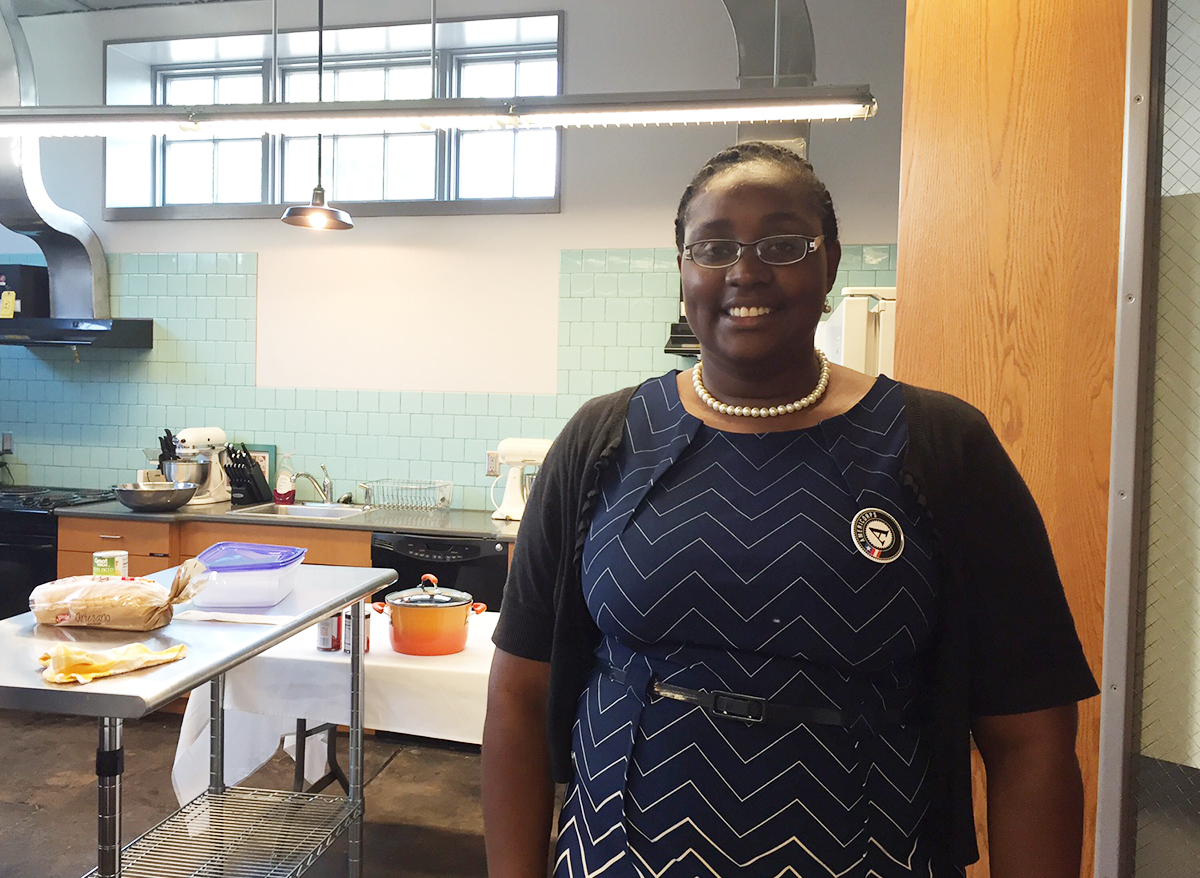
Kenyata Tate is seen in the Woodlawn Family
Resource Center kitchen where staff was preparing for a recent "Let's Cook!" even for neighborhood families. (Kathryn Sesser-Dorné, for The Birmingham Times)
By Kathryn Sesser-Dorné
For The Birmingham Times
Kenyata Tate is seen in the Woodlawn Family Resource Center kitchen where staff was preparing for a recent “Let’s Cook!” even for neighborhood families. (Kathryn Sesser-Dorné, for The Birmingham Times)
Kenyata Tate is not afraid to work.
A single mother of three, Tate, 33, has been employed, as well as going to school, since she was 16 years old. A year ago, she decided to make a big leap and become an AmeriCorps member. Her gamble paid off, and it’s been a blessing in her working life, as well as in the life of her own children.
Previously working as a payment plan representative with State Farm Insurance, Tate realized she wasn’t happy with the position even though it paid the bills. She decided to take a chance with AmeriCorps, even though it meant she would bring in less money for her family of four.
“I feel like I took a step outside of what I was doing when I was making money, but I wasn’t happy. I told myself, ‘Let me do something that I want to do,’” she said. “And even though it’s a sacrifice money-wise, it’s paid off. For me, I keep getting confirmation I did the right thing.”
‘Stepping out’
Tate and her co-worker Jennifer Thomas at the Woodlawn YWCA were recently chosen as two of the four finalists for AmeriCorps Member of the Year. “So I feel like my work is paying off. It’s not like I was trying to be a shining star, but it was worth me stepping out.”
No stranger to the struggle faced by those she helps in Woodlawn, Tate has been working nearly half of her young life.
“When I was 16, I started working in fast food, which I did for five years,” she said. During this time, Tate bought a house, and quickly realized that she couldn’t pay a mortgage while working for minimum wage. She had her second daughter by then, and realized she needed a “good job” and took a position with Wells Fargo working in their call center as a customer service representative. When that job began to focus more on sales, she knew it wasn’t the place for her.
Her next plan was school, so Tate began a two-year pharmacy tech program. “I didn’t make the best decision on what I wanted to do when I went back, so that was a waste of money and time. Although I did finish with an A average, it just didn’t pan out for me. When I finished, I didn’t feel like I was prepared to go out into the field.”
Instead of feeling discouraged, she just kept pushing. It’s what she does best.
She started a work study at Birmingham Civil Rights Institute, but with that being minimum wage, she turned to St. Vincent’s where she began to work in the parking deck, which led to a position as a secretary.
“I only left St. Vincent’s because I worked seven on, seven off, which took me away from my kids. My week I had to work, I had to take them, all their clothes and food over to their auntie’s house. And they told me they were tired of having to stay over there so much, so I changed jobs to better accommodate them.”
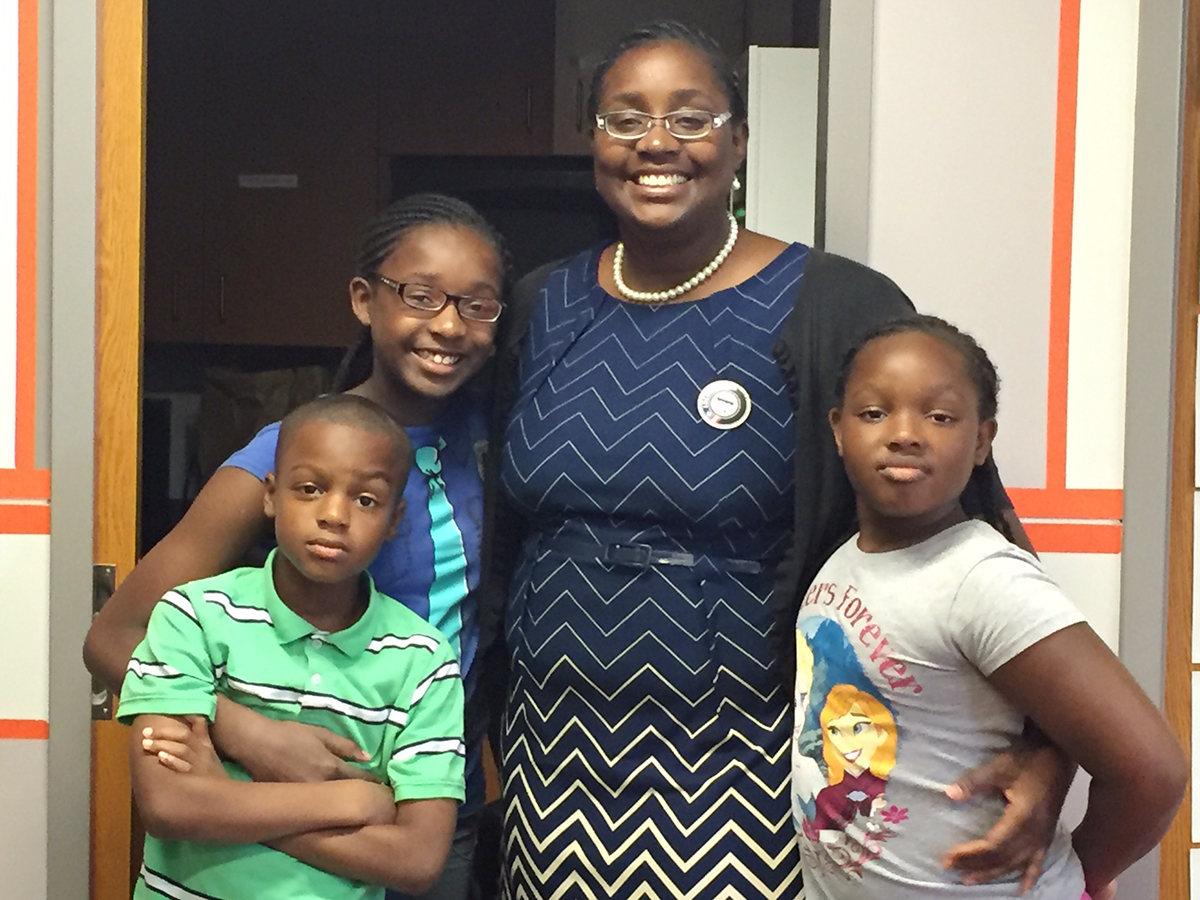
Kenyata Tate, a single mother of three, has been working nearly half of her life to help better provide for her children. Keyonté Williams, 12, Kamiya Williams, 11, Kasiya Williams, 9, often participate in programs at the Woodlawn Family Resource Center while their mother is working. (Kathryn Sesser-Dorné, for The Birmingham Times)
Greater Calling
That is when she moved to State Farm, where she would later realize her greater calling.
“Three years ago, we happened to discover FRC (Woodlawn’s Family Resource Center). My daughters were in Girls on the Run, which met here, so I talked with Jennifer (Thomas) about AmeriCorps and what it had to offer.
“I think I am in the place that I am supposed to be. I’m here. I’m in school and working toward getting my degree in social work. It’s a challenge, trying to do this and school,” she added. She plans to transfer to UAB in the fall, and her projected graduation will be the summer of 2018. To top it off, Tate is also in the Army Reserves, trying to get her PT together so she can earn a promotion.
“I’m wearing a million different hats right now,” she said.
Tate had her children in the span of three years. Her youngest was just five months old when their father passed away, leaving her a single mother at just 24. “It’s been a challenge, just trying to work through things, trying to find a balance after realizing for the most part, it’s just me.”
She is fortunate enough to have help from her family, an aunt or uncle helps some, and her mother is able to pitch in help when Tate is away for drill or school or work. “She loves to have her grandbabies come over, but I don’t ask her too much. She already raised us, and we’re grown,” she says. “I have a support system, but when it comes down to it, it’s just me.”
Still in the same house she bought in 2005, she knows that she’s come a long way, and has proven herself to be a great role model to her children. Keyonté Williams, 12, Kamiya Williams, 11, Kasiya Williams, 9, all go to Cornerstone School, a few blocks away from the Woodlawn Resource Center. They have been able to participate in some of the programs there as well.
Currently, Tate is heading up the C.R.E.W. program at the center, which she started planning for in December. “It stands for Creating Responsible Educated Working Teens, and it’s for students grade 9 through 12. We put them in actual work sites Monday through Wednesday and they work from 8 a.m. to noon.
“It’s a lot of planning, but I am a planner anyway because of my life,” Tate said with a laugh.
Enrichment
After work each day, the students return to the center to have a home-cooked lunch, and are able to listen to guest speakers and work on life skills training until 3 p.m. On Thursdays, the students are taken on enrichment trips, including Tuskegee University, Jacksonville State University and the University of Montevallo. They also recently paid a trip to Cooking Light Magazine to see how their operation works.
“I think they learn a lot. We do a lot of team building during orientation, and they learn that communication is key,” Tate said. “They get paid a stipend of $6 an hour, based on when they work Monday through Wednesday. They get paid on Thursday, in cash, and they have to pay us $3 for their lunches just so they know that when you get paid, you have bills to pay. It’s the easiest money they will ever make.”
This year 30 students are participating in the seven-week program. The work sites include the Family Resource Center, where some of the students work in the community garden, and then come back to the center and help prepare lunch for students and staff; others participate in the Jones Valley Teaching Farm at Woodlawn High School; at GraceWorks, part of Grace Episcopal Church, which is a summer camp for students; at the Birmingham Central Library; at Norwood Resource Center in the Norwood Master Gardening Camp; some are with United Cerebral Palsy; and a few work at the Birmingham Civil Rights Institute.
“They come in and apply, and we interview them and go through a normal hiring process. More than 80 applied this year, so word of mouth has definitely been a big part of getting the kids here,” Tate said. “We would love to increase the numbers but there is always some type or variable you have to work through, mainly funding and transportation.”
Tate will be stationed at Woodlawn Resource Center another year through AmeriCorps, where she will undoubtedly make a difference in others’ lives as she continues to better her own.
“I think AmeriCorps is a great opportunity to really hone in on what it is you’re trying to do,” she said. “It opens you up and allows you to come out of your shell, and to be an example for others. I think it’s a great program.”
AmeriCorps is a program that engages adults in public service work with a goal of helping others and meeting critical needs in the community.
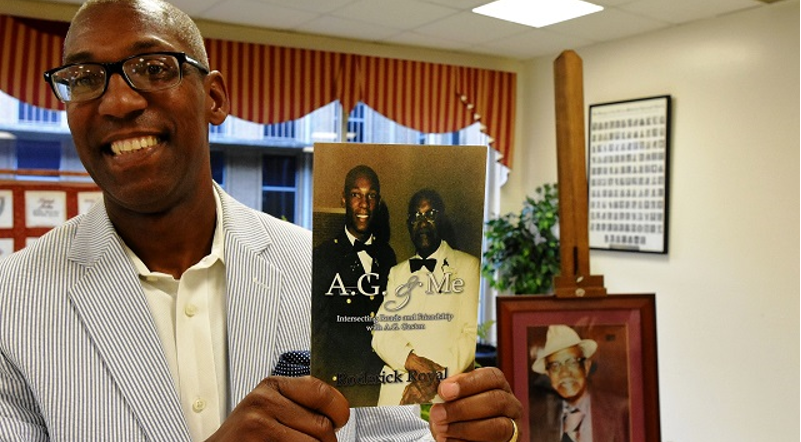
RoderickRoyal has written a new book on his interactions with A.G. Gaston (Solomon Crenshaw Jr./Alabama NewsCenter)
By Solomon Crenshaw Jr.
Alabama NewsCenter
Roderick Royal has written a new book on his interactions with A.G. Gaston (Solomon Crenshaw Jr./Alabama NewsCenter)
Roderick Royal vividly remembers the day A.G. Gaston visited the Boys Club that bore Gaston’s name.
Royal was about 11 when the wealthy black man came to the club on Seventh Avenue North. The youngster asked Gaston if he could drive his car. Gaston said sure and reached for his keys as the youngster asked what the philanthropist would pay him.
“He said, ‘Everything is not done for pay,’” Royal recalled. “That was the first of many lessons that I and many other boys got from Arthur Gaston.”
Royal tells that and other stories in his book, “A.G. & Me – Intersection Road and Friendship With A.G. Gaston.” The 70-page paperback, available for $16.99 at Books-A-Million, chronicles the mentoring relationship between a boy from Fountain Heights and the man who was considered the richest black man in Alabama.
The institutional influence of Gaston, born July 4, 1892, on boys in Birmingham is well known. He rallied businessmen in the city to fund the club and also donated the property where it was built.
But there was more to the intersecting paths of Royal and Gaston, who truly became acquainted when a 13-year-old Royal was tabbed the Boys Club’s State Boy of the Year. By the time Royal received a national Boys Club honor, Gaston knew him by name.
“I think it was just a natural attraction, just a natural thing,” said Royal, a former president of the Birmingham City Council who is now pastor of Zion Cumberland Presbyterian Church in Smithfield. “He took a personal interest in what I was doing. In one of those letters that I have in the book, he said, ‘You are our best example so far.’”
Royal and Gaston had several things in common. Each attended Tuggle Elementary School and Royal studied at Tuskegee University while Gaston was a member of that school’s board of trustees.
“Whenever he would come to Tuskegee, he’d always invite me to come by Dorothy Hall, which was the guest house, and spend a little time with him,” said Royal, who also teaches at Miles College. “Later on, whenever I was in town, we would have lunches.”
Those weekly Wednesday lunches in Birmingham continued when Royal completed his stint in the Army, often frequenting Joy Young, Gaston’s favorite Chinese restaurant. Sometimes they would go to the Relay House Club, the forerunner of today’s Summit Club.
“I still have the matchbook from the first time we went to the Relay Club,” Royal said. “He signed it for me because going to the Relay Club was a big thing, especially if you were a poor kid and had never been exposed to that kind of thing.”
Royal had a book launch on Thursday at St. John AME Church, where Gaston was a member. A book signing is set for July 23 at Books-A-Million at Brookwood Village.
The University of Alabama last week announced plans to prevent and respond to racial discrimination and increase diversity within the school’s fraternities and sororities.
The U.S. Attorney’s Office and the Civil Rights Division had contacted the university in 2013 to inquire about allegations of race discrimination in the selection process for new members in the school’s traditionally white sororities.
The action plan announced last week establishes a clear and consistent process for investigating and responding to allegations of discriminatory conduct and provides a campus free of racial tension, school officials said in a statement.
The University of Alabama claims the largest fraternity and sorority community in the nation with regard to overall membership.
“We recognize this is a process that will take sustained focus and effort, and I am confident our student leaders will build upon the momentum generated over the last three years,” said Dr. David Grady, UA’s vice president for student affairs.
School officials say the plan provides a model to promote inclusion in the recruitment process for its Greek community. The model captures three years of focused effort, which began in fall 2013 and resulted in increasingly diverse new member sorority classes in 2013, 2014 and 2015.
The action plan was announced following discussions between the school and the U.S. Attorney’s Office and the Civil Rights Division.
“Greek life is a vital part of the college experience for many students,” said U.S. Attorney Joyce White Vance. “With [its] action plan, the University of Alabama makes a commitment that this important component of university life, which plays a significant role in the formation of relationships students will carry forward into their adult lives, is not tarnished by racial barriers.”
Vance added that her office looks forward to the university’s prompt and full implementation of the action plan. “We appreciate the students who came forward with allegations about discrimination in sorority rush and made this action plan possible,” she said. “We urge the community to contact our office if they have any concerns about discrimination or other civil-rights violations on any campus.”
The U.S. Attorney’s Office Civil Rights Intake Specialist can be contacted at (205)244-2185 or usaaln.civilrights@usdoj.gov.
“While I try not to respond to intentional mischaracterizations – especially in the media, the sheer audacity of one “reporter’s” actions demand a response. I am a retired, disabled veteran of the United States Army and the United States Army Reserve. During my service to this nation, we were taught to value life. We were drilled to understand that we were not trained and deployed to take lives, but instead to protect life, freedom, and justice. We were taught to respect life, and to honor the sacrifices that so many people unselfishly make. So, when it is made to appear that I do not understand the scope and tragedy of the Holocaust, I was understandably very upset. And after much thought, I knew that I needed to set the record straight.
It was written by this “reporter” that I “demeaned” the death of six million men, women and children, which is an incorrect statement that I refuse to allow to go unchallenged. The Holocaust was a man-made atrocity of unimaginable proportions. Death was, literally, as far as the eye could see. My point, however, remains the same: how and why do we choose whom we memorialize, Shadow Lawn Memorial or the Holocaust Memorial? I support both.
Shadow Lawn is the final resting place of some who survived slavery, and others who struggled through Jim Crow and the regularity of terrorist bombings of homes and churches – dozens of which happened in this City alone.
When this Council sought out a way to simply ensure that these hallowed grounds were properly preserved and protected, we were shooed away by the City’s legal department. They told us that we couldn’t give funds to Shadow Lawn Memorial but for the same reasons they wanted to fund the Holocaust Memorial.
For the record, I will be clear: I support the use of public funds for the Holocaust memorial. However, I will only vote to allocate these funds when we are provided with clear guidance about the law pertaining to funding memorials.
And, I will only do so, when we commit to the exploration of creating an appropriate and quiet space to reflect on the life of those who fought so hard to create the Birmingham that we get to enjoy today.”
Sheila Tyson is a Birmingham City Councilor who represents District 6.
Birmingham Voices is a forum to provide commentary and opinions.
Stephanie Yates introduces the basics of budgeting, saving, and other money matters to students at Birmingham’s Putnam Middle School.
Last summer, UAB student Brandon Pickett worked as a lead counselor in a camp where the kids learned survival skills—the kind involving dollars and cents. During the four-day Money Math Camp, he and other counselors taught 45 middle-schoolers from low-income and minority school districts about money management and the impact of career choices on future lifestyles.
“As a kid, I was never taught the importance of saving and investing and other financial tools needed for success,” says Pickett, who is pursuing a master’s degree in business administration. The camp, he says, offers an opportunity to guide and mentor the next generation so that it can capitalize on that invaluable knowledge throughout their lives.
The Money Math Camp is one facet of the Regions Institute for Financial Education at UAB, a bold and broad effort to help people successfully manage their personal finances by learning the skills and knowledge essential to that task. Regions Bank provided a gift to the UAB Collat School of Business to create and support the institute. Now the two are partnering to organize programs for K-12 students as well as UAB students, employees, and the Birmingham community.
A financial education center is an important resource for a growing community, says Stephanie Yates, Ph.D., institute director and UAB associate professor of finance. “Here, families and individuals can get answers in one place from credible sources,” she explains.
Building piggy banks
The institute dispenses useful, practical information tailored to each stage of life. Grade-school children love learning the basics of money through hands-on activities, Yates says. “They get to handle money, build piggy banks, and do some role-playing involving money decisions,” she notes. “College students want to know about credit, debt, and investing. Adults want to know how to send their kids to college and prepare for retirement.”
In the classroom, the institute and Regions focus on college and career readiness. They have partnered with Birmingham City Schools to provide financial education to approximately 3,500 students over seven years through the Pathways to Success program. Working with GEAR UP Alabama and GEAR UP Birmingham, they will reach approximately 9,500 students throughout the city and Alabama’s Black Belt over seven years through programs such as the Money Math Camp. Even teachers can take part through sessions designed to help them better explain financial topics to high-school students.
On campus, UAB students, athletes, faculty, and staff can participate in Financial Education Boot Camps, one- to two-hour workshops on topics such as paying for college, budgeting, and basic investing. Future courses will help students understand financial topics relevant to their majors.
The public has explored saving and budgeting at sessions hosted by the institute at the Birmingham Public Library. “We are trying to reach as many people as possible to provide them with the knowledge they need in order to be financially successful,” says Jackie Russell, J.D., instructor in the UAB Department of Accounting and Finance.
Organizers envision the center becoming a nationally known personal finance resource, with research to evaluate the immediate and long-term outcomes of its programs, Yates says. Currently, Yates is studying gender differences in financial education delivery, based on research conducted during last summer’s Money Math Camp. Her findings will help to shape the design and implementation of future financial education programs.
Immediate impact
For Collat School of Business faculty, the opportunity to share financial expertise with the community represents a chance to make an immediate impact. “There are a lot of people who manage their finances based on what they heard from somewhere or what someone told them, and the institute provides a venue to help clear up some of those misunderstandings,” Russell says. “I want to teach people the power of the money that they already have. Everyone wants more money, but for most, there is a process to get there. So you have to learn to manage a budget, manage your credit, understand the impact of student loans, understand why you would invest in your 20s, and so forth.”
The institute “shows the importance of the community working together to produce responsible future members of society,” adds Elizabeth Turnbull, a UAB business instructor who teaches financial lessons to K-8 students. “Hopefully, by starting with the younger members of the community, we can help them practice good money management, and they will teach others to do so as well. Students will see how important this topic is in their lives, both now and in the future.”
The summer program gives students academic support so that when they return to school, they will go in with a stronger grasp of all academic subjects. (Chanda Temple photo).
By Chanda Temple
Birmingham City Schools
The summer program gives students academic support so that when they return to school, they will go in with a stronger grasp of all academic subjects. (Photo by Chanda Temple).
More than 90 students in the district’s English as a Second Language program attended classes this summer to improve their academic performance in English and math.
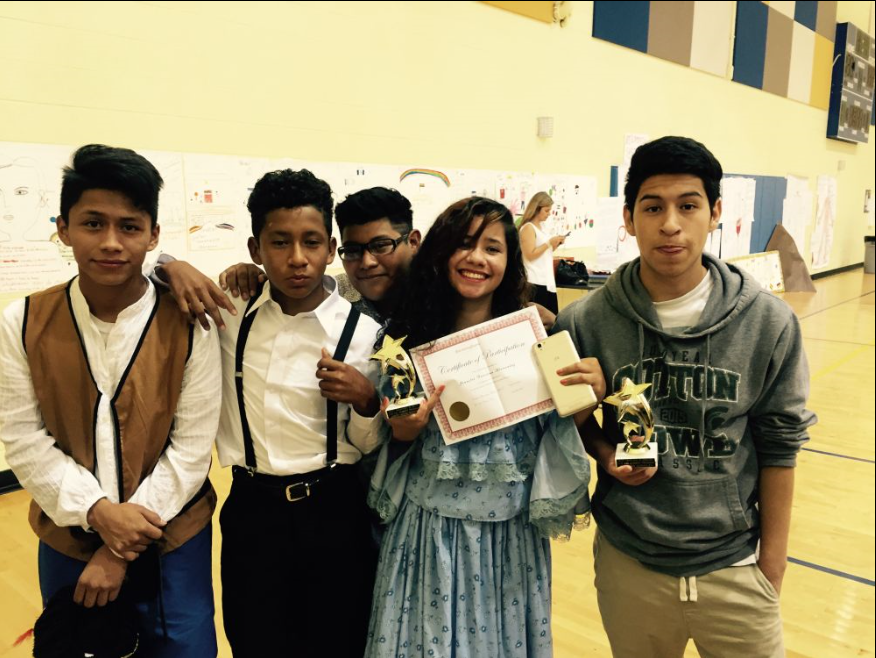
On Thursday, June 30 at Tuggle Elementary, these students participated in a closing ceremony, which included a parade of costumes and dances from nearly 20 countries, authentic Latino food and awards for summer achievements.
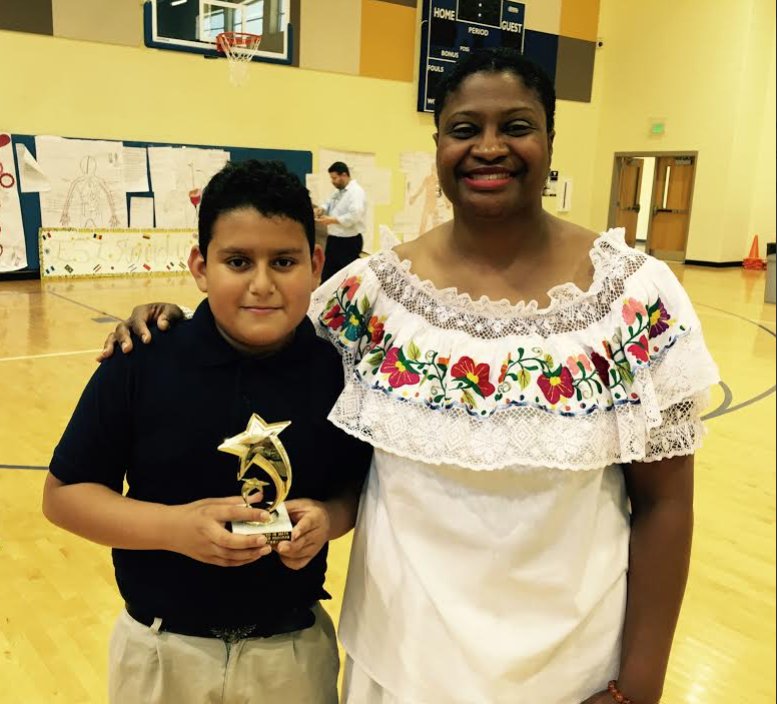
One award recipient of note was sixth grader Jeffery Serrano.
English as a Second Language student Jeffery Serrano with teacher Tamika Lamb. Jeffery received an award for Most Improved in Math. (Photo by Chanda Temple).
When Jeffery enrolled in the summer program in 2015, he tended to duck down in his seat as a way to become “invisible” when the teacher sought math answers from the class.
But after Jeffery had gone through a full year of the ESL program during the regular school year and returned to the three-week summer program in June, ESL teacher Tamika Lamb saw a different Jeffery.
One day in class when they were discussing fractions, he immediately figured out how to solve the problem. It was like a light bulb had gone off, Lamb recalled.
“Now, when he does fractions, his hand shoots up in the air,” Lamb said. “And even if he doesn’t have the right answer, I’m just proud that he raises his hand and tells me what he thinks.”
Native dances, songs and a parade of costumes from nearly 20 countries were on display as the English as a Second Language program concluded last month. (Photo by Chanda Temple).
A victory like Jeffery is just one example of what organizers not only see in the summer with ESL students, but throughout the year.
During the regular school year, about 900 Birmingham students are in the ESL program. Students new to America knowing limited or no English, are enrolled. The program helps students make major strides in English and other areas.
The summer program gives students academic support so that when they return to school, they will go in with a stronger grasp of all academic subjects. This summer, students not only worked on math and English, but they also studied human anatomy and democracy. The program is headed by Dr. Rosalva Ballin.