Home Blog Page 1259

BET Awards 2015: 90’s Throwback, Diddy Takes A Tumble And Tom Joyner Is Honored [VIDEO]


0

Sean Combs, Lil' Kim

Diddy dropped it like it’s hot at the BET Awards — figuratively and literally.

The entertainer fell during an exciting performance Sunday that celebrated Bad Boy Records’ 20th year anniversary, one of the night’s highlights. Lil Kim, Mase, Faith Evans, 112 and The Lox joined Diddy as they performed a medley of past hits. A video montage of rap king Notorious B.I.G. played in the background as his verse from “Mo Money Mo Problems” played.

BET Awards co-host Anthony Anderson brought on the laughs when he dressed as singer Sam Smith, who won best new artist but didn’t attend the awards show.

Anderson sported a suit similar to Smith’s taste and rocked a wig that mirrored the British singer’s hairstyle.

“Sam Smith isn’t here tonight because he’s white and he didn’t think he would win at the BET Awards,” Anderson said as the audience at the Microsoft Theater in Los Angeles burst into laughter. “He didn’t think he could win. But we showed him that we love him, too.”

“This award is going to stay with me for you not showing up to BET,” Anderson sang, referencing Smith’s ubiquitous hit, “Stay With Me.”

The show Sunday brought a mix of funny and serious moments. Rapping on top of a police car with a large American flag waving behind him, hip-hop prince Kendrick Lamar kicked off the BET Awards with a dose of seriousness, but also brought a fiery energy thanks to his charisma and his song’s beat.

Members in the audience rapped along to “Alright,” while background dancers danced in the aisles and others onstage wore black and waved the American flag behind Lamar. He later won best male hip-hop artist.

“This is for Compton, this is for Watts,” the Los Angeles-born rapper said.

Janelle Monae and Jidenna also brought a serious vibe to the stage when they performed “Classic Man”: The singers and their background dancers wore large “I’m a Classic Man” signs around their necks, a reference to the historic “I Am a Man” civil rights era protest signs.

Anderson and fellow “Black-ish” actor Tracee Ellis Ross followed Lamar’s performance with a hilarious song poking fun at pop culture, including Robin Thicke’s “Blurred Lines” case, Pharrell’s signature hat and Rachel Dolezal, the former president of the Spokane chapter of the NAACP.

“Is white really the new black,” Anderson sang as two photos of Dolezal — one old, the other recent — appeared on screen.

Chris Brown screamed loudly, Nicki Minaj whipped out her phone to record the moment and Laverne Cox was teary-eyed as Janet Jackson entered the stage at the BET Awards.

Janet Jackson accepts the ultimate icon: music dance visual award at the BET Awards at the Microsoft Theater on Sunday, June 28, 2015, in Los Angeles. (Photo by Chris Pizzello/Invision/AP)

The pop star was honored Sunday with the Ultimate Icon: Music Dance Visual Award as she made one of her first public performances in sometime as she readies a new album and tour this fall.

“It’s been a very long moment to this journey … my heart is so full,” Jackson said onstage, where her mother and father sat next to one another. “To my beautiful mother, to my beautiful father, and to my entire family, your love is unbreakable.”

An impressive Ciara, Jason Derulo and Tinashe paid tribute to the 49-year-old veteran by mimicking her signature dance moves at the Microsoft Theater in Los Angeles.

“Twenty five years ago we created ‘Rhythm Nation,’ hoping the world would be a better place, but today there’s even more to be done,” Jackson said. “And last but not least, my loving husband, and to all the fans. I’ve missed you so much and I love you so much.”

Rihanna was among the A-listers who sat in the audience, and she sang along during Omarion and Chris Brown’s performance of the pop hit, “Post to Be.” Alicia Keys surprised the audience when she joined The Weekend to sing his hit, “Earned It.”

Smokey Robinson received the Lifetime Achievement Award, performed a medley of his hits and earned a standing ovation from the audience when he spoke about Hollywood and humility. Ne-Yo, Robin Thicke and rising singer Tori Kelly paid tribute to the icon. Tom Joyner was presented with the Humanitarian Award for his work with historically Black colleges and universities, along with using his syndicated radio platform to bring awareness to issues impacting African-Americans.

Nicki Minaj, who won her sixth consecutive best female hip-hop artist award, brought her mom onstage. She gave a shout-out to fellow nominee and rising rapper Dej Loaf, as well as her rapper-boyfriend Meek Mill, who sat next to her at the show (and she later joined him onstage for his performance).

“Momma, I want to thank you from the bottom of my heart for everything you’ve done for me. I love you so much,” she said. “Shout-out to all the girls nominated … Def Loaf … you’ve been very, very interesting to me and super forward.”

Terrence Howard, star of the hit Fox series “Empire,” won the first award for best actor.

“To the Empire!” he yelled three times. “I got to thank Taraji P. Henson because she stood up for a brother.”

Brown performed multiple times, and won two honors: best male R&B/pop artist and the fandemonium award.

“A lot has changed in my life, a lot of mistakes, a lot of lessons learned. The best thing I’m most thankful for is my daughter,” he said onstage. “I’m so thankful and happy to have the loyal fans … and everybody here that knows me, to know me is to love me.”

The BET Awards is celebrating its 15th year anniversary. For a full winner’s list, click HERE. 

UAB Honors the Charleston Victims.

0
IMG_7293
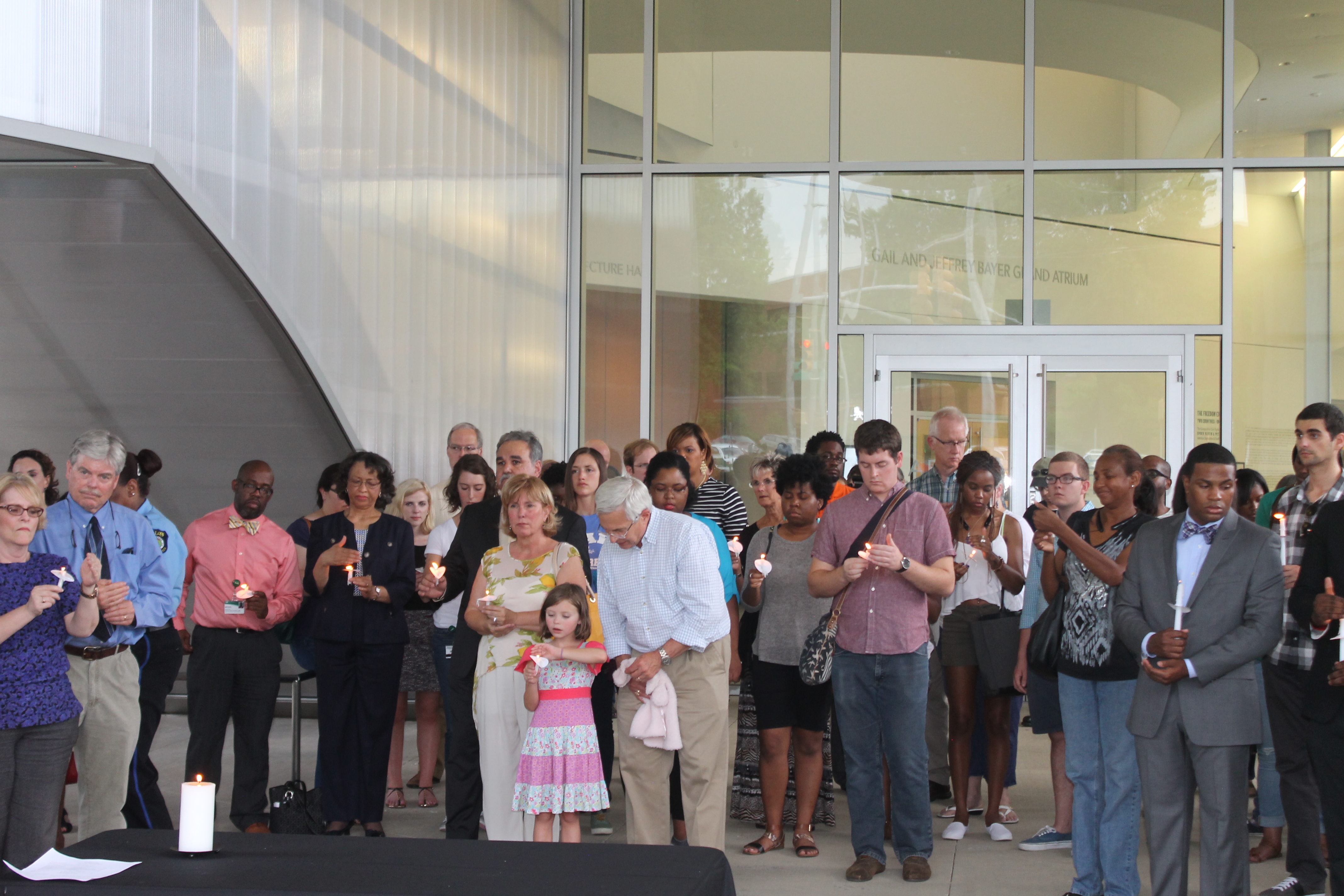
People gathered together

By Chris Ruffin

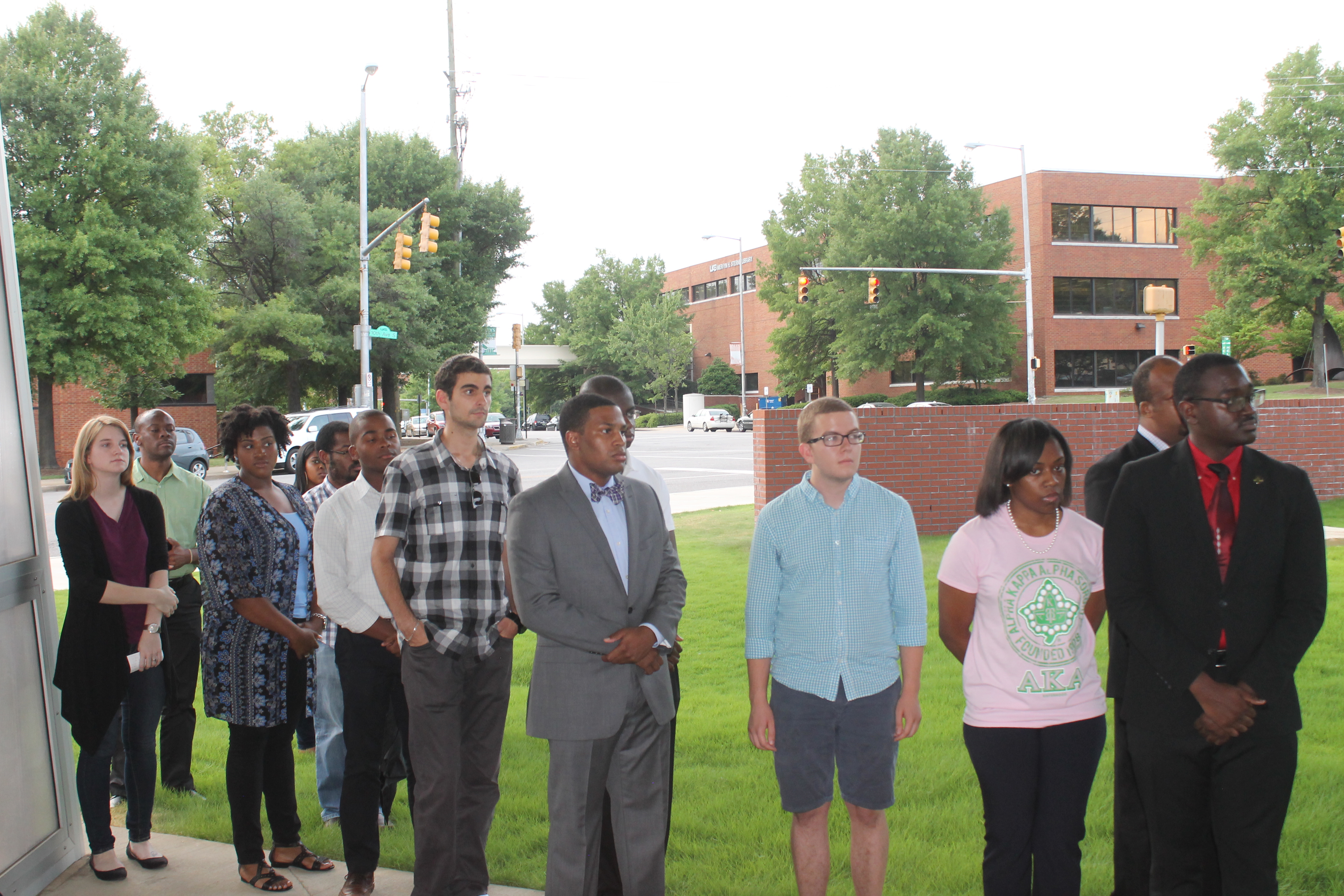
The Birmingham community came out to participate in Stand in Unity: A Candlelight Vigil for Charleston, to give honor to the nine victims at the Emmanuel AME Church shooting which happened June 17 in Charleston, SC.

The vigil was held at the Abroms-Engel Institute for the Visual Arts, located on the University of Alabama at Birmingham’s Campus on Wednesday June 24.

Kathryn Morgan, Director of African American Studies at UAB, spearheaded the vigil.

“We have to stand together, and honestly when we stand together we can make a difference,” Morgan said.

Candles were lit in remembrance of the victims by several UAB and Samford University students; Emmanuel Talley (UAB), April Moton (UAB), Jason C. Gardner (UAB), Garrett Stephens (UAB), Samuel Sullivan, IV. (UAB), Mohamad Moughneyah (UAB), Carlon Harris (UAB), Keiah Flowers (UAB), Chelsea Pennington (Samford).

Samuel Sullivan IV, a Junior Accounting major said, “Having this candlelight vigil truly shows that we care for the city of Charleston and that we’re here for them, in support of their losses.”

Once the students lit their candles, they dispersed into the crowd to light everyone elses candle for a moment of silence.

Rev. Mashon Evan, Pastor of St. John AME Church, gave words of encouragement. Following was a music selection by Dr. Paul Moateller, Associate Professor of Voice at the UAB Department of Music.

Lisa Tamaris Becker, Director of AEIVA said, “The vigil is really important because of the people coming together to remember and memorialize the lost lives, but also coming together and focus to create a more just future, in which we work to eliminate the racism, hatred and violence associated with this tragedy.

“Becker concluded the vigil with an invite to the one of AEIVA’s exhibition, The Freedom Exhibition: Two Countries One Struggle.

The exhibition features comparative photography of Spider Martin and Peter Magubane, which partially inspired the vigil to take place at the AEIVA. Martin was a Civil Rights photographer and Magubane was a South African apartheid photographer. The exhibition displays and compares approximately 100 photographs of the segregation in Birmingham during the Civil Rights Movement and the apartheid in South Africa.

The exhibition will continue through August 8, 2015

IMG_7237IMG_7273

The Charleston Shootings: A Tragic Embrace of Death

0

By James Strong

In the interest of reality, journalists write the facts as they are. In the interest of fiction, they write them as they aren’t.
But the massacre of nine church members at Emanuel African Methodist Episcopal Church in Charleston, S.C., by white racist Dylann Roof is a thousand discus throws from reality and fiction. In such a case, a writer must fly on angel’s wings, a task many journalists cannot attain. But we try.
Hence, as Black America once again grieves over the racist killings of its people, words lose sense and tears move from moisture to rainfall in seconds. Yet, one wonders what goes through Roof’s mind when he hears that Black and white residents of Charleston cry together and lay flowers on the sidewalk and street in front of Emanuel AME Church hand-in-hand.
Can he see that their grief is not mere anguish, but anguish that tremors in the aftermath of death’s earthquake? It is an anguish that mirrors the glow which shines on heaven’s face at the divine reception those nine now receive in glory.
They now witness continuous acclaim at the banquet of praise that honors them, as those Lakota Sioux men, women and children massacred at Wounded Knee by white racist U.S. Army troops in 1890 received; as those four little Black girls bombed in Birmingham, Ala., in 1963 received; and as those 2,000 or more innocent Palestinians slaughtered in Gaza by a racist Israeli military during the summer of 2014 received.
Does Roof not realize that the depth of the Black community’s grief is deeper than the ocean’s floor and will pass as a dividend to the future growth and prosperity of all African-Americans?
Black America feels this grief in a powerful yet unusual way. There is no deepness of mourning in the soul of man for a dead murderer who killed his daughter. Even more so, grief, deep grief, will probably vacate his duty if Black conservatives are massacred by the Klan or run over by a bus.
The traitors to the nation and the enemies of the nation eventually suffer the same fate. And grief will not sniffle or blow his nose.
Thus, while Black America grieves deeply for the nine Charleston victims, she probably will never shed a tear for the Clarence Thomas whose Supreme Court decisions have granted neo-Nazis and other racists boldness to commit such atrocities.
Can Roof not see, then, how profound the grief is? We grieve for heroes; we don’t for villains. And the profoundness of that grief never dries up.
As the Rev. Clementa Pinckney, Pastor of Emanuel AME Church, pleaded with Roof not to kill, evil preached a sermon of hate and Roof killed anyway. Pinckney died and we still cry. But when someone like Black Republican Ben Carson dies, Black America will shed tears wet with wax and graffiti.
We don’t know what Roof would have done if he had listened to Pinckney, given that his killings may have surpassed even the worst of sins. But, regardless, the anvil of anger perseveres under mercy’s harshest blows to forgive, as well as the red hot heat of an iron rage. But anger will never forget.
In fact, anger reveres the blows, as it worships the rage, because of the holiness of the church Roof desecrated, because of the sacredness of the Bible study he defiled, because of the wicked weapon he used to kill, and because of the nine dead whom we can now only vindicate by their deaths, since we were not there to save them when they lived.
Yet, at the moment of their deaths, I think they were superior to any reports of courage or news of poise written after their lungs ceased to breathe. And for this and other reasons, they are not just heroes, but have ascended on high as martyrs.
What an honor, because to be a martyr is the highest testimony to a good life!
In contrast, what we see, but cannot feel, is an apostrophe. Roof sees Blacks, but lacks love. And, thereby, he is merely half man and half bull.
Thus, the grief Black America feels for those nine Charleston dead began as almost insufferable anguish, the anguish became painful and deep, and the deep pain crossed over into a profound sentiment difficult to comprehend.
Still, however, from this tragedy, the future requests a reply from the present: “When will you learn to defend yourselves?”

ATTORNEY GENERAL LORETTA E. LYNCH DELIVERS REMARKS AT THE COMMUNITY POLICING CONVENING AT BIRMINGHAM CIVIL RIGHTS INSTITUTE

0

BIRMINGHAM, ALABAMA

Thank you, U.S. Attorney [Joyce] Vance, for that kind introduction; for your lifelong commitment to public service; and for your exceptional work on behalf of the people of this community.  It’s a privilege to join so many law enforcement officers, student and faith leaders, and community officials as we take this opportunity to discuss the critical work underway here in Birmingham and in cities across the country.  I’d like to thank Chief of Police [A.C.] Roper for welcoming me to Birmingham and for his exemplary leadership of the Birmingham Police Department.  I’d also like to thank Priscilla Cooper, President of the Birmingham Civil Rights Institute, for hosting us this afternoon and for the wonderful tour of the institute.  And I’d like to thank everyone who helped make today’s event possible.

As you all know, our country has recently witnessed a series of deeply distressing events in cities experiencing a breakdown in trust between law enforcement officers and the citizens we serve.  Each new tragedy has weighed heavily on our hearts and put a spotlight on deeply-rooted issues we are still confronting as a nation.  That spotlight has in some ways helped us make progress.  Important conversations have begun within our communities and across our nation and groups that have felt marginalized are standing up and speaking out as never before.  These are important developments.  But in order to keep healing the rifts that divide us, we must continue to work together, to be constructive and assume good faith on all sides and to seek out new ideas and fresh approaches.

Restoring essential trust where it has eroded is one of my top priorities as Attorney General and I want you all to know that the Department of Justice will do everything we can to help.  That’s why I am convening roundtable discussions like this one – beginning last month in Cincinnati and continuing in the coming weeks in East Haven, Connecticut; Pittsburgh, Pennsylvania; Seattle, Washington; and Richmond, California.  Through conversations like this one, I want to highlight the innovative ways you all are strengthening police-community relations and to think about how the steps you’re taking can be translated into other jurisdictions.  I am hopeful that these vital conversations will help guide the transformative change we would all like to see nationwide.

I’m here in Birmingham because this city’s law enforcement and elected leaders understand that progress requires us to work closely together – across issues, across backgrounds and across neighborhoods – to make sure the entire community thrives.  From the police department’s citizen’s police academy – which gives individuals from all walks of life a close-up view of police work and a deeper appreciation for its challenges – to the city’s demonstrated interest in using new technology to promote accountability and trust – Birmingham’s leaders have shown unwavering dedication to community-oriented policies that advance public safety, reduce crime and foster mutual trust and respect.  I’m also here in Birmingham because this community understands the need for commitment, engagement and ongoing communication with police and government on these important issues.  You have taken advantage of your unique history and used it to come together on this and so many other important issues.

The Department of Justice is committed to supporting you and your work at every step, which is why I am pleased that Birmingham is one of six pilot sites for the national initiative for building community trust and justice.  The initiative is a long-term effort to foster lasting ties and enduring trust between law enforcement officials and the citizens they serve.  By focusing on three core concepts – advancing procedural justice, reducing implicit bias and supporting reconciliation – the initiative is intended to strengthen community policing, ensure that people are treated fairly and put longstanding tensions and misconceptions finally to rest.  In Birmingham and our other pilot sites, we will work with local leaders to develop an overall plan for progress, as well as specific strategies tailored to each city’s needs.  We will lend guidance to help pilot sites implement data-driven methods to evaluate their success.  And we will use the results in each pilot city to identify and define best practices that will steer efforts nationwide for years to come.

This is vitally important work.  You know from your own experience that when police and residents share strong, reliable and resilient relationships, residents are more likely to help with investigations and police will more often hear from victims and witnesses of crime.  And when officers receive the tools, training and support they need, they are better able to serve their neighbors and constituents safely and effectively.  With the bold steps you are taking in Birmingham to realize those goals, you have put yourselves at the leading edge of what it will take to keep the American people safe in the 21st century.

I want you to know that the Department of Justice – and the entire Obama Administration – will stay engaged on these issues and stand alongside you not just now, but for the long term.  We know how much work is ahead of us.  We understand we face difficult challenges.  I have no illusions that these issues will be solved overnight. But from what I have seen and heard in my visit today, I am confident that this city will provide a shining example of what we can achieve when dedicated public servants, passionate community members and  devoted law enforcement officers come together to create the stronger, safer, more united community that all Americans deserve.  I look forward to working with you in the days and months ahead and I want to thank you all, once again, for your partnership, your leadership and your justly renowned hospitality.

###

How Women May Be the Difference
 Makers in Business Leadership


0

Gallup: Only 18 percent of companies hire the right managers

Businesses do a poor job picking managers to lead their employees, collectively costing companies billions of dollars each year, according to a recent Gallup report titled “State of the American Manager.”
The report is based on more than “four decades of extensive talent research, a study of 2.5 million manager-led teams in 195 countries, and analysis from measuring the engagement of 27 million employees.”
The research yields a striking failure rate – 82 percent – when it comes to how well companies select their managers.
“On the plus side, with such an abysmal success rate in hiring managers, we can reasonably expect improvement in the workforce,” says Debora McLaughlin, CEO of The Renegade Leader Coaching and Consulting Group (www.TheRenegadeLeader.com), and author of “Running in High Heels: How to Lead with Influence, Impact & Ingenuity.”
“More importantly, Gallup points out what many of us have known for decades – that including more women in leadership positions will reliably improve conditions within an organization’s work culture.”
An important criterion for how success is measured in management is engagement, where women have a decided advantage. Those who work for female managers are, on average, 6 percentage points more likely to be engaged, and those who work for female managers outscore employees of male managers on 11 of 12 engagement items.
“While I am a strong advocate for women in leadership positions, I think it’s safe to say that all of us, no matter our gender, have room to improve our management skills,” says McLaughlin, an executive and business coach who offers insight into achieving management goals.
•  Rigidity won’t help you retain top talent; be open. The ideal management style for today’s business climate is evolving. The traditional top-down hierarchal structure is giving way in favor of a more collaborative team approach. That means being open to communication, empathy and encouraging inspiration in employees.
“In my years as a business coach, I’ve had to convince men that a strictly hierarchal approach is often a company’s demise,” McLaughlin says. “Retaining and encouraging talent today means I emphasize open communication, empathy and employee inspiration.”
•  Encourage engagement by focusing on an employee’s strengths or positive characteristics. Of course, emphasizing someone’s positive traits doesn’t require you to ignore areas that could or should be improved. Clearly, if an employee is severely underperforming, then that must be addressed. However, if you can assume your employees are at least competent, then be proactive with your praise. Expressing positive reinforcement toward their tangible contributions has an empowering effect that will yield greater ownership of their roles.
“For many, this positive reinforcement may mean encouraging employees to be themselves,” McLaughlin says. “Our natural talents are freer to flow when we aren’t battling ourselves.”
•  Too many exceptional women succumb to ‘off-ramping.’ Multiple studies have found that, on a woman’s path to the C-suite, she faces an abundance of “off-ramp” options – life decisions that take her off her career path. And, since the recession, the “on-ramps” have become scarce. According to a 2010 study from the Center for Work Life Policy, 73 percent of women trying to return to work after a voluntary timeout for childcare or other reasons had trouble returning to work or finding a job.
“This can lead to a cascade of resulting problems, such as reduced pay for women when they return  or not off-ramping in the first place, which tends to yield an over-burdened lifestyle,” McLaughlin says. “This is a developing issue with more studies to be completed. However, I believe companies that are accommodating to a woman’s familial needs, for example, are ultimately helping themselves by retaining proven talent, promoting loyalty and preempting the uncertainty of a new hire.”

Networking

0

by Christopher Ruffin

Political commentator and entrepreneur Armstrong Williams once said, “Networking is an essential part of building wealth.”
Many people honor the art of networking just for the simple fact that they may not be who they are or where they are without networking with others.
A lot may not know what networking is or how do you start doing it.
Well, the search for your answer is over. According to merriam-webster.com, networking is the exchange of information or services among individuals, groups, or institutions.
Networking can be utilized in any setting. You can network at conferences, coffee shops, and sporting events or even at your local gym. Networking is often viewed as a hard task. Many may not know it, but it can be as simple as starting a conversation with someone about where did they get their suit/dress from? Everyone should not only network, but also learn how to master networking.
Networking is an art that we all can benefit from.

Making Certain Every Child Achieves

0

Marc H. Morial
President and CEO
National Urban League

 By passing this bill, we bridge the gap between helplessness and hope for more than 5 million educationally deprived children. We put into the hands of our youth more than 30 million new books, and into many of our schools their first libraries. We reduce the terrible time lag in bringing new teaching techniques into the Nation’s classrooms. We strengthen State and local agencies which bear the burden and the challenge of better education. And we rekindle the revolution – the revolution of the spirit against the tyranny of ignorance.” – President Lyndon B. Johnson, on the signing of the Elementary and Secondary Education Act, April 11, 1965

In a matter of weeks, our nation’s senators will decide whether to improve access to this country’s promise of opportunity for every child through quality education, or deny our most vulnerable children – many from historically disadvantaged groups – equity, excellence and accountability in our public school system, and along with that, a proven path to future opportunity and success in this country.
If the Every Child Achieves Act of 2015 passes in its current, deficient form, children in low performance schools, children of color, children with disabilities, and those born into poverty and poor neighborhoods are sure to be left behind.
The ECAA is the U.S. Senate’s bipartisan reauthorization of the Elementary and Secondary Education Act, also commonly known as No Child Left Behind. The ESEA was signed into law 50 years ago. It was a landmark piece of federal civil rights legislation that became a critical cornerstone of President Lyndon Johnson’s “War on Poverty” initiative designed to close the education achievement gap between lower- and higher-income children. Fifty years later, with Congress currently considering a vote on the ESEA reauthorization bill, the gap in educational opportunity, achievement and funding has only grown wider and the promise of equity in education for all of our nation’s students will be betrayed by a bill that does not provide additional support and opportunities for disadvantaged students.
For the first time in our nation’s history, students of color are the majority of the U.S. student body. And according to a recent survey by the Southern Education Foundation, a majority of all public school students come from low-income homes. The continued success of our nation on the domestic front and the international playing field will be in large part determined at the intersection of civil rights and education.
A nation fully committed to the future success of all of its children and, by extension, its own future, must pass a reauthorization bill that holds schools and districts accountable in every instance and manner that leaves no vulnerable students behind. We must spend our education dollars and resources where the need is greatest. Without strong federal oversight and the ability to course correct when necessary, the practice of understaffing and underfunding schools in our most vulnerable communities will continue unchecked. The practice of not requiring school districts to provide equitable resources, or to close the comparability loophole in all its schools, for vulnerable student subgroups like English language learners or students with disabilities, will only serve to perpetuate the very inequality the original bill sought to make the stuff of history in our modern-day schoolroom textbooks. We all know knowledge is power, therefore the reauthorization bill also needs to provide the transparency, data and reporting families and communities need to effectively advocate for their children and schools.
Without critical provisions like these, like so many families, government officials and advocacy groups, the National Urban League will stand firm in its opposition to the current incarnation of the ECAA and demands that Congress revisit and recommit to the original vision of ESEA when it was first signed into law 50 years ago.
This week, we were joined in our opposition and fight to revise the bill by 84 members of the Congressional Tri-Caucus – a group composed of the Congressional Asian Pacific American Caucus, the Congressional Black Caucus and the Congressional Hispanic Caucus. The group sent a letter to the education committee in the Senate acknowledging the flaws in current law the bill has remedied, but they also maintained “the bill in its current form does not do enough to protect the historically disadvantaged and vulnerable students the ESEA is intended to serve.”
We commend the Tri-Caucus for standing on principle and opposing the bill. We also look forward to working in partnership to craft an ESEA reauthorization bill that will prepare all children for college, work and life – no matter their family income, race or zip code – allowing every child the opportunity to realize and act on their full potential.

From the Top Announces 2015–2016 National Tour

0

BOSTON – Now in its 15th year, From the Top with Host Christopher O’Riley, the preeminent showcase for young musicians, announces its 2015–2016 National Tour. The 17-city tour invites audiences to live recordings of the popular NPR radio program, featuring outstanding classical musicians ages 8 to 18.
Season highlights include a live recording event featuring the Rochester Philharmonic Orchestra, conducted by their new Music Director, Ward Stare. One of the country’s leading pre-professional ensembles, The National Repertory Orchestra, will be featured in a concert in Vail, Colorado, presented by Bravo! Vail. From the Top will also be on hand at the 2016 Mondavi Young Artists Competition in Davis, California, to showcase some of the competition’s all-stars. For the fifth time, From the Top will return to the Aspen Music Festival and School and will also make its first visit to Naples, Florida, for a concert presented by Artis-Naples.
In all, From the Top is planning three shows in California, three in Texas, two in Colorado, and one in Montana for a really great ride west of the Mississippi; shows will also be recorded in Georgia, Massachusetts, Maine, Florida, New York, and more.
In addition to recording its live radio show, at each tour stop From the Top helps young musicians take their music beyond the concert hall to diverse audiences in school and community settings. Each performer participates in an Arts Leadership Orientation where they explore their leadership pathways and brainstorm ways to take music beyond the concert hall. The young Arts Leaders then put those new skills to use in a unique outreach event crafted for each community on the tour. In the 2015–2016 season, From the Top will extend the outreach programs in several select communities with the generous assistance from Tippet Rise Fund of the Sidney E. Frank Foundation, the William R. Kenan Jr Charitable Trust, and the Howard and Geraldine Polinger Family Foundation, as well as many other generous donors.
Recognizing that financial need often does, but never should, hold a young musician back, From the Top and the Jack Kent Cooke Foundation will also award $200,000 in scholarships to extraordinary young musicians with financial need. Since 2005, The From the Top Jack Kent Cooke Young Artist Award has awarded over $2 million to pre-collegiate musicians to support their musical development.
Broadcast on over 220 stations nationwide to an audience of more than 700,000 listeners, From the Top celebrates the amazing performances and captivating stories of America’s best pre-college classical musicians. The most popular weekly one-hour classical music program on public radio, the show has been described by the Boston Globe as, “an entertaining, accessible and inspirational mix of outstanding musical performances, informal interviews, skits and games; the show is a celebration of extraordinary musicians who happen to be teenagers leading fairly normal lives.”

From the Top is now accepting applications from eligible young musicians at fromthetop.org/casting.

The Skin Cancer Foundation Shares Summer Sun Protection Tips for the Whole Family

0

NEW YORK, N.Y. –  Summer is right around the corner, and families will spend more time outdoors. Exposure to the sun’s harmful ultraviolet (UV) rays increases the risk of skin cancer, which is why proper sun protection is essential. In fact, the sun’s UV rays are responsible for about 90 percent of nonmelanoma skin cancers and 86 percent of melanomas.
“Exposure to UV radiation is directly linked to all three forms of skin cancer,” said Perry Robins, MD, president of The Skin Cancer Foundation. “By adopting good sun safety habits families can enjoy summer outdoor activities without increasing their skin cancer risk.”
The Skin Cancer Foundation offers the following tips to help families enjoy a sun-safe summer:

At the Beach
•    Use a broad spectrum sunscreen daily. For extended outdoor activity, use a water-resistant broad spectrum (UVA/UVB) sunscreen with an SPF of 30 or higher. Reapply every two hours or after swimming or excessive sweating.
•    Cover up with clothing. Look for high-UPF (Ultraviolet Protection Factor) swim shirts or rash guards, and choose bathing suits that cover more skin, like one-piece suits and long trunks. Make sure to apply and reapply sunscreen to exposed areas of the skin not covered by fabric. To help avoid missing spots apply sunscreen before putting on your bathing suit. When shopping for high-UPF clothing, look for The Skin Cancer Foundation’s Seal of Recommendation.
•    Avoid tanning. There is no such thing as a safe tan, because tanning itself is caused by DNA damage to the skin. In addition to increasing skin cancer risk, tanning also leads to premature skin aging, including wrinkles, leathery skin and age spots.

At Summer Camp

•    Remind kids to seek the shade. Advise kids to play in shaded areas to limit UV exposure. Check with counselors to see if there are adequate places for campers to seek shade during outdoor activities taking place between 10 a.m. and 4 p.m., when UV rays are most intense.
•    Dress kids in sun-protective clothing. For optimal protection from the sun, send kids to camp in sun-protective clothing. Look for tightly woven or knit, dark- or bright- colored fabrics, which offer the best protection. Don’t forget wide-brimmed hats and wraparound, UV-blocking sunglasses.
•    Practice sunscreen application beforehand. Teach children to apply 1 ounce (2 tablespoons, or about the size of a golf ball) of sunscreen to all exposed areas 30 minutes before outdoor activities. Remind them to cover easily missed areas such as the back of the neck and tops of the ears. If camp rules allow, ask counselors to help children reapply sunscreen every two hours, or after swimming or excessive sweating.

On the Road
•    Treat your vehicle to window film. Car windows don’t provide complete sun protection. Though UVB radiation is effectively blocked by glass, more than 60 percent of UVA radiation can pass through windows. UV-protective film, also known as window film, blocks out up to 99.9 percent of UV radiation. If you have window film installed, remember that it protects you only when the windows are closed. When shopping for window film, check to see if the product has The Skin Cancer Foundation’s Seal of Recommendation.
•    Drivers beware. Nearly 53 percent of skin cancers in the U.S. occur on the left, or drivers’ side of the body. Don’t forget to apply sunscreen, particularly when spending extended time in a car that has no window film.

Additional Skin Cancer Prevention Tips

•    Do not burn. At any age, a person’s risk for melanoma doubles if he or she has ever had five or more sunburns.
•    Keep newborns out of the sun. Sunscreen should be used on babies over the age of six months.

Buffalo Exchange Offers Its Customers Sell By Mail

0

Buffalo Exchange now offers customers the opportunity to sell their clothing by mail. Customers in areas without a local Buffalo Exchange can request a free Sell By Mail kit online. Each kit comes with a prepaid shipping bag and an information card on what to pack. When the customer receives their kit they can fill the Sell By Mail bag with their former fashion favorites, and ship it, at no cost, directly to Buffalo Exchange through any UPS store. Sell By Mail will be available to customers within the U.S., excluding Hawaii and Alaska.
The Sell By Mail buying process mirrors the company’s brick and mortar locations, although there are a few specifications for the items that can be sold through the Sell By Mail process. This will be indicated in the Sell By Mail kit, as well as on the company’s website. Once an offer has been made, customers will be able to choose between a check or in-store credit. In-store credit will be redeemable at most Buffalo Exchange locations.
Buffalo Exchange hopes this new service will give customers not living in cities near Buffalo Exchange stores the chance to sell their items. For more information visit BuffaloExchange.com/SellByMail.
In May 2015, Buffalo Exchange introduced sister store, The Vintage Buffalo, an online vintage shopping boutique. The Vintage Buffalo is looking forward to giving customers the opportunity to experience unique finds and true vintage. For more information visit TheVintageBuffalo.com.
A pioneer in resale fashion, Buffalo Exchange works to protect the environment by reusing and recycling clothing. Clothing and accessories are bought, sold, and traded with customers, highlighting creativity, diversity, and fashion trends unique to each community. Since its beginning in 1974, this family-operated company has grown to 48 stores in 17 states. More information about the company can be found on its website, as well as Facebook, Instagram and Twitter.