An invasive ant may have met its match in a naturally occurring fungus that can destroy it from the inside out.
The crazy ant (Nylanderia fulva), sometimes called the “raspberry ant” in Texas, is originally from Argentina. It is dubbed “crazy” because of its quick, unpredictable movements.
The tawny-colored ants are reportedly overwhelming populations of fire ants — known for having a venomous bite — because of their ability to detoxify the fire ants’ venom.
They measure about 1/8 of an inch. Related species are found across the world, except in cold climates and central and northern Europe.
Spreading in the southeastern U.S. states, they are also driving out various native insects and small animals.
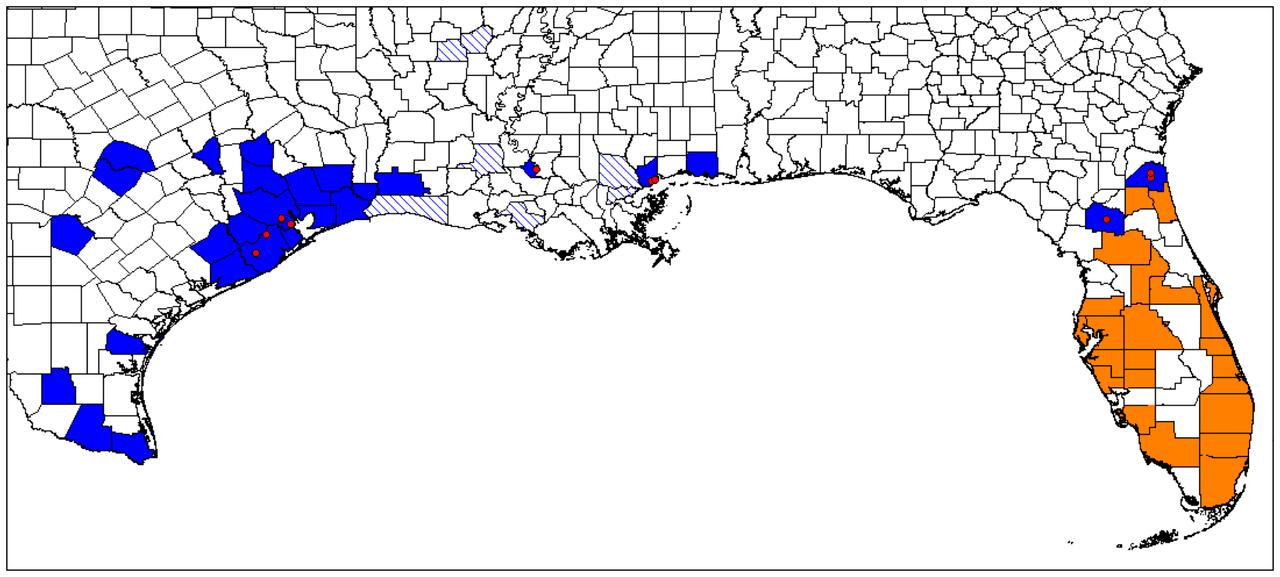
The above map shows the distribution of crazy ant colonies in the southeastern United States as of 2018. However, the extent is believed to be greater. (Gotzek D. et. al. 2012/CC BY-SA 2.5)
In Colombia, where they have displaced other ants, they kill poultry by asphyxiating them and attack cattle by infesting their eyes and nostrils. They forage for plants and tend tiny aphids in underground galleries to feed on the honeydew these creatures excrete, drying out grasslands as a result. Baby rabbits have also been blinded by these ants.
The ants are not attracted to ant baits currently in use and are immune to over-the-counter pesticides. Their colonies are hard to exterminate because of their multiple queens. In 2008, the Environmental Protection Agency approved the temporary use of fipronil, a moderately toxic pesticide that is very toxic to rabbits, in an exemption that expires on May 6, 2022.
However, a study appearing in the journal Proceedings of the National Academy of Sciences indicates that a group of fungal pathogens previously unknown to science may serve to control the spread of crazy ants. These microsporidian pathogens hijack the ants’ fat cells, turning them to the production of spores.
“I think it has a lot of potential for the protection of sensitive habitats with endangered species or areas of high conservation value,” said researcher and lead author Edward LeBrun of the Brackenridge Field Laboratory at the University of Texas.
Scientists had noticed that wild populations of crazy ants had become infected by the fungus and collapsed without human intervention.
A microscopic view of microsporidia spores found inside a crazy ant collected at Pace Bend Park in central Texas. This pathogen is considered a natural biocontrol for the invasive ant species. (Edward Lebrun/University of Texas)
The stakes are high not only for farmers and ranchers but also for homes and businesses. Crazy ants swarm into electrical circuits, breaker boxes, air conditioners and other electrical devices, causing short circuits.
Study co-author Rob Plowes collaborated with LeBrun on a study of the ants in Florida in 2005. They observed crazy ants with abdomens swollen with fat and found microsporidian spores in them. The pathogen may have come from the ants’ native habitat in South America. Since then, the researchers found that every infected colony declined, with 62 percent dying out completely.
“You don’t expect a pathogen to lead to the extinction of a population,” Le Brun said. “An infected population normally goes through boom-and-bust cycles as the frequency of infection waxes and wanes.”
LeBrun believes that the pathogen shortens the lifespan of worker ants, making it harder for a colony to survive during cooler months.
However, microsporidia do not appear to harm native ants and other arthropods, potentially making the pathogen ideal as a biological control.
In 2016, LeBrun and his colleagues used microsporidia on an experimental basis at Estero Llano Grande State Park in Texas, which was losing native reptiles, birds, insects and scorpions to the invasive ants. “They had a crazy ant infestation, and it was apocalyptic — rivers of ants going up and down every tree,” LeBrun said.
University of Texas scientist Edward LeBrun examines a crazy ant colony in Texas. In a new study, researchers test the ants’ vulnerability to a fungus that may originate in the ants’ native habitat. (Thomas Swafford/University of Texas)
After placing infected ants in nest boxes in the park, the team baited the ants with hot dogs at the entrances of established colonies. Once the introduced ants and locals were merged, the disease spread throughout the colonies. In just two years, the number of crazy ants plummeted at the park.
Crazy ants have since been eradicated at the site, allowing native ants to re-establish a presence. The research team has also been able to eliminate a second population near Convict Hill in Austin, Texas.
Crazy ants bite but do not sting. They excrete formic acid from their abdomen as venom, in what is believed to be an adaptation to ward off fire ants. Meanwhile, fire ants have alkaloid-based venom that paralyzes competitor species, but this is neutralized by crazy ants’ formic acid antidote.
“This doesn’t mean crazy ants will disappear,” LeBrun said. “It’s impossible to predict how long it will take for the lightning bolt to strike and the pathogen to infect any one crazy ant population. But it’s a big relief because it means these populations appear to have a lifespan.”
LeBrun and his team will test this biocontrol approach elsewhere in Texas later this year.
President Joe Biden speaks after signing the Emmett Till Anti-Lynching Act in the Rose Garden of the White House, Tuesday, March 29, 2022, in Washington. Vice President Kamala Harris, left, and Michelle Duster great-granddaughter of civil rights pioneer Ida B. Wells look on. (AP Photo/Patrick Semansky)
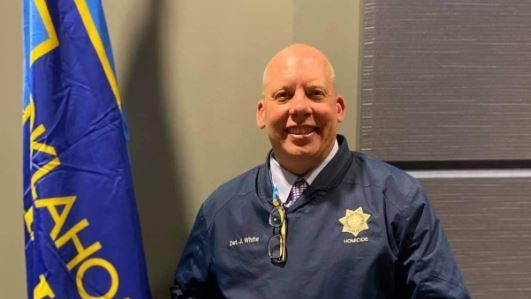
Solving crimes is a tedious process that requires, patience, diligence and experience. Solving murders can be even more difficult, especially for homicide detectives who face issues such as lack of cooperation, evidence tampering and fleeing suspects. Detective Jason White’s calm demeanor in interrogation rooms, his personable attitude, and his attention to detail make him one of the highlights of the A&E series, “The First 48.”
He has a high arrest and conviction rate, and follows his cases all the way through until sentencing. A true professional, White’s fair but firm stance shines through.
Detective White takes Zenger on a patrol through his career, his future interests, and much more.
Percy Crawford interviewed Jason White for Zenger.
Percy Crawford interviewed Jason White for Zenger. (Heidi Malone/Zenger)
White: No, but we’re from the same state, and I’m a lot older. No relation, but it’s a good way to get people to remember my name.
Zenger: I have to be honest; I was completely oblivious to how dangerous of a city Tulsa, Oklahoma, is until I started watching “The First 48.”
White: Our numbers here, generally speaking, are around 60 to 70 homicides per year. Occasionally, we’ve had a few years when it eclipsed 80. Honestly, per capita, when you look at our population which is around 400,000, it’s one of your higher numbers per capita in the country.
It is a little bit surprising, and people often ask me, why is that? I don’t have a definitive answer as to why we have the number of homicides we have here. Considering how many we solve; you would think people would think twice about committing one here because the likelihood of them getting away with it is going to be pretty remote. I don’t really know what the deal is on that.
I encourage people to come here. Don’t get scared off from coming to Tulsa because of what you see on TV. If you come to Tulsa, what you’re going to find is a really nice city, a lot of things to do here, and the vast majority of the people that end up getting killed is primarily due to the lifestyle that they’re keeping. Occasionally, we do have a legitimate victim. Nobody should be victimized. But what I mean by that is individuals who are absolutely innocent victims. Those are very few and far between.
Zenger: Did you ever imagine there would be a lane for homicide detectives to be followed around and recorded during investigations on television?
White: The first thing that comes to mind when you ask that, do I think a show like “The First 48” is a show that you’re going to see on TV? The answer is, yes, because there are a number of shows that are out there, from “Cold Justice” to various other programs that are out there because murder is fascinating to most people. I find it fascinating. “The First 48” has been on TV since 2004, and it’s been running strong ever since. I’ve been a fan of the show since the onset of it.
I’m a little surprised that a show like “The First 48” would end up landing in Tulsa. I see where you’re coming from, you think big cities where they have a significant murder rate. You would think a show like that would be all over those cities. There are a few things that they are looking for. Number one, they are looking for cities with a pretty decent solve rate. I don’t think that show would really attract a lot of viewers if all they did was show cases where they weren’t solving them. The city got approached many years ago, they were interested in coming here, so in 2014 they made it official. That’s when they first started filming here and they have been here ever since.
Zenger: Getting an arrest isn’t where the door closes for you. You follow throughout the court proceedings and up to conviction. Why?
White: This is me speaking personally — I like to see it all the way through. You’ll find some detectives that once they make the arrest, they’ve had closure on it, in essence… there’s still going to be work to be done, but I think a lot of those guys kind of put the case to rest as far as, I’ve done my part, that’s it.
For me, I think I have a little bit more of a stress level that continues on through the case, through court proceedings, and really up until the time when we get a conviction. Ultimately, even later to make sure the things have been affirmed by the Court of Criminal Appeals. I try to make it to every single one of my court cases in reference to closing arguments. I’ll wait around with the family often times until they come back with a verdict. I try to hang out with them until this thing is finally put to rest. It’s a long process.
I think a lot of people don’t realize that, first off, these cases are relatively difficult from the onset, and then after that, we might get the story, and we might find witnesses, all of which will be really beneficial in court. But most of these people that are involved in the case to some extent don’t really want to meet with us the first time, let alone for one or two other visits to a courtroom. We’re constantly having to do what I would call witness management — finding people and trying to convince them that, “Hey, this is the right thing to do.”
And you have to remember in today’s day and age with social media like it is, you have witness intimidation that is just to a whole other level. People get blasted on some of these social media platforms that they’ve talked to the cops, or the defendant has released some of the documents that are a part of the case and part of the discovery and posted on there who is talking. We have to combat all of that on top of it.
Then, when you take that all into play, here in Tulsa, we have an exceptionally high rate of not only solving the cases, but we have an exceptionally high rate of getting convictions. I think one of the reasons for that is we have a good relationship with the Tulsa District Attorney’s office. We really work well together. I’ve seen it on other shows, such as “Dateline,” where they are working with a jurisdiction somewhere else in the U.S. where there is always this power struggle between the detective and the D.A.’s office. We just don’t have that here. We have a really good collaborative effort, and I think that plays into the success level we have here. I hope there are other places just like us.
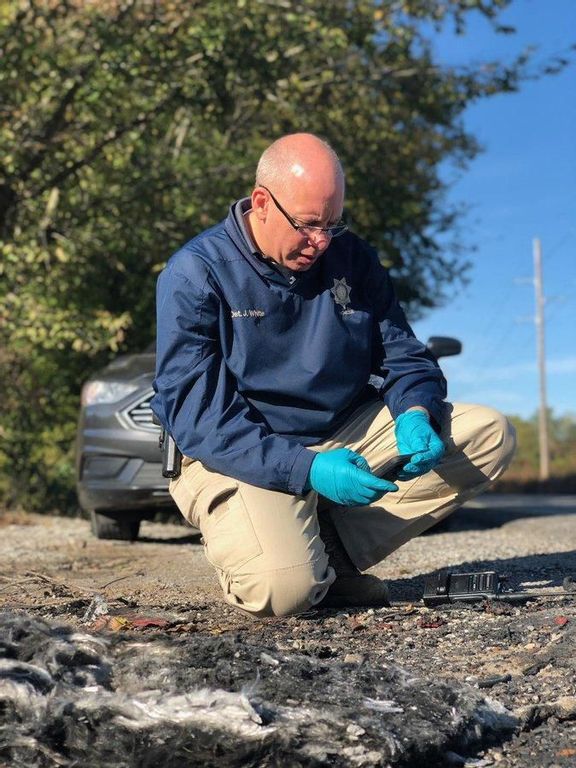
Jason White collecting evidence on a crime scene in Tulsa, Oklahoma. (Courtesy of Jason White)
Zenger: How has social media helped and hurt detective work?
White: Before I came to homicide, where I’ve been for about 12 and a half years, I actually worked in the crime scene unit for about a year and a half. I remember working in crime scene, and I didn’t have any social media accounts whatsoever. I worked at night. We were like the firefighters of that department, basically. We would respond to major crimes when they would call for us. We were assigned cases in the middle of the night, other than just assisting in a crime scene capacity.
I remember working that unit and all the other guys having MySpace pages. We didn’t have anything else to do other than sit there and read articles on the internet. I got a MySpace account, and I thought it was cool, I vowed to never get a Facebook account. I didn’t want anything to do with that. That was the time that I can remember, probably 2007–2008, I joined homicide in 2009.
That’s when I started seeing detectives becoming more active with social media outlets. Today, I can tell you that I try to utilize that to our advantage, and I have put some cold cases that we’ve had in the past, and I reprofiled them. I definitely want to do more of those. I reprofiled some cold cases and just talked for 3 or 4 minutes about a specific case from years ago just to put it out there. And I do that because, it’s like doing a canvas from door to door, and it’s reaching tens of thousands of people.
It’s amazing the reach that it has. It hasn’t solved a case yet… at least here, anyway. But I can tell you, the families love it because it shows that we still care about those cases. But also, we have gotten several tips from profiling a case or two on there, and it’s given us leads to at least go out and knock on some doors, talk to some people and see if we can move the case forward. I think that’s the wave of the future. It’s something that needs to be explored more. That’s the positive thing about it. There are some great things you can do with social media. But as I mentioned earlier, witness intimidation and such things are negatives.
Zenger: Your calm demeanor is the interrogation room is commendable. Does that come with experience or are you just a natural people person and it translates during your interviews?
White: In addition to working in the detective division, I actually was a crisis negotiator for a little over 10 years. In saying that, you get inundated with active listening skills and communication skills. Here in our department, they spend a tremendous amount of time with the cadets in our academy teaching active listening skills and communications skills in general to a variety of different customers, from individuals suffering from mental illness to the run-of-the-mill crisis situations.
I appreciate what you’re saying and any compliment you want to throw my way, but I think everybody in our unit, and I’m sure other units that exist in the police department, who are exceptional interviewers. There are guys that have probably never worked in the detective division, that work the streets that just have the ability to talk to individuals. One of the things for me — and it seems to get better with age — I just get nicer (laughing). I just don’t sweat the small stuff anymore. I try to just treat people right.
One of the things that I teach young cadets is I’ll see them do a scenario when they are talking to somebody, and they’re in that cop mode. I’ll ask them, “How would you talk to that individual if it was one of your family members in crisis, or in a situation when they just witnessed something horrific?” And they would be like, “Well, I would do this-this-this-and this.” Well, just do it.
We’re not building a rocket here. We’re just talking to someone you need to get information from and put them at ease. The other thing that we combat a little is you’re dealing with a generation who has had a lot of contact with the police, so you may have some that have generational hatred toward the police. When they finally end up meeting you, it’s like, “You’re not that bad after all.” If I was bad, my name would be known in the streets as being that guy. The reputation that you get out in the communities that you serve, if you’re one of those evil dudes out there doing bad stuff, it’s not going to take long for your name to get out on the streets about that.
A lot of these individuals who are asked to put themselves out there don’t have the financial means to move. They don’t have the ability to get away from this element that they are around. I call it intimidation domestic terrorism, and a lot of these individuals are dealing with that. Certain neighborhoods are controlled by those intimidators. You have to combat that by finding those individuals willing to do the right thing. They are heroes to me. They have a lot of courage and if they come forward and tell us the truth, they literally are heroes, and not just for the victim but for the community.
Homicide Detective Jason White prides himself on bringing justice to the families of murder victims in Tulsa, Oklahoma. (Courtesy of Jason White)
Zenger: 48 hours in not a lot of time. Why are those first two days so important during investigative work?
White: I can give you the preface of the show, defense attorney’s like to throw this out there, “Isn’t it true, detective that you’re supposed to make an arrest within the first 48 hours?” It has nothing to do with any of that. What the first 48 hours thing comes from, it goes way back, long before this show existed. It goes back to detectives’ philosophy that if you don’t get a lead within the first 48 hours, then the chances of you moving this case forward and possibly solving it is going to go down dramatically.
I do think there is some truth to that. I think if you don’t strike while the iron’s hot, you might miss out on the potential of video surveillance. In some instances that stuff disappears within 24 hours, some it can be three days, it can be a month.
There is a show on Amazon called “Bosch.” It’s about a homicide unit, LAPD, and one of the best things about it is one of the lead characters on that show has a sign next to his desk that says, “Get off your ass and go knock on some doors.” It couldn’t be truer than that. If the public wants to know how we solve these cases, it’s generally not from DNA and fingerprints.
I’ve been assigned to close to a hundred homicides straight out of the gate, and I’ve assisted on about 500 other ones. I can think of a couple of occasions where a fingerprint has led us to the identity of the perpetrator when we had no idea who the person was. I can think of a couple of other occasions where we had no idea who this person was, and their DNA led us to the identity of this individual. It just doesn’t happen very often.
What leads to our success is a couple of things, and number one is teamwork. The key in Tulsa is, we all attack these cases together. Number two is your ability to be able to communicate with the public. If you can’t do that, you won’t get very far.
Here in Tulsa, we have the luxury of really good people who live here. But you’re from Louisiana, and if you were to go to New Orleans — and I’m sure the detectives there would agree with this — the demographics are very different. Down there, people are not going to talk to the police. It just does not happen. It has nothing to do with them not wanting to solve those cases. It’s the fact that for the people down there, it is ingrained in them that you don’t talk to the cops. Here, it’s not completely opposite, because everyone tries the “I don’t know anything.” We get lied to all the time, but the demographics here are just easier than it is in other cities like Chicago, New Orleans, and L.A.
Zenger: What would you be doing if you weren’t in law enforcement?
White: That’s a good question. There’s always other things that I want to do. I’m really too old to be exploring certain jobs. I would have loved to be a firefighter. I always thought it was fascinating, and everybody likes them. I’ve always considered going back and getting a nursing degree and being a traveling nurse. I don’t know if I would be able to do that or not. We’ll see. I’ve always enjoyed helping people.
Also, in some way or another, I’d like to do something in the world of teaching. I teach police officers, along with a lot of kids in high school and college about what we do. I thoroughly enjoy being an ambassador for this profession. I enjoy getting people to see us without the preconceived negative notion about police. Letting them know who we really are. I think 99.9 percent of cops out there are really trying to help people. It’s a constant battle, and we have to work that much harder when one cop does something stupid.
Healing is a gratifying nectar to Makuyo, for whom honey serves as the foundation of SIIKA Herb + Honey Co. A devotee to the thick, golden liquid’s “vast healing properties,” Makuyo is a creative alchemist who believes “infusing herbs with honey allows us to signify that healing can be so sweet.”
Makuyo is named after her Ghanaian paternal grandmother, who shares the traditional Krobo name. The creator named her four herb-infused honey products in honor of her family matriarchs.
“I can trace working with plants and herbs directly through these women,” said Makuyo, a well-traveled entrepreneur with a bachelor of science in computer engineering from North Carolina A&T and a master’s of science from The George Washington University.
“Siika translates to ‘wealth, luxury or riches.’ I chose the word Siika as an homage to wealth in terms of culture, tradition and rituals. Makuyo, meantime, is my preference — no middle name, initial or last name. I choose to go by that single name because it’s unique enough.”
Makuyo’s four honey samples are named for her mother, grandmother, maternal great-grandmother and paternal great-grandmother. (Courtesy of Makuyo)
Zenger: What is the significance of the name, SIIKA?
Makuyo: My brand is SIIKA Herb + Honey Co. In my paternal Ga language, Siika translates to “wealth, luxury, or riches.” Beyond monetary wealth, I choose the name Siika as an homage to wealth in terms of culture, tradition, and rituals. As a communal people, rituals are what Africans and Indigenous Americans cherished before colonization.
It’s what connected us to ourselves, our families, our ethnic groups and our environment. And so, SIIKA creates herb and honey infusions that intersect taste and tradition, so you can honor your true nature, true wealth and true rituals.
Zenger: What is its makeup?
Makuyo: The tisanes (herbal teas) are named after and inspired by the African continent. Sankofa, meaning “Go Back and Get It” is SIIKA’s take on the traditional Chai tea, but with African ingredients. In this we have South African Rooibos as the base, with amazing and fragrant vanilla beans from Madagascar, mixed with cloves from Zanzibar.
Likewise, our Kindred blend pays homage to a popular hibiscus drink that is consumed throughout the diaspora, whether it be known as Sarkade, Sorrel, Sobolo, etc. Lastly, the Clarity blend is a fragrant and visually pleasing blend inspired by the ocean. We are children of the diaspora, and more specifically the Atlantic Ocean, which can represent a path of bondage, or a path of freedom — it just depends on which perspective you choose to focus on.
The honeys are very, very personal to me. They are named after women in my lineage. I can trace working with plants and herbs directly through these women. Also, pre-colonization, Africa and most indigenous societies were matrilineal, which meant that while the men were the foundation, the women were the core. Family life revolved around the women. And SIIKA is about honoring that which made and continues to make us whole.
Zenger: What is the name, and what are the ingredients of the one for your maternal grandmother?
Makuyo: The infusion, Freddie, is named after my maternal grandmother, Freda Lee, affectionately called Freddie by her father and brothers. She was such a sweet and pure love … but she was so spicy! She and I would watch “The Price is Right” and soap operas back-to-back daily when I got dropped off from elementary school.
Collards, kale, or mustards would always be simmering, and were a constant at our every-Sunday family dinners. However, she was known for telling the dirtiest of jokes!
She would wait until the children were outside, playing, to get into her jokes, but somehow we still heard them anyway. For her blend, we pair raw honey with pimento pepper for a subtly sweet, but undeniably fiery experience.
Zenger: How about the one for your mother, Renee?
Makuyo: I infused orange peel, cloves, cinnamon, and ginger with honey to create this blend. My mother switched to a plant-based lifestyle in the mid-’70s. It was an unpopular decision, but she stuck with it, learned, studied and experimented on her own. She is now is the go-to for countless friends and family looking to switch to a healthier lifestyle.
She is the health-conscious teacher, advisor and example that she didn’t have. I always remember her going to the gym and keeping us active in sports (which I later found out was her tool to keep us off the streets and away from drugs).
Though it was difficult understanding why we shouldn’t eat sausage or pepperoni pizzas at the soccer teams’ pizza parties, her health-based eating and lifestyle habits are evident in each of her children today, through our health-based careers and mindsets. This infusion honors my mother, Renee Anastasia, the first true healer I know.
“This infusion honors my mother, Renee Anastasia, the first true healer I know,” said Makuyo of the honey sample shown here. (Courtesy of Makuyo)
Zenger: What is the name and ingredients of the ones named after your paternal grandmother and why?
Makuyo: She is my namesake. This honey is infused with vanilla beans and lavender. My paternal ethnic group, the Krobo of present-day Ghana, names their children by position and/or characteristics in birth. It happens that both my grandmother and I were the fourth child of our fathers, so we are both named Makuyo. By her children and grandchildren, she is known as Yaayo. Though I speak little Ga, and she spoke no English, somehow we still found a way to communicate and connect. The vanilla and lavender in this blend is the perfect balance of determination and gentleness, just like my Yaayo.
Zenger: How about for your maternal great-grandmother, Elnora Terry?
Makuyo:This infusion is named after my great-grandmother, Elnora, whom we affectionately called Mama. It contains chocolate mint, calendula, and rosemary. Myself, my mother and grandmother shared a connection with gardening and sewing.
I remember sewing patchwork quilts and working in an urban garden with my mother and grandmother as an adolescent. This love and fellowship through gardening and sewing can be directly traced back to Mama, who grew all varieties of vegetables and herbs alike for her family on our land in Mississippi.
My most recent Indigenous ancestry, as the original inhabitants of this country, is also directly traced back to Mama. As such, many Native American tribes believe that Rosemary is a gift from the Creator and widely used varieties of mint to treat a plethora of conditions.
The infusion, Mama, is named for Makuyo’s great-grandmother, from whom she inherited a love of gardening and sewing. (Courtesy of Makuyo)
Zenger: What is the significance of using honey?
Makuyo: While working with herbs is innate to me, I intuited the idea to create herb-infused honeys. While herbs are normally attributed to healing, honey has vast healing properties as well.
Honey is also attributed to sweetness and an almost soft-like joy. Not only delighting the taste buds, SIIKA hone’s cause you to pause and to be reminded of the sweetness of life.
That pause and that reminder can be healing in such a fast-paced, hectic world. So infusing herbs with honey allows us to signify that healing can be so sweet.
Zenger: I understand that you like to travel. What are some of your noteworthy destinations?
Makuyo: I’ve traveled across the country, the Caribbean, as well as a few countries in South America and Asia. I did my first solo trip to Salvador de Bahia in Brazil and it was an amazing experience. Through all of that, I definitely want to see so much more of Africa. It is such a beautiful and rich continent, culturally, in its resources and its landscape. There’s so much more I want to experience there.
Astrologically, I’m a Sagittarius Sun, which are known as travel-enthusiasts, sporadic and considered the truth seekers of the zodiac. I was created to love travel. I don’t travel just to go or get away, I travel to experience peoples and cultures. It allows me to understand that though we may be thousands of miles and oceans away, there is an interconnectedness in us, no matter what the modern world displays.
For instance, when I went to Brazil solo, I spoke very little Portuguese, and ill-informed of me, the people there speak little to no English. Yet I was still able to carry on conversations and interact because we weren’t so much focused on what separated us — the language barrier — but more on what connected us — the human experience. Likewise, I named one of my teas, Kindred. Travel is very much a learning experience for me.
The infusion, Kindred, honors Makuyo’s overcoming a language barrier with Brazilians during a trip to that country. “I was still able to carry on conversations and interact because we weren’t so much focused on what separated us … but more on what connected us — the human experience,” she said. (Courtesy of Makuyo)
Zenger: How critical are sisterhood and empowerment to black women?
Makuyo: While sisterhood and camaraderie are essential amongst black women, we do a disservice to ourselves when we ignore the importance of unity with black men.
Again, indigenous African and American communities revolved around the nuclear family, that’s how we created community — common unity.
I see a lot about uplifting and empowering black women, which is great, but we should be careful not to miss uplifting our black men, as well. We need both our men and women to truly be able to rise and accelerate as a people.
Zenger: You’d mentioned playing soccer earlier. Was that game instrumental in your development, physically, spiritually, mentally and philosophically?
Makuyo: Critical to my brand is my development as a woman. I played soccer from age 6 until I graduated from high school, not so much for its competitive aspect, but because it taught me discipline that extended far beyond the playing fields.
Through soccer, I had the opportunity to be around a diverse group of teammates, experiences (my club coach played professionally overseas), and was also my first taste of travel via traveling state-to-state for tournaments and camps.
Zenger: I understand that you elected not to play college soccer, although the opportunity was there?
Makuyo: Yes. Although I was offered a scholarship to continue playing soccer in college, I ultimately chose a school that did not have a soccer program, North Carolina A&T, which was and still is an engineering powerhouse. I knew from a young age that I wanted to be an engineer. Being raised on the East Coast, it was second nature for me to attend a Historically Black College/University.
My sister attended Howard University and since it was local, I was constantly in their yard with her. However, after visiting NCAT, learning about the history of their Black Panther Party and The A&T Four (who started the Sit-In Movement), my decision was made. Beyond academics, NCAT was integral in my growth as a black woman.
A plumber who landed a record deal after being heard singing while he worked on a music mogul’s bathroom is having a Hollywood movie made about his life.
Kev Crane secured himself the life-changing music deal after singing along to the radio as he worked at the home of record producer Paul Conneally.
The 50-year-old spent six weeks installing a new bathroom completely unaware Paul was a music boss — until he offered him a new job.
Kev went on to make a 1980s influenced album under the label New Reality Records and it proved so successful he is releasing a second record in April.
His dramatic rise to stardom has also now seen L.A.-based film producers get in touch to get the rights to his story, which first hit the headlines last September.
The plumber who landed a record deal after singing while he worked on a music boss’s bathroom is having a Hollywood movie made about his life. (Steve Chatterley/Zenger)
Award-winning writer and director Stacy Sherman and American screenwriter and producer Billy Ray are now working on the screenplay about Kev’s life.
Ray wrote the 2012 blockbuster “The Hunger Games” as well as the latest installment of the Terminator franchise “Terminator: Dark Fate” in 2019.
Meanwhile, a script has been written by legendary British sitcom and film writers Dick Clement and Ian La Frenais.
The pair is behind hit comedies including “The Likely Lads,” “Porridge,” “Auf Wiedersehen,” “Pet” and “The Commitments.”
Kev says the last six months have been a complete whirlwind as he continues to juggle fitting bathrooms in the East Midlands while working as a singer.
And for the upcoming film, which is due for release in two years, Kev and Paul say they would like to be played by British comedy duo Simon Pegg and Nick Frost.
Kev, who lives with wife Karen in Quorn, Leicestershire, said: “It’s like I’m watching this happen to someone else.
“Not for one minute did I think this could happen to me.
“I’ve had some sleepless nights thinking about this whole story — the record deal and now the film. It’s so exciting.
“We grew up watching shows like ‘Porridge’ and ‘Auf Wiedersehen’, ‘Pet’ along with films like ‘The Commitments’.
“So it feels unreal to be now working with the creators of those and having Zoom calls with them in LA and to think it’s our story that they’re working on.
“My wife has been so overwhelmed by it all — in tears about it. I am just going with the flow.”
Kev used to be in a cover band called “The Reprise” in 1990s covering bands like Depeche Mode, as well as writing his own music.
But after two unsuccessful auditions for Fame Academy and Stars in Their Eyes in the early 2000s, he decided to give it up.
But his big break came when he got a call from Paul for a quote to fit some bathrooms at his house last year.
The plumber who landed a record deal after singing while he worked on a music boss’s bathroom is having a Hollywood movie made about his life. (Steve Chatterley/Zenger)
Kev added: “I started work at Paul’s house and I like to sing while I am working and he pulled me into the living room one night for a conversation about my singing voice.
”I started telling him that I love music and I used to be in a band and that I had written an album — more of a hobby really.
“I was shocked when he said he wanted to hear it. He later pulls me into his office and told me, to my surprise, that he really liked my album.
“He offered me a chance to sign up to his label — it was just like that.”
Paul, 62, of Loughborough, Leicestershire, said he noticed his plumber had a “good voice” as he sang along to the radio to the likes of Meatloaf and David Bowie.
He added: “Never in a million years did I think this would happen when I first heard Kev singing.
“It’s been a sharp learning curve for us both but the team in L.A. are so supportive.
“We know the story won’t follow our life stories exactly but will be based on it and we can’t wait to see exactly what they do with it.
“We’re learning just how much work goes into the making of a feature film, especially one made in L.A.”
When asked who might play them, Paul said: “I think actors like Simon Pegg and Nick Frost might work.
“Not because they look like us but because like Kev and I, they work well together and they’re English.”
Kev added: “Other names suggested by various people we are working with include Jude Law, Colin Firth, Jason Statham and Ricky Gervais.”
U.S.-based writer, producer and director Stacey said: “This is a story about the human spirit and music.
“What could be better? Sinks fixed, dreams dashed, heartache, hope and U.K. music.”
The rising cost of fuel has been a popular topic for the past month amid record-high prices at the pump and while gas prices throughout the country are the highest in years, one gas station, in particular, has grabbed lots of online attention.
Located in Furnace Creek, California, lies just one gas station for the entire town, the Furnace Creek Fuel and Auto Service. Situated near the oft-visited Death Valley National Park, Furnace Creek, officially referred to as a census-designated place, is home to just 136 people as of 2020.
But despite the low population, Furnace Creek is a popular place to stop for tourists.
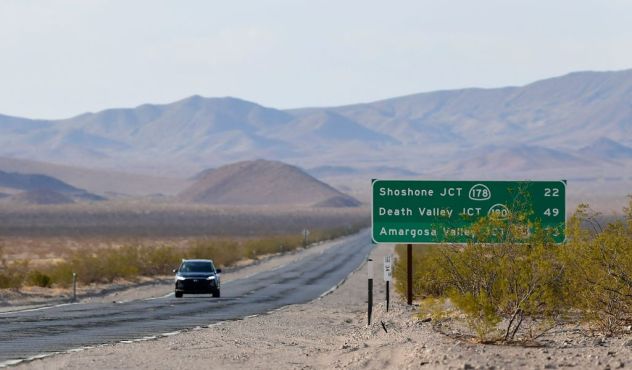
Situated conveniently off California State Route 190, Furnace Creek is popular for those traveling to the national park because it is the only highway that runs into and through the park.
Because transporting goods to Death Valley is both difficult and dangerous, gas prices are commonly higher than other places in Southern California and across the country. So as gas prices began to increase across the country, so did the already high prices in Death Valley.
In mid-March, Furnace Creek Fuel and Auto Service had regular fuel available for $8.75 per gallon and diesel for $9.99 per gallon.
A vehicle drives through Death Valley, California, on July 11, 2021. (Photo by FREDERIC J. BROWN/AFP via Getty Images)
Despite its popularity, Death Valley is a challenge and a danger to access due to winding highways, unconstructed gaps and long stretches of desolate interstates, including one stretch along Route 190 that only has seven intersections along a 130-mile stretch.
But it’s not just travelers that are inconvenienced by these logistical hurdles. Getting items and services to Death Valley is also a challenge.
Only three gas stations are positioned along the long eastern portion of State Route 190. For fuel tankers coming eastbound, trucks have to carry fuel through many dangerous mountain passes and detour significantly to the south before going north due to the gap in Route 190.
Despite Fresno only being located 17 miles north of Furnace Creek, the drive often requires a 110-mile detour south before routing back north.
Going westbound, the first station is located about 30 miles after Death Valley Junction.
On top of that, harsh and quickly changing weather conditions can occur on these routes in all seasons, as a drive to Death Valley often requires driving through the southern part of the Sequoia.
Weather conditions can be vastly different in the Sequoia compared to Death Valley, even though it’s only a few hours away. While conditions are brutally hot and dry in Death Valley, shipments often deal with the cold and snow in the Sequoias.
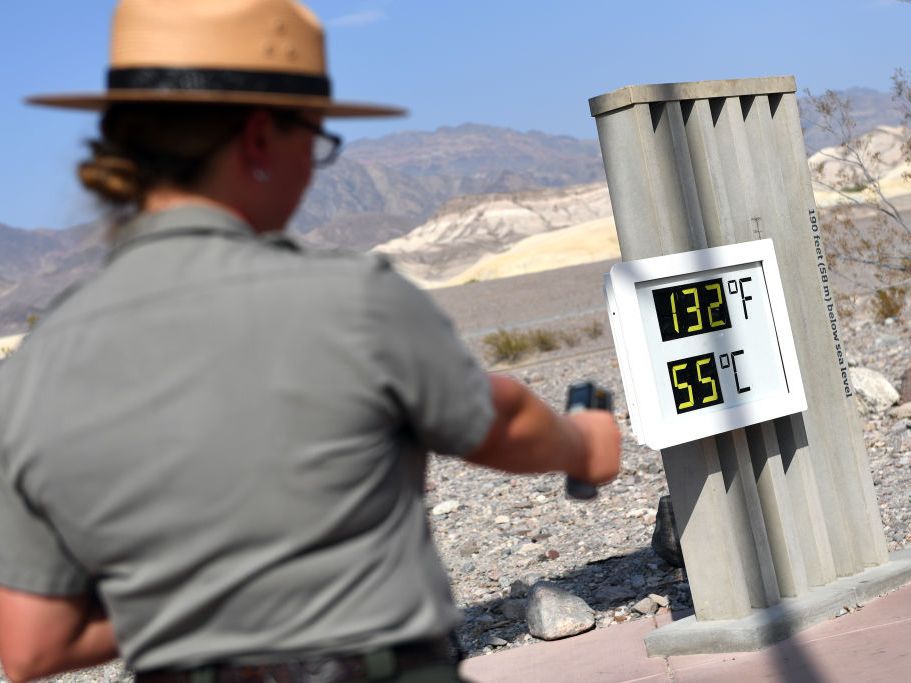
United States Park Ranger Jeannette Jurado takes a surface temperature reading from an unofficial thermometer reading 132 degrees Fahrenheit/55 degrees Celsius at Furnace Creek Visitor Center on July 11, 2021, in Death Valley National Park, California. (David Becker/Getty Images)
“The issue of seeing snow on the ground, to seeing just dry ground or nothing, can be an issue for travel,” said AccuWeather Senior Meteorologist Alan Reppert.
The mountainous Sequoia region is situated just west of Death Valley, preventing most moisture from reaching Death Valley, which averages less than 2 inches of rainfall per year.
“A lot of the time, precipitation struggles to get in there as the mountains around it may get rain or snow. The lack of rain is due to being in the middle of a large valley between mountains and in SoCal area,” said Reppert.
Most famously, Death Valley is known as the hottest place on earth and the driest place in North America, according to the National Park Service. The warmest air temperature ever recorded on earth occurred in Death Valley on July 10, 1913, when the station in Furnace Creek recorded a temperature of 134 degrees Fahrenheit.
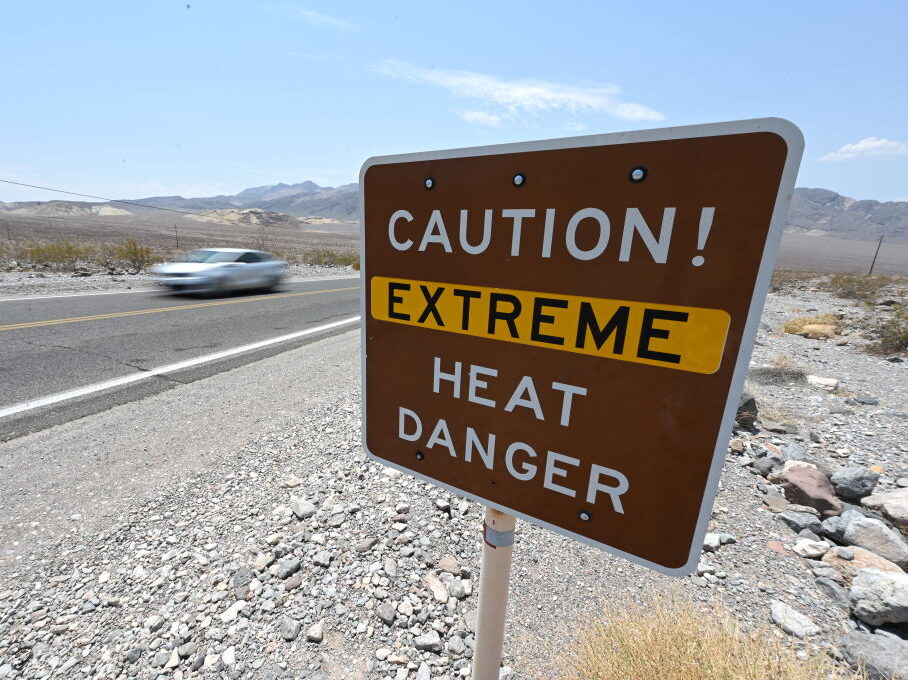
Due to the extreme heat, summer can be an even more dangerous time to drive into Death Valley. Drivers transporting goods could easily face heatstroke without proper equipment, and even the roads themselves could turn into a danger to transport.
“As we get into the summer, the ground can be so hot that it causes issues with the road and tires,” said Reppert.
A warning sign posted alerts visitors of heat dangers on July 11, 2021, in Death Valley National Park, California. File photo. (David Becker/Getty Images)
Overheated engines can also become a problem to those traveling into the area during peak warmth. In 2020, multiple vehicles broke down in the park due to overheating engines while the air temperature was 128 degrees.
With the weather getting warmer and summer just a few months away, gas will become more expensive to produce due to refiners switching from winter blend to summer blend. Winter blend gasoline is cheaper to make due to its higher Reid Vapor Pressure, the measure of how easily fuel can evaporate at a certain temperature. A higher RVP is achieved in the winter by mixing butane into the fuel.
However, when temperatures warm up, fuel with higher RVP can contribute to increased emissions and air pollution, according to AMSOIL. This results in refiners having to reduce butane and replace it with pricier alternatives.
A newly discovered seabird has been placed straight on the “critically endangered” species list.
The fate of the New Caledonian storm petrel, found in the South Pacific, rests on scientists being able to find and protect its breeding grounds.
The population is estimated at between 100 and 1,000 pairs as they are nocturnal, discreet and tend to nest on isolated islands.
The birds were first spotted off the islands’ capital of Nouméa in 2008 and again in the Coral Sea, east of Australia, in 2010.
The newly discovered seabird has been placed directly on the “critically endangered” species list as its breeding grounds have not yet been found for conservation purposes. (Jon Mills/Zenger)
An international team of scientists has identified the new species as Fregetta lineata in a study published in the Bulletin of the British Ornithologists’ Club, but they say time is running out for the species unless the breeding grounds are found quickly.
“We present evidence that confirms the streaked Fregetta lineata is a valid extant species that breeds on New Caledonia and endorse the vernacular name New Caledonian Storm Petrel,” the study’s abstract stated.
The birds are distinct from other storm petrels because of their streaked belly compared with the latter’s white belly.
A white-faced storm petrel (Pelagodroma marina) photographed off the coast of North Carolina in the United States. Specimens of the newly discovered New Caledonia storm petrel species have until now been misclassified as similar bird species. They are more easily distinguished from petrels like the one pictured as they have streaked bellies rather than the common white belly. (Dominic Sherony/CC BY-SA 2.0)
Five specimens collected during Pacific expeditions more than 100 years ago were recently rediscovered in museum collections around the world, but they had been wrongly assigned to different species.
Three of these specimens have now been identified as the New Zealand storm petrel, which was once thought to be extinct but was later spotted in 2003.
Scientists initially thought they had glimpsed this New Zealand species in New Caledonia in 2008.
But the recent study of the morphology and genetics of the other two mysterious museum specimens — one collected from the Marquesas Islands in 1922 and one from Samoa in 1839 — revealed they were in fact members of a new, distinct species.
A third, more recent, specimen collected in 1973 on an island off Brisbane, Australia, was also confirmed to be a member of the new species.
The researchers have already spent many nights searching for the birds’ breeding grounds on small islands in the southern lagoon of New Caledonia but have had no luck.
They believe it could be located on islands in the unexplored Bouloupari Lagoon or further inland along the Tontouta River Valley, where another species of petrel breeds.
“It is now vitally important to find breeding burrows where immediate protective measures will be required. … Compared to breeding on islets, nesting in the mountains would be far more difficult to confirm and conservation management far more difficult to implement,” the authors wrote in the study.
Between one and five new bird species are reportedly discovered every year, adding to the 10,000 — or as many as 18,000, according to a 2016 study — that have already been documented worldwide.
The rapid retreat of sea ice in Antarctica can be explained by the “simple physics” of the sun’s melting powers, according to a new study.
Heat from the sun could explain why ice around the South Pole does not expand and retreat at the same speed, scientists say.
Ice cover around Antarctica gradually expands from March to October each year, covering a space larger than Russia, or six times its original size.
It then retreats at a faster pace, most dramatically around December, when the South Pole experiences constant daylight.
Wind patterns and warm ocean currents were thought to be behind Antarctica’s asymmetric seasonal sea ice cycle.
But now, scientists at the University of Washington have found the sun’s rays could be responsible for this discrepancy, describing their results in the journal Nature Geoscience.
Mountains near the coast of West Antarctica, as seen from a window of a NASA Operation IceBridge airplane on October 27, 2016. Researchers have attributed the difference in ice cover expansion and retreat rates to the amount of sunlight the area receives at different times of the year. (Mario Tama/Getty Images)
“In spite of the puzzling longer-term trends and the large year-to-year variations in Antarctic sea ice, the seasonal cycle is really consistent, always showing this fast retreat relative to slow growth.
“Given how complex our climate system is, I was surprised that the rapid seasonal retreat of Antarctic sea ice could be explained with such a simple mechanism,” said lead author Lettie Roach, a polar climate scientist at Columbia University, based at NASA Goddard Institute for Space Studies.
Global climate models, which mapped the quicker retreat of Antarctic sea ice, were reviewed by the researchers.
Using a simple physics-based model for testing, they attributed the phenomenon to seasonal changes in incoming solar radiation, or sunlight.
The sun’s melting power reaches its peak around midsummer, just as a hot summer day reaches maximum sizzling conditions in the late afternoon.
But throughout the rest of the year, when sunlight is low, temperatures change more gradually.
At the North Pole, ice cover has gradually decreased since the 1970s due to global warming.
Antarctic ice cover, on the other hand, has seesawed over recent decades, and researchers are still trying to fully understand its movements.
“I think because we usually expect Antarctic sea ice to be puzzling, previous studies assumed that the rapid seasonal retreat of Antarctic sea ice was also unexpected — in contrast to the Arctic, where the seasons of ice advance and retreat are more similar.
“Our results show that the seasonal cycle in Antarctic sea ice can be explained using very simple physics.
“In terms of the seasonal cycle, Antarctic sea ice is behaving as we should expect, and it is the Arctic seasonal cycle that is more mysterious,” said Roach.
The researchers have now turned their attention to understanding why Arctic sea ice does not follow this pattern.
Icebergs from the Sermeq Kujalleq glacier float in the Ilulissat Icefjord on Sept. 04, 2021, in Ilulissat, Greenland, within the Arctic Circle. The year 2021 saw one of the biggest ice melt years for Greenland in recorded history. Researchers from Denmark estimated that in July 2021, enough ice melted on the Greenland Ice Sheet to cover the entire state of Florida with two inches of water. Researchers have found that sunlight affects the rate of ice cover expansion and reduction in Antarctica, but the same phenomenon has not been observed in the Arctic region. They are currently trying to determine why this is the case. (Mario Tama/Getty Images)
This could prove to be more challenging because its geography is not as simple as that of Antarctica, which is a polar continent surrounded by ocean.
“We know the Southern Ocean plays an important role in Earth’s climate.
“Being able to explain this key feature of Antarctic sea ice that standard textbooks have had wrong and showing that the models are reproducing it correctly is a step toward understanding this system and predicting future changes,” said study co-author Cecilia Bitz.