Home Blog Page 533

No Animals Harmed In New Chip Drug Tests That Are Faster And Cheaper
0

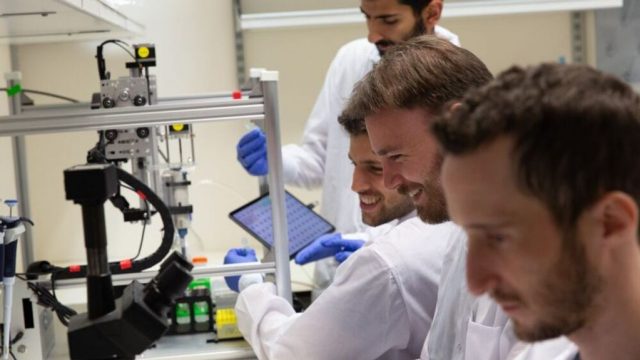
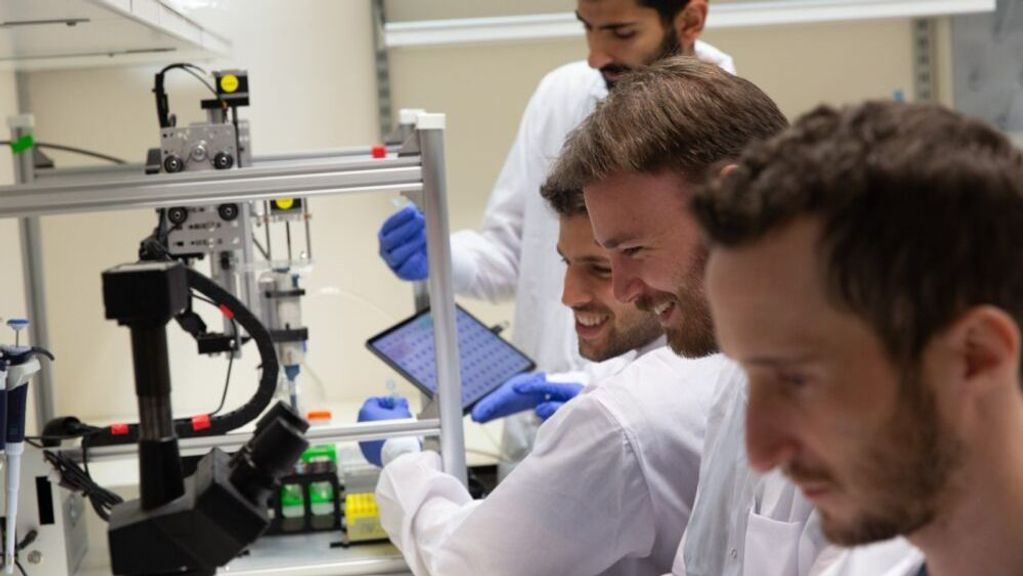
Some of the Quris team in Tel Aviv. The company's newly launched, highly scalable automated platform can test thousands of novel drug candidates at once, on hundreds of miniaturized “patients-on-a-chip.” (Courtesy of Quris)


By Abigail Klein Leichman

Billions of dollars, hundreds of mice and decades are sacrificed to research and development for the average pharmaceutical — with no guarantee of success. Nothing about that equation makes sense anymore.


And that’s why some of the most impressive minds in science are behind Israeli startup Quris, which is rolling out the world’s first clinical-prediction AI (artificial intelligence) platform to evaluate the safety and efficacy of new drugs.

This newly launched, highly scalable automated platform can test thousands of novel drug candidates at once, on hundreds of miniaturized “patients-on-a-chip.”

Using AI to predict which drug candidates will safely work in humans is expected to improve efficacy and cut drug development costs dramatically.

Israeli Nobel laureate Dr. Aaron Ciechanover and Moderna co-founder Robert S. Langer are actively involved in guiding the science, technology and strategy of Quris, dual-headquartered in Boston and Tel Aviv.

“We are at the tipping point of the modernization of drug discovery. I think the Quris platform could be of significant value to pharma companies and the health of society at large,” said Langer, one of 12 Institute Professors at MIT.

Saving money and time is the biggest advantage. Eliminating or at least minimizing the use of rodents in drug testing is also important, and not only for animal welfare reasons.

“We are not mice, so what works in animal-based trials is not a proper indicator of what will work for people,” said Ciechanover, a physician and research professor at the Technion – Israel Institute of Technology in Haifa.

“Using a breakthrough way to test drug candidates on miniaturized patients on chips, Quris can demonstrate their safety and efficacy, or lack thereof, through preliminary chip-based clinical trials. This has never been done before,” said Ciechanover.

Quris CEO Isaac Bentwich said AI-driven drug discovery has become the leading frontier for pharma innovation.

However, this “wildly expensive” technology does not address clinical safety and efficacy. Therefore, most novel drugs still fail clinical trials – costing pharma companies more than $30 billion annually.

“Quris is the first AI platform to predict which drug candidates will safely work in humans, filling a critical gap in clinical prediction,” Bentwich said.
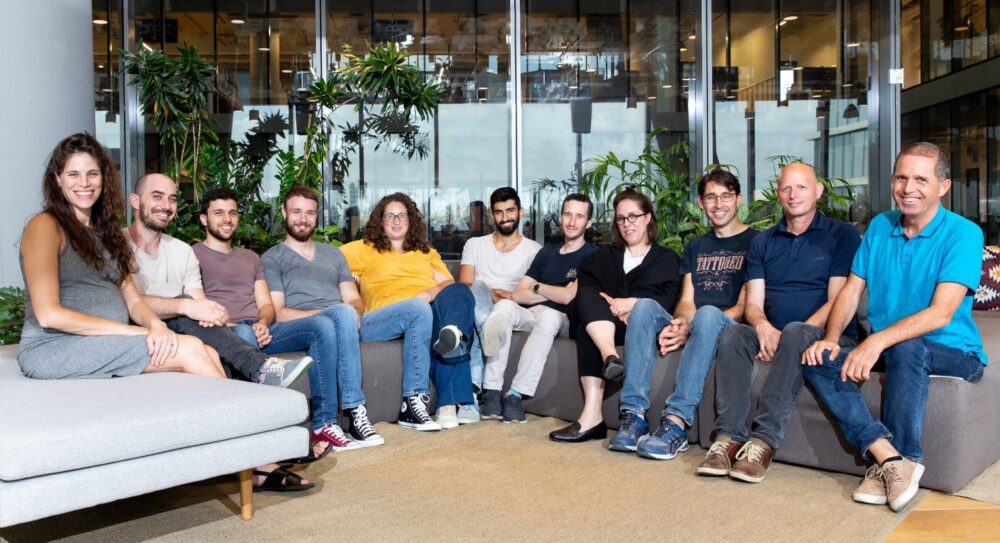
CEO Isaac Bentwich (right) with part of the Quri team in Tel Aviv. (Courtesy of Quris)

While there are organ-on-chip technologies available to test the effect of drug candidates on, say, the liver, they cannot achieve high throughput.

“To generate large amounts of data, you need a platform to perform thousands of experiments, and the current organ-on-a-chip technology does not allow that to happen. It’s usually performed one organ at a time,” Bentwich said.

“Our chip-on-chip solution does multiple such experiments to train the AI and let the AI define if the drug is safe or not.”

Hundreds of genetically diverse ‘patients’

Joining together several organs-on-a-chip to build a patient-on-a-chip has proven cumbersome and unscalable, he said, citing one such device built at Harvard that took up a big box filled with tubes and pipes.

“And that was just a single patient-on-a-chip. Our device is two-by-three inches and simulates a hundred patients on a chip by using different architecture and innovations in nanosensing. It’s much more scalable and inexpensive,” said Bentwich.

Patient-on-a-chip technology will lower the cost and time of drug testing dramatically. (Courtesy of Quris)

Testing to see if a drug is toxic on a single patient-on-a-chip is better than testing it on a mouse. But it’s not perfect because different people react differently to the same drug, he adds.

Here’s where Quris’ exclusive partnership with the New York Stem Cell Foundation Research Institute comes in.

“We generate stem cells, and from them different organs, so you have an entire clinical trial on a chip before testing on humans,” Bentwich said.

“By testing thousands of drugs known to be safe or unsafe on male and female patients-on-a-chip from different genomic makeups, we are able to train the AI to create representative samples of populations based on many properties.”

First clinical trial for Fragile-X drug

Pharma companies can use Quris’ platform to develop safer drugs faster. At the same time, Quris is using its platform to develop its own pharmaceuticals.

And it made sense to focus on rare genetic diseases that cannot be modeled in mice and aren’t common enough to attract development dollars.

The first Quris drug addresses Fragile X Syndrome, the most common inherited cause of autism and intellectual disabilities worldwide. This drug candidate was developed initially at the Hebrew University of Jerusalem.

“Our Fragile X Syndrome drug is moving into clinical testing in the first half of 2022,” said Bentwich, noting that most AI pharma companies do not have drugs at the human clinical testing phase.

Five years to market

“This will be a test case to demonstrate how our system can bring a drug to market in five years with millions of dollars, not 20 years with billions,” said Bentwich.

“We are focusing generally on central nervous system disorders. Brain and liver diseases and cancer are the three areas where safety and efficacy failures of drugs are especially high,” he said.

In addition to 18 granted and pending patents, Quris has partnerships with the Technion for various aspects of development, with Tel Aviv University in nanotechnology, and with Hebrew University’s NewStem drug-discovery spinoff.

The company is doing all this with a lean team of about 20.

“It’s very moving to see extremely talented young guys fresh out of army, not very experienced, working alongside experienced biologists, chemists, nano scientists, micromechanics and robotics experts, using bioconvergence to solve big problems,” said Bentwich.

Dr. Kobi Richter, founder and chief technology officer of Medinol, explained why he participated in Quris’ recent $9 million seed round.

“Our drug discovery process is broken, and technology darlings across biotech, artificial intelligence, machine learning and big data have not been able to overcome the colossal clinical trial failure rate.

“With a remarkable team of scientific pioneers at the helm and its extraordinary clinical prediction platform, Quris will be a game-changer for the industry and lead the next era of drug discovery,” Richter said.

For more information, click here.

Produced in association with Israel21C.

Recommended from our partners


The post No Animals Harmed In New Chip Drug Tests That Are Faster And Cheaper appeared first on Zenger News.

Vayyar Teams With Alexa To Aid Seniors Who Fall At Home

0

figure class=imageimg src=https://www.birminghamtimes.com/wp-content/uploads/2021/12/c45e1f40-e297-4e93-add0-85d4d354da1b.jpg alt=figcaptionVayyar's contactless, wall-mounted sensors alert responders when a person has fallen and isn’t able to push a button or pull a cord to summon help. (Courtesy of Vayyar)/figcaption/figure


By Brian Blum

Israel “sensors-on-a-chip” startup Vayyar has launched Vayyar Care, a camera-free solution that provides round-the-clock protection for seniors at home.


The contactless, wall-mounted sensors alert responders when a senior has fallen and isn’t able to push a button or pull a cord to summon help.

Seniors won’t have to remember to strap on a wearable monitor every morning. That’s not an insignificant problem: A third of seniors forget to put on their devices, while a fifth refuse to use them entirely, fearing a loss of independence.

Vayyar will be available as part of Alexa Together, a new subscription service from Amazon designed to facilitate safe aging in place.

If Vayyar Care detects a fall, it will contact the Alexa Together Urgent Response emergency helpline. Alexa will also send a notification to the designated caregiver.

Vayyar Care can detect falls in all lighting conditions — including pitch darkness and dense steam — making it ideal for use in bathrooms, which is where some 80 percent of falls happen and where customers don’t generally want to install a security camera.

“We designed Alexa Together to help aging customers feel more comfortable and confident living independently,” said Nicolas Maynard, senior manager for Amazon Alexa.

“Alexa Together offers even more value for aging customers when they can connect a device like Vayyar Care.”

The company has come a long way in the past several years.

Vayyar places multiple sensors on a single silicon chip to reduce the physical footprint of the device as well as the cost. The company’s “4D” sensors were originally created to detect breast cancer.

Vayyar sensors can detect whether children are present and wearing their seatbelts. (Courtesy of Vayyar)

That was then expanded to cars — Vayyar sensors can help a car navigate in bad weather and without line-of-sight visibility. Inside the car, it can detect whether children are present and wearing their seatbelts.

The company won a CES award for its Walabot wall scanner that lets contractors “see through” walls to find studs.

Vayyar is now poised make its greatest impact yet.

“With today’s seniors more empowered and engaged than ever, there’s a clear need for smart technologies that enable them to maintain their lifestyles, providing the protection they demand and the peace-of-mind their families expect,” said Raviv Melamed, Vayyar’s CEO.

Melamed and co-founders Miri Ratner and Naftali Chayat discovered in 2011 that each had a family member suffering from cancer. They set out to make a difference. The product they built was a thumb-sized sensor with 24 built-in RF antennas.

RF signals can penetrate anything from human tissue to concrete walls. Because objects made of differing materials absorb the RF signals at varying rates, some signals go straight through an object while others bounce back at distinctive strengths, creating what Vayyar head of marketing Malcolm Berman describes as “a reflection.” Vayyar then uses its many antennas to stitch those reflections into a 3D image.

For breast cancer, Vayyar could be used to differentiate between normal tissue and a tumor, and between benign and malignant tumors.

Vayyar’s founders soon realized that the same technology could be used in almost unlimited applications — from smart homes to self-driving cars.

Vayyar Care is available now for Amazon Alexa Together.

Produced in association with Israel21C.

Recommended from our partners


The post Vayyar Teams With Alexa To Aid Seniors Who Fall At Home appeared first on Zenger News.

‘I could tell he wouldn’t ever break my heart’

0

BY JE’DON HOLLOWAY-TALLEY

Special to the Birmingham Times

Demand For Gasoline Seems Hard To Meet

0

Gasoline is at the highest price level since late 2014, but marks a decline from the average of $3.40 per gallon realized for much of last month. (Spencer Platt/Getty Images)


By Daniel James Graeber

Gasoline demand continues to hold up reasonably well amid elevated prices and refineries may now be struggling to keep up, analysts told Zenger.


Travel club AAA listed a national average retail price of $3.35 for a gallon of regular unleaded gasoline for Tuesday. That’s still the highest level since late 2014, but marks a decline from the average of $3.40 per gallon realized for much of last month.

The price for crude oil, the largest factor that determines what consumers pay at the pump, has been on a steady decline since the discovery of the new Omicron variant of the novel coronavirus that causes COVID-19. West Texas Intermediate, the U.S. benchmark for the price of crude oil, fell more than 20 percent last month, but has recovered 8 percent so far in December.

Above all else, it’s the price of oil the determines what consumers see at the pump. (U.S. Energy Information Administration)

Patricia Hemsworth, a senior vice president at Paragon Markets, told Zenger from New York City that retail gasoline prices are gradually declining, but a recent decision from the Organization of the Petroleum Exporting Countries to keep their regular monthly meeting in open session has added a bit of a premium to the price of oil because it shows the group is ready to pounce on any abnormal market factors. The increase in crude oil prices is subsequently impacting consumers at the pump.

Meanwhile, the Omicron variant may be more contagious than other strains, but symptoms so far are reportedly mild. Those factors are just some reasons for bullish trends on broader markets this week.

“We are having a rally today in stocks, all futures and gasoline,” Hemsworth said.

From supply chain issues to the inflation stemming from the pronounced economic recovery since the depths of the pandemic, there are a myriad of factors keeping the price at the pump at multiyear highs.

However, Matthew Kohlman, an associate director for refined products pricing at S&P Global Platts, said that demand is still steady.

“Demand is looking just fine,” added Patrick DeHaan, the senior petroleum analyst at GasBuddy.

Elevated prices on the West Coast skew the national average price higher, though prices are still at multi-year highs. (U.S. Energy Information Administration)

On top of everything else, supplies aren’t keeping up with demand levels and refiners are struggling as well.

“Refineries had been simply hampered by deep freezes, hurricanes, flooding and even ransomware attacks slowing down their output far greater than usual until the end of the year,” Kohlman said.

There can be ample supply of feedstocks going into refineries, but if they’re idled by extraordinary factors, those extra supplies are meaningless.

Meanwhile, the U.S. Energy Information Administration in its monthly market report for December said it expected retail gasoline prices to move below the $3 per gallon threshold next year. The agency expects prices to move closer to the $3 per gallon level through December and average $2.88 per gallon for 2022.

Edited by Bryan Wilkes and Kristen Butler

Recommended from our partners


The post Demand For Gasoline Seems Hard To Meet appeared first on Zenger News.

Miss Universe Hopefuls Dress For Social Impact

0

Jerusalem Deputy Mayor Fleur Hassan-Nahoum, Director of Tourism for the Jerusalem Development Authority Ilanit Melchior, and Haboydem stylist Stephanie Strauch, kneeling, with Miss Universe contestants in Jerusalem’s First Station, all dressed by Haboydem. (Moran Samuelof)


By Jon Schiller

Israel is gearing up to host the Miss Universe 2021 competition next week, with special events, galas, and tours of the country for the contestants.


One of the events leading up to the competition was a special fashion show put on by the contestants and Jerusalem’s Haboydem (The Attic) — a secondhand clothing store and women’s rehabilitation center.

For the event, the Miss Universe contestants dressed in clothes from Haboydem, aiming to bring sustainable fashion, as well as mental health awareness, to the forefront.

 Miss Turkey found this dress at Haboydem secondhand shop in Jerusalem. (Mistamarindi)

Haboydem provides employment training for people with disabilities, especially those recovering from issues relating to mental health. Each employee has a personalized rehabilitation plan, designed with the assistance of a staff occupational therapist or social worker, and works short shifts.

At the end of the process, employees receive support in seeking a job in the free market. This includes dealing with the pressures of the interview process, integrating into a new job, and maintaining steady employment.

“Haboydem is about giving a second chance [and the idea] that pre-loved clothes, just like our employees, can be given a second chance,” said Haboydem GM Eris Avihod.

Last-minute makeup for a Miss Universe contestant dressed in secondhand clothing from Haboydem. (Mistamarindi)

Among those taking part in the special event was Jerusalem Deputy Mayor Fleur Hassan-Nahoum, an avid supporter of Haboydem.

“I am thrilled that we are able to show the delegates from Miss Universe the very best of Jerusalem,” she said. “I consider Haboydem not only as one of the jewels in Jerusalem’s social-impact business scene, but also a go-to place for beautiful clothes and am delighted that these worlds will come together in the fashion show.”

Haboydem stylist Stephanie Strauch said many customers come for ideological reasons, “while others come to support and encourage our workers during their rehabilitation. Some are financially motivated and some just like the thrill of a ‘find.’”

The Miss Universe pageant on Dec. 12 and will be broadcast live in more than 170 countries.

The Miss Universe Organization, its website states, “is a global, inclusive organization that celebrates women of all cultures and backgrounds and empowers them to realize their goals through experiences that build self- confidence and create opportunities for success.”

The organization prioritizes the importance of being involved and giving back through a dedicated international platform of charitable partnerships, the website states. “As leaders and role models within their communities, our delegates and titleholders affect positive change through volunteering, fundraising and advocacy.”

The site lists Smile Train and Best Buddies as among the charities it supports.

Produced in association with Israel21C.

Recommended from our partners


The post Miss Universe Hopefuls Dress For Social Impact appeared first on Zenger News.

BlackFacts Minute: Dec. 7, 1941, Hero ‘Dorie’ Miller Defends US Ships During Pearl Harbor Attack

0


By BlackFacts

BlackFacts Minute: December 7, 2021


On this day in 1941, Doris “Dorie” Miller defends U.S. ships during the attack on Pearl Harbor. He was the first black American to be awarded the Navy Cross, the highest decoration for valor in combat after the Medal of Honor.

Less than a month before his twentieth birthday, Miller enlisted in the United States Navy. Following boot camp training in Norfolk, Virginia, he was assigned to the USS West Virginia as a messman, an enlisted man on temporary duty in the sailors’ or officers’ dining quarters who serves food, clears the tables and other duties. When the Japanese attacked Pearl Harbor on Dec. 7, 1941, Miller was doing laundry below decks. During the attack, he helped several sailors who were wounded, and while manning an anti-aircraft machine gun for which he had no training, he shot down several Japanese planes.

Produced in association with BlackFacts.com.

Edited by Claire Swift and Kristen Butler

Recommended from our partners


The post BlackFacts Minute: Dec. 7, 1941, Hero ‘Dorie’ Miller Defends US Ships During Pearl Harbor Attack appeared first on Zenger News.

Made-To-Measure Dresses Can Also Be Eco-Friendly

0

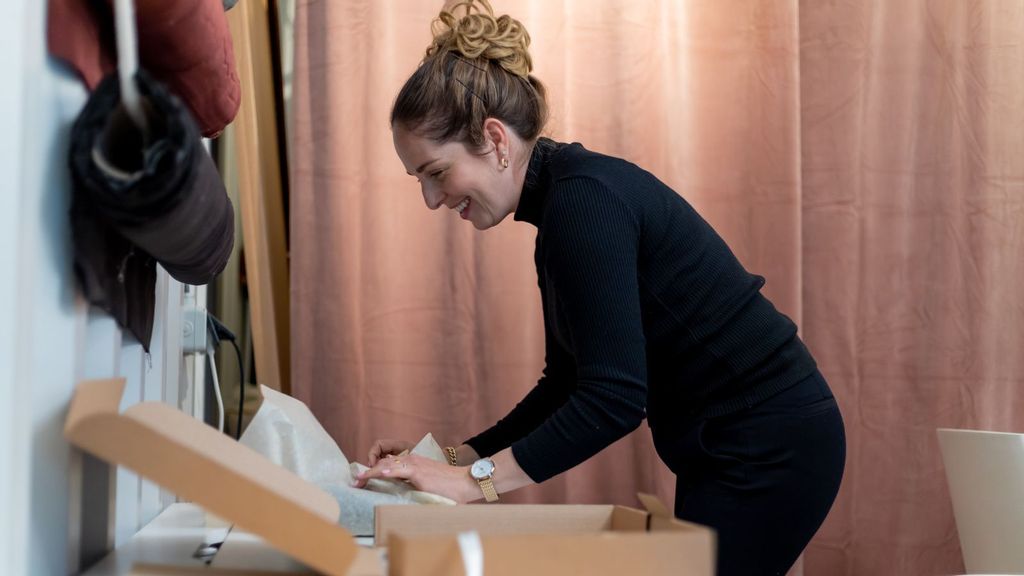
ATALYE CEO and founder Tal Atzmon Shaked wraps a made-to-measure dress made in her Amsterdam studio. (CPTL-Y)


By Naama Barak

It’s a problem we all know too well: you spend hours scrolling online to pick out what promises to be a perfect dress, only to have it delivered and find it’s too long, too tight and has awkward-looking sleeves.


An Israeli-run, Amsterdam-based startup ATALYE has a solution.

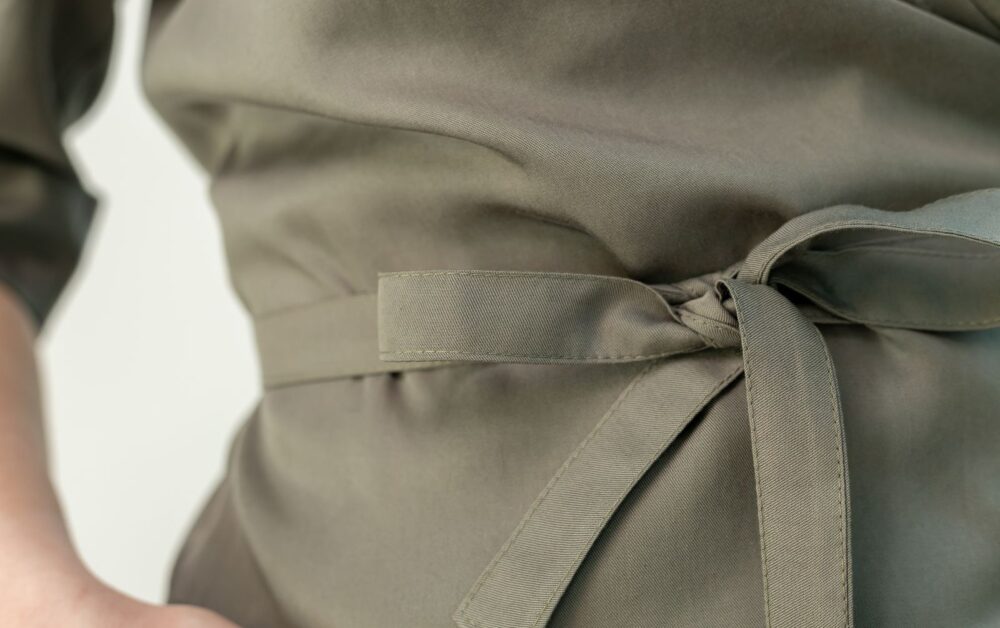
ATALYE combines technology and design to deliver well-fitting, eco-friendly dresses that are made-to-measure by simply scanning yourself with a phone app.

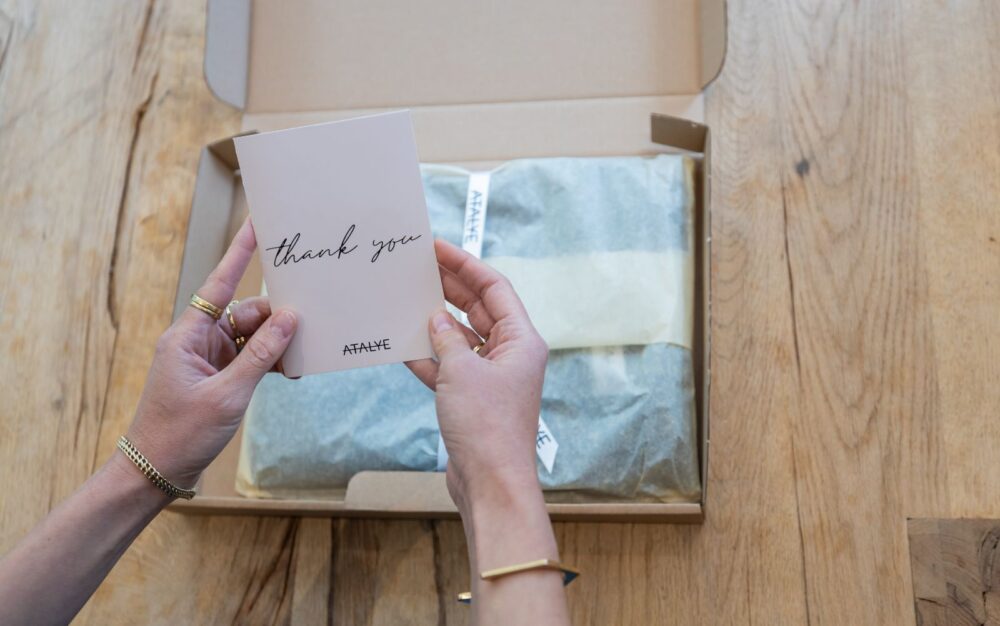
ATALYE customers receive made-to-measure clothes in fast-fashion times. (CPTL-Y)

ATALYE founder Tal Atzmon Shaked didn’t originally see herself in the field of fashion.

“I’ve always loved fashion, but I never thought of working in it, because I saw what it did to friends around me, how it made them feel and what it made them do,” she said while on a visit back home to Israel with her two young children.

Two articles she read in 2015 left a lasting mark. One was about the collapse of a clothing factory in Bangladesh in 2013, in which 1,134 workers died. The other was about an app that scans the body to determine size.

Customers get to choose what color, length and sleeve fit their dress will have using ATALYE’s technology. (CPTL-Y)

“It reminded me of my parents’ stories of how in Israel of the 1950s there weren’t any [retail] chains and you’d go twice a year to the tailor,” she said.

That’s when the thought of combining the two ideas clicked, but Shaked had no experience in either fashion or tech. When her partner took on a job in The Netherlands in 2017, she enrolled in a master’s program there specializing in entrepreneurship in fashion.

“It was an amazing opportunity for me to turn this idea into something tangible,” she recalls. “At the end of our studies, each person had their own booth to present their business to people from the industry and there was a prize. My business won the prize, so I decided that I’m really going to go for it.”

Ready-to-cut patterns

Shaked proceeded to study dressmaking. Together with a model-making and a coding company, she created ATALYE’s technology, a web-based software that can alter dressmaking patterns and create a ready-to-cut pattern.

This technology is now combined with a physical scanner located at ATALYE’s Amsterdam studio and with an app that enables buyers to scan themselves from home, allowing the startup to create the perfect-fitting garment for each customer.

ATALYE scans its customers’ bodies to ensure the best clothes fit for them. (CPTL-Y)

Everything was put in place just before the outbreak of COVID. Once the pandemic hit, Shaked gave up on the idea of a store. She kept only the studio and launched the ATALYE website this summer.

Website customers don’t design their garment but rather customize one type of dress, changing its length, sleeve lengths, color and, of course, fit. The dress is customizable into 1,000 different designs.

Environmentally friendly

Having a dress made-to-measure also has environmental benefits.

“Since we’re only creating each order to measure, we don’t keep large stocks of fabric,” Shaked said.

All the fabrics are either “dead stock,” that is, fabric that didn’t sell and is headed to landfills; or eco-friendly fabrics such as Tencel.

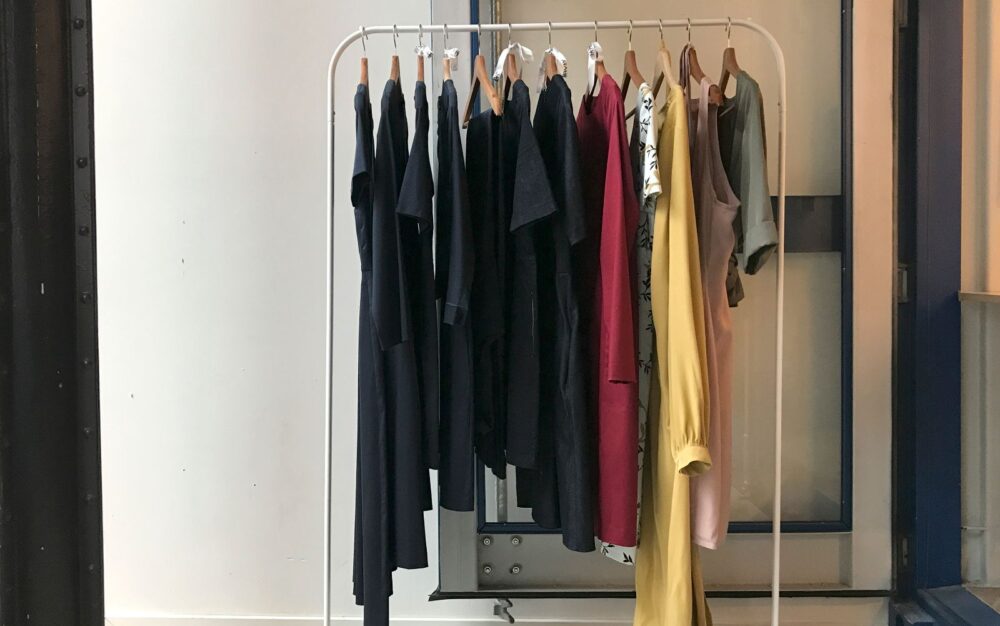
The fabrics used for ATALYE dresses are either dead stock or eco-friendly ones such as Tencel. (CPTL-Y)

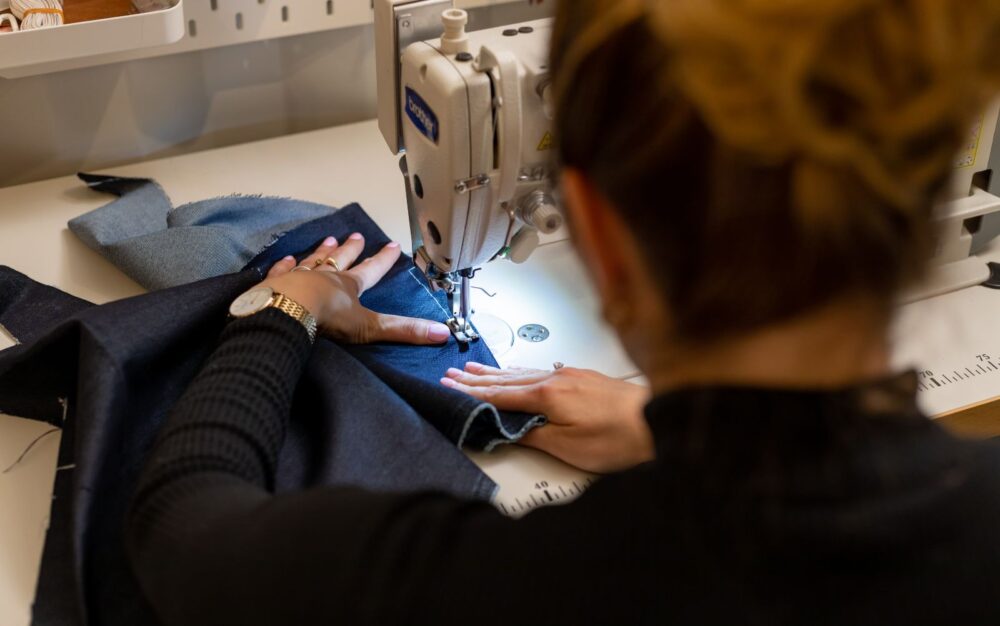
The company only uses fabrics made in Europe, created in adherence to environmental regulations. The garments are sewn by dressmakers in the Amsterdam area.

“The vision is to grow and develop and offer fast fashion, only differently. Nowadays, green brands say that they create slow fashion, and made-to-measure brands tell their customers that their orders will arrive within a month. We promise delivery within two weeks, and I believe that we’ll be able to shorten that in the future.”

ATALYE clothes are sewn in the Amsterdam area. (CPTL-Y)

The concept of virtual made-to-measure clothing already exists, Shaked notes, particularly with two companies creating jeans and men’s suits this way.

But when it comes to women’s fashion, she says that ATALYE is the first, perhaps because of the difficulty of capturing women’s body volume using a scanner.

“Fifty percent of the population is in between sizes,” she said. “In the online world, you don’t know whether things will fit or not. I don’t have a particularly unusual size, but I generally avoid ordering things online. There’s no standardization. Each brand works with different sizes and different cuts according to the customers it seeks.”

That’s why ATALYE’s slogan is “In our future, no sizes are needed. Just your body.”

Feeling special

Shaked said everyone who hears about ATALYE “gets really, really excited about it. It’s a very special experience for women; it makes them feel special.”

Retailing at around $200 per dress, ATALYE’s garments attract three types of buyers aged 30 to 50, Shaked said: busy working women who don’t have time to shop but want well-fitting clothes; “free spirits” who are in for the new experience; and women interested in sustainable fashion.

Currently funded by a private investor, ATALYE plans on expanding in terms of the clothes it offers, collaborations with different artists and fashion brands, and its locations.

Plans include expanding the range of clothes available under the ATALYE brand. (CPTL-Y)

“The vision is that in five years’ time there’ll be five stores in Europe or Europe and the United States, and that these will have returning customers who can order online and be certain that the clothes will fit them,” Shaked said.

Finally, asked how many ATALYE dresses she herself owns, Shaked laughs.

“The cobbler’s children have no shoes. I’ve now started creating things for myself too, and my goal for the winter is that I’ll only wear my clothes. You of course have to believe in your product, so wearing it is the best possible way to do so,” she said.

For more information, click here.

Produced in association with Israel21C.

Recommended from our partners


The post Made-To-Measure Dresses Can Also Be Eco-Friendly appeared first on Zenger News.

New Paint Additive Protects Surfaces From Deadly Pathogens

0

New chemical antimicrobial paint additive from startup Bio-Fence stabilizes disinfectants. (Photos/Unsplash)


By Brian Blum

Trust us: You don’t want to get a listeria infection.


The bacterial infection is fatal in 25 percent of cases, even when treated with antibiotics, and 90 percent of people who get infected are hospitalized in the ICU.

Salmonella and E. coli, the other two big bad bacteria that cause food poisoning, are no walk in the park either, but people rarely die from them. Listeria is significantly deadlier and can even cause miscarriages.

Listeria primarily plagues food-production plants. These stubborn bacteria tolerate extreme low temperatures and dry weather, salt and acidic chemicals. They hide in cracks and small niches. If listeria contaminate your store-bought frozen hot dogs or ice cream, they’ll still be active when you consume the food at home.

Disinfectants such as chloride or bleach only last a short time — and in some cases, protection wanes after just a few minutes.

A new chemical antimicrobial paint additive from Israeli startup Bio-Fence stabilizes disinfectants. Once the enriched paint is applied to floors, walls and ceilings in industrial facilities, disinfectants last much longer, providing prolonged protection, Bio-Fence CEO Ofer Shoham said.

Bio-Fence’s additive enhances the ability of disinfectants to fight off E. coli and salmonella, too, but deadly listeria is the company’s main focus.

If health inspectors find listeria, the factory “must go into an extreme cleaning protocol,” Shoham said. “If it’s found a second time, production stops. The third time, the facility will be shut down entirely.”

Hot dogs

Bio-Fence’s paint additive has been under development for three years and is being used in four projects in Israel and another couple abroad.

Bio-Fence CEO Ofer Shoham. (Courtesy of Bio-Fence)

“We have one customer that’s already made a repeat order,” Shoham said.

In an 11-week proof-of-concept test earlier this year, paint with Bio-Fence’s antimicrobial additive was applied to the floor and lower parts of the walls of a hot dog “peeling room” in a major Israeli sausage manufacturing plant.

Despite repeated, strict cleaning, the facility had a continuous presence of listeria prior to the pilot.

The peeling room presented specific challenges to maintaining hygiene levels: It’s cold inside, there is significant humidity and condensation, and heavy movement of workers and equipment all create an environment where listeria can take hold and multiply.

During the three-week control phase, prior to the test commencing, listeria was detected in 91 percent of the daily floor samples.

Following the application of the Bio-Fence-enhanced paint, listeria was completely undetectable on the floor surface.

The pilot demonstrated a 99.9 percent reduction in the level of “gram-negative bacteria” and a considerable improvement in hygiene levels. All cleaning practices – including using a chlorine-based product – remained the same before and during the trial.

First to succeed

Shoham has been working with food hygiene throughout his 38-year career, most of it at Diversey, an American provider of detergents and cleaning solutions with a division in Israel.

Bio-Fence got its start in 2018 as part of The Kitchen food-tech hub in Ashdod.

“The Kitchen Hub asked if I’d be interested in working on a product that was originally more related to food packaging and machinery,” he said. “I told them it won’t work. We have no control on the level of sanitizer being bound to the surface. And it’s a heavily regulated field.”

Bio-Fence became a chemical technology company instead. The concept of mixing an antipathogen additive into paint is not new, Shoham said.

“It’s well-known and has been researched for many years. But no one had succeeded in making a product out of it.”

This product doesn’t need regulatory approval because it is not sold as an antimicrobial product. Shoham does hope that a recognized authority such as the FDA may adopt Bio-Fence’s system as a new standard for keeping facilities germ-free.

Dr. Sanaa Khalil working at Bio-Fence. (Courtesy of Bio-Fence)

The company got a lot of attention during the early days of COVID-19 when “everyone was afraid of touching surfaces,” Shoham said, although it later became clear that it’s highly unlikely for Covid-19 to be transferred that way.

The seven-person company, which employs Jews, Muslims and Christians and has raised nearly $4 million, operates in Jerusalem’s Har Hotzvim high-tech center and in the Bar-Lev Industrial Park in Israel’s northern Galilee.

Protective paint

Bio-Fence makes a pathogen-fighting paint additive. (Courtesy of Bio-Fence)

The company intends to sell the additive directly to paint manufacturers. Bio-Fence ran a pilot with the local licensee of Sherwin-Williams, one of the largest paint producers in the world.

Shoham expects the additive to increase the price of a normal floor or wall coating by 10-15 percent per square meter. The chemical additive “won’t damage the basic function of those coatings. We’re simply adding another quality to the paint.”

While you probably won’t know if the food you buy was made in a facility protected by Bio-Fence, it’s good to know Israeli innovation is working behind the scenes to keep us healthy.

For more information, click here. 

Produced in association with Israel21C.

Recommended from our partners


The post New Paint Additive Protects Surfaces From Deadly Pathogens appeared first on Zenger News.

Early Christmas Gift: Walmart And Target Ignore Investors, Resist Raising Prices This Holiday Season

0

Customers are big winners with recent promises from Walmart and Target to hold the line on prices during the upcoming holiday shopping season. (Photo by Brandon Bell/Getty Images)


By Dustin Siggins

When investors say jump, many companies ask, how high? But Krista Walls, a mother of two who shops for family, friends and charities at Target and Walmart, is grateful for the retailers’ decisions to keep prices low despite investor pressure to raise them.


“I buy most of my Christmas gifts from Target and Walmart, and as my kids get older, those presents get more expensive!” Walls told Zenger News. “I was actually a little worried, between gas prices and grocery prices going up, about Christmas presents. Now, I couldn’t be happier.”
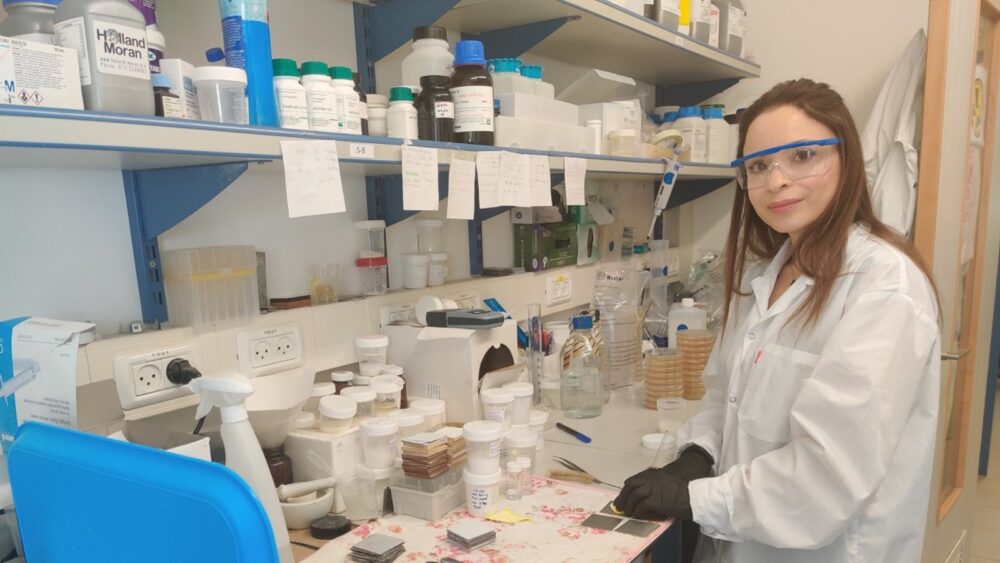
Indeed, Christmas did come early this year for millions of shoppers like Walls, when the two top retailers unveiled plans within a day of each other in mid-November to hold the line on prices over the upcoming holiday season.

In their most recent earnings calls with investors and analysts, the two bellwether businesses said that they would not raise prices to compensate for higher supply chain-related costs and pre-inventory purchases. Walmart even went so far as to tell investors that its competitive “price gap” was larger than normal, but that it wouldn’t take advantage of the opportunity to increase prices more than necessary.

Target shoppers won’t see price increases this holiday season. (Mark Wilson/Getty Images)

In the immediate aftermath of those announcements, many investors weren’t happy, with an overnight stock sell-off which one analyst told S&P Global cost Walmart and Target each 3.1 percent of their stock value. But Walmart and Target stuck to their guns because of the public relations and market share value of putting long-term customer loyalty over short-term profits.

What Walmart and Target said

Throughout a Nov. 16 investor call, Walmart executives made clear that they wanted to keep the traditional Walmart price advantage over the competition. When Citigroup Global Markets analyst Paul Lejuez asked about “cost inflation” for Walmart and its competition, as well as what the company and its competition are going “to do in terms of passing it through to the consumer,” Walmart U.S. president and CEO John Furner drew a line in the sand.

“We want to keep prices low for customers all across the business, and we’ll be the last to go up. So, we’re happy with our price positioning. We see gaps that are wider now than they were before the pandemic began, and we intend to maintain that position.”

The next day, Target executive vice president and chief growth officer Christina Hennington drew a similar line. She said Target had “recently announced the launch of our Holiday Price Match Guarantee, our most robust price match ever.” Most investor questions after Hennington’s comments seized on Target’s expensive pre-purchasing of inventory and other supply-chain-related challenges which left margins smaller than normal. Target CEO and board chairman Brian Cornell and CFO Michael Fiddelke didn’t waste words.

Walmart U.S. President and CEO John Furner drew a line in the sand on a recent investor call, pledging not to pass inflation and supply chain costs on to customers. (Mark Wilson/Getty Images)

Cornell: [Y]ou’ve heard us say a number of times already today, we’re investing in growth. We’re investing to maintain and continue to build market share positions and build on the extraordinary results that we delivered last year, where we added $9 billion of market share and continue to see that momentum grow in 2021.”

Fiddelke: “But I will say, over time, we expect to be a growth company. We expect to be a company that’s growing the top line and gaining share over time.”

It was after these calls that investors pushed their prices downward. However, Zenger looked at both companies’ stock prices before the opening bell on November 30 – both companies had rebounded from the temporary low points, and were higher than pre-Christmas season shopping stock prices.  Clearly, investors weren’t that scared of two of the world’s biggest retailers taking a years-long, loyalty-driven approach to increasing market share and revenue.

The right message at the right time

Inflation is 6.2 percent, gas prices are at their highest nominal price since 2012, and food prices are 5 percent higher than they were last year. Walls and two corporate branding experts told Zenger that Walmart’s and Target’s positions couldn’t have been better-timed for concerned consumers, especially since it contrasts sharply against other companies and investor expectations.

Target CEO Brian Cornell (C) said recently the company is investing in customer growth and will hold the line on price increases. (Andrew Burton/Getty Images)

“My family just moved, and we traveled for Thanksgiving, so our short-term costs are really high,” Walls said. “We normally spend hundreds of dollars on Christmas presents alone, plus everyday family items and groceries, so it’s a legitimate relief to be able to not squeeze quarters quite as hard.”

“Many consumers don’t feel that their government is listening to them or understanding their needs or challenges with rising prices,” said Christian Pinkston, founder and managing partner at Pinkston, a public relations firm. “Therefore, brands — including our clients at Pinkston — are stepping up and making decisions to show that they hear the American people and understand their plight.”

Touchdown Strategies founder James Davis agreed.

“Most Americans would not blame companies for increasing prices when supply-chain challenges and inflation have dramatically increased the cost of doing business,” said Davis. “Instead, Target and Walmart decided to forgo a short-term profit spike in favor of long-term market share by focusing on their customers.”

Customer loyalty creates investor valuation

Despite the economic difficulties over the last 18 months, both Walmart and Target are growing well, including beating investor expectations in the third quarter of 2021. They are also hiring huge numbers of temporary holiday staff: in September, Target announced an estimated 100,000 hires, and Walmart projected 150,000 such staffers.

Walmart shoppers won’t be paying extra this holiday season. (Mark Mainz/Getty Images)

These results made investors happy on the Nov. 16 and 17 calls, before the price decisions were announced. Business consultant Susan Trivers, who shops at Target, said the companies made the right choice for customers, growth and investors.

“Target and Walmart are known for their low prices. By keeping Christmas 2021 consistent with this long-term brand positioning, they are keeping customers from considering other retailers,” she told Zenger. “This will increase their repeat business, which will increase their market share, which will increase their value to investors.”

Walls agreed.

“I may not be a big spender, but millions of people like me are why Target and Walmart succeed. Pricing is a huge part of the relationship … ”

Edited by Matthew B. Hall and Bryan Wilkes

Recommended from our partners


The post Early Christmas Gift: Walmart And Target Ignore Investors, Resist Raising Prices This Holiday Season appeared first on Zenger News.