Home Blog Page 534

Nicholas Melillo Discovers The ‘Foundation’ For The Perfect Cigar 
0

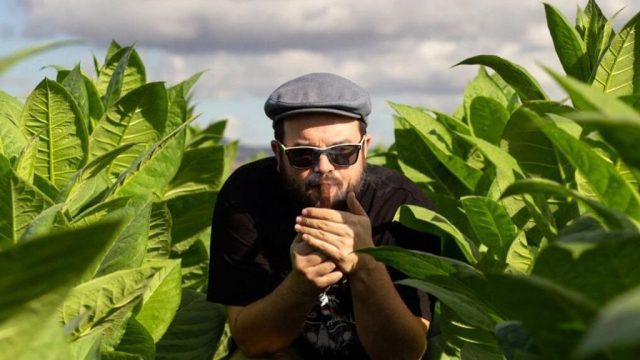
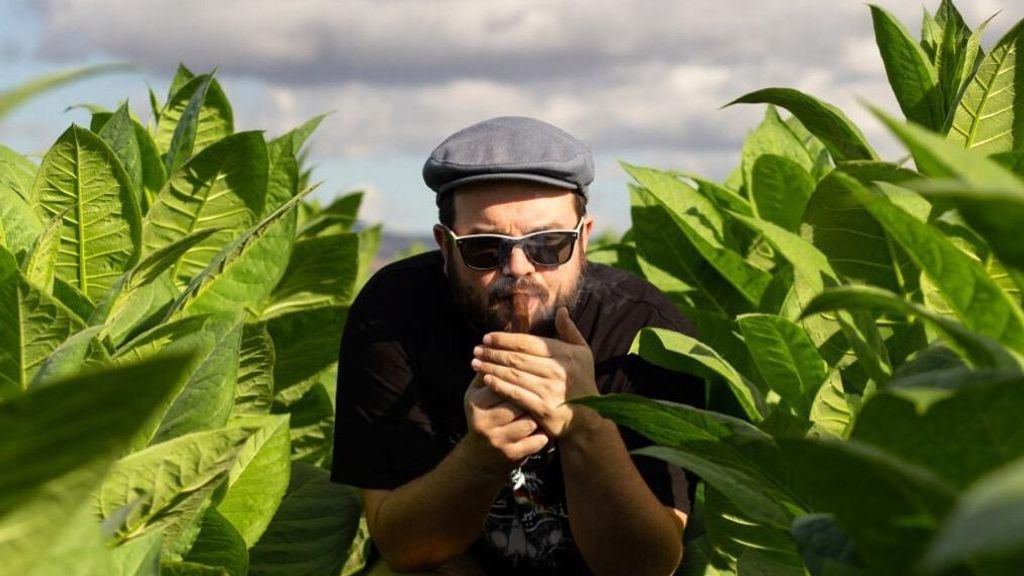
Foundation Cigars founder and president Nicholas Melillo enjoying a smoke in his tobacco leaf field in Connecticut. (Courtesy of Nicholas Melillo)


By Percy Lovell Crawford

You would be hard-pressed to find anyone with more knowledge about tobacco, particularly cigars, than Foundation Cigars president Nicholas Melillo. A longtime smoker, Melillo knows exactly what he’s looking for when it comes to a premium stick.


His background in quality and consistency while working in a Nicaraguan factory paid dividends when he embarked on starting his own company in 2015. By 2020, Foundation Cigars was listed as the Number 3 cigar of the year by “Cigar Aficionado” magazine. That ranking and props from popular comedian, UFC commentator, podcast host and former “Fear Factor” host Joe Rogan helped further boost the brand’s popularity.

The Windsor, Connecticut-based company creates some of the top premium handmade cigars in the world, and Melillo continues his quest to educate potential customers about such products.

Zenger gets a master class in everything cigars from the head honcho of Foundation Cigars, who also explains the concepts behind some of his unique brands and blends, which range from Biblical figures to Bob Marley.

Percy Crawford interviewed Nicholas Melillo for Zenger.


Zenger: Foundation Cigars is based out of Connecticut. Tell us about the location of the company.

Percy Crawford interviewed Nicholas Melillo for Zenger. (Heidi Malone/Zenger)

Melillo: A lot of people don’t know Connecticut grows some of the greatest cigar tobacco in the world in the Connecticut River Valley, north of Hartford. We have a really long history here for growing cigar tobacco. It’s where the Connecticut wrapper comes from. There are 30,000 acres north of the capital of Hartford that are perfect soil for growing cigar tobacco, mainly due to a glacier that was there 15,000 years ago.

Before the Communist regime of Fidel Castro took over Cuba 1959, Connecticut and that country had a really strong relationship. Cuba would send up filler tobacco for the inside of the cigar. And Connecticut would send down wrappers because that’s what we have been known for. When I started the company, I wanted to be sure to put our office here… our office is on a 100-acre farm in the River Valley.

Zenger: You started Foundation Cigars in 2015. Are you satisfied with its growth so far?

Melillo: I am, Percy. We have really been doing it in a way that focuses first and foremost on quality and consistency, because that’s what my background is. I used to run another company’s factory for 12 years. I moved to Nicaragua in 2003. At that time, it was the smallest factory in Nicaragua, and over 12 years, I helped build it into the largest cigar factory. Everything was handmade. We didn’t do anything with machines. I was in charge of 1,600 people, and we were making 105,000 handmade cigars a day. My main responsibilities were quality control, blending and tobacco purchasing.

My focus is always quality, being a cigar smoker myself. I know how important it is to get the right product into consumers’ hands. With that in mind, we started in 2015. I launched Foundation at the industry’s annual trade show, and man… the growth and the reception has been mind-blowing. I started the company a lot smaller than I originally expected. At first, I was looking at bringing on investors, and last minute decided to do it myself.

I left my previous job because I wanted to be my own boss. So, the idea of taking on investors was more daunting than actually working for somebody. Especially if you’re taking on investment money — I’m the kind of person that doesn’t like debt. I would spend my last breath trying to pay you back. I really wanted to do it all on my own. I started smaller but in hindsight, it was better to do it that way. The growth has been so organic from the beginning.

Zenger: Could you elaborate on the difference between hand-rolled cigars as opposed to machine-rolled ones?

Melillo: There is a tremendous difference, and we have been fighting this, especially educating the government and the FDA, because they have been trying to regulate us. The cigars you see in gas stations, convenient stores and so forth, those are all mechanized, those all use what we call homogenized tobacco, it’s not even tobacco, it’s basically tobacco dust that’s made into a paper. It’s made in huge machines that spread them out. The machines that are used to make cigars are high volume, very expensive, and the tobacco is just completely different.  You’re basically dealing with homogenized leaf which is tobacco dust and paper.

Whereas on the handmade side, we’re talking about some of the best tobaccos in the world. The growing in the fields and then the fermentation time, we’re talking about two to three years minimum before those handmade cigars are even rolled. We deal with a lot of what we call long filler, so it’s actually the whole leaf of tobacco, to where the machine-made market uses what we call short filler, which is basically diced up tobacco.

To give you a sense of the difference, the handmade market is such a small boutique industry amongst all these different tobacco products, the percentage of actual handmade cigar smokers is very tiny compared to machine-made cigars or other high volume tobacco products. To give you an idea, Nicaragua, Honduras and the Dominican Republic — which are the three largest areas for handmade cigars — produce about 300 million units annually, whereas the machine-made market is 13 billion.

The distribution channels are very different. There are probably 250,000 gas stations throughout the country, compared to about 2,500 cigar shops. A very small percentage of the nation enjoys handmade cigars. It’s a much different experience as far as the custom of smoking cigarettes. Those type of tobacco products are more like a nicotine delivery. You get off a plane and need to smoke a cigarette. With cigars, it’s more of a ceremony. The custom of sitting, cutting, lighting, the comradery, it’s very much like a modern-day ritual in many aspects. This is what we have been going through with the FDA. We are trying to show them that kids and younger people don’t really smoke our products, and that the price point and act of smoking hand-rolled cigars are so different from machine-rolled ones.

Nicholas Melillo enjoys one of his Foundation cigars. (Courtesy of Nicholas Melillo)

Zenger: How major was it for Foundation Cigars to receive a shout-out from Joe Rogan?

Melillo: Mind blowing! I’ve listened to Joe for many years, so to see him get into enjoying cigars, and to get a shout-out from him… I ended up making him his own cigar. It was super cool, man. A real honor.

Zenger: Another milestone for the company, in 2020, Cigar Aficionado listed Foundation as a Top 25 cigar.

Melillo: In the ’90s when I first started working in cigar shops, the internet was just starting, and there was no social media. The only media where you could find out about cigars was “Cigar Aficionado,” so personally that magazine meant a lot to me. We ended up getting Number 3 Cigar of the Year. It was huge! Definitely one of the top honors of my career. It really helped expose Foundation to a wider array of cigar smokers. It was a huge honor.

Zenger: Your David & Goliath Tabernacle is a very good smoke. What’s the backstory of that particular cigar?

Melillo: The concept of the brand follows my Tabernacle brand. I mentioned this battle we have been going through with the FDA. You could imagine the influence of big tobacco and how they have influence over legislative proceedings and the FDA, so it felt like that battle of David & Goliath. Goliath being big tobacco, the government, and the handmade cigar being David.

I thought it was appropriate for the time. It really fit nicely with my brand called The Tabernacle. The sizes of those two cigars are called Perfectos. Which is a really old-school shape where both ends are kind of pointed. That shape was one of the classic shapes from Connecticut back in the early 1900s. For both David & Goliath, we use the outside wrapper, we make one that is Connecticut broad leaf wrapper, right from the valley, and the newer David & Goliath is a Havana seed, which is a Cuban seed that’s grown in the Connecticut River Valley. That seed is very unique. It’s a special blend, a special project, and that’s one of my favorite daily morning smokes.

Zenger: You say the leaf is the true foundation for a perfect cigar. I’m sure that makes the selection of the leaf a strenuous process for you.

Melillo: Yeah, man! It’s the quality, the consistency of the leaf that you’re putting into your blend. I have been fortunate to work with so many amazing legends in the cigar world, so I’ve been able to learn what we call black tobacco, which is cigar tobacco. I’ve been exposed to the best leaf that you can buy in the world as far as cigars go. I’ve also been fortunate to learn the fermentation process.

I always compare it to my grandmother and great-grandmother’s pasta sauce. My family is Italian, so pasta sauce is a very serious thing. It’s the difference between grabbing a can, popping it open and throwing it on the stove, compared to my grandmother, who used fresh ingredients, fresh tomatoes and low heat over eight hours. What does that do? Once you turn up the heat, Percy, you start losing some of the goodness within the leaf to the elements. The heat actually starts dissipating a lot of the goodness — the oils and essential flavors. It really is slow and steady. It’s like the pasta sauce; the same is true for tobacco fermentation — you have to have time, you have to have patience, and you have to be able to cure it at low temperatures over a long period of time.

The logo of Foundation Cigars features the essential elements needed to grow tobacco leaf. (Courtesy of Nicholas Melillo)

That’s where it gets difficult. You’re talking two to three years, sometimes longer, until you’re turning that leaf into a sellable product. That takes a lot of resources. A lot of times things are rushed. You can cure tobacco really fast by bringing up the natural fermentation heats fast, and you can do it quick. But the real way to do it is slow and steady. That preserves the essential oils in the leaf and the flavor. The proof is in the pudding in the blends and the quality of cigars.

Zenger: The Upsetter is another interesting concept you came up with. Could you elaborate?

Melillo: I started smoking cigars in ’96. At that point, Jamaica was making some of the best cigars in the world. A very infamous brand called Macanudo, was made in Kingston, Jamaica. Near there, you have an area called May Pen, which is the main tobacco growing region. They were making a brand there called Royal Jamaica. At the same time in ’96, I was really falling in love with Reggae music. Once I heard Bob Marley, it just opened these doors. I started looking at life so differently. I started really seeing how everything is interconnected. I’m getting into the roots of Reggae. My love never stopped.

So, about five years ago I was working on starting the company, and I realized that a few days earlier would have been Bob Marley’s 70th birthday. So, I flew from Nicaragua to Kingston with no plans. Just showed up at the family’s house. There was a huge party for his 70th, which I had no idea was going down. I ended up hanging out with Lennox Lewis all day, and some of Bob’s kids. It was amazing.

At the end of the night, everybody was cleaning up, and I saw a gentleman pull a leaf of tobacco out to roll up a spliff. It was a whole leaf and I asked him where he got it from. Long story short, I spent the next week going up into the mountains, going to May Pen, and sourcing… Jamaican Cow Tongue because of the shape. I ended up sourcing that and always wanted to make a brand to pay homage to reggae, ska and rock steady music. The Upsetter cigar is based on the producer, Lee “Scratch” Perry, who passed away earlier this year. He was known as “The Upsetter,” and was one of the originators of dub music.

Edited by Matthew B. Hall and Judith Isacoff

Recommended from our partners


The post Nicholas Melillo Discovers The ‘Foundation’ For The Perfect Cigar  appeared first on Zenger News.

Snout Of Line: Trackers On Wild Pigs Show That Weather May Help Predict Their Movements

0

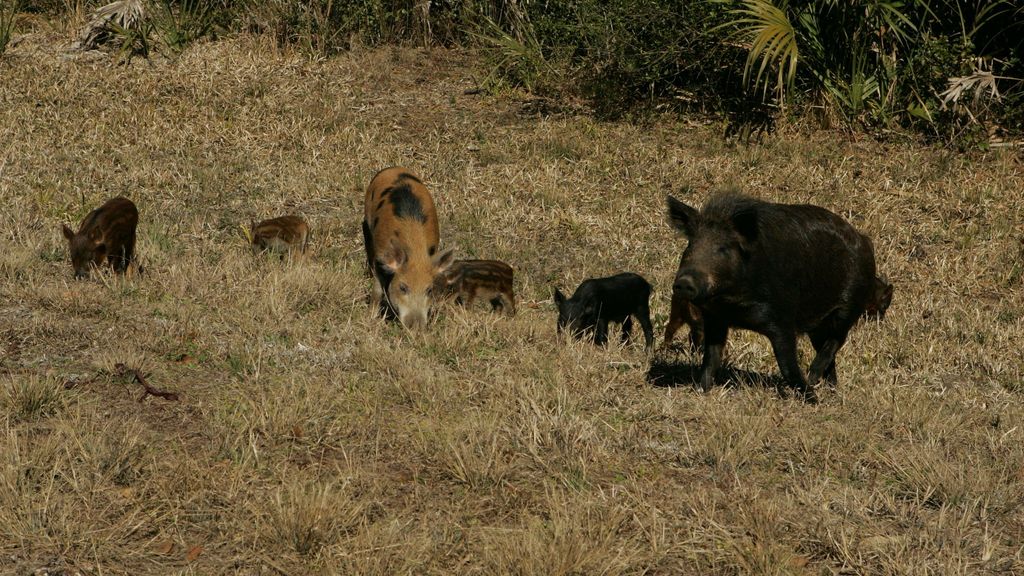
Wild pigs are running rampant in Southern states, such as Texas, Louisiana and Mississippi. Their variegated color reflects admixtures of domestic breeds. (U.S. Fish and Wildlife Service)


By Martin M Barillas

The spread of wild or feral pigs has become a growing problem in the United States and Canada despite efforts by authorities and landowners to eliminate them. But new research may offer strategies to control the porcine menace that threatens wildlife and costs millions of dollars in losses to farmers and other property owners.


Researchers at the University of Georgia’s Savannah River Ecology Lab and Warnell School of Forestry and Natural Resources tracked wild pigs in and near the Savannah River Site in South Carolina. They confirmed that the hogs choose a home range based on a preferred habitat, but found that weather can aid in predicting where they will roam.

European pigs were first brought to the Americas in the 1500s by Spanish explorers and conquistadors who released them into the wild to fatten up on the virgin land. In more recent times, wild pigs originating from farms and hunting preserves have spread throughout much of the United States but also as far north as the Canadian provinces of Alberta, Saskatchewan and Manitoba, where they thrive despite sub-zero temperatures.

Pigs have gone hog wild in Alberta, Manitoba and Saskatchewan, having adapted to the cold by burrowing under vegetation and snow to survive Canada’s harsh winters. (Ryan Brook, University of Saskatchewan) 

Up to 9 million wild pigs in the United States cost approximately $1.5 billion in damages annually, according to the U.S. Department of Agriculture, wreaking havoc on parks, farmland, golf courses and other private property. Public authorities and private landowners have tried poisoning and trapping, as well as hunting pigs from the air. Yet, the pigs continue to multiply.

“Pigs are one of the most adaptive ecological generalists,” said study co-author Jim Beasley of the University of Georgia. “They’re really intelligent animals, and management of them often has to be really adaptive as well, changing on a week-to-week or even day-to-day basis. It all ties back to efficiency of management and how you allocate your resources.”

The research team used baited traps to capture 49 pigs and fit each with a radio collar. Once released, the pigs were tracked for over a year. The data collected showed that the pigs usually stayed close to bottomland hardwood swamps, which are their preferred hangout. While this environment offers plenty of food, such as acorns, a nearby source of water is important in a hot climate. Pigs do not regulate their body temperature well and, much like dogs, require water to stay cool.

University of Georgia researchers attach a radio collar to a wild pig that had been caught in a soft, netted trap and quickly sedated. The animal was not harmed in the process. The rapid spread of the wild pig population has cost over $1 billion in annual damages as the animals wreak havoc on public and private land. Tracking their movements may help contain the spread. (University of Georgia)

Female pigs tend to stay close to home, the researchers found. “In most mammals, females are more tied to resources than males,” Beasley said. “Males often move around more throughout the landscape to gain access to females — especially pigs, which can breed year-round.”

The team looked at variables such as weather, landscape and habitat quality, so land managers can make better decisions about controlling pigs, week by week. “The idea was to provide knowledge of wild pig movements at a temporal scale, at which most management practices and decisions occur,” said lead author Lindsay Clontz.

Of particular interest was the finding that when air temperatures rose and air pressure fell, the pigs tended to stay put, which may be key to controlling their spread.

A map of the lower 48 states of the United States shows where wild pigs were found in 2014. (University of Georgia)

“You’ve probably heard people talk about pets or animals responding before a storm,” Beasley said. “When these bad weather events hit, pigs tend to concentrate their movements, probably in areas of cover to stay out of the elements. That has a direct application in how we implement trapping or other control programs and [decide] where and when to concentrate efforts.”

The study has broader implications because pigs spread diseases among themselves and to human beings. Health authorities in Europe and Asia are coping with African swine and classical swine fever contagion. These can destroy both domestic and wild pigs and may affect human health. The viruses can be transmitted by dead or living animals, as well as through pork food products.

The danger posed to human health convinced German authorities to fence off large tracts of forestland to limit the spread of African swine fever among domestic pigs. An outbreak of the disease could endanger Germany’s annual export of nearly $5 billion in pork products. Meanwhile, classical swine fever has spread in Japan for the last two years, according to the researchers, causing massive economic and environmental damage. When an outbreak is detected, millions of pigs must be slaughtered and disposed of.

Edited by Siân Speakman and Kristen Butler

Recommended from our partners


The post Snout Of Line: Trackers On Wild Pigs Show That Weather May Help Predict Their Movements appeared first on Zenger News.

Birmingham City Councilors On Their Plans To Spend $35M in Federal Money

0

By Ryan Michaels

The Birmingham Times

Instant Fresh Hummus Is Now Only A Push Of A Button Away

0

A new machine is designed to create a restaurant-level spread by combining cooked, ground and seasoned chickpea mash with raw tahini paste at the push of a button. (Nicholas Barbaros/Unsplash)


By Naama Barak

Ever had a strong craving for hummus but not inclined to go through the trouble of making it yourself? Or maybe you just can’t find a brand you like in the supermarket.


With the rising popularity of plant-based foods comes new technology that could make fresh hummus available at office kitchens near you… that is, if you work in Israel.

Humix, an instant hummus-making machine, is to be marketed across Israel in coming months by food giant Strauss Group, which also serves up very popular ready-made hummus brands.

Humix is designed to create a restaurant-level spread by combining cooked, ground and seasoned chickpea mash with raw tahini paste at the push of a button, eliminating the need for preservatives or heavy machinery. It even lets particular hummus aficionados select their golden chickpea-to-tahini ratio for each serving.

The instant hummus machine being rolled out by food giant Strauss. (Tamuz)

The machine is aimed at cafés, restaurants, hotels and office canteens that wish to serve hummus without the messy process of actually making it, according to the company.

Humix is also unique in that apparently it can blend the two required ingredients in a perfect manner using a biodegradable mixing element that requires replacing every day or two. This eliminates the need to clean the machine — no mean feat, as those of you who ever tried cleaning an old crusty pot of hummus may recall.

“As experts on hummus with a passion for innovation, we decided to invest in answering the need for fresh, preservative-free hummus while solving significant challenges in terms of quality and safety in manufacturing outside of a food plant,” said Dagan Eshel, vice president, innovation, at Strauss Group.

Fresh hummus is very appealing. (Anna Pyshniuk/Pexels)

“Plant-based food in general, and hummus in particular, are a good nutritional alternative in replacing animal protein, which is a growing trend. At the same time, we’re also seeing a growing demand for ready-made food with minimal processing, minimal ingredients and with an emphasis on familiar ingredients,” Eshel said. “The hummus that we’re offering is made only of cooked, seasoned chickpea paste and tahini.

“This enables us to produce a product that is as similar as possible in terms of flavor and texture to fresh, homemade hummus, without all the work involved in making it at home,” Eshel said.

The origins of hummus date back to the 13th century, according to the Encyclopedia of Jewish Food, with the earliest known written recipes for a dish resembling “hummus bi tahina” recorded in cookbooks written in Cairo.

Hummus is widely eaten in the Middle East as a dip for bread and vegetables. Chickpeas, the main ingredient, are also mashed, cooked and formed into small flat cakes or balls and fried for falafel.

Produced in association with Israel21C.

Recommended from our partners


The post Instant Fresh Hummus Is Now Only A Push Of A Button Away appeared first on Zenger News.

VIDEO: Gervonta Davis Overcomes Isaac Cruz To Earn Toughest Career Victory 

0

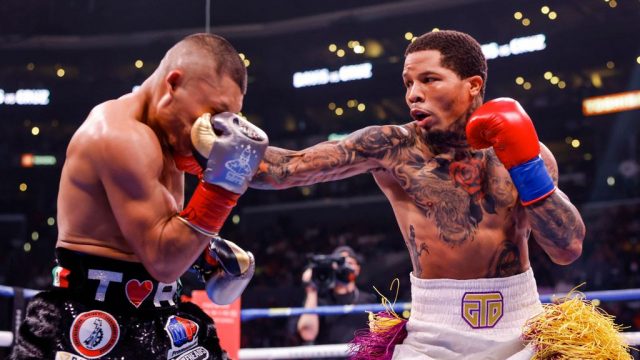
WBA 135-pound champion Gervonta Davis (right) refused cite a sixth-round left-hand injury following Sunday's unanimous decision victory over Isaac “Pitbull” Cruz. “Forget the hand. I don’t want to put it on my hand. I did what I did, and it’s about boxing. I knew what I was coming into this fight with.” (Esther Lin/Showtime)


By Lem Satterfield

 Gervonta “Tank” Davis and Isaac “Pitbull” Cruz promised fireworks during Sunday’s clash for Davis’ WBA “regular” 135-pound title, and the two combatants delivered an explosive and breathtaking toe-to-toe battle for 12 action-packed rounds.


Davis (26–0, 24 KOs) didn’t earn his 17th straight knockout, but he gutted out victory over the steel-chinned Cruz (22–2–1, 15 KOs) of Mexico City in the most difficult fight of his career to retain his crown by narrow unanimous decision (115–113 twice, 116–112). En route to victory, Davis had to overcome a left hand injury suffered during training that was aggravated in the fight’s sixth round before nabbing a victory in front of a sold-out of crowd of 15,850 at Staples Center in Los Angeles.

“I‘m happy to be in the position I’m in,” said WBA 135-pound champion Gervonta “Tank” Davis following Sunday’s unanimous decision over Isaac “Pitbull” Cruz. “I feel that I’m the top guy at 135. (Esther Lin/Showtime)

Davis displayed skills against Cruz that rank him among boxing’s biggest draws in his third straight pay-per-view event after being called “the best fighter at 130, 135 and 140” pounds by retired two-time welterweight champion Shawn Porter following their sparring session three weeks ago.

When the decision was announced, Davis ran to a neutral corner, stood on the ropes and thrust both fists skyward.

“Tank is a fighter. He showed that he can dish it out as well as take it. Tank did exactly what I asked him to do,” Floyd Mayweather, Davis’ Hall of Fame promoter, said during the post-fight press conference. “Turn him, turn him, box him, make him miss and make him pay, and that’s what he did. The guy was rough. If I would have fought this guy when I was younger and at my peak, I probably wouldn’t have knocked the guy out. He was tough.”

During a post-fight embrace with Cruz, Davis said, “hell no,” to the prospect of a rematch, later adding, “if we were to fight again, I’d knock him out,” and, “I’m fresh and could go another 12 rounds.”

“This is the first time that [a hand injury] has ever happened to me. It feels like not just one knuckle, but a couple of them. But it ain’t no big deal. I got the job done. [Cruz] is definitely a warrior. Even though he didn’t win, a star was born tonight,” Davis said. “At the beginning of the fight, we knew that my opponent would come out strong. But I felt that as I was going on and on with the fight that he would break down. But I hurt my hand, so I couldn’t get him outta there.”

It was after the sixth round that Davis, a 27-year-old Baltimore native, returned to his corner and complained to his career-long trainer, Calvin Ford, that he had injured his left hand.

“If there is a chance at a rematch, then I want it,” said Isaac Cruz (left), who relentlessly pounded the body of WBA 135-pound champion Gervonta Davis (right) during his unanimous decision loss on Sunday. (Esther Lin/Showtime)  

“Gervonta came to the corner after the sixth round and said, ‘my hand is hurt.’ If you look at the tape, I said, ‘I don’t wanna hear that. Fight through it,’” said Ford, revealing the injury happened in training.

“Gervonta hurt his hand in camp and never complained about it. He just came out here and put on a helluva show, and that’s the bottom line. He fought this kid with one hand. Now give this young man his props.”

Ford worked alongside lead corner man Barry Hunter for the first time.

“Tank’s performance was beautiful tonight. He had a chance to show the world another facet of his boxing skill set,” Hunter said. “The average fighter facing somebody like Cruz with one hand and under that type of pressure, stress and duress would have broken down. Cruz took the role of the bull, and ‘Tank’ was the matador.”

Cruz took every shot imaginable from Davis, using brilliant head movement and relentless pressure along with brutal blows to the head and body.

But Davis refused to cite the injury as an excuse.

“Forget the hand. I don’t want to put it on my hand,” Davis said. “I did what I did, and it’s about boxing. I knew what I was coming into this fight with.”

Davis nevertheless delivered another resounding message among lightweights auditioning to face undisputed division champion George “Ferocious” Kambosos, who was ringside, as were current and former NBA stars Magic Johnson, Carmelo Anthony, Kevin Garnett, Dwight Howard, Paul Pierce, Kenny Smith and Kawhi Leonard.

“I’m happy to be in the position I’m in, but I don’t think I’m the face of boxing right now,” said Davis, calling his division counterparts “easy work.” “I feel that I’m the top guy at 135, but I don’t call anybody out. They can call me out, and when the time comes, it will come.”

Davis’ 96-percent knockout ratio is second to that of IBF/WBC 175-pound titleholder Artur Beterbiev (16–0, 16 KOs) among world champions. Davis narrowly out-landed Cruz in total punches (133–121) and power shots (113–112), but he did out-jab him 20–9.

Cruz, 23, entered at 17–0–1 (12 KOs) since falling by eight-round unanimous decision to Luis Miguel Montano in February 2016.

“The fans are speaking to who they thought won the fight tonight. A star was born,” Cruz said. “In the fifth round, I noticed his hand wasn’t working correctly. My style as the ‘Pit Bull’ is to always pressure, and I maintained a rhythm from start to finish. If there is a chance at a rematch, then I want it.”

Davis-Cruz represented the third straight high-profile, 135-pound clash within nine days and among four in a two-week span, following up an upset split-decision victory on Nov. 27 by Kambosos (20–0, 10 KOs) over Teofimo Lopez (16–1, 12 KOs), whom “Ferocious” dethroned the IBF/WBA/WBO and WBC franchise champion.

Davis has consistently produced between 200,000 and 230,000 pay-per-view buys over the last 14 months, his previous three victories being a 12th-round TKO of three-division champion Yuriorkis Gamboa (December 2019), a sixth-round KO of four-division champion Leo Santa Cruz (October 2020) and an 11th-round TKO that dethroned previously unbeaten WBA 140-pound champion Mario Barrios (June 2021).

Davis floored Gamboa once each in the second, eighth and final rounds to earn the WBA’s vacant lightweight crown, Santa Cruz was knocked out for the first time in his career by Davis’ ripping left uppercut, and Barrios was floored twice in the eighth and once in the 11th, falling to 26–1 (17 KOs) following “Tank’s” fight-ending left hook to the solar plexus.

A capacity crowd of 16,432 packed State Farm Arena in Atlanta to see Davis dispatch Barrios, and, in July 2019, 14,686 witnessed “Tank’s” second-round TKO of Ricardo Nunez at Royal Farms Arena in his native Baltimore.

“Tank is a fighter. He showed that he can dish it out as well as take it,” said Hall of Fame boxer Floyd Mayweather Jr. (right) of WBA 135-pound champion Gervonta Davis (left) following Sunday’s unanimous decision victory over Isaac Cruz. (Esther Lin/Showtime)

“We were in Atlanta a few months ago, and we had more fans at our fight than the [NBA’s Atlanta] Hawks had at their playoff game,” said Leonard Ellerbe, CEO of Mayweather Promotions during an interview following Saturday’s weigh-in.

“The numbers don’t lie. We’ve gone to the UK, we’ve gone to Baltimore, we’ve gone to New York. Everywhere Tank goes, this young man sells out. You can feel the energy [during his ring walk].”

Davis entered the ring behind rapper Lil Durk wearing the late Kobe Bryant’s jersey numbers “8” and “24” on each side of his trunks.

“Davis is the cash cow of the division, and he came out west tonight and had another sellout. Everywhere he goes, Tank always has a hot artist with him, and the place is just rocking,” Ellerbe said.

“You hear some promoters complaining about nobody’s selling tickets, but we don’t have that problem with this young man, because he’s the most exciting fighter in the entire sport; he gives the fans exactly what they want to see. He’s that guy for this new, young generation. They don’t care who he fights, so it all begins and ends with ‘Tank.’”

“Tank’s” latest fight came the day after WBC counterpart Devin Haney (27–0, 15 KOs) earned a unanimous decision over former champion Joseph Diaz (32–2–1, 15 KOs) and in advance of southpaw three-division champion Vasyl Lomachenko (15–2, 11 KOs) battling former champ Richard Commey (30–3, 27 KOs) on Dec. 11.

“I feel as though none of the other guys can do what I do. I feel as though I’m the best fighter at 135,” Davis said. “I feel like I’m the best at what I do. I’m at my best staying at 135 and fighting with the other guys. That’s where a lot of the monsters are, and I feel as though we have a great division right now. I still have a lot more to improve on. There is no limit to what I can accomplish.”

Edited by Matthew B. Hall and Stan Chrapowicki

Recommended from our partners


The post VIDEO: Gervonta Davis Overcomes Isaac Cruz To Earn Toughest Career Victory  appeared first on Zenger News.

University of Alabama Business Students Show Support for Birmingham City School

0
Donald Greene, right, with his 6th-grade social studies class. (Haley Wilson, The Birmingham Times)

By Haley Wilson

The Birmingham Times

Innovation Laboratories Aim To Provide Scientific Solutions For Industry

0

The new laboratories' application-focused model is different from traditional basic research, which usually begins with the interests of the researcher. These labs will aim to address specific needs defined by industries. (Courtesy of Tel Aviv University)


By Jon Schiller

Several new laboratories are set to join forces with Israeli industry to advance groundbreaking research with potential applicability within three to seven years.


Tel Aviv University announced its intention to launch the Center for Innovation Laboratories before the 2021-2022 academic year.

Six laboratories, along with additional labs under construction, will try to provide a comprehensive scientific and innovative solution for specific needs conveyed by industrial and public bodies such as hospitals and schools.

For example, if the health industry expresses a need for unique diagnostic photographic technology, the researchers will try to provide an appropriate solution within a relatively short time frame.

The application-focused model is different from traditional basic research, which usually begins with the interests of the researcher.

“Tel Aviv University’s vision includes internationality, multidisciplinary and connections with knowledge-intensive industry and society,” said TAU president, professor Ariel Porta.

“The Center for Innovation Laboratories will integrate all of the components of this vision. As the largest and most diverse research university in Israel, we strive for the groundbreaking research innovation of the university’s researchers to benefit society in Israel and around the world.”

The new center will bring together experts from a wide range of disciplines, who will enrich various dimensions of research from different perspectives, including design, branding and accessibility to diverse audiences.

The industrial sector will take on a significant part of the funding of the research in a format that involves “club membership” conferring product development rights.

“This unique center redefines the interface between academia and industry,” said its director, professor David Mendlovic.

“The academic freedom to create and innovate on the one hand, and the desire for research that has practical applicability on the other, has led to a center that brings together innovation labs dealing with a variety of topics and actors such as industry, hospitals, and government agencies.”

Other areas of innovation

The Startup Nation is known for numerous other technological innovations, including: The Kitchen, the world’s first food-tech hub. It was launched in 2015 by The Strauss Group, one of Israel’s largest food producers, as part of the Israeli Innovation Authority’s Technological Incubators Program.

Today, The Kitchen has 19 portfolio companies cooking up innovations to feed the world more efficiently, sustainably and securely.

But The Kitchen is no longer alone: Governmental, corporate and academic food-tech labs and incubators are opening across Israel. The number of food-tech startups has risen to approximately 400.

Another recent innovation has involved using ice to store solar energy. Nostromo Energy’s modular IceBrick, installed on the roof, basement or walls of commercial and industrial buildings, stores energy in ice capsules and directs it to commercial space cooling, which accounts for up to 45 percent of global global power demand during peak hours.

Produced in association with Israel21C.

Recommended from our partners


The post Innovation Laboratories Aim To Provide Scientific Solutions For Industry appeared first on Zenger News.

Not So Balloonatic: How Fleets Of High-Tech Balloons Could Scrub CO2 From The Air

0

Capturing CO2 when it’s frozen at high altitude, using high-tech materials carried by balloons, could totally disrupt the carbon-capture technology world. (Umit Cem Pamuk/Pexels)


By Abigail Klein Leichman

In the same way that too much dressing ruins a salad, too much carbon dioxide (CO2) in the Earth’s atmosphere ruins the air. This is one of the main drivers of today’s environmental crisis.


Climate scientists agree that in addition to preventing further damage to our atmosphere we must isolate and remove excess carbon dioxide to reverse existing damage.

But this task is like trying to scrape the dressing off a tossed salad.

Which is why a new approach from Israel — capturing CO2 when it’s frozen at high altitude, using high-tech materials carried by balloons — could totally disrupt the carbon-capture technology world.

“Humanity generates 50 billion tons of CO2 each year from electricity generation, deforestation, heating, transportation and industry. Around half of it stays in the atmosphere, causing floods, fires and climate change,” said Nadav Mansdorf, cofounder and CEO of Ramat Gan-based High Hopes Labs.

“There are a lot of resources being allocated to capturing CO2 from the air because if we don’t, we are facing a catastrophe,” says Mansdorf, a high-tech serial entrepreneur with high hopes for improving the world.

The problem is that current carbon-capture technologies are removing no more than a few thousand tons annually out of that 25 billion.

A wakeup call

About two years ago, scientist Eran Oren phoned Mansdorf in the wee hours of the morning to share an ingenious idea.

“Eran called me at 4 a.m. and said he found a solution for the world’s biggest problem. I think we haven’t slept since then,” Mansdorf jokes.

Eran Oren, chief technology officer of High Hopes Labs. (Courtesy of High Hopes)

Oren, a veteran of the IDF’s Talpiot program for promising young physicists, had pored over every climate-change report he could find. His research moved him from initial skepticism to all-out alarm.

“It’s far worse than generally presented to the public,” he said.

Scaling up CO2 capture seemed critical, and he drew on his knowledge in chemistry and advanced materials to propose how to do this better.

The key, Oren believed, was ultra-low temperatures. At high altitudes, CO2 freezes and becomes easier to remove from the atmospheric salad. Advanced materials that work as sponges and filters also work better at lower temperatures.

“We use these phenomena to make the task of carbon capture from the mixture much more efficient in cost and time, making carbon capture an actual valid solution for climate change,” said Oren.

The 4 a.m. phone call came after a sleepless night of figuring how to use balloons to do the job, and confirming that nobody else had tried it.

“The field of high-altitude ballooning has undergone a leap in technology over the last decade,” said Oren. He said that Google, Amazon and NASA have developed ways to drive balloons up and down in a highly controlled manner.

Up, up and away

Mylar balloons are strong, cheap and lightweight. Filled with helium or hydrogen, they can lift a payload way up high, in this case a storage vessel for CO2.

High Hopes proposes using fleets of such balloons to extract the frozen gas from the air 10 miles above ground in stages. Strong winds blow the CO2 through the vessel and it sticks to the high-tech filter material inside.

The CO2 is held under pressure at high concentrations and brought down to be sequestered safely underground.

Oren said scientists are still working out how to use captured carbon; for now, it must be sequestered.

“Nadav and I were developing the technology for a year before we were satisfied with its feasibility. We performed proof-of-concept experiments and that was our launching point to the next phase,” said Oren, who is now in Germany running optimization experiments at High Hopes’ subsidiary there.

The project was at first bootstrapped because “it seemed too crazy to ask anyone else to fund it,” said Mansdorf.

“When we did our calculations and understood it’s possible and scalable and makes sense, we raised money from angels in less than a month, about a year ago. Now we are raising a major seed round.”

Whereas the Swiss company Climeworks reports that it can capture carbon at a cost of $1,000 or more per ton, High Hopes plans to start pricing around $100 per ton and reduce it by half as they scale up.

And instead of capturing 1,000 tons of CO2 per year, High Hopes aims to capture at least one ton per day per balloon. A fleet of such balloons could capture billions of tons, Mansdorf said.

Coming out of stealth mode on Earth Day last April, High Hopes receives daily inquiries from governments, energy companies and large corporations across the world.

“It is a very humbling experience. We are small and new, not famous or rich, but there are weeks in which each evening we have Zoom meetings with Fortune 500 companies,” said Mansdorf.

For more information, click here.

Produced in association with Israel21C.

Recommended from our partners


The post Not So Balloonatic: How Fleets Of High-Tech Balloons Could Scrub CO2 From The Air appeared first on Zenger News.