
2021 Veteran’s Day Celebrated in Birmingham, AL



By Donald Hunt


Crude oil prices lost ground during the Wednesday session, with overtures on controlling U.S. inflation overshadowing some usual market movers for the day.
West Texas Intermediate, the U.S. benchmark for the price of crude oil, closed trading Wednesday at $81.34 per barrel, a 3.3 percent decline from the previous session.
Crude oil prices remain at multiyear highs and, added to other inflationary measures, could undermine U.S. economic growth.
The market on Wednesday typically moves on the usual weekly data from the U.S. Energy Information Administration on commercial storage levels of crude oil and refined petroleum products such as gasoline.
“Crude oil traded a bit softer after the release, primarily I think due to the drop in natural gas prices, both in the U.S. and especially in Europe,” said Ole Hansen, the head of commodity strategy at Saxo Bank in Denmark.

Natural gas prices, which have been on an exponential rise for weeks, have been moderating on assurances of more supplies. So-called fuel switching, where power generators, for example, look to crude oil or other fuels when natural gas prices are high, has led to a surge in commodity prices across the board.
Meanwhile, the federal energy data was a bit of a mixed bag. Oil storage level increases usually point to lackluster demand, while the opposite holds for decreases. For the week ending Nov. 5, crude oil in commercial crude oil inventories increased by 1 million barrels from the prior week, while gasoline inventories decreased by 1.6 million barrels.
“Crude prices extended declines after a surprise build and on growing expectations the Biden administration will do something after inflation hit a 30-year-high,” said Edward Moya, a senior market analyst at OANDA.
The federal government reported prices for U.S. consumer goods increased 6.2 percent in October from year-ago levels. That’s the highest inflation rate since 1990. For just energy, inflation over the 12-month period ending in October rose a steep 30 percent.

Elsewhere, federal energy data showed there was a sizable withdrawal from the Strategic Petroleum Reserve. Often used in emergency situations such as hurricane-related outages, oil refiners can borrow crude oil from the reserve and replace that later with additional quantities.
U.S. President Joseph R. Biden Jr. has suggested tapping into the Strategic Petroleum Reserve to counter higher prices. But a monthly report from the Energy Information Administration released earlier this week showed supplies will outweigh demand next year, pointing to lower prices in the future. That could negate the need of tapping into strategic reserves.
Al Salazar, the managing director at energy data firm Enverus, said it was the petroleum reserve that was the star of the show.
“President Biden has been exploring all options to ease gasoline prices, including tapping SPR reserves in a more material manner,” he said.
“The acceleration in pace of SPR draws this past week as reported by the EIA, suggests that perhaps President Biden is already testing the SPR option and its impact on prices,” Salazar said, referring to the Strategic Petroleum Reserve and the Energy Information Administration.
The Energy Information Administration’s November monthly market report said it expected crude oil prices would hold around current levels for the remainder of the year.
Edited by Bryan Wilkes and Kristen Butler
The post Did Biden Beat Oil Prices? appeared first on Zenger News.


By Rachel Barr
Israeli innovation is seemingly everywhere. Hardly a week goes by without a new company from the Startup Nation ringing the opening bell at the New York Stock Exchange. Peruse a list of successful tech companies and you’re bound to find a few Israeli firms among them.
But there is one list that Israeli companies have yet to join: the Race to Zero Campaign.
Organized by the United Nations, the Race to Zero brings together public and private entities from around the globe who have pledged to reach net-zero carbon emissions by 2050 at the latest. By this date, companies must release no more carbon to the atmosphere than the carbon we can remove through either natural or technological means.
Many believe companies must move even more quickly than this if they are to halt the consequences of catastrophic climate change.
As long as atmospheric concentration of CO2 keeps rising, so will temperatures. Emitting net-zero carbon is necessary to achieve a sustainable future.
Thousands of businesses, along with hundreds of cities and educational institutions, have already committed to participating. Race to Zero has become the largest global coalition to unite for the singular purpose of achieving net-zero carbon emissions by 2050.
Together, these players account for almost 25 percent of global CO2 emissions and more than 50 percent of gross domestic product (GDP).
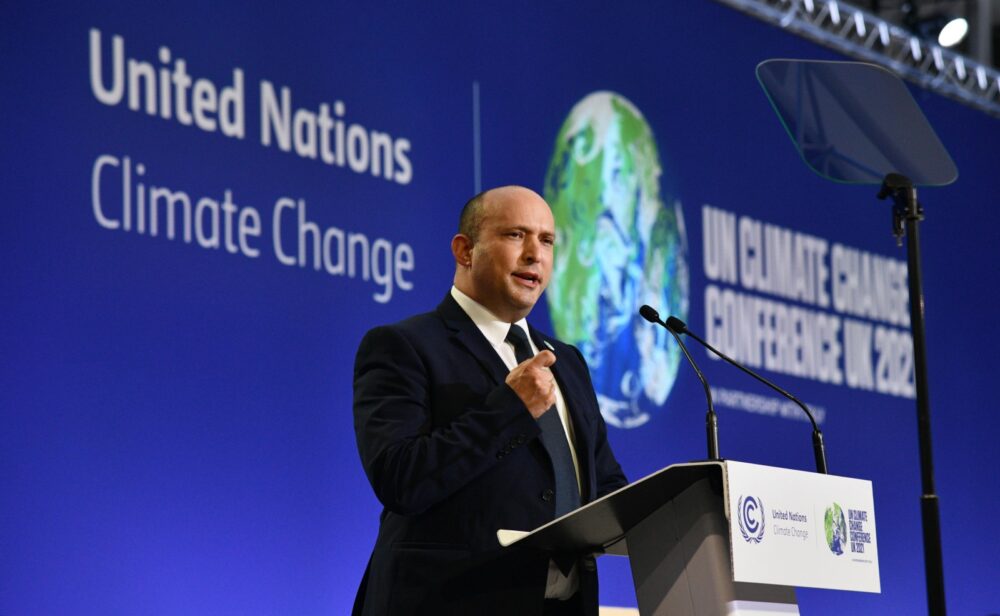
The shared goal of these businesses, cities, investors and others who have committed to the Race to Zero is to build a decarbonized economy. With the UN’s climate summit taking place in Glasgow right now, companies have an invaluable opportunity to advance this vision and build on momentum.
The heat is on
The scientists behind the latest report from the Intergovernmental Panel on Climate Change (IPCC) are highly confident that human activities have contributed to this warming trend.
As demonstrated in this interactive climate projection tool from the World Bank, the severity of the warming we experience throughout the rest of the century will be tied to the amount of greenhouse gases we emit.
The effects of climate change will be dangerous and expensive. The World Bank estimates that the cost of the predicted changes, if no action is taken to prevent or adapt to the impacts, will amount to 5 percent of Israel’s annual GDP.
UBQ Materials: Lone Israeli racer?
To date, only one entity from the Startup Nation is listed in the Race to Zero coalition – UBQ Materials.
UBQ is an Israeli cleantech company that has developed a patented solution to convert unsorted household waste, including all organics, into a climate-positive thermoplastic.
By diverting food scraps, greasy pizza boxes and dirty diapers from landfills, UBQ prevents the production of methane, a potent greenhouse gas that is gaining more and more infamy for its role in climate change.

For every ton of UBQ material produced, 1.3 tons of landfill waste are diverted, and 11.7 tons of carbon dioxide equivalent are prevented from polluting the atmosphere.
This makes UBQ material the most climate-positive thermoplastic on the market, able to substitute oil-based plastics, wood or concrete in thousands of applications.
Addressing the climate emergency is central to UBQ’s work. In 2020, the company took this commitment to the next level by pledging to reach net-zero greenhouse gas emissions by 2030 across its entire supply chain.
One country, one planet, one goal
The Race to Zero is not a competitive event. UBQ envisions building a robust community of Israeli businesses working toward the same goal, inspiring and learning from one another.
Supporters say there is not a better time for Israeli companies to get on board, with Israel’s President Isaac Herzog launching Israeli’s Climate Change Forum and recruiting policymakers to ensure that climate action is at the top of Israel’s agenda.
For more information, go to Race to Zero.
Produced in association with Israel21C.
The post Companies Join In Creating A Decarbonized Economy appeared first on Zenger News.


By Peter Barker
NASA’s SpaceX Crew-3 astronauts were blasted into orbit by a Falcon 9 rocket, beginning their journey to the International Space Station.
NASA astronauts Tom Marshburn, Kayla Barron and Raja Chari, along with European Space Agency astronaut Matthias Maurer, were launched into space aboard a rocket built by entrepreneur Elon Musk’s SpaceX from NASA’s Kennedy Space Center in Florida at 9:03 p.m. on Tuesday, Nov. 10.
The crew is expected to dock at the forward port of the space station’s Harmony module at 7:10 p.m. on Wednesday, Nov. 11.
Earlier this month, the launch date for the Crew-3 mission was pushed back for several days due to what NASA described as “a minor medical issue” involving one of its crew members. “The issue is not a medical emergency and not related to COVID-19,” the agency said at the time.
The astronauts that lifted off on Tuesday are setting off on a six-month mission carrying out research in the lab on the space station covering such areas as materials science, plant science and health technologies.
In video released by NASA, the astronauts can be seen preparing for the mission and waving for the cameras as they walk toward the launch site.

They then take their positions aboard the Dragon capsule that sits atop the Falcon 9 booster. Shortly after that, the powerful, reusable booster roars to life, launching the crew out of Earth’s atmosphere and into space. At liftoff, the Falcon 9’s massive orange exhaust fireball briefly brightens the area surrounding the launch pad.
When they arrive at the space station roughly 22 hours after liftoff, the crew members will be met by NASA astronaut Mark Vande Hei and Russian cosmonauts Pyotr Dubrov and Anton Shkaplerov, the crew members from Expedition 66 who are on board the space station.
The latest mission, NASA said, is part of a wider plan to “restore and maintain American leadership in human spaceflight.”

By carrying out regular long-term missions, NASA is able to rotate crews and carry out extensive research and technology investigations on the space station.
The research benefits the people back on Earth by contributing to the technology and understanding needed for future missions to Mars and the moon, the agency said in the statement.
The launch marked the third operational crew launch by Elon Musk’s SpaceX Falcon 9 booster and Dragon capsule for NASA. Earlier this week, the station’s predecessor Crew-2 safely returned to Earth after a record-setting stay on the space station by a U.S.-crewed spacecraft. That crew, which consisted of two NASA astronauts, along with one each from the European agency and Japan Aerospace Exploration Agency, was aboard the station for 199 days.
Edited by Matthew B. Hall and Kristen Butler
The post VIDEO: X-Cellent! Elon Musk’s Dragon SpaceX Shot Finally Blasts Off After Medical Delay appeared first on Zenger News.


In the biggest plant genome sequencing project ever, an international team assembled a pan-genome from thousands of chickpea lines in 60 countries, which may lead to increased yields for this essential legume.
Researchers identified 29,870 genes in chickpeas (Cicer arietinum), including 1,582 previously unreported ones. The India-based International Crops Research Institute for the Semi-Arid Tropics (ICRISAT) conducted the study, placing chickpeas among the few crops to have had such an extensive genome map. The study was published in the journal Nature.
“By employing whole genome sequencing, we have been able to affirm the history of chickpea’s origin in the Fertile Crescent and identify two paths of diffusion or migration of chickpea to the rest of the world,” the study’s lead researcher, Rajeev Varshney, said. “One path indicates diffusion to South Asia and East Africa, and the other suggests diffusion to the Mediterranean region (probably through Turkey) as well as to the Black Sea and Central Asia (up to Afghanistan).”

Varshney and his team sequenced the genomes of 3,366 chickpea lines from 60 countries. The world’s third-most cultivated legume, chickpeas are essential in many nations’ diets.
“This research provides a complete picture of genetic variation within chickpea and a validated roadmap for using the knowledge and genomic resources to improve the crop,” Varshney said.
Once the initial 2013 sequencing was complete, the sequencing of more lines led to an understanding of chickpea genetic variation, including wild types, and domestic landraces (domesticated varieties developed by farmers). The authors sequenced 3,366 accessions, which represent the chickpea’s genetic diversity in a much larger global collection.
According to the UN Food and Agriculture Organization, an accession is a “distinct, uniquely identifiable sample of seeds representing a cultivar, breeding line or a population, which is maintained in storage for conservation and use.”
The taxonomic name of the chickpea species is Cicer arietinum. The authors found that the cultivated species diverged from its wild progenitor species, Cicer reticulatum, about 12,600 years ago. The wild plant now grows only in the southeast corner of Turkey, where it may have been domesticated. Chickpea seeds are stored at several gene banks.

The number of chickpea varieties reached a minimum about 1,000 years ago but saw a strong expansion in the last 400 years, suggesting a renewed interest in the legume. By analyzing the branching out of eight chickpea species over time, researchers can identify misclassification or duplication of accessions. This should result in better management of chickpea germplasm held at gene banks.
“The demand for chickpea is set to increase in the coming years as the world’s population rises,” yields increase and crops become more climate-resilient, according to study coauthor Trilochan Mohapatra.
“By developing many genomic resources for chickpea over the last decade, ICRISAT has helped the crop shed its ‘orphan’ tag. With our partners in agricultural research for development, we will continue to research chickpea and translate findings into crop varieties that benefit farmers, consumers and nations,” said Jacqueline Hughes of the crop research organization.
Comparison of the genetic variation in cultivated chickpeas and its wild progenitor helped in identifying genes that reduce crop performance. These genes were more abundant in the wild progenitor because over time they were bred out of cultivated lines through selection and recombination. In the future, deleterious genes can be further purged through genomics-assisted breeding or gene editing.
The authors identified haplotypes (blocks of genes) in landraces that can significantly improve yield, climate resilience and seed characteristics. The study examined historical data of all chickpea varieties released between 1948 and 2012, providing insights into the use of haplotypes in varieties of chickpeas.

“We examined 129 varieties released in the past. Though a few superior haplotypes were detected in some of these varieties, we found that most varieties lacked many beneficial haplotypes,” said study co-author Manish Roorkiwal. The research team uncovered 56 promising lines that can “bring these haplotypes into breeding programs to develop enhanced varieties,” he said.
The crop research institute’s efforts have resulted in the last three years in seven improved chickpea varieties in India and Ethiopia. “Genomic resources are crucial for accelerating the rate of genetic gains in crop improvement programs,” researcher Arvind Kumar said. “Genomic resources are crucial for accelerating the rate of genetic gains in crop improvement programs.”
The team hopes the study will help breeders “revolutionize chickpea breeding without eroding its genetic diversity,” Kumar said.
The authors of the study suggest three breeding approaches based on genomic prediction, with the aim of improving 16 species traits. The study shows that by applying them, an increase in yield ranging between 12 and 23 percent can be expected.
Edited by Richard Pretorius and Kristen Butler
The post Easy Peasy: Huge Genome Study Set To Boost Chickpea Yields appeared first on Zenger News.


Raul Castillo stars in Hulu’s “Mother/Android,” a sci-fi thriller series about a dystopian future where androids — human-looking robots — revolt against their master creators. “Mother/Android” will debut on Dec. 17.
Budding filmmaker Mattson Tomlin wrote and directed the series, which is a Miramax production. Tomlin’s directing credits include the indie drama thrillers “The Projectionist” and “Solomon Gundy.” He recently penned Netflix’s “Project Power” and co-wrote “The Batman,” the next installment in the DC Comics’ “Dark Knight” franchise.
Chloë Grace Moretz (“Kick-Ass”) and Algee Smith (“Judas and the Black Messiah”) co-star in “Mother/Android.”
In the series, Georgia (Moretz), a pregnant young woman, and her boyfriend Sam (Smith) embark on a dangerous journey to escape a nation caught in an unexpected war with artificial intelligence. The couple must reach safety before the woman gives birth. One of the few men willing to help the parents-to-be is Arthur (Castillo), a reclusive and psychologically challenged computer whiz. Arthur has developed a camouflage shield against androids.
View this post on Instagram
Castillo’s “Mother/Android” role will cap a busy 2021. The 44-year-old Texas-born actor has been featured in half a dozen films, including Netflix’s “Night Teeth” and “Army of the Dead” and the MGM action/crime thriller “Wrath of Man.” He was also featured in the indie film “Bless Me, Ultima,” based on Rudolfo Anaya’s novel of the same title.
Castillo was nominated for the Film Independent Spirit Award for his role in the 2018 film “We the Animals.” Three years earlier, he won the Vision Award of the National Association for Multi-Ethnicity in Communications to Best Performance – Comedy for his role in the HBO series “Looking.” He shared that award with Academy Award winner Don Cheadle for “House of Lies.” “Looking” also won Castillo two nominations for the Imagen Awards.
Castillo’s other series credits include cable channel Starz’s “Vida” and Netflix’s “Ghost Tape” and “Seven Seconds.”
View this post on Instagram
A theater actor since high school, Castillo has performed extensively in Off-Broadway plays, including “A Lifetime Burning.” His stage credits also include “Jesus Hopped the ‘A’ Train,” “The Way West,” and “Adoration of the Old Woman,” and he starred alongside Sandra Oh in “Death and the Maiden.”
Andrew Golov, whose credits include “Wrath of Man,” is “Mother/Android’s” executive producer. The series producers include Matt Reeves and Bill Block, who have worked on popular sci-fi and action flicks in different capacities. Reeves directed “War for the Planet of the Apes” and “Cloverfield.” He is also a producer in the upcoming “The Batman.” Miramax’s Block produced “The Gentlemen” and was the executive producer of “District 9.”
Raul Castillo Co-Stars in Hulu’s Upcoming Futuristic Series ‘Mother/Android’ is published in collaboration with LatinHeat Entertainment.
Edited by Gabriela Alejandra Olmos and Melanie Slone
The post Raul Castillo Co-Stars In Hulu’s Upcoming Futuristic Series ‘Mother/Android’ appeared first on Zenger News.


By her own admission, Tamika Farr is every inch a “glass half-full” person.
That’s an important mindset to have when leading a 43-year-old nonprofit, whose mission is to bring quality child care and educational services to disadvantaged communities.
Farr, who took over as executive director of Pathways LA, in Los Angeles, California, in May, recognizes the challenges her agency faces and embraces her new position with the enthusiasm and commitment of someone accustomed to getting things done.
“I am a problem-solver. I’ve always been that way, and I see opportunities,” Farr said. “If the answer isn’t ‘no,’ then there is an opportunity. And even in ‘no,’ there is opportunity to shift and find a different resource or a different path.
“I’m always looking for a way to accomplish our goal, especially when we consider our youth and creating paths for them,” she said. “We can’t give up on them. You can’t quit.”
Farr frequently uses the word “path” when talking about her nonprofit work and her own journey. That her career has led her to Pathways LA — established in 1978 and now serving 4,000 children annually — seems fortuitous.
For Farr, the Pathways post is a perfect fit, a position her education and previous work prepped her for.
Born in Vicksburg, Mississippi, Farr grew up in a small, close-knit and predominantly African-American community.
“I came from humble means, but we always had everything we needed,” she said. “We supported each other and ensured our community’s basic needs were met, and everyone was happy and healthy. But it’s not until you leave your own community that you get an awareness of the world at large.”
Farr moved with her family to the San Francisco Bay Area when she was in high school. The experience of being able to board a BART train and see different communities was eye-opening. She began to observe the effects of systemic issues, particularly the ways in which factors such as the lack of education, feelings of hopelessness and mass incarceration affect young people.
The experience inspired her to study child development.

“Caring for children and making sure they have everything they need to have a head start to education has always been a passion for me,” said Farr, a mother of two children, ages 13 and 6. “I believe education and healthy attachment with adults is very important in a child’s life and a child’s development. Those are determining factors that can break intergenerational poverty.”
Farr previously worked at Rosemary Children’s Services, a nonprofit that supports children who have suffered abuse, neglect and abandonment. She was also executive director of the YWCA of Pasadena-Foothill Valley and executive director of El Centro de Amistad, a nonprofit that provides mental health services to California families.
After earning a master’s in business administration, Farr felt her passion for working on behalf of children and her skills as an administrator could be put to good use with an organization that shared her mission and values. Pathways LA checked the boxes.
Founded as the Children, Youth and Family Services Agency, it was one of the first nonprofits to receive public funding in support of children with disabilities and special needs. Through partnerships with municipal agencies, Pathways LA helps families obtain affordable child care and promote school readiness for children from disadvantaged communities. The agency has a $32 million annual operating budget.
Farr was recruited through an executive search. She began her tenure at Pathways LA at the end of the 2020-2021 fiscal year, just as Gov. Gavin Newsom was in the final stages of planning the state budget. Farr had the added challenge of being the person selected to replace Jessie Salazar, who had been with the agency for 27 years.
“A lot of people had worked with our previous director before, and we needed someone who could come in and handle the situation with grace and also strategically move the agency forward,” said Pathways LA board president Jenn Hsu. “Tamika is a lovely person with good energy. She has really come in and been able to take charge.”
“What I love about Pathways’ mission,” Farr said, “is that we are engaged with families and engaged with children early on, allowing families the dignity to go out and earn and provide for their children or to further their education. It’s also putting children in environments where they can grow and blossom and be prepared for school readiness.”
She references data that shows children who are raised in a healthy environment have a greater chance of growing up to attend college and earn higher wages.
“We have looked at the homeless population in Los Angeles and how it’s growing beyond what Measure H [passed in 2017 to put money toward homelessness and other social services] dollars are prepared to support. From my perspective, L.A. County has not proposed a solution. Building housing for residents who don’t have housing is reactionary. That’s not getting to the root of the issue. I know our mission does get to the root of reducing homelessness and embracing success in school.
“I know the work we’re doing has a long-term impact that will affect L.A. County as a whole.”
Like all nonprofits, Pathways LA — and its leadership — face challenges, particularly as the nation emerges from the pandemic. Pathways LA advocates to increase the reimbursement rate for child-care providers, which, for many years, was stuck at the 2016 level.
“Many of our providers are women of color, and they have an enormous responsibility to provide care for children and create an environment where they can grow socially, emotionally and academically,” Farr said. “Ideally, we would be at the 2020-2021 reimbursement mark, but for so long, it had been at the 2016 rate.
“We’re up to the 2018 standard, which is where my glass half-full perspective comes in,” she said. “We’re making progress.”
Edited by Judith Isacoff and Fern Siegel
CLARIFICATION: Nov. 11, 2021 1:37 p.m.
This article has been updated clarify comments from Tamika Farr.
The post She’s Charting A Path To Improving Quality Child Care appeared first on Zenger News.

For young entrepreneur Champion-Ikaika Nettey, some days are busier than others.
“On my days off, I like to play soccer or go running, or I might go on my scooter and stuff,” said “Champ,” who also makes time for his “older by a couple of days girlfriend.”
“On another day, I might also take a nap, just in case I’m tired. Or I might have my downtime — my TV time. Today I’m going to go to the pool and swim.”
Champ might be all business on other days, selling T-shirts from his Aloha King Champ clothing line for “$25 a pop” in sizes for kids on Alohakingchamp.etsy.com.
“Aloha means, ‘Hi,’ in Hawaiian. I’m Hawaiian and of African descent,” said Champ, an Olney, Maryland, resident who primarily operates out of his mother Neki’s, KaribFit dance studio in downtown Silver Spring. “We’re still working on developing jumpers, hats, jeans, maybe some kids shoes or something. You can buy them by checking out my website or getting the address to the studio.”
Not bad for a home-schooled 6-year-old.
“My shirts are affirmations. Like, ‘You’re excellent,’ and, ‘You’re a rock star.’ I remind children to know how great they are,” said Champ, whose business began when he was 5. “I design my own shirts. People tell me they’re awesome and cool. When people wear my clothing, I want them to be happy, excited and generally to feel better about themselves.” (Using Champ’s designs, the apparel is produced by a shop whose name Champ’s mom declines to disclose.)
Ask Champion-Ikaika about his own name, and he not only knows what it means, but why he’s named the way he is.
“It means that I’m powerful and that I’m a survivor, because when I was a baby, I couldn’t breathe or anything,” he said. “They [doctors] had to put this little mask thing on my mouth and my nose, so I could get some oxygen. It was a little scary.”
Champ’s two elder siblings are loving role models.
Rei Nettey, 14, is a distance runner who is a nationally ranked, 11-time All-American who competes while barefoot. Rei is learning to support himself, making “extra cash” cleaning the properties owned by his uncle, Tetteh, a physical therapist.
Armon, 19, is a former high school wrestler who placed third in each of the Montgomery County and Maryland public school’s state tournaments with a regional championship earned between the two. Armon is now a college sophomore wrestling at Alderson Broaddus University in Philippi, West Virginia.

Beyond his T-shirts, Champ has other responsibilities at the KaribFit studio. He plays drums on Mondays and Tuesdays during esteem-building-themed children’s classes for all ages.
“KaribFit empowers, encourages and enlightens through fitness and dance. Champ does some African drumming alongside the adults that are drumming for the kids and the adults’ classes. We use movement to connect our people and to connect the community to the cultures of Africa and the Caribbean, primarily,” said his mother.
“All of our classes start with affirmations of gratitude for what our bodies can do and gratitude for what they allowed us to do that day. We have yoga classes that focus on healing, mentally and physically. It’s a means of helping people to feel grounded, energized and to relieve stress.”
Champ spent a recent Tuesday studying Hawaiian and Yoruba, a Nigerian language spoken in West Africa. The length of time he spends on his schooling depends on his interests and the unit of study, according to his home-schooling mother.
“Today, we were working on phonics … . We also worked on different things to incorporate science, math and things like that,” said Neki Nettey.
“We don’t go on time, it’s more about what he’s interested in and what he wants to work on for that day. For example, today, we were supposed to stop after doing a few things, but he wanted to keep going, so we wound up spending an extra 45 minutes on assignments for the day.”
As a 7-year-old, Champ’s brother, Armon, began an annual Christmas-time gift-giving tradition to the homeless.

“Armon has many times visited Washington, D.C., whether it was the museums or my mom or the different festivals and things. But with all of those big things going on around him, Armon’s focus was on those who were in need. He always sees and always has been someone who roots for the little guy. So he wanted to do something to give at Christmastime when everyone else was getting,” Neki Nettey said.
Armon, Rei and Champ do the gift-giving every year, with last Christmas the most successful, despite the pandemic.
“Last year, we had so much given to us before Christmas that we needed two days, so it was on Christmas and the day after Christmas,” Neki Nettey said. “There were sandwiches, there were chips, there were treats, water and also some masks and sanitizer and things like that. There was a lot of stuff.”
Champ enjoys helping Armon.
“Giving food to people helps them to survive more,” Champ said. “That makes me want to do more good things for people.”
But for Champ, the real motivation is something else.
“I make a lot of money,” he said. “That’s why I’m selling shirts right now. I’m a piggy bank pioneer.”
Edited by Judith Isacoff and Matthew B. Hall
The post 6-Year-Old ‘Champion’ Wants His Clothing Line To Help People ‘Feel Better About Themselves’ appeared first on Zenger News.
