By Ameera Steward | The Birmingham Times
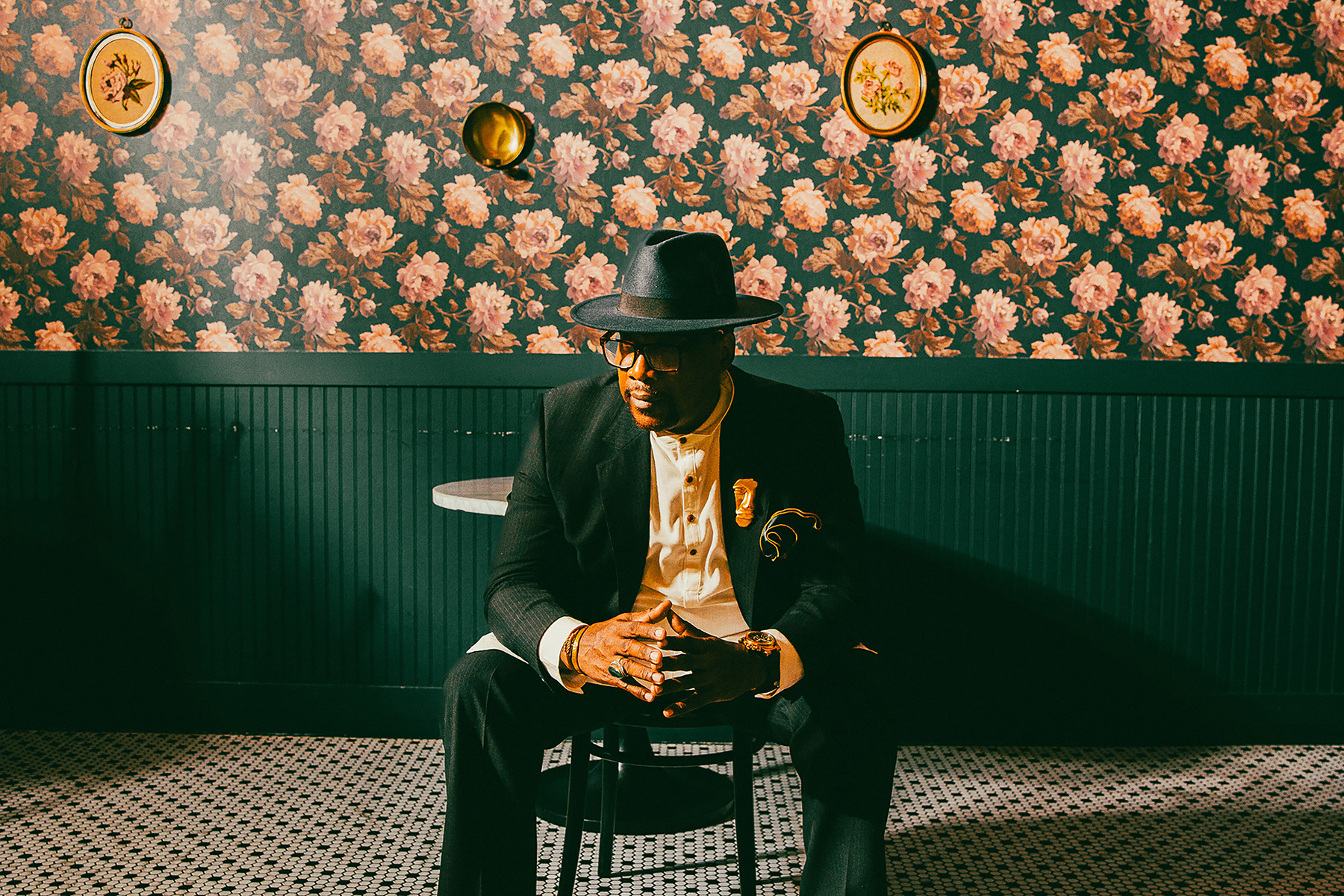
Perry Varner, 52, likes to describe himself as a full-time designer, stylist “and somewhat of a socialite in Birmingham.”
Originally from Montgomery, Alabama, Varner has always been an artist: “I did all the flyers and yearbook stuff at Verbena High School, in Verbena, Alabama.”
He added, “I can draw. I can paint. I can sketch anything. … But I was also very well dressed, … and I loved to take vintage clothes and reconstruct and upcycle them.”
Those skills led him to design for other people and school organizations.
“My love for the arts turned more toward fashion, [and] I stuck to fashion,” said Varner, who found his way to Atlanta, Georgia, for an internship with a company called Earthlink Live, an internet service provider with a concert venue.
“I was learning how to market products and services related to promotion, entertainment, concerts, … artist development,” he said. “But I was working so much because nobody knew how to find designers, brands, or stylists—and that was the lightbulb moment.”
For the past three months, The Birmingham Times interviewed some of the area’s leading fashion designers and tastemakers about the cultural and historical examination of Black style.
Realizing that people struggled to find designers, brands, stylists, etc., gave Varner the idea for The Style Experience, a fashion show centered on cultivating the talent of Black designers.
Having made so many connections while working in Atlanta, Varner realized that “I could take all of these resources … and just put Black designers and stylists on [by] bridging the gap between clients and artists, entrepreneurs, designers, stylists, [and] makeup artists.”
Then in 2003 Varner made his way to Birmingham, where he continued his work in fashion as creative director at 205 Flava, a brand that was frequently worn by “American Idol” Season 2 winner Ruben Studdard. He also was the designer of Amani Raha Ultra Lounge, a venue in Birmingham’s Pepper Place entertainment district that was owned by NFL Hall of Fame player Terrell Owens. Additionally, Varner served as creative director of BirminGLAM, an HIV awareness fashion show, and he coordinated the University of Alabama at Birmingham (UAB) Black Student Awareness Fashion Show. He brought The Style Experience to Birmingham, too.
You can follow Perry Varner on Instagram: @perry_varner.
Q&A
The Birmingham Times (BT): Why is dressing well important as a Black man?
Perry Varner (PV): “I think doing everything well is important to me. … I think showing up as your best self speaks volumes about who you are, … [and] dressing is just one way to do that. Before you speak to someone, before they know your name, they’re going to notice how you dress, right? It’s important to me [to] show up as [my] best self. And why not? It takes the same amount of time to look a mess as it does to just put some thought into looking good.
“My reason for dressing well is very intentional. I’m [the] son of a preacher, and [church] is a big part of how you show up—you dress well, you put on your Sunday best. I’m also a member of Alpha Phi Alpha Fraternity, Inc., [and we] are considered to be men of distinction. … It’s like everything that’s defined my life has been centered around being intentional about how you show up.
“Dressing well for Black men is not just a fashion statement—it’s actually a form of resistance. It’s a movement. It speaks volumes to the struggles we’ve been through, from slavery to Civil Rights to dandyism to all of these things where we get to choose how we show up to others. So, it should be intentional. … That’s important—how we show up, how we dress, how we carry ourselves.”
BT: What is your process when getting dressed for the day?
PV: “It depends on the season and the event. If it’s just day-to-day, usually I wear black because it’s chic. … I can run around town or I can throw on a vest or a jacket [over] my black and walk into a cocktail party afterward. … You can kind of get away with a lot if you just wear a black silhouette.
“I want to look curated, so if there’s a cocktail event and it’s after five, that to me denotes a certain look. If there’s a Sunday morning brunch and it’s before noon, that’s a certain look. I [want] my looks to be curated, like I’m showing up intentionally for the event. … With everything I do, it takes months and months of planning. It’s knowing the season, knowing the time of day, knowing the appropriate fabrics. … I want everything to have been thought out.”
BT: Any advice for young Black men who wish to dress well?
PV: “I wear only designer clothes, but I don’t pay designer prices. … I’ll go to a thrift store, and I’ll spend the investment time it takes to go through those things and find what I need. … My point is I’m looking for a certain silhouette, and I’m looking for a certain quality. … I usually find [those things] in a designer label, but I don’t believe you have to pay $700 for [it]. … You can find whatever you need if you invest the time.
“So, I would tell any young person, show up as your best self all the time. You never know where the opportunity is going to be. You never know who’s watching. You never know who’s listening. … There’s no excuse [not to show up as your best self] because it doesn’t have to cost a lot of money. It just has to be [an investment], it has to be intentional—and you can do it … at work, at church, and in the streets.
For more stories in this series:
Birmingham’s Well-Dressed: Daniel Grier, founder, Splashed by DKG | The Birmingham Times
Birmingham’s Well-Dressed: Dewon Moton, ‘Judgment is Inevitable, so be Aware’ | The Birmingham Times