PEOPLE, PLACES & THINGS



By Christopher Weber, Travis Loller and Adrian Sainz

The Birmingham Times
By Sym Posey | The Birmingham Times
If there is anyone who knows the importance in reducing gun violence in the city of Birmingham, it’s Cardell Jones who was shot in December of 2023.
“I was helping my mother get to work and she was trying to change the tire. And then she got into an altercation with a neighborhood friend, and he actually put his hands on her. Before I got the car to protect her, I got hit in the shoulder [with a bullet],” said Jones.
He said the experience was, “traumatic, but it was life changing. It started off with me trying to protect my mother to going to the hospital not knowing what my next steps in life were going to be.”
Those next steps now include working with the Offender Alumni Association with the Heroes in the Hood program, a youth program under OAA that works with 13- to 17-year-olds in the Jefferson County area over a three-year period to instill work ethics and a sense of community pride.
“Every Saturday we go get them and do some counseling, [talk] about life skills, and just show them that there’s other things to do other than run outside with a gun,” Jones said.
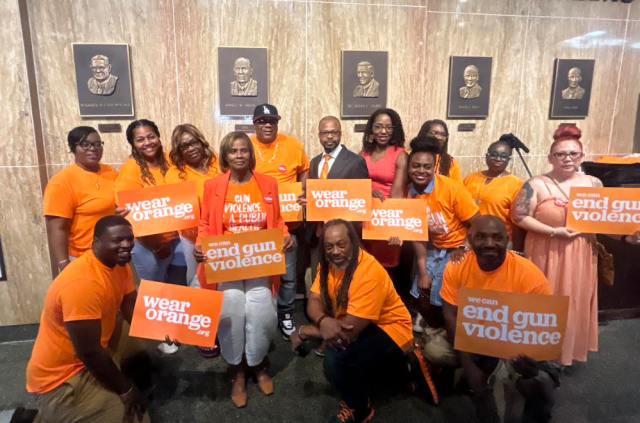
Jones was at Birmingham City Hall on Friday as area leaders marked June 7 as National Gun Violence Awareness Day. Those in attendance wore orange to remember those killed, to honor survivors of gun violence, and to signal a commitment to reduce gun violence.
“Violence is an epidemic not just in Birmingham but across the United States. I found this to be very important for us to stand in solidarity,” said Birmingham City Councilor LaTanya Tate, who organized a press conference. “The goal here in Birmingham is to reduce gun violence. Many initiatives have been rolled out like Common Ground but there needs to be more.”
Tate was joined by the Offender Alumni Association clad in orange, Jefferson County Health Department Health Officer Dr. David Hicks, and Dr. Nadia Richardson-Johnson, founder, and CEO of the Black Women’s Mental Health Institute.
“The safety and well-being of all of Jefferson County residents is our top priority,” said Hicks. “Last month the Jefferson County Board of Health passed a resolution declaring that gun violence is a public health problem. It’s not just a law enforcement issue, but a public health problem that affects all of us. It’s essential that we come together as a community to address this issue head on.”
Every day since the shooting has been a work in progress and he’s still working through the trauma, said Jones.
He credits the Violence Intervention and Prevention Partners (the VIP² program is a collaboration between the Offender Alumni Association, the Jefferson County Department of Health, the City of Birmingham, and UAB Hospital) with his recovery.
A team of violence intervention specialists provided Jones with mentoring and support. These mentors, with their own lived experience, provide connections to social, medical, and mental health services.
“After my shooting, I was a shell of my former self. I didn’t want to speak to anybody. I didn’t want to be bothered. I wanted to be to myself [but] my case manager showed me that this is not something that [I] should let traumatize, stop, or harm (my) life. It’s a day-to day thing. I go to counseling every Tuesday,” Jones added
His experience is “something that you shouldn’t take for granted … [but use to] help change other people’s lives,” he said.
By Anna Jones | UAB News
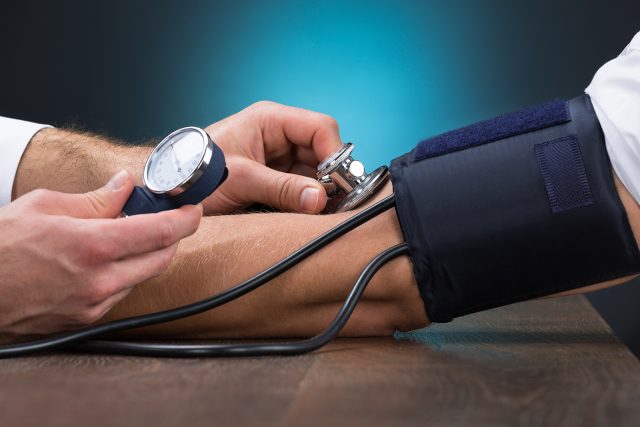
Experts at the University of Alabama at Birmingham Cardiovascular Institute are offering a new treatment for patients with uncontrolled hypertension who have not had success lowering their blood pressure with the use of medications. The new treatment involves renal denervation — a minimally invasive procedure that targets nerves near the kidneys that can become overactive and cause high blood pressure.
“There is no current alternative to treating resistant hypertension or poorly controlled hypertension with medical therapy, except for renal denervation,” said Hussein Abu Daya, M.D., an assistant professor in the UAB Division of Cardiovascular Disease. “This new system is one of two commercially available systems used for renal denervation, and it uniquely uses radiofrequency energy to achieve that. It complements medications and lifestyle modifications to help reduce blood pressure.”
Over 42 percent of Alabamians reported having high blood pressure in 2021, according to the Alabama Department of Public Health. High blood pressure is sometimes called the “silent killer” because it usually has no noticeable warning signs or symptoms until other serious problems arise. Having high blood pressure increases the risk for heart disease and stroke, two leading causes of death in Alabama.
After mild sedation, the doctor inserts a very thin tube into the artery leading to the kidney. The doctor then administers energy to calm the excessive activity of the nerves connected to the kidney. The tube is removed, leaving no implant behind. This procedure has been clinically proved to help reduce blood pressure in patients for whom neither medications nor lifestyle changes have been successful.
“For the first time, UAB patients now have access to a groundbreaking technology that has been FDA-approved and has the potential to transform the lives of patients suffering from resistant or poorly controlled hypertension, including those who are intolerant to antihypertensive medications,” Abu Daya said. “This technology promises safe, significant and sustained decrease in blood pressure levels that complements existing medical and lifestyle modification therapy.”
UAB Medicine is among the first in the state offering this treatment and is one of the facilities across the country selected to participate in the AFFIRM study, evaluating the long-term safety, efficacy and durability of the procedure in real-world patients with uncontrolled hypertension and comorbidities such as diabetes, isolated systolic hypertension and chronic kidney disease.
“Our team at UAB felt that it is strategically vital for us to bring this new FDA-approved technology to UAB and Alabama to make it available to our patients,” Abu Daya said. “We are looking forward to helping our patients with uncontrolled hypertension through this new treatment.”