New research from the University of Alabama at Birmingham shows a significant workforce reshuffling is underway as people increasingly seek environments where they feel valued and appreciated. (Adobe Stock)
ByAdam Pope | UAB News
New research from the University of Alabama at Birmingham shows a significant workforce reshuffling is underway as people increasingly seek environments where they feel valued and appreciated. Amid this backdrop, a recent study is shedding light on the crucial factors for retaining employees.
Conducted by a team led by UAB Department of Health Services Administration Assistant Professor Katherine Meese, Ph.D., the study, published in the Journal of Multidisciplinary Healthcare, surveyed over 4,400 health care workers to delve into the dynamics of employee turnover and organizational support. These findings underscore the importance of perceived organizational support in fostering a positive workplace environment, transcending the boundaries of individual health care institutions.
“Time is short, right? People witness others’ falling ill, receive distressing news and consequently begin to reassess their priorities,” Meese said. “They start to question how they spend their time.”
Meese says that, as a result, people have begun to value different things. Many individuals undergo a process of realization, deciding not to remain in environments where they feel undervalued or unappreciated or where their work lacks meaning.
“This has led to a significant reshuffling of employees, as they seek out environments they hope will provide a better experience, or at least one that isn’t worse,” Meese said.
In the study, Meese says trust in senior leadership emerged as a critical factor, overshadowing the influence of direct managers in retaining employees.
“These findings are significant because much of the work revolves around supervisors and managers,” Meese said. “However, what we’re truly observing is that the senior-most leaders hold considerable influence over decisions to stay or go.”
She says another perspective to consider is that, even if an individual has a strong relationship with their direct manager, if they lack trust in the leadership above, they will not feel secure there, and they may not remain hopeful that conditions will improve in the future.
Communication breakdowns and misconceptions were identified as potential threats to trust in senior leadership, impacting employee retention.
She says the main factors that predict whether people plan to leave or fail to recommend the organization are not financial. They are durable, work culture elements and leader behaviors that boil down to six key issues:
Burnout – Can I stay here and preserve my mental health and energy?
Organizational Support – Does the organization care about my well-being and value my extra efforts and contributions?
Trust in Senior Leadership – Do I trust the people at the top?
Availability of Resources – Do I have what I need to do my best work?
Recognition – Am I appreciated for my contributions here?
Belonging – Is this the place for me?
Strategies such as effective rounding and leader visibility contribute significantly to building trust and a sense of belonging among health care workers, and can also apply to non-medical organizations, while collaboration between different units and recognition play pivotal roles in fostering trust in senior leadership, according to Meese.
She says the study’s insights come at a crucial time as health care institutions and other organizations grapple with workforce retention amid the ongoing challenges of the pandemic. As accountability remains essential for maintaining standards of behavior and retaining top-performing employees, a balance between setting standards and acknowledging job market dynamics is necessary to overcome challenges in accountability without compromising morale.
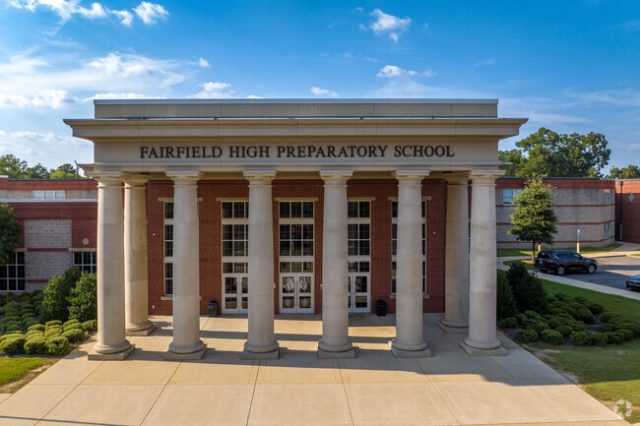
United Way of Central Alabama’s Bold Goals Coalition recently won a $2.5 million federal grant to continue providing services and support to students and families through the Community Schools strategy, which it began implementing last year in partnership with Fairfield City Schools. (Provided)
uwca.org
United Way of Central Alabama’s Bold Goals Coalition recently won a $2.5 million federal grant to continue providing services and support to students and families through the Community Schools strategy, which it began implementing last year in partnership with Fairfield City Schools.
The grant, administered by the U.S. Department of Education, will provide $2.5 million over five years, adding to the $1.5 million that UWCA has already dedicated to the first three years of the program.
The federal funding will enable United Way to hire two more Community Schools Coordinators, who will work to facilitate the provision of services by United Way’s network of partners. The addition of these two employees will allow United Way to place a coordinator in each of the four locations of Fairfield City Schools (FCS).
U.S. Rep. Terri Sewell, who helped United Way receive the grant, said she is excited to see such progress in connecting Fairfield residents to resources.
“We have already begun to see the positive outcomes of this partnership for our students and families, which is why I was proud to advocate for this grant at the federal level,” Sewell said. “This funding will go a long way in helping UWCA expand their efforts and serve even more families here in Fairfield.”
While still in the early stages, numerous organizations have already agreed to begin a variety of additional services in Fairfield because of the collaborative energy of the Community Schools strategy, which seeks to use school properties as physical hubs for a range of services, besides education alone, to address the needs of students and families. Such services may include healthcare, mental health counseling, nutrition and dental services, high-quality early learning, after-school and summer learning programs and technical job skills training.
This year marked the beginning of the Modern Manufacturing Program, sponsored by Central Six Alabama Works!, which offers high school students up to eight credentials and valuable experience toward future employment. Big Brothers Big Sisters of Greater Birmingham has also started its Beyond School Walls mentorship program in Fairfield, which allows students to shadow specific Southern Power employees in their daily work environment.
Additionally, Fairfield has strengthened its connection with the Nurse-Family Partnership of Central Alabama, administered by the University of Alabama at Birmingham School of Nursing, enabling pregnant students to gain access to extra care from the time of early pregnancy to giving birth and beyond.
Drew Langloh, President and CEO of UWCA, said the organization is uniquely positioned to draw on, and coordinate resources from, its six-county service area for the benefit of the Fairfield community.
“The scale of United Way means we can serve as connectors for communities like Fairfield,” Langloh said. “We are proud to be Community Schools leaders in our region and hope to serve as a model for others.”
Dr. Regina Thompson, FCS Superintendent, said more than 90 partners, including local businesses, residents and nonprofits, have been working to establish common goals for Fairfield.
“Originally, everyone was working on different needs,” Thompson said. “We had 90-plus partners, but… they were only bringing to the table what they could do, and then they would go back to their respective businesses. But [then we said,] “Okay, if we’re really going to talk about Community Schools, everyone needs to work on the same goals.”
Fairfield Mayor Eddie Penny said schools are one of the few avenues through which a “whole family” can be reached and that the economic situations of families within communities directly impact the success of children.
“If you don’t have to worry about the financial portions of life” Penny said, “and you’re not worried about a place to stay, you’re not worried about being warm or cold, you’re not worrying about food, all you’ve really got to concentrate on is your studies.”
Samford University will serve as the evaluation partner for the work, giving Samford an opportunity to engage with its surrounding community “in partnership, service and cultural understanding,” said Beck A. Taylor, President of Samford.
“We are excited to collaborate with United Way of Central Alabama and Fairfield City Schools to change lives for the better with these comprehensive efforts,” Taylor said.
To read more about how Fairfield residents and leaders have responded to the early results of the Community Schools strategy, visit uwca.org/fairfield.
Average risk individuals start colorectal cancer screenings at the age of 45. Colorectal cancer screenings can be performed either through colonoscopy or stool-based studies. (Adobe Stock)
By Brianna Hoge | UAB News
Individuals in their 20s and 30s should be aware of the warning signs of colon cancer to know when to seek medical attention. When most people think about colon cancer, they associate the disease with older populations. However, the American Cancer Society reports that one in every five colon cancer diagnoses in 2019 was in someone younger than 55 years old. This is an increase of 9 percent since 1995.
Drew Gunnells, M.D., assistant professor in the UAB Department of Surgery, emphasizes that the biggest concern of colorectal cancer is a strong family history. He recommends seeking out family members and discussing their medical history as this may change the window of screening time.
“Genetics plays a significant role in colorectal cancer, and if you have an immediate family member with colorectal cancer, then you will need to relay this information to your medical providers to start screening earlier,” Gunnells said.
“Drinking, smoking, eating highly processed foods and meat, and high sugar diets are going to increase your risk factors,” Gunnells said. “That’s not to say that you should not eat anything with sugar or that is highly processed, but be mindful of the amount you are consuming.”
Another way an individual can lower their risk is to incorporate physical activity into their day-to-day routine. This can include:
taking the stairs instead of the elevator
parking toward the back of a parking lot
stretching while watching television
Recently, one UAB researcher found that music can have a positive or negative impact on athletic performance during exercise. Learn more about how to select the right workout playlist, here.
Warning signs
Red flags for individuals in their 20s and 30s are bowel habits, abdominal pain or bloating, weight loss, fatigue, or change in appetite. But, no matter one’s age, Gunnells stresses that blood in the stool and rectal bleeding are never normal.
“Many times, it is not cancer and is likely something minor, like hemorrhoids; but it is something that needs to be evaluated,” Gunnells said.
A primary care provider is central to obtaining necessary screenings and discussing additional risks for colorectal cancer. To find a UAB Medicine provider, click here.
Learn about the services and treatments for colorectal cancer that the O’Neal Comprehensive Cancer Center at UAB offers here.
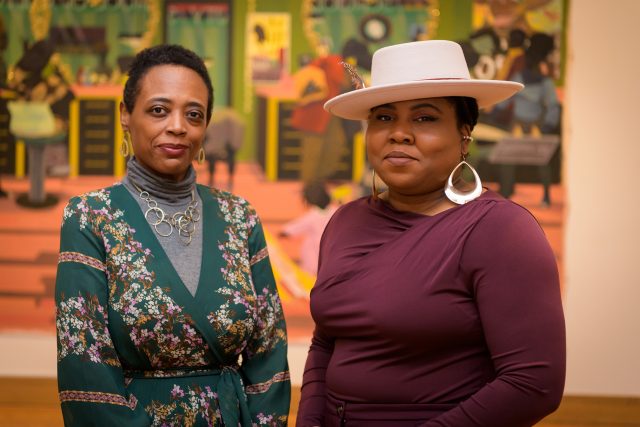
Salaam Green, City of Birmingham's inaugural Poet Laureate, left, and Ashley Jones, Poet Laureate of the state of Alabama, inside the Birmingham Museum of Art. (Amarr Croskey Photo, For The Birmingham Times)
By Javacia Harris Bowser | For The Birmingham Times
It’s a sunny Tuesday in January, and Salaam Green is making a couple of stops in the Magic City. First, she attends a Birmingham City Council meeting, which is no ordinary gathering—it’s where she is sworn in as Birmingham’s first Poet Laureate. Now, Green is arriving at the Birmingham Museum of Art for a conversation with another local poet who has made history—Ashley M. Jones, Poet Laureate of the state of Alabama.
In 2021, Jones was tapped to serve as the state’s Poet Laureate from 2022 to 2026. Jones, 33, is the first person of color and the youngest person to hold this position since it was established in Alabama 93 years ago.
She is also well known in the local literary community for leading her “Write to Heal” workshops—a series of seminars that teach both individuals and organizations how to use poetry, writing, and storytelling to reclaim their voices and change their lives.
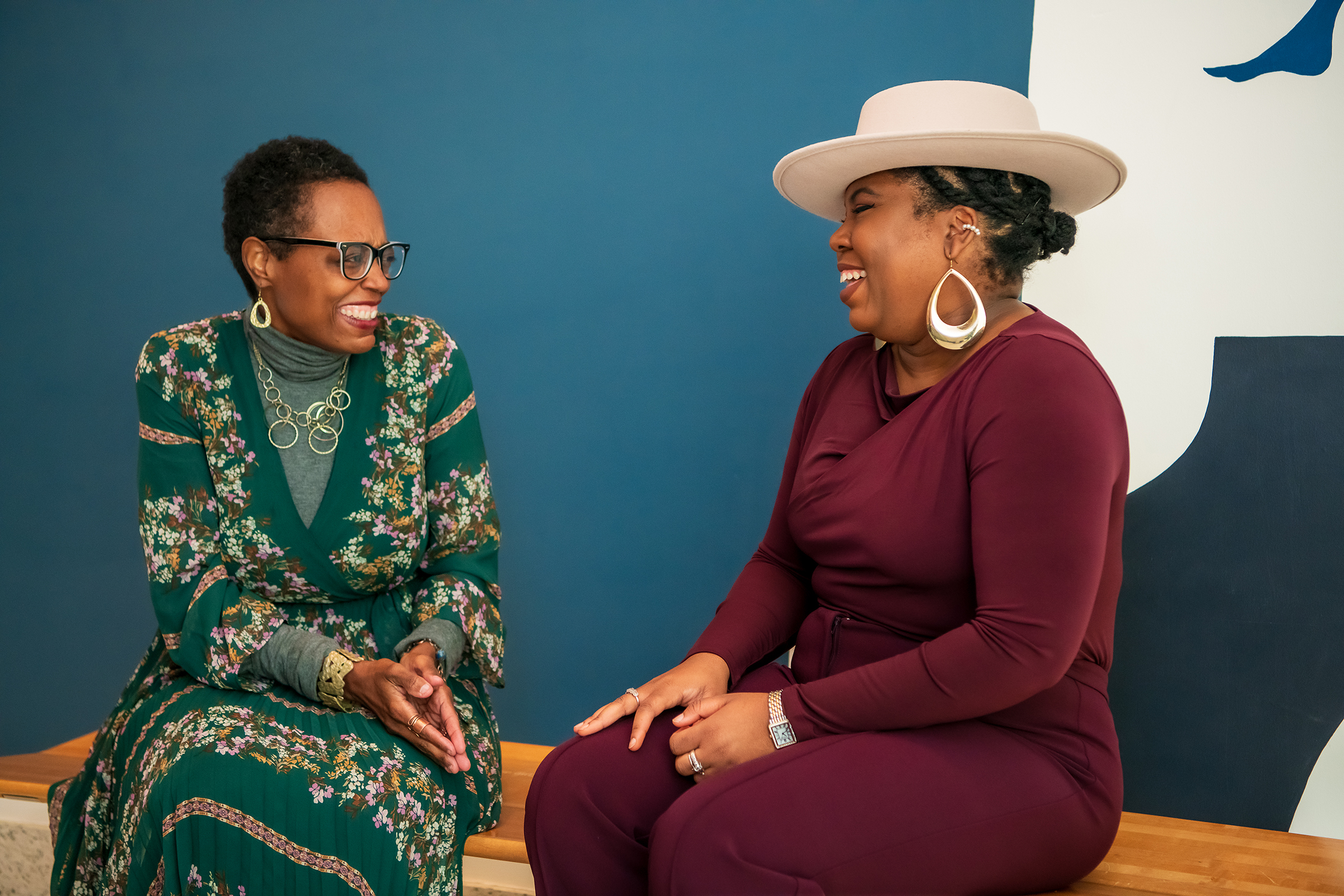
The Birmingham Times brought the two Poets Laureate together for a Women’s History Month exclusive, where they share words of wisdom and encouragement, moments of laughter, and heartfelt love and joy with one another.
Salaam Green, City of Birmingham’s inaugural Poet Laureate, left, and Ashley Jones, Poet Laureate of the state of Alabama. (Amarr Croskey Photo, For The Birmingham Times)
Green on what it meant to her when she learned that Jones had been selected as Alabama’s youngest and first African American Poet Laureate.
Green: I don’t cry a lot, but I was feeling teary. The idea of Alabama doing something right. The idea of you not just stepping into this role, but this role I feel like you were birthed to do—it felt like my cousin, my play cousin, my sister is over there, and look at what she’s doing.
[Speaking to Jones] Just to see your beautiful face all over the place—it meant so much. So, I just want to say thank you for being you and for giving me the opportunity to celebrate that. It was monumental.
Jones: That means a lot to hear you say. I love your work, and I’m just so grateful for what you do. For you to say that you’re proud of me, that makes me feel like I’m doing something right. Everything I do, I feel like, is in service of the people. For me, the respect of my peers means everything. These higher-up people—they’re whatever. But people who are on the ground, if you think I’m worth it, that means it’s true. If some person up in New York says, ‘Oh, we like you,’ it doesn’t necessarily mean as much to me. So, I really do appreciate that.
Green: I remember your [debut poetry collection], “Magic City Gospel,” and taking it into my “Write to Heal” workshops. I’m like, “OK, I’m taking this book everywhere!” It has a beautiful cover number one, but also for young people to see the covers of books with the names of our people on them.
And then they see you transition into this monumental role and see that you’re everywhere, even on [ABC’s a.m. news program] “Good Morning America.” You stepped into your dream, into your destiny. And then others can see themselves in you.
Jones: When I was on “Good Morning America,” y’all went up there with me. No, you weren’t there physically, but I was like, “OK, I’ve got to make all my people proud. I can’t be on this TV talking crazy.”
Jones reflects on learning there would be a city of Birmingham Poet Laureate and that Green had been selected.
Jones: I was really excited to find out they wanted to start one. Our city is just so vibrant and so full of artists, and I feel like it’s not enough to have somebody just for the state. Somebody needs to represent us, very specifically. So, when I found out that it was going to happen, I hoped that it would be someone who really had a spirit of the city, someone who was involved already, not just someone who wanted to put something on their resume.
Green: I don’t think I even have a resume.
Jones: When I found out it was you, I was so ecstatic. Of course, I was very proud that it was another Black woman. I think we do everything wonderfully, but to know that you would be the one spreading your message of healing and authentic life to everybody in Birmingham—that was amazing to me. I was just so elated. I know you’re going to take our city to a new level with poetry and show people what you can do. I’m just so excited. I cannot wait.
Green shares why she decided to apply for the role of Birmingham’s first Poet Laureate.
Salaam Green, City of Birmingham’s inaugural Poet Laureate, left, and Ashley Jones, Poet Laureate of the state of Alabama. (Amarr Croskey Photo, For The Birmingham Times)
Green: I was so excited when I heard that the Alabama State Council of Arts had decided to do this. I looked at the application, but I came aboard a little bit late. I put my application in probably an hour before it was time to be submitted. That is so like me.
[In August 2023, Create Birmingham, in partnership with the city of Birmingham and through funds by the Alabama State Council on the Arts and the Birmingham City Council’s Cultural Arts Committee, began accepting applications for Birmingham’s inaugural 2024–2025 Poet Laureate.]
Jones: Wow! Clearly, it was meant for you.
Green: I had so many people who were encouraging me, so many people who I was inspired by, but I’m thinking, “This is the Magic City that is full of poets and spoken word artists like this person and this person.” Other people kept saying, “Just try.” So, toward the end [of the submission period], I filled out the application hurriedly. I thought, as a Black woman who is aging with wisdom and as a Black woman who has touched the city and who the city has touched, why not just try and trust and believe.
Jones on what she’s learned during her first two years as Alabama’s Poet Laureate.
Jones: The first thing I would say is, honor your downtime. Before anybody asks you to do anything, know what time of yours untouchable. That is the biggest mistake I’ve made just generally in life but certainly in my first two years as Poet Laureate. I was so eager to just be there for everybody, not realizing that I needed to take time for me in order to show up better wherever I was asked to go. The second biggest thing is just to really stay true to who you are, which is what’s so great about you already—that you are always Salaam, all the time. You always bring your spirit to everything. Just try to protect that. You’ll be asked to write for various occasions, and sometimes that can make you feel like you’re not speaking as yourself. But the reason you were selected is because of who you are, so protect yourself and your own spirit at all costs because that’s the thing people want to experience, that’s what’s going to bring people to poetry and together, as well.
Green: That’s powerful.
Jones: The third thing I would say—and this one may be a little silly, but it’s me, so I’m going to say it—have a few go-to outfits ready for certain types of occasions. You know you’re going to have your official stuff, so get you a couple of suits that are just ready to go and good to photograph. And the value of the hat—I really cannot overstate that because sometimes, at least for me, the afro doesn’t want to act right. The hat will eliminate any issue.
Green: I love that. I know the value of a head wrap. Believe me.
Green asks for more advice on being a Poet Laureate.
Green: You’ve been doing this for a while, and it’s been a pleasure to watch you do this. But also, it’s been a pleasure to watch you stay true to yourself. How have you done that? Your identity, your fashion, your private life, your public life? How have you stayed true to Ashley?
Jones: It hasn’t necessarily been easy. I always feel like I’m being pulled in a lot of directions all the time. But I’d say one thing is knowing who your people are and keeping them close. So, for me, that’s my family and my boyfriend. Having my core group of people who will hold me accountable, who keep me humble. My mom will always say, “You’re not going to get the big head as long as I’m here.” And I have not.
Having people that you can really be real with and vent to, as well. When you’re a public figure, you really can’t vent in a public space. Yes, we are poets, and we vent in our poetry, but there’s a certain other level that we’re at now as public officials. So, having those people who are a safe space for you is vital. That’s going to help you to maintain yourself. It’ll help you to face every situation. If you’re able to bounce ideas off of somebody you trust, that is key.
Also, I keep reminding myself, the reason that I have this position is because of me, because of who I am already. I didn’t have to put on any airs to get the position, so I don’t have to do that to keep the position.
This slideshow requires JavaScript.
Green shares her Poet Laureate platform.
Green: The Poet Laureate, as you know, came with duties and responsibilities already. So, I’m elated to do those things and many of those things I was doing in the city already. But I think one of the biggest things that I really want to do is look at how do we use poetry as a political activation, particularly in a Civil Rights– and justice-oriented city. And this is an election year. There are some charged emotions. For me, part of my tenure is looking at poetry as a healing tool, a political activation tool, and a tool for advocacy. And then also a tool so that others can see, yes, you can spit poetry. Yes, you can perform poetry. Yes, you can do all those beautiful things. Poetry also can take you into rooms, it can take you into spaces, it can take you into legislative houses. I want to talk to government officials about how we can activate poetry into public spaces and the political realm.
Jones: I’m voting for you for president.
Green shares life advice for Jones.
Green: First of all, don’t let anyone tell you that any age has any limitation. But I would say my biggest advice—and this is what I would say to any Black woman—is stay as Blackity Black as you possibly can. I’m talking about collard greens. I’m talking about sitting around barefoot outside. I’m talking about allowing your culture of who you are as a Black woman permeate not just your writing and your artistry but through who you are. Whatever you decide to be, be as Black in those spaces as you can. When you go out into the world as this New York Times best-selling author, Pulitzer Prize–winning …
Jones: I’m claiming it. Yes.
Green: … We can say, “That’s Ashley. That’s my play cousin with those earrings telling me I need to go get a hat and a head wrap.” Sometimes we lose the most important part of ourselves, which is what the Spirit has put inside of us to be, the thing that has caused us to shine. I know you will never lose that. As you get older, remember that you have nothing else to prove. You never did. You are enough. You always have been.
Jones: I’m about to shout! I did not come here to be filled with the Holy Spirit! But this is why I love being around Black women.
Green and Jones reflect on what life experiences have prepared them for their respective positions.
Jones: I’ve been studying writing professionally since I was 12. A lot of people, when they see I’m the youngest this or that, assume I just magically became this. I’ve been working hard for so long. So, to me, this took a really long time to get here. It just so happened that I started really early. All of the preparation at [the Alabama School of Fine Arts (ASFA), at [the University of Alabama at Birmingham (UAB)], at [Florida International University (FIU)]—all the schools I attended—of course, prepared me for the writing side of it. As far as the public-facing side, I think being a poet who was already doing touring gave me some experience being in front of cameras, having to answer questions off the cuff. Being a teacher prepared me a lot, actually, for this because being in front of students every single day is scary.
But I think also just being raised by people who made sure I knew I was good enough, just as myself, that kind of laid the groundwork for me always returning to my authentic self. Throughout my life, I’ve not always liked who I am authentically. I used to think, “I’m not Black enough. I’m not smart enough. I’m not pretty enough.” These are thoughts that were in my head as a young child. But because I had that foundation from my mom and my dad, I knew I always could return to, “Well, they said I was worthy, so it must be true.” And that’s really what I’ve been coming back to even as an adult. Even at 33, I’m going back to 5-year-old Ashley hearing my parents say, ‘You’re great. You’re beautiful. You’re smart.’ Salaam, what about you?
Green: I think we have two different paths. I used to really get sad and cry about the fact that I wish that I started poetry when I was 12 years old. I wish I had gone to college [to study writing], and I had that opportunity. But there wasn’t any space in my life for that. I didn’t even know it was available.
So, what I think has prepared me for it has been life experiences and being a community poet. It has been really challenging not having that background as an academic poet. I felt some shame around that for so many years. Even in this role, I was thinking, “Salaam doesn’t have a book, she doesn’t have a [Master of Fine Arts (MFA) degree]. How is the Spirit going to say, ‘Let me just drop you into this role.’” But I think what has prepared me for it has been community, as well as knowing that I always could speak well and I have a voice.
Jones: I will say, though, about what you just said, about not having an MFA and being a community poet, I’m very passionate about opening up the idea of who poets can be. Because, even though I’m an academic poet, I sometimes feel like I’m not cool enough to be in these community spaces. I don’t memorize my poems. I mean, I have a reading presence, but I’m not out here performing in the way that some spoken word artists do. So, I think on both sides, there’s a lot of just this feeling of “Am I enough?”
When they asked me what I thought should be the requirements for this position, [Alabama Poet Laureate], I said, “We can’t have a publication requirement or MFA requirement.” The poetry itself has nothing to do with those things. I didn’t start writing because I wanted to do something in school. It was inside of me. So, I think having both of us as Poets Laureate in this state demonstrates that there’s a wide range of experiences, of backgrounds. Different types of poets are able to represent everybody. There’s space for everybody.
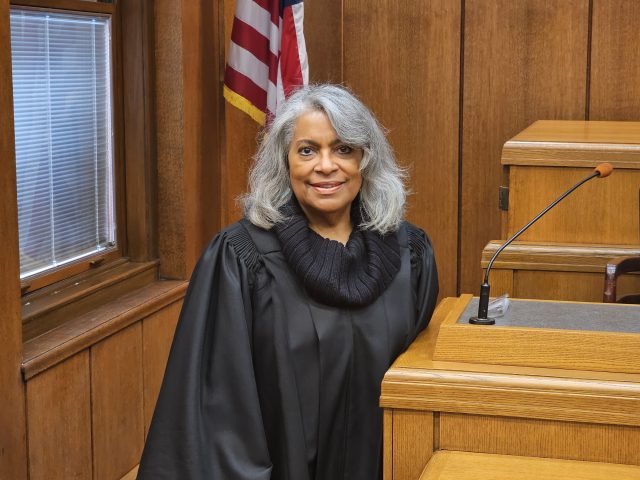
Jefferson County Circuit Court Judge Tamara Harris Johnson grew up in Birmingham’s College Hills neighborhood. Recently, she was awarded the 2023 Birmingham Bar Association Lifetime Achievement Award — and she is the first African American woman to earn the recognition. (Provided)
By Sym Posey | The Birmingham Times
Whether it’s Black History or Women’s History, Jefferson County Circuit Court Judge Tamara Harris Johnson has a resume that can qualify for both. Recently, she was awarded the 2023 Birmingham Bar Association Lifetime Achievement Award—and she is the first African American woman to earn the recognition.
“I am very honored that the Birmingham Bar Association presented me with this award. When I looked at the recipients, there were names that I recognize who had made significant achievements in the legal community,” Harris Johnson said about the award, which was created in 1972 to recognize outstanding and distinguished members of the Bar.
As the 51st recipient, Johnson was just the sixth African American to receive the award.
“A lot of people in my neighborhood were influential in the Civil Rights Movement, and I didn’t really realize their significance until later in life,” she said. “On my corner was Bishop Jasper Roby, [pastor of the historic 17th Street Apostolic Overcoming Holy (AOH) Church of God who also oversaw the building of the AOH Cathedral in downtown Birmingham]. The Rev. Joseph Lowery [founder of the Southern Christian Leadership Conference with Martin Luther King Jr. and others] and his wife lived on the corner of our block. Jesse J. Lewis, [founder of The Birmingham Times], lived a few blocks over. Arthur Shores, [the renowned Civil Rights attorney known as Alabama’s ‘drum major for justice’], and his wife lived not too far up the street. My parents were friends with the parents of Angela Davis, [a political activist, professor, and author who was an active member of the Communist Party and the Black Panther Party], and I was friends with her brother. There were a lot of people who were important to me that I lived around and that were influential in my life.”
Still, Harris Johnson recalls feeling very protected from racism while she was growing up.
“An example of that is when we traveled,” she said. “My father would be sort of anxious. At the time I didn’t realize that it was because a lot of the places along the way would not allow us to use the restroom. He and my mother bought me a little metal blue pot with yellow polka dots. I wish I still had it because it made me think I was little princess.
“Whenever we would have to stop, I would use the pot because [my parents] told me how nasty public restrooms were. They turned what could have been a horrible and ugly experience into something that gave me a lot of confidence,” she said.
“You Have a Purpose”
Harris Johnson was born in Nashville, Tennessee, while her father was attending Meharry Medical College, one of the nation’s oldest and largest historically Black academic health science centers.
Her family later moved to St. Louis, Missouri, where her father completed his internship and residency in obstetrics and gynecology. Then, in 1961, her family moved to Birmingham with the intent of her father joining his father, Samuel Francis Harris, M.D., in his medical practice.
“I was in the third grade when we moved to Birmingham. I remember when I came back that I was kind of afraid in a way because of all the things you would hear about the South.
“Even as a child, even though we would visit, I remember telling my mother, ‘That is where they hang Black children.’ That was the vision I had in my mind even as a child,” said Harris Johnson, who graduated from the now-closed Brunetta C. Hill Elementary School in Birmingham’s Smithfield neighborhood.”
She was one of the first group of African Americans to integrate Ensley High School, which she attended for two years, and she subsequently graduated from Ramsay High School.
“There was a group of us that attended Ensley High School. We integrated it, and it was miserable for us because it was just a racist environment. If I was talking to someone who was white, I would overhear teachers as they pulled students aside [and told them] if they said anything to me, they would tell their parents. We would tell our parents we didn’t want to be there, but they would tell us, ‘You have a purpose.’”
Following Her Own Path
Harris Johnson’s maternal family primarily worked as educators, and her paternal family primarily worked as health care professionals. She followed a different career path, but she did not initially aspire to be in the legal profession.
Harris Johnson’s father wanted her to go into the medical field, but she “hated science and could not stand the sight of blood,” she said. On several occasions, her father would take her to the hospital to see him perform surgeries, but it did not appeal to her.
“I thought I wanted to be an actress,” Harris Johnson said. “Then I wanted to work in the United Nations building to be an interpreter. When I went to Spelman College, [in Atlanta, Georgia], I was going to be a foreign language major, but they did not have the languages I really wanted to study. … I chose political science because my parents kept telling me I was a good lawyer just by how I would rationalize things when I was a child.”
Growing up, whenever Harris Johnson wanted to do something that her parents disagreed with, they would let her “plead her case,” she said.
“It was a precursor to me going into law in the first place. We would sit at the table, and they would say, ‘Tell me why you think you should do what I said you can’t do.’ Then one of three things would happen: Sometimes, they would tell me that I convinced them, and they would reverse their decision; other times, they would tell me no; and the third one was interesting because they would tell me that I shouldn’t be denied, but what I wanted to do required a financial component.
“They would say, ‘We are not going support something financially that we don’t want you to do. So, while, in theory, you can what you want to do, practically, you have no money to finance it.’”
“He Saw Something In Me”
In 1974, Harris Johnson earned a Bachelor of Arts (B.A.) degree from Spelman College, where she studied political science with a minor in English. She then attended Howard University Law School in Washington, D.C., and earned a Juris Doctor (J.D.) degree.
“Even after graduating from Spelman, I had no desire to be a lawyer,” she said. “But my father gave me a proposition—either I get a job or I go to law school. So, off to law school I went. He saw something in me that I guess I did not see in myself.”
Harris Johnson would go on to become the first African American woman to serve as Birmingham City Attorney, a position she held under the administration of former Mayor Bernard Kincaid. She also was the first in-house counsel hired by the Birmingham Public Schools system, where she was hired under interim superintendent Geraldine Bell.
Harris Johnson is the proud mother of daughters Erica Nicole Parker, M.D., an emergency medicine physician, and Maj. Ashley Noelle Johnson, a U.S. Air Force Judge Advocate General’s Corps (JAG Corps) lawyer licensed in Washington, D.C., California, and New York.
She has a son-in-law, Joel L. Parker, M.D., also an emergency medicine physician, and two grandsons: Caden and Harrison Parker. She has two sisters: Tollese Harris Bankett, M.D., a pediatrician in Maryland, and Terea D. Harris, M.D., a retired internist and infectious disease specialist in Michigan.
“I am very family oriented. I am extremely proud of both of my daughters. Ashley is a member of three of the hardest Bars in the country, and she was a part of the Peace Corps. She will give you the shirt off of her back. [Erica] is a physician. They both are some of the kindest people I know,” said Harris Johnson, who doesn’t travel much unless she is going to visit her daughters.
“If I am not in Florida seeing Ashley, I am in Tennessee visiting Erica and my grandsons,” she said. “They are what fulfill me, and I just enjoying seeing them and being with them.”
Over the past year, the city has used $12 million in federal funds on a major resurfacing project involving more than 40 miles of roadways that stretch across every part of the city. (File)
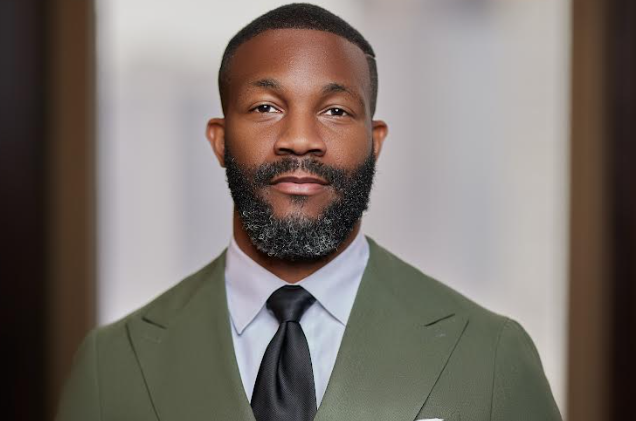
By Mayor Randall L. Woodfin
Drive through Birmingham, and you’ll see remarkable signs of progress. The first things you may notice are the streets. Over the past year, we’ve been working our way through a $12 million resurfacing project involving more than 40 miles of roadways that stretch across every part of the city. As we pave, we’ve been adding bike lanes and other features to make our streets safer for all traffic, including people on bikes and people on foot.
Birmingham Mayor Randall Woodfin.
You’ll also see an unprecedented number of cranes, bringing new housing options and other amenities spilling out of our city center; demolition and site work as big blighted sites are brought back to life; and countless neighborhood projects to repair sidewalks, spruce up parks and repair homes.
What’s happening in Birmingham is a testament to our talented city employees, our City Council, our businesses, our community partners and our residents who are working hard every day to make our city an even better place to live.
But it would be grossly unfair not to acknowledge the huge role played by the Biden Administration. President Biden’s agenda of “Investing in America” is already making a difference for Birmingham, and it will have an even bigger impact in the years ahead.
Birmingham received $141 million from the American Rescue Plan Act, and those funds are being used to support some of the projects already in progress. They are helping us remove blight, improve transportation, repair homes, and replace aging playground equipment.
But there are so many more COVID recovery investments not visible that will arguably have even more lasting impact in Birmingham. These are investments that will create jobs and train people for them, improve education for children, expand access to transit and mental health care, and reduce violence and crime in our communities.
Under the Biden administration, more than $10 million supported Birmingham residents struggling to pay rent and utility bills due to the impact of COVID. Through Housing and Urban Development ARPA funds, we have $5 million to increase affordable housing and address homelessness.
Separate from COVID recovery funds, we have received a $50 million Choice Neighborhoods grant from the U.S. Department of Housing and Urban Development to revitalize the neighborhoods of Smithfield, Graymont and College Hills. We are partnering with Birmingham’s public housing authority and other partners to replace an aging public housing community, expand neighborhood resources, upgrade transportation, and address derelict properties. This historic area of our city will be home to 900 new, mixed income apartments for families and seniors, with on-site access to supportive services such as workforce resources, coaching, tutoring, counseling and health programs.
Through the Bipartisan Infrastructure Law, we received $8 million to address safety issues with rail crossings and $21 million to create an urban trail through our Civil Rights District and stretching to the Smithfield area. We’ll retool a little more than three miles of roadways that will make our community more connected, walkable, bikeable and safe. You’ll see new streetscapes, multi-use paths and the city’s first two-way cycle track.
In all, we can point to $30 million in federal support for transportation projects in our city that is helping us with sidewalks, walking trails and other infrastructure to improve the lives of the people of Birmingham.
In addition, our entire region stands to receive tremendous benefits from our recent designation as a federal Tech Hub, which allows us to compete for as much as $75 million in funding to support and expand our biotech industry.
On the eve of President Biden’s State of the Union Address, we’re already hearing criticism about the White House and its priorities. But I don’t want to let this moment pass without acknowledging that President Biden’s agenda has been a tremendous boost to Birmingham. We’ve been fortunate to have President Biden and Congresswoman Terri Sewell in our corner to maximize these opportunities. President Biden’s investments in America have made and will continue to make a huge impact in cities and counties across Alabama.
These are generational investments that are letting us catch up on long-overdue upgrades to our infrastructure, improve our neighborhoods, and empower our greatest asset, our people.
You can see the dividends already as you drive through Birmingham. But more important to me is what a child growing up in Birmingham will see – a stronger community for today and more opportunities for tomorrow.
Randall Woodfin is the 30th Mayor, City of Birmingham, Alabama.
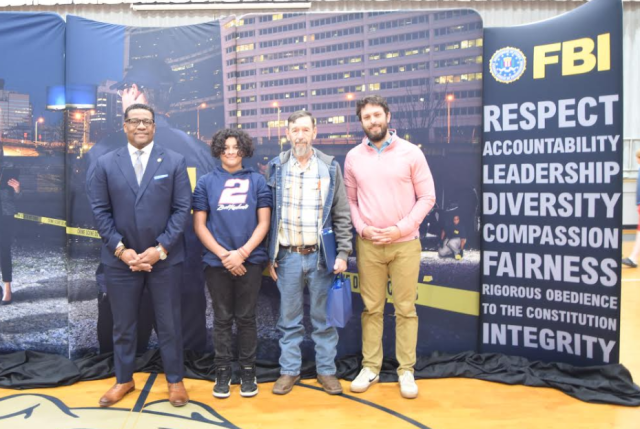
Special Agent in Charge Carlton Peeples presents seventh grade student with a letter from FBI Director Christopher Wray. (Provided)
www.fbi.gov
Special Agent in Charge Carlton L. Peeples of the FBI Birmingham Division presented a letter from FBI Director Christopher Wray to a Sumiton Middle School seventh grade student interested in a career as an FBI agent.
Students wrote letters of interest to companies and organizations they have an interest in pursuing as a future career for a class assignment in Coach Drew Jenkins’s Writing and Grammar class.
On hand to speak with the students were several members from the FBI Birmingham team to answer questions and conduct equipment demonstrations.
“We are grateful to the Sumiton Middle School Administration and staff for allowing us to present this letter and share our passion for the FBI Mission with the students,” said Peeples of the Birmingham Division. “This is a great time for students to start thinking about their futures and a great opportunity for the FBI to engage in the communities we serve.”
March is Women’s History Month. Therefore, we will use this opportunity to spotlight some African American women who are trailblazers in their fields. Women whose names and voices are not commonly known or heard from. This week that name is Dr. Marian Croak, who has more than 200 patents.
Dr. Marian Croak has more than 200 patents. (WIKIPEDIA)
One of her patents you may be the most familiar with is U.S. Patent No. 7.599,359 — VoIP (Voice over Internet Protocol). Let’s learn more about this remarkable African American woman who has changed the way the world operates and conducts business.
Croak was born on May 14, 1955, in New York City. She credits her father, Raymond Rodgers, who only completed elementary school, with her success. Her father built her a home chemistry set, which became her inspiration in pursuing a Science Technology Engineering and Math (STEM) career.
She obtained her bachelor’s degree from Princeton University in 1977 and her Ph.D specializing in Quantitative Analysis and Psychology in 1982 from the University of Southern California.
After college, she began working for AT&T Bell Laboratories, where she worked in various positions at the senior executive level for over three decades.
It was during her work while at AT&T that Dr. Croak and her team contemplated the potential of digital telecommunications. She worked on advancing Voice over Internet Protocol technologies which converts voice data into digital signals that can be easily transmitted over the internet instead of using a traditional phone line. Her work has furthered the capabilities of audio and video conferencing resulting in zoom conferencing.
During her time at AT&T, Croak also patented the technology that allowed users to donate money to organizations using text messaging. This technology was developed during the aftermath of Hurricane Katrina. Her patent revolutionized how people donate to charitable organizations. She received the Thomas Edison Patent Award for this technology in 2013.
Croak currently works as a senior vice president at Google. This innovator in 2021 became one of two African American females to ever be inducted into the National Inventors Hall of Fame and the National Academy of Engineers. In 2022, she was inducted into the Academy of Arts and Sciences.
Croak is also a renowned philanthropist dedicated to helping those in need. She has mentored many individuals pursuing STEM careers. She serves on several boards and is wife and the mother of three adult children.
CELEBRATING WOMEN HISTORY AND BLACK HISTORY…every day!
TODAY…
**READ THE BIRMINGHAM TIMES. Catch up on the news!
**THE JOE LOCKETT SHOW Live Podcast with NEPHEW CLIFF and MS. DENISE, Monday-Friday at 4 p.m.
**BRANDON LAKE – TEAR OFF THE ROOF TOUR, 7 p.m. at the BJCC.
**FILM – 7 p.m. at the Sidewalk Film.
**CODY PARKS & THE DIRTY SOUTH & THE MUMMY CATS at the Nick.
**THIRST TRAP THURSDAY, 5 p.m. at 2400 7th Avenue South.
**BIRMINGHAM BLACK ECONOMIC ALLIANCE – Bi-Monthly Business Mixer, 6-8 p.m. at Sienna, 1025 20th Street South. Guest Speakers are EVAN JEFFERSON, Virtual Dispensary Owner and NIECKO GLOVER, Community Organizer/Advocate.
**LIVE BAND KARAOKE hosted by ELLE JAI at Perfect Note.
**KIKSTART at WaterMark in Bessemer with Free Food Boxes, 9 a.m.
**COMPUTER CLASSES AT THE FIVE POINTS WEST LIBRARY every Tuesday and Thursday.
**EACH AND EVERY THURSDAY HAPPY HOUR, 5-8 p.m. at D’ZIRE with SPECIALS.
**MOVIES EVERY THURSDAY at Sidewalk Fest.
**THIRSTY THURSDAYS at D’ZIRE Bar and Lounge.
**KARAOKE, 5-9 p.m. at Courtyard Alabaster Bar and Grill.
**THIRD THURSDAY BLUES JAM, 7 p.m. at True Story Brewing.
**TASTEMAKER THURSDAY – Every Thursday at Blaze Ultra Lounge, 228 Roebuck Plaza Drive, 8 p.m.- 12 a.m. with DJ Ace Twon (95.7 JAMZ) in the mix hosted by Audio Life and GMC Promo.
**THIRSTY THURSDAY at Hookah 114 17th Street No.
**TEQUILA THURSDAY at the Vibe Bar & Lounge.
**THROW BACK THURSDAY at Tha Vibe Bar & Lounge, 3801 Richard Arrington, Jr., Blvd.
**FILMMAKER HAPPY HOUR- Every 3rd Thursday, at Sidewalk Film Fest. Meet with other filmmakers and discuss your newest projects.
**EVERY THURSDAY NIGHT KARAOKE, 6:30 at Ruth’s Place hosted by LADY WOO and with DJ SHAY.
FRIDAY…
**EVERY FRIDAY DURING LUNCH – FRIDAY COUPON CHEAT DAY WITH HOT107 at 1918 Catering. (Use the coupon ANY DAY.)
**THE JOE LOCKETT SHOW Live Podcast with NEPHEW CLIFF and MS. DENISE, Monday-Friday at 4 p.m.
**FRIDAY NIGHT WRITES, 8 – 11 p.m. at 7611 1st Avenue North.
**ALL CAPS: MF DOOM TRIBUTE at The Nick.
**FRIDAY NIGHT LIVE WITH SHARRON COLLINS at Perfect Note.
**MOM JEANS at Iron City.
**EVERY FRIDAY – R&B FRIDAY, at The Chandelier, 212 Cahaba Valley Road in Pelham with DJ MANISH mixing live. FREE Entry.
**EACH AND EVERY FRIDAY HAPPY HOUR, 5-8 p.m. at D’ZIRE with SPECIALS.
**FOOD TRUCK FRIDAY at City Hall, 11 a.m.- 2 p.m. at the short 20th Street North.
**RIPCORD, 8 p.m. – 2 a.m. at 4501 Gary Avenue in Fairfield.
**QUE’S BAR & GRILL GROOVIN’ on 19th Street in Ensley.
**LIT FRIDAYS WITH RIPCORD, 8 p.m. – 2 a.m. at 4501 Gary Avenue in Fairfield.
**AFRO CARIBBEAN NIGHTS (Every Friday Night) at Ash’s on 2nd, 7 p.m. until with Reggae, Afro Beats, Dancehall and Top 40 Hits.
**FIREBALL FRIDAY at Tha Vibe Bar & Lounge.
**FRIDAY NIGHT RAP, Every 1st and 3rd Friday at Crescent Cultural Center, 1121 Tuscaloosa Avenue, W.
**ALI SIDDIQ: I GOT A STORY TO TELL at the Lyric Fine Arts Theatre, 7 p.m.
SATURDAY…
**PUBLIX VILLAGE 2 VILLAGE RUN 2024 is March 9th in Mountain Brook.
**EVERY SATURDAY at BIRDSONG FARMERS MARKET, 9 a.m. – 12 p.m., 2824 5th Avenue South at Automatic Seafood.
**ATM WHEN A MAN LOVES A WOMAN PT 2, 10 a.m., 3233 Jefferson Avenue S.W. featuring an all male panel of ministers for a Q & A Session.
**SPRING FARMERS MARKET, 12 p.m. at Ross Bridge Farmers Market.
**5TH ANNUAL POWERED BY GIRLS CONFERENCE, 1 p.m. at UAB’s ArtPlay.
**WINE DOWN HAPPY HOUR, 4 p.m. – 9 p.m. at Saferoom Lounge Bar.
**EACH AND EVERY SATURDAY HAPPY HOUR, 5-8 p.m. at D’ZIRE with SPECIALS.
**EVERY SATURDAY SOLD OUT – THE SATURDAYS JUMP OFF, 10 p.m. at Onyx of Bham, 615 8th Avenue West.
**THE JOE LOCKETT SHOW Live Podcast with NEPHEW CLIFF and MS. DENISE, Monday-Friday at 4 p.m.
**STUN GUN, SICK FUCKS, YOUNG ROBOT & PENNY CIRCUS at The Nick.
**ENCORE PERFORMANCE TRIBUTE TO JOHNNIE TAYLOR featuring DENNIS MITCHELL at Perfect Note.
**ELECTRIC AVENUE – THE 80’S MTV EXPERIENCE at Iron City.
SUNDAY…
**WORSHIP AT THE SIXTH, 9:30 a.m. at Sixth Avenue Baptist Church.
**SUNDAY FUN DAY at DZIRE BAR AND LOUNGE, 4120 3rd Avenue South. Call 205-266-2594 for more.
**SUNDAY FUNDAY for the grown Folks Kickback at Tha Vibe Bar & Lounge.
**EVERY 3rd SUNDAY JAZZ JAM SESSION, 4-8 p.m. at the Ferus on 41st.
**CITY WIDE PRAYER MEETING, Every 4th Sunday, 4 p.m. for one hour at Birmingham Easonian Baptist Bible College. The Lord’s Supper will be served and hosted by the Knights of Pythias & Court of Calanthe.
**ZACH AUSTIN, SHAWN HESS and HUNTER HICKS at The Nick.
**SOULFUL SUNDAY with SAXOPHONIST DELON CHARLEY at Perfect Note.
**FRIDAY NIGHT WRITES, 8 – 11 p.m. at 7611 1st Avenue North.
**DRAG NIGHT at The Nick.
**FRIDAY NIGHT LIVE WITH DEIRDRE GADDIS at Perfect Note.
NEWS TO USE…**WOMEN IN MEDIA PANEL AND WORKSHOP is March 14, 1-3 p.m. at Miles College. In honor of Women’s Appreciation month, this event will empower women with an interest in journalism, media and press. Influential women in Birmingham will be recognized. The participants will gain valuable tools and knowledge for creating digital business cards. Expert panelists include SHEILA SMOOT, HAILEY YEAGER, DIAMOND TYLEIR, MYA JOLLY and KEISA SHARPE. For more info and to register: almediaprofessionals.org and Nicole@nicolesade.com.
CELEBRATING WOMEN…
**WOMEN IN FILM WEEK is March 5 – 10 at Sidewalk Film, 1821 2nd Avenue North. This event celebrates the women’s voices in film.
**WOMEN OF THE KAUL WILDFLOWER GARDEN, March 19, 6-7 p.m. at the Birmingham Botanical Gardens. Join MOLLY HENDRY as she shares the rich history of the Kaul Wildflower Garden.
FOR GARDEN LOVERS…
AT THE BIRMINGHAM BOTANICAL GARDENS…
**CELEBRATE FRIENDSHIP during the month of March with special perks for new, renewing and current members, including $10 off any new or gift membership with coupon code MM24.
**March 14 – HOME GROWN TOMATOES, 11 a.m. – Noon in the Adventure Classroom with CHIP EAST.
**March 23 – JAPANESE GARDEN TOUR, 9- 10 a.m.
**KAUL WILDFLOWER GARDEN TOUR, 12:30 – 1:30 p.m.
**March 23 – There are member-exclusive morning and afternoon tours on Saturday.
**March 28 – PLANTING POLLINATORS AND KEEPING BEES, 11 a.m. – noon in the Adventure Classroom with OLIVIA FULLER.
**April 2 – NEW GARDENING CLASS – RIGHT PLANT, RIGHT PLACE, 11 a.m. – noon with BETHANY O’REAR.
**April 2 – THYME TO READ – The Garden of Small Beginnings by Abbie Waxman. FREE.
**April 4 – Spencer Lecture: THE GARDENS OF BUNNY MELLON, 5:30 – 7:30 pm. with THOMAS LLOYD and BRYAN HUFFMAN.
**April 6 – BASICS OF TREE SELECTION, 1 – 2:15 p.m.
**April 11 – (Member Shopping) SPRING PLANT SALE. Bring your folding cart or wagon.
**April 12-13 – (Public Sale) SPRING PLANT SALE. Bring your folding cart or wagon.
**INTERNSHIP OPENINGS – Learn more at the bbgardens.org.
**DEVELOPMENT ASSOCIATE – Learn more at the bbgardens.org.
FOR ART LOVERS…
**NOW THROUGH MAY 10 – ROOTS & RENAISSANCE, an African American Journey Through Art, at C.A. Kirkendoll Learning Resource Center, 5500 Myron Massey Blvd., Fairfield, Miles College. The Roots And Renaissance Art Exhibition at Miles College LRC is open Monday-Thursday 8 a.m. – 10 p.m., Friday 8 a.m. – 5 p.m., Saturday 8 a.m. – 3 p.m. and Sunday 2 p.m. www.fairfieldblackartcollective.com.
FOR FOOD LOVERS…
**3RD ANNUAL GREAT BIRMINGHAM BAKE OFF is April 6, 2-4 p.m. at Cahaba Brewing. Sample baked goods made by competing teams of local bakers. All baked goods start with one of the WE made Southern Staples baking mixes. Your ticket lets you sample each of the competing baked goods plus you will receive a Cahaba Brewing beer. There will be live music, food trucks and the Junior Board will be selling WE Made mixes and other products. Support how you can. Sign up at bakeoff.swell.gives.
HAPPENINGS AT SIXTH AVENUE BAPTIST CHURCH
…SEE YOU AT THE SIXTH…EVERY SUNDAY!
**EVERY MONDAY MORNING MEDITATION WITH PASTOR CANTELOW, 7:15 a.m. Contact the church at (205) 321-1136 or (205) 321-1137.
**CHILDREN’S CHURCH & COLLISION CHURCH, each First Sunday at 9:30 a.m. for K-5th (Children’s Church), 6-12th (Collision).
COMING SOON…
**JULY 11 – CHRIS BROWN “11:11 TOUR” with Special Guests AYRA STARR and MUNI LONG at Legacy Arena.
Well, that’s it. Tell you more ‘next’ time. People, Places and Things by Gwen DeRu is a weekly column. Send events, your things of interest and more to my emails: gwenderu@yahoo.com and thelewisgroup@birminghamtimes.com