Home Blog Page 485

‘Unprecedented’ Water Levels Threatening Hydropower Generation In The West


0

Lake Powell, a critical source of hydropower and water for the West, is continuing to dry up. In this file photo, the tall bleached bathtub ring is visible on the rocky banks of Lake Powell on June 24, 2021 in Lake Powell, Utah.  (Justin Sullivan/Getty Images)


By Zachary Rosenthal

The nation’s second-largest reservoir, Lake Powell, is continuing to dry up, placing water supplies and power generation in the West in potentially dire straits.


Lake Powell is an artificial lake in the middle of the Colorado River on the border between Arizona and Utah. Created in 1963 after the construction of the Glen Canyon Dam, the lake has become a critical source of hydropower and water for the West.

Now, for the first time, the water levels at the lake are threatening to dip below 3,525 feet in elevation, a critical elevation marker, with water levels dropping a full 45 feet in the past year.

“[The critical elevation] provides 35 feet of buffer before we reach our minimum power pool elevation where Glen Canyon Dam can no longer generate hydropower, ” said Heather Patno, a hydrologic engineer for the U.S. Bureau of Reclamation.

Levels are expected to be below the target elevation for a few weeks before rebounding in April due to snowmelt from mountains along the Colorado River Basin. Hydropower generation is not expected to be affected this spring, but it is possible that the reservoir’s level will dip to critically low levels again in the summer.

“We’re talking about multiple seasons of well-below-average rain and snow that have kind of gotten us to this point, coupled with exceptionally high temperatures which we attribute to regional warming from global warming,” said Justin Mankin, an assistant geography professor at Dartmouth College and a co-lead at NOAA’s drought task force.

Water conservation measures will likely need to be implemented, something that Mankin says will hit farmers in the West first. As drought conditions continue to build, farmers may be asked to limit their water usage, something which makes growing crops more difficult.

“These are unprecedented times, and these decisions are not taken lightly, and we’re aware of the impacts it has to the Colorado Basin, where there’s 40 million people within the basin,” Patno said.

While water cuts might be necessary to sustain the water supply this year, Mankin believes that the continued drought in the West indicates that more structural solutions might be needed in the future.

A current look at drought conditions in the Western United States as of March 10, 2022. (AccuWeather)

One peer-reviewed study published recently in the journal Nature Climate Change found that the western United States and parts of northern Mexico are experiencing their driest period in at least 1,200 years, with some calling the unprecedented period of dryness a “megadrought.”

“This drought is indicating we need a structural orientation of our management of water in the West,” Mankin said. “What does it mean for the West to be in an exceptional drought, that is, a drought without exception, every year?”

Reporting by Bill Wadell.

For the latest weather news check back on AccuWeather.com. Watch the AccuWeather Network on DIRECTVFrontierSpectrumfuboTVPhilo, and Verizon Fios. AccuWeather Now is now available on your preferred streaming platform.

Produced in association with AccuWeather.com.

Recommended from our partners


The post ‘Unprecedented’ Water Levels Threatening Hydropower Generation In The West appeared first on Zenger News.
Loner Jays Learn Just As Well As Social Jays, Scientists Say

0

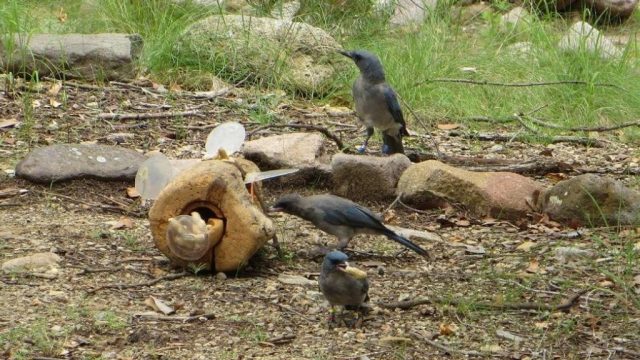
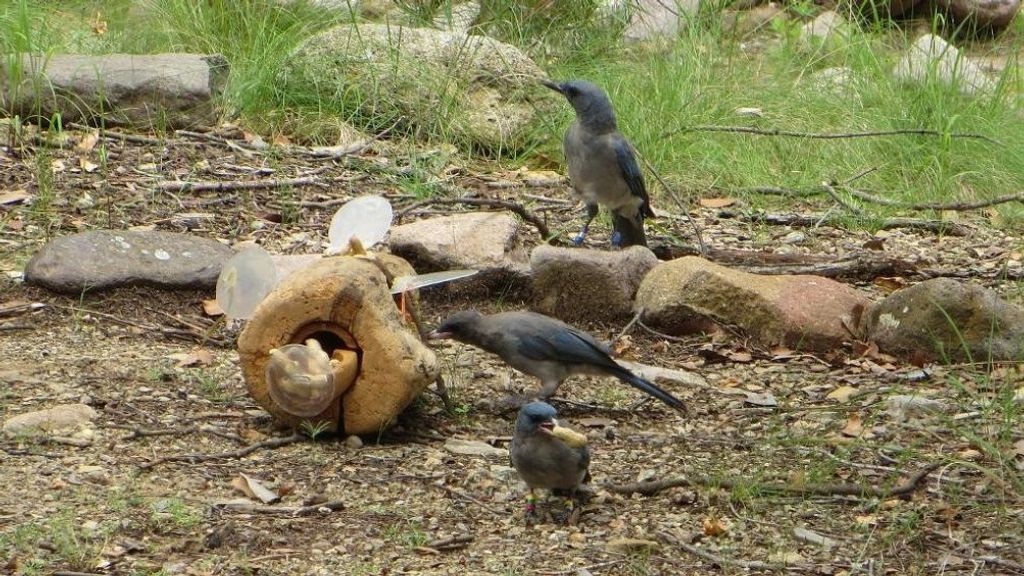
California scrub jays are seen defeating a puzzle containing food, developed by scientists to test whether sociable birds have cognitive abilities superior to those of less sociable birds. (Oregon State University)


By Martin M Barillas

Some loners learn just as easily as more sociable creatures, according to the findings of a new study on related species of birds.


An international team of researchers has found that California scrub-jays, which live in mated pairs, learn just as well as Mexican jay birds, which are social and flock when feeding. The discovery, published in the journal Scientific Reports, means that animal behaviorists may have to rethink the accepted theory that animals living in groups tend to be smarter than their mated peers.

“Further studies with wild animals are clearly necessary to develop a better understanding of when, where and why intelligence evolved,” said researcher and study co-author Jonathon Valente of Oregon State University.

The authors believe that their discovery underscores the complex link between the evolution of intelligence and social behavior and may have ramifications for understanding human intelligence.

Having devised a novel food puzzle to study animal cognition, the scientists had expected the sociable Mexican jays (Aphelocoma wollberi) to outperform the closely related California jays (Aphelocoma californica).

The log puzzle created by the researchers featured four doors. Three doors were locked and held a cache of peanuts, while the fourth was unlocked and held sunflower seeds. The jays were willing to address the challenge of unlocking the doors to get to their preferred food rather than settling for the more easily available sunflower seeds. (McCune et al., 2022/Scientific Reports)

Both species are opportunistic, generalist foragers that feed on tree nuts such as acorns and prefer dry, open habitats of pine and scrub oak. They also similarly cache food. However, Mexican jays flock in groups of five to 30, while the non-social scrub-jays live with a single mate.

Both species are related to the blue jay, which is well-known in the eastern part of the United States. The three species belong to the Corvidae, or crow, family of birds.

Animal behaviorists sought to discover why some species developed with greater intelligence than others, coming up with the theory that those living in groups were smarter because they would require more complex levels of thinking than species that are not so social.

“The group-oriented animals rely on intelligence to cooperate with and learn from — and also deceive — their group mates,” said lead author Kelsey McCune.

McCune noted that until now, the theory had not been tested on wild animals because of “the difficulty of testing cognition outside the laboratory.”

To test the theory, McCune and Valente joined colleagues in South Korea and developed two identical puzzle apparatuses fashioned from logs. Three out of four doors on the log had a simple lock, while another was unlocked and featured a less preferable food: sunflower seeds. The birds showed a stronger preference for the peanuts locked behind doors.

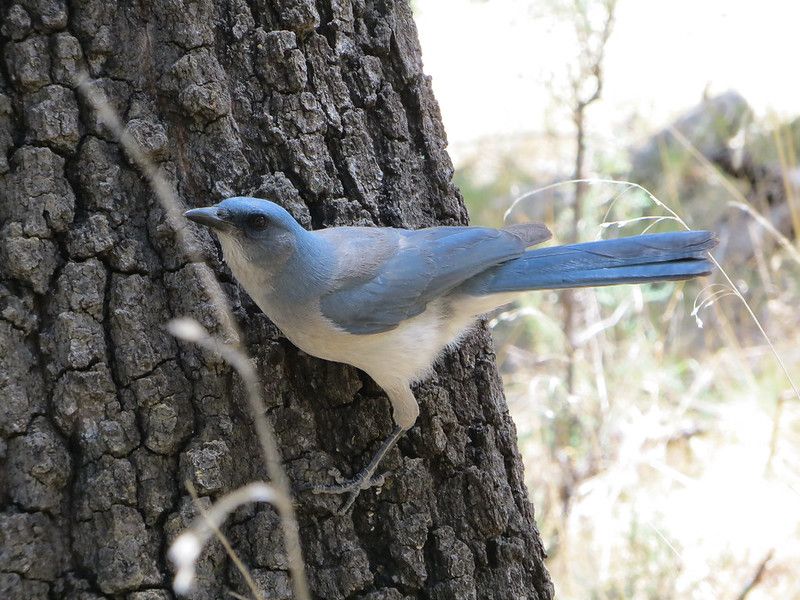
The California scrub jay (Aphelocoma californica) is native to southern British Columbia through California and western Nevada. It travels in mated pairs and is not as sociable as related Mexican jays. Above is one of the puzzles scientists developed to test how the birds learn. (Oregon State University)

Researchers trained a demonstrator bird from each of the two species to open locked doors before setting them free among wild birds along with the puzzles. They observed some 49 Mexican jays in Arizona and 25 California scrub-jays in Oregon attempting to extract food from the puzzles.

“Having an unlocked door helped prevent ‘naïve’ jays from abandoning the foraging area due to a failure to get food, thus increasing their probability of observing group mates interacting with the puzzle,” Valente said.

“We compared intelligence between these species by testing their abilities to either innovate a solution to the puzzle or to learn to solve the puzzle by observing other birds solving it,” McCune said. “Contrary to what we thought we’d find out, the two species showed similar abilities to learn.”

The researchers found that Mexican jays learn by watching other birds trying to solve the puzzle. But scrub-jays appeared to be more self-reliant when obtaining food.

The Mexican jay (Aphelocomo wollweberi) is native to parts of the southwestern United States, as well as the Sierra Madre range in Mexico. It flocks in groups, seeking acorns, pine nuts and other plant and animal foods. (Oregon State University)

“Surprisingly, members of both species tended to avoid interacting with parts of the puzzle where they observed other birds obtain food,” said Valente.

He believes this means the birds rely on social learning to avoid competition rather than to learn how to open the puzzle for the food. “Regardless, the findings suggest the relationship between social behavior and the evolution of intelligence is a highly complex one,” he said.

The study concluded that “both species used social information to avoid, rather than copy, [members of the same species]. Our findings demonstrate that while complex social group structures may be unnecessary for the evolution of social learning, it does affect the use of social versus personal information.”

Edited by Siân Speakman and Kristen Butler

Recommended from our partners


The post Loner Jays Learn Just As Well As Social Jays, Scientists Say appeared first on Zenger News.

Salvation Army Offers Relief to Ukraine. Here’s How to Help

0

By Haley Wilson

The Birmingham Times

End Addiction Bham Walk in Railroad Park this Saturday

0

By Haley Wilson

The Birmingham Times

Jerusalem Launches New Accelerator For TV Formats

0

With the proven world popularity of Israeli TV formats — think “False Flag,” “Fauda,” “Beauty and the Baker” and “Shtisel” — it’s no wonder executives from Netflix, A&E and HBO are heading to Jerusalem to scout the next big hit. (Glenn Carstens-Peters/Unsplash)


By Abigail Klein Leichman

With so much TV content for viewers to choose from, producers are on the lookout for new, original, high-quality content that will stand out from the rest.


And with the proven world popularity of Israeli TV formats — think “False Flag,” “Fauda,” “Beauty and the Baker” and “Shtisel” — it’s no wonder executives from Netflix, A&E and HBO are heading to Jerusalem to scout the next big hit.

Larry Tanz (Netflix), Maia Hollinger (HBO) and Barry Jossen (A&E) are among senior network executives planning to visit a new accelerator launched by New Legend and the Jerusalem Development Authority’s Jerusalem Film & Television Fund.

The accelerator has accepted 12 content projects selected from hundreds of proposals. The creators will receive a grant, as well as support and guidance from leading mentors.

Among the selected projects:

  • A new project by Nir Berger, creator of “Dismissed” (“HaMefakedet”)
  • A tragicomedy by two screenwriters from East and West Jerusalem, respectively
  • A project by Tal Mikhalovich, screenwriter for the hit Israeli show “Kupa Rashit” (“Head Cashier”)
  • A comedy-drama by Tal Miller, Mickey Trieste and El Ad Cohen about a deaf man and woman raising their hearing son
  • A project based on the experiences of Raz Shmueli, runner-up from the first season of reality singing competition “The Voice” in 2012

“My team and I were very impressed with the wide range of ideas presented by the participants and are waiting to hear more in a face-to-face meeting,” said Hollinger, VP of Drama Programming at HBO Original Programming.

Jossen, senior VP at A&E, said, “Discovering new talents and stories is an essential part of our work and that’s why I’m happy to collaborate with New Legend and the Jerusalem Development Authority’s Film and Television Project, in a workshop so practical as this. The rich pool of talent in Israel provides a global perspective that contributes to the story and produces compelling content for viewers around the world.”

One step further

Udi Ben-Dror of the Jerusalem Development Authority noted that this is the first public sector and private sector collaboration of its kind.

“We are happy to cooperate for the benefit of the creators with the leading broadcasters in the world and are excited about the visit of Jerusalem by world industry executives who come to accompany the creators,” Ben-Dror said.

The accelerator is intended to help Israeli creators develop content for sale to leading international broadcasters. Participants will receive guidance throughout the process, from the scriptwriting stage to the presentation and sale stage.

At the end of April, a senior member of the industry is expected to come to Jerusalem for a pitching event.

New Legend will continue accompanying the creators after the end of the accelerator period and in the future may consider an initial investment in the leading projects.

“As a producer and creator, I have participated in a lot of accelerators, both in Israel and abroad, where they receive guidance and direction, and sometimes surprising professional opportunities come through them,” said producer Asaf Nawi, VP of production and content at New Legend, which funds, develops, produces and distributes commercial television and film content.

“New Legend’s vision for this accelerator takes it all one step further,” he continued.

“We have built an accelerator that aims not only to develop the content, but to give creators the tools and make the connections that will allow for sale in international territories, even beyond the intensive development period of the accelerator for a year or more.”

Nawi said the founders of the accelerator received positive feedback from all broadcasters, who were happy about the opportunity to come to Israel to get to know the Israeli creators and initiatives and also “gave feedback on the projects themselves and proved themselves wonderful potential partners.”

Produced in association with ISRAEL21c.

Recommended from our partners


The post Jerusalem Launches New Accelerator For TV Formats appeared first on Zenger News.

Pelicans Prefer Native Fish At Popular Sport-Fishing Reservoir

0

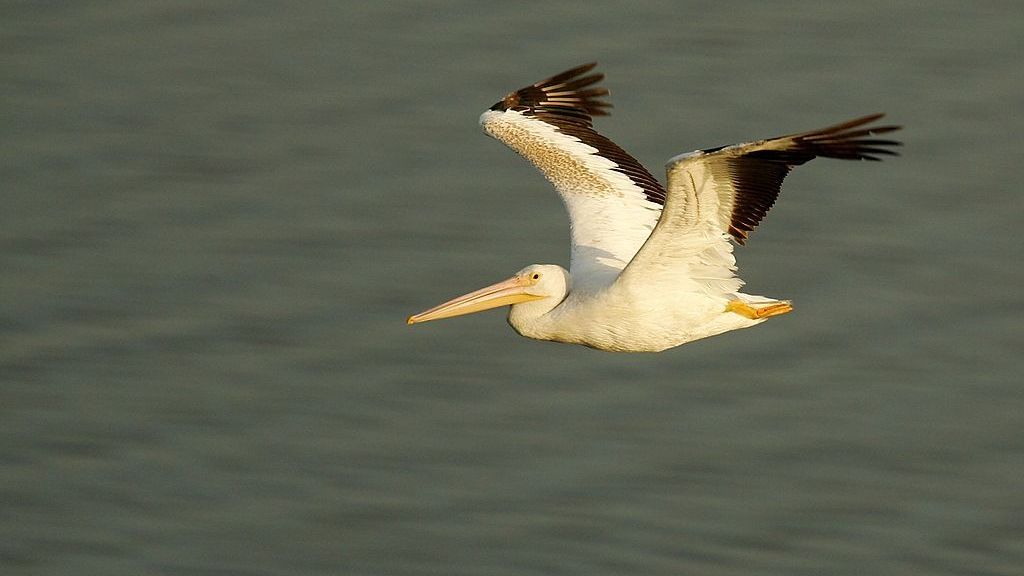
An American white pelican flies over the Sonny Bono Salton Sea National Wildlife Refuge, a major stop for birds on the Pacific Flyway, on June 23, 2006, near Calipatria, California. (David McNew/Getty Images)


By Martin M Barillas

Pelicans are picky eaters, say researchers who examined the dietary choices made by the fish-eating birds at a reservoir in Utah.


American white pelicans feast on native fish such as the Utah sucker but leave game species such as the cutthroat trout alone, according to new research by Utah State University scientists.

Strawberry Reservoir is one of the most popular fishing spots for anglers in northern Utah. But when migratory birds fly from the deserts of the Great Basin, they linger at the man-made body of water — to go fishing.

Recognizing the economic importance of sport fishing to the state and the cost of stocking the reservoir with game fish, researchers had to determine how a feature so new to the landscape functions on an ecological level. They also studied how the pelicans interact with the various populations of fish.

In 2014, researchers placed solar-powered transmitters on pelicans to record their migratory routes, which saw them fly from Central America and Mexico to the western United States during the warmer months, then returning south for the winter. (Utah Division of Wildlife Resources)

“Cutthroat trout are fast swimmers and can out-swim native chubs and suckers, and they stay too deep for pelicans when they are out in the open water,” said Phaedra Budy, lead author of a paper published in the Canadian Journal of Fisheries and Aquatic Sciences. “Pelicans eat what they can easily catch, and chubs and suckers are relatively slow swimmers and like [a] shallow habitat where they are easy for pelicans to catch.”

Over the last 20 years, the census of cutthroat trout in the reservoir has varied from the 2007 high of 464,000 adult fish to lows of approximately 220,000 in both 2012 and 2014. Stocking and maintaining game fish is expensive. Meanwhile, the death of cutthroat trout has been blamed on predation by other fish, predation by pelicans, harvesting and release by anglers and age and disease.

To find out whether pelicans are to blame, the team examined exactly what these birds like to eat.

For the most part, pelicans eat local fish species. During the two years of the study, the scientists found that the pelicans’ diet was made up of 85 percent Utah suckers, 6 percent Utah chubs, 3 percent cutthroat trout and 6 percent other prey. Because chubs and suckers are prolific native fish, with an expanding population of some concern, it was good news to wildlife managers that pelicans prefer them.

Kevin Chapman releases an American White Pelican. Diet analysis of pelicans at Strawberry Reservoir in Utah showed that the vast majority of their diet included abundant native fish rather than sport fish such as cutthroat trout. (Frank P. Howe)

This underscores research conducted by the university in 2016.

During cutthroat spawning season at the beginning of May and into mid-June, diet samples were taken from pelicans. The researchers found that the birds ate more Utah chub (24 percent) and cutthroat trout (10 percent), even while Utah suckers still made up most of the birds’ diet. They also found that pelicans ate only one percent of the adult population of cutthroat trout in the reservoir.

The cutthroat trout is a cagey species, according to the researchers, because they quickly swim away when they sense the shadows of boats. Utah chubs and suckers are not as wary or concerned about fishers.

Pelicans form barriers or feeding “fences” when they line up at the edge of a reservoir to block spawning tributaries when young cutthroat trout are migrating to deeper waters. Wildlife managers wanted to know if there were ways to stop pelicans from scooping up young trout while they swam in shallower water.

Migrating pelicans prepare to spend the night at a water reservoir before heading south on Oct. 28, 2009, at Emek Hefer in central Israel. An estimated 500 million birds fly over the region twice a year as they make their annual migrations from Europe and Asia to Africa and back. Researchers at Utah State University noted that pelicans form “fences” on the shoreline of reservoirs, blocking spawning tributaries. (David Silverman/Getty Images)

“Because pelicans are highly visible and congregate in large numbers at Strawberry Reservoir, anglers assume that they are eating tons of trout,” said study co-author Frank Howe. But, he says, the study demonstrates that pelicans and anglers are not interested in the same fish.

“Knowing that the impact from pelicans to cutthroat trout is minor and short-lived will let managers focus on more important factors impacting trout populations at the reservoir,” he said.

Howe and colleagues found that trout at Strawberry Reservoir swam into spawning streams even when the pelicans were there. But days with the highest recorded densities of pelicans also saw delays in trout travel. Therefore, the scientists developed a threshold number of pelicans for wildlife managers to use as a rule of thumb for dispersal to save the trout in the long run.

By eating native chubs and sucker fish, the pelicans may be removing competing native fish in far greater numbers than wildlife managers can do themselves and at no cost, said Budy.

Game fish at Strawberry Reservoir include sterilized rainbow trout, cutthroat trout, kokanee salmon and crayfish. In 1990, the reservoir was poisoned to eliminate all aquatic life in an effort to eliminate so-called “trash fish” such as the Utah chub. However, soon afterwards, Utah chubs reappeared. Cutthroat trout were introduced to predate on the chub. Currently, there are strict catch-and-release regulations in place for game fish.

Another challenge has been the unhealthy level of phosphorus introduced by the Strawberry River because of cattle grazing along its banks. A program of planting grasses and trees was completed in 2019 to improve the wildlife habitat and reduce phosphorus, even though grazing was still permitted.

Edited by Siân Speakman and Kristen Butler

Recommended from our partners


The post Pelicans Prefer Native Fish At Popular Sport-Fishing Reservoir appeared first on Zenger News.
President Bobbie Knight’s Golden Touch Brings Miles College Success

0
Miles College President Bobbie Knight. (Joe Songer, File, For The Birmingham Times)
By Javacia Harris Bowser
For The Birmingham Times

How Miles College Leads The Way With Public-Private Partnerships

0
Students at Miles College recently received new iPad Pros at no cost. (Joe Songer, For The Birmingham Times)
By Ryan Michaels
The Birmingham Times

Meet 20-year-old Cameron Johnson, UAB’s Award-Winning Composer

0
By Ryan Michaels
The Birmingham Times