Researchers at the National Oceanic and Atmospheric Administration (NOAA) came across a historic discovery while mapping the ocean floor recently — an oil tanker that dates back to World War II.
The sunken oil tanker is called the SS Bloody Marsh. Its construction was completed in 1943, and it faced its ultimate downfall that same year when it was struck by a torpedo from a German U-boat. It was made amid a push to get more oil tankers into the Atlantic and toward Europe during the war.
The oil tanker set off from a port in Houston, Texas, on June 28, 1943. It was headed for New York when it was torpedoed on July 2 that same year.
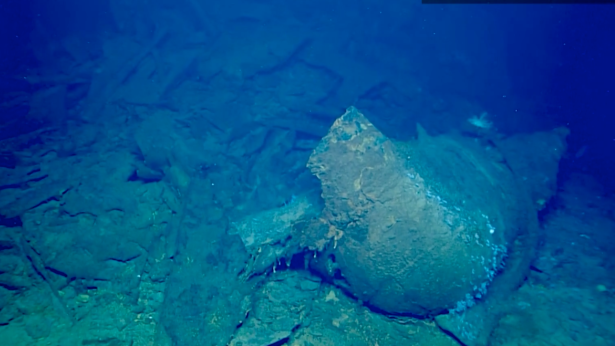
The SS Bloody Marsh, which completed construction in 1943, was recently found when the NOAA was mapping the ocean floor off the coast of South Carolina. (NOAA Ocean Exploration)
When the torpedo struck the Bloody Marsh, it destroyed the engine room and killed three crewmen. According to reports from the time, the oil tanker sunk very quickly following a second torpedo in the attack. Some crew members were able to abandon ship and escape on life rafts.
The discovery was a long time coming. The Bloody Marsh was found off the coast of South Carolina while the NOAA researchers were mapping the ocean floor as part of the Windows to the Deep 2021 expedition.
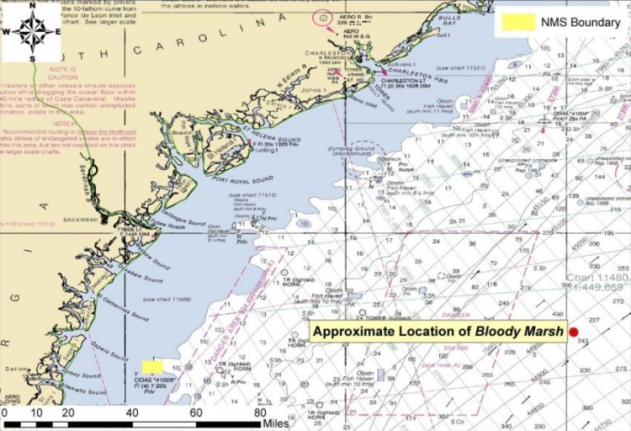
A map from NOAA shows the approximate location of the S.S. Bloody Marsh, which was discovered off the coast of South Carolina this year during mapping of the ocean floor. (NOAA)
There is something about this wreck that makes it stand out to researchers aside from its history — its ecological impacts.
“It was important to find Bloody Marsh and get an ROV [remotely operated vehicle] on-site to identify the wreck and assess it for pollution risk,” Mike Brennan, a Maritime Project archaeologist for SEARCH Inc., said.
The wreck is on the NOAA’s “Potentially Polluting Wrecks” list, which is a list of 87 sunken vessels located in various spots across the United States ocean floor that could pose a threat to the nation’s coastal and marine resources through oil pollution. As the wrecks on the list corrode on the ocean floor, they may release hazardous materials and oil into the environment.
Of the 36 sunken vessels, 17 have been recommended for further assessment and potential removal.
The above map shows the 17 sunken vessels from the NOAA’s list of potentially polluting wrecks that have been recommended for further assessment and potential removal along the coasts of the U.S. While the Bloody Marsh is on the list of potentially polluting wrecks, it has not been recommended for further assessment and removal like the wrecks shown in the map above. (NOAA)
According to the NOAA, there are approximately 20,000 sunken vessels across the U.S. ocean floor, but only some of them are believed to contain oil.
An oil slick has been observed about 2.5 miles away from the shipwreck, which allowed the team of researchers to identify the wreck. At the time of the sinking, the Bloody Marsh was believed to be carrying more than 106,000 barrels of oil. According to Brennan, the slicks are likely due to the gradual corrosion of the wreck.
“Given the location of this wreck, the oil slicks observed upstream of it, the welded joinery and general appearance of the wreck as that of a T2 oil tanker, and the matching of the length of the hull section with the torpedo damage, I am confident that this is the wreck of SS Bloody Marsh,” Brennan said in a report from NOAA on the discovery.
Israeli racecar driver Alon Day was the Asian champion in the Formula Renault competition in 2008 and the champion of the European NASCAR series in 2017, 2018 and 2020.
As of January 2022, he has a new job as a virtual driver for Israeli esports company Finest. Day sits at a computer monitor playing sim-racing games while legions of fans watch on YouTube, Twitch and other streaming platforms.
For Day, it’s not such a stretch: As a teenager, he came “to the world of racing through computer games and simulators,” he says. So, “joining Team Finest is a great opportunity.”
Finest is Israel’s first professional esports group. Founded as “Team Finest” in 2019 by Rubik Milkis, with Yotam Nachshon joining a year later, the organization runs teams in four of the most popular multiplayer video games: Fortnite (a Battle Royale game), FIFA (football/soccer), and two first-person shooter games, Counter-Strike and Valorant.
Finest even has a professional women’s team for the latter (impressive given that streaming game viewership is 85 percent male). Finest competes in Israel with Nom, the country’s only other professional esports group.
Libi Kapostin and Talya Oshia, players on the female Valorant team. (Courtesy of Finest)
Esports is big business, with half a billion fans watching their favorite players click, swipe and sometimes stab. Revenues are currently over $1 billion with year-over-year growth at 12 percent.
Where the younger generation is at
In esports, viewers don’t pay to watch, so where does the money come from?
Some is shared by Finest’s streaming partners. Most, however, comes from sponsorships — just like in nonvirtual sports. Sponsorships pay for prize money, which can reach multiple millions of dollars in some cases.
Among Finest’s sponsors are Pizza Hut, Logitech and Tazos, a leader in the blockchain space that is helping Finest make money in another way — by selling NFTs (non-fungible tokens). You can also buy tangible t-shirts and hoodies on the company’s website.
Tal Perry, chief revenue officer for Radarzero. (Courtesy of Tal Perry)
“Every brand wants to be affiliated with gaming,” explains Tal Perry, chief revenue officer for Radarzero, which owns a majority stake in Finest.
“This is where the younger generation is at and it’s hard to reach them. They’re not listening much to the radio or watching TV. If they’re online, they’re on streaming sites. For traditional content sites, more than a third have AdBlock installed, so they’re not even seeing the advertisements,” Perry says.
“For brands that want to reach this audience, esports is one of the best ways to do it. They can sponsor tournaments or work with gaming influencers who stream content online.”
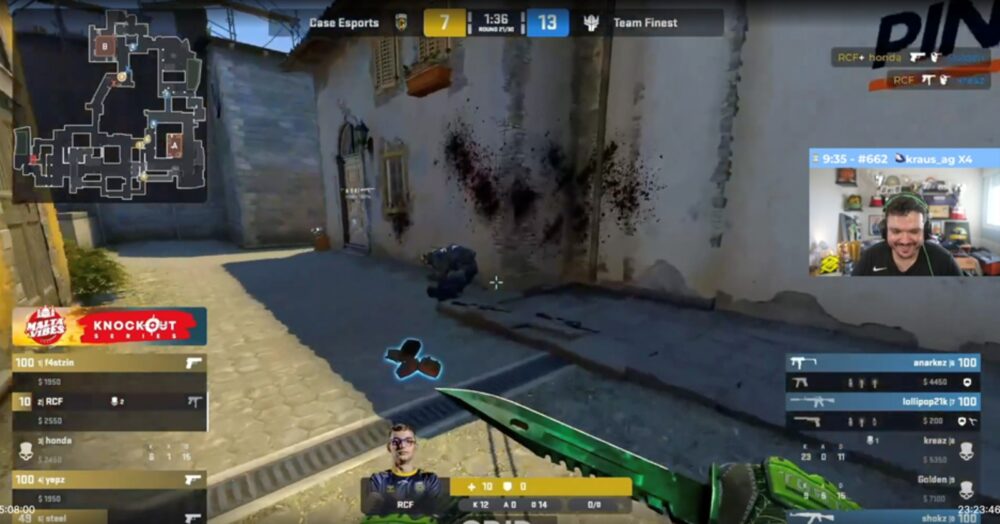
Here’s an example of an online influencer promoting Finest against Case Esports playing Counter-Strike and watching on Twitch.
An online influencer promoting Finest against Case Esports. (Courtesy of Finest)
The video has already racked up over a million views. Indeed, it’s not unusual for a top team in Europe or Latin America to have 45,000 or more concurrent viewers watching live — equivalent to filling up a large stadium IRL (in real life).
In North America, those numbers can climb into the hundreds of thousands of concurrent views. The games themselves are played on the servers of the game makers; Twitch and YouTube only allow fans to observe.
Serious training
Just as with the real thing, Finest players practice six to eight hours a day with a coach. Actual game play might include three or more matches in a day with players on their computers up to 10 hours straight.
Players watch film of the teams they’re due to play against, as well as recaps of their own play so they can talk strategy. Team Finest has a sports psychologist on the payroll. And most important, players get a full-time salary to Twitch and ’tube.
Before the advent of Covid-19, Finest even sponsored in-person bootcamps.
Ben Batash at the last Poland bootcamp. (Courtesy of Finest)
Most esports games are for PCs and consoles rather than the app-based games you play on your phone.
“Not a lot of companies are dealing with this in Israel because the investments are quite high and the length of time until you see revenue is longer than for an app you upload to the app store,” Perry explains.
Perry first met Finest when it was mostly an amateur club not paying salaries or even organized as a legal entity. Today, the company’s teams compete across Europe.
“The teams play in regions, so we don’t play in Asia,” Perry notes. “We’d like to get there,” especially since an estimated 35% of the esports market is in China. “We played against a Chinese team once when they were in a bootcamp in Europe.”
The main problem with crossing too many time zones is latency — that’s when the servers have trouble communicating and the game play stutters and stops.
Pandemic effects
COVID-19 proved to be a surprising boon for Finest. With people stuck at home, “esports grew parabolically,” Perry says. When real-world stadiums shut down, even the TV sports channels started broadcasting esports.
There were downsides, too.
“We had plans for local community tournaments where at least the semifinal would be offline with a live audience,” Perry says. “That had to be scrapped. Sending the team to a bootcamp in Europe had to be scrapped a couple of times, too. Even the prize money for the winners became less, as there were fewer major events.”
But overall, the pandemic “strengthened esports with an audience and generation that weren’t there but were in front of the computer all the time anyway.”
Finest now has over 40 people on the payroll, including all the players, and is building its own “performance room” in Tel Aviv so everyone, as well as those based in Europe, can be together for practices and official competitions.
Not fantasy sports
In contrast to fantasy sports, where gamers draft a team from real-world players and watch them compete, esports has players dedicated to their simulated craft.
Esports got started in the 1970s. The earliest known video game competition took place at Stanford University in 1972 for the game Spacewar. Video console maker Sega began sponsoring arcade tournaments in Japan in 1974. Atari jumped in by 1980 with a video game competition for the then uber-popular Space Invaders. In America, the televised esports program Starcade aired 133 episodes from 1982 to 1984.
Nintendo threw its hat into the esports ring by the 1990s. PC games benefited from Internet connectivity during this period, too, which is when games like Counter-Strike emerged. Nintendo hosted the Wii Games Summer 2010 and, today, even the Olympics are exploring esports options.
Scientists’ assumptions about strands of plasma looping around the sun are being challenged by a study providing new information on the solar atmosphere.
Coronal loops, which have long been thought to be strands of plasma in the sun’s atmosphere, may actually be optical illusions, according to research published in The Astrophysical Journal. Researchers at the National Center for Atmospheric Research (NCAR) conducted a 3D simulation of the corona — the solar atmosphere’s outermost layer — which allowed them to identify individual coronal loops.
On finding some coronal loops, they discovered that what had appeared to be loops in images of the sun are really just wrinkles of glowing plasma in the sun’s atmosphere. When sheets of plasma fold upon themselves, they resemble thin, brightly shining lines that mimic the way self-contained strands of plasma look.
“I have spent my entire career studying coronal loops,” said lead author Anna Malanushenko of NCAR. “I never expected this. When I saw the results, my mind exploded. This is an entirely new paradigm of understanding the sun’s atmosphere.”
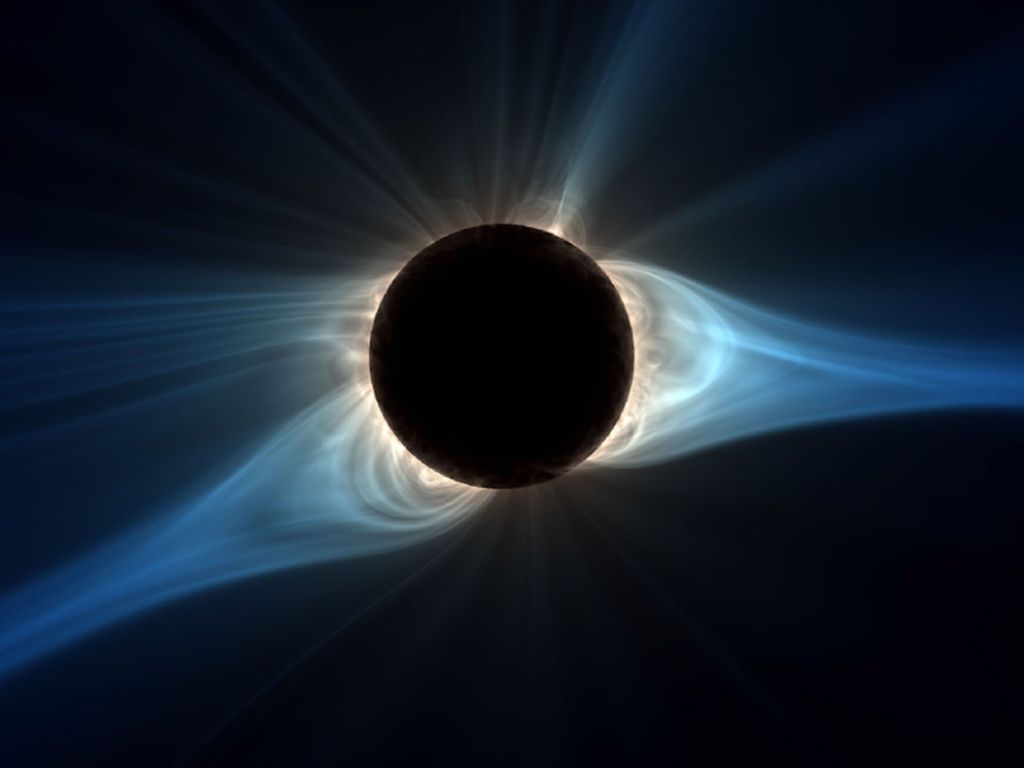
NASA and Predictive Science Inc. developed a simulation of how the solar corona would look during the Aug. 21, 2017, total solar eclipse. (Predictive Science, Miloslav Druckmuller, Peter Aniol, Shadia Habbal/NASA Goddard, Joy Ng)
The study team believes that their “coronal veil” hypothesis could significantly change the heretofore accepted understanding of the sun. For decades, coronal loops were used by scientists to infer the characteristics of the solar atmosphere, including its density and temperature.
“This study reminds us as scientists that we must always question our assumptions and that sometimes our intuition can work against us,” Malanushenko said. To determine which coronal loops are actually optical illusions, carefully designed observational methods and new data analysis techniques will be needed, the researchers said.
What is known about magnetism on Earth informs scientists’ assumptions about coronal loops. Schoolchildren have long been shown that when iron filings are sprinkled around a bar magnet, the filings orient according to the magnetic fields that loop from one end of the magnet to the other. These lines spread out and become less dense as they get farther from the magnet.
Because the sun has a significant magnetic field and the presumed coronal loops resembled the filings around a magnet, scientists had concluded that the sun’s magnetic field lines trapped ropes of plasma, creating coronal loops.
This close-up from a video clip taken May 30-June 1, 2018, shows a large active region of the Sun in extreme ultraviolet light as the bright magnetic field lines above it shift and twist. Note the Earth scale below the active region: the longest loops extend about 10 times the diameter of Earth. When the magnetic field lines get themselves tangled up enough, they can erupt with a solar storm. (NASA/GSFC/Solar Dynamics Observatory)
Although the new study confirms that such loops likely exist, the loops have never behaved as they should, based on what is known of magnets. While magnetic lines on the sun would be expected to spread apart as they move higher in the corona, the plasma trapped between the field lines should spread out between them and create thicker, dimmer loops. But this doesn’t happen. Instead, the loops farther out appear thin and bright.
Understanding the loops as wrinkles in a coronal veil, the study suggests, would explain the loops’ behavior. But the study’s authors raised new questions, too. What determines the shape and thickness of the folds? How many of the apparent loops in images of the sun are actual strands of plasma and how many are optical illusions?
The team produced an extremely detailed simulation of the solar corona, using an innovative radiative magnetohydrodynamic model, which refers to the magnetic properties of electrically conducting fluids such as plasma. The model allowed scientists to simultaneously model events in multiple regions of the sun.
NASA’s Solar Dynamics Observatory scientists used computer models to generate a view of the sun’s magnetic field on Aug. 10, 2018. They compared an extreme ultraviolet view of the Sun with the same image showing the superimposed field lines. The bright active region right at the central area of the sun clearly shows a concentration of field lines, as well as the small active region at the Sun’s right edge but to a lesser extent. Magnetism drives the dynamic activity near the sun’s surface. (NASA/GSFC/Solar Dynamics Observatory)
These ranged from the upper convective zone about 6,200 miles below the sun’s surface and up through the surface and 25,000 miles into the corona. These regions exhibit vastly different characteristics, including pressure and density, which scientists had not previously represented mathematically in a simulation.
In a novel development, the study’s authors visualized how solar flares develop from a swelling of energy beneath the sun’s surface to its final burst of explosive energy. They also produced 3D data sets of the sun’s magnetic field and plasma, allowing them to dissect overlapping structures of plasma loops with “synthetic” observations of the solar atmosphere. This had not been possible with other instruments and observatories.
“We know that designing such techniques [will] be extremely challenging, but this study demonstrates that the way we currently interpret the observations of the sun may not be adequate for us to truly understand the physics of our star,” Malanushenko said.
From left: Rashada LeRoy, who is producing the opening and closing ceremonies; Kathy Boswell, who serves as vice president of community relations; and Pam Cook, chief marketing officer. (Amarr Croskey, For The Birmingham Times)
Nicole King, is a Birmingham city attorney and her father, David Sullivan, represents the city of Midfield. (Solomon Crenshaw Jr., For The Birmingham Times)