

In 2021, Birmingham homicides neared all-time high; city councilors, residents react

Antarctic Seals Help Oceanographers Reach Places Ships Can’t
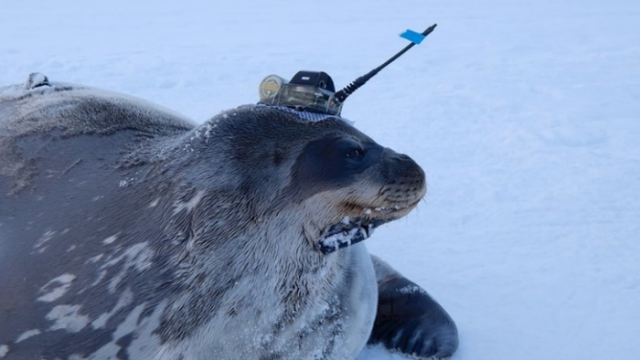
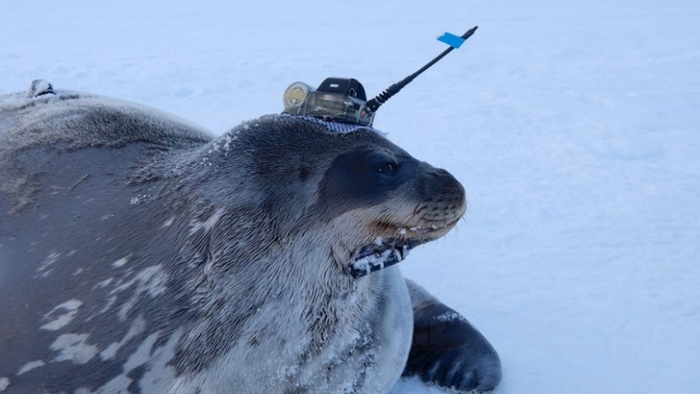
Inventive oceanographers glued sensory instruments onto the heads of Antarctic seals to record temperature changes on the continental shelf around the frozen continent.
Some of the most biologically productive regions of the world’s oceans surround the southernmost continent. The Antarctic Ocean is noted for prolific phytoplankton on which a variety of animals rely. Tiny shrimp-like krill swarm in Antarctic waters by the millions, providing food for whales and fish. In turn, penguins and orcas feed on other sea life supported by the plankton in these waters.
The authors of a study published in the journal Limnology and Oceanography sought to describe how interactions between ocean, sea ice, and ice shelf generate such large amounts of nutrients and biological diversity. But it is difficult to get data on the Antarctic continental shelf while aboard ships obstructed by ice attached to the shore.
Coastal areas of open, unfrozen seawater, known as polynyas, are surrounded by sea ice. The sea ice attached to the shore, known as landfast ice, is an ideal hunting spot for predators including native Weddell seals (Leptonychotes weddellii) and emperor penguins.

To understand the exchanges of sea-ice, ocean and ice-shelf water outside the polynyas, scientists deployed data-logging equipment on Weddell seals.
“Previous studies using instruments strapped to migrating southern elephant seals and resident Weddell seals — a deep-diving predator — had shown some interesting physical processes in Antarctic areas,” said author Nobuo Kokubun of Japan’s National Institute of Polar Research. “But even here, there has barely been anything investigating coastal areas covered by landfast ice.”
The exchanges of seawater, particularly from deep, warm off-shelf areas, seasonal sea-ice zones and coastal polynyas, may be important in biological production across the continental shelf.
The data-logging device that Kokubun and his colleagues attached to the Weddell seals recorded conductivity, temperature and depth to understand the characteristics of the ocean throughout the water column while the seals swam, allowing scientists to estimate the origin of the waters.

During the Antarctic winter, the researchers conducted a field study to examine the conditions of the ocean and its biology, exploring the wintertime oceanographic conditions and their biological consequences in eastern Queen Maud Land administered by Norway, or Dronning Maud Land, and western Enderby Land administered by Australia.
From March to September 2017, eight Weddell seals bore data loggers weighing about one pound each and roughly the size of a small Rubik’s Cube. The areas were chosen for their extensive landfast ice and lack of vast continental shelves or distinct coastal polynyas.
Based on the data gathered, the scientists discovered that warm water with low salinity appeared in the subsurface during autumn and went deeper as the months passed. Using meteorological and oceanographic modeling, they found that prevailing easterly winds during autumn cause a flow of warm surface water from the continental shelf, which possibly also brings prey for the seals.
Weddell seals are apex predators that dive as deep as 1,800 feet in search of prey, such as cod and silverfish. They also eat various cephalopods, such as squid, to add to the 110 pounds of prey an adult eats in a day. While they are safe on landfast ice, in the water Weddell seals face predation by orcas and leopard seals.
The research team found that using oceanographic sensors on seals opened up large areas beneath landfast ice for studies of the continental shelf and its rich biodiversity. With further research, the team aims to determine the amount of water and prey being brought to the continental shelf by wind-driven processes to predict how the Antarctic marine ecosystem responds to rapid changes in sea ice.
Edited by Siân Speakman and Kristen Butler
Recommended from our partners
The post Antarctic Seals Help Oceanographers Reach Places Ships Can’t appeared first on Zenger News.
America’s Sweetheart Betty White Dies At 99


Just 17 days shy of her 100th birthday, longtime actress Betty White died in her home in Los Angeles.
The entertainment giant tweeted about her 100th birthday celebration on Dec. 28: “My 100th birthday… I cannot believe it is coming up,” White wrote alongside a photo of the People Magazine cover story celebrating the occasion.
White’s timeless charm and cheeky sense of humor made a mark in the fast-growing television industry. A trailblazing actress with a career spanning seven decades, White leaves a multigenerational fan base in her wake.
White was born on Jan. 17th, 1922, in Oak Park, Illinois, as the only child of Tess and Horace White. The family moved to Los Angeles when White was just over a year old.
White graduated from Beverly Hills High School in 1939 with dreams of a career as a forest ranger, but women were not allowed to serve as rangers at the time. She discovered her love for performing when she appeared in an experimental TV broadcast as a dancer.
When World War II broke out, Betty White paused her acting dreams to volunteer for the American Women’s Voluntary Services, where she worked as a supply truck driver.
White appeared on various radio shows throughout the 1940s, sometimes reading commercials. She was offered her own radio show, “The Betty White Show,” which was later rebranded as a television sitcom on CBS under the same name.
A longtime advocate of animal welfare, White began working with the Society for the Prevention of Cruelty to Animals Los Angeles in the 1940s. The actress became a trustee of the Greater Los Angeles Zoo Association, and was later honored for her work as an animal activist by the City of Los Angeles.
“Her loss leaves a great hole in our hearts. The L.A. Zoo cannot thank Betty enough for her decades of support and we share in this grief with all of you. There truly will never be another person like her,” said Denise M. Verret, CEO and director of the Los Angeles Zoo, in a statement.
White began hosting the variety show “Hollywood on Television” in 1949. She won her first Emmy in 1951 for best actress on television, a category that was created that year.

White was the star of “Life with Elizabeth” from 1952 to 1955, a show that she also produced, which was nearly unheard of for a woman at the time.
White appeared on the game show “Password,” hosted by Allen Ludden, in 1961. The two quickly hit it off, and became engaged on Easter in 1963. Having been briefly married twice before, White said Ludden was the love of her life. The couple were happily married for 18 years before Ludden died of stomach cancer in 1981. White never remarried.
White became a staple of television game shows throughout the 1960s. When NBC offered White an anchor position for the “Today” show, White turned down the role because she did not want to move to New York City. The role was then given to Barbara Walters.
White was cast as Sue Ann Nivens on “The Mary Tyler Moore Show” in 1973, where she won another Emmy. White’s role as the gullible Rose Nylund on “Golden Girls” in 1985, a first-of-its-kind sitcom that portrayed the lives of four older women enjoying retirement in Florida, won her yet another Emmy in 1986.
White guest-starred in many programs throughout the 1990s and 2000s, including an Emmy-winning appearance as herself on” The John Larroquette Show” in 1996.
White starred alongside Sandra Bullock and Ryan Reynolds in the 2009 romantic comedy “The Proposal.”
Reynolds expressed his condolences for White’s passing on Twitter: “The world looks different now,” Reynolds wrote. “She was great at defying expectation. She managed to grow very old and somehow, not old enough. We’ll miss you, Betty. Now you know the secret.”
At 88 years old, White became the oldest person to host “Saturday Night Live” in 2010.

Her stardom reached new levels throughout the 2010s, during which she earned a recurring role in the sitcom “Hot in Cleveland.” White paid homage to her early radio days with multiple voiceover roles, including in “SpongeBob SquarePants” and “Toy Story 4.” White also narrated the film “Letters to Jackie: Remembering President Kennedy.”
“Betty White brought a smile to the lips of generations of Americans. She’s a cultural icon who will be sorely missed. Jill and I are thinking of her family and all those who loved her this New Year’s Eve,” tweeted President Joseph R. Biden.
The Guinness Book of World Records in 2013 recognized White’s career as the longest of any female performer in television history.
Edited by Kristen Butler
Recommended from our partners
The post America’s Sweetheart Betty White Dies At 99 appeared first on Zenger News.
Turning New Year’s exercise resolutions into realistic, long-term habits

Cashing In On Cryptocurrency And NFTs: Buyer Beware


By Lisa Chau
NEW YORK — Cryptocurrency is going mainstream, as evidenced by the large turnout at the recent NFT NYC conference. Indeed, increasing numbers of companies are accepting the digital money that takes the form of virtual coins or tokens.
There are over 11,000 cryptocurrencies in existence, with more than 400 exchanges for such digital money, financial website Motley Fool reports. Roughly 14 percent of American adults own cryptocurrency and many more say they are planning to buy some. El Salvador recently made Bitcoin legal tender..
One of the hottest concepts in such circles is NFTs (non-fungible tokens) Indeed, Cointelegraph recently reported record numbers in Google searches for NFTs, blowing past traffic for “DeFi,” “Ethereum” and even “blockchain” — search terms which had dominated searches for cryptocurrency-related information.

“While Dogecoin firmly captured the public’s imagination during the second quarter — with search volume for ‘Dogecoin’ rising to rival ‘Bitcoin’ in early May, dog-token fever quickly subsided in the third quarter,” wrote Kiera Wright for the Cointelegraph site, whose self-proclaimed mission is to cover “the future of money.”
James Haft is the chairman of DLTx, which deploys blockchains and tech infrastructure used to build the foundations of Web 3, the next iteration of the internet. DLTX is a public company listed on the Oslo Børs Stock Exchange of Norway, hosted a satellite investor event at the NFT confab with LD Capital, GDA Capital & Akash Network. The attendee list included guests from Coinbase, FTX, Facebook, PayPal, Bitfinex, Grayscale, Pantera Capital, Fenbushi Capital, Consensys, Polymath, BlockFi, Blocktower Capital, Republic, Wax.io, IOTA, Hedera Hashgraph, Valhalla Capital, Sovryn, Yugen Partners, Casper Labs, BitMart Exchange, Huobi, Shima Capital, 6th Man Ventures, Graph Protocol, Yield Ventures, EY, Coindesk, Forbes, Insider and others.

Haft believes that the strong attendance numbers at the conference and its satellite events not only showcased the strength and increasing momentum of the new NFT economy, it also demonstrated the world is returning to in-person business transactions.
“The wildfire growth of NFTs and the meme stocks and tokens illustrate the path to mass adoption of crypto. These new economies are signing up more new users faster than the classic crypto markets,” Haft said. “The enthusiasm of these new users for the content-based NFTs and memes will likely abate, and then these users will move into the classic markets en masse.”
Gumi Cryptos Capital General Partner Miko Matsumura points to play-to-earn game Axie Infinity as a reflection of industry growth. The NFT-based online video game developed by Vietnamese studio Sky Mavish boasts approximately 23 million monthly active users. Matsumura sees a future where users will abandon internet services that don’t include them as owners.
Instead, users have begun focusing on work that is more personally empowering. That trend is reflected in a Civic Science poll posted on BeInCrypto, which showed 4 percent of Americans have quit jobs based on crypto gains.
“This is an unusual part of an economic recovery that represents the power of nerds and technology on behalf of art and meaning. Crypto nerds have become wealthy sovereigns who are now powering a new renaissance,” says Matsumura. “Right now, ‘Bored Apes’ are the kings of pure NFT culture. They will go down in history that way. Eventually this kind of culture will infuse everything and will be less ‘radical’ but for now that’s the tip of the spear.”
While the blockchain industry is getting bigger, it’s still a blip on the radar for the general population, said Bettymedia Founder and Creative Director Bettinna (who goes by one name only). For instance, a couple of members on her team were baffled by NFTs. They had heard her talk about bitcoin, crypto, NFTs, but they didn’t fully understand those concepts until NFT NYC this year.
One of her colleagues was excited to open his first crypto-wallet, and got a free NFT at the Palladium. Although excited, he didn’t know what it really meant before Bettinna gave him a thorough explanation.
“My team said NFTs are like a massive underground world they didn’t know about,” Bettinna said. “I don’t know if NFTs or NFT NYC signal an economic recovery for the industry, because the NFT community has been thriving before the pandemic and during the pandemic. It’s just many of the general public who didn’t know about the NFT community and crypto before Covid-19 found out about it during the pandemic.”
Amid all the newfound excitement, observers say it’s important to be careful when investing in NFTs. Scams are everywhere and in every industry and the ruses include impersonators, fake accounts and misinformation. Bettinna believes that the NFT community does a decent job of calling people out, but that sometimes the major social media companies don’t move fast enough to shut down scammers.

She recalled the Fame Lady Squad incident which happened over the summer. The $1.5 million NFT project claimed it was created for women to support women. But collectors found out that the founders and their female avatars were in fact Russian men. Collectors said they felt duped and ultimately the founders surrendered the project to a team of females in the community.
“I bring up this story because some saw it as a scam and I believe they have every right to feel the way they did, but I didn’t see it as a total scam,” said Bettinna. “The collectors got beautiful crypto art from the very beginning. They all got their investment and after this controversy, these NFTs from that project will live on in history books. I do see the positive side of all this, at the same time I do think people should be mindful of the NFT world.”
With that in mind, Gumi Cryptos Capital’s Matsumura offer this advice to those thinking about entering the cryptocurrency realm:
“If someone offers you a yield or profit, and you don’t understand where it’s coming from, YOU are the yield.”
Edited by Matthew B. Hall and Bryan Wilkes
Recommended from our partners
The post Cashing In On Cryptocurrency And NFTs: Buyer Beware appeared first on Zenger News.
Record New Investments In Israeli Climate Tech In 2021


Investments in Israeli climate tech companies reached an all-time high in 2021.
“By the end of the 2021, the annual investments in Israeli climate tech companies reached $2.2 billion, exceeding last year’s fundraising record of $1.4 billion by 57 percent,” said Uriel Klar, director of PLANETech, a joint venture of the nonprofit Israel Innovation Institute and the Consensus Business Group.
The trend highlights how Israeli businesses from a variety of verticals are devoted to finding solutions for a more sustainable world.
“Israel is a global leader in climate tech, with 1,200 companies — 637 of them startups — that help reduce greenhouse gas emissions in Israel and around the world,” Klahr said.
The four highest funding rounds were achieved by startups from different fields:
1. Future Meat raised $347 million in Series B funding round for the development of its sustainable cultivated meat technology.
2. Wiliot raised $200 million to improve supply chain footprint via battery-free sensors.
3. UBQ Materials raised $170 million to convert household trash into climate-positive thermoplastic.
4. Via raised $130 million to promote an advanced digital platform for shared transportation.
“In addition, SolarEdge has become the first Israeli company to enter the S&P 500 index and Tomorrow.io is going public on NASDAQ with a $1.2 billion valuation,” Klahr said.
He said that capital raising for global climate tech companies reached a peak of $87.5 billion between June 2020 and June 2021, an increase of 210 percent from the previous year, according to PwC.
Israel has become a hotbed for food-tech companies. Aleph Farms, Redefine Meat, Rilbite, SuperMeat, Future Meat and More Foods are all working on burgers – some plant-based and others real meat grown in a lab without harming animals.
There are an estimated 50 alternative meat startups in the country. Two food-tech incubators — The Kitchen and Fresh Start — help keep innovation fueled.
“Solving the problems of climate change is not going to happen using any single approach. It’s going to require that everyone comes to the table with their strongest tools,” University of Haifa marine geoscientist Beverly Goodman-Tchernov said in October.
“We’ve passed the point where we can ask if climate change is really happening and who’s to blame. The real question now is whether we’re going to carry on the same ‘normal’ that our parents, grandparents and great-grandparents gave us or whether we’re ready to take on a new normal where we can use the technology and knowledge we have to slow, and perhaps even reverse, the damage we’ve already done.”
Produced in association with Israel21c.
Recommended from our partners
The post Record New Investments In Israeli Climate Tech In 2021 appeared first on Zenger News.
VIDEO: Russian Heavy Rocket Launch Vehicle Blasts Off Launchpad On Test Flight


Russia’s newest heavy launch-vehicle rocket — the first to be developed by the country after the collapse of the Soviet Union 30 years ago — has successfully completed a third test flight.
The new Angara-A5 heavy-class launch vehicle took off from the Plesetsk cosmodrome in Mirny, some 500 miles (800 kilometers) north of Moscow. The launch took place at 10 p.m. local time on Dec. 27.
Video released by the Russian Ministry of Defense starts by showing the rocket being taken by railcar to its launchpad. That’s followed by a daytime image of the rocket standing upright in its pad, followed by a nighttime image of its liftoff.
“All prelaunch operations and the launch of the Angara-A5 rocket took place in the normal mode. The ground-based automated control complex of the Aerospace Forces monitored the launch and flight of the launch vehicle,” the defense ministry said in a statement.
“Three minutes after the launch, the Angara-A5 launch vehicle was taken for escort by ground-based means of the V.I. German Titov of the Aerospace Forces.”
“At the estimated time, the Perseus upper stage routinely separated from the third stage of the Angara-A5 launch vehicle and began launching a non-separable overall-mass payload model into the calculated orbit.”
The third stage and the heavy rocket’s dummy payload separated several minutes after launch.

In a separate news release, Roscosmos State Corp. — the country’s space agency — congratulated the Aerospace Forces and the entire Russian space industry on what it described as “the successful test launch of the Angara-A5 launch vehicle with a new-generation upper stage.”
“Compared to the previous version of the oxygen-hydrogen engine, which we manufactured and tested according to the project for the upper stage of the Angara-A5 rocket, we boosted the new copy by 20 percent in thrust,” Viktor Gorokhov, chief designer of Russia’s Chemical Automatics Design Bureau, said in a statement.
The Angora-A5’s first two tests took place on Dec. 23, 2014, and Dec. 14, 2020.

Within a few years, Russia plans launch such rockets on a regular basis from the Plesetsk cosmodrome.
“During a working trip to the cosmodrome, the Minister of Defense of the Russian Federation General of the Army Sergei Shoigu noted that from 2025 [on] the cosmodrome will be able to perform up to 20 launches of the Angara launch vehicle per year. This will ensure guaranteed independent access and Russia’s permanent presence in space,” the ministry said in a statement released in November 2020.
News of this latest test flight comes just days after the $10-billion James Webb Space Telescope launched atop an Ariane 5 rocket from French Guiana to become the biggest telescope ever sent into space. Its goal is to explore the early universe, as well as nearby exoplanets and more.
The Webb telescope was developed by NASA, with assistance from the European and Canadian space agencies.
Edited by Matthew B. Hall and Kristen Butler
Recommended from our partners
The post VIDEO: Russian Heavy Rocket Launch Vehicle Blasts Off Launchpad On Test Flight appeared first on Zenger News.

In Memoriam 2021: Notables who Passed Away This Year