



Parker High School’s Wendell Hudson on Being First Black Hoops Player at UA

By Solomon Crenshaw Jr.
Alabama NewsCenter


Birmingham boasts an extraordinary musical legacy over 150 years
Alabama News Center

How To Use The Mind To Improve Physical Performance
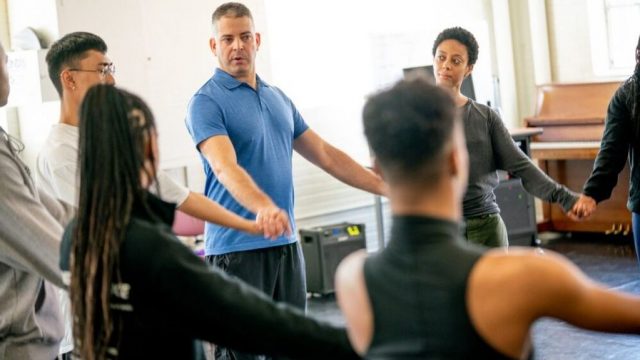
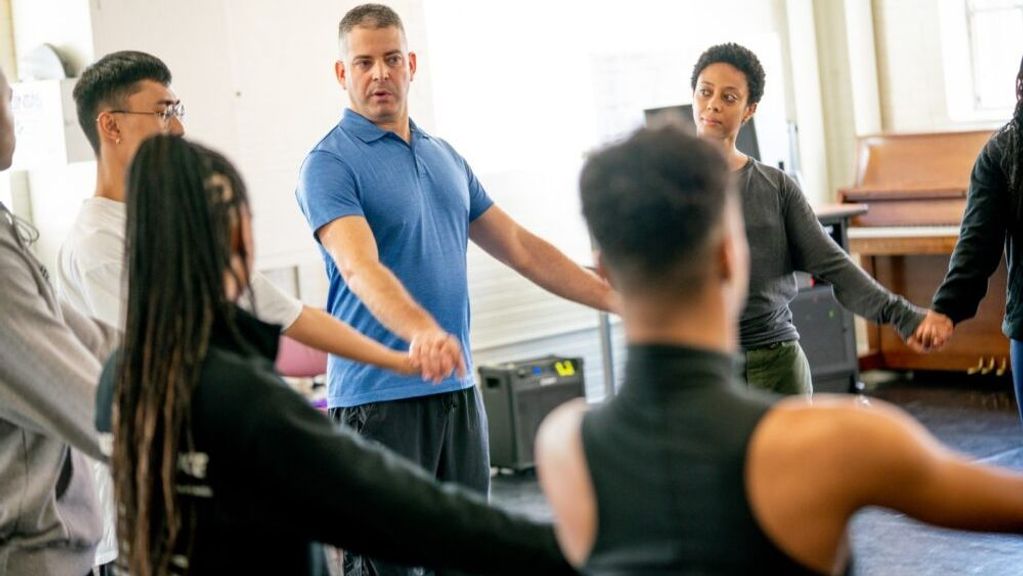
Most of us can conjure up a vivid mental image of our favorite food. Just thinking about it can make our mouths water.
Israeli physical therapist Amit Abraham heads a lab at Ariel University that’s translating this phenomenon into innovative training protocols to enhance dancers’ and gymnasts’ performance and improve rehab results for people with Parkinson’s disease.
Over the past year, he worked with Israel’s Olympic rhythmic gymnastics team, which finished the Tokyo Games in sixth place.
“Mental imagery by itself has been extensively used and researched. Even ancient Egypt used mental imagery,” Abraham tells ISRAEL21c.
“Our lab is one of very few in the world studying the neurocognitive aspects and integrating it into training and rehabilitation. Some of the things we are doing in this field for the very first time internationally.”

Following his postdoc research at Emory University School of Medicine in Atlanta with movement scientist Madeleine Hackney, Abraham returned to Israel in 2020 and established the Mental Imagery & Human Embodied Potential Lab in Ariel University’s Department of Physical Therapy.
Not child’s play
The lab’s goal is to provide scientific evidence for the motor and cognitive benefits of creating experiences in the mind.
“We do group and one-on-one sessions in a specific process of bringing to life the mind-body connection,” he explains.
“A lot of athletes visualize before competing. But they are not trained in how to use this efficiently as a tool to its fullest potential. That is my goal.”
In his initial session, he often needs to overcome participants’ hesitancy. “People think mental imagery is childish and feel embarrassed to use it, especially in a group setting,” Abraham says.
“So we start from scratch by explaining how to use it, what are its possibilities and limitations, the science behind it, and how to address lack of belief in it. Once people get excited about it, they can step out of their comfort zone and then it’s easier.”
Imagine motion without moving
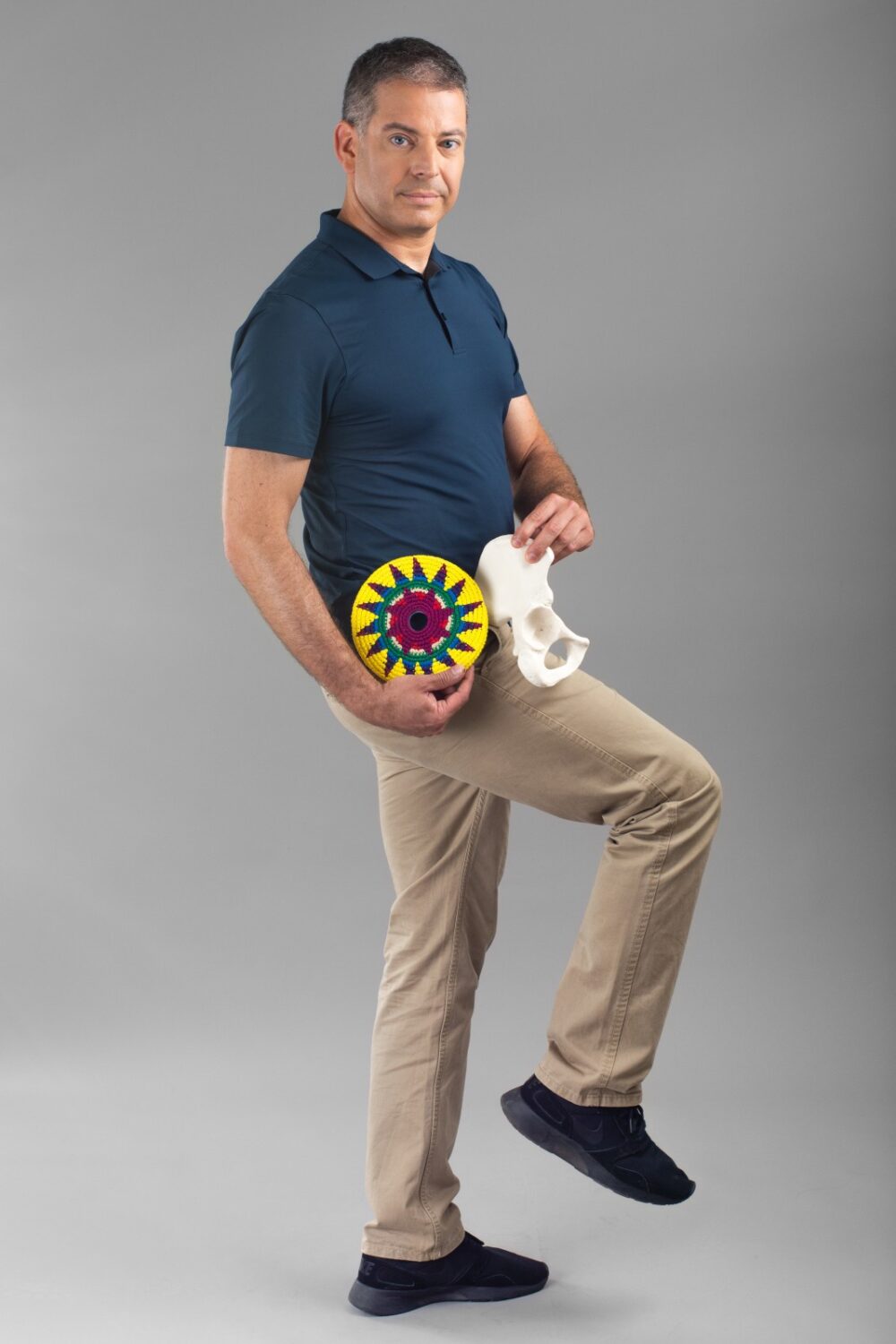
Abraham explains that just as it’s possible to imagine the taste of coffee without drinking it, you can imagine moving your arm without moving it.
“Or you can lift your arm slightly while imaging your arm doing a full range of motion,” he says.
“If you want to improve your quality of movement, you can imagine your arm as light as a feather. That’s called ‘metaphorical imagery’ and it’s a core component of the Franklin Method, developed my mentor and colleague, Eric Franklin, for teaching body alignment.”
This is not always simple. For someone has lower back issues, for example, it is challenging to image the spine moving fluidly without pain.
“We are confronting a reality that doesn’t always match the imaging,” Abraham says. “However, this is exactly the huge potential of mental imagery — to overcome the reality with the goal of changing it.”
The final step is individualized interventions or training protocols, whether for a rhythmic gymnast or an individual with Parkinson’s disease.
“My training as a musculoskeletal physical therapist helps because we can address a problem mechanically as well as with mental imagery,” says Abraham.
“We’re trying to be less dependent on the therapist or on technology and more focused on the individual’s potential for self-empowerment.”
Openminded coaches
Abraham finds that if the team trainer or coach is open to trying this evidence-based approach it’s more likely to catch on with the athletes.
In the case of Israel’s rhythmic gymnastics team, head coach Ira Vigdorchik was quite enthusiastic to try this approach.
Abraham did group training in collaboration with Vigdorchik’s coaching team, individual training to address specific areas for improvement, and an assessment of how the trainings impacted performance.
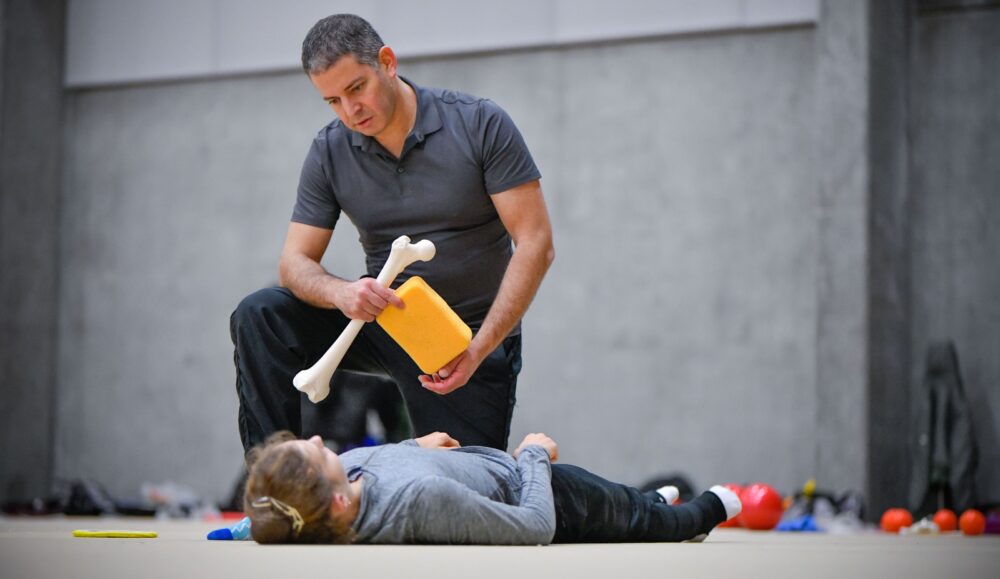
“We started with traditional motor imagery: They lie on their back and mentally image the entire sequence of an exercise. We made it more codified, feeling the sensations and perspectives of first and third person,” he says.
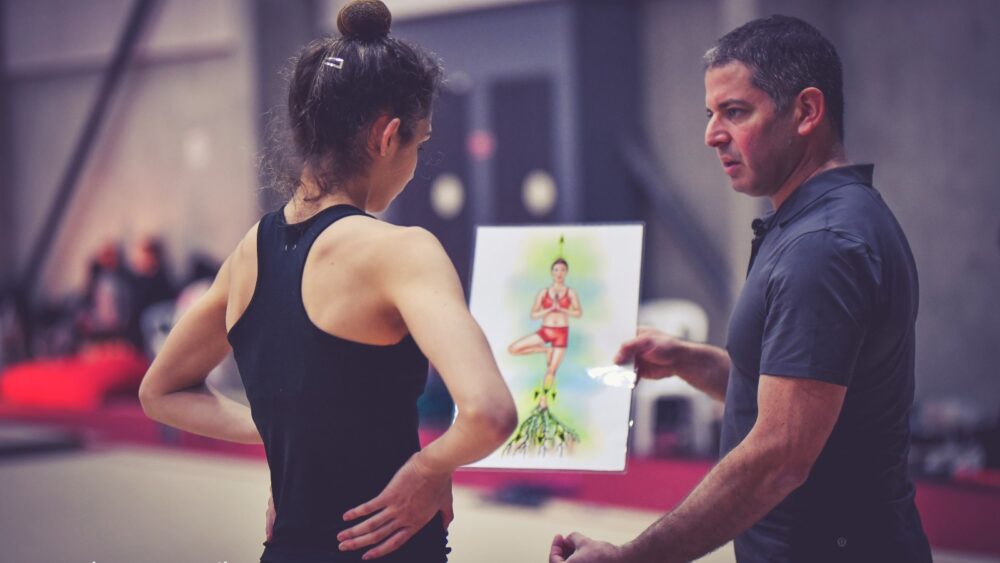
Abraham also does metaphorical imagery. For example, while balancing on one leg the gymnast visualizes that leg as a tree rooted in the mat.
Team member Bar Shapochnikov tells ISRAEL21c: “The mental imagery work with the Franklin Method and Dr. Abraham helped me enhance my performance. My range of motion increased, my confidence in performing increased, and the training became more efficient.”
Abraham admits that achieving further improvements at this high level of expertise is extremely difficult. “Therefore, we’re constantly looking for novel approaches that can help the gymnasts and athletes without putting them under even greater physical stress.”
Neurocognitive imagery for Parkinson’s
At Emory, Abraham did the first research on integrating dynamic neurocognitive imagery into Parkinson’s disease rehab.
He tailored a pilot intervention, based on the Franklin Method, to correct distorted mental representations of the body that can worsen motor and cognitive functioning.
“Parkinson is a multifaceted condition, mostly known for slowness of movement, rigidity, balance dysfunctions and resting tremor. But about 60 percent of individuals also have sensory and cognitive deficits that are less talked about. We thought mental imagery could address these deficits,” he explains.
This unique embodiment approach taught people to connect imagery with physical sensations. This intervention eased both motor and non-motor symptoms of the disease, as described in a paper Abraham and colleagues published earlier this year in a special issue of Brain Science exploring novel therapies for movement disorders.
“We have to develop protocols in this and other neurological and orthopedic populations,” says Abraham.
“It’s kind of out of the box to focus on different populations but I see mental imagery as connecting them all.”
Abraham aims to become an international leader in the field of mental imagery for rehabilitation and performance.
“We collaborate with various researchers in the U.S. and Europe, but this is more than just research. We are looking to really make an impact on dance and gymnastics performance. We are constantly looking for teams and dance companies worldwide willing to try it to enhance performance and wellbeing,” he says. “Shoot me an email if our research intrigues you.”
Produced in association with ISRAEL21c.
Recommended from our partners
The post How To Use The Mind To Improve Physical Performance appeared first on Zenger News.
Mummy Digitally ‘Unwrapped’ To Reveal Egyptian Pharaoh

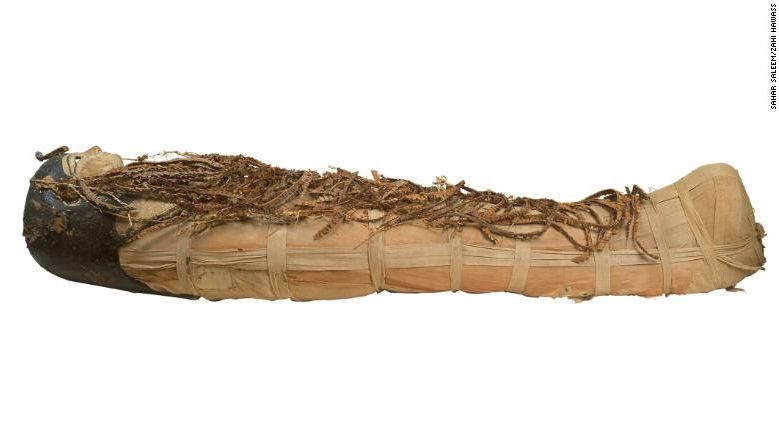
Until now, no Egyptologist has dared to gaze upon the visage of Pharaoh Amenhotep I, who died about 3,500 years ago. But with modern technology, archeologists digitally “unwrapped” the mummy of the ruler, using noninvasive 3D computed tomography (CT) scanning to peer at the monarch and the splendid artifacts that accompanied him into the afterlife.
In a paper published in Frontiers in Medicine, co-authors Sahar Saleem of Cairo University and famed archeologist and media personality Zahi Hawass described their methods, the lifelike mask featuring inset stones covering the monarch’s neck and face, and the perfectly wrapped corpse.
The only other time that the face of Amenhotep I had been revealed was 400 years after his death when priests of the 21st Dynasty restored and reinterred royal mummies after their desecration by thieves. All other mummies discovered in the 19th and 20th centuries have been unwrapped for study by experts, according to the authors.

“The fact that Amenhotep I’s mummy had never been unwrapped in modern times gave us a unique opportunity: not just to study how he had originally been mummified and buried but also how he had been treated and reburied twice, centuries after his death, by high priests of Amun,” said Saleem, a radiologist who serves on the Egyptian Mummy Project.
By peeling off the mummy’s layers digitally, she said, the well-preserved remains could be studied in “unprecedented detail.”
At the time of his death, Amenhotep I was about 35 years old and approximately 5 feet 6 inches tall, Saleem said. In addition, he was circumcised and displayed healthy teeth. “Amenhotep I seems to have physically resembled his father. He had a narrow chin, a small narrow nose, curly hair and mildly protruding upper teeth,” Saleem said.

The CT scan did not reveal any wounds or disfigurement due to disease that could give the experts a clue as to the cause of death. During the process of mummification, the embalmers removed his brain and heart. Grave robbers may have disfigured the mummy following his first burial.
Discovered in 1881 in the company of other reburied royal mummies, the Amenhotep I mummy was found in a cache at Deir el Bahari in southern Egypt. As the heir of his father Ahmose I, Amenhotep I was the second pharaoh of the 18th dynasty. He ruled from approximately 1525 to 1504 B.C. after the deaths of his elder brothers.
During his reign, Egypt saw prosperous and secure times. As pharaoh, he led successful invasions of Libya and northern Sudan. In death, he and his mother Ahmose-Nefertari were deified.

In years past, both Saleem and Hawass had theorized that the purpose of the 11th-century B.C. restoration was to reuse royal burial offerings for later pharaohs. However, their latest study proved them wrong.
“We [found] that at least for Amenhotep I, the priests of the 21st dynasty lovingly repaired the injuries inflicted by the tomb robbers, restored his mummy to its former glory and preserved the magnificent jewelry and amulets in place,” said Saleem.
Saleem and Hawass have examined more than 40 royal mummies of the New Kingdom, the period between the 16th and 11th centuries B.C. Of these, 22 mummies, including that of Amenhotep I, were transferred this year to a new museum in Cairo.
“We show that CT imaging can be profitably used in anthropological and archeological studies on mummies, including those from other civilizations, for example Peru,” Saleem and Hawass wrote in the study.
Edited by Siân Speakman and Kristen Butler
Recommended from our partners
The post Mummy Digitally ‘Unwrapped’ To Reveal Egyptian Pharaoh appeared first on Zenger News.
