Home Blog Page 522

Mind Over Pain: Retraining The Brain To Lessen Chronic Pain


0

Individuals experiencing chronic pain may find relief in retraining their perception of it, according to a study led by Hayley Leake, 2021 “Australian Survivor” champion. (Sasun Bughdaryan/Unsplash)


By Martin M Barillas

Learning about pain and how to deal with it is the focus of a new study that applies a biopsychosocial model to coping with chronic pain by reframing the reaction to pain without the stress or fear of causing re-injury and further pain.


Research by Hayley Leake, the 2021 champion of the “Australian Survivor” reality TV series, shows that patients can apply the following three concepts while coping with pain: Pain does not mean that my body is damaged; Thoughts, emotions and experiences affect pain; and I can retrain my overprotective pain system.

“Chronic pain is experienced by one in five Australians, and when pain persists, it can disrupt every aspect of life — including school or work, social and family connections and physical and mental health,” said Leake, a doctoral student at the University of South Australia. She said that pain is the brain’s “protective output” in response to threat. “Threat may take many forms, not just what’s happening in your body, but also your thoughts, emotions and context.”

Leake recalled that during an appearance on “Survivor,” she stood on narrow, wooden pegs for nearly five and a half hours. To manage the resulting pain, she repeated to herself, “My feet are strong; my body is safe; this is not dangerous.” Her research gave her an understanding of the pain mechanism and how resilient human beings are. She also believed it reduced her pain during her feat on “Australian Survivor.”

Hayley Leak, 2021 Brains over Brawn champion of “Australian Survivor,” stood on wooden pegs for more than five hours to demonstrate resistance to pain. (Nigel Wright)

The Australian athlete and researcher used a mixed-methods approach to educate 97 study participants in pain science. Her study, published in The Journal of the International Association for the Study of Pain, claims her methods helped patients recover from chronic pain by learning that it does not mean that their bodies are injured. The study found that emotion and stress can worsen the perception of pain, but this perception can be reframed as overprotection that can be reduced.

Leake said it is a misconception that pain reflects tissue damage and hopes pain sufferers can cope by “reframing knowledge of pain.”

Teenagers report feeling uncertain and anxious about their diagnosis of chronic pain; they want a further explanation beyond just a label. It is important we help them make sense of their pain,” Leake said.

Chronic pain can create feelings of uncertainty and anxiety, which can be combated by a better understanding of the link between pain and stress. (Klara Kulikova/Unsplash)

If teens learn that pain does not indicate damage to tissue, she said, they may not fear re-injury, thus “helping them move and start to recover sooner.” By understanding how stress can affect pain, Leake said, teens can address how these are intertwined.

Leake’s study identified several objectives in teaching how to understand pain. Her method instills the belief that pain is a protector, the pain system can become overprotective, pain is a brain output and not an accurate marker of tissue state, there are many potential contributors to anyone’s pain, we are all bioplastic (adaptable to change) and pain education is treatment.

“Reframing perceptions of pain is key,” Leake said. “Instilling hope that change is possible can make all the difference to a young person struggling with chronic pain.”

Edited by Siân Speakman and Kristen Butler

Recommended from our partners


The post Mind Over Pain: Retraining The Brain To Lessen Chronic Pain appeared first on Zenger News.


100-Year Mystery Of Children’s ‘Chalky Teeth’ Finally Solved

0

Bobby, whose two front teeth had dropped out, gives his twin brother Jerry some assistance with his loose front teeth in this photo from around 1955. Genetic anomalies and nutrition issues may be at the root of a childhood condition known as “chalky teeth,” researchers now believe. (Nocella/Three Lions/Getty Images)


By Martin M Barillas

Chalky, discolored teeth in children have long worried dentists and parents. An international team of researchers has now found the condition may be triggered by common childhood illnesses.


A study published in Frontiers of Physiology noted that one in five children has visibly discolored enamel, known as chalky enamel, on their teeth. For more than 100 years, researchers had sought to determine the origin of this source of severe tooth decay and toothache, which can lead to dangerous abscesses, orthodontic issues and tooth extraction.

Bernhard Gottlieb, a European physician and dentist, first studied chalky teeth in 1920 when he showed that only some parts of some teeth were affected.

Chilean and Australian researchers have now determined that this hypomineralization of teeth happens when the enamel in growing children is contaminated by albumin, which is a protein in blood and the tissue fluid that surrounds developing teeth.

They found that this condition is triggered by childhood diseases.

“The result is a sort of ‘mineralization blockage,’ which is highly localized to the areas on individual teeth that become chalky enamel spots,” said study co-author Mike Hubbard of the University of Melbourne. “This discovery allows us to correct 40 years of medico-dental dogma which blamed defective enamel-forming cells.”

“What this dogma couldn’t explain is why chalkiness affects only one or a few teeth in a child’s mouth,” Hubbard added. “We’ve shown instead that albumin leaks in occasionally at weak spots, binding to enamel-mineral crystals and blocking their growth. It’s not a system-wide problem but a very localized one.”

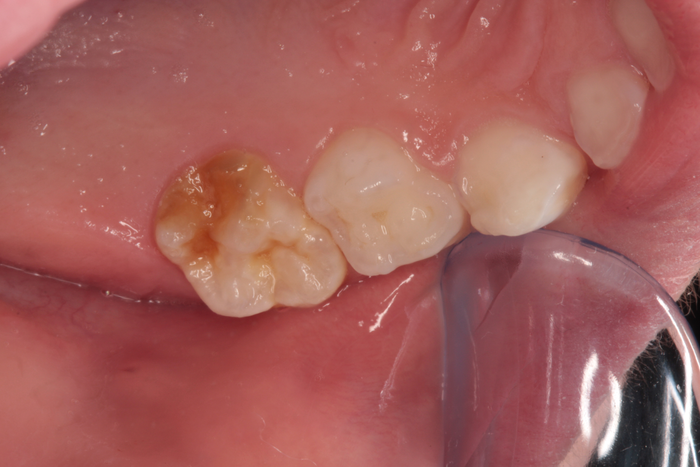
As seen in molars, the photo shows early signs of chalky teeth that include creamy-brown patches or extra-white spots on the teeth. (The D3 Group)

Chalky teeth, according to the researchers, are triggered by routine conditions such as fever. Now they want to find the underlying causes, including genetics, pathogens and environment, and then spread the word to parents, dentists and other child healthcare professions.

“We can’t yet prevent chalky teeth from developing in the first place, but if health professionals catch them early — when they first enter the mouth — then we dentists can usually save them,” study co-author Vidal Perez of the University of Talca, Chile, said.

Genetic anomalies and nutrition issues may be at the root of chalky teeth, the researchers believe. They focused on molars, having noted that they are especially prone to decay. “They are hidden away at the back of our mouths, with grooves that catch food, and they’re harder to clean,” Perez said. Hypomineralization of a tooth multiplies its tendency to decay by a factor of 10, which the team qualified as a “silent epidemic” that causes suffering.

Hubbard found that despite the fluoridation of water supplies and a significant reduction in child tooth decay, there are still children with unexplained decay. The study’s researchers found that fluoride protects against decay of normal tooth enamel but has hardly any effect on chalky molars in both developed and developing countries.

Hubbard points out that the study may lead to a strategy for addressing this global problem. “This new avenue of research could one day eliminate about half of childhood tooth decay, along with its disturbing costs to affected individuals and society,” he said.

Edited by Richard Pretorius and Kristen Butler

Recommended from our partners


The post 100-Year Mystery Of Children’s ‘Chalky Teeth’ Finally Solved appeared first on Zenger News.

8 Israeli Startups Make CB Insights Top 150 List

0

Digital technology is transforming healthcare. (Christopher Furlong/Getty Images)


By Jon Schiller

CB Insights has named eight Israeli-based health-tech startups in its ranking of the Top Digital Health Companies of 2021, a list of 150 of the top private companies using digital technology to transform healthcare.


Winners were selected by CB Insights’ Intelligence Unit from a pool of over 11,000 companies, including applicants and nominees.

Vocalis Health — A digital software solution that analyzes voice to assess the probability of Covid-19 infection without additional information or prior knowledge about the user.

Sweetch — A personalized artificial and emotional intelligence engagement platform providing personalized health recommendations adapted to each user’s personality, progress and real-world context.

DiA Imaging Analysis — AI-based solutions for ultrasound analysis, making cardiac and abdominal ultrasound imaging smarter, faster, more accurate and more accessible.

B.Well — An online digital health service platform that allows users to navigate easily among different procedures, services and providers available to them.

C2i Genomics — A cloud-based platform that performs cancer tumor monitoring on a global scale, leveraging pre-installed genome sequencers around the world.

Sweetch’s team in Tel Aviv. (Courtesy of Sweetch)

Lumen — A handheld breathing device that allows users to analyze and monitor their metabolism with their smartphone.

Nym — An AI-based medical chart coder that allows medical bills and insurance claims to be calculated and audited more efficiently and accurately.

Theator — A surgical intelligence platform that allows physicians to document and analyze surgery procedures, allowing them to gain insights, compare peer-performance and simplify decision making.

While most companies ranked in the CB Insights list are based in the United States, Israel placed third among the 18 countries represented, just behind the UK with nine ranked companies.

“This year’s Digital Health 150 is one of our most expansive yet, spotlighting 16 categories including virtual care, clinical trials tech, and workflow automation, as well as adding new categories such as home health tech and computer-aided imaging,” said Brian Lee, SVP of CB Insights’ Intelligence Unit.

“Last year’s class has seen more than 20 exits, raised an additional $18.6B in aggregate funding, and announced over 250 partnerships since being recognized, and we’re excited to see the future success of this year’s winners.” 

Produced in association with Israel21c.

Recommended from our partners


The post 8 Israeli Startups Make CB Insights Top 150 List appeared first on Zenger News.

Dog Allergy Vaccine May Be Within Reach, Scientists Say

0

Even short-haired dogs can spread allergens into the air that can be inhaled by allergic people, but scientists are close to learning how to target a potential vaccine for dog allergies. (Scott Barbour/Getty Images)


By Martin M Barillas

Dog allergies have inspired many studies on their origin and development, but until now, scientists had not been able to identify the specific allergens that may yield a cure.


Dog allergies are increasingly being reported all over the world, causing sleep problems, eczema and itchy skin and difficulty breathing for people with asthma. Now, scientists have published in the Federation of European Biochemical Societies journal the results of a study that revealed a way to develop a dog-allergy vaccine.

Scientists have previously identified seven different allergens, which are molecules or molecular structures that bind to an antibody, causing an excessive response by the immune system. These allergens are dubbed Canis familiaris 1 to 7 (Can f 1-7). However, it is just one allergen, Can f 1, that causes roughly 50 to 75 percent of reactions in people allergic to dogs. Can f 1 is found on dogs’ skin, tongue tissue and salivary glands.

A single allergen, Can f 1, causes roughly 50-75 percent of reactions in people allergic to dogs. (Baptist Standaert/Unsplash)

So far, scientists haven’t identified Can f 1’s IgE epitopes — the parts of antigens recognized by the immune system that stimulate or determine an immune response. Epitopes are also known as antigen determinants. Epitopes are amino acid sequences in proteins that determine an overreaction of the immune system.

Epitopes lock into a paratope — a specific part of the antigen receptors — on the surface of immune system antibodies known as B cells or T Cells, much like the pieces of a jigsaw puzzle. Also known as immunoglobulin, there are five different isotypes or classes of antibodies: IgA (for immunoglobulin A), IgD, IgE, IgG and IgM. Found only in mammals, the IgE isotype has a primary role to play in allergies. And there is a specific IgE epitope that fits the IgE isotype’s paratope.

“We want to be able to present small doses of these epitopes to the immune system to train it to deal with them, similar to the principle behind any vaccine,” said study co-author Takashi Inui of Osaka Prefecture University, Japan. “But we can’t do this without first identifying the Can f 1’s IgE epitope.” Takashi, a specialist in allergy research, was also involved in previous efforts to develop an epitope-focused vaccine.

Using X-ray crystallography, by which X-ray radiation is diffracted through a material to identify its structure, the researchers identified for the first time the structure of the Can f 1 protein as a whole. They determined that Can f 1 closely resembles three other Can f allergens. But where electrical charges on the surface of Can f 1 were located was quite different. This suggested that there are residues on the surface that may be good candidates for interlocking with the IgE epitope.

Researchers for the first time have identified candidates for those parts of molecules that make up dog allergens that could produce a dog allergy vaccine. (Takashi Inui, Osaka Prefecture University)

While further research is necessary, an epitope-based vaccine against an allergy would break ground not only for dog allergens but for any other allergic reaction. The principles used in the new study could be used to fight other common allergies, too.

Dogs, cats, rodents, birds and other feathered or fur-bearing animals shed microscopic flecks of skin, known as dander, which can cause allergic reactions and asthmatic attacks, according to the American Lung Association.

In addition, the proteins in saliva, urine and feces of dogs and cats can cause such reactions. Dried saliva may fall from a pet’s fur and be carried by the air, where it can be inhaled by the allergic person. Dust from dried feces can be inhaled similarly.

Pet allergens can remain airborne for long periods, and the microscopic size of these allergens allows them to easily adhere to bedding, fabrics and furniture. (Jenny Evans/Getty Images)

The fur of animals does not itself cause allergic reactions: short-haired and hairless pets also contribute dander to indoor air pollution as do long-haired animals.

Pet allergens, according to the association, can remain airborne for long periods, and much longer than allergens left by cockroaches and dust mites. The microscopic size of these allergens allows them to easily adhere to bedding, fabrics, furniture and items carried into residences. They have been found in schools, public buildings and even homes without pets.

At least 20 percent of the world’s population suffers from dog allergies, according to a study in the journal Allergy Asthma and Immunology Research.

Edited by Siân Speakman and Kristen Butler

Recommended from our partners


The post Dog Allergy Vaccine May Be Within Reach, Scientists Say appeared first on Zenger News.

Fred Watson Named Interim AD To Replace Reginald Ruffin at Miles College

0

By Barnett Wright

The Birmingham Times

National Wildlife Federation: Giving Thanks to Community Partners

0
Build UP students in Birmingham worked with the National Wildlife Federation throughout the community to address local environmental issues.

By Tatiana Eaves

Lost In Space: Astronomers Find Evidence Of Dozens Of Free-Floating Rogue Planets

0

An artist’s impression of a rogue planet detected in the Rho Ophiuchi region where infrared and other imaging helped uncover at least 70 of these objects. These free-floating planets have masses comparable to those of the planets in our solar system but do not orbit a star, instead roaming freely on their own. (European Southern Observatory/M. Kornmesser)


By Martin M Barillas

Mysterious free-floating planets (FFPs) have long defied imaging attempts. But a team of astronomers has now discovered a way to detect them with sensitive cameras on large telescopes.


“Identifying FFPs within a star cluster is a major challenge, like finding a needle in [a] haystack,” said astronomer Núria Miret-Roig. “Stars are relatively bright and easy to spot, whereas planets are several thousand times fainter and can only be detected with large aperture telescopes and sensitive detectors.” Distinguishing rogue planets from stars and galaxies is an additional challenge, she said.

Far from any star, rogue planets are normally impossible to image. However, Miret-Roig and her colleagues found that the planets glow so hot, even millions of years after formation, that infrared cameras can capture their images. The team has found more than 70 planets with masses comparable to Jupiter’s in the Upper Scorpius and Ophiuchus constellations.

Lost in space, a free-floating rogue planet wanders in space in this artistic representation. (University of Bordeaux)

With 20 years of data and over 80,000 wide-field images from telescopes in space and on Earth, the team measured colors, luminosities and tiny motions of tens of millions of objects in space. “These measurements allowed us to securely identify the faintest objects in this region, the rogue planets,” said Miret-Roig. “We did not know how many to expect and are excited to have found so many.”

The team used the European Southern Observatory’s (ESO) Very Large Telescope, among other facilities, to capitalize on their wide field of view and unique sensitivity.

“We used tens of thousands of wide-field images from ESO facilities, corresponding to hundreds of hours of observations, and literally tens of terabytes of data,” said astrophysicist and project leader Hervé Bouy. The team also used data from the European Space Agency’s Gaia satellite.

The study, published in Nature, asserts that many more rogue planets are waiting to be discovered. “There could be several billion of these free-floating giant planets roaming freely in the Milky Way without a host star,” said Bouy. Some astronomers believe that they were formed from a collapsing gas cloud or may have been spun off by parent stellar systems. These explanations have yet to be confirmed.

New technology in the form of the ESO’s forthcoming Extremely Large Telescope is currently being built in Chile’s Atacama Desert.

The number of FFPs is difficult to calculate because astronomers have not been able to measure their mass. Objects with masses higher than 13 times the mass of Jupiter are probably not planets and were not included in the count. Without values for mass, the researchers had to study the rogue planets’ brightness to arrive at the number of rogues observed. The planets’ brightness, or luminosity, is related to their age. Older planets have cooled and are not as bright. The method gave a count of between 70 and 170.

Artist’s conception of the Wide-field Infrared Survey Explorer (WISE) 0855-0714, a sub-brown dwarf 7.3 light-years from Earth. This potential rogue planet within the Hydra constellation is the coldest known object of its type, with a temperature in the range of 225 to 260 K (−48 to −13 °C). It is 3 to 10 times Jupiter’s mass, with possible water clouds in its atmosphere. (Pablo Carlos Budassi/CC BY-SA 4.0)

With tens of thousands of images and about 100 terabytes of information, the team assembled the largest sample of FFPs in a single stellar association, nearly doubling the total number of FFPs known.

The team believes that the number of rogue planets they found cannot be explained merely through the contraction of gas clouds in interstellar space but shows they were shaped near stars and then flung away. By assuming that there are other similar regions where stars are formed, the study suggests that billions of FFPs await discovery, orphaned and tumbling in space.

“The large number of FFPs we found points to dynamical ejection from planetary systems as an important mechanism to their formation, as solely collapse from clouds would not result in so many FFPs. This result implies relatively short timescales, between 3 and 10 million years, for the formation of giant planet systems,” said Miret-Roig.

Edited by Siân Speakman and Kristen Butler

Recommended from our partners


The post Lost In Space: Astronomers Find Evidence Of Dozens Of Free-Floating Rogue Planets appeared first on Zenger News.

Oscar Shortlist For Horror Show Of How Jewish Refugees Had To Keep Nazi Defectors ‘Happy’ In US

0

“Camp Confidential: America’s Secret Nazis” reveals how Jewish soldiers were commanded to gather intelligence from the Germans at a secret camp in the Washington, D.C. area. (Netflix)


By Naama Barak

Camp Confidential: America’s Secret Nazis,” a short film directed by two Israelis, was recently shortlisted to the 94th Academy Awards, competing in the Documentary Short Subject category.


The partially animated film, directed by Mor Loushy and Daniel Sivan and available on Netflix, tells the story of World War II Jewish refugees from Europe who, upon joining the U.S. Army, found themselves guarding a secret camp holding none other than leading Nazi scientists destined to work on American rocket technology that would lead to American superiority in the Cold War space race.

Called PO Box 1142, the secret military camp was first used to house German prisoners of war before being turned over to host some of Nazi Germany’s top rocket scientists, including Wernher von Braun, who developed the V-2 rockets that rained over London during the war.

The Jewish soldiers were commanded to gather intelligence from the Germans at the camp, as well as to keep them happy, taking them, for example, to go underwear shopping for their wives and accompanying them on outings to dinners and nightclubs.

The Washington, DC-area camp, which was kept classified for more than 50 years, came to light in 2006 when the National Park Service conducted interviews with its veterans, some of whom also appear in the movie and share the difficulties and dilemmas that they experienced in carrying out their orders.

“The Jewish soldiers soon discover that their prisoners are no other than Hitler’s top scientists,” a summary of the film states. “What starts out as an intelligence mission to gather information from the Nazis, soon gets a shocking twist when the Jewish soldiers are tasked with a very different mission altogether. A mission that would question their moral values — exposing a dark secret from America’s past.”

The film was produced with the support of the Israeli Film Council and the Israeli Ministry of Culture and Sport and was chosen along with 14 others to qualify for the shortlist out of a pool of 82 films from around the world. The winning film is set to be announced at the Academy Awards ceremony on March 27, 2022.

Loushy and Sivan had previously cooperated on other documentaries, including “Kings of Capitol Hill” and “The Oslo Diaries.”

Produced in association with Israel21c.

Recommended from our partners


The post Oscar Shortlist For Horror Show Of How Jewish Refugees Had To Keep Nazi Defectors ‘Happy’ In US appeared first on Zenger News.

Babies With Fragile Hearts Now Can Be Monitored Remotely

0

A new partnership between med-tech startup Datos Health and The Heart Institute at Sheba Medical Center’s Safra Children’s Hospital now offers remote home monitoring of babies diagnosed with heart conditions. (Steve Parsons - Pool/Getty Images)


By Abigail Klein Leichman

At-home monitoring of babies born with complex heart malformations has been shown to reduce mortality from 15 percent to less than 5 percent.


A new partnership between med-tech startup Datos Health and The Heart Institute at Sheba Medical Center’s Safra Children’s Hospital now offers remote home monitoring of pediatric cardiac patients in medically underserved communities: Israel’s ultra-Orthodox sector, the Palestinian Authority, the West Bank, Gaza, Iraq, Kurdistan and Cyprus.

“We are proud to offer this new program to families in Israel and beyond to improve the care and survival of children born with complex heart conditions,” said Dr. Yoav Bolkier, senior pediatric cardiologist at Sheba, the largest medical center in the Middle East.

Datos Health, a member of Sheba’s ARC (Accelerate, Redesign, Collaborate) Telemedicine Hub, developed the connected platform with clinicians from The Heart Institute to track these fragile infants between hospital visits and enable proactive care in areas lacking adequate medical infrastructure.

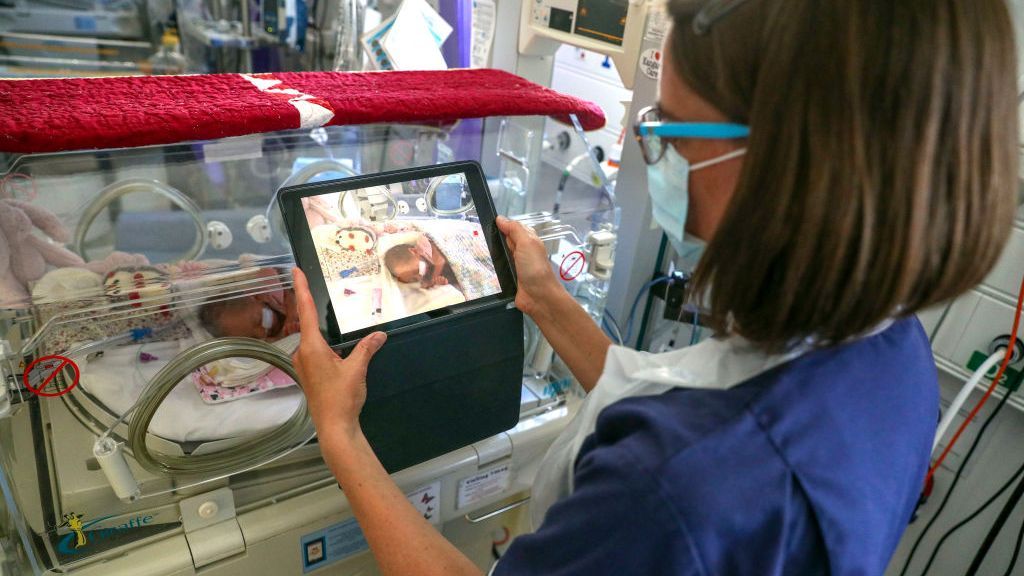
Parents of babies will receive devices for measuring weight, oxygen saturation, pulse and blood pressure, which they will transmit every day via a connected tablet. (Christopher Furlong/Getty Images)

“Being able to provide this program remotely means that we can truly break through physical boundaries and even borders to help those children that need us most,” said Iris Shtein, codirector of the Telemedicine Hub at ARC.

Parents of babies in the virtual clinic will receive devices for measuring weight, oxygen saturation, pulse and blood pressure, which they will transmit every day via a connected tablet.

“This remote monitoring program is another hybrid service ARC has been developing as part of Sheba’s overall strategy to transform healthcare and improve quality, access, and health equity in Israel and around the world,” said Dr. Eyal Zimlichman Chief Medical Officer and Chief Innovation Officer at Sheba Medical Center and founder of ARC.

Produced in association with ISRAEL21c.

Recommended from our partners


The post Babies With Fragile Hearts Now Can Be Monitored Remotely appeared first on Zenger News.