To address the dangers posed by orbiting space junk, researchers have found a way to manipulate the debris with spinning magnets that may allow robots to one day remove the speeding trash.
There are more than 27,000 pieces of space debris bigger than the size of a softball currently orbiting Earth, according to NASA. Hurtling at speeds of up to 17,500 mph, even small pieces of junk left behind by years of space missions threaten to damage or destroy satellites and spacecraft.
A team led by University of Utah mechanical engineering professor Jake J. Abbott published a paper in the journal Nature that describes using spinning magnets to manipulate orbiting debris. The method could eventually be used to robotically repair or maneuver space junk into deep space or into a death spiral headed toward Earth without touching any pieces.
Jake J. Abbott, a University of Utah professor of mechanical engineering, led a team of researchers that discovered how to manipulate objects in space with spinning magnets. (Dan Hixson, University of Utah)
“NASA is tracking thousands of space debris the same way that air traffic controllers track aircraft. You have to know where they are because you could accidentally crash into them,” Abbott said, noting that the United States and other countries recognize the problem of accumulating space junk.
“What we wanted to do was to manipulate the thing, not just shove it, but actually manipulate it like you do on Earth,” Abbot said. “That form of dexterous manipulation has never been done before.”
This process involves manipulating non-magnetized, metallic objects with spinning magnets, which subject the objects to a changing magnetic field. That causes electrons within the metal to circulate in loops, like swirling coffee in a cup.
The method turns a piece of space junk into an electromagnet that produces torque and force, which allows manipulation of the junk without touching it. The researchers built on previous understanding of magnetic currents to discover that using multiple magnetic-field sources in a coordinated fashion allowed the objects six degrees of movement, including rotation. In the past, researchers only knew how to move objects by just one degree, like a single push.
The above image depicts some of the thousands of objects currently circling the Earth, as seen from about 15,534 miles in space. (NASA Orbital Debris Program)
The new method would give scientists the ability to stop a damaged satellite’s wild spinning to repair it. “You have to take this crazy object floating in space, and you have to get it into a position where it can be manipulated by a robot arm,” Abbott said. “But if it’s spinning out of control, you could break the robot arm doing that, which would just create more debris.”
The new method also allows scientists to manipulate with gentle magnetic force especially fragile objects that could be damaged by the claw of a robotic arm.
During their tests, the researchers used magnets to move a copper ball on a plastic raft in a tank of water to simulate slow-moving objects in microgravity. The ball moved not only in a square but also rotated. This method can use either a spinning magnet on a robotic arm, a stationary magnet that creates spinning magnetic fields or a spinning super-conductive electromagnet resembling magnetic resonance imaging (MRI) scanners.
“I’m starting to open my mind to what potential applications there are,” Abbot said. “We have a new way to apply a force to an object for precise alignment without touching it.”
On at least two occasions, the Attorney General has asked for an arrest warrant for 31 researchers linked with the Scientific and Technological Consulting Forum (FCCyT), for “patrimonial crimes against the public treasury.”
It is looking into 244 million pesos $(12 million) the group received over six years through Conacyt, under former President Enrique Peña Nieto.
In a press release, the Attorney General’s office noted the researchers involved created, authorized and funded a company with money earmarked for research, and then joined that company. They are being investigated for organized crime, money laundering, embezzlement and illicit use of attributions and faculties.
In response, a District Judge said there was no criminal act committed and rejected the request, arguing the researchers are allowed to receive and manage money, per Conacyt regulations.
Yet, on Oct. 5, the Attorney General’s office indicted the 31 researchers. It seeks to hold them responsible for the diversion of money from the public treasury.
Jesús Ramírez Cuevas, the general coordinator of Social Communications for the Mexican Presidency, said the FCCyT received 571 million pesos ($28 million) over 16 years, but it used only 100 million for science and technology projects, and the rest for operations costs.
El Foro Consultivo gastó 471 mdp en tintorería, comidas, viajes y salarios. El 1 de diciembre de 2018, el @GobiernoMX cambió las reglas de financiamiento; el Foro presionó para recibir 33mdp del @Conacyt_MX habiendo ejercido ya 16mdp, adjudicados desde la administración de EPN.
On social media, academic institutions, members of the scientific and academic community and students and public officials have said the case amounts to persecution by the Attorney General, Alejandro Gertz Manero, toward Conacyt.
Others say it is in response to criticism by researchers of Conacyt, regarding how research is being handled under the current administration.
In a press release, the FCCyT said it is not a private company, as the Attorney General said. “All the accounts have been handed over to Conacyt accordingly.”
The general director of Conacyt, Maria Elena Álvarez-Buylla Roces, has distanced herself from the rift. When questioned about the accusations against the researchers, she said she wholeheartedly supports the country’s scientific researchers.
“I don’t know what you’re talking about. I didn’t come here to support the first Government of the Fourth Transformation [President Andrés Manuel López Obrador’s project] or to accuse anybody of anything. We are not the entities with the faculties or the responsibility for this case,” she said to the media on September 23, which journalist Raúl Adorno caught on video.
La Directora General del Consejo Nacional de Ciencia y Tecnología (Conacyt), María Elena Álvarez-Buylla Roces, declaró que no había denunciado a nadie “no sé de qué me estás hablando” al referirse a los 31 científicos perseguidos por la FGR por presunta delincuencia organizada pic.twitter.com/ZJ7W6WAlYO
President López Obrador, who has placed all his trust in Gertz Manero, said at a press conference that researchers “blackmailed” the government in exchange for resources. In May 2020, he ordered a 75 percent budget cut in public administration costs, which included Conacyt, saying it is full of abuse and corruption.
“I believe in no impunity, in the law being applied fairly. Just because I’m a researcher, I don’t have the right to steal. Nobody has the right to steal, no matter who it is. What we have to do is make sure crimes are not fabricated, that vengeance is not behind it,” he said on October 11.
Another crucial point is the lack of opportunities in Mexico, something these government actions could worsen. Conacyt encourages research, and these accusations could hinder such efforts.
Researchers who benefited from Conacyt scholarships in the past, such as Salvador Navarro, a PhD in economics and a professor at the Western University, in Ontario, in Canada, saw better opportunities outside of Mexico. Navarro has lived in Canada for several years and says these types of problems in Mexico affect the reputation of Conacyt and its researchers.
“I don’t have anything bad to say about the researchers. If they have to be investigated, go ahead. I don’t see why being a researcher automatically makes you free of sin. But there’s no doubt this is affecting Conacyt’s reputation. Conacyt was one of the best things in Mexico. Very few countries support people in their studies like Conacyt does,” he told Zenger.
Navarro says he had to leave Mexico, his homeland, to seek out better opportunities. He says Conacyt helped raise the level of research. But unlike other countries, Mexicans have little tolerance for and understanding of the research community. People expect results that cannot be seen quickly or easily.
“I understand you’re using public funds. People want to know where that money is — if it’s in that new robot or that new policy to deal with poverty. A good deal of research is hard work, and you may not see results right away,” he said.
The Conacyt community asks for scientific research not to be “criminalized.”
Perla Fragoso, a researcher with Conacyt, said the government’s actions are part of a campaign to stigmatize and criminalize the institution and harm the overall scientific community.
“They are showing us that all researchers are unethical, that we spend that money on travel, that we don’t work or that we might use that research money on something else. When you start to criminalize one sector, it’s easy to criminalize them all, and we’re not criminals. We’re researchers seeking decent working conditions and social justice,” she told Zenger.
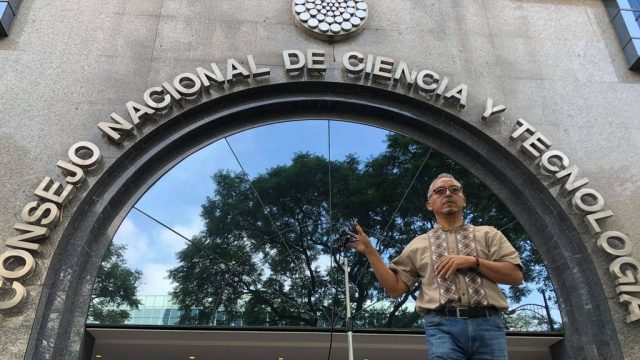
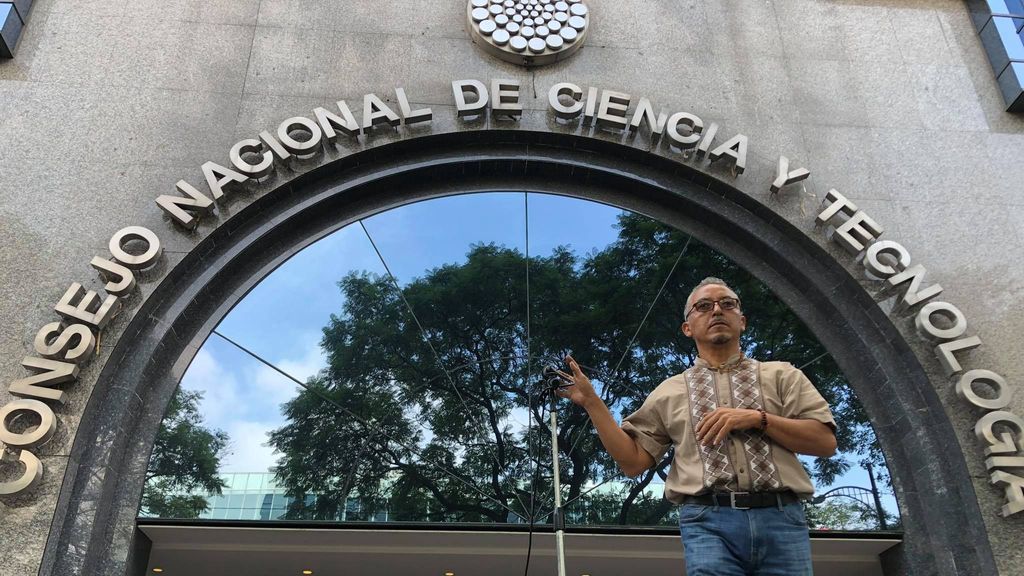
Members of Conacyt are being investigated by the Attorney General for alleged organized crime, money laundering, embezzlement and illicit use of attributions and faculties. Some members protest the lack of support for their work and the attempt to criminalize the scientific community. (Julio Guzmán/Zenger)
Carolina Robledo, a Conacyt researcher, said Conacyt has several aspects that sometimes conceal the precarious situation some researchers face, which is more evident with the budget cuts.
“There are different areas within scientific research. Some people start to earn a salary with no protections … We realize there are people who have profited off scientific research, who have pulled resources for their own benefit. But it’s a fact that those privileges are gone and now those of us in this sector have less labor security and don’t even have money for research,” she said.
As for the Oct. 5, indictments, the Chief Justice of the Supreme Court, Arturo Zaldívar, said the court will act “independently and impartially” in its duties.
Edgar Guerra, a Conacyt researcher, asks the government to focus on other problems instead of the research issue.
“There are structural problems, like a lack of positions to do research, low salaries, no retirement plan for professors, budgetary issues. The problem is this conversation is not taking place, and instead certain problems are being simplified,” he told Zenger. “A certain prejudice is being created around scientific research that means the serious conversation needed is not happening.”
Translated by Melanie Slone; edited by Melanie Slone and Fern Siegel
Who would have guessed how playing a shady street hustler who always had knockoff items for sale on the streets on “Everybody Hates Chris” would propel actor Mike Estime’s career?
That’s exactly what happened. His role as “Risky” on the show about Chris Rock’s teen years created opportunities for the stand-up comic. Although Estime says he prefers stand-up to sitcom and movie work, he remains busy on the big screen, while maintaining stand-up dates.
He currently flanks Kim Fields, Wanda Sykes and Mike Epps as the character Tony on Netflix’s “The Upshaws.”
Estime talks to Zenger about the importance of sharing his knowledge with younger comedians, expresses concern about a war on freedom of speech, how his father is “the most miserable funny man” he’s ever known, and much more.
Percy Crawford interviewed Mike Estime for Zenger.
Zenger: How is everything going? You have been busy.
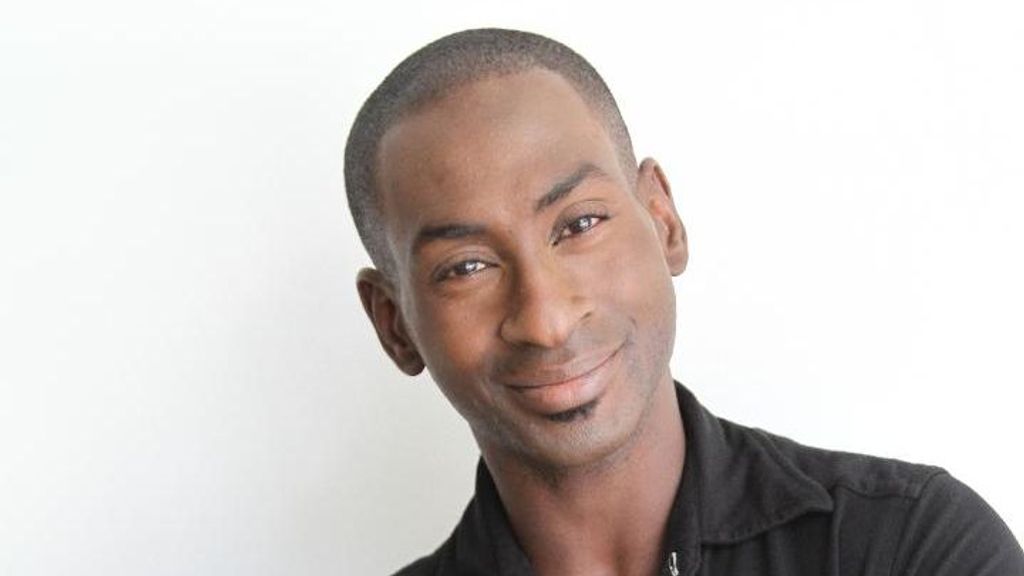
Percy Crawford interviewed Mike Estime for Zenger. (Heidi Malone/Zenger)
Estime: Trying to stay busy, brother. The hustle is always going on. I’m doing well. Just had a show that I was able to be a part of, “The Neighborhood” with Cedric The Entertainer, on CBS. So, that was cool. Found out we start working again in the new year. The clubs are starting to open back up, so I’m doing comedy again, which is even better. Involuntarily being a stay-at-home-teacher, which I’m going to quit. I’m going to put in my pink slip. They all going to go to trade school or something. This is whack. But all in all, everything is good.
Zenger: (Laughing). Which do you prefer: sitcoms, movies or being on stage doing stand-up?
Estime: I prefer the stand-up. That’s my bread and butter because I’m the director, I’m the producer. It’s almost like playing golf or tennis. I don’t rely on my teammates. If it goes wrong, I have nobody else to blame but myself. I don’t hold back. I’m able to be as free as I want to be. In TV or movies, you’re playing into the hands of a writer because you want to make sure you’re doing the right adjustments and put out what he or she has in her mind. As well as with the director, make sure you’re at this spot and make sure you’re here.
It’s just so much more choreographed. I would look at it as TV and film is synchronized swimming and stand-up is like a freestyle hip-hop battle. It’s like jazz, just doing scat and having a jam session. I prefer the jam session.
Zenger: You are funny as hell without influence, but then I look at some of the shows you have been a part of: “The Neighborhood,” with Cedric The Entertainer, “The Upshaws,” with Mike Epps and Wanda Sykes, “Everybody Hates Chris,” with Chris Rock, and you have been around the late Bernie Mac. How has that influenced you or motivated you?
Estime: Not just them, just being around funny people. Shoot, some members in my family are funnier than Cedric and Mike. Not to throw shade on them — they probably would say the same thing. That’s where they get their humor from. Family members are the funniest people without being on stage because they’re so true. You’re not going to get any BS from them. That’s where the comedy stems from.
My father is the most miserable funny man that I know. “Can you believe that they are charging $15 for pineapples in Hawaii? What is this?” He would just go off on a rant. And I’m like, “Dude, I don’t make the prices. Can’t you just enjoy Hawaii?” “I just can’t believe it! Is it a different kind of pineapple? It tastes the same. A can of Dole not that much.” “Yeah, but that’s canned pineapples.” I’m having a conversation about some damn pineapples.
He’s talking about his tire pressure being low. “Why is my tire pressure low?” Just put some air in the damn tire. I’m like, “What you got, a side chick who is letting the air out at night?” Old folks in general and just the people around me are the funniest people. I just try to hang around funny people because that keeps me fresh. Sometimes it gives me inspiration to write about something from a funny situation.
Ced and those guys… same as Mike and Kevin Hart, they are brands. They’re businesspeople. All of these brothers, they’re very funny, and I looked up to all of them. But at the same token, and I’m sure if I talked to them one on one, they’re cool, but when they are around other people, they gotta be careful of what they say. People can take words out of context, and you want to make sure that doesn’t happen. Normal everyday folk, there’s no filter, and they are just funny. It keeps you on your toes. I like to be around funny folks that just cut loose, and sometimes that includes professionals, but more so everyday folks.
His role as “Risky” in the TV series “Everybody Hates Chris” boosts Mike Estime’s career as comedian and actor. The show originally ran 2005-2009 and is still available in reruns. (Red Tail Creative Imaging)
Zenger: Does the sensitive nature of the era we are in change your approach to comedy? Look, for example, at the firestorm Dave Chappelle stirred up with his comments on trans people in his latest Netflix comedy special, “The Closer.”
Estime: I think Dave said it first, and I continue to repeat it: There is a war on comedy. Basically, it’s a war on free speech. Comedy is an art and like every art form, there are going to be some people that like it, and there are going to be some people that don’t. If I see something on television that I don’t like, I just change the damn channel. If you like it, you sit there and take it in.
Now everybody is a critic on social media. If you don’t like something, that’s fine, but don’t try to cancel the person out because you don’t like it. If you have a difference of opinion, then just have a difference of opinion. Now free speech doesn’t come free without consequences.
There is a limit and a line you can cross. I don’t mess around when you’re talking about beating up women, or something about children, the elderly or disabled. That’s too much. A person can’t help being disabled, and you think that’s funny. I think that’s poor taste myself. But other things where there is an intelligent debate about, whether it be race, gender, fluidity, trans folks, if it’s done in a way where it’s not vicious, I think it should be said.
But if it offends you, just because it offends you, doesn’t mean everybody else should be offended. Everyone is missing the point on that. Let the chips fall where they may, I know in my heart and a lot of comics hearts, they are not bad people. It’s just how they see the world. You have to use your art to express and vent how you feel.
Zenger: You are approaching 20 years in the business, what is the best lesson you have learned?
Estime: Stay true to yourself and don’t listen to the outside noise. There was a time when I was trying to appease my peers to prove that I belonged. And a lot of times, some peers don’t have your best interest at heart. The comedy game is a competitive field. It’s very rare that you find some cool comics to hang out with. At a certain point, comics don’t respect you because you’re trying to cater to them, they respect you because you’re true to the craft, and you respect the craft. As long as you’re true to yourself and the art form, that is what I really learned.
Most importantly is to pass that knowledge off to the ones that are coming up. Maybe a few here and there that I can remember, but a lot of times I didn’t have that guidance. I had to figure stuff out on my own. So, what I try to do, when a comic ask me a question, I’m never going to be like, “Man, you gotta figure that out on your own.” I try to say, “Let’s break down this joke. What’s your personality? I seen your bit; this would work better.” Give them at least 10-15 minutes because that time that you spend with him or her could mean a lifetime to them.
It is hard. It’s a lonely business. Aside from you being at the club with other comics, you’re by yourself in a hotel room, in your car, just talking to yourself. Then, you are relying on a bunch of strangers to validate you as being funny. It’s important to have that brotherhood or that sisterhood to make sure you’re not alone in this game. Don’t be selfish with your knowledge.
Mike Estime seconds Dave Chappelle’s belief that there is “a war on comedy” these days. (Courtesy of Mike Estime)
Zenger: Everyone loved you as “Risky” on “Everybody Hates Chris.” There is a Risky in every ‘hood. Did you draw from a street hustler from your neighborhood selling stolen goods, or did you just get into character and nail it?
Estime: Brother, it was just me understanding the role and getting into it. I think not only in our neighborhoods, but we have some Riskys in our families. The next big thing is always around the corner. It’s on the lower end, but don’t worry, it’s the same as the name brands. Instead of Nikes we get Ikes. “We trying to break away from the brand, brother. It’s just a “N.” We don’t need that.” I didn’t know how big it was going to get when we were shooting it. It’s actually taken off much more now that it has been off the air, and it’s in reruns. And folks are just loving the show. Bruh, I’m getting likes from Brazil.
It’s been amazing to see and hear the response that folks have to the character and the show. When I used to do cruise ships, this Brazilian guy came up to me, and he said the same thing you just said, “There is a ‘Risky’ in my neighborhood. We can relate to that.” That role was a huge boost and created so many opportunities, when I got with the right team, that is. I got with the right team, and they pushed that narrative, and that part of my career and that took it off. I think that is one part of why I was able to get the show, “The Upshaws.”
Zenger: It is an honor speaking with you. Good luck with “The Upshaws” and everything else you have going on. Is there anything you would like to add?
Estime: Thank you, brother. Just be sure to check out the Netflix show, “The Upshaws.” Season two will be coming out. We will be starting to film in the beginning of 2022. Thank you to everyone that supported the first season. It was an amazing response, and we promise the next season will be even better.
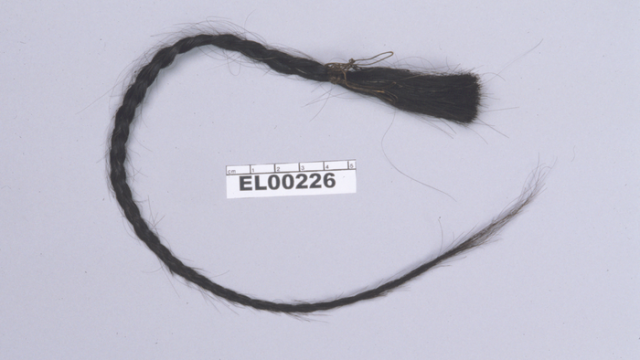
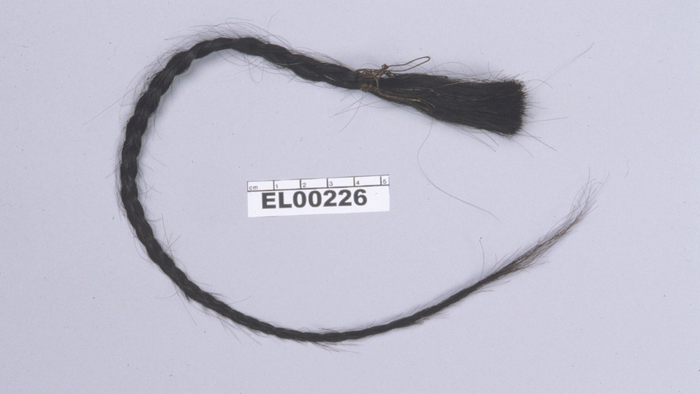
Scientists used the preserved hair of Tatanka Iyotanka, better known as Sitting Bull, in an innovative method of DNA testing to show a familial relationship for the first time between living and dead individuals.
In a study published in the journal Science Advances, scientists traced ancestry by searching for autosomal DNA in the genetic fragments in the sample. Each parent contributes half of the autosomal DNA in any individual, meaning that genetic matches can be made regardless of whether an ancestor is on the father’s or mother’s side of the family.
“Autosomal DNA is our non-gender-specific DNA. We managed to locate sufficient amounts of autosomal DNA in Sitting Bull’s hair sample and compare it to the DNA sample from Ernie Lapointe and other Lakota Sioux and were delighted to find that it matched,” said study co-author Eske Willerslev of the University of Cambridge.
The claim of Ernie Lapointe (pictured) to be descended from Tatanka Iyotanka “Sitting Bull” was confirmed by DNA analysis. (Courtesy Ernie Lapointe)Period photograph of Lakota Sioux leader Tatanka Iyotanka “Sitting Bull” (1831–1890). (Smithsonian Institution, Washington D.C.)
The match confirmed Lapointe as a great-grandson and closest living descendant of the Hunkpapa Lakota leader most known for easily defeating U.S. 7th Cavalry Lt. Col. George Custer’s battalion at the Battle of Little Bighorn in 1876.
“Over the years, many people have tried to question the relationship that I and my sisters have to Sitting Bull,” Lapointe said.
Until now, Lapointe’s descent from Sitting Bull could only be shown by birth and death certificates and the historical record.
It took 14 years for the scientists to determine how to get useable DNA from a piece of Sitting Bull’s hair measuring just a couple of inches. Stored for more than a century unrefrigerated at the Smithsonian Institution, the hair had become extremely degraded before its return to Lapointe and his sisters in 2007.
Previous DNA analyses looked for genetic matches of specific DNA in the Y male chromosome, or, if the ancestor was female, specific DNA in the mitochondria passed from a mother to her children. These are not very reliable, and neither was used in this case because Lapointe claimed to be related to Sitting Bull through his mother.
The technique in the study can be used when limited genetic data are available, as well as in old human DNA too degraded for analysis. This could be a boon for criminal forensic investigations and would enable confirmation of relationships between historical figures and their putative living descendants.
“In principle, you could investigate whoever you want — from outlaws like Jesse James to the Russian tsar’s family, the Romanovs,” Willerslev said. “If there is access to old DNA — typically extracted from bones, hair or teeth, they can be examined in the same way.”
Four Native Americans with their interpreter. Back: Julius Meyer (interpreter) and Red Cloud. Front: Sitting Bull (1834–1890), Swift Bear and Spotted Tail. Original Artwork: Original print in sepia. (Hulton Archive/Getty Images)
Sitting Bull’s buried remains are in Mobridge, South Dakota, according to Lapointe. He fears the gravesite may not receive proper care. Currently, visitors come to two burial sites claimed for Sitting Bull: Morbridge and Fort Yates, North Dakota. With the new DNA evidence to confirm a family relationship, Lapointe plans to reinter his ancestor at an appropriate place.
Before the remains at Morbridge can be reburied, a genetic analysis would have to ensure a match to Sitting Bull. Lapointe owns the legal rights to Sitting Bull’s genetic data and thus can decide who should do the analysis.
At Standing Rock Reservation, Sitting Bull was shot to death by Indian Service agents and buried at Fort Yates in 1890. His descendants exhumed his purported remains in 1953 and reburied them at Morbridge.
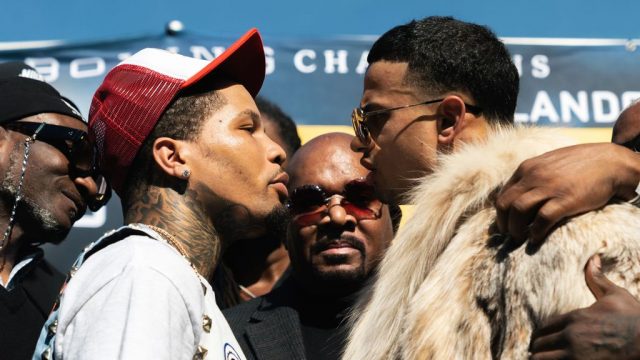
Three-division champion Gervonta Davis and undefeated lightweight prospect Rolando Romero aim to knock each other senseless when they clash for Davis’ WBA 135-pound title on Dec. 5 at Staples Center in Los Angeles.
The hammer-fisted combatants share a genuine animosity, with Davis (25-0, 24 KOs) calling his adversary “a scared chump,” and Romero (14-0, 12 KOs) vowing “to knock Gervonta the f*** out” in a Premier Boxing Champions event on Showtime Pay Per View (8 p.m. ET).
“Gervonta Davis and Rolando Romero are both very dangerous and determined fighters with the power in both hands to get you out of there,” said Leonard Ellerbe, CEO of Mayweather Promotions.
“When you have fights like these, a lot of times it comes down to whose power can get there first. There is a very high probability that this fight won’t go the distance, so you’ll have to tune in on Dec. 5 to see what happens.”
Yet despite their acrimony, the 26-year-olds share similar backgrounds.
Davis: “Boxing has saved my life”
Davis is from a crime-filled section of West Baltimore, Maryland. He spent time in foster care and group homes before a friend, Quaadir Gurley, guided him into the Upton Boxing Center’s gym as a 7-year-old.
Gurley introduced Davis to his dad, Calvin Ford, the man who became and remains the champion’s longtime coach.
Ford guided Davis through a 206-15 amateur career that included winning a National Golden Gloves Championship in 2012, three consecutive National Silver Gloves titles from 2006-2008, and two each in National Junior Olympic gold medals, the National Police Athletic League and Ringside World Championships.
Two years before Gurley was shot and killed in 2013, Davis grieved the loss of Ronald Gibbs, a rising amateur boxer who was 17 when he was stabbed to death. The following year, Angelo Ward, another promising amateur, was shot to death.
“Before Coach Ford, I had no father figure because my father was in and out of jail. Angelo Ward, Ronald Gibbs and Coach Calvin’s son — they’re guys who died and were such a major influence on my life,” said Davis, a southpaw nicknamed “Tank” by an amateur coach for his large head.
“Whenever I fight, I feel like their legacy is going into the ring with me. It’s a big responsibility, but I’ll take that. There’s a lot of bad stuff that comes from Baltimore, but if they see that one person can do it, then the next one can do it, and so on and so on. The only thing that I can do is to bring light to Baltimore. Boxing has saved my life.”
Romero: Death on the doorstep
Romero slept through gunshots in his downtown Las Vegas neighborhood as a child. One day, the savagery found its way to the doorstep of his family’s home.
“Growing up, there was a lot of violence,” Romero said. “When I was about 7 years old, the brother of my best friend at the time got shot and killed right in front of my house.”
A 9-year-old Romero channeled aggression into judo, in which he excelled along with his sister, Angelica, a seven-time U.S. national champion.
“I started at the same time as my sister, who is a year and a half younger than me,” said Romero, whose nickname, “Rolly,” came from his father, Rolando Sr. “I won a lot of tournaments, but I wound up in second place in all of the national tournaments I competed in.”
Encouraged by Rolando Sr., a former boxer in his native Cuba, a 16-year-old Romero first boxed at the Las Vegas-based Johnny Tocco’s Ringside Gym.
“I didn’t start boxing until after watching the Olympics of 2012,” said Romero, whose father assists head trainer Bullet Cromwell. “Up until that moment, I never really cared about boxing. It had been a chore for me because I had never sparred. But then I started thinking, ‘I can do this.’”
Davis: ‘Floyd has passed [knowledge] on to me’
At 18, Davis displayed two-fisted power, dazzling speed, accuracy and athleticism during his professional debut in February 2013, an 89-second knockout of 125-pound rival Desi Williams, which was the first of eight consecutive stoppage victories.
After Davis recorded knockouts in all five bouts in 2015, his 14-0 record (13 KOs) caught the attention of four-division champion Adrien Broner, who introduced him to his current promoter, five-division champion Floyd Mayweather Jr.
Five-division champion Floyd Mayweather Jr. was impressed enough to sign and promote both WBA lightweight champion Gervonta Davis and challenger Rolando Romero. The undefeated duo will clash on Dec. 5 at Staples Center in Los Angeles on Dec. 5. (Sean Michael Ham/Mayweather Promotions)
“There’s a lot of knowledge that Floyd has passed on to me,” said Davis. “He has shown me the right things in and outside of boxing. I’m trying to reach the next younger generation of fighters who look up to me.”
Romero: ‘Floyd gave me his number’
An 18-year-old Romero began his brief amateur career in 2013, his 25-10 record including a third-place finish at the Olympic trials of 2015.
Romero’s skills caught Mayweather’s attention following his sparring sessions during trips to his Las Vegas-based Mayweather Boxing Club.
“I did some rounds with a lot of top guys. I can punch very hard, so I stopped a lot of people. When one of those sessions was about to start, Floyd hopped up on the side of the ring. I beat the s–t out of that guy that day,” Romero said.
“So the next day, I went over there again, I did some more damage, and, once again, Floyd hops on the ring. I was feeling so good because he said he wanted to sign me. He gave me his number, I called a week later, and the next day [in November 2016] I was signed.”
Romero was 21 when he made his professional debut — a 61-second stoppage of David Courtney in December 2016 — which was the first of four straight knockouts to begin his career.
Davis already was a 130-pound champion in 2018 when he failed to appear for a scheduled sparring session, according to Romero.
“We were supposed to spar in 2018,” said Romero. “But he didn’t show up to the gym. He did that twice because he knew he was getting beat.”
WBA lightweight champion Gervonta Davis (left) or challenger Rolando Romero (right) could lose for the first time — likely by knockout on Dec. 5 — at Staples Center in Los Angeles. (Sean Michael Ham/Mayweather Promotions)
Davis: ‘I’d rather punish Romero for 12 rounds’
“Tank” won his first crown by obliterating previously unbeaten IBF 130-pound champion Jose Pedraza via seventh-round TKO in January 2017.
“I was on a mission when I fought Jose Pedraza for the title,” Davis said. “I didn’t do any trash talking. I went in there and proved that I’m a top guy.”
Davis will be after 17th straight knockout victory against Romero, his past three stoppages coming in the 12th round over three-division champion Yuriorkis Gamboa (December 2019), the sixth against four-division title winner Leo Santa Cruz (October 2020), and the 11th to dethrone previously unbeaten WBA 140-pound champion Mario Barrios (June 2021).
Gamboa hit the deck three times as Davis won the WBA’s vacant 135-pound title, Santa Cruz was knocked out cold and stopped for the first time in his career and Barrios was floored three times as he slipped to 26-1 (17 KOs).
“I’d rather punish [Romero] for 12 rounds than knock him out quickly,” Davis said. “This guy [Romero] is just here to talk. I’m going to do the talking in the ring on Dec. 5.”
Romero: ‘Come watch me knock Davis out’
“I told Rolly that Gervonta Davis is standing in the way of changing your family and your legacy. We got a job to do,” Cromwell said. “I have a lot of respect for Tank and his team. He’s a great fighter, but Rolly is going to be the new WBA champion on Dec. 5.”
Romero has knocked out eight of his last nine opponents and is coming off July’s three-knockdown, seventh-round stoppage of Swedish southpaw Anthony Yigit, who slipped to 24-2-1 (8 KOs).
“I’ve been calling ‘Tank’ out since 2017. He has such a big head, it’s going to be hard to miss it. He gets touched up by every opponent he faces. Leo Santa Cruz was beating him up, and Barrios was getting to him, too,” Romero said.
“Gervonta wants to run out of the ring whenever he gets hit. Everybody come watch me knock [Davis] out on Dec. 5. I’m here to knock him out in the ring. He’s arrogant and tries to act like he’s tough, but I’m going to knock Gervonta the f*** out.”
As gasoline prices remain high, a troubling lack of crude oil production in a tight market is emerging from U.S. Energy Department data, analysts said.
The U.S. Energy Information Administration, part of the Energy Department, publishes weekly data on commercial storage levels of crude oil and refined petroleum products such as gasoline and diesel. Inventory gains are usually indicative of a slump in demand, while the opposite holds for declines.
All products — commercial crude oil, motor gasoline and distillates, including diesel — showed gains in the latest report. But all of these are below what would be normal for this time of year, showing the market remains tight, which means gas prices will remain relatively high.
U.S. commercial crude oil inventories, not counting what’s stored in the Strategic Petroleum Reserve, increased 4.3 million barrels from the previous week. That took some of the steam out of the recent rally in commodity prices, which for the U.S benchmark for the price of oil is still at seven-year highs.
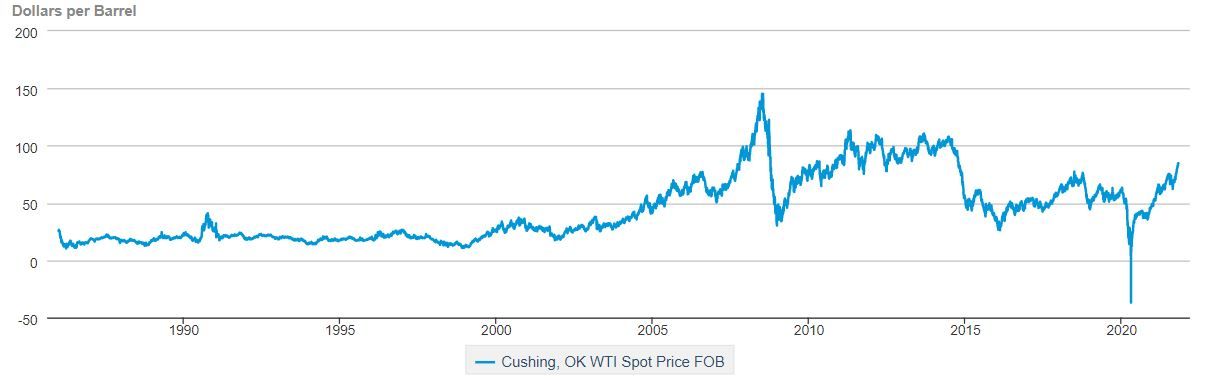
West Texas Intermediate, the U.S. benchmark, closed trading Wednesday at $82.66 per barrel, down some 2.4 percent on the day.
US crude oil prices remain at seven-year highs, but may be cooling off. (U.S. Energy Information Administration)
Complicating the matter is the fact that commercial crude oil inventories are about 6 percent below the five-year average for this time of year.
The market still seems a bit tight given that producers aren’t putting more oil on the market, Geoffrey S. Lakings, the chief strategist at IIR Energy, told Zenger
“Neither U.S. shale nor OPEC+ is seemingly willing to bring back supply,” he said.
The White House over the course of a month or so has been pressuring OPEC and its non-member state allies, a group called OPEC+, to open the spigot. Saudi Arabia, the de facto leader of the group, has rebuffed those calls and said the broader market picture is a reflection of a lack of investments in fossil fuels more than any sort of artificial effort to keep prices higher.
OPEC+, however, does seem comfortable with oil at around $80 per barrel. But Lakings suggested that it would be a bit of a surprise to see oil prices move too much higher this year.
Domestic stockpiles of crude oil are near the bottom of the five-year range. (U.S. Energy Information Administration)
Seconding that sentiment is Al Salazar, managing director at energy data firm Enverus, who said some of the weakness in products apart from oil may spill over to take some of the life out of the bull market.
“For those that are into technical analysis, $86 per barrel is proving to be a very, very tough nut to crack,” he said of West Texas Intermediate.
That said, the fact that crude oil and refined petroleum products are below the five-year average suggests the floor won’t give way to a repeat of a rare phenomenon in April 2020, when U.S. crude oil traded briefly in negative territory. Production is still short and demand is high enough to keep prices near current levels.
Domestic production for the week ending October 22 was just under the five-year average and the cumulative daily average to that date is actually about 5.6 percent below year-ago levels, which suggests producers are more disciplined now than when they were during the pre-vaccine stage of the pandemic.
Some of the federal energy data this week was largely expected due to seasonal factors which cause demand to drift lower, such as it getting colder and darker earlier, which keeps more drivers home. But the lack of an increase in production is “a disappointment,” said Ole Hanson, the head of commodity strategies at Saxo Bank.
Producers, bending to shareholder pressure, may be favoring renewables more than fossil fuels, complicating matters in the tight market.