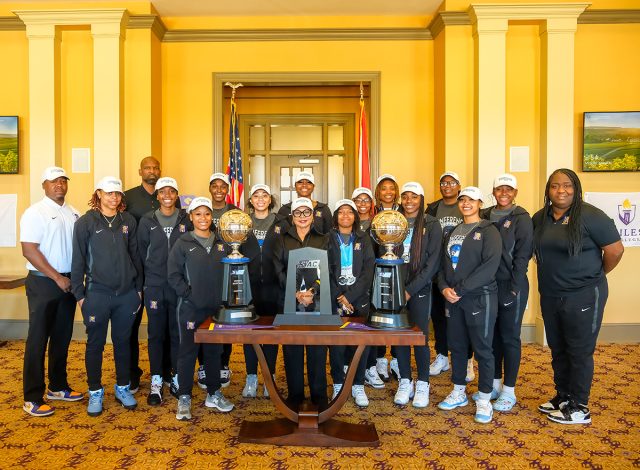
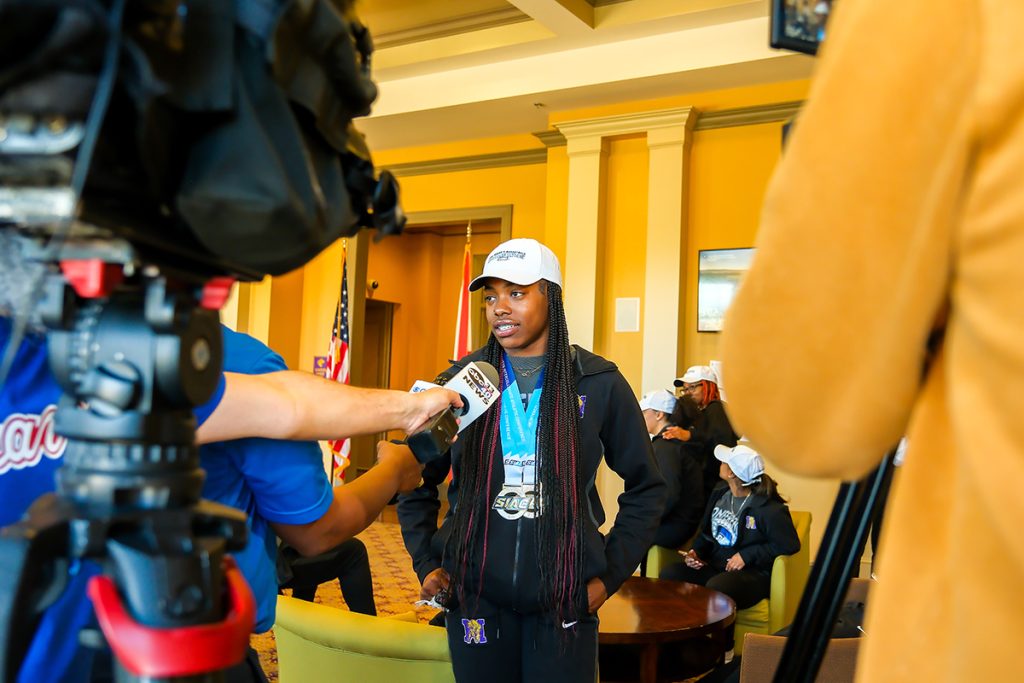
Miles College Lady Bears are headed to the NCAA Division II South Region tournament with an automatic bid after capturing its second consecutive 2025 SIAC Women's Basketball Tournament on Saturday in Atlanta. (Ta’Ron Williams/Miles College)
The Birmingham Times
After a dominant victory in the SIAC Women’s Basketball Tournament last Saturday, winning back-to-back Southern Intercollegiate Athletic Conference tournament titles, the Miles College women’s basketball team earned an automatic berth into the NCAA Division II South Region tournament.
The Lady Bears, which earned the eighth seed in the tourney, will face top-seeded Union in the opening round. The Lady Bulldogs, winners of the Gulf South Conference, will host the tournament in Tennessee and play will begin on Friday, Mar. 14.
On Saturday, the Lady Bears dominated rival Tuskegee in Atlanta to win the 2025 SIAC Women’s Basketball Tournament for the second consecutive year, a feat never before accomplished in the history of the program and just the sixth time in the 45-year history of the league’s women’s basketball tournament.
Feliah Greer, a 5-9 senior at guard/forward, was one of the leaders for Miles during the SIAC tournament and joined the All-Tournament team along with Tederia Ashley and Iemyiah Harris, the tournament MVP. (Ta’Ron Williams/Miles College)
Featuring a swirling defense and swarming Miles trailed for only 16 seconds. After allowing the opening bucket of the game, Feliah Greer answered with a jumper to tie the game and Iemyiah Harris followed with a 3-ball for a 5-2 lead. The Lady Bears never trailed again. Madison Lee followed with a 3-pointer as part of her six-point quarter and the Lady Bears would lead 14-11 after the opening period.
Miles took control in the second quarter with a 13-1 run was paced by Harris, the Tournament Most Valuable Player. Tuskegee trailed 29-18 at the half but scored the first four points in the opening two minutes of the third quarter to draw to within seven. But the Golden Tigers never got any closer.
Harris scored a game-high 24 points, Greer added 15 points, Lee had 12 and Tederia Ashley finished with eight for the Lady Bears. Greer and Ashley joined Harris on the All-Tournament Team.
The Lady Bears are 22-6, the second-most single-season wins in program history, and have won their last nine games by an average of 19.6 points per game. Miles is Top 5 in the country in defending the 3-point shot and overall defensive field goal percentage. The Lady Bears are also among the Top 25 in the country in allowing points, rebounding, and forcing turnovers.
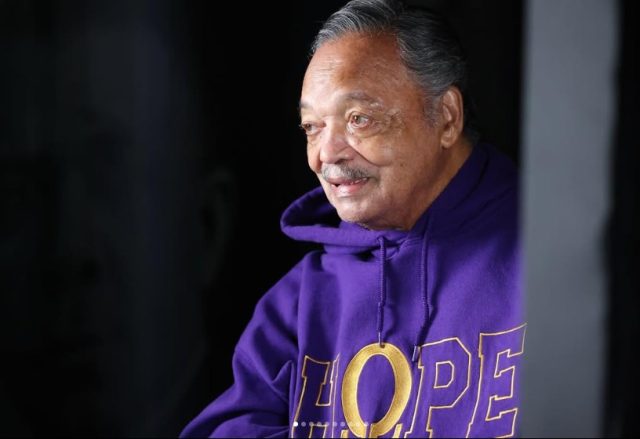
At the historic A.G. Gaston Motel in Birmingham last Friday, the Rev. Jesse Jackson said, “It’s good to be home again ... I have Parkinson’s and I can’t talk very well, but my mind is on freedom.” (City of Birmingham)
By Barnett Wright | The Birmingham Times
The Rev. Jesse Jackson, his son U.S. Representative Jonathan Jackson, and his daughter Santita Jackson stopped by the A.G. Gaston Motel and Coffee Shop Friday.
The Rev. Jackson was also in Selma, Alabama Sunday for the 60th commemoration of the clash that became known as Bloody Sunday. The attack shocked the nation and galvanized support for the U.S. Voting Rights Act of 1965.
Jackson and his family were at A.G. Gaston Motel to explore future partnership opportunities with Kendra Woodfin, wife of Birmingham Mayor Randall Woodfin, and KultureCity, a nonprofit dedicated to sensory inclusion and disability accessibility.
“It’s good to be home again,” Jackson whispered from his wheelchair. “I have Parkinson’s and I can’t talk very well, but my mind is on freedom.” He added, “The Bible says, ‘Remove not the ancient landmarks which thy fathers have set.’ This is a landmark. Never forget it. It is dark, but the morning comes. When it is really dark, you can see the stars more clearly. Amen.”
In an Instagram post, Woodfin said she and KultureCity “had the incredible honor” of hosting Jackson. “He didn’t speak much, but when he did, his words carried weight … we linked arms and sang ‘We Shall Overcome.’ It was powerful. It was a reminder of where we’ve been, how far we’ve come, and the work still ahead.”
“These pioneers, some of them are still living today, like Jesse Jackson,” she said. “To have him back in this space is momentous.
“To even be able to have a conversation with him about what’s going on in the climate today, with Civil Rights, disability rights, equality,” Woodfin continued, according to the website. “It’s still a conversation that we need to have. To be able to have it with the people who fought so hard for it back then is amazing.”
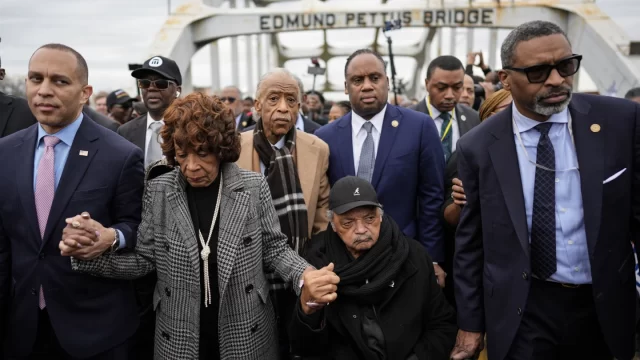
U.S. Rep. Hakeem Jeffries, D-N.Y., U.S. Rep. Maxine Waters, D-Calif., Rev. Al Sharpton, Rev. Jesse Jackson and NACCP President Derick Johnson, from left, march across the Edmund Pettus bridge during the 60th anniversary of the march to ensure that African Americans could exercise their constitutional right to vote in Selma. (Mike Stewart, Associated Press)
SELMA, Ala. (AP) — Charles Mauldin was near the front of a line of voting rights marchers walking in pairs across the Edmund Pettus Bridge in Selma, Alabama on March 7, 1965.
The marchers were protesting white officials’ refusal to allow Black Alabamians to register to vote, as well as the killing days earlier of Jimmie Lee Jackson, a minister and voting rights organizer who was shot by a state trooper in nearby Marion.
At the apex of the span over the Alabama River, they saw what awaited them: a line of state troopers, deputies and men on horseback. They kept going. After they approached, law enforcement gave a two-minute warning to disperse and then unleashed violence.
“Within about a minute or a half, they took their billy clubs, holding it on both ends, began to push us back to back us in, and then they began to beat men, women and children, and tear gas men, women and children, and cattle prod men, women and children viciously,” said Mauldin, who was 17 at the time.
Selma on Sunday marked the 60th anniversary of the clash that became known as Bloody Sunday. The attack shocked the nation and galvanized support for the U.S. Voting Rights Act of 1965. The annual commemoration pays homage to those who fought to secure voting rights for Black Americans and brought calls to recommit to the fight for equality.
For those gathered in Selma, the celebration comes amid concerns about new voting restrictions and the Trump administration’s effort to remake federal agencies they said helped make America a democracy for all.
Speaking at the pulpit of the city’s historic Tabernacle Baptist Church, House Minority Leader Hakeem Jeffries said what happened in Selma changed the nation. He said the 60th anniversary comes at a time when there is “trouble all around” and some “want to whitewash our history.” But he said like the marchers of Bloody Sunday, they must keep going.
“At this moment, faced with trouble on every side, we’ve got to press on,” Jeffries said to the crowd that included the Rev. Jesse Jackson, multiple members of Congress and others gathered for the commemoration.
Members of Congress joined with Bloody Sunday marchers to lead a march of several thousand people across the Edmund Pettus Bridge. They stopped to pray at the site where marchers were beaten in 1965.
“We gather here on the 60th anniversary of Bloody Sunday when our country is in chaos,” said U.S. Rep. Terri Sewell of Alabama.
Sewell, a Selma native, noted the number of voting restrictions introduced since the U.S. Supreme Court effectively abolished a key part of the Voting Rights Act that required jurisdictions with a history of racial discrimination to clear new voting laws with the Justice Department. Other speakers noted the Trump administration’s push to end diversity, equity and inclusion efforts and a rollback of equal opportunity executive orders that have been on the books since the 1960s.
In 1965, the Bloody Sunday marchers led by John Lewis and Hosea Williams walked in pairs across the Selma bridge headed toward Montgomery.
“We had steeled our nerves to a point where we were so determined that we were willing to confront. It was past being courageous. We were determined, and we were indignant,” Mauldin recalled.
He said the “country was not a democracy for Black folks” until voting rights. “And we’re still constantly fighting to make that a more concrete reality for ourselves.”
Kirk Carrington was just 13 on Bloody Sunday and was chased through the city by a man on a horse wielding a stick. “When we started marching, we did not know the impact we would have in America,” he said.
Dr. Verdell Lett Dawson, who grew up in Selma, remembers a time when she was expected to lower her gaze if she passed a white person on the street to avoid making eye contact.
Dawson and Mauldin said they are concerned about the potential dismantling of the Department of Education and other changes to federal agencies.
Support from the federal government “is how Black Americans have been able to get justice, to get some semblance of equality, because left to states’ rights, it is going to be the white majority that’s going to rule,” Dawson said.
“That that’s a tragedy of 60 years later: what we are looking at now is a return to the 1950s,” Dawson said.
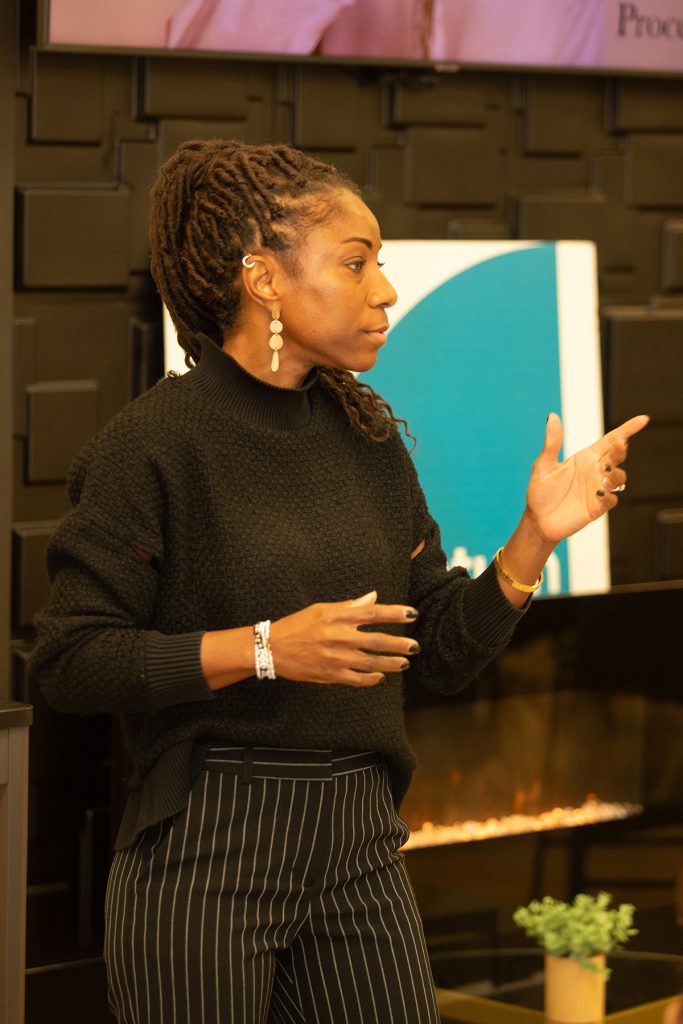
Raven Holloway, Program Director, Momentum Works. (Momentum)
By Je’Don Holloway-Talley | For The Birmingham Times
(Women’s History Month Special)
Raven Holloway radiates health and prosperity on a quiet Saturday afternoon in her modern, elegant home in the Ross Bridge community of Hoover, Alabama. Dressed in sleek athleisure wear, she exudes the effortless glow of someone who prioritizes wellness of the mind, body, and spirit.
Holloway is Program Director for Momentum Works, which is a part of Momentum, Alabama’s premier women’s leadership program that empowers participants to develop leadership skills that impact business, culture and politics in their respective communities and across the state.
At her home, where sunlight is streaming through large picture windows, illuminating her smooth brown skin and the striking mix of green and hazel in her eyes, Holloway explains why she has been so successful in her role as program director, which has become a space where women shift from doubt to confidence, from stagnation to growth.
“Women need to be able to sit across from other women and see the possibility of what they can be,” she says.
The proof is in the numbers: In just one year, program participants reported more than $450,000 in salary increases, with an average reported salary bump of $13,947.
Holloway’s own journey and unwavering belief in women’s potential mirrors the transformation happening within each participant, making Momentum Works not just a program but a movement.
Holloway, 44, (no relation to the author) is an Arthur Harold (A. H.) Parker High School graduate, the eldest of three siblings, the only girl, and the only one to be raised by their maternal grandmother.
“My mom struggled with alcoholism, and my grandmother made my mother leave me with her,” Holloway said. “[My mother] and my brothers weren’t far away, but they had their dad, and I didn’t. Granny wanted me where she could see me, and I would not be on the journey I’m on without the folks in those projects who really saw me and poured into me.”
Holloway was part of the drama and theater department in high school, and after graduating in 1999 she went on to study theater at Alabama State University.
“I could have used the barriers of my growing up in the [Loveman Village] projects and being poor, of my grandmother raising me and my mom [dealing with alcoholism], but I was curious. … I looked for opportunities, and I wasn’t going to allow anything or anyone to hold me back,” Holloway said.
“Relentless Curiosity”
Raven Holloway, Program Director, Momentum Works. (Momentum)
Despite the challenges of her upbringing, Holloway said it took “relentless curiosity” about life and its nuance to propel her forward. She leaned into her strengths and embraced every chance to grow.
That same spirit of resilience, self-discovery, and breaking barriers is exactly what Momentum Works aims to foster in women like Holloway, women who are determined to step into their full potential despite the obstacles they’ve faced. She would eventually realize that her journey of perseverance and self-advocacy aligns perfectly with the group’s mission.
After college, Holloway worked odd jobs, but it wasn’t until she developed a deeper interest in her mother’s plight with alcoholism that she “began to research and study it,” she said. “I not only did that but also decided to take a job with Bradford Health Services,” an addiction treatment center in Jefferson County.
“They have multiple outpatient programs, so I took a job in one of the outpatient programs in Hoover and started to learn about addiction treatment. … I was there for 14 years and moved all the way up to becoming the national marketer, the face for Bradford.”
Holloway had an idea that would deepen her involvement with her patients. The longtime yoga and meditation practitioner saw an opportunity to bring holistic healing to Bradford’s patients. She pitched a curriculum and, to her surprise, the company backed her vision, agreeing to pay for her training.
Adding yoga certification to her repertoire would prove beneficial.
“I realized there should be a holistic approach, so I wanted to incorporate teaching our patients yoga and meditation, [as well as encourage them to start] working out and just really caring about themselves from a holistic standpoint,” Holloway said. “I truly believe that meditation produces manifestation. Also, I believe that it’s how we should begin the morning, how we set the intentions for the day.”
The Pivot
The COVID-19 pandemic led to department cuts at Bradford, and Holloway’s position was eliminated in 2022.
The loss of the job created the pivot, which was [the formation of] Wellness WorX, through which she offered holistic health services. “I never knew anything about business or any of that, but it took off and it did well. I’m very, very proud of myself for that,” Holloway said. “But I realized that I’m a connector and I like being around people. Being an entrepreneur is incredible, but I enjoyed getting up every morning, putting on clothes, and being around people who were all on the same mission.”
She found herself craving the structure of a traditional role. “I felt like I needed a nine-to-five,” she said. That search led her to a social services organization in Birmingham, where she accepted the position of Director of
Philanthropy. However, the day-to-day work for her left much to be desired, she said.
“I’ll be honest with you, it was not a job that I enjoyed at all,” she said.
Fundraising lacked the direct connection to people that had always fueled
her passion. “Although I was very much in love with the mission, I was not in love with the work,” she said.
It would be in Jamaica where clarity finally came, she remembered. “I knew it was time to let go.” That was 2023 and she decided that 2024 would be her year to grow and embark on something greater and more aligned with her calling. “But what I didn’t realize was that growth only happens where there’s pruning,” she said.
Just weeks after returning home from Jamaica, Holloway received a call informing her that her mother was in the hospital. When her mother passed away, Holloway was forced to confront a deeper truth: growth often comes through loss. “That loss reshaped everything,” she said. “And it showed me I had to let go [of that job]. I was being pruned, and pruning requires removal.”
After leaving that job Holloway didn’t have a clear plan for what was next, but said she knew one thing for certain — she would never again step into a role that wasn’t in divine alignment for her.
“A Future You”
And just like that, her next opportunity came. Momentum had been watching her professional development work at the University of Alabama at Birmingham’s Regional In-Service Center, where she led leadership workshops for educators.
Andrea McCaskey, Momentum’s former statewide director of programs, called and asked Holloway to facilitate a session for the Executive Class. After a successful first session, Holloway was invited back to lead another for the Huntsville Executive Class.
Then came a question she wasn’t expecting: Are you looking for a job? “That’s how I ended up with Momentum Leaders,” Holloway recalled. “It was on the heels of facilitating a piece that I curated called ‘A Future You.’”
Now, as program director of Momentum Works, Holloway isn’t just teaching leadership, she’s living it—and the women who step into Momentum Works learn the same truth that changed her trajectory in 2024: sometimes, stepping into the life you’re meant for means surrendering your old one.
Learn more about Momentum Works and other Momentum Leaders programs at momentumleaders.org.
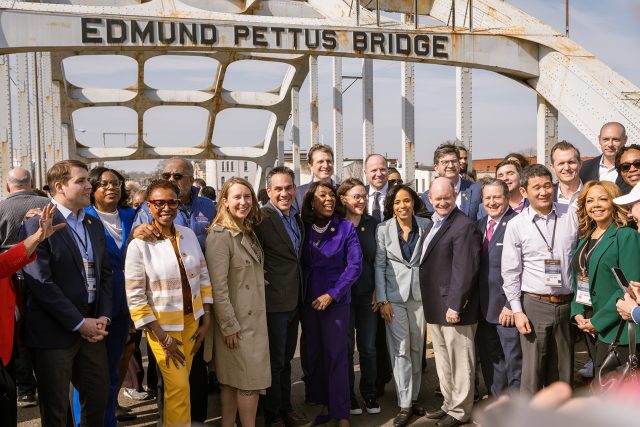
Local, state and national elected officials, civic and community leaders gather at the foot of the Edmund Pettus Bridge in Selma during the 60th commemoration of Bloody Sunday. (Amarr Croskey, For The Birmingham Times)
By Sym Posey | The Birmingham Times
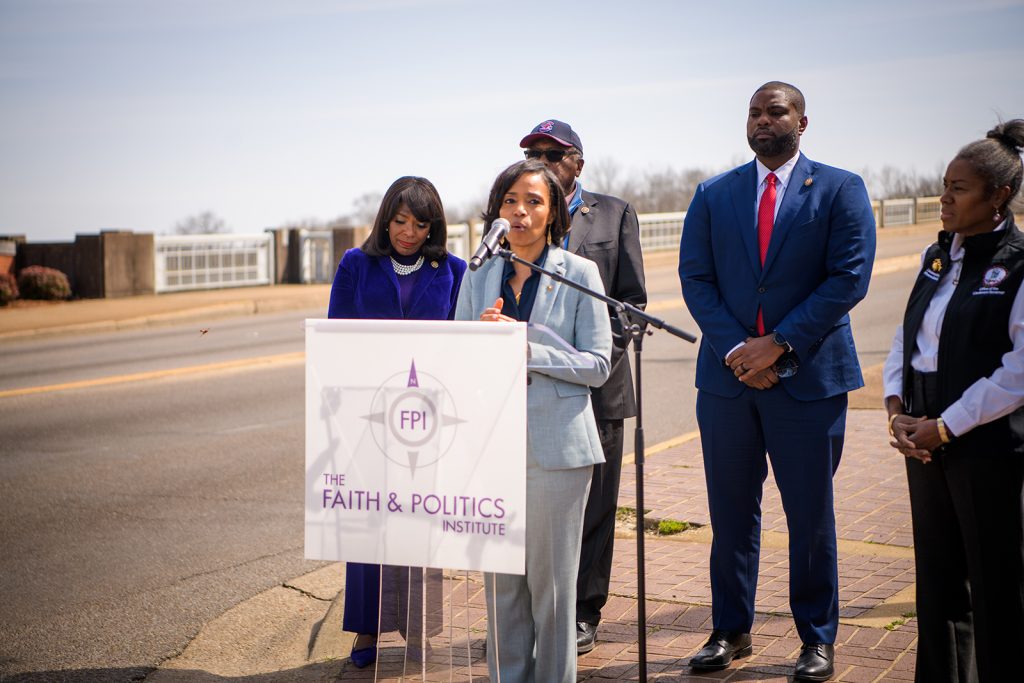
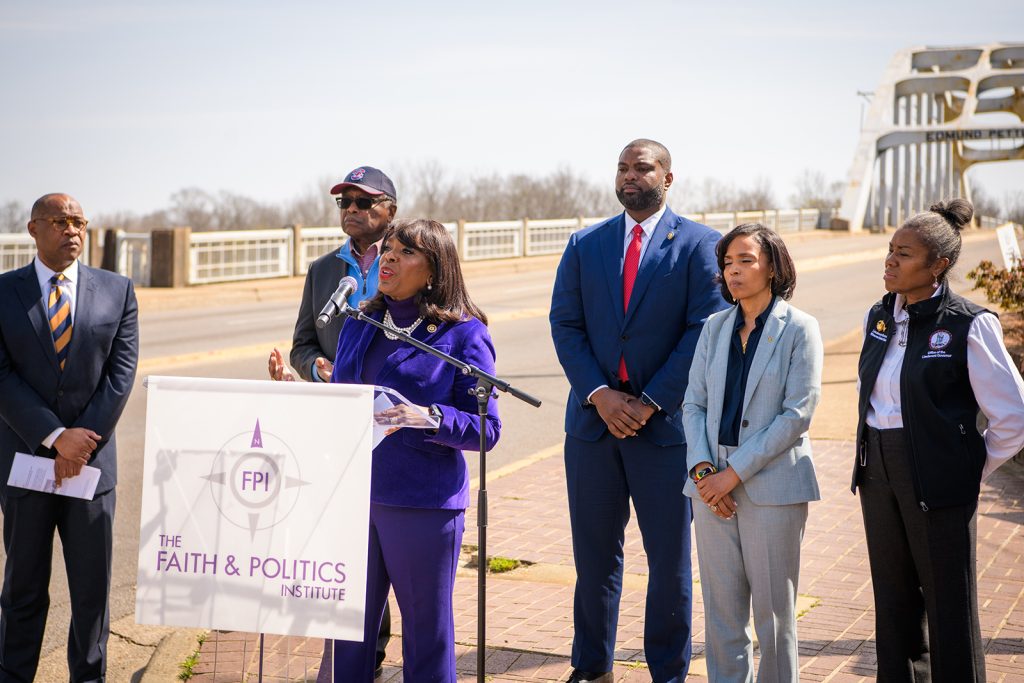
SELMA – Standing at the foot of the Edmund Pettus Bridge where hundreds of Foot Soldiers were attacked 60 years ago while demonstrating for the right to vote, Alabama Rep. Terri Sewell and several political leaders part of the 2025 Faith and Politics Congressional Civil Rights Pilgrimage spoke forcefully about a continued fight for voters to have a say at the ballot box.
“This year’s theme, ‘Walking Forward Together’ comes in a very challenging time for our democracy, seemingly every day we see new efforts to erase our history or roll back our progress and make it harder for Americans to vote,” Sewell said. Without the full protection of the Voting Rights Act, these efforts go unchecked,” said Sewell.
On March 7, 1965, 600 people, a mixture of Civil Rights leaders and nonviolent activists attempted to march from Selma to Montgomery, Alabama, including the late Congressman John Lewis, in an effort to fight for African American’s right to vote but their plans were thawed as they were met with brutal violence from Alabama state troopers in what became known as “Bloody Sunday.”
Later that year, the Voting Rights Act passed.
U.S. Senator Angela Alsobrooks, (D-Md.) speaks during the 2025 Faith and Politics Congressional Civil Rights Pilgrimage at foot of Edmund Pettus Bridge in Selma. (Amarr Croskey, For The Birmingham Times)
Sewell was joined at Friday’s commemoration by U.S. Senator Angela Alsobrooks (D-MD), U.S. Congressman Jim Clyburn (SC-06), and U.S. Congressman Byron Donalds (FL-19).
“I’m honored every year to be a part of faith in politics pilgrimage,” Sewell said, during a press conference. “It is not just a Republican or Democrat. It’s America’s history that we actually are observing.”
Alsobrooks said she was a direct descendant of the those who marched and made for her to serve as a United States senator.
“I’m reminded not only of their courage and their foresight, but I am deeply grateful that I am here as a result of their efforts,” she said. “I’m reminded as well that I am here as the result of the efforts of my great grandmother, who I think about today, who on July 4, 1956 following the murder of her husband in Seneca, South Carolina, had to make it difficult decision. The family was told that if they didn’t leave, they’d killed the whole family. And within a week’s time she brought our family to a place called Prince George’s County, Maryland.”
Despite many gains over the past 60 years Alsobrooks said “the journey is not over, and so I am here today in solidarity with those who still believe that the best is still coming for our country, recognizing that our efforts that their [marchers] were not in vain, but we still have so much work to do.”
U.S. Rep. Terri Sewell (D-AL) speaks during the 2025 Faith and Politics Congressional Civil Rights Pilgrimage at foot of Edmund Pettus Bridge in Selma. (Amarr Croskey, For The Birmingham Times)
Sewell said the best way to commemorate the 60th anniversary of the march is to pass the John Robert Lewis Voting Rights Advancement Act in the House of Representatives which she re-introduced last week.
“Our bill would fully restore the protections of the Voting Rights Act of 1965 and ensure that every American has access to the ballot box,” she said.
The bill has previously been introduced but failed to gain traction. Sewell said Friday, “I’m reminded of a scripture that’s one of my favorites. It happens to be Hebrew 11:1. ‘Faith, the substance of things hoped for the evidence of things unseen.’”
Rep. Terri Sewell has introduced the Nancy Gardner Sewell Multi-Cancer Early Detection Screening Coverage Act. This legislation would establish Medicare coverage for new blood tests capable of detecting cancer at early stages. (Adobe Stock)
By Claudia Hardy | Special to The Times
Nancy Gardner Sewell was the first Black woman elected to the Selma City Council. She dedicated her life to championing equitable access to health care for Alabamians and continued that fight until she lost her battle to late-stage pancreatic cancer in 2021.
Claudia Hardy (Provided)
Her legacy, though, lives on through her daughter, U.S. Rep. Terri Sewell, who is leading efforts in Congress to combat the disease with the reintroduction of the Nancy Gardner Sewell Multi-Cancer Early Detection Screening Coverage Act. This legislation would establish Medicare coverage for new blood tests capable of detecting cancer at early stages.
Congress has made tremendous progress on Representative Sewell’s bill — passing it unanimously through committee, generating support from hundreds of cosponsors across the political spectrum, and carrying support from more than 500 advocacy organizations nationwide. Among those showing support is Dallas Cowboys quarterback Dak Prescott, who lost his mother to colon cancer in 2013.
This legislation has the potential to transform lives throughout the country and certainly in Alabama, where the burden of cancer is alarmingly high – particularly in rural and underserved areas – and exceeds the national average.
As a Selma native who devoted my professional life to improving cancer outcomes and reducing cancer disparities in rural and underserved communities in Alabama, I am keenly aware of the need for better access to cancer screenings and better options for treatment.
Multi-cancer early detection tests use a simple blood draw to detect the presence and location of dozens of cancers before symptoms appear, an improvement over a status quo in which only five types of cancer have recommended screening capabilities. These groundbreaking technologies enable earlier diagnoses, paving the way for more effective, less invasive, and more affordable treatment options. Countless Americans who would otherwise be facing late-stage diagnoses and the likelihood of a shorter lifespan could have access to a better quality and longer life.
As Representative Sewell’s forward-thinking approach offers the potential to reshape healthcare, it is essential that policy evolve with science in order to ensure inclusivity and prevent some Americans from being left behind. Communities in Selma and across Alabama deserve their access to be prioritized.
Medicare covers the majority of Americans diagnosed with cancer. About 58 percent of cancer patients are 65 or older, and this number is growing. It is essential they have access to these cancer detecting blood tests.
Early detection improves survival rates for many cancers, often to at least 90%, offering patients a better chance at recovery. It also enhances their quality of life along the way. Anyone who has supported a loved one through the cancer journey understands the profound importance of this all too well.
When Nancy Gardner Sewell was diagnosed with pancreatic cancer, no screening existed to catch it early and improve the odds.
By prioritizing access to MCED tests in 2025, Congress can deliver tangible and much-needed benefits to Alabama families and cancer patients and their loved ones across the country. That will be the ultimate tribute to Nancy Gardner Sewell’s legacy, led proudly by Rep. Sewell and her colleagues in Congress who named the legislation for Nancy Gardner Sewell. Pass this bill now.
Claudia Hardy recently retired after 32 years at UAB’s O’Neal Comprehensive Cancer Center, where she led community outreach and engagement efforts, managed minority health programs and developed an extensive network of community health advisors in rural communities across Alabama.
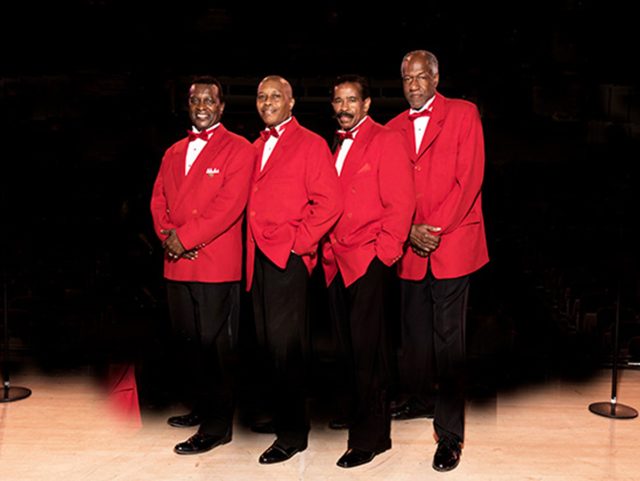
From the comedy of Cornell Gunter’s Coasters to the Motown magic of The Drifters, these two Rock & Roll Hall of Fame groups were instrumental in helping create the rock ’n’ roll/doo wop sound. Few artists can boast a richer musical resume: Together they have been associated with well over 40 of the top tracks from classic rock ’n’ roll history, from “Under the Boardwalk,” “Charlie Brown” and “Yakety Yak” to “Poison Ivy,” “Up on the Roof,” “This Magic Moment” and “On Broadway.”
The Drifters, touring the United States again under the auspices of their original management team, deliver a timeless sound, and Cornell Gunter’s Coasters will have audiences reminiscing about the golden age of rock ’n’ roll. This show has songs to please every palate, delivered just the way you remember from the radio.
Follow the Alys Stephens Center on Facebook and Instagram for the latest performance updates and announcements.
Arts Circle members enjoy benefits including access to a pre-reception in the Abroms Patrons Lounge one hour prior to performance for beverages and hors d’oeuvres. Become a member.
The performance will be at 7 p.m. in the Alys Stephens Center’s Jemison Concert Hall. Tickets are $25, $35, $45 and $59. For tickets, visit AlysStephens.org, call 205-975-2787 or go by the ASC Box Office at 1200 10th Ave., South.
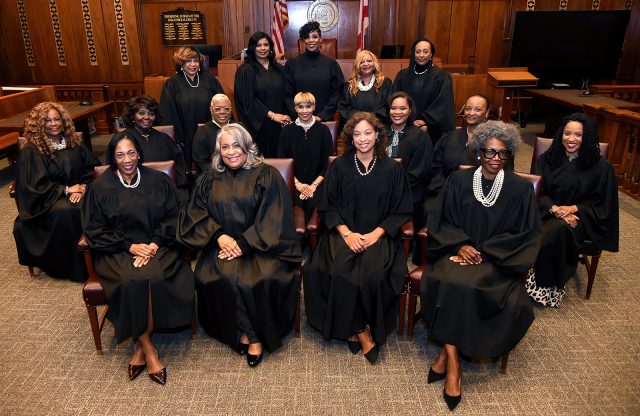
Back Row, from left: Judge Pamela Wilson Cousins (left office Jan. 20, 2025); Judge Debra Weston Pickens; Judge Ruby Davis Clark; Judge Lorraine Pringle (Retired); Judge Maria Fortune. Middle Row, from left: Judge Brendette Brown Green; Judge Patricia Stephens; Judge Marshell Jackson Hatcher; Judge Javan Patton Crayton; Judge Kechia Davis; Judge Janine Hunt-Hilliard; Judge Shanta’ Owens. Front Row:, from left: Judge Agnes Chappell (Retired); Judge Tamara Harris Johnson; Presiding Court Judge Elisabeth French; Judge Annetta Verin (Retired). This photo was taken April, 2022. (Joe Songer, For The Birmingham Times)
By Sym Posey | The Birmingham Times
(Women’s History Month Special)
The 60th Anniversary of Bloody Sunday and the Selma to Montgomery March this week marks a pivotal moment in American history, honoring the foot soldiers who marched for voting rights and changed the course of democracy.
The event commemorates March 7, 1965 when a group of about 525 African American demonstrators gathered at Brown Chapel A.M.E. Church to demand the right to vote. They walked six blocks to Broad Street and across the Edmund Pettus Bridge, where they were met by more than 50 state troopers and a few dozen on horseback. When the demonstrators refused to turn back, they were brutally beaten.
One of the groups at the forefront of this year’s commemoration is Salute Selma, Inc., a women-led, Black-led nonprofit organization that will host number of activities March 7 through 9 dedicated to celebrating Black civic engagement, leadership, and activism while addressing the ongoing fight for justice and democracy.
Those events include a “Call to All Black Women Judges” to assemble at the Edmund Pettus Bridge for an iconic photo on Friday, March 7.
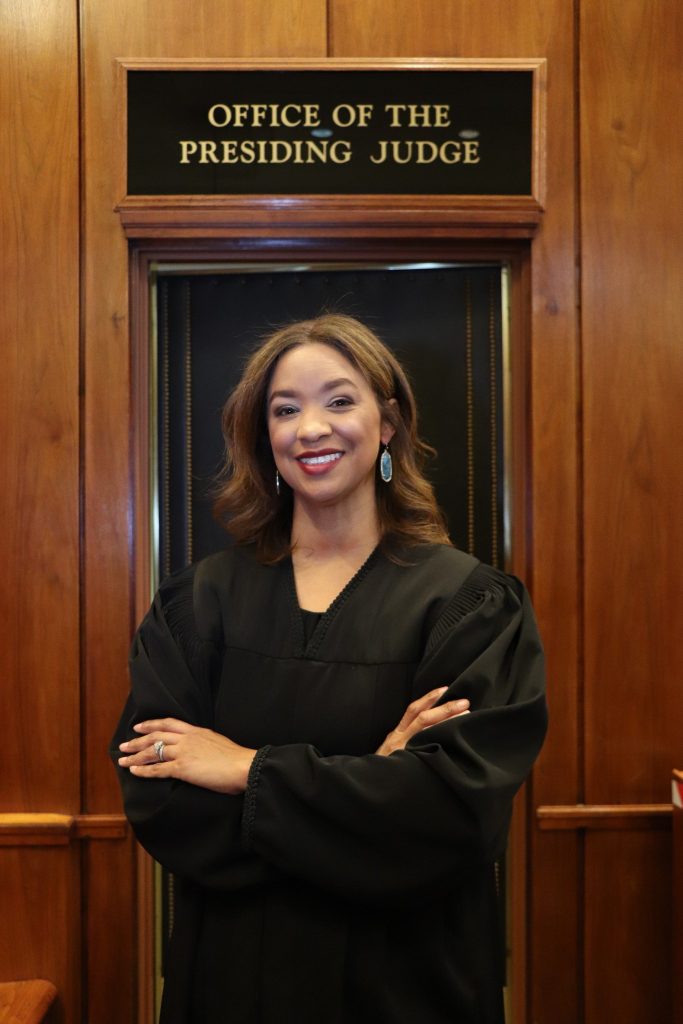
Jefferson County Presiding Judge Elisabeth French. (Provided Photo)
Elisabeth French, Presiding Judge, Jefferson County Courts said the gathering can send a powerful message.
“Often times, young Black students don’t have any lawyers in their family and they don’t know any Judges on a personal level,” she said. “The assembly of this group of Black Judges sends a message that these students can finish high school. They can finish college. They can go to law school and become licensed attorneys. They can see that others who look like them have been successful and that is proof that they too can accomplish their goals.”
“I hope that the photograph encourages and inspires others to push to fulfill their hopes and dreams,” said Jefferson County Judge Pat Stephens, who plans to attend. “In looking at that photograph standing on the Edmund Pettus bridge, I hope it’s a burning flame that never goes out and inspires generations to vote.”
The events of 60 years ago have meaning today, Stephens said.
“We should reflect on the importance of the Selma March because it was tremendous act of courage for the marchers who would not be told ‘no,’” Stephens said. “People who had the courage to say, ‘we won’t give up.’ People who had the courage to say, ‘we want change.’ The courage to say, ‘we have the constitutional right to vote. We have the constitutional right to have a voice in a country that was built on the blood, sweat and tears of the ancestors.’”
Abina Billups, Co-Founder of Salute Selma, Inc. said the rights enjoyed by African Americans today came at a cost “and Selma was at the epicenter of that sacrifice. “We have a responsibility to continue this fight, to honor those who came before us, and to make sure that history is not just remembered — but protected.”
She added, “Selma is sacred ground. The blood, sweat, and sacrifice of ordinary people changed the course of history, ensuring that democracy extended beyond privilege to all. To reflect on that moment is to remind ourselves that the fight for voting rights is ongoing. Commemoration is not just about remembering—it’s about recommitting.”
Billups said that Selma is not just history, “it’s a call to action. We can’t afford to romanticize the past without recognizing the urgency of the present,” she said. “The fight for voting rights, equity, and justice is ongoing, and it demands our collective voice and action. The best way to honor those who marched 60 years ago is to keep marching today.”
Presiding Judge French said the Selma events of 1965 brought national attention to racism and injustice. “It is important to remember that the injustices occurred and to remember why they occurred in order to join together to prevent them from happening again … I want to thank the organizers of this event for recognizing the need to commemorate and for having the courage to continue to stand in the gap for justice, for voting rights and to celebrate the many accomplishments and contributions of Black women Judges.”
Earlier on the day of the photo, the Women’s Legal Symposium will convene legal professionals and scholars for a keynote conversation on democracy and justice. During this event, Salute Selma will present the Legal Guardian of Democracy Awards, recognizing trailblazers including Judges U.W. Clemons, Myron Thompson and Arnette Hubbard; Attorney Fred Gray, and Attorney Ernestine Sapp. A posthumous tribute will honor Birmingham Attorney Arthur Shores, Attorney J.L. Chestnut, and Attorney Michael Figures for their enduring contributions to the fight for Civil Rights.
The Bridge Crossing Jubilee, Inc.
Affectionately called “The Jubilee”, the organization was founded in Selma to commemorate and preserve the spirit of the struggle for the right to vote. The goal is to inspire people of all ages and ethnic backgrounds to respect and appreciate the power of their vote.
Every year the Bridge Crossing Jubilee, Inc., hosts the commemoration of this historic event and the struggle for the right to vote by gathering at the foot of the Edmund Pettus Bridge in a festival of music, art and historical remembrance.
Several years ago, this yearly event was dubbed “The Annual Pilgrimage to Selma.” Tens of thousands of people flock to Selma the first weekend of every March to hear personal stories from surviving freedom fighters from the movement and walk hand-in-hand with history makers who were willing to lay down their lives for the right to have a voice in the country they helped to build. For over a decade the heroes of the movement and a host of other civic, political and national leaders have made the annual pilgrimage to Selma, AL
For over a decade The Jubilee has attracted noted individuals from all walks of life. Past attendees have included: Rosa Parks; Mrs. Coretta Scott King; Former President Barack Obama; Congressman John Lewis; Former President Bill Clinton; Former President George W. Bush; Senator Hillary Rodham Clinton; Rev. Jesse Jackson and Andrew Young.
Tech giant Amazon will be title sponsor of the Magic City Classic in October, it was announced on Thursday.
The rivalry between Alabama A&M University and Alabama State University at Birmingham’s Legion Field is the largest Historically Black College and University (HBCU) football game in the country.
The announcement was made in a packed Birmingham City Council chamber with representatives from the city, Amazon, Alabama A&M and Alabama State and Coca-Cola, which has been a presenting partner for the past decade-plus.
The 84th Amazon Magic City Classic presented by Coca-Cola will kick off October 25, 2025 at Birmingham’s historic Legion Field.
“Today is about continuing a legacy … and we are honored to have Amazon as the sponsor of the Magic City Classic, an event we define is the personification of Black culture,” said Mayor Randall Woodfin. “ … it’s all about celebrating the power of Black colleges and universities and Birmingham is proud to forever be the epicenter of this celebration … We thank Amazon for joining in on what is the best thing happening in Birmingham.”
City officials said the Classic generates $23 million in economic impact; 36 states have purchased tickets, and the game routinely attracts 65,000 in attendance and another 60,000 tailgating outside the stadium.
“We’ve had over 83 years of Classics and this partnership will only make this event better,” said Perren King, Executive Director of the Magic City Classic. “By joining us Amazon is supporting these two schools’ legacy of excellence and invested in the future.”
He added that the partnership represents a shared commitment to education, diversity and economic growth in Birmingham, he said. “We look forward to working with Amazon to elevate the Classic experience for our fans and the broader HBCU family.”
Donetta Houser-Sly, HR Director, Amazon North America People Experience & Technology, the game not only unites the community but also celebrates the rich legacy of HBCUs which have been “pillars of academic excellence and leadership development for over 150 years … and Amazon, as a great partner with HBCUs, is committed to ensure they are growing and developing.”
Previously, McDonald’s was the presenting sponsor of what officials say is the most lucrative HBCU game in the country.
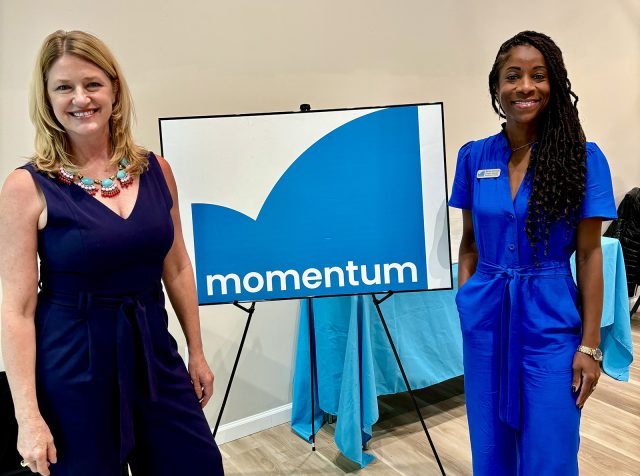
April Benetollo, left, Momentum CEO, and Raven Holloway, Momentum Works Program Manager. (Provided)
By Je’Don Holloway-Talley | For The Birmingham Times
(Women’s History Month Special)
Momentum Leaders’ CEO, April Benetollo, almost turned down her nomination to join its 2013 Executive Class.
When she was nominated, she wasn’t sure she needed it. At the time, Benetollo was a seasoned leader at Daxko, a Birmingham-based software company, and had already climbed the corporate ladder, holding high-level roles in marketing, product strategy, sales, and human resources for over 16 years.
She was reluctant “for a lot of the reasons that we hear all of our Momentum women say,” Benetollo admitted. “‘I don’t have time to dedicate to that.’ ‘I didn’t feel like I necessarily need it’. I had a host of reasons for not wanting to participate.”
But something pulled her in. And on the first day of her Momentum retreat in 2013, she realized she had been missing something vital all along.
“I was stunned by the caliber of women that I was surrounded by, and was deeply moved to be in a room of such high-powered, influential women who also had the same sort of struggles and obstacles and doubts and fears and hopes and dreams that I had,” she said.
It wasn’t just about career advancement. Momentum gave her something she hadn’t realized she needed: a space where leadership, personal growth, and sisterhood intersected. It was a place where women weren’t just succeeding in their careers but learning how to navigate the unique burdens of leadership as women, mothers, and community builders.
April Benetollo Momentum CEO, is a Birmingham native and Ramsay High School graduate. (Provided)
Unpaid Office Work
Benetollo, a Birmingham native and Ramsay High School graduate, attended the University of Alabama, where she earned a bachelor’s degree in international studies with a minor in French. The C-suite executive, wife to Emmanuel Benetollo and mother of two — ages 22 and 20 — spoke candidly about the unseen and unsung challenges professional women face, emphasizing that they are expected to be nurturers not only at home but also in the workplace.
“Women do an extraordinary amount of unpaid office work [from] organizing parties and doing the things that women are naturally led to do [such as] nurturing and caring for people, showing people that they matter, encouraging people— we do all of those things in every aspect of our life,” said Benetollo.
“So it poses some interesting challenges in the workplace when you’re the one responsible for being at all of the family events, being at all the kids’ doctor’s appointments, being at all of your mother’s doctor’s appointments, being at all your dad’s surgeries, and the list goes on and on…”
Inspired by her experience, she volunteered with Momentum after leaving Daxko, eventually taking on a part-time role in marketing and strategy. When Momentum’s founder, Barbara Royal, announced her plans to step down—what she called a “pro-tirement”—she encouraged Benetollo to apply for the CEO position.
Benetollo applied and in what she calls her “great fortune,” in 2017, she was chosen to lead the very organization that had transformed her own career path.
Founded in 2002 by Barbara Royal, Momentum was created to fill a void. Women at the top had few peers, no leadership networks, and often navigated their careers alone. The program started as a high-level executive leadership course but over the past 22 years, it has expanded to support women at all career stages.
The Evolution of Momentum
Now, Momentum is Alabama’s leading women’s leadership organization, offering a range of programs tailored to women at different career stages. The Executive Leadership Program is a nine-month development experience designed for high-level executives, while Upward focuses on early to mid-career professionals, equipping them with the confidence to step into leadership roles.
Additionally, Luminary Women serves as a networking initiative that connects senior-level women leaders, fostering mentorship and collaboration. Momentum Works, a newly launched cohort-based program, provides leadership training for women in the workforce who might not otherwise have access to such opportunities.
Momentum Works is a tuition-free program designed to help participants develop the skills and confidence needed to grow both personally and professionally. The program spans six months, with half-day Saturday sessions. The curriculum covers: Emotional Intelligence, Strengths Assessment, Resilience, Taking Initiative, Negotiation, Prioritization, and Building Community.
Participants like LaPorsche Jymi leave the Momentum Works program with a stronger sense of self, a deeper network, and a clearer path forward.
Momentum Works taught her to trust herself and her vision for her brand
H&H (Headwear and Hair Care) even more, Jymi said.
Momentum Works re-energized her faith in her business and that she had something unique to offer the market. “That’s why I love the name Momentum,” Jymi said. “It gives you that momentum to keep going. And when you can’t, it connects you to a pool of women that can pour into you at any time.”
To learn more about Momentum Leaders, visit: www.momentumleaders.org, and find them on Facebook, Instagram, LinkedIn and YouTube, @momentumleaders.




 City officials said the Classic generates $23 million in economic impact; 36 states have purchased tickets, and the game routinely attracts 65,000 in attendance and another 60,000 tailgating outside the stadium.