Home Blog Page 1196

Naturally Beautiful

0
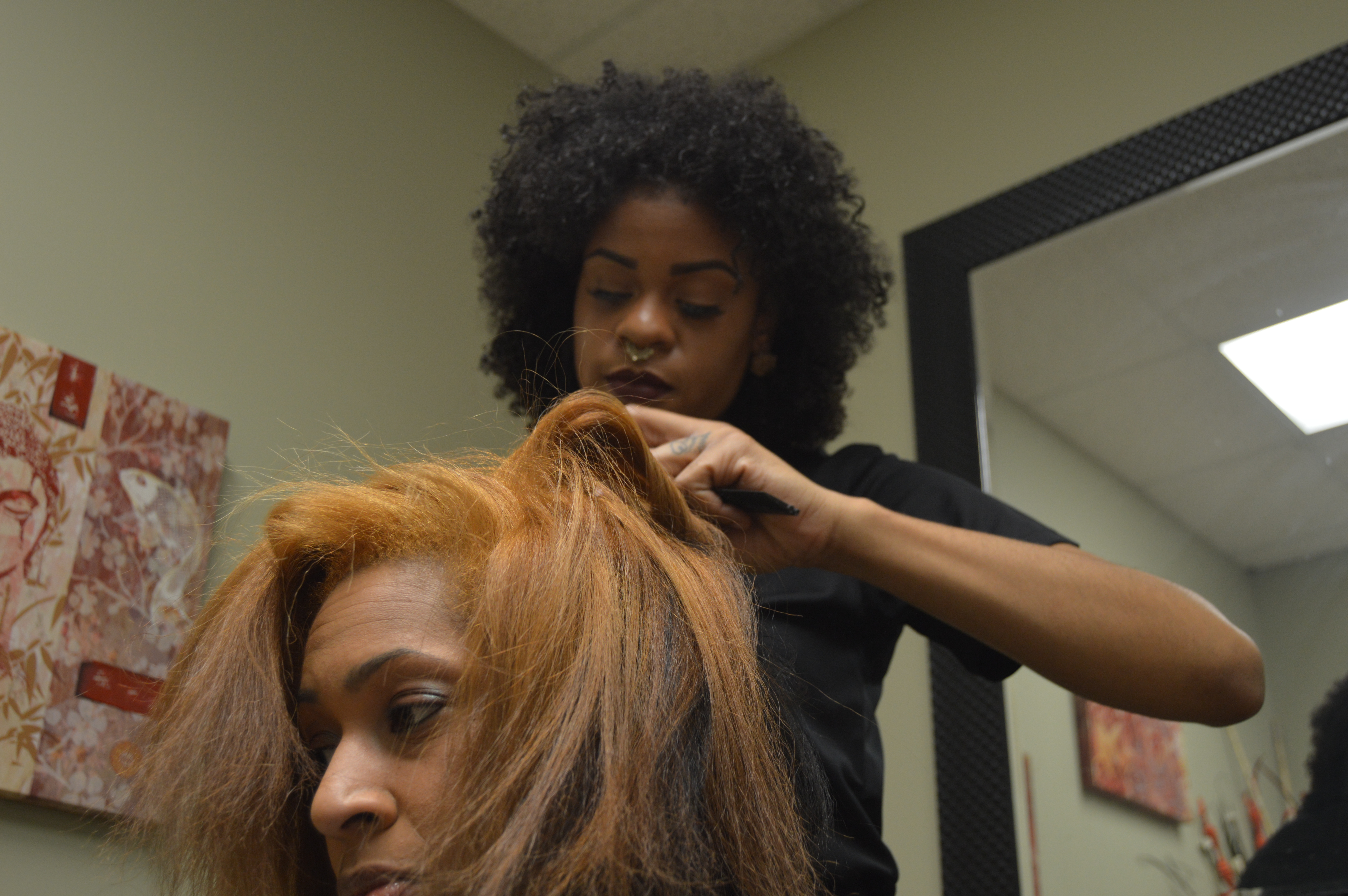
Charlie Maxine prepares to do a blowout to a clients hair. Clarie is a natural stylist at Natural Elements in Homewood. JOSEPH KENNEDY PHOTOS, SPECIAL TO THE TIMES.

How professional women put glam in the hair care movement 

By Ariel Worthy

Times Staff Writer
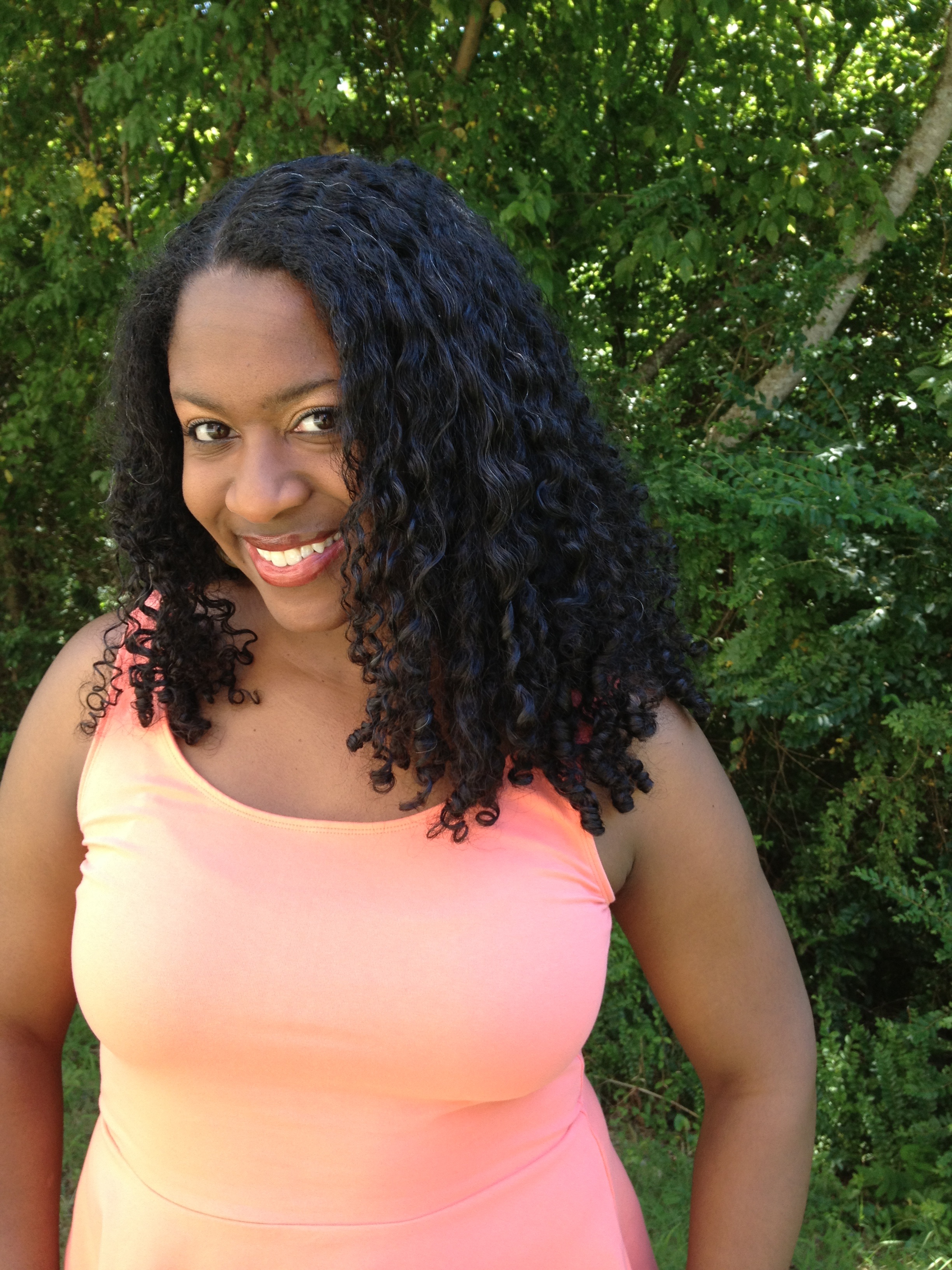
Javacia Harris Browser has been natural for 14 years. For Browser, her reasons for being natural are now political. COURTESY PHOTO.
Javacia Harris Browser has been natural for 14 years. Bowser believes that hair is only part of women celebrating themselves in their natural state. (COURTESY PHOTO)

 For decades, black women have been told that their natural hair— unaltered by chemical straighteners, such as relaxers and texturizers—is unattractive. And, for years, some believed it … until recently.

 In the mid-2000s, the natural hair movement took root in the black community and reminded men and women of color that their hair in its natural state is beautiful and healthy.

 Natural hair artist Shawn, owner of Natural Elements, a Homewood salon specializing in natural hair care and styling, said she has seen many women go natural for health reasons.

 “A lot of people don’t like to tell you ‘I’m going natural because of chemotherapy’ or because of medications they take,” said Shawn. “A lot of the baby boomer generation is going natural because they don’t have a choice. That’s one of the reasons I got into natural hair.”

 Everyone’s natural hair journey is different. Shawn’s began with a haircut 16 years ago.
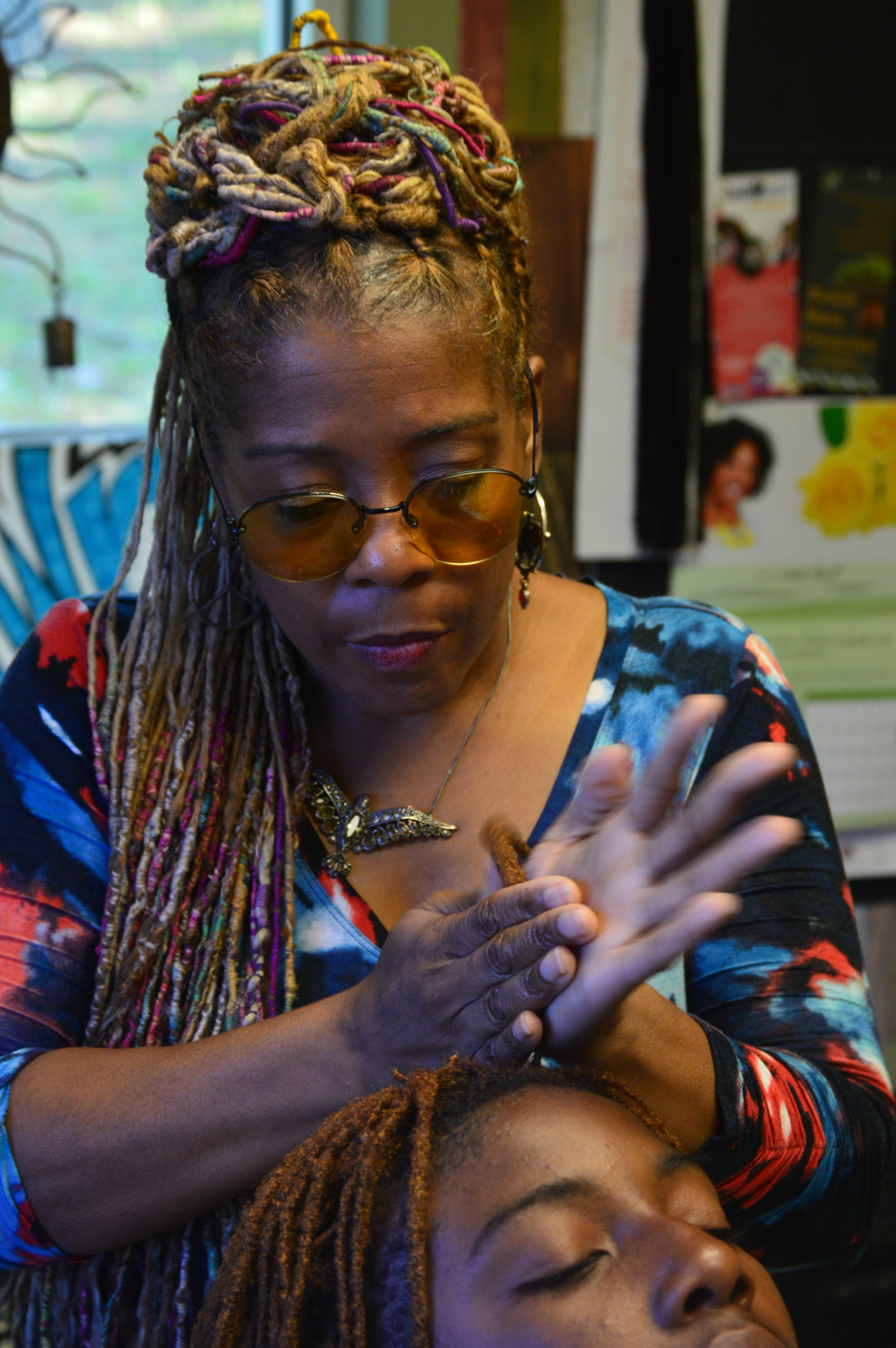
Natural Element owner Shawn re-locs Ahmari J.s hair. Shawn has been natural for over 16 years.
Natural Element owner Shawn re-locs Ahmari J.s hair. Shawn has been natural for over 16 years. (JOSEPH KENNEDY PHOTOS, SPECIAL TO THE TIMES)

 “I sat in the mirror one day and started cutting,” she said. “I had a beautiful texture of curly hair. That was the first time I got introduced to my hair. That was the first time I met me.”

 Natural hair is not a new phenomenon in the black community. The movement, in fact, has roots dating back to the early 20th century.

 Today, natural hair is also showcased in influential media outlets— including magazines like Essence and Black Enterprise, and online blogs like Madame Noire and NaturallyCurly.com — as well as at hair shows and expos nationwide. For the past five years, Birmingham has hosted the Natural Hair and Health Expo, which attracts thousands of women to the Magic City.

The Choice is Yours

Thanks to the natural hair movement, women have myriad resources available if they choose to sport their kinks and curls. Whatever the reason for the decision, though, it’s important for women to know it’s OK to go the natural-hair route.

 “Some women may have decided to wear their hair natural for a trend or a fad, and that’s OK,” said Javacia Harris Bowser, 35, who has worn her hair natural since 2002. “I think we need to let that be OK.”

 Bowser, who is founder of See Jane Write, a popular local blog, chose to go natural out of frustration.

Charlie Maxine prepares to do a blowout to a clients hair. Clarie is a natural stylist at Natural Elements in Homewood. JOSEPH KENNEDY PHOTOS, SPECIAL TO THE TIMES.
Charlie Maxine prepares to do a blowout to a clients hair. Clarie is a natural stylist at Natural Elements in Homewood. (JOSEPH KENNEDY PHOTOS, SPECIAL TO THE TIMES.)

“Growing up, I lived in a household where straight hair was considered pretty hair,” she explained.

 Even with a relaxer, however, Bowser still had to straighten her hair — and the process would take hours.

 “When I was 21, I was an intern, and it would take me forever to get ready for work,” said Bowser, who is also an English teacher and freelance writer. “One day, when I was going through my three-hour straightening process, my roommate looked at me and said, ‘Why don’t you wear your hair curly?’ No one in my 21 years of living had ever suggested to me that it would be OK for me to just let my hair be the way it naturally is.”

 WVTM-13 news anchor Eunice Elliott chose to go natural for health and professional reasons.

 “I had a perm for 30 years, until about two years ago, after I had gotten a job on TV,” said Elliott. “I was putting heat on my hair every day, so my hair wasn’t healthy. I decided to give my hair a year off, and I wore a wig on TV.”

 Elliott said her intentions were never to go natural. She just wanted to give her hair a break. Throughout the process, though, she enjoyed learning about her hair.

 “While learning about it, I got to a point to where I knew I would never relax my hair again.”

Driving Forces

 Women who have observed how the natural hair movement has taken off have credited it to many things. Some say social media played a role.

 “I think with social media, you’re able to see more,” Elliott said. “I think it’s also taken off because as you get older you want to spend time doing other things besides sitting in a hair salon. Trying to have your hair look a certain way requires a financial commitment and a time commitment. When you’re natural, you have more versatility with your hair, and you actually get more creative.”

 Bowser feels the natural hair movement started with frustration, and social media is only part of it.

 “Women, overall, are tired of people telling us what we should like. I think that is especially true for women of color,” Bowser said. “We’ve been told the way we look naturally — our hair, our noses, the size of our lips — is wrong. I think we’re just sick of it.”

With social media, Bowser thinks it is helping because of the blogs, images and YouTube for hair tutorials.

“We can scroll through our Instagram now and see all of these beautiful brown women, of all different shapes and sizes and all different kinds of hairstyles,” Bowser said. “And you see it and say, ‘wait, this is beautiful, so why don’t I think this is beautiful when I look in the mirror? And eventually you do; you recognize the beauty you see on your phone and you recognize it in the mirror, too.”

Natural hair is just one element of women accepting themselves for who they are, according to Bowser.

 “Women are not only accepting themselves but also celebrating themselves,” Bowser said. “We’re saying, ‘I don’t care what you think. I am beautiful whether you think so or not.’ ”

Evolve or Get Left Behind

  Hair artist Shawn feels the natural hair revolution has forced a lot of stylists to learn new hair techniques.

 “It’s time to either step into the 21st century or get left behind,” Shawn said.

 A few misconceptions have come with the natural hair revolution, Shawn said. One being that it is easy to take care of and requires little maintenance.

 “You still need to take care of your hair,” she explained. “You can’t just wake up and think it’s OK and it’s cute because its natural. A lot of maintenance is required with natural hair.”

 Another misconception: People think everything they see on YouTube will work for them, as well.

 “I think YouTube is dangerous. We have to correct a lot of hair because of YouTube,” Shawn said. “It’s deceiving. It’s just like finding a doctor. Would you find a doctor on YouTube and try to operate on yourself? YouTube is kind of like Craigslist for natural hair: buyer beware.”

Professional Advice

 When it comes to natural hair in the workplace, the debates and discussions are ongoing. One common question: Is natural hair acceptable in a professional setting, or is it is a distraction?

 “You have to know where you work,” Shawn said. “The first thing I ask a client is what kind of work they do. I need to know whether you’re a nurse or lawyer. There are different looks for different professionals.”

 Elliott feels natural hair isn’t unique when it comes to professional presentation.

 “People who don’t have natural hair can be considered unprofessional because their hair is purple or reaches the ceiling,” she said. “I think you always want to look well-groomed. If you have an afro, make sure that afro is well-groomed. Professionalism comes from a grooming, not a style.”

 In Elliott’s profession, everyone’s appearance is scrutinized —blacks and whites. “When I went natural, I didn’t have a discussion with my managers or bosses before I took my wig off,” she said. “And they didn’t have a discussion with me afterward. They have never had a conversation with me about my hair.”

 Bowser said her hair has helped in professional situations, especially when networking with other black women.

 “I am aware that I have ‘safe’ natural hair,” Bowser said. By “safe,” she means her hair texture is similar to that of whites with curly hair, so people are more accepting.

 “With other black women, my hair becomes an icebreaker,” Bowser said. “If I walk into a room full of black women who are natural or thinking about going natural, there is going to be a conversation because they want to know about my hair.”

 Shawn feels it is important for women to know that they have options with their natural hair, especially when it comes to their careers.

 “You can wear a wonderful blow out,” she said. “You can do a flexi-rod set, and it be just as beautiful and bouncy. Some people are natural, and most people have no idea.”

Hair-Raising Questions

Eunice Elliot has been natural for 2 years. For Elliot, her reasons for going natural were for health and job reasons.
Eunice Elliot has been natural for 2 years. Elliot never intended to go natural, just give her hair a break (COURTESY PHOTO)

 When not in a professional setting, Bowser said she gets more questions from black people than white people — and not all of them are good questions.

 “I get ‘What are you?’ a lot because I’m dark-skinned with hair like this,” she said. “I also get ‘What island are you from?’ I usually respond, ‘I’m from the isle of Ensley.’ ”

 Bowser said a lot of people also question whether her hair is actually hers.

 “My hair is what people foolishly call ‘good hair.’ I don’t like that term,” Bowser said. “Because my hair is long and in ringlets and because I’m black, people assume it’s not my hair.”

Hair Today, Gone Tomorrow?

 More and more people in the black community are choosing to wear their hair naturally. But some wonder whether this is simply a fad or if the trend is it here to stay.

 “People have been asking that question for more than a decade, and the fact that they have been asking for more than a decade is proof that it’s here to stay,” Bowser said.

 “For so many women, it’s more than fashion. That’s why it’s here to stay.”

  Elliott believes that as time goes on, people will continue to experience and embrace different types of beauty, and natural hair will take different forms.

 “Right now, it’s considered a fad because of social media and the marketing being driven toward natural-haired women,” Elliott said. “If you watch commercials with black women, their hair is natural. I don’t think it’s a fad, but I think that over time people will become more accustomed to it.”

 Shawn feels natural hair will be here for a long time, particularly now that the fashion industry has caught on. The fact that so many natural hair products exist is proof that natural hair isn’t going anywhere.

 “They have made our jobs easy,” Shawn said. “Anything I can dream up, they already have product for it.

Natural hair stylist Kayla Vaughn re-locs her client Rico Vaughns hair. Kayla is a stylist at Natural Elements in Homewood.
Natural hair stylist Kayla Vaughn re-locs her client Rico Vaughns hair. Kayla is a stylist at Natural Elements in Homewood. (JOSEPH KENNEDY PHOTOS, SPECIAL TO THE TIMES)

 “It’s wonderful to give a woman with a beautiful head of hair, who thinks she doesn’t have a lot of options, a beautiful style,” Shawn said. “When she goes out into the world and they tell her how beautiful her hair is naturally, that’s a healing process.”

Natural hair tips for beginners

0

By Ariel Worthy

Times staff writer

53697877fa

Nothing is more liberating than wearing your hair the way it naturally grows out of your scalp. However, a lot of women come to it years after wearing hair that may be damaged or rocking styles that have a different set of rules. While there are a lot of blogs and hair advice out there, it can be hard to know what is best for your hair, and it requires a lot of trial and error. Here are a few common mistakes that new naturals make.

  • ν Looking at the length. It can be hard not to do it, especially if you have gone through the big chop, but if you spend your days worrying about how long your hair is getting and using any means necessary to stretch it out (using blow dryers and flat irons), not only are you potentially damaging your hair, but you’re are stressing about your hair when you could be enjoying it. There are a number of styles for each length and each length has its positives—don’t miss them because you can’t appreciate where you hair is right now.
  • ν Using the wrong tools. It might come as a shock that the brush that said it is good for natural hair might not be good for your hair. That paddle brush may feel good on your scalp, but there’s a good chance it’s shredding your ends if you’re using it to detangle. Look for tools that are good for your hair texture, and not someone else’s. The same goes for products. Just because a protein-rich moisturizer is good for your friend’s curls, that does not mean yours won’t end up feeling like straw. You don’t have to be a product junkie to discover what works for you, but it is worth it to try different products over time.
  • ν Not trimming it enough. If you don’t straighten your hair often, it is easy to go months, even years, without getting a proper                                                                                       trim. But the daily demands of manipulating your hair, from detangling to twisting, can cause damage to your ends. Left alone, the damage can split up the shaft and make things look raggedy up top. How often your hair needs to be trimmed depends on your hair and how you handle it, but every six months is a good rule of thumb. Also, it is encouraged that you go to a professional to have your ends trimmed. You don’t want to snip away and cut too much.
  • ν Overdoing the heat. The versatility of natural hair is one of the best things about it, but applying daily heat is a guaranteed recipe for damage. In fact, many women who use flat irons frequently find that over time, their hair doesn’t curl up quite the way it used to.
  • ν Not moisturizing enough. Natural hair has a tendency to be dry. So it’s vital to impart moisture and seal it in. From your wash-out conditioner to your leave-in to your daily moisturizer to your oil, liberal use of hydrating products (and water itself) will keep your hair elastic and healthy.
  • ν Not detangling. Skipping detangling is a recipe for, well, tangled hair. Every time you shampoo, you should apply a slippery conditioner and work a wide-tooth comb (or your fingers, depending on your texture) through your strands. You’ll find that you shed less and your hair is easier to manage throughout the week.

100th celebration of Booker T. Washington draws diverse visitors to Tuskegee

0


By Solomon Crenshaw Jr.

Special to The Times


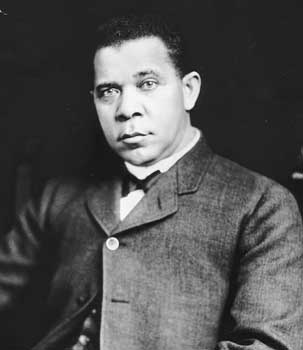
They came from about a dozen states and a variety of nations, religions and cultures for “The Inaugural National Forum on Race” as part of the 100th anniversary celebration of the life of Booker T. Washington, the first president of Tuskegee University.

No place in America has been more effective at dealing with race than Tuskegee during Washington’s tenure, said Johnny Ford, mayor of the city where the university is located.

“If you think that race is an issue now, it was more of an issue back then,” Ford said. “But Booker T. Washington had a way of rising above race and the difference between blacks and whites, even Native Americans. He had a way of blending and changing the system from within and from without.”

Washington founded Tuskegee in 1881 and served as its first president until his death on Nov. 15, 1915.

On Sunday, about 50 people took a modest first step to address issues related to race in the forum at the Tuskegee Airman National Park Auditorium.

Dr. Stuart Weeks, founder of The Center for American Studies at Concord, MA,

said race relations would be no problem if people kept their eyes closed.

“We would have realized how superficial on the surface this issue really is,” he said. “I understand when people say this is a big issue.  Booker T. Washington himself said this is a big issue.”

The conversation will continue in other places, including Charleston, S.C., Philadelphia, Pa., and Los Angeles, organizers said.

“We purposely came here to the spiritual home, in many people’s eyes, of my black brothers and sisters to do this here,” Weeks said. “This is the inauguration of the National Forum on Race: Keeping the Faith.”

Weeks said Washington’s spirit is alive and well. He said the educator, author, orator, and advisor to U.S. presidents would say society today could do a lot better in race relations.

“I think he would say there’s still room to be better,” he said, before quoting Washington. “Tuskegee was a place where without racial bitterness, but with sympathy and friendship, with the aid of the state, with the aid of black men and white men, with Southern help and Northern help, we are trying to assist the nation in working out one of the greatest problems ever given to men to solve.”

Tuskegee art professor Dr. Ronald S. McDowell said the event was the first brush of painting a brighter picture in race relations. He noted the diverse group that included persons from various nations, religions and cultures.

“Booker T. Washington said it is better to light a candle than to curse the dark and that’s what we’re trying to do here,” McDowell said.

Robert E. Smith, 75, former editor of the Southern Courier, a weekly newspaper founded in Montgomery to cover the Civil Rights Movement, said he is not satisfied where race relations are today.

“It’s all white versus black – white employers with disregard for black employees,” he said. “I’ve seen many attempts to try to get a fresh start at this and it’s all commendable. But as an older person, I guess, I’m a little frustrated.”

But, Smith said, it has to start somewhere.

“Even in a room like this,” he said. “And this might be it.”

Howard Comen, from Charleston, S.C., said he was thrilled listening to the heartfelt conversations. However, the message couldn’t stop in that auditorium, he said.

“What we do here isn’t going to make a bit of difference unless it gets out into the general public,” he said.


Miles’ golf program has come long way under retired Marine

0


By Rick Scoppe
Special to The Times

milespix0407


Two years ago in its inaugural season on the links Miles College finished, as its coach said, “dead last” by 39 strokes in the rain-shortened Intercollegiate Golf Championship with a team that had a football player as its fifth man.

Last year the Golden Bears improved, finishing 11th out of 14 teams in the consolation championship while Oglethorpe was claiming its third straight title at Paradise Point Golf Course aboard Camp Lejeune.

So what does this year hold for the NCAA Division II school from Fairfield, Ala., with about 1,600 students?

Well, for starters, the Golden Bears are coming off their first tournament title – remember, this is just the team’s third year in existence – after claiming the LeMoyne Owen Golf Classic in Tunica, Miss., last month.

While he deflects the credit to his players, the architect of this program is 54-year-old Leonard Smoot, who retired as a chief warrant officer after 24 years in the Marine Corps.

Smoot was never stationed at Camp Lejeune, nor has he to this day ever played Paradise Point. He was, however, the third African-American to make the USMC golf team back in 2002 when stationed in Okinawa. While he was more than willing to talk about the past, Smoot was focused on the present and his team’s chances at Southern Intercollegiate Athletic Conference Championship, which begins April 18.

“I’ve finally got a good core of players that will be able to compete this year,” Smoot said. “Being a Marine, it’s always about to me developing young men to be the best that they can be. We now have a solid golf team. I think we’ll compete very well.”

Under Smoot, the Golden Bears have come a long way in a short time. After retiring from the Marines, Smoot “never” thought he’d be a college golf coach.

“It was in my heart to be at the high school level or ‘First Tee’ teaching or something like that,” he said.

‘Great opportunity’

Smoot knew the Miles College president and knew the school was looking to add golf to its sports programs. So he talked with the president and interim athletic director, telling them it would be a “great opportunity … to bring in a golf team to add some prestige to their institution, that being a historically black college.”

Soon enough, the president asked if Smoot could make a 10 o’clock meeting.

“I said, ‘Yeah, I’ll be there,’” Smoot recalled. “The rest is really history.”

Before the budget had been established for the new sport, Smoot hit the road in May to do some “surveying” of the available talent. By August he had four players along with an inside linebacker from the football team.

“I was very proud to have him on the team, even though he wasn’t a golfer,” Smoot said. “He had heart. His character as a leader was there, despite the fact that he was getting his head beat in by golfers instead of being an inside linebacker on the football team.”

‘Being humble’

Smoot was asked what the toughest thing has been about starting a new golf program.

“Just the fact that you have to humble yourself,” he replied. “You always want to win. But humbling yourself, seeing yourself getting beat up and just knowing at some point things are going to get better and then continuing to motivate your team to help them realize there’s a bigger picture than just golf. It’s about how you are as a young man and what you are going to take forward as you move forward in your life.

“That probably was really our biggest challenge, being humble and saying things will get better.”

While from the outside the progress might seem better than expected, Smoot said the team is where he thought it would be in its third year. A year ago the Golden Bears began to show inklings of their improvement by finishing second in the Southern Intercollegiate Athletic Conference tournament after being in third place, 13 strokes back, heading into the final day.

“That just shows it’s about perseverance and keep grinding as you compete, and I never count my football player … so we were always one guy short,” he said. “But you just do your best with what you have.”

Along with having no plans to be a college golf coach after retiring from the Marines, Smoot, who was stationed at one point at Cherry Point, didn’t start out as a golfer, either. In fact, he didn’t take it up until he was in his late 20s after watching his “bosses” play the game.

“I picked up in the sport late, real late,” he said.

But not too late. While stationed in Okinawa, he competed for a spot on the USMC golf team – and he made it by “one stroke or two” on the final day.

“That,” he said, “was a phenomenal opportunity. That’s an honor.”

‘A player’s coach’

Smoot, who also boxed on the USMC team based in Okinawa, considers himself a “player’s coach,” one who is concerned with their success on the course and the classroom – and beyond. And that is why after learning of the Intercollegiate Golf Championship, he wanted his players to experience it.

Otherwise, he said, “those kids would never get an experience of being around military personnel and retirees so they can hear a story from a different perspective than just a civilian’s perspective and help them grow as young men. That was my main goal.

“I didn’t even know that tournament existed until I started doing my research and wanted to find tournaments to play in. When that one came up I said that’s the one we need to play in. … I just think it’s something that will carry with my guys for the rest of their lives, and they say that’s the best tournament they play in because of that experience.”


Housing Authority basketball camp helps girls reach hoop dreams

0


By Joseph D. Bryant

Housing Authority of the Birmingham District

hoop1


Music echoed through the gym at Cooper Green Homes, blending with the sound of bouncing basketballs and the shrieking of shoes across the floor as more than 80 girls spent part of their spring break refined their “skills and drills.”

Children from HABD communities throughout Birmingham participated in the Housing Authority of the Birmingham District’s Skills & Drills Basketball Camp. The workshop March 30-31 included girls 7 to 18 who received one-on-one training and encouragement.


The workshop is part of the “GIRLS,” Girls Involved in Recreation, Leadership and School program by HABD. Standout basketball players from Wenonah High School were the in-house experts.

Among those players was Kaitlyn Rodgers, a senior from Wenonah High School and a prized college recruit heading to Ole Miss next fall. Rodgers was courted by several schools including The University of Alabama, East Carolina, Virginia Tech, and Southern Miss.


Rodgers in 2015 earned the title of Birmingham Metro Player of the Year.

“I want them to know that you can do whatever you want to do,” said Rodgers, who plans to major in broadcast journalism. “They can respond well to me because I’m like them. It is something fun to do on their spring break.”

While the program centered on athletics, organizers said there was much larger purpose.

“We want to surround our girls in an environment that promotes not only athletic achievement, but also high self-esteem and personal achievement in whatever category they aspire to dominate,” said HABD Director of Resident Services, Galvin Billups. “Sports is the theme to promote these larger concepts.”

The sports workshop was a first for Kiara Little, a 5th grader at Oxmoor Valley Elementary and a resident of Kimbrough Homes.

“I enjoyed it because I got to learn more about basketball and I got to meet people I didn’t know,” she said.

Little said she especially enjoyed the pre-game warmups.

“We had to run up the hills and back. That made me tired, but I didn’t get too tired,” she said. “It was a good experience because I never got to do anything like this before.”

Little said she plans to play basketball in high school.

Before the first ball hit the floor, the girls received some sporting and life coaching from Wenonah High School coach Emanuel Bell. Bell stood near three state championship trophies and displayed his championship rings as tangible rewards of hard work and dedication.

“Pray and play,” he said. “You pray for it and then you go and play for it. You’ve got to get your brain mentally ready to take on the challenge.”

In his no-nonsense style, Bell also stressed the importance of balance by student athletes.

“Let me break it down for you. If you don’t get your lesson, you can’t play no basketball,” he said.

The first physical activity was led by HABD Recreation Director Darius Hall. Grabbing a cordless microphone with one hand and his other outstretched, Hall woke up his new recruits as he called out workout directions. But even he couldn’t keep a straight face as the girls sprinted down the court, trying to keep up with his directions.

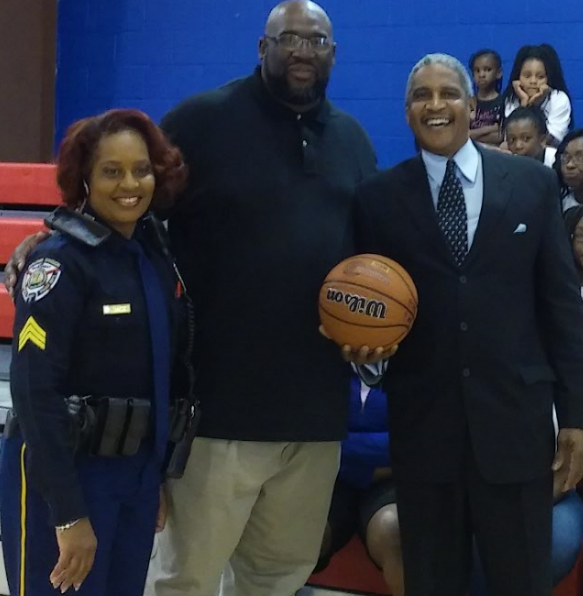
Standing on the sideline, HABD Board of Commissioners Chairman Cardell Davis had already traded in his tie, dress shirt and slacks for sweatpants and a t-shirt.

“The biggest benefit is giving these girls a chance to have camaraderie and getting to be with other girls from the housing authority community,” Davis said just before joining the girls on the court. “They’re also getting to learn skills from some of the top basketball players in the state. This is a perfect mix.”

HABD President Michael Lundy also spent time observing the action and meeting the young players.

“It is refreshing to be in room filled with so much energy,” he said afterward. “Our kids are enjoying themselves in a safe environment surrounded by both peers and mentors. This is just another way we can all work together to uplift our youngest residents and inspire them to succeed in the gym, in the classroom and wherever else they chose to go.”

Birmingham-Southern track and football star is off and running

0


By Solomon Crenshaw Jr.

Alabama NewsCenter

Jamalpix0407


Jamal Watkins said having his mother present last month when he competed in the NCAA Indoor Track and Field Championships was like receiving a late birthday present.

The Birmingham-Southern College sophomore made it a present to remember with a runner-up showing in the 60-meter final at Grinnell (Iowa) College. His second-place time of 6.76 was just 0.03 seconds behind national champion Alex Koenen of Wisconsin-La Crosse.

Watkins ran a 6.72 in preliminaries, which broke the Grinnell College facility record of 6.75, set in 2012.

Army Sgt. 1st Class Margaretta Watkins had been stationed in Kuwait for nine months. She had not seen her oldest son perform athletically since he transferred from Dodge City (Kansas) Community College, where he played football.

“It was almost like a birthday present for me even though my birthday is in January,” Watkins said. “It was a birthday present for her to get back days before nationals so she was able to come up and watch me compete.”

The feeling was mutual.

“It was more like an early birthday present for me,” Margaretta Watkins said. “My birthday was March 20th so just to receive that prior to my 45th birthday … It was more a birthday present for me.”

The senior non-commissioned officer at Fort Riley, Kansas, had long told her older son that he should compete in track. She had seen his running ability on the football field.

“At that time he was young and he didn’t want to do track,” she recalled. “I was very excited that he had taken an interest. And not just an interest but that he had excelled in it.

“I knew he had the speed on him at an early age, maybe 10, playing football,” the mother continued. “But I did not know he had matured so well in his running style. I was amazed at how well Jamal has developed.”

Watkins had been looking for Division I or Division II options for continuing his athletic career when BSC sprinter Cedric Campbell challenged him to consider the Panthers. The two were close friends at Georgia’s Dutchtown High School; he even moved in with Campbell when his mother was in Kuwait.

“He just said, ‘I bet you won’t apply,’” Watkins recalled. “It doesn’t take much to motivate me.”

The move to Birmingham was productive for the sophomore as he led Birmingham-Southern football in receiving with 40 catches for 567 yards and six touchdowns in the 2015 season. The highlight of his first BSC football season came Sept. 14 in a 35-34 victory over Huntingdon College in which he scored three touchdowns.

Two of those TDs came on back-to-back, fourth quarter kickoff returns of 92 and 93 yards. He finished with a game-high 289 all-purpose yards.

But track coach Ken Cox saw greater potential.

“I said he would shine even more in track and field,” he said, “and that was before the indoor season even started.”

Cox proved to be a prophet as Watkins’ times dropped from his first meet to his second, and then to his third.

“He’s like a sponge. Everything I’ve told him to do technique-wise, start-wise, mentally and physically, he’s done it well,” the coach said. “For that, he was rewarded at nationals.”

Watkins said there could be a benefit to falling short of the championship, giving him some success with motivation to improve.

“It sucks but it was close,” he said of the photo finish. “I’m blessed to have outdoor to go through it all again and this time come back with the gold to BSC.”

Criminal Justice Reform Snagged in Campaign Politics

0


By Dee Hunter

Urban News Service

reformpix


Planned reforms to federal drug and sentencing laws that imprisoned many African-Americans have become locked up by election-year politics.

“The cost of incarceration and a growing awareness of the problems with mandatory minimum sentences have created a diverse coalition calling for reforms,” said Kevin Ring, of Families Against Mandatory Minimums.

Reform supporters span civil rights advocates, law enforcement organizations, numerous federal judges, conservative groups and even Republican stalwarts, the Koch Brothers. Eighty percent of American voters support ending mandatory minimum sentences for drug offenses, according to a February Pew Charitable Trusts poll.

President Obama has made this issue a priority. He issued an executive order in January to prohibit solitary confinement of juveniles. He discussed criminal justice reform in his latest State of the Union address, and pardoned 95 federal inmates at Christmas. He also became the first president to visit a federal prison.

Several relevant bills enjoy broad bipartisan support in Congress. The Senate Judiciary Committee approved the Sentencing Reform and Corrections Act of 2015 by a 15-5 vote last October.

Judiciary Chairman Chuck Grassley (R-Iowa) introduced this legislation, which enjoys 28 Senate co-sponsors. “Our sentencing bill is a compromise that shows that senators from both sides of the aisle can come together to address a serious problem in a reasonable and responsible way,” Grassley said.

Traditional crime fighters and criminal-justice reformers debate whether drug offenders are violent. Thirty-five percent of drug offenders in federal prison had minimal criminal histories and no previous imprisonment, according to the Bureau of Justice Statistics. However, BJS also reports that 25 percent of drug offenders also used weapons in their most recent offenses.

Senator Ted Cruz (R – Texas) voted against the bill. As amended, it provides “leniency for violent criminals who use guns and gives lighter sentences to criminals already serving time,” he said before the Judiciary Committee.

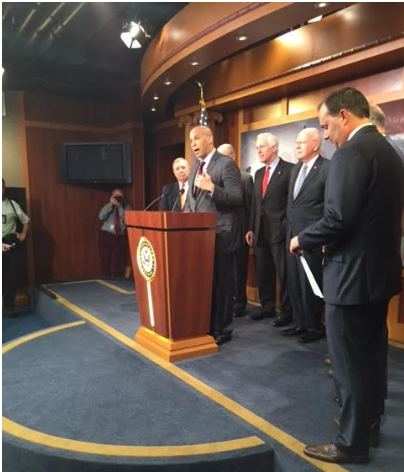
“That claim is false and does not factually line up with the reality of who is behind bars in our federal prisons,” said Senator Cory Booker (D-New Jersey) in response to critics who say the bill would free violent criminals. “Each case must also go before a federal judge, with the prosecutor present for an independent judicial review.”

Grassley’s measure addresses several stringent sentencing provisions that have helped swell the federal prison population over the past 30 years. It would repeal the “three strikes” law that requires a mandatory life sentence without parole for anyone with a third conviction on drug or violent-felony charges. Instead, the bill creates a mandatory 25-year sentence.

This legislation retroactively applies a 2010 sentencing-reform provision that reduced the disparity between crack and powder cocaine penalties. This change alone would let about 6,500 prisoners petition the courts for release or reduced sentences. Grassley’s bill also includes juvenile-justice reforms and language to help former prisoners transition back into society.

Senate Majority Leader Mitch McConnell (R-Kentucky), facing pressure from tough-on-crime Republicans, has not said whether he will allow a vote on Grassley’s proposal. “Our system of justice is not broken,” former U.S. attorney general John Ashcroft wrote last month in a letter to McConnell, signed by 40 high-ranking former law-enforcement officials. “Mandatory minimums have caused a dramatic reduction in crime.”

Reform advocates do not consider Grassley’s legislation the major overhaul of mandatory-minimum sentences for which they long have fought, saying his bill does not go far enough.

“It’s a Goldilocks reform bill. It’s not too much. It’s not too little. But it’s better than nothing,” said Nkechi Taifa of the Open Society Policy Center. “There was a time when this looked like a slam dunk…It was the right issue at the right time. Now it is not so clear.”

This bill only applies to the federal justice system, where about 200,000 inmates are held. This is just 8 percent of the 2.5 million Americans confined to state prisons and local jails.

While the Senate’s path remains clouded, the measure has a brighter future in the House. Legislators and reform advocates consider Speaker Paul Ryan (R- Wisconsin) an ally in overhauling sentencing and drug laws. Ryan said he supports all the measures that have cleared the House Judiciary Committee. “We will schedule floor time for them,” Ryan told journalists at a recent Capitol press briefing.

Until then, reformers sound as impatient as ever.

“All there has been is talk, and more talk,” said civil rights leader Barbara Arwine. “Action is long overdue. Mass incarceration threatens many of the gains we fought for in the Civil Rights Movement. It’s time for a vote.”


Brookwood Baptist Health Officially Launches in Central Alabama

2

Joint venture uniting Brookwood Medical Center, Baptist Health System and Tenet Healthcare represented by new brand, patient-focused community of care

brookwood

Birmingham – Brookwood Baptist Health – unifying the former Brookwood Medical Center and Baptist Health System with Dallas-based Tenet Healthcare Corp., one of the nation’s largest healthcare services companies – officially launched its new public-facing brand on Tuesday, April 5.

The new Brookwood Baptist Health brand showcases an intertwined, three-circle logo representing how the organization is putting people back at the center in order to support the unique health needs of each individual across the system. The brand was unveiled at simultaneous, system-wide launch celebrations attended by employees, community members and hospital leadership.

“We are inspired by Ecclesiastes 4:12, which states, ‘Though one may be overpowered, two can defend themselves. A cord of three strands is not quickly broken,’” said Keith Parrott, chief executive officer of Brookwood Baptist Health.

The merger, which was first introduced in December 2014 and finalized in October 2015, now represents Central Alabama’s largest healthcare network and is comprised of more than 1,700 licensed beds at five acute care hospitals: Brookwood Baptist Health – Brookwood Baptist Medical Center and Brookwood Baptist Health – Princeton Baptist Medical Center (Birmingham); Brookwood Baptist Health – Shelby Baptist Medical Center (Alabaster); Brookwood Baptist Health – Walker Baptist Medical Center (Jasper); and Brookwood Baptist Health – Citizens Baptist Medical Center (Talladega).

The Brookwood Baptist Health network also includes an additional 77 locations consisting of health centers, physician practices, imaging centers and a freestanding emergency department. At least $250 million in capital investments are planned at care locations over the next five years.

“While we have operated as one entity since the merger was finalized, our new brand solidifies our identity as a true community of care, united in service and devotion to the people we serve,” Parrott said. “Our commitment to caring for patients with quality, integrity and transparency is of utmost importance moving forward.”

Staff and patients will see immediate changes in select onsite hospital signage; however the full brand transition will be a long-term effort. Installation of new external and internal brand signage throughout each campus and local communities is in progress, and over the course of the next six-to-nine months, former logos and separate entity brand signage will be replaced with new Brookwood Baptist Health branding.

Brookwood Baptist Health’s hospital network on average serves more than one million patients annually and employs more than 1300 doctors and 7200 staff with a payroll of more than $430 million. Tenet Healthcare represents the majority stake in this joint venture and will play a central role in managing Brookwood Baptist Health operations.

“With our history in partnering with faith-based health providers, our strong financial standing and our positive relationships with 84 hospitals across the U.S., Tenet’s mission to help people live happier, healthier lives will continue to align with Brookwood Baptist’s patient-centric commitment,” said Garry Gause, chief executive officer, Tenet Healthcare, Southern Region.

The collective growth in footprint has increased the need for additional nursing staff. Brookwood Baptist Health will host a registered nurse recruitment event on Friday, April 8, at which attendees will have the opportunity to interview onsite with nursing leaders from all five hospitals with the potential for real-time offers.

“The future of the new Brookwood Baptist Health community of care is one of more resources, innovation and expertise to extend our Christian ministry of healing to those we serve,” added Parrott.

About Brookwood Baptist Health

With roots extending more than 90 years, Brookwood Baptist Health includes trusted providers from the former Brookwood Medical Center and Baptist Health System and is operated by Dallas-based Tenet Healthcare Corp.  Representing the largest healthcare network in Central Alabama, the network’s community of care is comprised of five acute care hospitals with more than 1,700 licensed beds: Brookwood Baptist Medical Center, Princeton Baptist Medical Center, Shelby Baptist Medical Center, Walker Baptist Medical Center and Citizens Baptist Medical Center. Brookwood Baptist Health also provides patients with the largest primary care network in the state, along with physician practices, diagnostic and outpatient surgery centers and a freestanding emergency department. Brookwood Baptist Health is united in service and devotion to the people of Central Alabama and dedicated to putting people back at the center of healthcare.  For more information, please visit BrookwoodBaptistHealth.com.

Once Allies, a Legendary Mayor and a Former Lawmaker Are Now in Court as Adversaries

0

What happened between Richard Arrington and Eric Major?

By Barnett Wright

Times staff writer

erarrington (2)
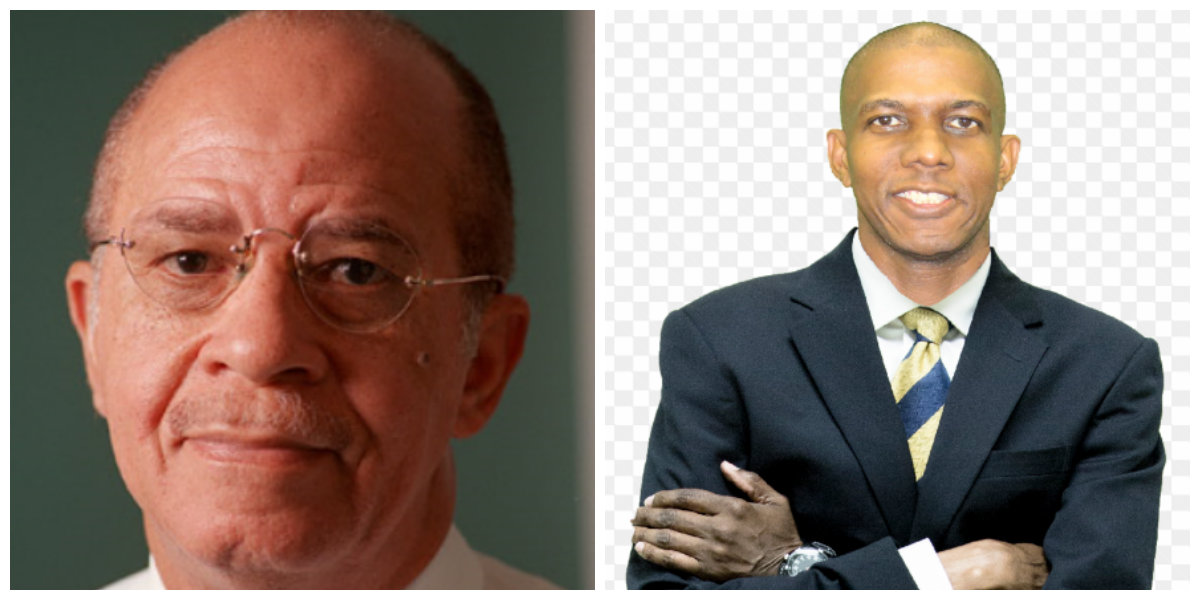
Richard Arrington and Eric Major


By all accounts, they were once allies.

When Richard Arrington made his historic run as Birmingham’s first black mayor in the late 1970s, one of his most ardent supporters was a young Eric Major. When Major later got into politics, serving as a state representative from 1998 to 2006, he received Arrington’s endorsement. Now, the two are at odds.

Major is in a runoff for the Democratic nomination to serve as Jefferson County treasurer. A win on Tuesday (April 12, 2016) would position him to become the first African American to hold the post.

Arrington has endorsed Major’s opponent, incumbent Mike Miles, but the Major camp has been distributing pre-marked voting ballots implying that its candidate has the former mayor’s support. Last week, a judge issued a temporary restraining order telling Major to stop publishing the ballots.

Behind the Rift

Arrington and Major are key players in Jefferson County politics. Major is chairman of the Jefferson County Citizens Coalition, which Arrington founded. And Arrington is president of the New Jefferson County Citizens Coalition, a reincarnation of the group that dominated Birmingham politics for two decades.

The feud goes beyond the two men, however. It also involves a historic alliance among three prominent black political groups that have joined forces to promote progressive candidates in the county: Major’s organization; Team Seven, co-headed by Jefferson County Commissioner Sandra Little Brown; and the Bessemer Voter’s League, headed by former state Rep. Lawrence McAdory. The organizations formed an alliance to promote a Unity Ballot for last month’s Democratic primaries—and each endorsed Major.

Following Major’s showing in the primary, Arrington filed a complaint saying Major distributed “counterfeit” sample ballots that “improperly and unlawfully used Dr. Arrington’s name and photograph in an effort to confuse and mislead voters and the general public.”

In an interview, Arrington, 81, said, “People, even candidates running, are constantly confused. He [Major] solicits money using my name and my picture, and I think those are serious violations.”

The High Road

Major, 48, said he wants to take the high road.

“One day I’m going to get older, so I’m not going to say anything disrespectful about Dr. Arrington,” Major said. “We are going to try to use this as a teachable moment in the sense that our kids are out here shooting at one another when they disagree. With this complaint, there is a way to resolve conflict. This is an opportunity to show the proper way to do it, and that’s the road we are going to take. We will handle it the way adults handle disputes.”

Major said he hopes to meet with Arrington to iron out the problem.

Arrington, who was mayor from 1979 to 1999, ended active participation with the Jefferson County Citizens Coalition in 2001 and formed the New Jefferson County Citizens Coalition in 2009. But this is not the first time there have been differences between the two men and their similarly named groups.

In 2010, Arrington and Major each endorsed a slate of candidates through the political organizations they chaired. At the time, Major’s group also included a photo of Arrington on its sample ballot.

Arrington “has never asked me or the organization orally or in writing to stop using his picture,” Major said.

Arrington said that’s not true.

“We have complained about [Major] putting out the ballot with my picture on it for several years,” Arrington said. “He ignores it.”

Major said he wants to avoid a public spat with Arrington and is more focused on unity, as his alliance with the Team Seven and Bessemer Voter’s League political groups shows.

“We decided that all of our purposes are the same,” Major said. “Rather than us going out here and fighting all the time, we all united because we want to do what’s best for the black community. We are trying to work in the spirit of bringing our leadership together, and that’s why I’m not going to say anything ugly or respond in a negative way to Dr. Arrington.”


Without Obama on the ballot, Young Professionals seek to engage voters

0

By Ariel Worthy

Times staff writer

BULYP member Tamir Buford stands outside Winn Dixie in Five Points West to point the direction for voter registration
BULYP member Tamir Buford stands outside Winn Dixie in Five Points West to point the direction for voter registration(ARIEL WORTHY, THE BIRMINGHAM TIMES)


Keeping blacks interested in the voting process without President Barack Obama campaigning has become a focus for the Birmingham Urban League Young Professionals.

During Obama’s first campaign voting among blacks increased from 60 percent in the 2004 election to 64 percent in 2008, according to the U.S. Census.

“A lot of people were excited during the process because they saw a candidate that they thought reflected their values and would make their lives better,” said Toni Wiley, senior director of advocacy for the National Urban League Young Professionals.

On Saturday March 26, the Young Professionals assisted people in the Five Points West community in registering to vote and updating polling information.

Wiley said she is hoping the momentum of Obama’s presidency is what will keep voters engaged during the upcoming elections. The president has help heightened awareness of candidates running for office.

“It’s more difficult now that Obama isn’t running because” blacks may lose interest, Wiley said. “But that’s why it’s so important why organizations like the Urban League address the issues valid to the younger people like college affordability, the ability to get a house and things like that.”

When it comes to younger black voters, Alana Robinson, a BULYP member, said, “People are now looking at candidates that align with their morals and values. They’re no longer saying, ‘that person looks like me, so I’m going to vote for them.'”

Local elections

IMG_1700
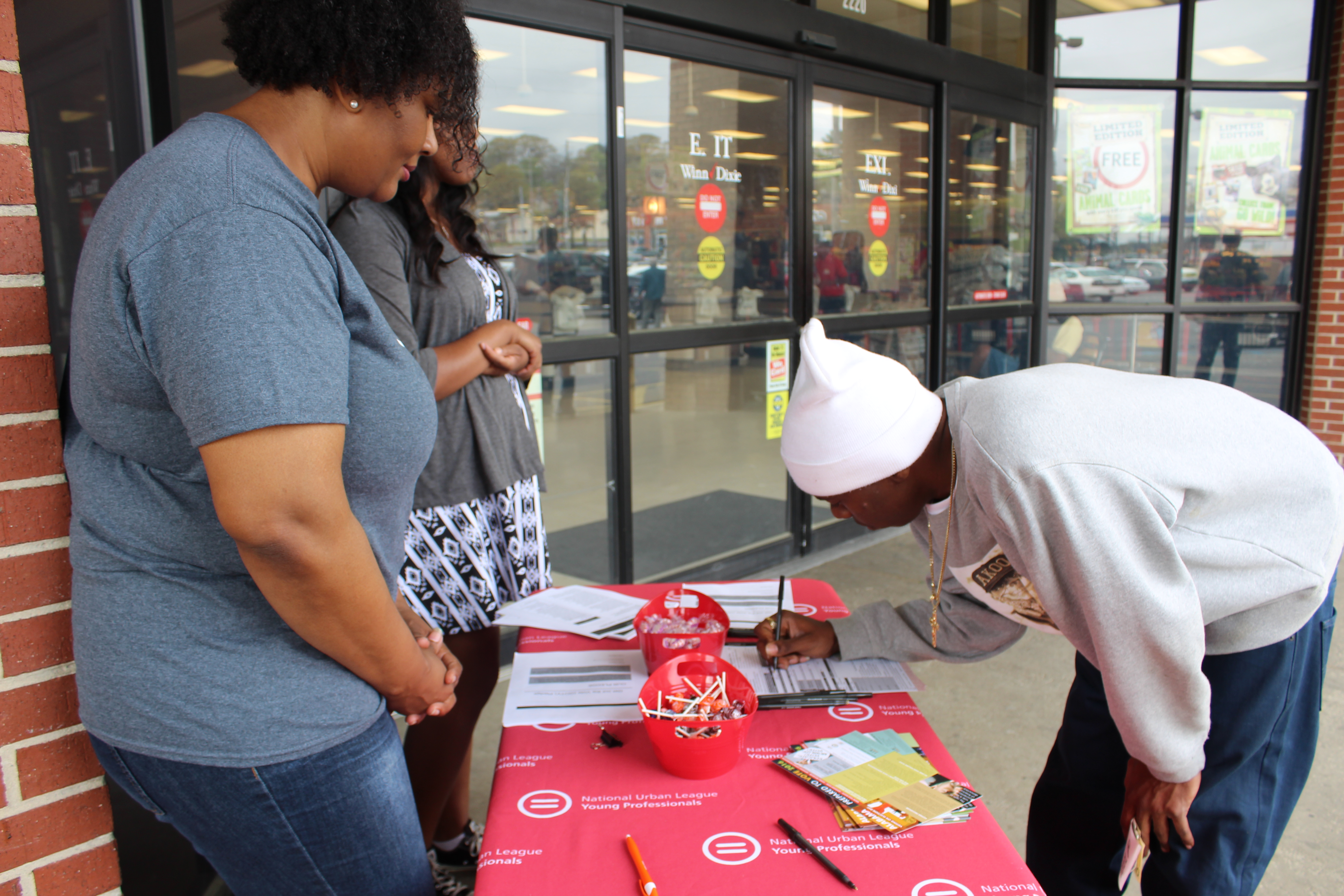
A young man registers to vote for the first time. The Birmingham Urban League Young Professionals spent Saturday at Winn Dixie giving out voting and poll information and helping residents to register to vote. (ARIEL WORTHY, THE BIRMINGHAM TIMES)


More than presidential elections, BULYP is also focused on local elections. Wiley thinks that as more young professionals are coming into the city and starting their careers here, they are more interested in what is going on locally.

“What we’ve been seeing at the BUL, especially with our young professionals, is that there are specific issues in the city surrounding entrepreneurship and changes in our neighborhood that we want to be aware of,” Wiley said. “People are more engaged on that level, but we’re here to connect their vote to making changes and being informed.”

Local elections are more important than national elections because education, roads, public safety and taxes are local issues.

“What we’ve been seeing at the BULYP, especially with our young professionals, is that there are specific issues in the city surrounding entrepreneurship and changes in our neighborhood that we want to be aware of,” Wiley said.

“People are more focused on access to broad bands, to help their children in schools, more entrepreneurial opportunities, and being more included in the changes in Birmingham,” she said.

The group will spend each month through the Nov. 8 election in specific Birmingham neighborhoods to “educate, engage, and empower” the people in the area about their rights of voting.

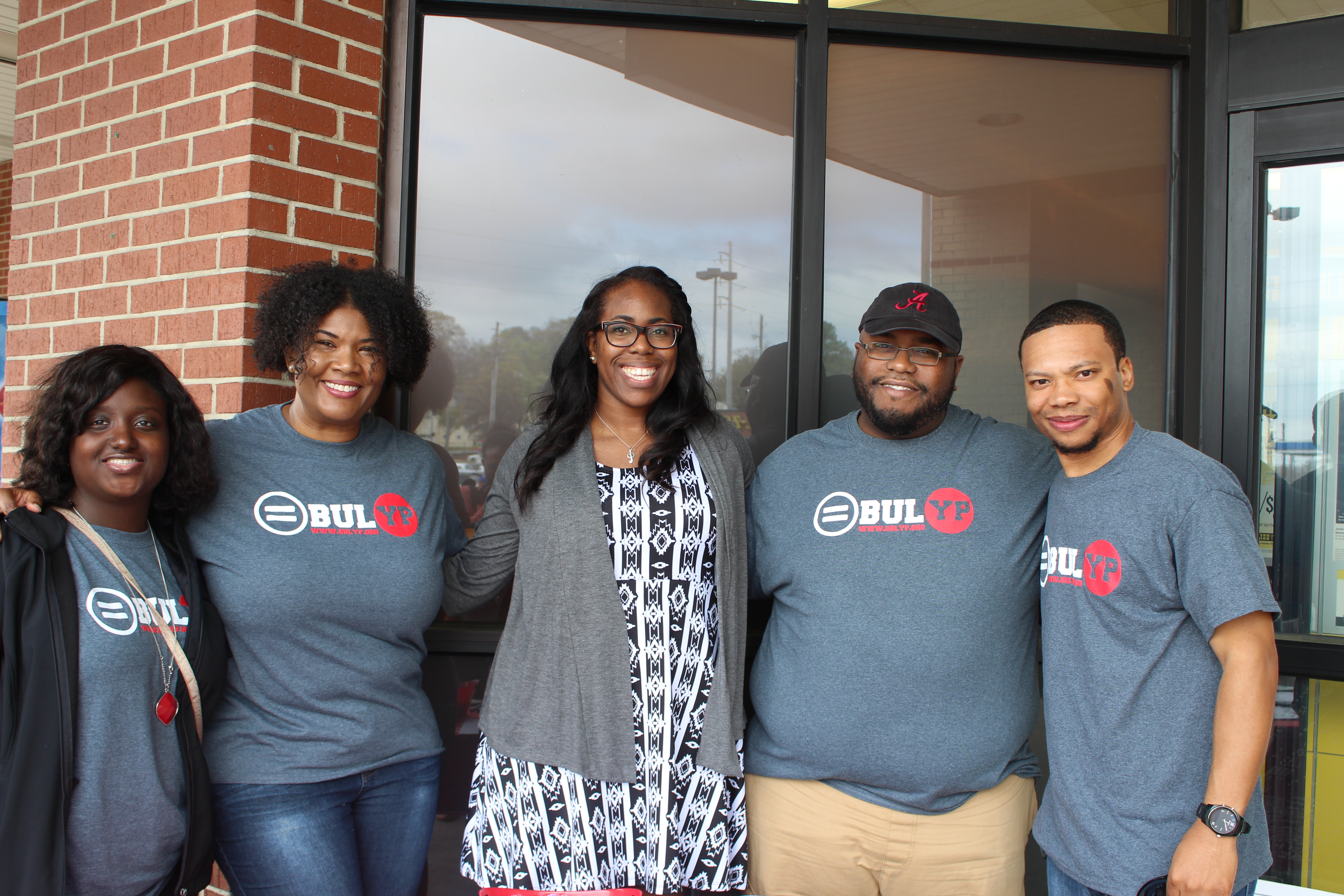
Birmingham Urban League  members ( L to R)L Ashely Newton, Toni Wiley, Alana Robinson, Prince Cleveland, and Tamir Buford.
Birmingham Urban League members ( L to R)L Ashely Newton, Toni Wiley, Alana Robinson, Prince Cleveland, and Tamir Buford.

“We want to make sure that they are actually aware of the issues and understand how all of the candidates align with their own agenda,” Wiley said. “We want to make them part of the discussion because they are the people who make up these communities, and we want to make sure they are confident in their information. We want them to know their rights when voting.”

Wiley added, “I think they are engaged, but we want make that connection to vote more locally, because you don’t have as much money, so you don’t have the ads and commercials, so people don’t know. we want to keep those [local] issues in the forefront for them and give them the information.”

Robinson said, “In order to see the change, we have to be part of the change. We can’t all be in office, so we certainly know what those candidates stand for, and vote for those candidates.”