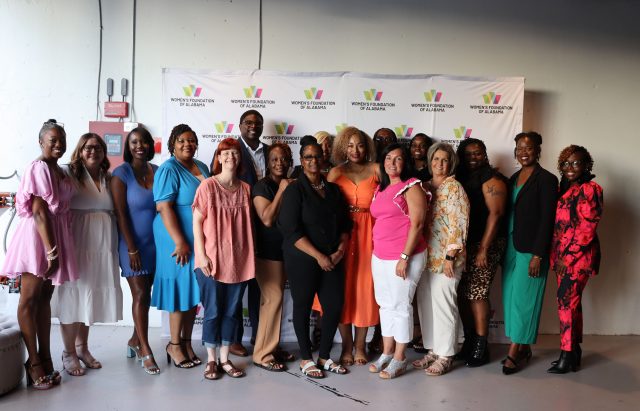
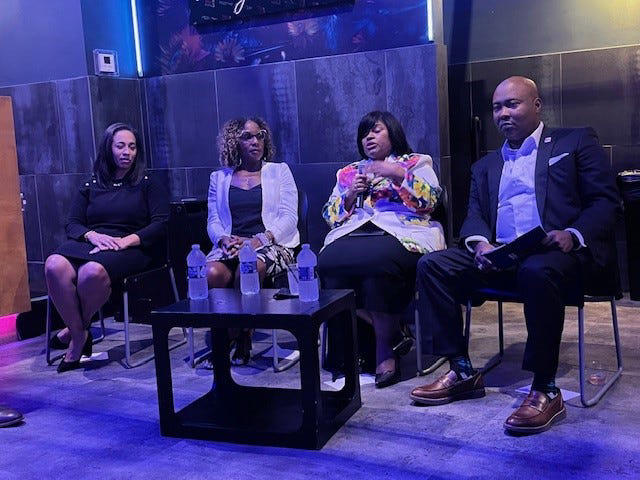
Inaugural members of the Childcare Accelerator cohort alongside Women’s Foundation of Alabama team members during graduation. (Provided)
By Javacia Harris Bowser | For The Birmingham Times
Even though 74 percent of Alabama families rely on a female breadwinner, Alabama has the 49th lowest female labor force participation rate in the nation. Research has shown that one of the key factors holding women back is lack of childcare.
Women’s Foundation of Alabama’s (WFA) now has an initiative in place to help address that problem. Advancing Alabama Childcare Accelerator is an 8-week program that focuses on the business side of owning a daycare facility with the goal of helping participants open centers that can offer accessible quality services for parents and competitive wages for the centers’ workers.
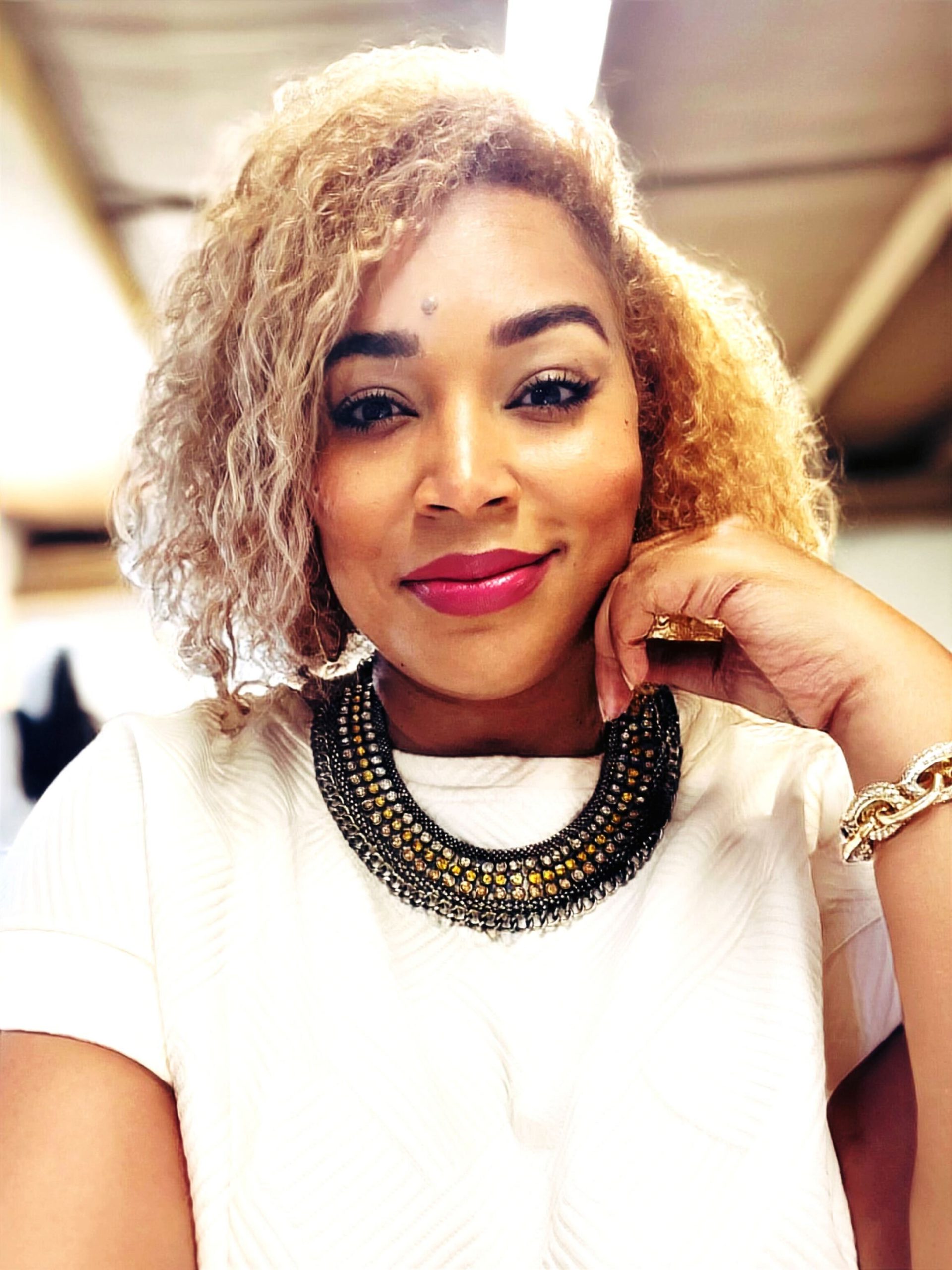
Zhaundra C. Jones, WFA Vice President of Philanthropy and Learning. (Provided)
The accelerator is the brainchild of Zhaundra C. Jones, Vice President of Philanthropy and Learning at WFA, which seeks to accelerate economic opportunity for women by supporting legislation, research and philanthropy that promote gender and economic equity.
“Comprehensively, what we’re really trying to do is focus on access, affordability, and workforce,” Jones said. “I felt like an accelerator would allow us to design something that would pour into these business owners and if we could also give them access to much needed infrastructure capital, we could do our part of this puzzle of addressing the childcare gap in the state.”
Participants met weekly this past spring — sometimes online, sometimes in person at Polaris in Woodlawn — and each class was led by a different subject matter expert.
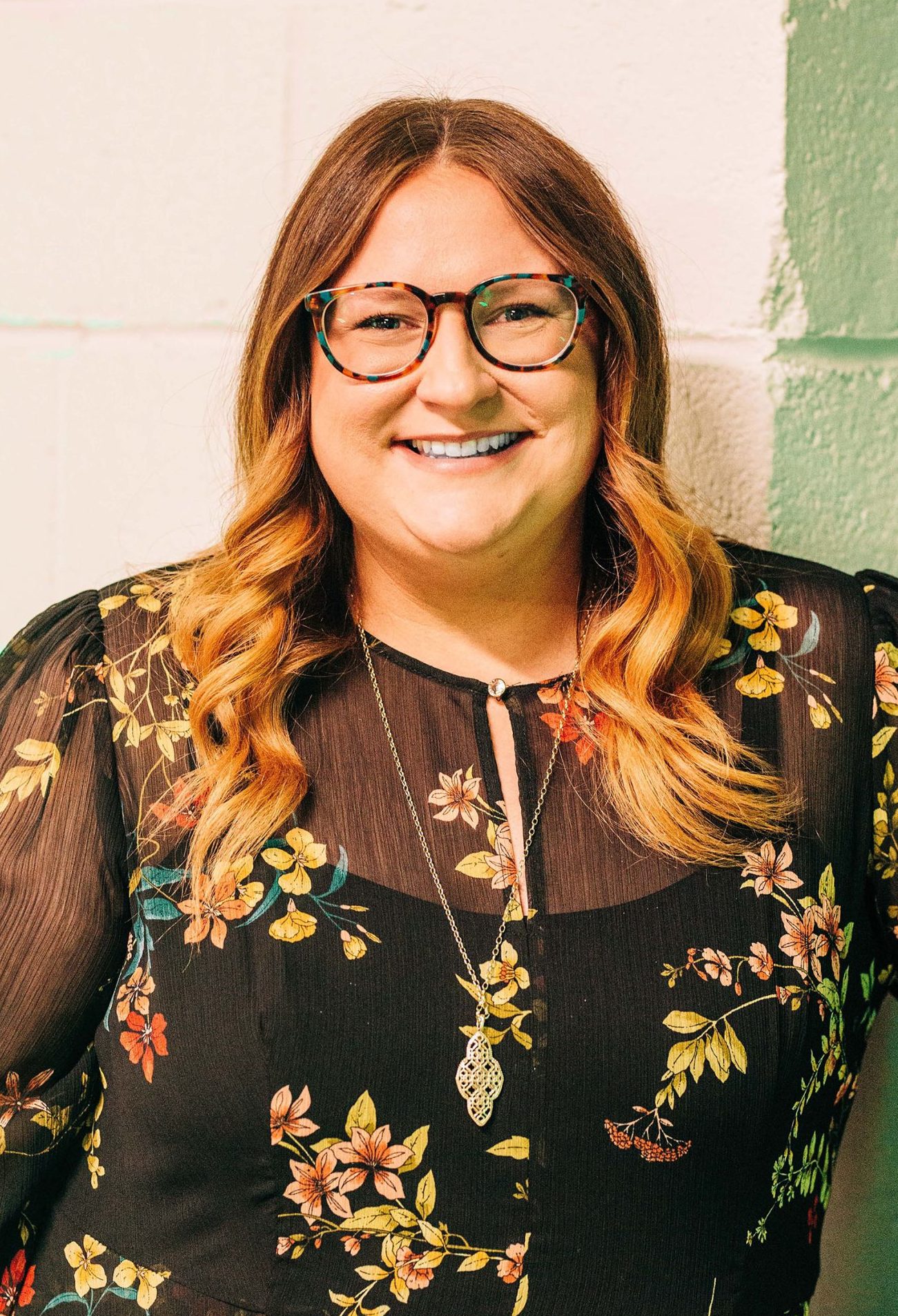
Kaitlee Daw, WFA Program Officer who facilitated the Childcare Accelerator. (Provided)
Kaitlee Daw, the Women’s Foundation of Alabama program officer who facilitated the accelerator, worked closely with the participants to ensure the program was providing the cohort with the resources they needed.
“I was meeting with them every week to make sure they felt it was a worthy use of time,” Daw said. “They were coming one to two nights a week and some were driving as far as Chilton County or Walker County to be there.”
Participants are working to open facilities in areas across Central Alabama including Bessemer, Center Point, Clanton, Hueytown and Parrish; and other places in Chilton, Jefferson, Shelby, and Walker counties.
Several are thinking outside the box, too. One entrepreneur in the program is developing a program centered on nature-based learning. Another is working on a program for kids with learning differences.
“They’re bringing really innovative programs to communities and still making them accessible,” Daw said.
Though classes were typically scheduled for only 90 minutes, they often lasted for two or three hours because the participants had so many questions.
“They were like sponges,” Daw said. “They wanted all the information they could get. They would come early, and they would stay late.”
For the first cohort, which began in April 2024, the selection committee had to choose 12 applicants from a pool of 55 candidates. They considered several factors when selecting the cohort participants.
“What’s your mission? What’s your goal here? What’s your background in childcare?” Daw said, listing some of the questions the selection committee had for applicants.
Jones explained, “We were really looking for folks that wanted to open a center and were pretty well positioned to do so within the next three to six months.”
During the program, participants also learned how to give pitch presentations, which they each delivered at their closing ceremony held in June.
May said she enjoyed learning about profit and loss statements, marketing strategies, and the importance of community engagement. “I know it was geared towards childcare, but what I learned in that class can take you on to any type of business,” she said.
May said she also appreciated learning about the importance of businesses having unique selling propositions and what makes her center stand out from others.
Learn more about the Women’s Foundation of Alabama at wfalabama.org
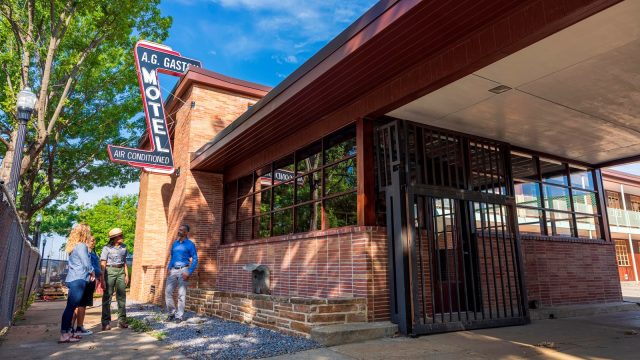
A Park Ranger shares the significance of the A.G. Gaston Motel with visitors on a summer day. (Alabama Tourism Department / Chris Granger)
www.nps.gov
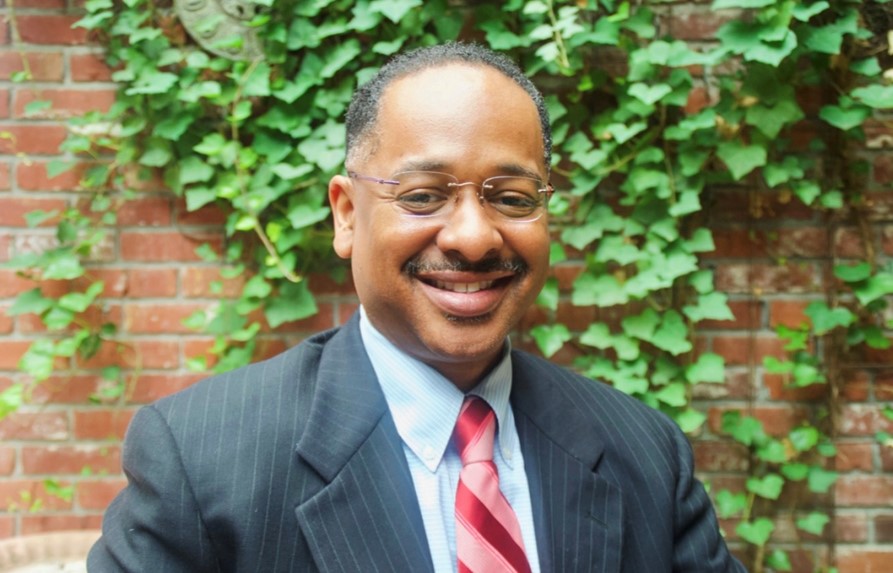
The National Park Service (NPS) announced the selection of Dr. Rolando Herts as superintendent of Birmingham Civil Rights National Monument and Freedom Riders National Monument in Alabama, effective Sep. 9.
Dr. Rolando Herts
“We are excited to welcome Rolando as superintendent as he builds on more than a decade of distinguished leadership advancing cultural heritage tourism and education in partnership with the National Park Service,” said Mark Foust, NPS South Atlantic-Gulf Regional Director. “Rolando’s experience developing sites of memory and empowering communities to preserve nationally significant stories will help solidify the foundation of these two relatively new parks.”
Since 2014, Herts has served as the director of The Delta Center for Culture and Learning, and executive director of the Mississippi Delta National Heritage Area, a Congressionally designated partnership with the National Park Service. He was previously associate director with the Office of University-Community Partnerships at Rutgers, The State University of New Jersey, where he received the Berkowitz Distinguished Service Award as a Leadership Newark Fellow.
Through community engagement and partnership development, Herts has strengthened collaborations with the National Park Service, the Alliance of National Heritage Areas, the National Endowment for the Humanities, Mississippi Delta Blues Festival Brazil and various regional and community-based organizations. Under his leadership, The Delta Center and Mississippi Delta National Heritage Area received awards and recognitions from the National Park Service, National Humanities Alliance, Mississippi Heritage Trust, Mississippi Department of Archives and History, GRAMMY Museum Mississippi, Delta Business Journal, among others.
“I am excited and honored to have been selected for this key leadership role with the National Park Service,” Herts said. “Community engagement is essential to developing authentic cultural heritage tourism, especially with civil rights sites. I look forward to collaborating with various communities to further illuminate stories of the Birmingham Civil Rights and Freedom Riders national monuments.”
Herts is a research fellow with Tourism RESET, a multi-university and interdisciplinary research and outreach initiative focused on race, ethnicity and social equity in tourism. He serves on the Association of African American Museums Board of Directors and the Advisory Committee for the Center of Southern Culture at University of Mississippi. He previously served on the Delta Regional Authority’s Delta Leadership Network Regional Advisory Council, Mississippi Blues Commission and Mississippi Commission for Volunteer Services.
Herts holds a Ph.D. in planning and public policy from Rutgers Graduate School-New Brunswick, an M.A. in social science from The University of Chicago and a B.A. in English from Morehouse College. As an Executive Academy Fellow with the Delta Regional Authority’s Delta Leadership Institute, he earned an executive education certificate in authentic leadership from Harvard University’s John F. Kennedy School of Government. His interests include organizational partnerships and holistic cultural heritage development, which involves community engaged approaches to tourism planning, education, storytelling and preservation.
About Birmingham Civil Rights National Monument
Established in 2017, Birmingham Civil Rights National Monument interprets the struggle for equality and civil rights in Birmingham, Alabama. The park’s boundary includes The Gaston Motel, Kelly Ingram Park, 16th Street Baptist Church, St. Paul United Methodist Church and a number of other historic properties that are part of the Birmingham Civil Rights National Register Historic District. These properties are significant with regard to the civil rights organizing and protests that occurred in downtown Birmingham between 1956 and 1963.
About Freedom Riders National Monument
Established in 2017, Freedom Riders National Monument preserves and interprets the sites where, on Mother’s Day in 1961, a Freedom Riders bus was attacked at the Greyhound Bus Station in downtown Anniston, Alabama, and attacked again and firebombed six miles away on State Highway 202. The Freedom Riders were a small interracial band of activists challenging discriminatory laws that required separation of the races in interstate travel. Images of the attack appeared in hundreds of newspapers, shocking the American public and spurring the federal government to issue regulations banning segregation in interstate travel.
About the National Park Service. More than 20,000 National Park Service employees care for America’s 430 national parks and work with communities across the nation to help preserve local history and create close-to-home recreational opportunities. Learn more at www.nps.gov, and on Facebook, Instagram, Twitter, and YouTube.
BY JE’DON HOLLOWAY-TALLEY | Special to the Birmingham Times
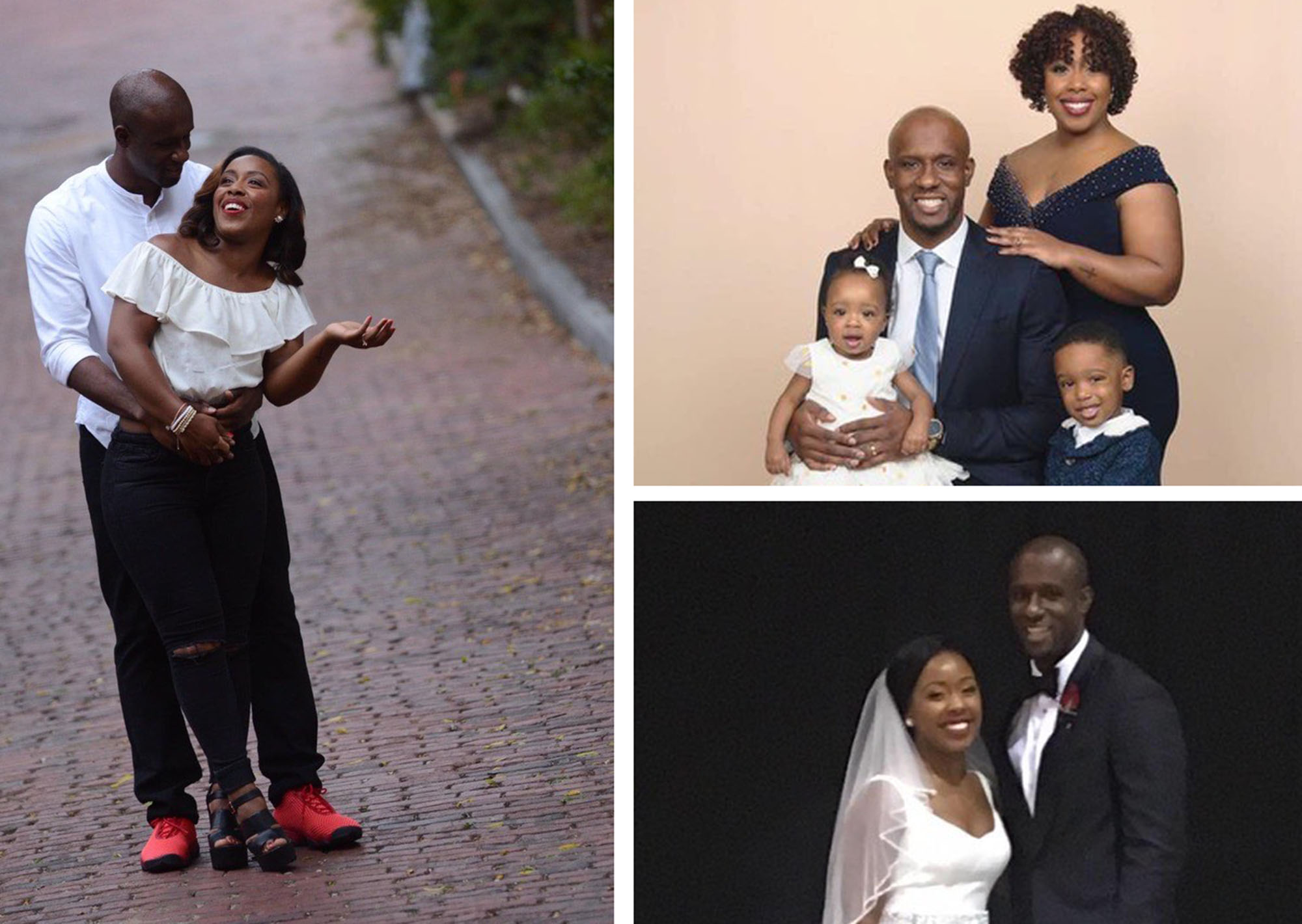
KATRINA AND DAVID DADA
Live: Hueytown
Married: Sept. 5, 2016
Met: September 2015 at their mutual friend Adeola Odutola’s housewarming in Gardendale. The men are frat brothers, and Katrina and Adeola were engineers at Alabama Power.
“I thought I knew all of Adeola’s friends, but got to the party and there were like 30-40 people there and I noticed Katrina immediately,” David recalled. “And about an hour later Adeola asked me to change a song and I went to his phone to do it and Katrina asked me, ‘What are you about to change the song to?’, and now this beautiful woman was talking to me so we made small talk.
Katrina and David began seeing one another in Adeola’s home at future gatherings. Soon after, Adeola hosted meetups for young professionals “and we would fellowship afterward, and we got to know each other at those gatherings…,” Katrina said.
By Adeola’s 2015 New Year’s Eve party, the attraction between David and Katrina had intensified. Eventually, Katrina slid into David’s DM’s on Facebook.
“I was already out having dinner with my line sister and we agreed to meet up at an eatery in Five Points South and we literally shut the place down,” Katrina said. “From that night forward, we’ve literally spent every day together.”
First date: January 2016. They took ballroom dance classes at the Fred Astaire Dance Studio in Hoover.
“I knew she liked to dance, I knew she had danced in college at Tuskegee on the Golden Essence [basketball dance team], and I thought it would be cool to learn something fun together,” David said. “I can two-step, I can hold my own. I have rhythm and that was a cool experience, I had never done the Waltz or the Rumba, and it was cool to learn.”
“I remember when he approached me with the date, I was freaking out about what to wear because that’s an unconventional first date. … And with the thought that he put behind the date, I could tell there was something different about him. He was really listening to me in those interactions that we had in the past, and he listened to my interests and wanted to make sure that this first attempt was something that I really enjoyed,” Katrina said.
And she got to know another side of him, she said. “David is really reserved, he’s like a scholar, and I got to see a more fun side of him and it was a great way to get to know each other in a different way. He stepped on my toes a couple of times, but it was impressive and it set the foundation that let me know this was someone I could grow and build with.”
The turn: For Katrina, it was late February 2016. “David has a friend who was running for city council in Huntsville and he hosted a fundraiser event here in Birmingham, and David asked me to go with him… and [after the event] on the way to the car he was oddly quiet and I felt like he had something to say but wouldn’t say it… The next day he told me he loved me and I said it back and that was the first time we confessed our love to each other and made it official,” Katrina said.
For David, it was March 2016. David had been praying about what he wanted in a wife since June 2015 after hearing a sermon that said he should be specific in his prayer details. After meeting and dating Katrina, he began to notice that she checked all of the boxes, and after the political fundraiser they attended together, he showed her his prayer list.
“I showed her the prayer because she was the fulfillment of all of those things … and when I shared it with her she looked up at me and said, ‘what are you trying to say?’ and I told her, ‘you embody all of the things I’m looking for and I want to pursue you with that goal [marriage] in mind,” David said.
“I was wondering if that was a proposal, that’s why I looked up at him like, ‘is there anything else you want to say?’” Katrina laughed. “That showed me that he was serious and confirmed that he was different than other guys I had been involved with.”
Katrina and David Dada met in September 2015 at a mutual friend’s house. The couple married a year later. (Provided Photos)
The proposal: June 11, 2016, at Symphony in the Summer at Railroad Park. David had arranged a surprise engagement party on the rooftop at Southern Kitchen in the Uptown District to celebrate with close friends, family, and their fraternity and sorority brothers and sisters.
“I knew she didn’t want a public proposal, so I had discerned that for the proposal it should just be us, but I knew she’d want to celebrate afterward. So we went to Symphony in the Summer and I proposed to her when we got back to the car. I opened the door, and I got on one knee and asked her to marry me, and she said ‘yes’,” David said.
“He was so quiet that day, and that whole walk to the car he wasn’t talking, similar to how he was the day I knew he was trying to tell me he loved me but didn’t say it. And so, he told me we were going to dinner so I started switching from flats to heels, and when he proposed I literally had one shoe on,” Katrina laughed, “I was like, ‘oh, this is happening.’ He didn’t make a big speech, he got straight to the point and asked me to marry him. And he ended up spilling the beans about the gathering at Southern Kitchen.”
The wedding: At The Bessemer Civic Center, officiated by Pastor Andra Sparks, of 45th Street Baptist Church in East Lake. Their colors were red, white, and black.
Most memorable for the bride were several small moments throughout the day. “I’m all about getting confirmations about stuff and there was one specific moment during the wedding day that let me know David was definitely my person. I’m a daddy’s girl, so for the father-daughter dance, the song I chose was Beyonce’s ‘Daddy’ song, and during the dance, my daddy said, ‘Why you ain’t pick a more upbeat song?’ and I laughed it off,” said Katrina.
She continued, “And David and I choreographed our first dance and David was great about it. I remember us practicing in our apartment. We danced to John Legend’s ‘You And I’, and having a husband that would agree to have a choreographed dance with me, and that [reminded me of] our first date and the dance lessons… And I had a ‘thank you God’ moment because he sent me a person who was very complimentary to me and whom I love a lot.”
Most memorable for the groom was learning from the videographer after the wedding ceremony that the videographer thought he’d lost the footage.
“…and we had to reenact [parts of the] wedding with the pastor, and in the midst of all of that, I was just calm and extremely happy. He ended up having the original footage, but I was just excited that we were married and was being optimistic,” David said.
They honeymooned in Coco Beach, Florida. “We changed hotels because the first one was crap,” Katrina said. “And it was on me because I’m the one who booked the hotel… it gave 4 stars on the website, but gave one star in person.”
Words of wisdom: “Don’t try to make your relationship or marriage like anyone else’s. That’s something we had to grow into early on in our marriage because you get these ideas of gender roles thrown at you throughout your life, and then when you [get married] you try to make what you learned fit into your marriage versus focusing on the two people in the marriage and what works for the two of you. Focus on building your own relationship,” Katrina said.
“Every day is an opportunity to grow, growth is the goal, and I’m not alone in that. I have an amazing partner that I get to grow with and the foundation is set for love. I don’t have to earn approval, I can have flaws and be free to work on things but we accept one another,” David said. “… enjoy the path of growing together. And love them as they grow into the best versions of themselves.”
Happily ever after: The Dada’s attend 45th Street Baptist Church in East Lake where David serves as a deacon, Katrina leads the praise dance ministry, and they both lead their church’s couples ministry. They have two children, a son, David III, 7, and a daughter, Davis, 3.
Katrina, 32, is a Bessemer native and Bessemer City High School grad. She attended Tuskegee University where she earned a bachelor’s degree in chemical engineering, is a member of Delta Sigma Theta Sorority Inc., and works for Ed Farm nonprofit in Birmingham as the senior program manager.
David, 35, is a Pratt City native and Ramsay High School grad. He attended The University of Alabama at Birmingham [UAB] where he earned a bachelor’s degree in psychology and a master’s degree in public administration. He is a member of Alpha Phi Alpha Fraternity Inc. and serves as the director of government relations at UAB.
“You Had Me at Hello’’ highlights married couples and the love that binds them. If you would like to be considered for a future “Hello’’ column, or know someone, please send nominations to Barnett Wright bwright@birminghamtimes.com. Include the couple’s name, contact number(s) and what makes their love story unique.
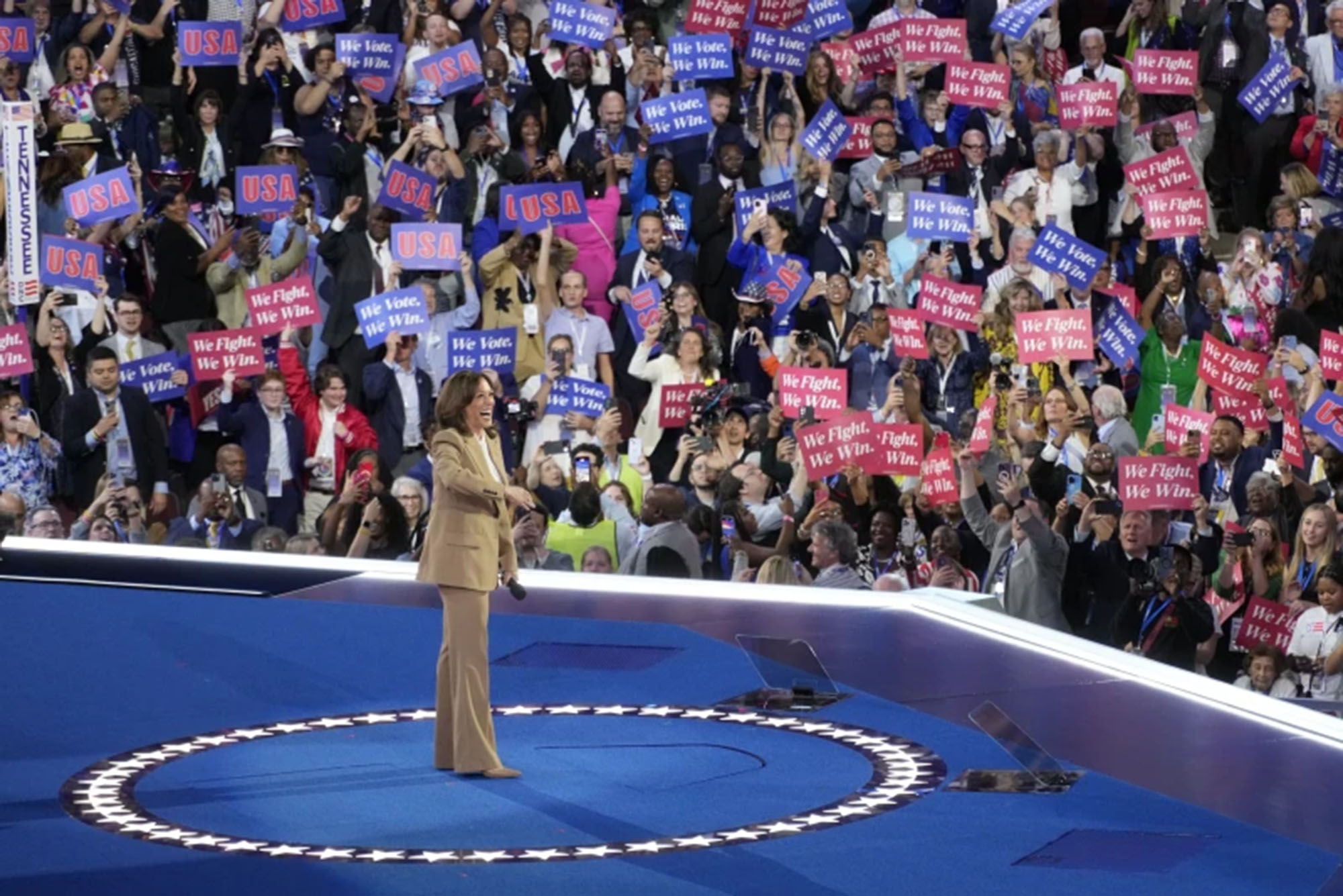
Hillary Clinton spoke hopefully of finally breaking the “glass ceiling” to elect a female president. Joe Biden laced into Trump and directly acknowledged the concerns of protesters against the war in Gazawho demonstrated a few blocks from the convention hall.
Here are some takeaways from the first night of the convention.
Biden begins long political exit
President Joe Biden wrapped up the convention’s opening night by beginning his long political farewell with an address that both framed his own legacy and signaled he was ready to start ceding control of the party to Vice President Kamala Harris.
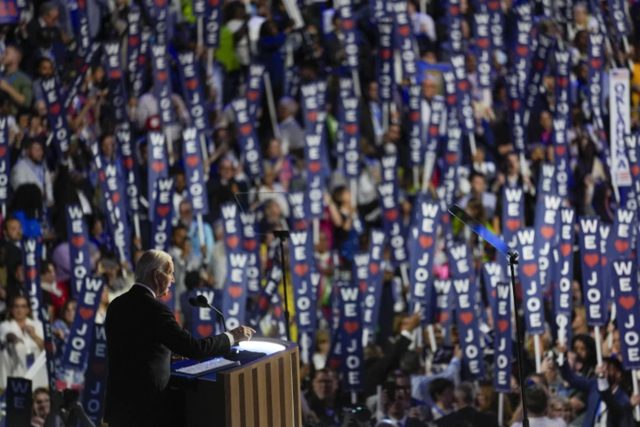
He took the stage to a long, raucous ovation from delegates hoisting “We love Joe” placards and told them in turn, “I love you!” After the affectionate opening, Biden spent long stretches of his 50-minute speech hitting Trump, returning to a key theme of the reelection campaign he’s no longer running.
Biden ticked through many of his administration’s achievements, including a major public works package and climate program, and shared the credit with Harris. He said picking Harris as his running mate was the best decision he ever made and promised to be the “best volunteer” that Harris and running mate Minnesota Gov. Tim Walz have ever seen.
His closing message to those still listening as the convention stretched late into the night: “I gave my best to you for 50 years.”
Democratic presidential nominee Vice President Kamala Harris speaks during the Democratic National Convention Monday, Aug. 19, 2024, in Chicago. (AP Photo/Morry Gash)
A surprise Harris appearance to pay tribute to Biden
The vice president made an unscheduled appearance onstage to pay tribute to Biden ahead of his own address to the convention. She told the president, “Thank you for your historic leadership, for your lifetime of service to our nation, and for all you’ll continue to do.”
On a night meant to honor the president who stepped aside to make way for Harris, the vice president added, “We are forever grateful to you.”
Gaza gets little attention inside DNC hall — except from Biden
Thousands of marchers churned through Chicago’s streets protesting U.S. support for Israel during the war in Gaza. But inside the convention hall, the combustible issue went largely unmentioned until Biden got to the microphone.
Rep. Alexandra Ocasio-Cortez got cheers when she praised Harris for working “tirelessly to get a cease-fire in Gaza and get the hostages home.” Sen. Raphael Warnock of Georgia made a brief allusion to the conflict.
A handful of delegates who ran on an “uncommitted” ticket protesting Biden’s position on the war unfurled a banner during his speech that read “Stop Arming Israel.” But it was blocked by supporters waving Biden signs before it was wrestled away and the lights over that section of the audience were shut off.
Biden himself addressed the issue head-on, saying he’d keep working to “end the war in Gaza and bring peace and security to the Middle East.”
“Those protesters out in the streets have a point,” Biden said. “A lot of innocent people are being killed, on both sides.”
The crowd cheered, and for a moment the war didn’t seem like it was dividing the party at all.
Clinton revives talk of breaking that ‘glass ceiling’
Clinton was greeted with wild and sustained applause that lasted for more than two minutes before she quieted the crowd. She delivered a fiery speech hoping that Harris could do what she could not –- become the first woman president by beating Trump.
Clinton evoked her 2016 concession speech by referencing all the “cracks in the glass ceiling” that she and her voters had achieved. And she painted a vision of Harris “on the other side of that glass ceiling” taking the oath of office as president.
She closed her speech with a striking desire for someone who’s stood at the pinnacle of American politics and power: “I want my grandchildren and their grandchildren to know I was here at this moment. That we were here and that we were with Kamala Harris every step of the way.”
Clinton dipped into traditional political attacks in her speech, including mocking Trump’s criminal record. That led to chants of “lock him up” — mirroring the ones that Trump’s supporters directed at Clinton in 2016.
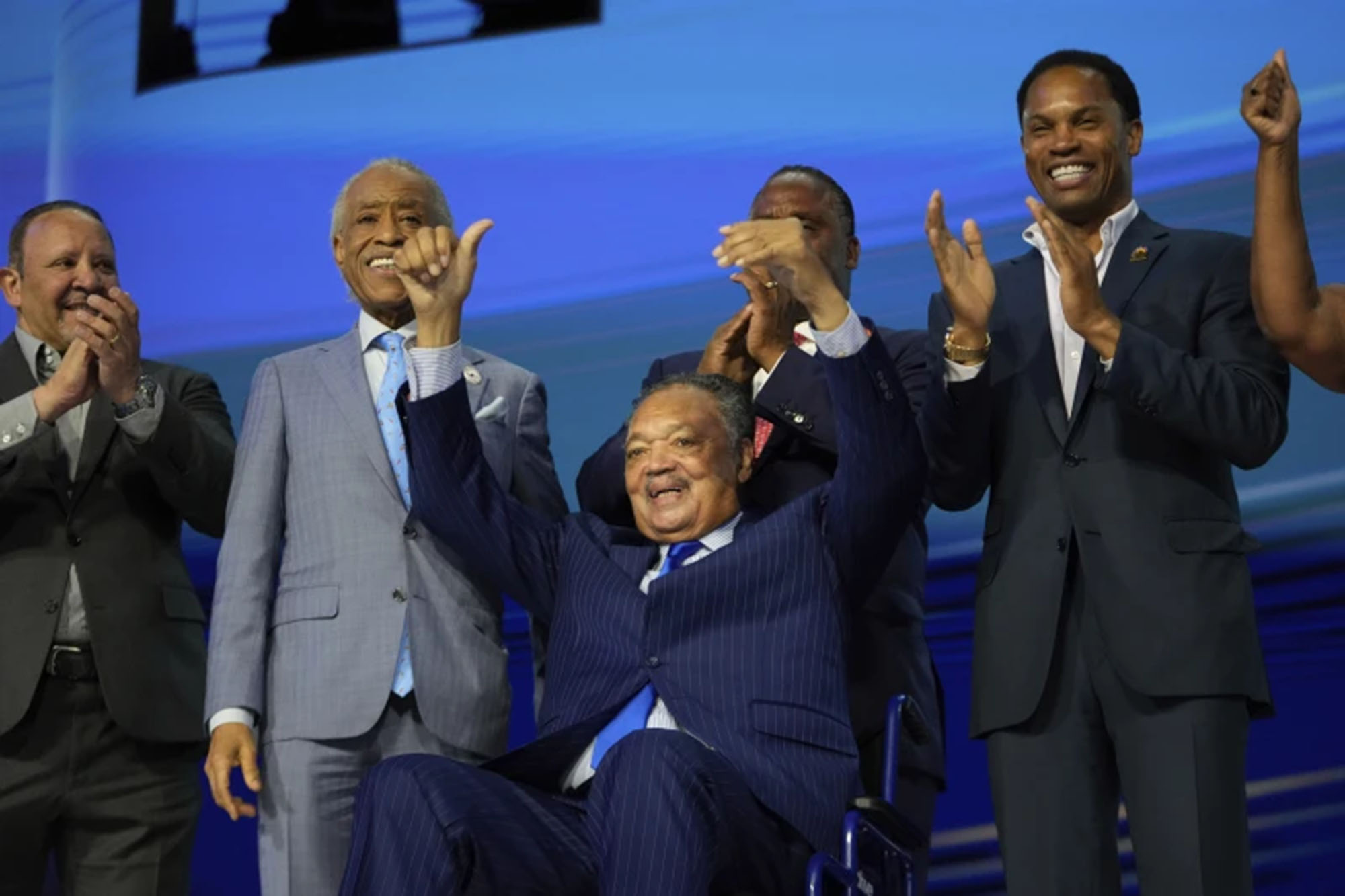
Rev. Jesse Jackson at the Democratic National Convention, Aug. 19, 2024, in Chicago. (AP Photo/Paul Sancya)
Tracing a line from Jesse Jackson to Kamala Harris
An early theme of the evening was celebrating the Rev. Jesse Jackson, a longtime civil rights leader in Chicago and former presidential candidate in 1984 and 1988. Many Democrats credit him with blazing a trail that helped Barack Obama win the White House in 2008 and Kamala Harris become the first woman of color nominated for the presidency.
Jackson was saluted from the stage by several speakers, including Chicago Mayor Brandon Johnson and California Rep. Maxine Waters. There was a video montage of Jackson’s career and legacy that played before the 82-year-old Jackson himself came to the stage in a wheelchair, thrusting his arms skyward and grinning. Jackson has been diagnosed with Parkinson’s disease.
During the 1984 Democratic convention in San Francisco, Jackson gave a speech declaring that America is “like a quilt: Many patches, many pieces, many colors, many sizes, all woven and held together by a common thread.” The address became known as the “Rainbow Coalition” speech, and Jackson used momentum from it to seek the Democratic nomination again in 1988.
Harris has called Jackson “one of America’s greatest patriots.”
Remember COVID? Democrats don’t want voters — or Trump — to forget
Democrats opted to shine the convention spotlight on the harrowing subject of the coronavirus pandemic.
It was a reflection of Democratic frustration at how Trump has portrayed his tenure in office as a golden age for the country, even though hundreds of thousands of Americans died of COVID-19 during the last year of his term.
There are plenty of risks for Democrats in hammering the pandemic. Even more people died of the virus during Biden’s presidency than during Trump’s, voters have shown an eagerness to move on and some preventative measures championed by Democrats — like school closures and masking — are not popular in retrospect.
Still, the lineup of early speakers focused on Trump’s performance during the pandemic. Minnesota Lt. Gov. Peggy Flanagan recalled how her brother was the second person in Tennessee to die of the disease and how she couldn’t visit him or hold a memorial service. Rep. Lauren Underwood of Illinois, a nurse, said of Trump: “He took the COVID crisis and turned it into a catastrophe. We can never ever let him be our president again.”
Rep. Robert Garcia, whose mother and stepfather died of the disease in 2020, recalled Trump’s missteps and concluded with one of the slogans of Harris’ young campaign: “We are not going back.”
Democrats one-up Republicans on labor
Trump’s convention last month featured a rare appearance from a union leader at such a GOP event: Teamsters President Sean O’Brien. That’s reflective of how Trump’s populism has cut into Democrats’ advantage with union households.
In that speech, O’Brien did not endorse Trump. But he criticized both major political parties for not doing enough to help working people.
Democrats didn’t invite O’Brien to their convention, but they countered with a half-dozen other union leaders onstage Monday. And then Shawn Fain, head of the United Auto Workers, led a blistering chant of “Trump’s a scab!” while wearing a red T-shirt emblazoned with those words.
Fain noted that Biden visited a UAW picket line last year and, when autoworkers struck in 2019, Harris, not Trump, walked the picket lines. “Donald Trump is all talk and Kamala Harris walks the walk,” Fain said.
The Center for Community Progress has awarded the City of Birmingham $50,000 in technical assistance to help revamp its code enforcement practices. (Adobe Stock)
birminghamal.gov
The Center for Community Progress has awarded the City of Birmingham $50,000 in technical assistance to help revamp its code enforcement practices. The Department of Planning, Engineering, and Permits (PEP) will use this resource to implement and educate the public about the recently passed foreclosure bill SB9 signed by Governor Kay Ivey.
“The SB9 legislation is another strategic tool in combating code enforcement issues within the City of Birmingham,” said Katrina Thomas, Director of PEP. “This legislation will provide a path forward for the City to pursue non-owner occupied property where we have seen repeat nuisance violations, unpaid code enforcement liens, and negligent response regarding abatement of such violations. We look forward to working hand in hand with Community Progress as we implement a local ordinance and educate our citizens on the tool.”
Birmingham’s Department of Planning, Engineering, and Permits engaged in a rigorous interview and application process for this competitive award. The team is partnering with the Birmingham City Council to build out a local ordinance that will put in place the legal mechanism to pursue foreclosure for non-owner occupied properties with code enforcement liens.
Since 2010, the Community Progress team of experts has provided urban, suburban, and rural communities battling systemic vacancy with the policies, tools, and resources needed to address the full cycle of property revitalization. Their Technical Assistance Scholarships enable the pilot and design of new programs and practices that become models for the community revitalization field to emulate and implement in order to address vacant, abandoned, and deteriorated properties.
“Each community selected for the Technical Assistance Scholarship demonstrated a strong commitment to evaluating their code enforcement practices and exploring reforms that will positively impact residents and their neighborhoods,” said Tarik Abdelazim, VP of Technical Assistance, Center for Community Progress. “We are thrilled to be working with leaders in the City of Birmingham as they work to implement new legal tools to address problem properties in pursuit of an equitable, safe, and resilient city for all.”
The national experts at Community Progress, who have worked with hundreds of diverse communities, will help scholarship communities shift from a traditional code enforcement approach to strategic code compliance — a far more equitable, effective, and efficient approach.
Each successful applicant will be awarded approximately 200 hours of customized technical assistance from a team of experts at Community Progress. These services cost approximately $50,000, but the scholarship will fully underwrite these costs. Cleveland, Ohio, and Lima, Ohio were also awarded scholarships.
Mawuli Davis, an attorney and human rights organizer, facilitates a panel discussion on the candidacy of Vice President Kamala Harris during a Black Men Lab meeting, Monday, July 22, 2024, in Atlanta. (AP Photo/Stephanie Scarbrough)
BY MATT BROWN, Associated Press
ATLANTA (AP) — Every Monday evening, the Andrew and Walter Young Family YMCA basement becomes a sanctuary for men who, local leaders say, have too often been denied one.
The Black Man Lab, which for nearly a decade has sought weekly to create a “safe, sacred and healing space” for Black men in metropolitan Atlanta, regularly gathers more than 100 men to pray, meditate and talk through challenges and triumphs they are facing and learn from peers and elders.
“It’s almost a communion,” said Carttrell Coleman, a visual artist from South Fulton, Georgia, who has attended the weekly meetings for seven years. “It’s an opportunity for us to share our voices and get resources. The networking is always a good thing. It’s a fellowship, of sorts.”
One recent meeting in the immediate aftermath of President Joe Biden’s suspension of his reelection campaign took on special weight as attendees considered the prospect of a Black woman winning the presidency. The candidacy of Vice President Kamala Harris has refocused attention on Black men, a demographic that Democrats and Republicans view as persuadable but whose multifaceted experiences and political preferences often go unaddressed in public debate.
Attendees gather and pray during a Black Man Lab meeting to discuss the candidacy of Vice President Kamala Harris, Monday, July 22, 2024, in Atlanta. (AP Photo/Stephanie Scarbrough)
Black male voters are traditionally one of the most consistently Democratic leaning demographics in the nation. This year, however, both major parties view Black men, especially those under the age of 40, as attainable voters. Whether Black men turn out in high numbers and to what degree they maintain traditional support for Democratic candidates may prove decisive in November.
“To be frank, I think early on in this process a lot of Black men viewed this election with much skepticism and dread,” said Bishop Reginald Jackson, who presides over all 534 African Methodist Episcopal churches in Georgia. “But since the change in the Democratic ticket, there has been a turnaround. I think they feel they have something that they can support. I think a lot of issues which made a lot of them skeptical are being addressed.”
The culminating effort also aims to address longstanding skepticism among many Black men about the political system, which is seen as discriminatory and unresponsive to their interests. Others have tackled potential hesitancy among men about electing a woman to the nation’s highest office.
Republicans, too, see an opportunity to make inroads with Black men precisely because of those longstanding frustrations. Donald Trump often speaks of his interest in garnering greater Black voter support. Black Republicans, including Reps. Byron Donalds of Florida and Wesley Hunt of Texas, have hosted a “Congress, Cognac, and Cigars” event series in cities including Atlanta, Philadelphia and Milwaukee.
“Black men have been taken for granted by the Democratic Party for years, but President Trump’s message is resonating at historic levels because he is doing the work,” said Janiyah Thomas, Black media director for the Trump campaign.
Attendees pose for photos after a Black Man Lab meeting to discuss the candidacy of Vice President Kamala Harris, Monday, July 22, 2024, in Atlanta. (AP Photo/Stephanie Scarbrough)
Marcus Robinson, a senior spokesperson for the Democratic National Committee, called Republican outreach strategy “hot air, racially charged rhetoric and offensive stereotypes, from questioning Vice President Harris’s identity to claiming Black voters should relate to Trump because he is a convicted felon.”
For many attendees at the Black Man Lab event, the reinvigorated presidential race is an opportunity to make sure their interests are addressed at the highest levels of government.
“I was in the street doing wild stuff and this saved my life,” said Damon Bod, an exterior house technician from Atlanta, of his experience with the Black Man Lab event. Bod said he lost his entire immediate family to violence and that the event provided him counsel and a community.
He said he would support Harris in the election because the men who supported him felt she would advance Black men’s interests.
“I’ve been looking at it and hopefully she’ll do a bit of good. My brothers have said she will, people who know me. But only God knows,” Bod said.
The Associated Press receives support from several private foundations to enhance its explanatory coverage of elections and democracy. See more about AP’s democracy initiative here. The AP is solely responsible for all content.
The Democratic National Convention kicks off Monday, as thousands of delegates gather in Chicago through Thursday. (Associated Press)
By Barnett Wright | The Birmingham Times
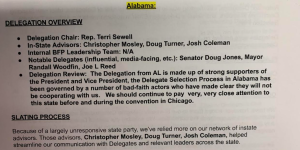
The delegate selection process in the state of Alabama has been governed “by a number of bad-faith actors” and the Democratic National Convention should “pay very close attention” to the delegation, according to a DNC document reviewed by the Birmingham Times.
A “Delegation Overview” has been compiled for each state that includes a synopsis of the delegation chair, notable delegates and the selection process.
“The delegation from Alabama is made up of strong supporters of the President and Vice President, the delegation process in Alabama has been governed by a number of bad-faith actors who have made very clear they will not be cooperating with us. We should continue to pay very, very close attention to this state before and during the convention in Chicago,” the overview reads.
The document did not name the “bad-faith actors” but friction between Alabama Democrats and the Alabama Democratic Party and the national party is not new.
However, Randy Kelley, chair of the Alabama State Democratic Party, has accused the DNC of engaging in “shenanigans” by appointing delegates to this week’s convention rather than allowing Alabama Democrats to elect their preferred delegate candidates.
After Kelley submitted a list of delegates, the Biden/Harris campaign (now d.b.a. Harris/Walz) rejected many of those and picked their own, after seeking suggestions from several Alabama Democrats including U.S. Rep. Terri Sewell, who now chairs the Alabama delegation.
The former Biden/Harris campaign said it selected the delegates “because of the largely unresponsive [Alabama] state party,” according to the document at the convention.
Jamie Harrison, chair of the Democratic National Committee, in a letter dated August 1, 2024, warned Kelley to “refrain from any further miscommunication or misinformation to convention participants” regarding the “status of Alabama’s delegation to the National Convention” in Chicago.
Kelley denied there was any “misinformation” but the problem was a national party that “handpicked” delegates that the people of Alabama did not get a chance to vote on, he told The Times last week. “No other [state] party in the history of the Democratic National Committee has been robbed of all delegates,” Kelley said. “… this is unprecedented.”
Harrison wrote that the Credentials Committee of the DNC on July 21, 2024, credentialed “the duly elected” Alabama district-level delegates to the convention.
Kelley told The Times that Alabama is “the only state in the Democratic Party and territories where we didn’t vote on a single delegate … the Democratic Party says it stands for a free and fair elections, [but] delegates were picked by some forces inside our party in the state along with people who don’t even live in Alabama,” he said.
Kelley added that he and his supporters, who include Joe Reed a longtime party leader and chairman of the Alabama Democratic Conference, the party’s most influential Black organization, have petitioned to go before the Credentials Committee in Chicago with their concerns. However, DNC Chair Harrison may have signaled that door has closed.
In his Aug. 1 letter to Kelley, Harrison wrote, “There are no pending credentials challenges and the window to file challenges has long passed … We look forward to supporting our Presidential and Vice Presidential nominees in Chicago and hope you will join us in working together to support the Democratic Party and our shared successes in November.”
Updated at 2:56 p.m. on 8/19/2024 to add DNC to the lede.
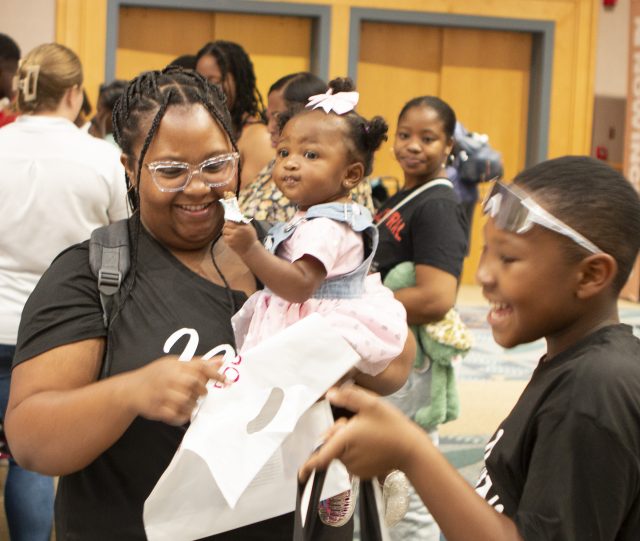
Sanjanika Prince attends Babypalooza with daughter Ameriah and son Aeden. (Marika N. Johnson, For The Birmingham Times)
The Birmingham Times
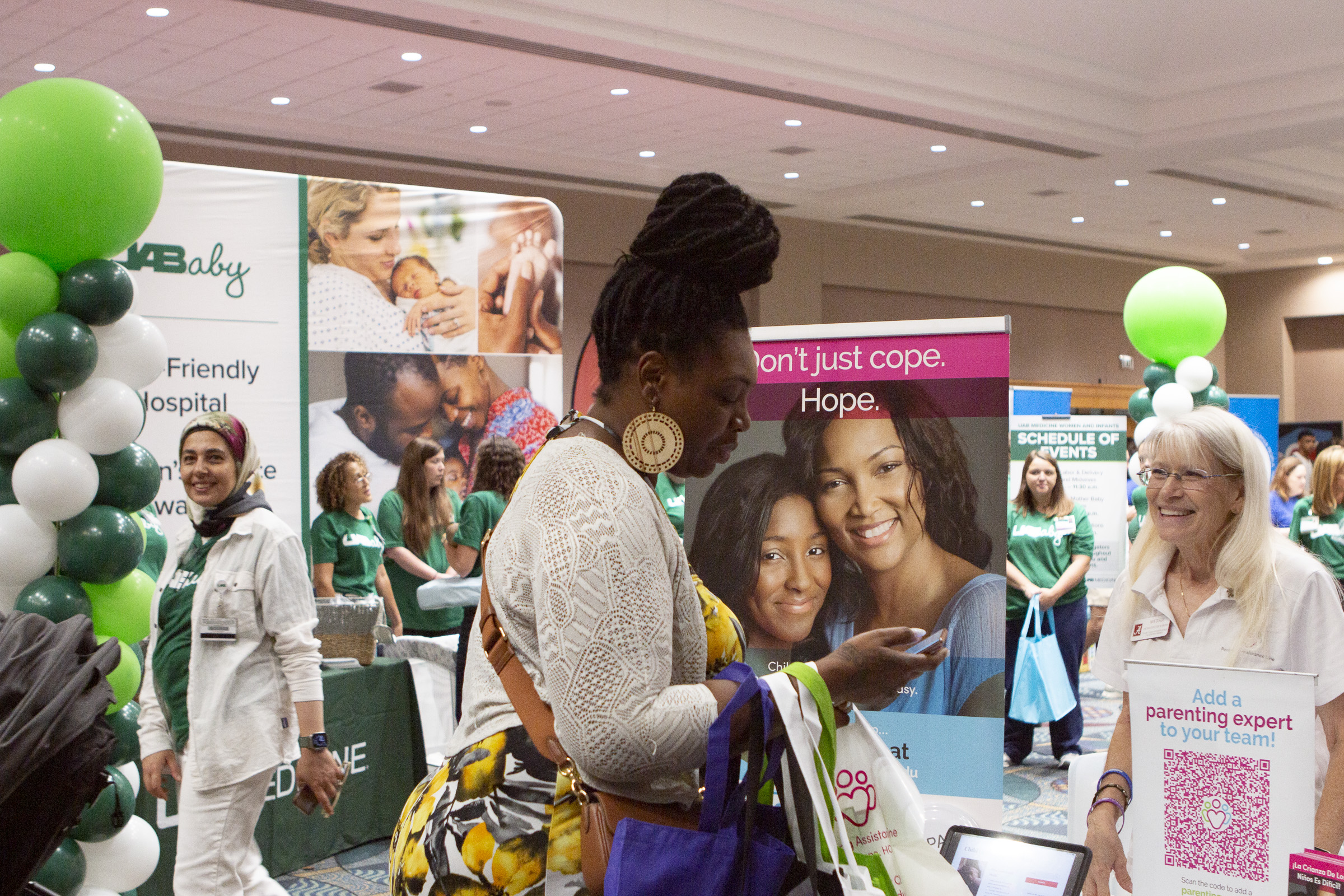
Babypalooza’s Black Maternal Health Expo returned on Saturday along with the Babypalooza Baby Expo to the Birmingham Jefferson Convention Complex (BJCC) East Ballroom.
Hundreds of visitors and dozens of local and national exhibitors that specialize in baby and maternity products and services filled the BJCC for the event that included starting a baby registry; interviewing preschools; starting a college savings plan and learning the essentials of caring for moms-to-be and the baby.
In the United States, Black women are disproportionately affected by maternal health disparities, facing a maternal mortality rate that is nearly three times higher than that of white women. This alarming statistic underscores the urgent need for comprehensive support and resources tailored specifically to the unique challenges Black mothers face.
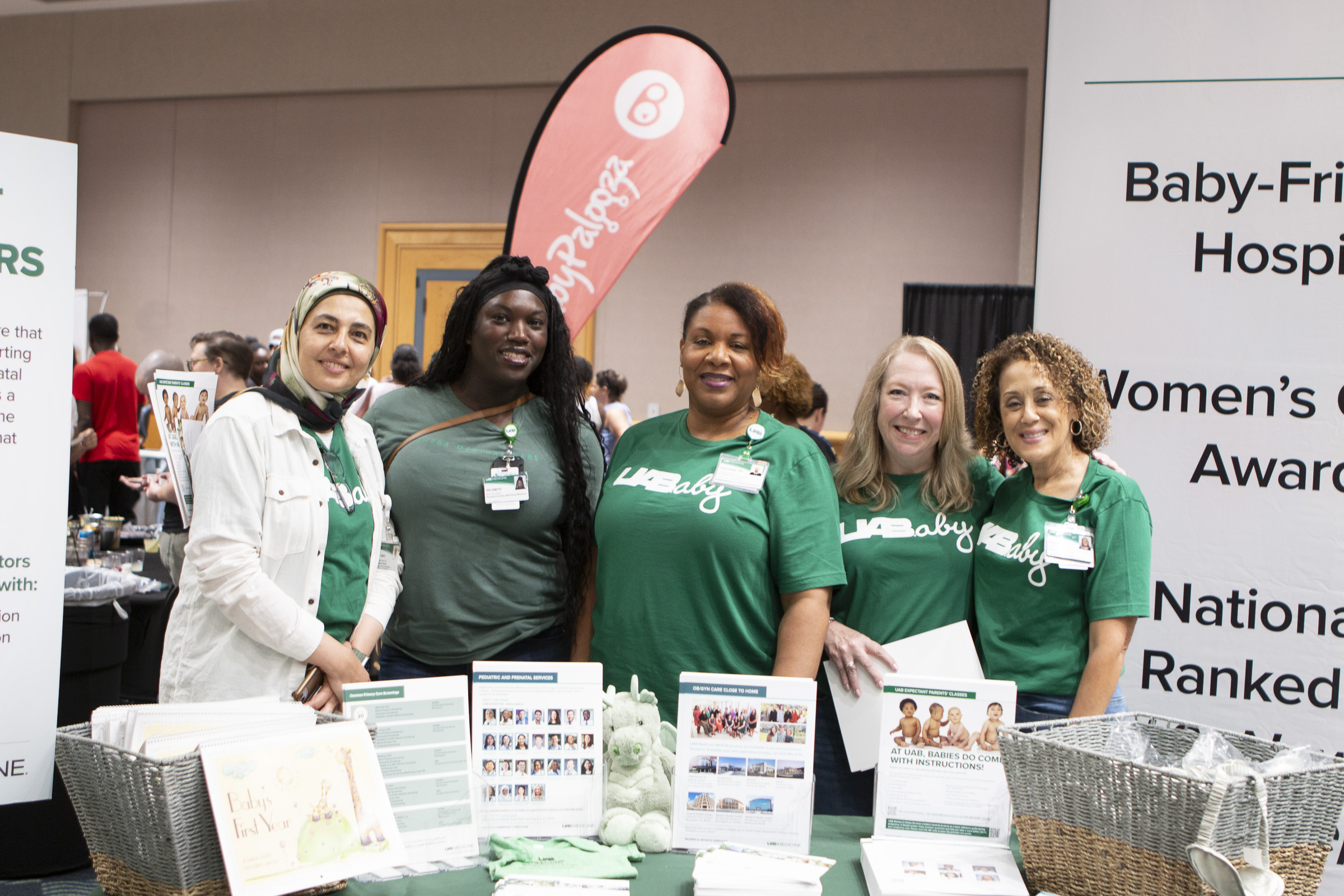
UAB Perinatal Nurse Navigators, from left, Sumayah Abed, MD, Bre’Lynn Smith, DO, TeShawn Hardy, RN, Robin Willingham, Paula Thomas, RN (Marika N. Johnson, For The Birmingham Times)
The Black Maternal Health Expo (BMHE) is a critical gathering designed to address these disparities head-on by providing a safe and empowering space for Black moms to access a wide range of resources. From support groups that foster community and solidarity to connections with culturally competent OB-GYNs, midwives, and doulas, the BMHE offered invaluable guidance and support.
At the expo, BLACK moms-to-be and new moms were able to find information on prenatal and postpartum care, breastfeeding support and mental health services. These resources are vital, given that Black women are more likely to experience pregnancy-related complications and often face systemic biases within the healthcare system.
The BMHE is not just an event; it’s a lifeline for Black mothers, offering them the tools and support they need to navigate their pregnancy journey with confidence and peace of mind. By bringing together healthcare professionals, community leaders, and support networks, the expo aims to uplift and empower Black mothers, ensuring they receive the care and respect they deserve.
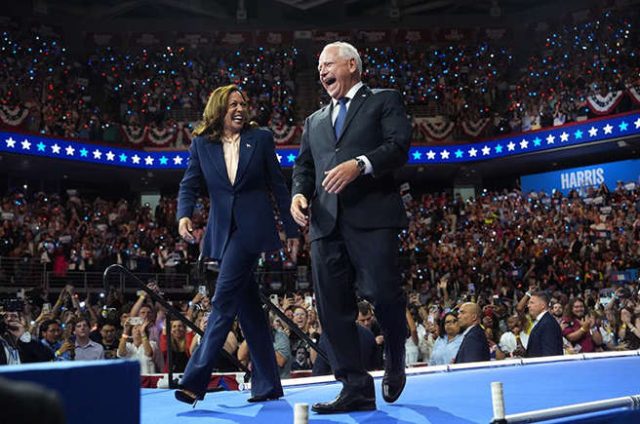
Democratic presidential candidate Vice President Kamala Harris and Democratic vice presidential candidate Minnesota Gov. Tim Walz appear on stage together during a campaign event at Girard College on August 6, 2024 in Philadelphia, Pennsylvania. (Andrew Harnik, Getty Images)
By Deborah Barfield Berry, USA TODAY
CHICAGO ‒ Less than three weeks remained until the Democratic National convention and Minyon Moore, chair of the party’s political showcase, didn’t know who Kamala Harris would pick as her running mate.
It had only been a couple of weeks since Harris had stepped up to become the party’s presumptive presidential nominee. Convention plans had been zigzagging for days.
Still, Moore was managing to “slightly” restructure the program to highlight Harris’ values and introduce her to American voters, as thousands of delegates, lawmakers, volunteers and others were getting ready to gather in Chicago to help her win the White House.
Interest in the convention has increased since Harris replaced President Joe Biden on the Democratic ticket, convention officials said.
For the first time, a woman of color will be a presidential nominee for a major political party and Black women will play most of the key roles in leading the Democratic convention – the party’s premiere national showcase.
“We’re seeing these prominent leadership roles in the hands of African American women,’’ said Wendy Smooth, a professor of Women’s Gender and Sexuality Studies and Political Science at The Ohio State University. “It really comes as no surprise because they have certainly put in the work and have been pivotal contributors.”
“This isn’t a pop-up moment,’’ she said.
For decades, Smooth and other experts said, Black women have worked – often behind the scenes – strategizing, mobilizing and organizing voters of color for the Democratic Party.
With them out front at the convention, among other things, that leadership will feature more speakers from often marginalized communities.
“We do want to make sure that America sees the diversity of who we are and how we’re trying to usher in … a new generation,’’ Moore told a small group of reporters recently in Chicago.
More young people, older people, people from LGBTQ+ communities and people of different ethnicities and faiths will appear on the podium than in years past, she said, and the convention will salute civil rights veterans such as the Rev. Jesse Jackson, who ran for president in 1984 and 1988. The lineup of speakers and programming hasn’t been finalized, convention officials said.
The diversity, experts and others said, could help energize a broad swath of voters.
“Black women play a significant role in the future of this party and have always, but especially now with a Black woman at the top of the ticket,” said Marcia Fudge, who served as convention chair in 2016 and is now co-chair of Harris’ presidential campaign. “The significance of it is that we all have the kinds of experiences that we know are going to be needed to get us through this convention and through this election.”
Democratic National Committee Chair Jaime Harrison and convention chair Minyon Moore (second from right), Keiana Barrett, senior advisor to the host committee, and Christy George, executive director of the host committee, talked to reporters in Chicago. (Deborah Barfield Berry, USA Today)
Black women leading convention ‘really quite historic’
Black women activists point to the impact of the late civil rights activist Fannie Lou Hamer, who gave an impassioned speech 60 years ago at the Democratic National Convention in Atlantic City, New Jersey. Hamer, a Mississippi sharecropper, challenged the makeup of her state’s all-white delegation and the national party’s lack of Black delegates.
Her efforts led to Democrats later requiring conventions to include more Black and women delegates.
“Our North Star has always been Fannie Lou Hamer,’’ said Donna Brazile, a longtime Democratic political strategist and former interim DNC chair. “She was denied a seat. We have spent the last 60 years making sure no one is denied a seat.’’
Glynda Carr, co-founder and president of Higher Heights of America, whose organization supports Black women candidates, said she’s excited to see the progression in the last decade of Black women to more visible roles, including at the convention.
The Democratic Party went from “what once was a very white leadership that Black women were the soldiers in to now these Black women are leading at the highest level,’’ Carr said.
She said Black women have been consistent in delivering the margins of wins for Democrats for years.
“Black women want a return on our voting investment,” Carr said. “And that’s in the form of seeing leadership that looks like us and policies that impact Black women, our families and our communities.’’
Black women have long played key roles in civic engagement efforts, including voter registration drives during the Civil Rights Movement. They were also involved during Reconstruction. But experts said they often weren’t in visible public positions.
“They said, ‘No more, that I’m going to lead. I’m going to step out there. I am going to use my voice and I’m going to be credited with the work that I am doing,’’ Smooth said. “But I’m going to claim it as Black women’s leadership.”
The Rev. Leah Daughtry, who will deliver an invocation next week and who served as convention CEO in 2008 and 2016, said this convention is personal for her and other Black women.
“For all of us, it takes a different kind of urgency, a different kind of care … Because it’s a Black woman and we know what the stakes are for Black women in this country,’’ Daughtry said. “Having a Black woman nominee makes us triple check that the T’s are crossed and that the I’s are dotted … We don’t get another chance as Black women. We have to be twice as good. We’re sensitive in that we want it to be successful. We want the ‘introduction’ of Kamala Harris to the world to be flawless and to be pitch perfect, so we’re paying extra attention.”
DNC convention ‘an opportunity to build a bench’
Biden selected people to head the convention, including people he trusted, who could get the job done and who had a wide network, Fudge said.
Fudge, co-chair of the DNC Credentials Committee, said Biden also chose people who had run conventions and “who were very capable of making sure that we have the best convention that we’ve ever had.’’
Moore, a Chicago native, has spent decades in national Democratic politics, including working on Jackson’s presidential campaign. She is also a former CEO of the DNC and was an adviser to Biden.
In addition to Moore, other African American women at the convention helm, include Christy George, executive director of the host committee, who helps raise money for the convention. George was first assistant deputy governor for budget and economy in the office of Illinois Gov. J.B. Pritzker.
Keiana Barrett, a senior adviser to the host committee, leads procurement efforts and advises on business equity practices and youth engagement. She has served on the communications team for Rainbow Push and the Congressional Black Caucus.
In addition to existing leaders, Moore said she, George and Barrett “recognize that the convention is an opportunity to build a bench of talented women.”
”Throughout my career, I’ve been in rooms full of people who don’t look like me or understand my lived experience,” Moore said in a statement to USA TODAY. “Not only is it important that Black women are now in the room, but we are swinging the door open and making sure to lift up the next generation of diverse and talented leaders.”
Other Black women in key roles, include Daughtry, co-chair of the DNCC Rules Committee who will present the committee’s report Monday.
Brazile, who is on the credentialing committee, also managed the presidential campaign of Al Gore in 2000.
Several other Black women are chairs of state caucuses and key committees, including Lottie Shackelford, the first woman elected mayor of Little Rock, Arkansas, who heads the DNC Women’s Caucus.
“We bring our own special sauce and the spices that go with it,” said Brazile, who is attending her 11th convention. “We came up through the process by which we were still fighting to have a seat at the table.”
Daughtry said the Democratic party has made strides since Alexis Herman served as CEO of the convention in 1992, noting that she and other Black women were appointed to their positions.
That “tells me that the party understands what we bring to the table and has been willing to trust us with these key and pivotal moments that are critical to the party’s forward movement, the party’s success,” she said. “Is there more room (for improvement)? Of course, there’s always more room.”
“People just didn’t pay as much attention because we were not at this kind of a critical and historic moment,’’ she said. “What we finally have done is we have reached a level that we have been able to navigate all of the things that it takes to run a convention.”
UAB Hospital in Birmingham, received recognition as one of the nation’s top hospitals. (UAB)
Special to The Times
UAB Hospital in Birmingham, received national recognition as one of the nation’s top 20 most beautiful hospitals. UAB Hospital was one of 80+ hospitals nominated in the prestigious contest.
The 2024 Most Beautiful Hospitals contest, which is sponsored by national healthcare staffing firm Soliant Health, recognizes hospitals for their commitment to developing and improving their campuses, facilities and staff, thereby creating holistic and healing environments. With 10,865 votes, UAB Hospital placed 18th in the national contest.
UAB Medicine is dedicated to educating future medical professionals, advancing medical science through groundbreaking research and providing exceptional healthcare services to over 1.6 million patients annually. As a leading trauma center, UAB Medicine treats the most critically ill patients in the state and offers numerous specialized services and research trials for promising new treatments, making it a beacon of hope for those seeking cutting-edge medical care.
“At Soliant, we believe that a beautiful hospital environment can play a crucial role in patient recovery and overall well-being. Each year, we are inspired by the innovative designs and thoughtful touches that make these hospitals not just places of healing, but places of comfort and hope. We congratulate all the winners of the Most Beautiful Hospitals contest and commend them for creating such exceptional spaces for patients, families, and staff,” said Soliant Health CEO David Alexander.
More than 200 outstanding hospitals have been recognized since Soliant began the program in 2009. The annual contest seeks to discover hospitals in the U.S. that are not only beautiful but have unique designs, landscapes, and elements, such as soothing art, gardens, or supportive staff who know that laughter is sometimes the best medicine.