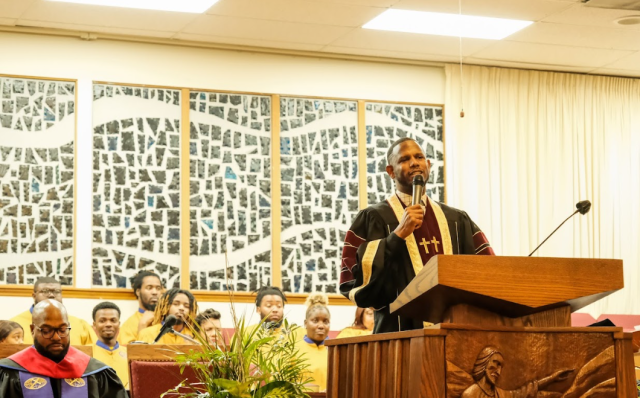
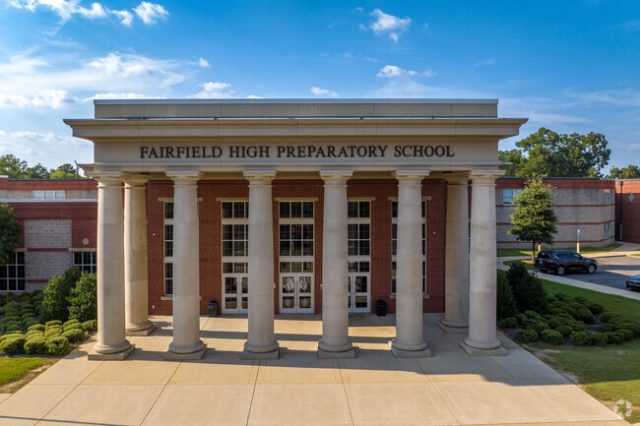
Dr. Thomas Beavers, pastor of New Rising Star delivers the keynote address during Miles College’s 126th Founder’s Day at First Baptist Church of Fairfield. (TA'RON WILLIAMS PHOTO, MILES COLLEGE)
By Barnett Wright | The Birmingham Times
Miles College celebrated its 126th Founder’s Day at First Baptist Church of Fairfield with Dr. Thomas Beavers, pastor of New Rising Star — known as “The Star” — as the keynote speaker.
“I was honored that [Miles College] invited me as the keynote speaker,” said Beavers, who spoke on how to honor the legacy of Miles and move forward.
“We honor that legacy by being lifelong learners and having a mindset that says that we never stop growing,” Beavers said. “The Bible says as great as Jesus was that He grew … in four different ways: He grew in wisdom, in stature, favor with God, favor with man. Wisdom is mentally, stature is physically, favor with God is spiritually, favor with man is socially and civically.
“When you think about how Miles was established it was established for Negroes to educate other Negroes and to develop Negroes to be productive citizens in America against all odds spiritually, educationally and civically” and we have to continue that legacy, said Beavers.
In the early 1890s, leaders in the Colored Methodist Episcopal (C.M.E.) Church saw a need for educated leadership in the Black community. In 1898 — 25 years after the incorporation of Birmingham — those leaders established Miles College, named for William H. Miles, a founding bishop of the C.M.E. Church.
Over its 126-year history, Miles College has graduated a number individuals with an impact in Birmingham, the state of Alabama, the country, including Autherine Lucy, the first African American to attend the University of Alabama; U.W. Clemon, the first African American federal judge in Alabama and Birmingham Mayors William Bell, Bernard Kincaid and Richard Arrington, Jr. — the first African American Mayor of the City of Birmingham
Birmingham native Bobbie Knight made history in August 2019 when she was named interim president of Miles College, becoming the first woman to lead the institution since its founding in 1898. On March 5, 2020, Knight was elected permanent president, becoming the 15th president of the historic institution.
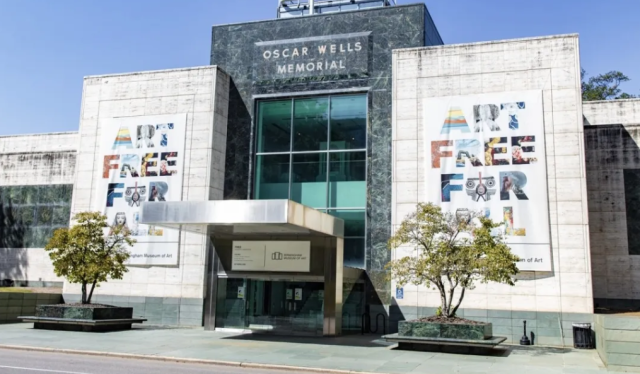
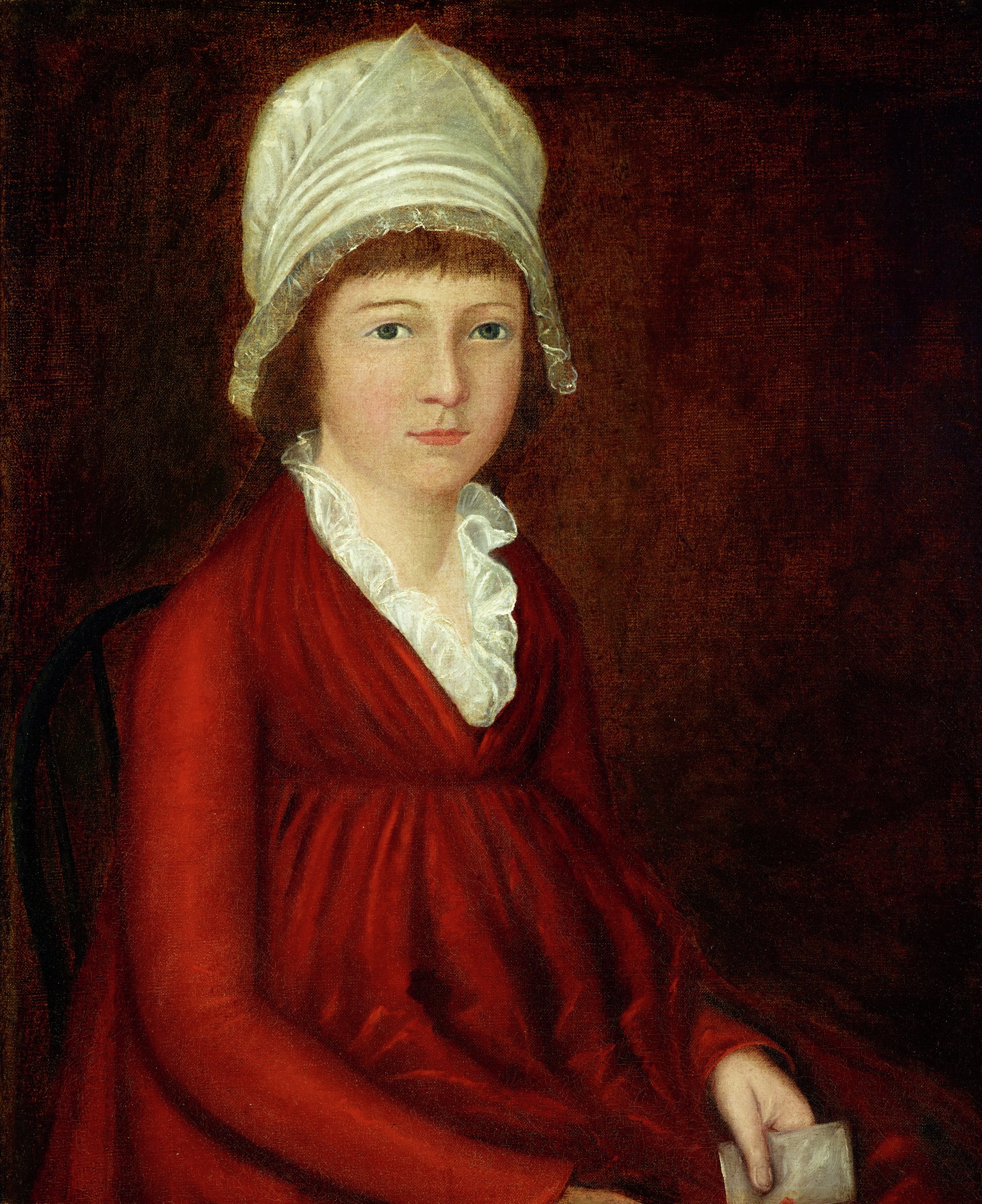
The Birmingham Museum of Art continues to expand its collection of African American art with the purchase of Joshua Johnson’s Portrait of Elizabeth Gilpin (1804–1892). (File)
artsbma.org
Joshua Johnson’s Portrait of Elizabeth Gilpin (1804–1892).
The Birmingham Museum of Art continues to expand its collection of African American art with the purchase of Joshua Johnson’s Portrait of Elizabeth Gilpin (1804–1892). Johnson, widely recognized as the first professional African American painter known to have worked in the United States, spent his career representing early nineteenth-century American life through his masterful portraiture. The painting is now on view in the BMA’s Styslinger Gallery of American Art.
“Acquiring this portrait is a testament to our continued commitment to presenting a more inclusive and comprehensive narrative of American art history,” says Dr. Graham C. Boettcher, The R. Hugh Daniel Director of the Birmingham Museum of Art. “Joshua Johnson’s work adds a crucial layer to our understanding of the diverse talents and perspectives that shaped our nation’s cultural landscape.”
Born into slavery, Johnson’s journey to becoming a self-taught professional portrait painter was unprecedented. After gaining his freedom in 1782, Johnson established himself in Baltimore, Maryland, at that time a flourishing hub of trade. He resided in the city’s Fells Point neighborhood, populated by Quakers, abolitionists, and free people of color.
From 1803 to 1815, he produced the majority of his known portraits, fewer than 100 of which survive portraying a diverse range of individuals, often including children. Johnson’s unique perspective on race and societal roles in the early United States remains a critical aspect of his artistic legacy.
Johnson painted Elizabeth Gilpin around 1814, when she was about 10 years old. The portrait reflects the artist’s distinctive, straightforward style in Gilpin’s direct gaze and the careful attention paid to capturing the textures of fabrics she wore.
A member of a prominent Quaker family from Philadelphia, Gilpin is depicted holding a letter, seated on a simple Windsor side chair. Her father, Joshua Gilpin (1765–1841) founded the first paper mill in Delaware on the Brandywine River in 1787. Elizabeth Gilpin’s family connection to the Quaker community adds depth to the narrative, as Johnson often painted abolitionist sympathizers and their families, and
Philadelphia’s Quaker community also often supported anti-slavery efforts. Dr. Katelyn D. Crawford, The William Cary Hulsey Curator of American Art at the BMA, said: “The acquisition of Portrait of Elizabeth Gilpin at the BMA helps to fill a critical gap in the museum’s collection, allowing for the exploration of new stories about race and childhood in early America.”
This acquisition comes after years of dedicated efforts by the BMA to expand its collection of African American art from the nineteenth century. In 1988, the BMA hosted the exhibition Sharing Traditions: Five Black Artists in 19th-Century America, exploring the lives and work of Johnson, Robert S. Duncanson, Edward Mitchell Bannister, Edmonia Lewis, and Henry Ossawa Tanner, five of the best-known African American artists of the nineteenth century.
At the time, Tanner was the only one of the five represented in the Museum’s collection. Now important works by each of these five artists anchor the Museum’s historic American art collection.
Founded in 1951, the Birmingham Museum of Art has one of the finest collections in the Southeast. More than 27,000 objects displayed and housed within the Museum represent a rich panorama of cultures, including Asian, European, American, African, Pre-Columbian, and Native American. Highlights include the Museum’s collection of Asian art, Vietnamese ceramics, the Kress collection of Renaissance and Baroque paintings, sculpture, and decorative arts from the late 13th century to the 1750s, and the Museum’s world-renowned collection of Wedgwood, the largest outside of England.
Birmingham Mayor Randall Woodfin announced Sunday that him and his wife, Kendra, are expecting their first child in August. (Instagram)
By AJ Holliday | CBS 42
BIRMINGHAM, Ala. (WIAT) — Birmingham Mayor Randall Woodfin and his wife Kendra are expecting their first child, according to an Instagram post Sunday.
The mayor posted a photo of himself holding his wife’s stomach, and the caption read “Kendra, LOVE is beautiful! LOVE is all we need! Baby Woodfin coming August 2024.”
The Woodfin’s got married on Oct. 8. They were engaged back in March. They were first publicly linked in a dance video posted the night Woodfin was re-elected mayor in August 2021.
The Birmingham Islamic Society (BIS) is inviting visitors to the Hoover Crescent Islamic Center during the holy month of Ramadan which starts on March 11. (Adobe Stock)
bis@bisweb.org
The Birmingham Islamic Society (BIS) is inviting visitors to the Hoover Crescent Islamic Center during the holy month of Ramadan which starts on March 11.
Muslims observe a daytime fast, abstain from food and drink from dawn to sunset, and refrain from being intimate with their spouses during daytime hours, among other spiritual exercises in self-restraint. At sunset during Ramadan, Muslims break their fast with a meal called ‘Iftar’.
Traditionally, the ‘iftar’ consists of breaking the fast amidst supplications with dates and water, followed immediately by the evening congregational prayer, before finally sitting down together to enjoy a delicious meal, all of which is always better when we have visiting guests!
Anyone with questions regarding beliefs and practices or concerns pertaining to Shariah law; “Jihad”; Women in Islam; Democracy and human rights and Islam; Jesus and Mary in Islam can visit.
Free copies of the Qur’an and Islamic literature will also be available on request.
The BIS welcomes groups of other faiths to join them to observe their prayer rituals and share the evening meal at the Hoover Crescent Islamic Center.
Fasting, along with the declaration of faith, daily prayers, charity, and pilgrimage to Mecca, is one of the “five pillars” of Islam.
Islam follows a lunar calendar and the month of Ramadan begins based on the sighting of the new moon. Because Ramadan is a lunar month, it begins about eleven days earlier each year.
There are an estimated 10,000 Muslims living in Alabama, with about 3,000 to 5,000 living in the greater Birmingham area.
The breaking of the fast at the Hoover Crescent Islamic Center typically draws about 700 participants nightly during Ramadan.
Dinner typically follows, with a brief presentation and then a question/answer session. The program usually runs about 2 hours in total, depending on the visiting group and their questions. Contact the center to reserve a spot for any day, starting March 12 through April 7 by calling (205) 879-4247 extension 6 or e-mail RamadanGuest2024@gmail.com.
The Alabama Power Foundation is working with the state's historically Black colleges and universities to help drive more Black men toward education careers. (Alabama Power Foundation)
ByCarlaDavis l Alabama NewsCenter
When Albert Ball was a student, what he “really needed” both inside and outside the classroom was Black male role models whom he could learn from and emulate.
Now, as a teacher himself, he stands as that role model, mentoring and leading young Black students in his own classroom.
“Being that confidante for young Black students is really important to me, and I can see that I make a difference every day,” said Ball, a math teacher at Liberty Middle School in Madison County and a graduate of Alabama A&M University.
Black male teachers like Ball can have a huge impact on students, but they make up only a tiny percentage of today’s educators. Only 1.3 percent of U.S. public school teachers in 2020-2021 were Black men – a drop from 6.5 percent just three years earlier, according to the National Center for Education Statistics.
The Alabama Power Foundation is partnering with several of the state’s Historically Black Colleges and Universities (HBCUs) to help change that trend. The foundation is funding a two-year pilot cohort aimed at increasing the number of Black male teachers in Alabama.
“Our Black Male Teacher Initiative is something we’re so proud to support. It’s one of the many ways that we partner with Alabama’s HBCUs to advance education,” said Staci Brown Brooks, Alabama Power Foundation president.
The foundation highlighted its work in this space in Birmingham at the UNCF Mayor’s Masked Ball on Saturday, which celebrated 80 years of supporting educational endeavors for minority students and the nation’s HBCUs.
Last year, the foundation invested more than $5 million in education, which is one of its primary focus areas. The new Black Male Teacher Initiative is just one facet of the foundation’s education-related efforts.
The objective of the Black Male Teacher Initiative is to work with select HBCUs, including Miles College, Alabama State University, Talladega College and Alabama A&M, to motivate more Black males to pursue education degrees and help prepare them for a career in the classroom, Brooks said.
“Representation matters in our schools,” she said. “We see this as an opportunity to help improve the perception of teaching as a career for Black men, and also to give hope and inspiration and mentorship to young Black men who need it.”
Jarred Rosser, a recent graduate of Miles, an HBCU in Fairfield, said because of the support he received through the Black Male Teacher Initiative, he was able to overcome financial challenges and complete his degree in early childhood education, keeping him on track to becoming a teacher.
Rosser said completing his undergraduate studies was especially meaningful because he’s the first person in his family to receive a college diploma.
Mario Lumzy, an Alabama State alumnus and principal at Birmingham’s William J. Christian K-8 School, can also testify that the Black Male Teacher Initiative is reaping results, even though the program is still in the early stages.
“The Black Male Teacher Initiative has certainly impacted students at Alabama State University,” Lumzy said. “We have so many males who benefit from seeing other Black males around the campus.”
During the Discovery Phase of the Black Male Teacher Initiative, research was conducted to select HBCU partners, evaluate their educational programs, identify needs and propose ways to provide support. In Phase II, the foundation will work with college faculty and school system administrators to develop ways to motivate program participants to remain in Alabama after graduation.
Grants from the foundation are being used to cover the cost of student teaching stipends, exam preparation and fees, and mentoring/professional development programs.
The foundation has also recommended other avenues for future support, including funding for sponsorships, new teacher grants, career fairs, professional development cohorts and networking opportunities.
With 23 years of experience in the classroom, Jeffree Wynn, a Talladega College graduate and special education teacher at Birmingham’s Huffman High School with 23 years’ experience in the classroom, had this advice for young Black males preparing for a future in education: “Lead with your heart.”
“There’s a certain aspect of emotion that goes into education, and being a role model in that way,” Wynn said.
“That starts with the heart.”
To learn more about the Alabama Power Foundation and its many programs and initiatives, visit powerofgood.com.
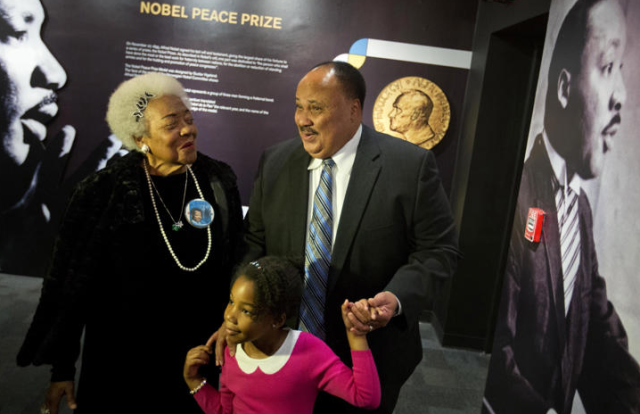
Martin Luther King III, right, the son of Rev. Martin Luther King Jr., walks with his daughter Yolanda, and Naomi King, left, the wife of Rev. King's brother, A.D., through an exhibition devoted to the awarding of the Nobel Peace Prize to King at the Martin Luther King Jr. Historical Site, Wednesday, Dec. 10, 2014, in Atlanta. Civil rights activist Naomi Barber King died Thursday, March 7, 2024, in Atlanta, according to family members. She was 92. (AP Photo/David Goldman, File)
Associated Press
ATLANTA (AP) — Naomi Barber King, a civil rights activist who was married to the younger brother of the Rev. Martin Luther King Jr., has died at age 92.
She died in Atlanta on Thursday, according to family members who issued a statement through the A.D. King Foundation.
Naomi King established the organization in May 2008 with a mission of empowering youth and women and advancing strategies for nonviolent social change.
“She was a woman of quiet dignity, overcoming strength, and steadfast support to her husband, family, and circles of influence within and beyond Atlanta,” the statement said.
Naomi King was born in Dothan, Alabama, according to the foundation’s website. She and her mother, Bessie Barber, moved to Atlanta to “make a better living” for themselves. In 1949, King entered Spelman College and spent a year studying French. She later attended the University of Alabama and studied interior design, according to the website.
She was married to the Rev. Alfred Daniel Williams King, a Baptist minister and civil rights leader she met after joining Ebenezer Baptist Church. The couple married in 1950 and had five children. A.D. King died in July 1969.
The couple supported Martin Luther King Jr., and his leadership in the Civil Rights Movement and were at his side during multiple historic events, including the 1963 March on Washington for Jobs and Freedom, one of the most famous political rallies in U.S. history.
Naomi King published a book in 2014 titled, “A.D. and ML King: Two Brothers Who Dared to Dream.”
Known for her love of butterflies and affectionately called the “Butterfly Queen,” King set an example of courage, resilienceand grace in the face of injustice, uncertainty and heartache, which were themes highlighted in a 2022 documentary about her life, according to the foundation.
She is survived by her daughter, Alveda King; her son, Derek King; and several grandchildren.
New research from the University of Alabama at Birmingham shows a significant workforce reshuffling is underway as people increasingly seek environments where they feel valued and appreciated. (Adobe Stock)
ByAdam Pope | UAB News
New research from the University of Alabama at Birmingham shows a significant workforce reshuffling is underway as people increasingly seek environments where they feel valued and appreciated. Amid this backdrop, a recent study is shedding light on the crucial factors for retaining employees.
Conducted by a team led by UAB Department of Health Services Administration Assistant Professor Katherine Meese, Ph.D., the study, published in the Journal of Multidisciplinary Healthcare, surveyed over 4,400 health care workers to delve into the dynamics of employee turnover and organizational support. These findings underscore the importance of perceived organizational support in fostering a positive workplace environment, transcending the boundaries of individual health care institutions.
“Time is short, right? People witness others’ falling ill, receive distressing news and consequently begin to reassess their priorities,” Meese said. “They start to question how they spend their time.”
Meese says that, as a result, people have begun to value different things. Many individuals undergo a process of realization, deciding not to remain in environments where they feel undervalued or unappreciated or where their work lacks meaning.
“This has led to a significant reshuffling of employees, as they seek out environments they hope will provide a better experience, or at least one that isn’t worse,” Meese said.
In the study, Meese says trust in senior leadership emerged as a critical factor, overshadowing the influence of direct managers in retaining employees.
“These findings are significant because much of the work revolves around supervisors and managers,” Meese said. “However, what we’re truly observing is that the senior-most leaders hold considerable influence over decisions to stay or go.”
She says another perspective to consider is that, even if an individual has a strong relationship with their direct manager, if they lack trust in the leadership above, they will not feel secure there, and they may not remain hopeful that conditions will improve in the future.
Communication breakdowns and misconceptions were identified as potential threats to trust in senior leadership, impacting employee retention.
She says the main factors that predict whether people plan to leave or fail to recommend the organization are not financial. They are durable, work culture elements and leader behaviors that boil down to six key issues:
Burnout – Can I stay here and preserve my mental health and energy?
Organizational Support – Does the organization care about my well-being and value my extra efforts and contributions?
Trust in Senior Leadership – Do I trust the people at the top?
Availability of Resources – Do I have what I need to do my best work?
Recognition – Am I appreciated for my contributions here?
Belonging – Is this the place for me?
Strategies such as effective rounding and leader visibility contribute significantly to building trust and a sense of belonging among health care workers, and can also apply to non-medical organizations, while collaboration between different units and recognition play pivotal roles in fostering trust in senior leadership, according to Meese.
She says the study’s insights come at a crucial time as health care institutions and other organizations grapple with workforce retention amid the ongoing challenges of the pandemic. As accountability remains essential for maintaining standards of behavior and retaining top-performing employees, a balance between setting standards and acknowledging job market dynamics is necessary to overcome challenges in accountability without compromising morale.
United Way of Central Alabama’s Bold Goals Coalition recently won a $2.5 million federal grant to continue providing services and support to students and families through the Community Schools strategy, which it began implementing last year in partnership with Fairfield City Schools. (Provided)
uwca.org
United Way of Central Alabama’s Bold Goals Coalition recently won a $2.5 million federal grant to continue providing services and support to students and families through the Community Schools strategy, which it began implementing last year in partnership with Fairfield City Schools.
The grant, administered by the U.S. Department of Education, will provide $2.5 million over five years, adding to the $1.5 million that UWCA has already dedicated to the first three years of the program.
The federal funding will enable United Way to hire two more Community Schools Coordinators, who will work to facilitate the provision of services by United Way’s network of partners. The addition of these two employees will allow United Way to place a coordinator in each of the four locations of Fairfield City Schools (FCS).
U.S. Rep. Terri Sewell, who helped United Way receive the grant, said she is excited to see such progress in connecting Fairfield residents to resources.
“We have already begun to see the positive outcomes of this partnership for our students and families, which is why I was proud to advocate for this grant at the federal level,” Sewell said. “This funding will go a long way in helping UWCA expand their efforts and serve even more families here in Fairfield.”
While still in the early stages, numerous organizations have already agreed to begin a variety of additional services in Fairfield because of the collaborative energy of the Community Schools strategy, which seeks to use school properties as physical hubs for a range of services, besides education alone, to address the needs of students and families. Such services may include healthcare, mental health counseling, nutrition and dental services, high-quality early learning, after-school and summer learning programs and technical job skills training.
This year marked the beginning of the Modern Manufacturing Program, sponsored by Central Six Alabama Works!, which offers high school students up to eight credentials and valuable experience toward future employment. Big Brothers Big Sisters of Greater Birmingham has also started its Beyond School Walls mentorship program in Fairfield, which allows students to shadow specific Southern Power employees in their daily work environment.
Additionally, Fairfield has strengthened its connection with the Nurse-Family Partnership of Central Alabama, administered by the University of Alabama at Birmingham School of Nursing, enabling pregnant students to gain access to extra care from the time of early pregnancy to giving birth and beyond.
Drew Langloh, President and CEO of UWCA, said the organization is uniquely positioned to draw on, and coordinate resources from, its six-county service area for the benefit of the Fairfield community.
“The scale of United Way means we can serve as connectors for communities like Fairfield,” Langloh said. “We are proud to be Community Schools leaders in our region and hope to serve as a model for others.”
Dr. Regina Thompson, FCS Superintendent, said more than 90 partners, including local businesses, residents and nonprofits, have been working to establish common goals for Fairfield.
“Originally, everyone was working on different needs,” Thompson said. “We had 90-plus partners, but… they were only bringing to the table what they could do, and then they would go back to their respective businesses. But [then we said,] “Okay, if we’re really going to talk about Community Schools, everyone needs to work on the same goals.”
Fairfield Mayor Eddie Penny said schools are one of the few avenues through which a “whole family” can be reached and that the economic situations of families within communities directly impact the success of children.
“If you don’t have to worry about the financial portions of life” Penny said, “and you’re not worried about a place to stay, you’re not worried about being warm or cold, you’re not worrying about food, all you’ve really got to concentrate on is your studies.”
Samford University will serve as the evaluation partner for the work, giving Samford an opportunity to engage with its surrounding community “in partnership, service and cultural understanding,” said Beck A. Taylor, President of Samford.
“We are excited to collaborate with United Way of Central Alabama and Fairfield City Schools to change lives for the better with these comprehensive efforts,” Taylor said.
To read more about how Fairfield residents and leaders have responded to the early results of the Community Schools strategy, visit uwca.org/fairfield.
Average risk individuals start colorectal cancer screenings at the age of 45. Colorectal cancer screenings can be performed either through colonoscopy or stool-based studies. (Adobe Stock)
By Brianna Hoge | UAB News
Individuals in their 20s and 30s should be aware of the warning signs of colon cancer to know when to seek medical attention. When most people think about colon cancer, they associate the disease with older populations. However, the American Cancer Society reports that one in every five colon cancer diagnoses in 2019 was in someone younger than 55 years old. This is an increase of 9 percent since 1995.
Drew Gunnells, M.D., assistant professor in the UAB Department of Surgery, emphasizes that the biggest concern of colorectal cancer is a strong family history. He recommends seeking out family members and discussing their medical history as this may change the window of screening time.
“Genetics plays a significant role in colorectal cancer, and if you have an immediate family member with colorectal cancer, then you will need to relay this information to your medical providers to start screening earlier,” Gunnells said.
“Drinking, smoking, eating highly processed foods and meat, and high sugar diets are going to increase your risk factors,” Gunnells said. “That’s not to say that you should not eat anything with sugar or that is highly processed, but be mindful of the amount you are consuming.”
Another way an individual can lower their risk is to incorporate physical activity into their day-to-day routine. This can include:
taking the stairs instead of the elevator
parking toward the back of a parking lot
stretching while watching television
Recently, one UAB researcher found that music can have a positive or negative impact on athletic performance during exercise. Learn more about how to select the right workout playlist, here.
Warning signs
Red flags for individuals in their 20s and 30s are bowel habits, abdominal pain or bloating, weight loss, fatigue, or change in appetite. But, no matter one’s age, Gunnells stresses that blood in the stool and rectal bleeding are never normal.
“Many times, it is not cancer and is likely something minor, like hemorrhoids; but it is something that needs to be evaluated,” Gunnells said.
A primary care provider is central to obtaining necessary screenings and discussing additional risks for colorectal cancer. To find a UAB Medicine provider, click here.
Learn about the services and treatments for colorectal cancer that the O’Neal Comprehensive Cancer Center at UAB offers here.
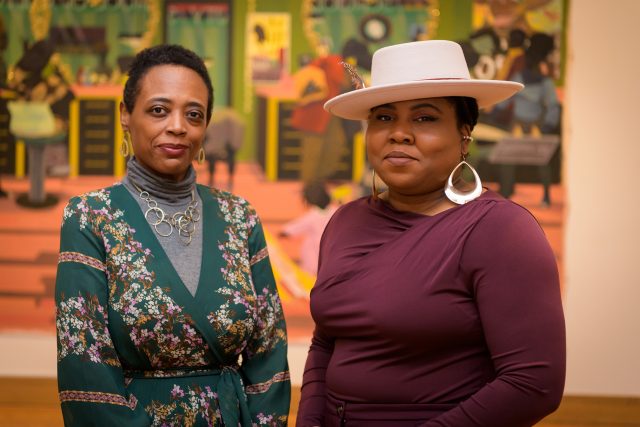
Salaam Green, City of Birmingham's inaugural Poet Laureate, left, and Ashley Jones, Poet Laureate of the state of Alabama, inside the Birmingham Museum of Art. (Amarr Croskey Photo, For The Birmingham Times)
By Javacia Harris Bowser | For The Birmingham Times
It’s a sunny Tuesday in January, and Salaam Green is making a couple of stops in the Magic City. First, she attends a Birmingham City Council meeting, which is no ordinary gathering—it’s where she is sworn in as Birmingham’s first Poet Laureate. Now, Green is arriving at the Birmingham Museum of Art for a conversation with another local poet who has made history—Ashley M. Jones, Poet Laureate of the state of Alabama.
In 2021, Jones was tapped to serve as the state’s Poet Laureate from 2022 to 2026. Jones, 33, is the first person of color and the youngest person to hold this position since it was established in Alabama 93 years ago.
She is also well known in the local literary community for leading her “Write to Heal” workshops—a series of seminars that teach both individuals and organizations how to use poetry, writing, and storytelling to reclaim their voices and change their lives.
The Birmingham Times brought the two Poets Laureate together for a Women’s History Month exclusive, where they share words of wisdom and encouragement, moments of laughter, and heartfelt love and joy with one another.
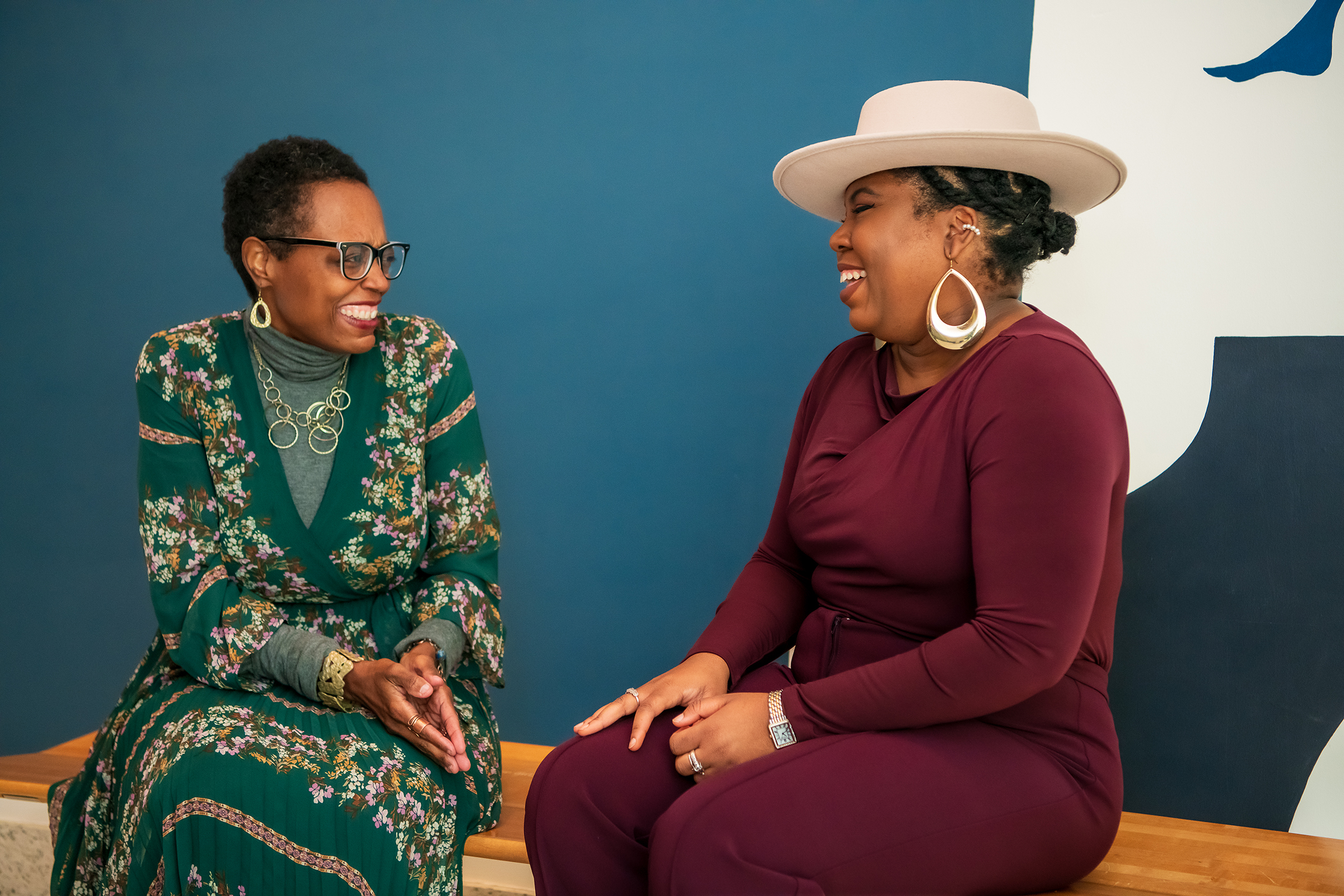
Salaam Green, City of Birmingham’s inaugural Poet Laureate, left, and Ashley Jones, Poet Laureate of the state of Alabama. (Amarr Croskey Photo, For The Birmingham Times)
Green on what it meant to her when she learned that Jones had been selected as Alabama’s youngest and first African American Poet Laureate.
Green: I don’t cry a lot, but I was feeling teary. The idea of Alabama doing something right. The idea of you not just stepping into this role, but this role I feel like you were birthed to do—it felt like my cousin, my play cousin, my sister is over there, and look at what she’s doing.
[Speaking to Jones] Just to see your beautiful face all over the place—it meant so much. So, I just want to say thank you for being you and for giving me the opportunity to celebrate that. It was monumental.
Jones: That means a lot to hear you say. I love your work, and I’m just so grateful for what you do. For you to say that you’re proud of me, that makes me feel like I’m doing something right. Everything I do, I feel like, is in service of the people. For me, the respect of my peers means everything. These higher-up people—they’re whatever. But people who are on the ground, if you think I’m worth it, that means it’s true. If some person up in New York says, ‘Oh, we like you,’ it doesn’t necessarily mean as much to me. So, I really do appreciate that.
Green: I remember your [debut poetry collection], “Magic City Gospel,” and taking it into my “Write to Heal” workshops. I’m like, “OK, I’m taking this book everywhere!” It has a beautiful cover number one, but also for young people to see the covers of books with the names of our people on them.
And then they see you transition into this monumental role and see that you’re everywhere, even on [ABC’s a.m. news program] “Good Morning America.” You stepped into your dream, into your destiny. And then others can see themselves in you.
Jones: When I was on “Good Morning America,” y’all went up there with me. No, you weren’t there physically, but I was like, “OK, I’ve got to make all my people proud. I can’t be on this TV talking crazy.”
Jones reflects on learning there would be a city of Birmingham Poet Laureate and that Green had been selected.
Jones: I was really excited to find out they wanted to start one. Our city is just so vibrant and so full of artists, and I feel like it’s not enough to have somebody just for the state. Somebody needs to represent us, very specifically. So, when I found out that it was going to happen, I hoped that it would be someone who really had a spirit of the city, someone who was involved already, not just someone who wanted to put something on their resume.
Green: I don’t think I even have a resume.
Jones: When I found out it was you, I was so ecstatic. Of course, I was very proud that it was another Black woman. I think we do everything wonderfully, but to know that you would be the one spreading your message of healing and authentic life to everybody in Birmingham—that was amazing to me. I was just so elated. I know you’re going to take our city to a new level with poetry and show people what you can do. I’m just so excited. I cannot wait.
Green shares why she decided to apply for the role of Birmingham’s first Poet Laureate.
Salaam Green, City of Birmingham’s inaugural Poet Laureate, left, and Ashley Jones, Poet Laureate of the state of Alabama. (Amarr Croskey Photo, For The Birmingham Times)
Green: I was so excited when I heard that the Alabama State Council of Arts had decided to do this. I looked at the application, but I came aboard a little bit late. I put my application in probably an hour before it was time to be submitted. That is so like me.
[In August 2023, Create Birmingham, in partnership with the city of Birmingham and through funds by the Alabama State Council on the Arts and the Birmingham City Council’s Cultural Arts Committee, began accepting applications for Birmingham’s inaugural 2024–2025 Poet Laureate.]
Jones: Wow! Clearly, it was meant for you.
Green: I had so many people who were encouraging me, so many people who I was inspired by, but I’m thinking, “This is the Magic City that is full of poets and spoken word artists like this person and this person.” Other people kept saying, “Just try.” So, toward the end [of the submission period], I filled out the application hurriedly. I thought, as a Black woman who is aging with wisdom and as a Black woman who has touched the city and who the city has touched, why not just try and trust and believe.
Jones on what she’s learned during her first two years as Alabama’s Poet Laureate.
Jones: The first thing I would say is, honor your downtime. Before anybody asks you to do anything, know what time of yours untouchable. That is the biggest mistake I’ve made just generally in life but certainly in my first two years as Poet Laureate. I was so eager to just be there for everybody, not realizing that I needed to take time for me in order to show up better wherever I was asked to go. The second biggest thing is just to really stay true to who you are, which is what’s so great about you already—that you are always Salaam, all the time. You always bring your spirit to everything. Just try to protect that. You’ll be asked to write for various occasions, and sometimes that can make you feel like you’re not speaking as yourself. But the reason you were selected is because of who you are, so protect yourself and your own spirit at all costs because that’s the thing people want to experience, that’s what’s going to bring people to poetry and together, as well.
Green: That’s powerful.
Jones: The third thing I would say—and this one may be a little silly, but it’s me, so I’m going to say it—have a few go-to outfits ready for certain types of occasions. You know you’re going to have your official stuff, so get you a couple of suits that are just ready to go and good to photograph. And the value of the hat—I really cannot overstate that because sometimes, at least for me, the afro doesn’t want to act right. The hat will eliminate any issue.
Green: I love that. I know the value of a head wrap. Believe me.
Green asks for more advice on being a Poet Laureate.
Green: You’ve been doing this for a while, and it’s been a pleasure to watch you do this. But also, it’s been a pleasure to watch you stay true to yourself. How have you done that? Your identity, your fashion, your private life, your public life? How have you stayed true to Ashley?
Jones: It hasn’t necessarily been easy. I always feel like I’m being pulled in a lot of directions all the time. But I’d say one thing is knowing who your people are and keeping them close. So, for me, that’s my family and my boyfriend. Having my core group of people who will hold me accountable, who keep me humble. My mom will always say, “You’re not going to get the big head as long as I’m here.” And I have not.
Having people that you can really be real with and vent to, as well. When you’re a public figure, you really can’t vent in a public space. Yes, we are poets, and we vent in our poetry, but there’s a certain other level that we’re at now as public officials. So, having those people who are a safe space for you is vital. That’s going to help you to maintain yourself. It’ll help you to face every situation. If you’re able to bounce ideas off of somebody you trust, that is key.
Also, I keep reminding myself, the reason that I have this position is because of me, because of who I am already. I didn’t have to put on any airs to get the position, so I don’t have to do that to keep the position.
This slideshow requires JavaScript.
Green shares her Poet Laureate platform.
Green: The Poet Laureate, as you know, came with duties and responsibilities already. So, I’m elated to do those things and many of those things I was doing in the city already. But I think one of the biggest things that I really want to do is look at how do we use poetry as a political activation, particularly in a Civil Rights– and justice-oriented city. And this is an election year. There are some charged emotions. For me, part of my tenure is looking at poetry as a healing tool, a political activation tool, and a tool for advocacy. And then also a tool so that others can see, yes, you can spit poetry. Yes, you can perform poetry. Yes, you can do all those beautiful things. Poetry also can take you into rooms, it can take you into spaces, it can take you into legislative houses. I want to talk to government officials about how we can activate poetry into public spaces and the political realm.
Jones: I’m voting for you for president.
Green shares life advice for Jones.
Green: First of all, don’t let anyone tell you that any age has any limitation. But I would say my biggest advice—and this is what I would say to any Black woman—is stay as Blackity Black as you possibly can. I’m talking about collard greens. I’m talking about sitting around barefoot outside. I’m talking about allowing your culture of who you are as a Black woman permeate not just your writing and your artistry but through who you are. Whatever you decide to be, be as Black in those spaces as you can. When you go out into the world as this New York Times best-selling author, Pulitzer Prize–winning …
Jones: I’m claiming it. Yes.
Green: … We can say, “That’s Ashley. That’s my play cousin with those earrings telling me I need to go get a hat and a head wrap.” Sometimes we lose the most important part of ourselves, which is what the Spirit has put inside of us to be, the thing that has caused us to shine. I know you will never lose that. As you get older, remember that you have nothing else to prove. You never did. You are enough. You always have been.
Jones: I’m about to shout! I did not come here to be filled with the Holy Spirit! But this is why I love being around Black women.
Green and Jones reflect on what life experiences have prepared them for their respective positions.
Jones: I’ve been studying writing professionally since I was 12. A lot of people, when they see I’m the youngest this or that, assume I just magically became this. I’ve been working hard for so long. So, to me, this took a really long time to get here. It just so happened that I started really early. All of the preparation at [the Alabama School of Fine Arts (ASFA), at [the University of Alabama at Birmingham (UAB)], at [Florida International University (FIU)]—all the schools I attended—of course, prepared me for the writing side of it. As far as the public-facing side, I think being a poet who was already doing touring gave me some experience being in front of cameras, having to answer questions off the cuff. Being a teacher prepared me a lot, actually, for this because being in front of students every single day is scary.
But I think also just being raised by people who made sure I knew I was good enough, just as myself, that kind of laid the groundwork for me always returning to my authentic self. Throughout my life, I’ve not always liked who I am authentically. I used to think, “I’m not Black enough. I’m not smart enough. I’m not pretty enough.” These are thoughts that were in my head as a young child. But because I had that foundation from my mom and my dad, I knew I always could return to, “Well, they said I was worthy, so it must be true.” And that’s really what I’ve been coming back to even as an adult. Even at 33, I’m going back to 5-year-old Ashley hearing my parents say, ‘You’re great. You’re beautiful. You’re smart.’ Salaam, what about you?
Green: I think we have two different paths. I used to really get sad and cry about the fact that I wish that I started poetry when I was 12 years old. I wish I had gone to college [to study writing], and I had that opportunity. But there wasn’t any space in my life for that. I didn’t even know it was available.
So, what I think has prepared me for it has been life experiences and being a community poet. It has been really challenging not having that background as an academic poet. I felt some shame around that for so many years. Even in this role, I was thinking, “Salaam doesn’t have a book, she doesn’t have a [Master of Fine Arts (MFA) degree]. How is the Spirit going to say, ‘Let me just drop you into this role.’” But I think what has prepared me for it has been community, as well as knowing that I always could speak well and I have a voice.
Jones: I will say, though, about what you just said, about not having an MFA and being a community poet, I’m very passionate about opening up the idea of who poets can be. Because, even though I’m an academic poet, I sometimes feel like I’m not cool enough to be in these community spaces. I don’t memorize my poems. I mean, I have a reading presence, but I’m not out here performing in the way that some spoken word artists do. So, I think on both sides, there’s a lot of just this feeling of “Am I enough?”
When they asked me what I thought should be the requirements for this position, [Alabama Poet Laureate], I said, “We can’t have a publication requirement or MFA requirement.” The poetry itself has nothing to do with those things. I didn’t start writing because I wanted to do something in school. It was inside of me. So, I think having both of us as Poets Laureate in this state demonstrates that there’s a wide range of experiences, of backgrounds. Different types of poets are able to represent everybody. There’s space for everybody.