

Two-Time Champion Benavidez “The Red Flag” Is Looking For a KO Against Lemieux


David Benavidez believes Canelo Alvarez is ducking him and that Jermall Charlo fears him.
The fighter known as “El Bhandera Roja” (The Red Flag) considers an all-Mexican clash with four-division champion Alvarez or a battle of unbeatens with WBC 160-pound champion Charlo among his most coveted matchups should he defeat former IBF middleweight titleholder David Lemieux on Saturday.
The 6-foot-2 Benavidez (25-0, 22 KOs) will pursue his sixth straight knockout and the WBC’s vacant interim 168-pound title against the 5-foot-10 Lemieux (43-4, 36 KOs) at the Gila River Arena in Glendale, Ariz., near his hometown of Phoenix. The Premier Boxing Champions’ event will be on Showtime (10 p.m. EDT).
“My main focus is always to get the knockout or the stoppage, and that will be no different against David Lemieux. I don’t want there to be any doubts in anybody’s mind, so knockout is how I want the fight to end,” Benavdez said. “I’m going to use my range. My game plan for David Lemieux is that I’m not going to be staying in there on the inside.”
Benavdez’s reach is 74.5 inches to Lemieux’s 70.
“The smart thing for me with him being the smaller fighter and me having the longer arms is that I’m gonna touch him, but when I want to be inside, then I’ll be inside. When I wanna be on the outside, I’ll be on the outside,” Benavdez added.
“I’m not just gonna sit there for David Lemieux to throw his left hook at me. I’m not just going to go in there and fight shot for shot. I’m going to get my shots in and then move out of the way. I’m going to use my jab and just keep him at distance. I’ll be in my hometown, so I’m just ready to make another statement.”

Benavidez faces Lemieux two weeks after a unanimous decision loss by Alvarez (57-2, 39 KOs), who fell to Russian WBA 175-pound champion Dmitry Bivol (20-0, 11 KOs).
“I always knew Canelo wasn’t unbeatable. Bivol exposed him a little, and, I thought, beat Canelo more convincingly than 115-113 on all three of the judges’ cards,” said Benavidez, who looks to become a WBC 168-pound titleholder for the third time in his career.
“If it was me, I’m an attacker, have great power, great speed, great jab, great body shots, would have shown more power, definitely gone more to the body and for the knockout. I’m also younger, much taller and have longer arms than Canelo.”
Benavidez last fought in November with a seventh-round TKO of Kyrone Davis at The Footprint Center in Phoenix, a week after Alvarez’s 11th-round stoppage of previously unbeaten Caleb Plant.
In victory, Alvarez added Plant’s 168-pound IBF crown to his WBA/WBC/WBO versions to become the first fully unified super middleweight champion.
“I believe a fight between myself and Canelo is a bigger fight now than ever, and that if he comes back down to 168, that’s the fight that should happen. I’m motivated to leave it out there and to make sure that I come out of the ring with no less than a victory over Canelo Alvarez,” Benavidez said.
“That’s why I’m going to be fighting smart and definitely going for the knockout against David Lemieux. Once I win the WBC’s interim title, I’ll become the mandatory, and then Canelo’s got to fight me or else give up the belt.”
On June 18, Charlo (32-0, 22 KOs) will make his sixth defense of the WBC 160-pound title against Maciej Sulęcki (30-2, 11 KOs).
“Charlo doesn’t want to get in the ring with me,” Benavidez said. “Because he’s a p***y.”
Benavidez said he “saw fear” in Charlo’s eyes during a face-to-face confrontation last month while the fighters were ringside at AT&T Stadium in Arlington, Texas, for IBF/WBA/WBC 147-pound champion Errol Spence’s 10th-round knockout of Yordenis Ugas.
Benavidez said the incident began as a result of an exchange between Charlo and Jose Benavidez Sr., his father and trainer.
“I saw him yelling at my Dad from the other side, so I went up to him, and I pushed him on his shoulder, and he went back, and he went behind his security guards, and that’s when he started yelling, and that’s when he started getting tough. But in reality, when I pushed him, if he really wanted to do something, then I was there and close to him. He didn’t have to go behind his bodyguards. We could have done whatever. I’m a fighter, he’s a fighter, so nobody wants to back down. I’m not going to let him disrespect me, and he’s not going to let me disrespect him,” Benavidez said.
“But when I put my hands on him and pushed him, I saw fear in his eyes. That’s when I knew he was scared of me. Why do you think he went behind his bodyguards? If somebody would have pushed me you know we would have gotten into it right there. I didn’t go behind any bodyguards. I’m not going to let somebody talk to me that way. So, I know he’s scared of me. He’s a little guy and I could see fear in him. If Jermall Charlo’s big, bad and tough like he says he is, then we’ll see if he moves up to 168. But I know he’s scared of me and what I’m gonna do to him once we get to that day.”
But for now, Benavidez’s focus is Lemieux, who is 9-2 (five KOs) in his past 11 bouts.
Lemieux became an IBF 160-pound champion in June 2015 with a unanimous decision over Hassan N’Dam but was dethroned that October by Gennady Golovkin, winner by eighth-round TKO.
“Styles make fights. David Benavidez comes to fight. That’s my style, too,” said Lemieux, 33. “Two bulls going in there. I do believe that my power will translate at 168 pounds. I have the style to hurt Benavidez, and I’m leaving with the WBC title on fight night.”
“I feel like I’ve been underestimated during my career. The only way to come back is with a strong victory against an opponent on an elite level. That’s what I’m planning on doing. I’m training hard to beat this guy.”
Once the youngest 168-pound world champion in history, Benavidez was stripped of his WBC crown in October 2018, declared “Champion in recess” and suspended for six months following a positive drug test for Benzoylecgonine (the main metabolite of cocaine).
Benavidez ended his ring absence with a second-round knockout of J’Leon Love in March 2019 before regaining the WBC crown that September with a ninth-round knockout of Anthony Dirrell.
An overweight Benavidez lost that title on the scales in advance of a 10th-round knockout of Roamer Alexis Angulo (August 2020) before scoring an 11th-round TKO over Ronald Ellis in March 2021.

“I’m kind of forgetting about Canelo because he’s over there doing his thing. Besides Caleb Plant or Jermall Charlo, Demetrius Andrade is the only other fight that makes sense. If not, it might be time to go up to 175 pounds. When I win the WBC interim title, I’ll have a little bit of leverage,” Benavidez said.
“I’m the complete package. I hurt everybody I touch, and there is nothing they can do about it. I have a good chin, I throw good body shots and combinations, I have a great jab, and I maintain a good distance. I have a great heart and desire to show and become the best fighter in the world. Once a fighter has that desire to do anything to earn his respect, he becomes a dangerous fighter.”
Edited by Richard Pretorius and Matthew B. Hall
Recommended from our partners
The post Two-Time Champion Benavidez “The Red Flag” Is Looking For a KO Against Lemieux appeared first on Zenger News.
VIDEO: Broom With A View: Dad Built His Harry Potter Fan Daughter A Hogwarts Inspired Castle


A Harry Potter superfan who begged her dad to build her her own Hogwarts when she was nine still has the castle in the garden – 14 years later.
Megan Mackin, 23, reread the books about the boy wizard over and over again as a child and was desperate for her own piece of the magic.
Her dad Sean Mackin, 54, spent a whole year recreating the iconic wizarding school in their garden in Belfast, Northern Ireland – complete with a two-floor tower.
“I drew a tower and a square coming off it and showed it to my dad, and he made it work!” said Megan
Over a decade later, the now-abandoned playhouse acts as a chill out space for the family with a sofa bed, cushions and TV.
Despite blocking sunlight from the kitchen, Megan doesn’t think the castle will ever be dismantled.
She said: “It’s actually kind of funny too, because you can see it from the street – the tower roof kind of pokes out over our sun room.
“Plus it’s a castle in your own garden, even now it’s kind of amazing!”
The student even plans to redecorate the interiors when she has finished her degree

A Harry Potter superfan who begged her dad to build her own Hogwarts when she was nine still has the castle in the garden – 14 years later. (Fiona Jackson/Zenger)
“I just really want to do a fun project before I graduate and there’s nothing like renovating a castle playhouse!” she said
Megan was an avid bookworm as a child, and was obsessed with all things Enid Blyton and Lemony Snicket before a friend recommended her the Harry Potter series.
She said: “I was about seven or eight at the time, it started there.
“I read all the books that were released at the time – it just became the one series I would read over and over again until I was at least 14.”
The architecture student became a superfan, collecting a Gryffindor cloak and tie, Harry Potter wand, Hogwarts train tickets and of course all the books and DVDs of the films.
She took her paperbacks everywhere with her and reread them over and over again, and even dressed up as Hermione for Halloween.
Megan said: “There’s a photo somewhere of me as a wee child, maybe at ten years old, reading the Half-Blood Prince and it’s just kind of funny because it’s a huge book and I look so small.
“I would even try and bring the entire series on holiday to read again, probably took up half the luggage space!
“My paperbacks are so worn down from reading and the spine is all wrinkled too from use.”
In 2009, when she was nine, she begged her father to build her her very own Hogwarts in their back garden.
“As a child, my imagination was definitely a bit wild so I guess there were no limits to what I thought could be done,” she recalled.
“My dad had previously built my sister and I a playhouse when we were two and five so it didn’t seem out of the realm of possibility, but we didn’t think it would be as big as it ended up being. “
Sean, who works in construction, spent the best part of a year building Megan and her sister the playhouse in his free time.
He used timber studs and curved laminated plywood to create the structure, insulated it with foil, and then covered it in roof tiles to emulate the effect of old stones.
The dad used equipment and materials from his work to keep the costs down, and his colleagues were always on hand to lend an idea if needed a bit of inspiration.
The final structure had a two-storey tower for the kids to play in.

A Harry Potter superfan who begged her dad to build her own Hogwarts when she was nine still has the castle in the garden – 14 years later. (Fiona Jackson/Zenger)
Megan said: “I was just speechless.
“I had seen the first stages of it being built, so the flooring and the rectangle part of it because it’s just outside our kitchen window.
“But for the summer that year I went to visit my mum’s extended family, and when I came back, the tower was up and all that was missing was a few bits and pieces.”
Megan played in her private Hogwarts every day for years, storing her toys in there and watching Disney films on her own TV.
She said: “The top tower room was great too because you can look out over the countryside and next door’s field would also have a cow or sheep in it.
“We had bean bags and all in it and a relative even gave us a sofa bed they were going to throw out.”
When she started her GCSEs, bar a few sleepovers, the Queen’s University Belfast student started to lose interest in her castle.
The toys have now all been cleared out, and now only contains a sofa bed some DVDs and blankets and pillows.
During the lockdown Megan was living at home while doing a placement, she would venture out to the den to watch TV or play on her Nintendo Switch as a nice escape.
And the family never plan on taking it down.
Megan said: “I think it was just kind of such an unreal type thing to have in your garden, they just left it up.
“It definitely blocks light getting in the kitchen but I think they would have taken it down years ago if that was a bother.
“My dad also thought that it would have fallen apart long ago because it wasn’t built to last – there was no weather-proofing and no water-proofing along the windows – so it’s kind of a feat that it is still up almost twelve years later!
“I am hopefully going to redo the inside and fix the outside whilst on my summer break off uni.
“I’m hoping to do some fun things on the interior because there is potential in the tower rooms. “
Recommended from our partners
The post VIDEO: Broom With A View: Dad Built His Harry Potter Fan Daughter A Hogwarts Inspired Castle appeared first on Zenger News.
Im Olding On: 82 Year Old Lottery Winner Vows To Carry On Working


By Lee Bullen
A man who won $285,000 on the lottery has said he has no plans to stop working as a waiter despite his ripe age of 82.
Vicente Mosquera – who still works at an Italian restaurant in Virginia Beach, Virginia, United States – said he used a special combination of numbers someone told him about many years ago.
The lucky waiter scooped $285,316 on the April 23 Cash 5 with EZ Match drawing.
Virginia Lottery said in a statement on May 17: “Vicente Mosquera says he just loves his job as a waiter in an Italian restaurant. That’s why he continues to do it, even at the age of 82.
“And winning the lottery isn’t likely to change that!
“The Virginia Beach man won a jackpot of $285,316 in the April 23 Cash 5 with EZ Match drawing. He matched all five winning numbers, 19-23-30-33-38, with a ticket he bought at the Food Lion at 2005 Sandbridge Road in Virginia Beach.”
The lottery company added: “He told Lottery officials he selected the numbers on his ticket using a combination someone told him years ago.

“After collecting his prize at the Lottery’s Hampton customer service center, Mr. Mosquera happily headed off to work.”
Earlier this month, a Michigan woman scooped $500,000 on the lottery after stopping to buy the ticket on the way to her weekend cottage.
Deborah Berschbach, from Royal Oak, Oakland County, Michigan, said she only realized she had won when she was heading home after the break.
She said: “I stopped and purchased a ticket before heading to our cottage for the weekend.”
In a statement on May 13, Michigan Lottery said: “Deborah Berschbach, 54, matched the five white balls – 14-22-38-56-60– in the May 7 Powerball Double Play drawing to win a $500,000 prize. She bought her winning ticket at Star Market, located at 1806 West 13 Mile Road in Royal Oak.”
Another Oakland County resident won $242,256 on the Michigan Lottery this month – after forgetting he had bought the winning ticket.
The 65-year-old man, whose name has not been released, bought some tickets while he was filling up with petrol but forgot all about them until he saw them later in his wallet.
He said: “When I checked the winning numbers on the Lottery app, I couldn’t believe what I was seeing.”

He went on: “I decided to get on my computer and check the numbers on the Lottery website to make sure there wasn’t a glitch on the app.”
In a statement on May 9, Michigan Lottery said: “An Oakland County man had a hard time believing he won a $242,256 Fantasy 5 jackpot from the Michigan Lottery.
“The lucky player, who chose to remain anonymous, matched the Fantasy 5 numbers in the April 30 drawing to win the big prize: 14-16-25-29-39.”
The man bought his winning ticket at a BP petrol station on West Maple Road in the city of Clawson.
Recommended from our partners
The post Im Olding On: 82 Year Old Lottery Winner Vows To Carry On Working appeared first on Zenger News.
Take Off: Brit Uni With Own Runway Gets $3.8 M To Develop Low Carbon Planes


A British University that started life as an aircraft development college and is the only European university with its own airport is heading back to its roots after getting a 3.1 million pounds ($3.8 million) investment to carry out sustainable aviation research.
Cranfield University was formed in 1946 as the College of Aeronautics is located on the then Royal Air Force base of RAF Cranfield.
The college later diversified and after gaining a degree awarding powers, became University in 1993 when it adopted its current name.
But the latest award for its sustainable aviation research, both into developing low-carbon aircraft and decarbonizing airport logistics, is a nod to its roots that have always been at the heart of the University’s activities.
The funding from Research England will also have an immediate impact on reducing or eliminating greenhouse gas emissions from flying and airside operations at Cranfield University, amounting to 305 tons of CO2e (carbon dioxide equivalent) per year.
The Net Zero Research Airport project won the funding from the UK Research Partnership Investment Fund (UKRPIF) Net Zero pilot funding scheme, an 18.9 million pounds ($23.4 million) funding boost to support universities in reducing carbon emissions and making research processes more environmentally sustainable.
It will unlock further potential from two existing Cranfield UKRPIF projects – the Aerospace Integration Research Center (AIRC) and the Digital Aviation Research and Technology Center (DARTeC) – by providing new facilities and equipment to support research focused on sustainable aviation.
Cranfield University, which has committed to its own target of net zero carbon emissions by 2030, has a long-standing focus on aviation and the environment.
“This funding is a welcome boost to our innovation and research at Cranfield University,” said Professor Iain Gray, Director of Aerospace at Cranfield University. “It will have an immediate impact on our own operations and emissions. And in the longer term it will help us to make a significant contribution to the government’s ambition of net zero aviation by 2050 and global net zero targets, as new technologies and developments are adopted by the aviation industry.
“There is a pressing need for a clear pathway to a future world of sustainable aviation, and Cranfield University can help to build that.”
The Net Zero Research Airport project will invest in new equipment for the University, which will have an immediate impact on reducing emissions.
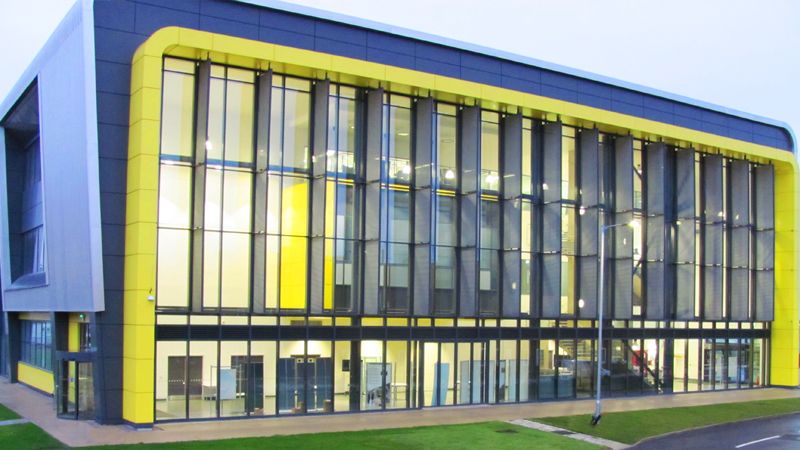
Note: This picture is from a press release (Aerospace Integration Research Center (AIRC) at Cranfield University).
This includes a Hydrogen electrolyzer, powered by solar panels, to supply fuel-cell aircraft research, ground operations vehicles and research into hydrogen internal combustion engines and gas turbine combustors. It will also include a mobile hydrogen compression and vehicle refueling system, supporting research projects across the Cranfield campus and two electric vehicle charging stations to charge airport ground operations vehicles.
University will add electric and fuel-cell ground operations vehicles to support the National Flying Laboratory and aircraft trials, including an aircraft tug, ground power unit and rapid response fire truck – moving the University away from using diesel-powered vehicles.
They are also planning a sustainable aviation fuel bowser to maximize the use of this fuel at Cranfield’s airport and air quality and metrological instrumentation to extend Cranfield’s Living Lab research system, monitoring aviation and transport emissions information for AIRC and DARTeC online, and integrating this with the UK Collaboratorium for Research on Infrastructure and Cities.
Cranfield University already plays a significant role in accelerating sustainable aviation research and translating this to regulated aviation. As the only university in Europe with its own airport, alongside leading aerospace research facilities and world-renowned experts, Cranfield is harnessing digital and physical technologies to achieve rapid innovation.
Professor Graham Braithwaite, Director of Transport Systems, leads the DARTeC project and said: “Our research has been developing at pace and it’s now crucial that we have this additional infrastructure to keep moving forward.
“The whole aviation ecosystem – from ground operations to aircraft, from airports to autonomy – is on the cusp of huge and positive disruption; and we have a lead role, working alongside industry partners and new start-up businesses, to bring the potential for net zero to fruition.”
Next-generation sensors will create ‘digital twin’ airport.
Part of the funding will go towards developing next-generation emissions sensing technologies through the Living Lab research project at Cranfield.
The expanded sensor network will develop and evaluate ground operations and aircraft handling to minimize noxious as well as greenhouse gas emissions, using carbon capture, sequestration, utilization and storage technologies already under active development.
Live sensor data from the airfield will also feed into an airport ‘digital twin’. This is a virtual model designed to accurately reflect the physical airport, and will enable researchers to deliver new virtual modeling of emissions for different aircraft operations and fuel types.
Research England Executive Chair, David Sweeney, said: “The UK Research Partnership Investment Fund has a strong track record in funding state-of-art facilities that support world-leading research and strengthen partnerships between universities and other organizations active in research.
“By piloting these innovative approaches to tackling net zero in infrastructure, we hope that this scheme will help us to learn more about what works so that we and the HE sector can factor this into future activity and build upon the already successful UKRPIF model.”
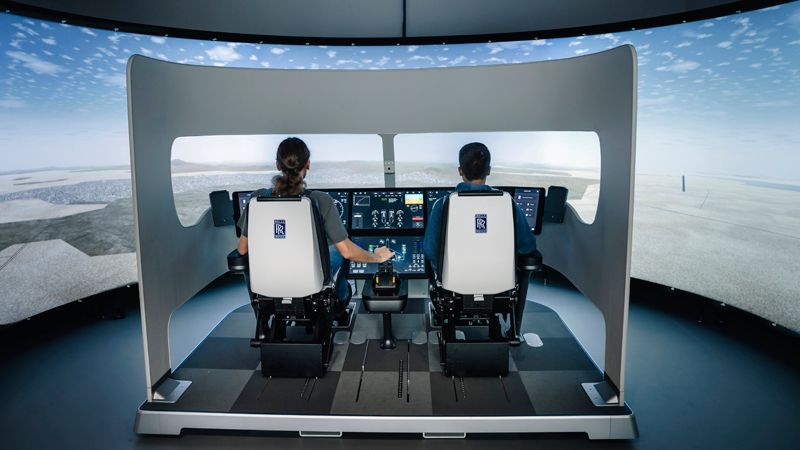
Professor Duncan Wingham, Executive Chair of NERC and sponsor for Environmental Sustainability and Net Zero in UKRI, said: “Our Environmental Sustainability Strategy commits UKRI to supporting the research sector to reduce its negative environmental impacts.
“This funding will help these leading national centers and facilities develop innovative solutions to reducing energy demand and increasing the use of renewable power in some unique research environments.
“UKRI is proud of its role in helping reduce carbon emissions from delivering cutting-edge research outputs in support of institutional and national net zero targets.”
Cranfield became a member of the National Center for Atmospheric Science (NCAS) in 2020 and has hosted its FAAM Airborne Laboratory since 2007.
In September 2020, Cranfield supported ZeroAvia in achieving the world’s first hydrogen fuel cell-powered flight of a commercial-grade aircraft. Cranfield Aerospace Solutions and the university are developing a retrofittable green propulsion system using hydrogen fuel cell technology.
Recommended from our partners
The post Take Off: Brit Uni With Own Runway Gets $3.8 M To Develop Low Carbon Planes appeared first on Zenger News.
Would Chew Believe It: Tiny Bots Could Deep Clean Teeth, Say Experts


Nano-sized robots manipulated using a magnetic field can help kill bacteria deep inside teeth to ensure the success of root canal treatments after the living tissue has been removed.
Root canal treatments are routinely carried out to treat tooth infections in millions of patients.
The procedure involves removing the infected soft tissue inside the tooth, called the pulp, and flushing the tooth with antibiotics or chemicals to kill the bacteria that cause the infection.
But many times, the treatment fails to completely remove all the bacteria – especially antibiotic-resistant bacteria such as Enterococcus faecalis – which remain hidden inside microscopic canals in the tooth called dentinal tubules.
But now, scientists at the Indian Institute of Science (IISc) and IISc-incubated startup, Theranautilus, say they are close now to clinical trials of the new technology, which will use nanorobots to clean the dentinal tubules.
Shanmukh Srinivas, Research Associate at the Center for Nano Science and Engineering (CeNSE), IISc, and co-founder of Theranautilus, said: “The dentinal tubules are very small, and bacteria reside deep in the tissue. Current techniques are not efficient enough to go all the way inside and kill the bacteria.”
In the study published in Advanced Healthcare Materials, the researchers designed helical nanobots made of silicon dioxide coated with iron, which can be controlled using a device that generates a low-intensity magnetic field. These nanobots were then injected into extracted tooth samples and their movement was tracked using a microscope.

By tweaking the frequency of the magnetic field, the researchers were able to make the nanobots move at will, and penetrate deep inside the dentinal tubules. “We have also established that we can retrieve them . . . we can pull them back out of the patient’s teeth,” says Srinivas.
Crucially, the team was able to manipulate the magnetic field to make the surface of the nanobots generate heat, which can kill the bacteria nearby. “No other technology in the market can do this right now,” says Debayan Dasgupta, Research Associate at CeNSE, and another co-founder of Theranautilus.
Previously, scientists have used ultrasound or laser pulses to create shockwaves in the fluid used to flush out bacteria and tissue debris, in order to improve the efficiency of root canal treatment. But these pulses can only penetrate up to a distance of 800 micrometers, and their energy dissipates fast. The nanobots were able to penetrate much further – up to 2,000 micrometers. Using heat to kill the bacteria also provides a safer alternative to harsh chemicals or antibiotics, the researchers say.
Theranautilus was spun out of several years of work on magnetically-controlled nanoparticles carried out in the lab of Ambarish Ghosh, Professor at CeNSE. His group, along with collaborators, has previously shown that such nanoparticles can trap and move objects using light, swim through blood and inside living cells, and stick strongly to cancer cells.

“These studies have shown that they are safe to use in biological tissues,” says Dasgupta.
The team has tested the dental nanobots in mice models and found them to be safe and effective. They are also working on developing a new kind of medical device that can easily fit inside the mouth, and allow the dentist to inject and manipulate the nanobots inside the teeth during root canal treatment.
“We are very close to deploying this technology in a clinical setting, which was considered futuristic even three years ago,” says Ghosh. “It is a joy to see how a simple scientific curiosity is shaping into a medical intervention that can impact millions of people in India alone.”
Recommended from our partners
The post Would Chew Believe It: Tiny Bots Could Deep Clean Teeth, Say Experts appeared first on Zenger News.
Dwarf Planet Ceres Was Formed In Coldest Zone Of Solar System And Thrust Into Asteroid Belt


A dwarf planet that exists between the orbits of Mars and Jupiter was probably created in the frozen deep space before it became part of the asteroid belt.
Ceres was almost a complete mystery until the robotic NASA spacecraft Dawn approached it for its orbital mission in 2015, and since then scientists have been gathering more and more data about Ceres, including the fact that it was formed in the colder region beyond Jupiter’s orbit, before being thrust into the Asteroid Belt.

Most bodies in the Asteroid Belt do not have ammonia, so the hypothesis is that Ceres was formed outside it, in the colder region beyond Jupiter’s orbit, and then thrust into the middle of the Asteroid Belt by the huge gravitational instability caused by the formation of gas giants Jupiter and Saturn.
Ceres is the largest object in the Asteroid Belt, a collection of celestial bodies located between the orbits of Mars and Jupiter. It is roughly spherical and comprises a third of the Asteroid Belt’s total mass, with a diameter of almost 1,000 km, less than a third of the Moon’s.
Its orbit around the Sun is almost perfectly circular, with 0.09 eccentricity, and an inclination of 9.73° to the invariable plane of the Solar System, much greater than Earth’s, which is 1.57°.
Ceres has too little mass to retain an atmosphere by gravitational attraction, but sunlight evaporates the ammonia and water ice below its surface, forming a mist that disperses into outer space. Ice deposits shine brightly at the bottom of its craters. The possibility of primitive life forms has not been ruled out. The craters were mapped by NASA’s 2007-18 Dawn Mission, which orbited Vesta, the second-largest body in the Asteroid Belt, as well as Ceres.
The dwarf planet’s core is probably made up of heavy matter – iron and silicates – but what differentiates it from nearby objects is its mantle of ammonia and water ice.
In an article published in the journal Icarus, researchers at São Paulo State University (UNESP) and collaborators report the findings of a study reconstituting the formation of the dwarf planet Ceres.
The research was conducted by Rafael Ribeiro de Sousa, a professor in the program of graduate studies in physics on the Guaratinguetá campus. The co-authors of the article are Ernesto Vieira Neto, who was Ribeiro de Sousa’s PhD thesis advisor, and researchers affiliated with Côte d’Azur University in France, Rice University in the United States, and the National Observatory in Rio de Janeiro.
“The presence of ammonia ice is strong observational evidence that Ceres may have been formed in the coldest region of the Solar System beyond the Frost Line, in temperatures low enough to cause condensation and fusion of water and such volatile substances as carbon monoxide [CO], carbon dioxide [CO2] and ammonia [NH3],” Ribeiro de Sousa said.
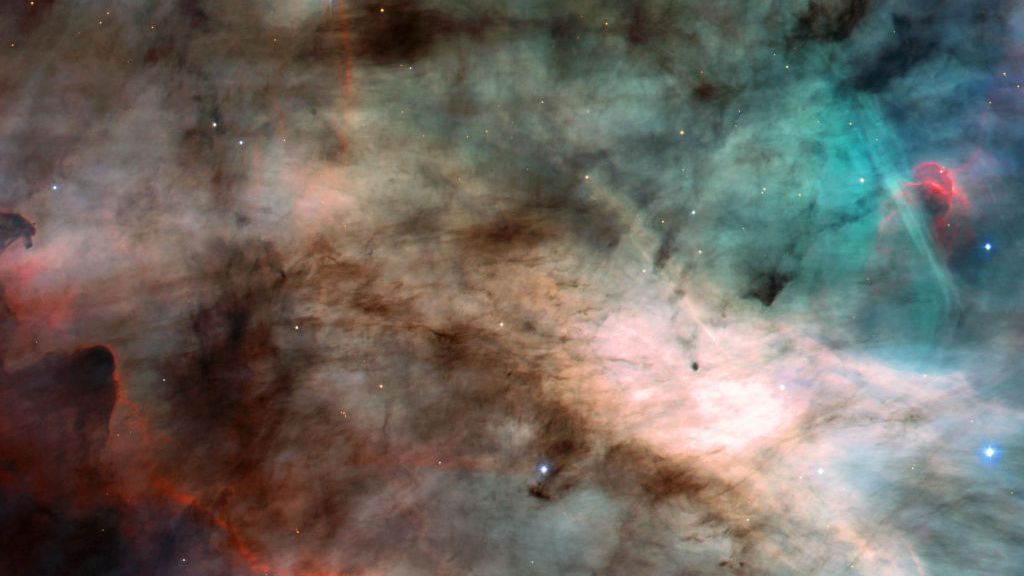
The Frost Line is now located very near Jupiter’s orbit, but when the Solar System was being formed 4.5 billion years ago, the position of this zone varied according to the evolution of the protoplanetary gas disk and the formation of the giant planets. “The intense gravitational disturbance produced by the growth of these planets may have changed the density, pressure and temperature of the protoplanetary disk, displacing the Frost Line. This disturbance in the protoplanetary gas disk may have led the expanding planets to migrate to orbits closer to the Sun as they acquired gas and solids,” Vieira Neto said.
“In our article, we propose a scenario to explain why Ceres is so different from neighboring asteroids. In this scenario, Ceres began forming in an orbit well beyond Saturn where ammonia was abundant. During the giant planet growth stage, it was pulled into the asteroid Belt as a migrant from the outer Solar System, and survived for 4.5 billion years until now,” Ribeiro de Sousa said.
To test the hypothesis, Ribeiro de Sousa and collaborators ran a large number of computer simulations of giant planet formation inside the protoplanetary gas disk that surrounded the Sun. In their model, the disk contained Jupiter, Saturn, embryonic planets (precursors of Uranus and Neptune), and a collection of objects similar to Ceres in size and chemical composition. The assumption was that Ceres was a planetesimal, one of a class of bodies thought to have been building blocks of planets, asteroids and comets.
“Our simulations showed that the giant planet formation stage was highly turbulent, with huge collisions between the precursors of Uranus and Neptune, ejection of planets out of the Solar System, and even invasion of the inner region by planets with masses greater than three times Earth’s mass. In addition, the strong gravitational disturbance scattered objects similar to Ceres everywhere. Some may well have reached the region of the Asteroid Belt and acquired stable orbits capable of surviving other events,” Ribeiro de Sousa said.
Three main mechanisms acted to keep these objects in the region, he added: the action of gas, which smoothed their orbital eccentricities and inclinations; mean motion resonances with Jupiter, protecting them against ejections and collisions caused by that giant planet; and close encounters with invader planets, scattering planetesimals to more stable inner regions of the Asteroid Belt.
“Our main finding was that in the past there were at least 3,600 Ceres-like objects beyond Saturn’s orbit. With this number of objects, our model showed that one of them could have been transported and captured in the Asteroid Belt, in an orbit very similar to Ceres’s current orbit,” he said.
Other research groups had already estimated this number of Ceres-like objects, based on observation of craters and on the sizes of other populations of celestial bodies beyond Saturn, such as those of the Kuiper Belt, where Pluto and other small planets orbit. “Our scenario enabled us to confirm the number and explain Ceres’s orbital and chemical properties. The study reaffirms the accuracy of the most recent models of the formation of the Solar System,” he said.
A Solar System planetary formation scenario based on the latest information available helps understand the study by situating Ceres in the overall process.
“From observational evidence, we know that any planetary system, not just our own Solar System, is formed from a disk of gas and dust that surrounds a newborn star. Events that form stars are still poorly understood, but the consensus so far is that stars are born from the gravitational collapse of a giant molecular cloud,” Ribeiro de Sousa said.
The existence of protoplanetary disks is not mere supposition. On the contrary, there have been robust observations, such as images obtained by the European Space Agency (ESA) using the 66-antenna Atacama Large Millimeter/submillimeter Array (ALMA) in Chile, with impressively high resolution and a wealth of details showing protoplanetary disks around very young stars.
“In the case of the Solar System, the data we have suggests the protoplanetary disk was 99% gas and 1% dust. The dust probably came from older stars that had ended their lifecycle and ejected heavy matter into space,” Ribeiro de Sousa explained. “The dust that accumulated around the Sun was sufficient to form at least the smaller bodies, the terrestrial planets, and the cores of the gas giants. The first solids to condense in the protoplanetary disk were calcium-aluminum inclusions (CAIs), which have been found in meteorites and dated as far back as 4.568 billion years ago.”
Several young stars have been observed in environments characterized as planetary nurseries, and have been dated to between 1 million and 10 million years ago. This is important information because it shows that the formation of gas planets, like Jupiter or Saturn, or planets with a gas envelope, like Uranus and Neptune, should occur within the first 10 million years of a star’s life at most. After that, protoplanetary disks no longer have enough gas.
Rocky planets of the terrestrial type could emerge earlier or later. No one knows, but other available information shows that the formation of Earth and the Moon was one of the latest events in the genesis of the Solar System, and occurred 4.543 billion years ago. The smaller bodies in the system (dwarf planets, satellites, comets, asteroids, dust, etc.) are the remains of planet formation, and evolved physically and dynamically before and after the gas stage via processes such as interaction with gas, collision, and gravitational capture.

The planetary formation process is complex, comprising stages that go from dust with a particle size as tiny as a micron (10−6 m) to planets several times larger than Jupiter. “Dust accumulates through adhesions and collisions inside the protoplanetary disk. Gravitational attraction between particles isn’t relevant, but the Sun’s gravitational pull makes gas rotate more slowly than dust, and this produces very strong aerodynamic drag on the dust, which sweeps the particles into the plane of the gas disk and drives them radially toward the Sun. When the dust reaches a size of a few centimeters, it forms pebbles, which make all the difference in the process of planetary growth because they influence the speed at which the gas rotates. When the velocities of the gas and pebbles become the same, the gas drag practically disappears, giving the pebbles a chance to accrete sufficiently to give rise to planetesimals – bodies with sizes ranging from 10 km to 1,000 km. These are the building blocks of planets and precursors of small bodies,” Ribeiro de Sousa said.
In the next stage, larger and larger objects are formed by gravitational capture of pebbles and dust, or by collisions. When an object grows large enough to have the mass of three to ten Earths, the gravitational disturbance it produces in the gas disk makes it migrate to an orbit closer to the star. When it grows larger than ten Earths, it starts accreting a gas envelope, and the build-up of gas makes its growth very fast.
“Formation of the giant planets Jupiter and Saturn produced such a huge gravitational disturbance that it modeled the gas disk and triggered a new type of planetary migration. This violent stage made planets collide and ejected planets from the Solar System until gravitational balance enabled the system as a whole to acquire a degree of stability,” Ribeiro de Sousa concluded.
Recommended from our partners
The post Dwarf Planet Ceres Was Formed In Coldest Zone Of Solar System And Thrust Into Asteroid Belt appeared first on Zenger News.
Hyundai Motors Into NFTs


Korea’s largest automaker, Hyundai, announced that it is entering the online community-based non-fungible token (NFT) market, becoming the first automaker to do so.
Hyundai said in a press release that it is collaborating with Meta Kongz on NFT projects and memorandums of understanding (MOUs).
“The Hyundai NFT community will provide its users with the Hyundai brand experience in the metaverse by sharing NFTs depicting its mobility solutions. The Hyundai NFT Discord and Twitter channels opened on April 15, and the official NFT website is scheduled to open soon in May,” Hyundai said in the press release.
A short film introducing the automaker’s Metamobility Universe was also released. In it, the automaker presented its vision for a future in which virtual reality will be used to enhance mobility.
“The Hyundai NFT universe will extend the Hyundai brand experience, especially with MZ generation, in a completely new way, further reinforcing our commitment to innovation in both the real world and in the metaverse,” Thomas Schemera, Hyundai Motor’s global chief marketing officer, said. “We are extremely excited to introduce ‘Metamobility’ through our own NFTs and start this journey with Meta Kongz.”

The automaker distributed 30 limited-edition NFTs on April 20 to commemorate the premiere of the short film. Even as the Hyundai NFT universe evolves, these releases will continue throughout the year, the company said. The proceeds from the sale of Hyundai NFTs will be allocated to project and community management, it added.

Meta Kongz has just completed governance voting on an agenda pertaining to the migration of the Klaytn chain to the Ethereum chain. The majority of votes cast were in support of the migration.
Meta Kongz will migrate to the Ethereum blockchain, a necessary step for the internationalization of the project. Due to the purported difficulty of attracting non-Koreans to the Klaytn chain, many NFT traders prefer to use the Ethereum chain with the Metamask wallet. As a result of the relocation, Meta Kongz it likely to receive increased exposure.
Hyundai Motor Co. has operations in more than 200 countries with more than 120,000 employees. “Based on the brand vision ‘Progress for Humanity,’ Hyundai Motor is accelerating its transformation into a Smart Mobility Solution Provider,” the company said in its press release.
“The idea behind Metamobility is that space, time and distance will all become irrelevant. By connecting robots to the metaverse, we will be able to move freely between both the real world and virtual reality,” Chang Song. Hyundai’s president and head of the transportation-as-a-service division, said earlier this year.
Produced in association with MetaNews.
Recommended from our partners
The post Hyundai Motors Into NFTs appeared first on Zenger News.
New Tech Will Jolt The Battery Industry


The future of battery technology means new propulsion systems and power generators will become more energy-efficient, environmentally friendly and cheaper.
The world’s largest battery makers are pursuing these goals in China, South Korea, Europe and the U.S. Developed nations are accelerating these non-carbon developments as they move from fossil fuels and toward new electrical sources to power autos and eventually entire cities.
This new battery technology is so important that President Joe Biden created a Presidential Invocation of Defense Production Act for Battery Materials to develop a domestic supply chain. This legislative act is essential to national security — battery metals can be mined through environmentally and socially responsible methods.
To accomplish these new national goals, battery manufacturers use everything from 3D printing, water-based battery-manufacturing processes and new chemicals to produce longer-lasting batteries with higher energy density.
Often, they are made by new manufacturing processes.
Today, the world leaders in lithium-ion (LI) battery manufacturing are the China-based company CATL, the leading lithium-ion battery maker with a market share of 32.5 percent in 2021, followed by Korea’s L.G. Chem, with 21.5 percent. Third place was held by Panasonic, at 14.7 percent.
LI batteries have become the most popular energy source because they are powerful and can recharge without little degradation.
The U.S. is also trying to fill the battery tech gap with a $3.1 billion infusion of federal money from the U.S. Energy Department. The funding was part of the Bipartisan Infrastructure Bill to build battery materials technology.
The largest battery manufacturers in the U.S. are Tesla, followed by General Motors, Ford and Volkswagen. Other non-U.S. battery materials providers include Samsung, L.G. and Panasonic, which announced plans to increase U.S. production.

All these companies are working to find cheaper, longer-lasting and environmentally friendly batteries. But making this historic technological transformation will require significant changes, such as discovering and developing new eco-friendly raw materials, and creating new storage technologies.
While research is moving ahead globally, here are some developments in each critical areas:
Building More Powerful Batteries
At the University of Texas, researchers are studying a new type of cathode that uses 89 percent nickel, supplemented with manganese and aluminum instead of the more expensive cobalt. Nickel is more abundant, cheaper and a better storage medium than cobalt.
New cathode designs are also improving efficiency.
NAWA Technologies of Rouset, France, has designed and patented its Ultra-Fast Carbon Electrode, which it claims is a “unique electrode material that combines the best of nanotechnology and clean technology. The new design uses a vertically-aligned carbon nanotube the firm says can make batteries 10 times more powerful, boost energy storage capacity three times and boost battery life five times.
“The cobalt-free cathodes are now scaled up by a startup company TexPower EV Technologies in Houston, Texas. TexPower is in the process of putting up a pilot plant to manufacture 150 tons of cobalt-free cathodes per year,” Nat Levy of the University of Texas Cockrell School of Engineering told Zenger in an email.
Levy added the cost to produce the new type of battery “will be certainly lowered, and the driving range will be increased. But it is hard to put a number for cost reduction at this stage as the prices of cobalt and nickel fluctuate.”
Sourcing New Raw Battery Materials
At the California Institute of Technology, the search is for more environmentally friendly materials, such as calcium, zinc and magnesium. These materials are more readily available and cause minor environmental damage than mining for lithium, nickel and cobalt, the current core battery materials.
Using combinations of these more-available materials can produce more powerful batteries, but there is always a trade-off, according to Kimberly See, Caltech assistant professor of chemistry. Lee said her research indicates these combinations of materials could match or even exceed lithium’s energy density, known as volumetric energy density, because they can store more electrons than their lithium counterparts.
In Woodinville, Washington, Group14 Technologies has invented a silicon-carbon composite material to substitute for graphite anodes, now used in lithium-ion batteries. This composite lithium-silicon battery cell material can boost battery performance by 50 percent and accelerate recharging times, according to Rick Costantino, Chief Technology Officer of Group14 Technologies.
The company’s website describes the new lithium-silicon material as having five times the capacity and up to 50 percent more energy density than conventional graphite for Lithium battery anodes.
“Its unique hard carbon-based scaffolding keeps silicon in the ideal form – amorphous, nano-sized, and carbon-encased. The result is the best-in-class anode material that exhibits outstanding first cycle efficiency and long life upon Li-ion battery cycling,” Costantino said.
In a release, Costantino said the new technology is “a significant milestone in our goal to enable EVs to achieve true cost-parity with internal combustion engines.”
Advances in Storage Technology
Energy storage is essential to take the energy produced by wind, solar, hydrogen, water and batteries and then power electrical grids and electric vehicles.
Advances in storage are coming fast.
Ryan Brown, co-founder-CEO of Salient Energy, a Canada-based zinc-ion battery manufacturer, said this decade “will be a breakout decade for the energy storage sector.” Brown said that because of its cheap cost to produce, lithium-ion batteries should dominate storage technology shortly. But that could change.
The industry is also developing alternative storage technologies by turning to hydrogen-related sources. These include lithium-iron-phosphate combinations that can replace lithium-ion and new applications, such as flow batteries that rely on a zinc hybrid cathode device. Brown noted that zinc is over 100 times more abundant than lithium, cheaper and more environmentally friendly.
Storage technology also received a huge boost from the Bipartisan Infrastructure Bill that could inject up to $9 billion, including $2.5 billion for “alternative fueling technologies.” This bill will create a national standard for electric vehicle (E.V.) charging stations using Direct Current Fast Charging technology, John Miller, a Cowan Washington research group policy analyst, said in an April 2022 podcast.
Miller said: “The impact of this spending remains underappreciated as expectations for E.V. charging investments became decoupled from political reality in 2021. We see multiple positives,” including an expected inflow of new investments into these technologies. The states that should be significant beneficiaries of the $1 billion in new funds include Texas, California and Florida.
Making Better Batteries for the Environment
With the proliferation of batteries, recycling them will benefit the environment. In Nevada, the American Battery Technology Co. (ABTC) said it is developing and “commercializing a first-of-kind processing train to manufacture battery-grade lithium hydroxide from Nevada-based sedimentary claystone resources.”

Company CEO and chief technology officer Ryan Melsert told Zenger.news via email the company has received a grant from the U.S. Department of Energy’s Advanced Manufacturing Office , in partnership with DuPont. DOE funding was about $2.2 millionand the costs share the same, for a total of over $4.5 million. While in the research phase, the company said it had produced battery metal lithium products that are more environmentally friendly than other processes.
On the application side, Melsert said ABTC “has pioneered a closed-loop battery recycling process that will separate and recover critical materials, including lithium, nickel, cobalt, manganese and copper from end-of-life batteries. The recovered materials are then purified back into battery metals to the same, or higher, quality specifications than conventional materials sourced from virgin mining operations.”
As an example of how complex this recycling process has become, Melsert said ABTC’s recycling and primary extraction processes were developed and “continually optimized” by scientists housed at its facilities in Reno, Nevada, and Somerville, Mass. Once completed, the company’s Fernley, Nevada, recycling facility will house a research and application center, including onsite analytical and process laboratories and test areas for validating next-generation technologies.
To make recycling more efficient, a team from Florida Atlantic University (FAU) and the German Federal Ministry of Education and Research are working together. The goal is to produce recyclable and environmentally-friendly electrodes and then use nanotechnology to isolate and recycle valuable, reusable materials.
By inserting microscopic magnetic markers in specific ratios into the electrode components, specific batteries and their recyclable components can be identified, according to FAU’s Karl Mandel, professor of inorganic chemistry.
“The markers enable the constituent parts of batteries to be separated, according to type, using electrohydraulic fragmentation, which another research team in the consortium is investigating in detail,” Mandel wrote. The project also uses centrifuges to isolate valuable battery materials as part of the recycling process.
Edited by Fern Siegel and Matthew B. Hall
Recommended from our partners
The post New Tech Will Jolt The Battery Industry appeared first on Zenger News.

