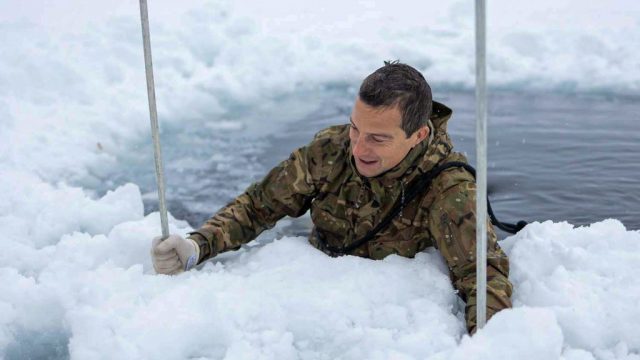
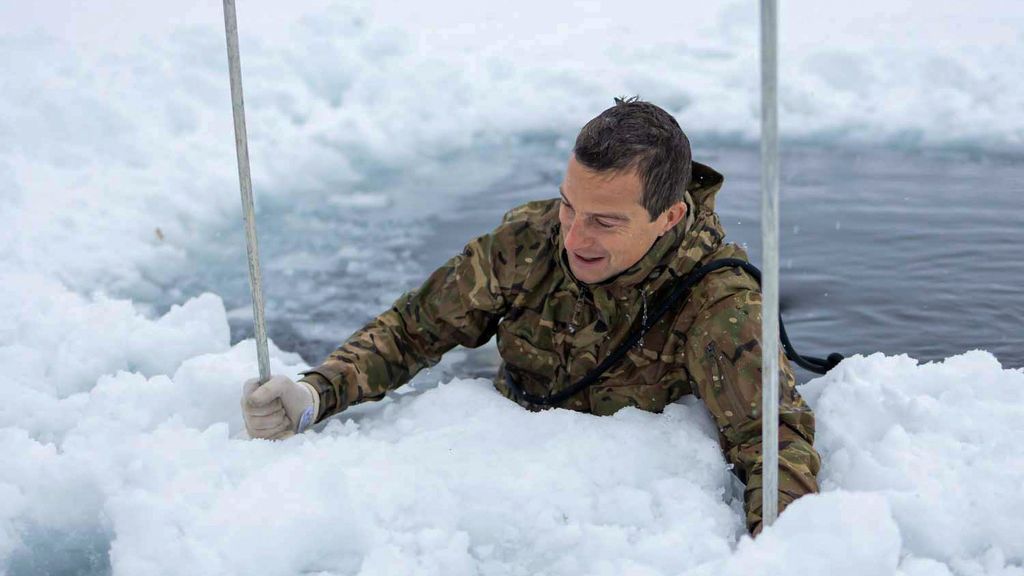
British adventurer Bear Grylls participated in an ice-breaking drill with Royal Marines carrying out Arctic warfare exercises in northern Norway.
“It’s always inspiring to spend time with the commandos, seeing them demonstrate their unique winter survival combat skill set in such challenging conditions is a reminder of what heroes they are,” Grylls, who is a Royal Marines honorary colonel, said of the early February training exercises in the mountainous Troms and Finnmark County in northern Norway.
Grylls became well-known from the television series “Man vs. Wild” (2006–2011) and similar adventure shows in which he starred.
Adventurer and Royal Marines Honorary Colonel Bear Grylls working alongside Royal Marines in Norway. (Royal Navy/Zenger)A Royal Marine takes on the ice-breaking drill in Norway. (Royal Navy/Zenger)
Grylls, who grew up on the Isle of Wight, joined Royal Marines in being plunged into freezing water to test reactions to cold shock.
“For a young marine, the Arctic is such an amazing experience, and if they can operate here, then they can operate anywhere,” Grylls said.
Royal Navy ships and aircraft, including aircraft carrier and NATO command ship HMS Prince of Wales, are participating in the Norwegian-led exercises dubbed Exercise Cold Response. They will involve about 35,000 troops from 28 nations “with allied warships and aircraft working closely together as the powerful task force tests its ability to protect Norway from modern threats,” the Royal Navy said in a statement.
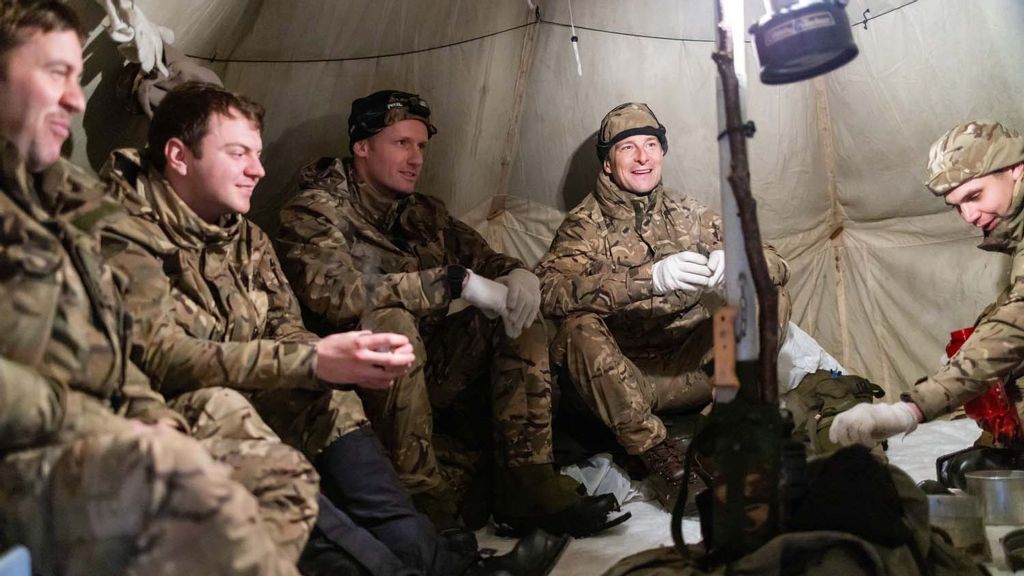
Royal Marines commandos participated in ski and snowshoe training during Arctic exercises in Norway. (Royal Navy/Zenger)Bear Grylls (back right), who joined the Royal Marines for Arctic exercises in Norway, said that “even though the conditions are tough, the bootneck sense of humor is always so strong with smiles all round even after our ice drills all together.” (Royal Navy/Zenger)
“Every winter the next generation of Royal Marines heads to the high north to train in surviving, moving and fighting across the rugged coasts and unforgiving mountains of northern Norway, demonstrating the UK’s commitment to protecting one of its closest NATO allies,” the statement said.
“The commandos are the UK’s experts in operations in all extremes of environment, including the frozen mountains and fjords of the Arctic Circle — one of the harshest environments known to man where the sun doesn’t rise for two months of the year and temperatures can plummet below -35 C [minus 31 F].”
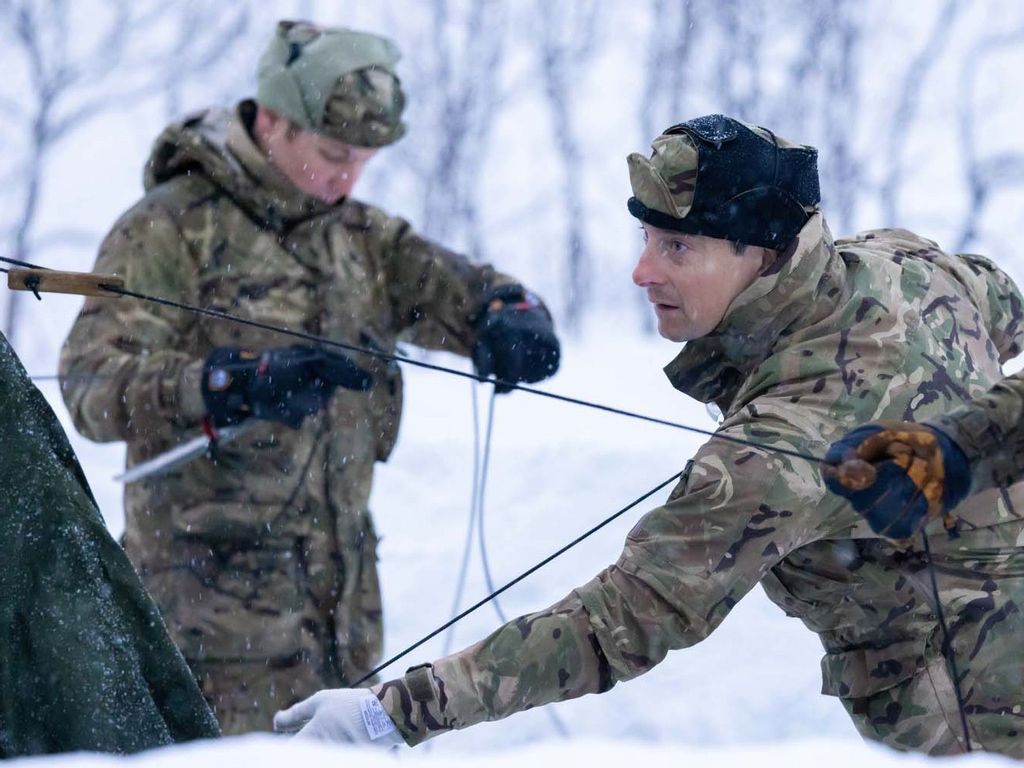
The commandos are testing their navigation skills on skis and snowshoes while carrying weapons and equipment in drills designed to teach them how to out-maneuver adversaries.
A Royal Marine builds a snow shelter in during Arctic exercises in Norway. (Royal Navy/Zenger)Adventurer Bear Grylls joined Royal Marines in Norway for Arctic exercises. (Royal Navy/Zenger)
“This is my fourth Norway. Just surviving here presents unique challenges, but if you can operate here, you can operate anywhere,” Lance Corporal Jack Cooper said.
Calling Norway an incredibly harsh environment, 19-year-old Marine Mark Clarke said that “with a few specialist skills and doing the basics well, sustaining and operating out here is a lot more manageable.”
Grylls, whose feats include crossing the North Atlantic Ocean in a 36-foot boat and scaling the Ama Dablam peak on the way to the top of Mount Everest, summed up the experience by saying: “Even though the conditions are tough, the bootneck sense of humor is always so strong with smiles all round even after our ice drills all together.
“For me, it’s a humbling reminder of why the Royal Marines are so special.”
Time truly slowed down during the height of the COVID-19 pandemic. Entertainers and musicians alike were hit hard by the deadly spreading virus, which halted performances, canceled tours and changed the creative process for better and worse.
Technology took center stage, while release dates were forced to be pushed back. Grammy-nominated R&B star J. Holiday worked diligently to compose a masterpiece. His album “Time,” released on Feb. 7, focuses on the nuances that come along with time. A calculated play on words, this album highlights the one word that we were all forced to pay closer attention to at COVID’s peak: time.
Zenger spoke with the R&B star to discuss his new album; he also talks about the lack of in-depth R&B music and explains the lack of features on “Time.”
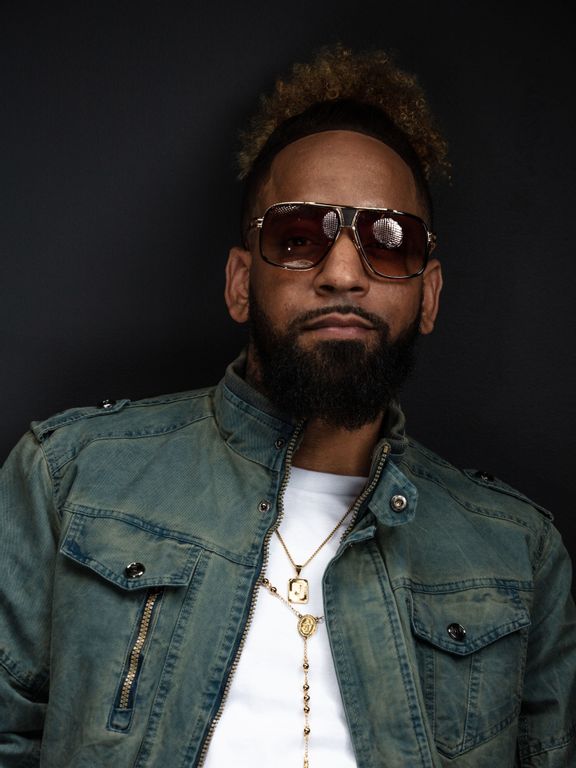
Percy Crawford interviewed J. Holiday for Zenger.
Zenger: How are you?
J. Holiday: I’m good, man. No complaints. Just gearing up for the album, but I’m good.
Zenger: Feb. 7, you release your next studio album, “Time.” When the project is done, and it’s down to the waiting game, what is it like for an artist?
J. Holiday: I think it’s always a little bit of nervousness and anxiety. You just want it to be well-received. It’s my music, so I’m going to love it anyways, but you still have that thought of pleasing the fans, so I think it’s always a little bit of that.
Zenger: What was the creative process like for this album?
J. Holiday: For me, we had the album pretty much finished like two years ago. Then we got into the pandemic. I think we have only done like 2 more songs [since] when it started. It was just … gotta wait for the right time. People thought it might be smarter because people were sitting in the house, people are listening more, but you can’t really get to the people.
Percy Crawford interviewed J. Holiday for Zenger. (Heidi Malone/Zenger)
The process has been more like waiting for the right timing. I’m always kind of creating anyway, whether it’s mixtapes or in the studio doing records. That process wasn’t that different, I think just the rollout process has been a lot different because of what time we are in now.
Zenger: What made these 11 tracks the perfect ones for this album?
J. Holiday: Honestly, we didn’t record a bunch of tracks. Every song was pretty strategic. We specifically picked lyrical content for each one. We have a theme for each song. “Okay, we need to talk about this, so let’s do this.” We were very strategic in the way that we put the album together.
Zenger: You gave us another single from the album, “Zero To Sixty.” What was the thought process behind releasing another song before the album dropped?
J. Holiday: Just getting people excited about the album. We have three other songs on the album that we released. Some people will be like, “Those songs are old, so let’s not put those on the album.” But they were a part of the strategy that we put together. We didn’t mean for it to happen like that.
We dropped “25 To Life” because we were ready to start rolling out the album, but then the pandemic happened, and it was like, “Okay, we still gotta keep giving the people new music.” We didn’t want to take away from “Time.” I could have put out any kind of songs, but it’s like, if they are going to get something from me, it’s going to be from “Time.” We did “Ride,” and that was letting people know we’re coming with the album. We’re getting kind of normal again a little bit. So, we figured now is the time to roll out the album.
“Zero To Sixty” got a little bit of tempo. If you think about when you’re buying a new car, the first thing you want to know is how fast does it get from zero to sixty. Which is a time aspect, so like I said, we were very strategic on everything. It’s all about getting people excited about it. We haven’t showed our hand yet. We got some records on the album, but it was like, let’s tease them a little bit.
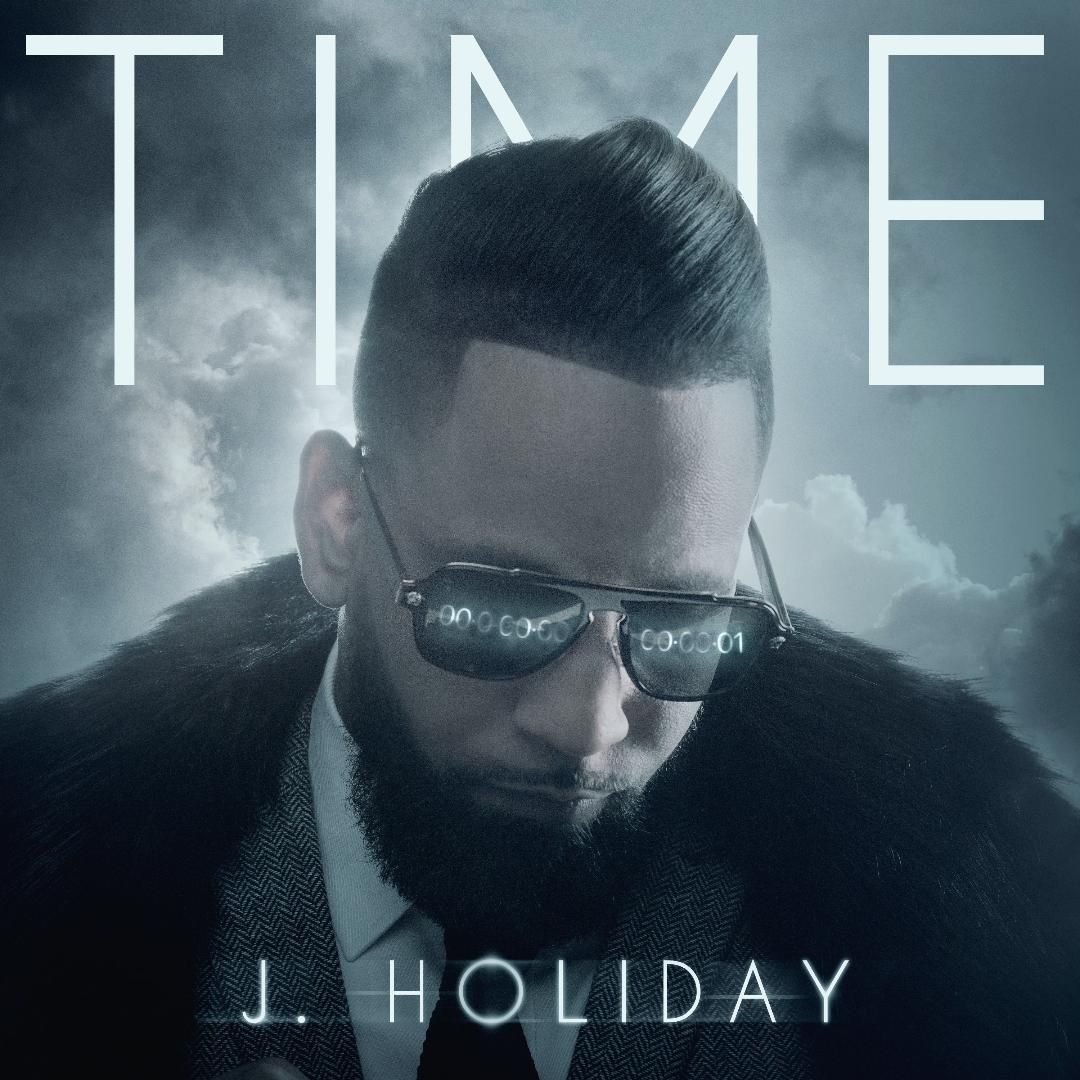
Album cover for J. Holiday’s new project, “Time,” released on Feb. 7. (Aaron Hamilton)
Zenger: Last time we spoke you broke down the different levels of time and the many aspects in which time is used and obviously the importance of it. And then you revolved an entire album around the word. Why?
J. Holiday: People probably don’t notice it, but everybody in the world probably says the word “time” at least once a day. What time is it? It’s time for me to get up. People don’t realize how important time really is. I always say in every interview that I’ve been doing, we’re always asking for time, but we’re always wasting it. Just trying to get people a little more focused.
I’m not saying that the music is bad out here, but it’s like, what are we doing lyrically? What are we talking about? There are some great songs, and then there are great songs, but they aren’t really talking about nothing. I like it, it’s catchy, but is this something that I want to hear every day?
Zenger: I did a quick search of your name on Twitter before we got on because I like to get a feel for what is being said prior to speaking to certain people. You were in the conversation of giving people their flowers while they are here for the classics that you dropped. How does it feel to be talked about in that light?
J. Holiday: I love it. I’ve been singing for a long time. I’m a connoisseur of the art of R&B. For me, I want to be mentioned in those conversations. I want to be mentioned with the greats. I don’t want to be known for having “Bed” and “Suffocate.” I want the people that listen to my albums to know that, when you dive into my albums, I’m giving it my all. It’s good to hear. I don’t necessarily do it for the recognition. … Fame to me, I can do without it. But it’s a part of the game, so it feels good to know that there are people that appreciate what I do.
Zenger: Looking at your social media post, I can tell you feel like you have one with this “Time” album. What is it about this album that gives you the feel that you delivered on this one?
J. Holiday: When people are hungry, right, you can get a snack, but you’re still hungry. It’s like, let me get a snack to hold myself over. I feel like that’s the kind of music that people have been getting. They have been getting snacks. This is the meal.
It goes back to what we were just talking about, people appreciating what I do. People know that when I drop my stuff, it’s going to be R&B. I’m not getting with the gimmicks. I’m not trying to ride nobody’s wave or sound. It’s always going to be my sound. I think it’s something that the people want. They want to hear some good music, man. Again, that’s not to say that there is bad music out here, but they want to hear good R&B.
The “Time” is right for J. Holiday to restore pure R&B music. (Courtesy of Darius Jones)
Zenger: You kept the features light on this album. Was that intentional?
J. Holiday: I’ve always kind of been like that. Even my past albums, like when I had Rick Ross on “Wrong Lover,” that just happened. It wasn’t something that was sought after. He just so happened to have heard the record and put a verse on it, and we were like, “Oh … cool!” We didn’t even have to pay Rick for that. That’s the type of features I like. You doing it because you love it, not because I’m paying you.
I always want my albums to be about me. I don’t like when people use features to sell their music. I feel like it’s almost like a con. Sometimes it’s good. Some features are great. When you got 15 songs on the joint and 10 of them have features, am I listening to them or you? I’ve always liked to keep my albums just about me because that’s supposed to be why they’re buying the album, to hear me, not other people. I have never been a big feature dude. You don’t hear me on a bunch of people’s records. That’s a gift and a curse ’cause it’s always good to be on other people’s stuff. The features I want to do are with the people I look up to. I want to get on an Outkast joint. If I can’t make that happen, then I’m cool.
Zenger: I love what you are doing with the positive posts on your Facebook page. How did that become your thing?
J. Holiday: I’ve been in the entertainment news for certain things that I said. I don’t ever want to be looked at negatively. If I’m saying something, I’m coming from a positive place with it. It might not be received well, or you might not like what I have to say, but I just … hate that we’re in an industry where … what that lady said, “Shut up and dribble!” What you mean my opinion don’t count? “Shut up and sing.” So, I’ll keep those opinions to myself. If I talk about things like that, it’s within my team, and I’ll keep it at that. In this pandemic, people just need good stuff to hear.
Zenger: Feb. 7 is the date, the album is “Time,” everyone check that out. Anything else before I let you go, J.?
J. Holiday: Ah man, everybody stay safe, stay positive, the sun will come out tomorrow. Everybody will be all right, every day that you wake up and you’re breathing, don’t waste your time. Enjoy life as best that you can. Don’t let stuff get you down. It’s always going to be something that you deal with, you gotta learn how to dig your heels in and get through it. Stay positive.
Medical science has not yet found a way to restore walking ability in someone paralyzed from a traumatic spinal cord injury.
Within a few years, a first-of-its-kind 3D-printed spinal cord tissue implant, made from the patient’s own cells, could make that dream come true.
Using technology developed over the course of a decade in Prof. Tal Dvir’s regenerative biotechnology lab at Tel Aviv University, the implant enabled paralyzed lab mice to walk again.
A paper published today in Advanced Scienceprovides the remarkable details.
“It is like science fiction,” says Dr. Asaf Toker, CEO of Matricelf, the company working to bring Dvir’s groundbreaking technology to market.
Dvir and Alon Sinai cofounded Matricelf that year and it went public in 2021. On January 30, the company signed an exclusive global licensing agreement with Tel Aviv University technology transfer company Ramot to commercialize and utilize the patent for 3D-printing tissues and organs.
“With our technology, we can create any tissue we want,” Toker tells ISRAEL21c. “The first one is neural implants for people with a spinal cord injury causing paralysis.”
No rejection
Dvir explained that the technique begins with taking a small biopsy of belly fat tissue from the patient.
“This tissue, like all tissues in our body, consists of cells together with an extracellular matrix of substances like collagens and sugars,” he explained.
“After separating the cells from the extracellular matrix, we used genetic engineering to reprogram the cells, reverting them to a state that resembles embryonic stem cells capable of becoming any type of cell in the body.”
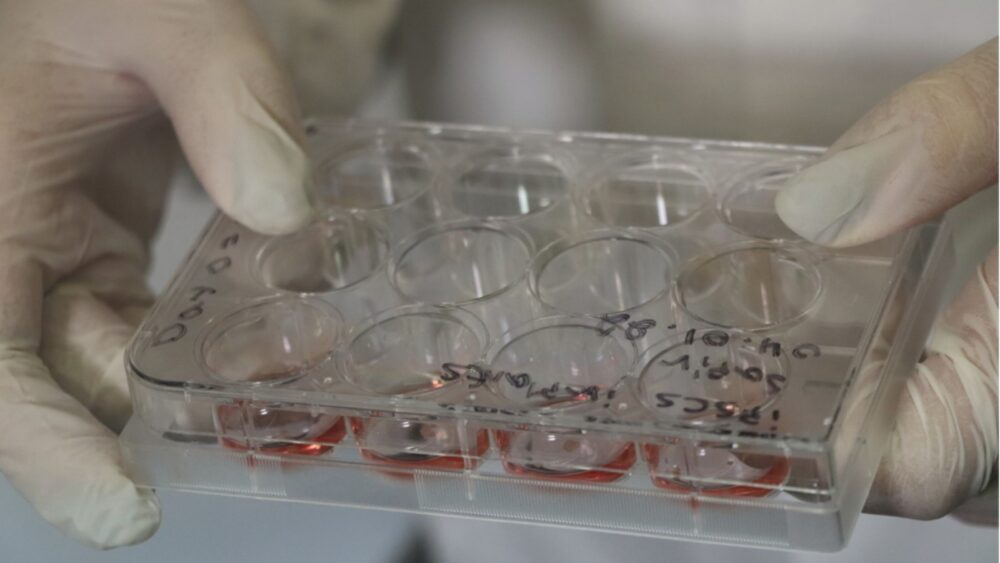
A Petri dish with regenerated tissue samples. (Courtesy of Sagoltau Center for Regenerative Biotechnology)
The extracellular matrix didn’t go to waste. It formed the basis of a personalized hydrogel that will not trigger an immune response or rejection after implantation – which is the main problem with donor implants.
“We then encapsulated the stem cells in the hydrogel and, in a process that mimics the embryonic development of the spinal cord, we turned the cells into 3D implants of neuronal networks containing motor neurons,” said Dvir.
The human spinal cord implants were then implanted in mice. Half had only recently been paralyzed (the acute model) and half had been paralyzed for the equivalent of a year in human terms (the chronic model).
Up and walking again
Following the implantation and a rapid rehabilitation process, 100 percent of the mice with acute paralysis and 80% of those with chronic paralysis regained their ability to walk.
“This is the first instance in the world in which implanted engineered human tissues have generated recovery in an animal model for long-term chronic paralysis – which is the most relevant model for paralysis treatments in humans,” Dvir said.
“Individuals injured at a very young age are destined to sit in a wheelchair for the rest of their lives, bearing all the social, financial, and health-related costs of paralysis” because there has never been an effective treatment, Dvir pointed out.
Seven of Matricelf’s 10 employees are women. (Courtesy of Matricelf)
“Our goal is to produce personalized spinal cord implants for every paralyzed person, enabling regeneration of the damaged tissue with no risk of rejection.”
Place here TAU human spinal cord implants graphic, no caption
Following discussions with the US Food and Drug Administration (FDA), Matricelf plans the first human clinical trial of the spinal cord implant at the end of 2024.
“Since we are proposing an advanced technology in regenerative medicine, and since at present there is no alternative for paralyzed patients, we have good reason to expect relatively rapid approval of our technology,” said Dvir.
In the meantime, additional efficacy and safety trials will be done on lab rats.
Printing tissues and organs
Toker explains what makes this technology unique.
Matricelf CEO Dr. Asaf Toker. (Courtesy of Matricelf)
“Tissue engineering requires two ingredients: cells and extracellular matrix as a scaffold for the cells to build the tissue,” he says.
“Many companies do tissue engineering using synthetic materials for scaffolds or using cells from a donor. But when you introduce foreign material to the body, the immune system attacks it, and the implant fails unless the patient takes drugs to suppress the immune system.”
The Matricelf technology developed by Dvir uses autologous (the patient’s own) cells and extracellular matrix. The immune system recognizes them and doesn’t attack them.
“The new licensing agreement with Ramot also enables us to 3D-print tissues and organs,” says Toker.
“An organ is built from a variety of tissues and cells. So our bioprinter has several bioink cartridges to print different tissues in the same printing, just like in four-color printing where the printer knows where to put each color.”
The bioink is enclosed inside another fluid to support the organ’s structure.
“When you print a hollow organ like a heart, if you don’t use this technology the tissue will collapse,” Toker explains. “To print organs with cavities inside them you need the technology to support it. That is our unique aspect.”
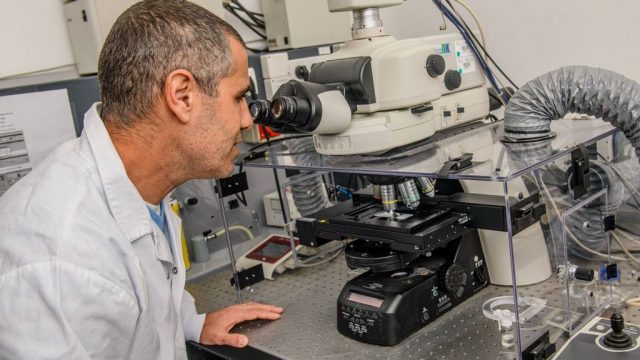
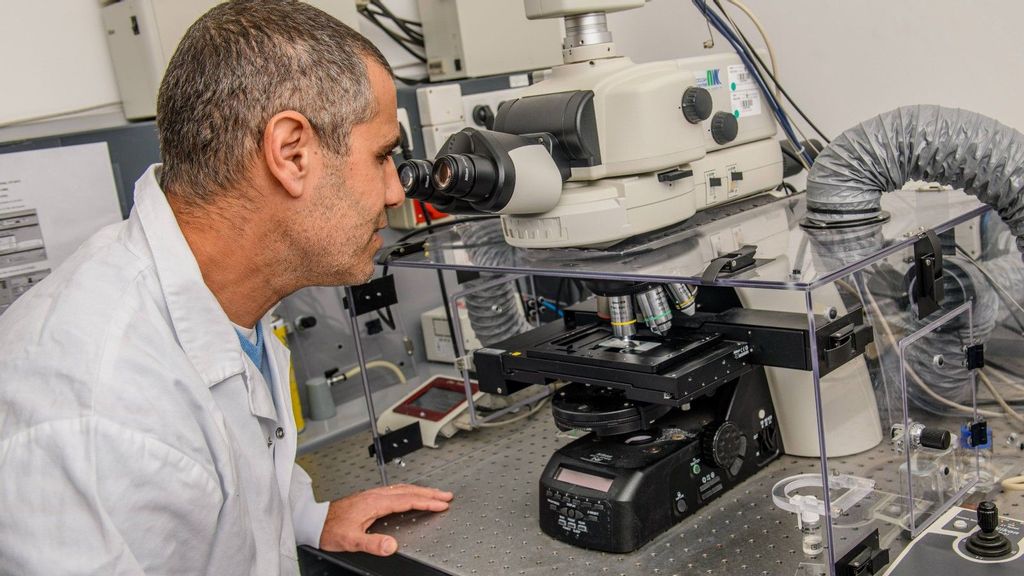
From left, Tel Aviv University’s Dr. Yona Goldshmit, Prof. Tal Dvir and PhD student Lior Wertheim. Photo courtesy of Sagol Center for Regenerative Biotechnology
The spinal implant was developed by Dvir and lab members Lior Wertheim, Dr. Reuven Edri and Dr. Yona Goldshmit along with Prof. Irit Gat-Viks from the Shmunis School of Biomedicine and Cancer Research, Prof. Yaniv Assaf from the Sagol School of Neuroscience, and Dr. Angela Ruban from the Steyer School of Health Professions, all at Tel Aviv University.
Matricelf, based in Ness Ziona, employs 10 people – seven of whom are women, Toker tells ISRAEL21c. It is well-positioned to become a prominent player in the 3D bioprinting market, estimated to be worth about $650 million in 2019 and an expected $1.6 billion in 2024.
A predictive lighting control system, connected to the internet, can predict sunlight and run electric lights in greenhouses in a way that will sharply reduce operators’ electric bills.
Researchers at the University of Georgia have published a study in the journal Plants that offers farmers a way to use electric lights only when needed and thus reduce costs by as much as 33 percent.
Plants receive additional lighting on rainy or cloudy days, which can be expensive and place a heavy load on the grid. Horticultural lighting consumes $600 million worth of electricity per year, according to a 2017 report from the U.S. Department of Energy.
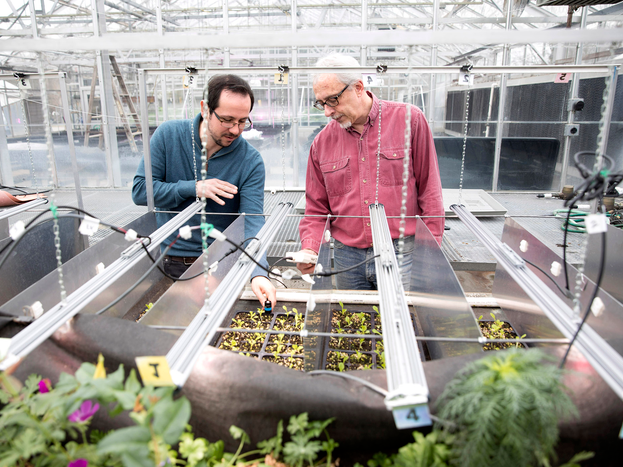
Eric Mattos (left) and Marc van Iersel, co-founders of Candidus, adjust plant growth lamps in a horticulture greenhouse, where they are testing their lighting technology on various crops. (Dorothy Kozlowski/University of Georgia)
LED lights, however, reduce costs. “When LED lights first came to market, they gave us an opportunity to control greenhouse lighting on a level that was not possible before,” said study co-author Marc van Iersel of the University of Georgia. “At the time, a lot of research was happening to optimize the lights themselves, but almost no one was working on smart control of the lighting system.”
“The electricity used for the lights is anywhere from 10 percent to 30 percent of the cost of running a greenhouse,” Van Iersel said. His team sought a way to reduce the energy cost and impact the “efficiency and sustainability of greenhouses.” Van Iersel and his team designed a lighting system to reduce the electrical demand of greenhouses, without harming the plants they contain.
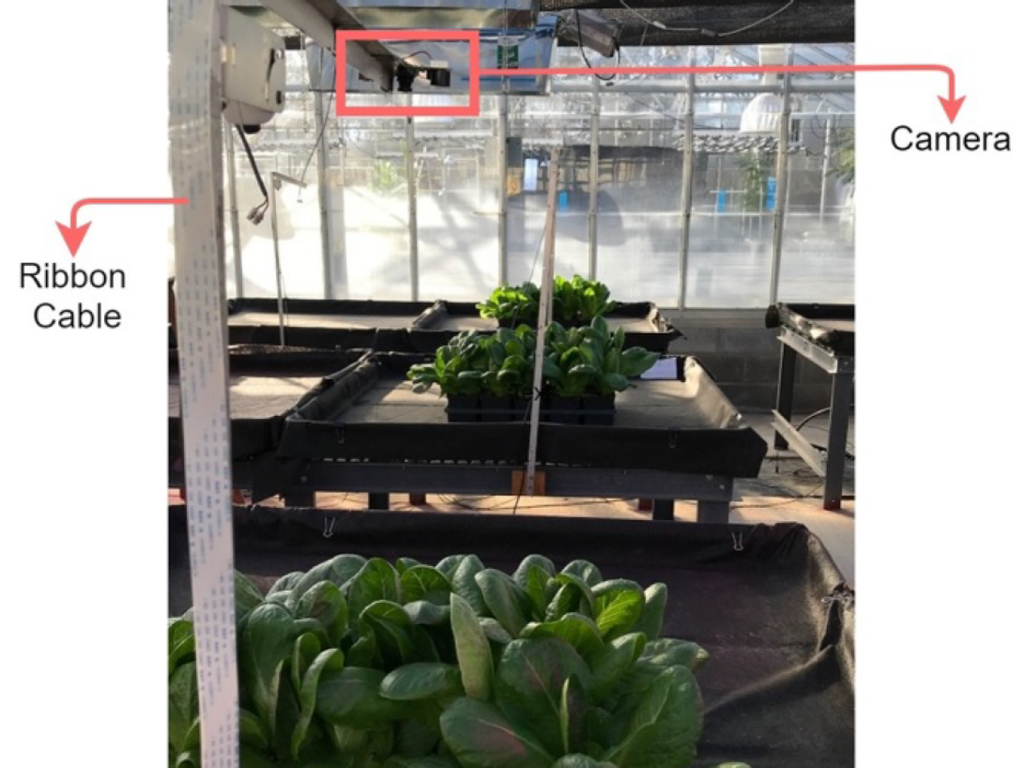
The team built a system of sensors to monitor the weather and designed light-predicting algorithms. This enables them to predict the amount of sunlight that can be expected in the future to optimize the lighting.
Imaging setup in the greenhouse. (Afzali et al. (2021)/Plants)
The team studied greenhouses during the winter and spring months, which is when they are predominantly used. The results showed that plant growth was maintained while costs were reduced. During the spring, the team reduced costs by 33 percent, but the winter showed only a 4 percent reduction. The researchers found that energy costs drop during the spring when there is more sunlight, as opposed to during winter when more artificial light is needed to compensate for fewer daylight hours.
However, the team believes that actual future savings may be even greater as the study assumed a fixed cost for electricity. In reality, greenhouse farms can see varied prices for electricity. The system the team devised is programmed to take these variables into account. Future research could reveal the resulting savings.
Commercial cannabis growers may see the most benefit from this research. In Washington and Idaho alone, their electricity usage will grow from about 200 megawatts per year in 2022 to 300 megawatts by 2035, according to the Northwest Power and Conservation Council. Cannabis is legal to purchase in 33 states for recreational and/or medicinal use, while there are states that allow commercial growing.
Your newest golfers might be the only ones who truly play for nuts — cashews, that is.
In studying the problem-solving skills of Goffin’s cockatoos (Cacatua goffiniana), also known as the Tanimbar corolla, Austrian researchers tested whether the birds would push a stick to hit a marble into a hole that hid a cashew reward.
“I wanted to design an experiment to test the extent to which these amazing creatures pay attention to simultaneous actions when using tools,” Antonio Jose Osuna Mascaro of the Messerli Research Institute of the University of Veterinary Medicine in Vienna said.
Goffin’s cockatoos are considered a particularly tool-loving bird, and they learn how to use new objects through exploration and play, just like humans, researchers said.
“I couldn’t easily mimic the way other tool users like chimpanzees crack nuts with rocks because cockatoos don’t have hands, so I had to come up with a task that allows movements that are more natural for these animals. The answer was in front of me on my way to the lab: a golf course,” Osuna Mascaro said. “A golf-like task would allow me to test the animals’ ability to perform combined tool actions.”
Antonio Jose Osuna Mascaro is seen with the birds in the study he led at the Messerli Research Institute of the University of Veterinary Medicine in Vienna. (University of Veterinary Medicine, Vienna/Zenger)
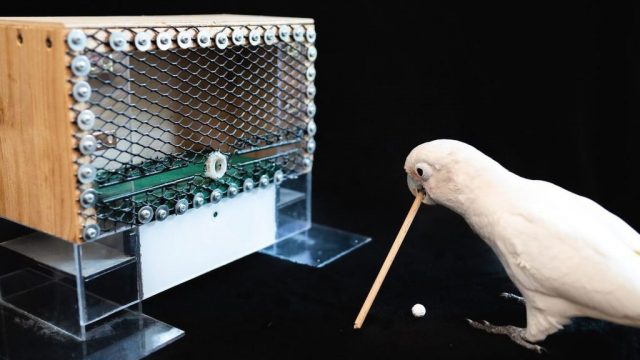
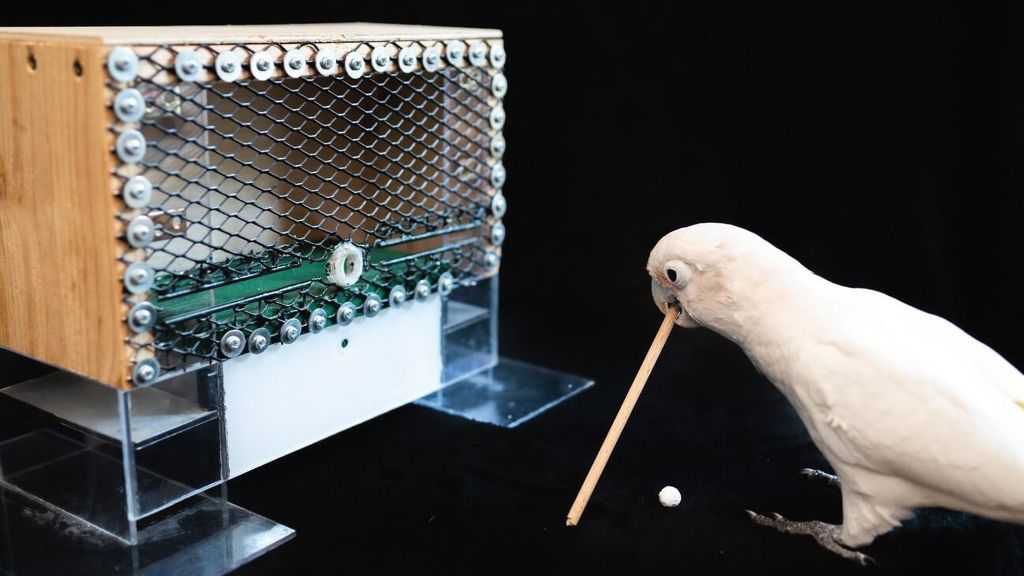
The task consisted of a green-carpeted platform housed in a box with a latticed front. Each side of the green had a rectangular hole with a trap door underneath. During the experiment, one of the two trapdoors was baited with a cashew nut. In the front grille was a central hole through which a heavy white marble could be inserted. Using a stick positioned through the grate, the bird could push the ball into one of the holes on top of the trapdoor, releasing the cashew if chosen correctly.
“Three of our cockatoos managed to use the stick in such a way that they could hit the ball into the right hole and get the reward, a real demonstration of tool innovation at a very high level,” Osuna Mascaro said.
“One of the most amazing aspects of the exercise was watching these animals each invent their own technique for grabbing the stick and hitting the ball, sometimes with amazing dexterity.”
A sketch of the process the cockatoos followed in a golf-inspired experiment shows how they figure out how to use complex combined tools. (University of Veterinary Medicine, Vienna/Zenger)
Osuna Mascaro said one of the birds held the stick “between its upper and lower jaws, another between the tip of the beak and the tongue and another with its claw, much like a primate.”
“This is the first example of the combination of these abilities outside primates and indicates that the cognitive preconditions for composite tool use have also evolved outside the primate lineage,” the researchers wrote in their study, published in the journal Nature.
Construction work on the world’s biggest telescope in a Chilean desert is “making progress” following delays caused by the COVID-19 pandemic, officials with the European Southern Observatory (ESO) say.
The Extremely Large Telescope (ELT) is being built on top of Cerro Armazones mountain in northern Chile’s Atacama Desert with an expected completion date in 2025.
When finished, the ELT will be the world’s largest optical/near-infrared telescope and capable of gathering 13 times more light than the largest optical telescopes operating today, according to the ESO.
Artist’s impression of what the Extremely Large Telescope, now under construction, will look like when it is fully operating. (ESO-L. Calcada/Zenger)
It included a photograph of the enormous telescope’s foundations in a statement, saying that work continues at the desert site.
“The foundations of the mammoth 39-m telescope have been laid, taking us one step closer to uncovering some of the most elusive mysteries of the universe,” the statement said.
“The immense structure will be about 80 meters [262 feet] high, with a diameter of about 88 meters [288 feet], roughly equivalent to the area of a football pitch,” it said.
The scaffolding and the first formwork of the dome’s pier were depicted in the photo with the statement saying that the pier will be surrounded by a circular auxiliary building
“The various electrical, thermal and hydraulic plants used to operate the ELT will be housed here,” the statement pointed out. “The entire structure will rest on shock absorbers, already installed and aligned, to protect against major earthquakes and other vibrations.”
An aerial view of the construction site of the world’s largest telescope for looking at the sky, ESO’s Extremely Large Telescope in Antofagasta, Chile. (G. Hudepohl-ESO/Zenger)
A 262-foot dome will house the observatory, covering the entire site. A 180-foot circular pit will house the foundation for structures to support the telescope’s mirrors.
The telescope’s main mirror, “a fundamental component of the adaptive optics system of the ELT, can be quickly deformed to correct for turbulence in the Earth’s atmosphere, as well as vibrations caused by the telescope’s motion and the wind,” the statement said.
The ELT construction site is a 30-minute drive from ESO’s Very Large Telescope, which is actually four telescopes working together. That proximity should help with support and maintenance, officials say.
The mountaintop location in Chile was chosen in part because the air is so dry and thin that atmospheric refraction, which obscures astronomers’ views of the cosmos, is less of an obstacle than almost anywhere else on the planet.
“When finished, this will be the largest adaptive mirror ever made for a telescope, allowing ESO’s ELT to see the universe in unprecedented detail,” the ESO statement said.
Claressa Shields has spent years turning calamity into relative serenity.
Raised in an impoverished section of Flint, Michigan, where there has been a years-long water crisis, Shields witness her mother struggle with alcohol abuse. Her father was imprisoned until she was nine, two years later introducing her to pugilism.
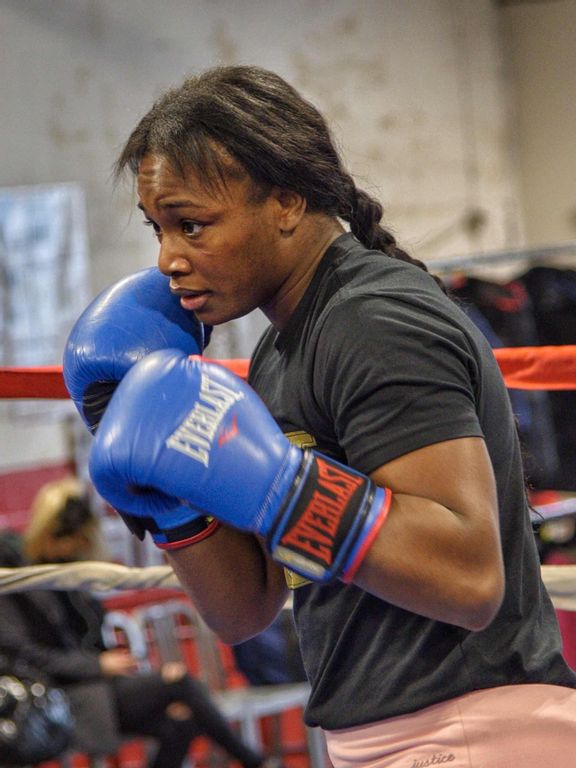
Today, Shields, 26, is arguably the most accomplished boxer in history, male or female, as well as the Greatest Woman Of All Time (GWOAT). “T-Rex” Shields is the only American amateur boxer to earn back-to-back gold medals at the Olympic Games, doing so in 2012 in London and 2016 in Rio de Janeiro.
A three-division champion, Shields (11–0, 2 KOs) will travel to Cardiff, Wales, to defend her IBF/WBA/WBC middleweight titles on Saturday against southpaw Ema Kozin (21–0–1, 11 KOs) of Slovenia. The bout will be broadcast on Sky Sports pay-per-view (3 p.m. ET). A Shields win would likely set up a summer title unification fight with WBO counterpart Savannah “Silent Assassin” Marshall (11–0, 9 KOs) of England.
Marshall was the lone fighter to defeat Shields as an amateur, doing so in the latter’s 26th bout of an overall 77–1 career.
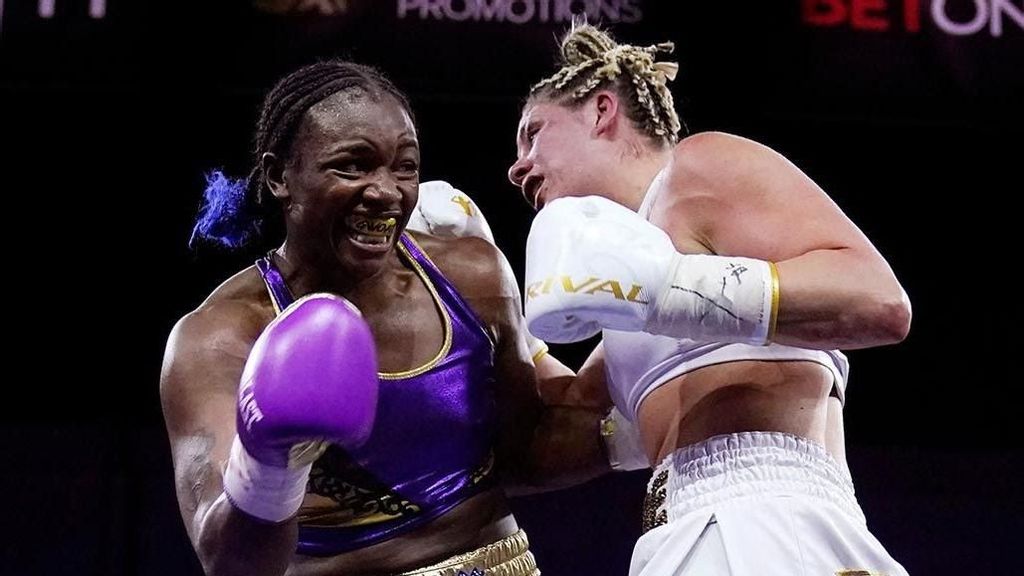
Claressa Shields (left) became an undisputed IBF/WBA/WBC/WBO 154-pound champion with a unanimous decision victory over previously unbeaten southpaw Marie-Eve Dicaire of Canada in March. In victory, Shields became the first male or female boxer in the four-belt era to be undisputed champion in two divisions. (Mauricio Sulaiman/World Boxing Council)
An advocate for women’s rights and against sexual assault, the latter of which she experienced as a child, Shields spoke to Zenger about her future, including the movie, “Flint Strong,” that is in the works about her life.
Zenger: What can we look forward to learning about you in the film “Flint Strong” by Universal Studios and Oscar-winning director Barry Jenkins?
Shields: The movie, “Flint Strong,” has a very good writer. Barry Jenkins, and I sat down for hours when we met in person to talk about my life and the message that I wanted to send off.
What do I think people will learn about me from the movie that they don’t know?
I think they’ll see that I’m really a family-oriented person, and I take care of my family. Some people box because they want money or they want houses or cars and stuff like that, but my motivation was always to work for my family.
I’ve always wanted to make a way for us not to be poor anymore, and I think that goes over people’s heads. They see all of the gold medals and the success. But they don’t know how hard my struggle really was to get me to where I am.
Zenger: What role does Ice Cube play in the film, and do you have any perspective on how Ryan Destiny is doing in preparation to portray you in the film?
Shields: Ice Cube is playing my boxing coach, Jason Crutchfield, and Ryan Destiny is portraying me. I think it’s going great just from seeing Ryan Destiny in Flint, Michigan.
I’ve seen some photos they have and they match well with her wearing certain clothes and wearing scarves and how I used to dress leading up to the 2012 and 2016 Olympics.
Zenger: Are you contributing to the boxing techniques they’re using in the movie?
Shields: Ryan Destiny and Ice Cube went to Flint, Michigan, and trained with Jason Crutchfield. I guess he showed them some stuff, and they have videos to go off of.
Ryan has also used a fitness trainer. Ryan is very petite, but the fitness trainer has had her doing push-ups to help her to get stronger and to look as if she has bigger arms.
They’ve had her drinking protein shakes. I don’t know if, in the movie, she’ll move like me, but I think she’ll do a great job, regardless.
Zenger: Can you discuss your role as an advocate for social causes, including the ongoing water crisis in Flint, women’s rights, campaigning against sexual assault and representing a beacon of hope for a working-class city struggling with violence, poverty and everyday essentials?
Shields: I’m a sexual abuse survivor, having been abused at the age of 5. Being able to learn about myself and being able to deal with that. … You know, for a lot of years, it was a self-blame thing where you feel like what happened to you was your fault.
But, now that I’m older, I realize that it’s not, and I just want to speak on that, because it really takes a great deal of internal strength for you to be able to actually deal with that. So to actually hear somebody speak about it publicly before I spoke out about it actually encouraged me.
Now, I want to tell my story in order to help other girls deal with the trauma of being abused. I like to give people a different perspective and let them know that, you know, that because that happened to us, we don’t have to continue to live in that moment.
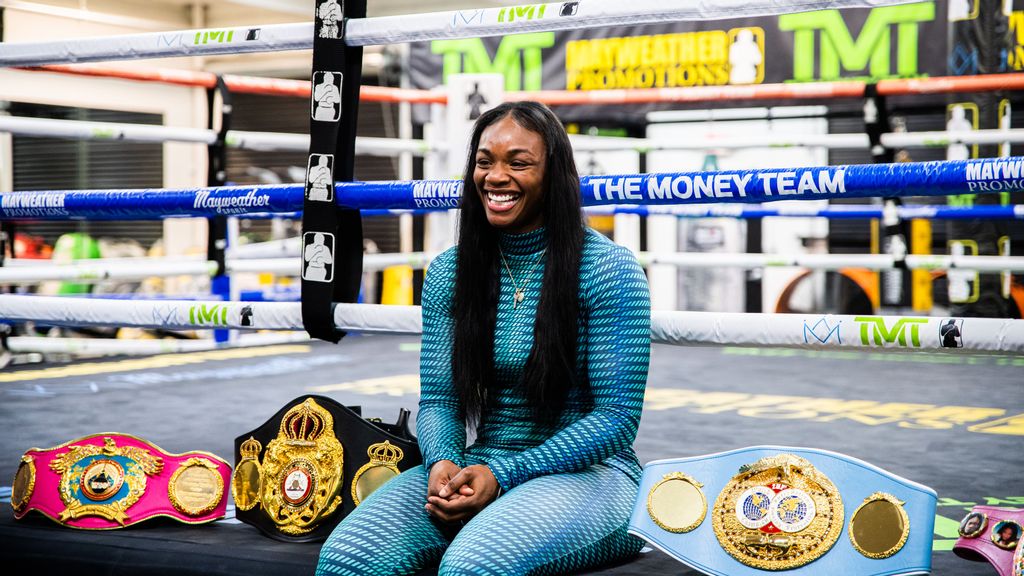
“I’m a sexual abuse survivor, having been abused at the age of 5. You know, for a lot of years, it was a self-blame thing where you feel like what happened to you was your fault,” said Claressa Shields. “I want to tell my story in order to help other girls deal with the trauma of being abused. I like to give people a different perspective and let them know that, you know, that because that happened to us, we don’t have to continue to live in that moment.” (Sean Jorgensen/Salita Promotions)
Representing Flint has always been me, and I’ll be wearing my hair blue until we get some clean water. Flint has always supported me. Whenever I’ve fought anywhere in the United States, they’ve always come out.
Flint is ready for me to fight in Las Vegas because we’re going to fill up the T-Mobile Arena. Flint has some of the strongest and most resilient people that I know. That’s where I’m from, so I will always represent them.
Zenger: Are you uniquely qualified to reach youth today given your own personal lived experiences as a female athlete in a male-dominated sport who has experienced childhood trauma and whose parents have had their own struggles?
Shields: I think what helps me to reach the youth is that I’m really one of them. A lot of the youth that I reach are kids who grew up in the same environment that I grew up in. I’m able to reach other kids, too, who probably have it a little bit better.
But I can understand those kids who come from the nitty-gritty, you know? The kids who come from the bottom and who actually had that struggle where their parents weren’t there or their father wasn’t there.
Or they had to make a way for themselves, right? I actually understand them. So when it comes to throwing events or having the school giveaways, the turkey giveaways or the Christmas giveaways, I know what I’ve got coming up when I go to those events. I know what kids want.
I know they want to have a great Christmas even though they don’t have a lot of money. They want to eat good food even though they can’t afford it. They want to be able to meet some of their favorite celebrities.
You always feel like when you come from a certain area or you come from a certain upbringing that that’s never going to happen to you, so I just present those opportunities because I know that’s what kids want and what they love because I was one of those kids.
“I think what helps me to reach the youth is that I’m really one of them. A lot of the youth that I reach are kids who grew up in the same environment that I grew up in,” says Claressa Shields. “The kids who come from the bottom and who actually had that struggle where their parents weren’t there or their father wasn’t there. Or they had to make a way for themselves, right? I actually understand them.” (Sean Jorgensen/Salita Promotions)
Zenger: As a black female athlete in a traditionally male-dominated sport, is it important for African-American women to see through you what’s possible to achieve along the lines of emerging Black female leadership such as Vice President Kamala Harris and a potential African-American woman as a Supreme Court nominee?
Shields: As far as women’s empowerment, I’m not really big into politics, but I will say that representation is everything. I didn’t know I had a lane in boxing, right? I looked up to the males, which is just something I did.
But it made me more comfortable knowing that there was a Laila Aliand that there was an Anne Wolfe. There was Mary Jo Sanders. Those women. To see a woman boxing actually gave me more encouragement to fulfill my dreams.
Growing up, as a female athlete, my representation, my role model and my inspiration was Serena Williamseven though I don’t play tennis. I wanted to have achievements and commercials and magazine covers — just like Serena Williams, but just in boxing.
That’s what I see as my vision. So without the representation, some people will never be able to see themselves doing it. So that’s why it’s important for women to have a voice. That’s very important because women add power to anything we’re involved in.
I feel as if women’s boxing is finally getting its just due, even though it’s been a while. We’ve gotta keep on pushing for the future. We can’t stop now. So the more we speak up and the more leaders we have, black and white, I think it’s just better for the whole world.
Zenger: Can you discuss the Floyd Mayweather video in which he invites you to his facility and any general words of wisdom imparted regarding focus, handling the limelight, tactics and/or skills?
Shields: Floyd is just an inspirational person to be around. He’s very funny. I can say that his words have stuck with me from our phone calls or when I see him face-to-face, him just telling me that I can be great at whatever I want to be great at.
He’s always reminding me that manifestation is everything, but that also hard work with manifestation makes it even better. He’s said a lot of things to me while I’ve been in camp.
He’s watched me hit the bags, shadow box, hitting the pads, and he’s very fond of my skills.
He keeps saying, “You are the greatest. You are a great female fighter. You’ve got power.” Talking about my record, he said: “Watching you work, hitting the pads, the bag and sparring and everything, your record is 11–0 with two knockouts. All you need to do is to simmer down.”
He said, “Once you simmer down, you’ll start getting these girls outta there.” He said, “Skill ain’t the problem and power’s not the problem.” He said it’s more about how anxious I am when I get into a fight. So we talked about ways I can relax more, and going in there and having fun and picking the shots, and it’s been a great last two weeks of camp.
Zenger: How motivated are you in returning to the United Kingdom to face Ema Kozin where you’ve had so much Olympic success, and is a knockout something you’re looking for given Savannah Marshall’s recent comments with a potential unification clash between the two of you looming?
Shields: I don’t care about what Savannah Marshall has to say. The fight is with Ema Kozin, and if the knockout presents itself, I will go for it. But I’m going to have a spectacular performance. I’m going to show my skills, show my power, show my combinations and my speed.
I’m going to show everybody a different look and remind everybody why I am considered the greatest woman boxer of all time, not just by myself. Most of the boxing world considers me, Claressa Shields, the greatest woman boxer of all time, pound-for-pound, No. 1.
“The fight is with Ema Kozin, and if the knockout presents itself, I will go for it. I’m going to show my skills, show my power, show my combinations and my speed,” says Claressa Shields. “I’m going to show everybody a different look and remind everybody why I am considered the greatest woman boxer of all time.” (Sean Jorgensen/Salita Promotions)
That’s with skills, defense, speed, power, combinations and IQ. I plan to show all of that. It doesn’t matter whether Marshall is saying that or not. She’s gonna realize that her barking up the Claressa Shields tree was the wrong tree to bark up.
PROFESSIONAL & AMATEUR BOXING:
• Two-time Olympic Gold Medalist. Won first Olympic Gold when she was 17 years old
• The most accomplished amateur boxer in U.S. history — male or female — and the only American boxer to capture back-to-back gold medals at the Olympic Games
• Became Unified Super Middleweight World Champion in just her 4th professional fight and Undisputed Middleweight World Champion in just her 9th professional fight — becoming the fastest fighter male or female to become an undisputed champion
• Became the fastest fighter — male or female — in boxing history to win a world title in three weight divisions when she won Unified Junior Middleweight Champion in just her 10th professional fight
• Became the only boxer — male or female — to hold undisputed world championships in two weight divisions in the four-belt era when she won the Undisputed Super Welterweight World Championship in her 11th professional fight.
• At 26 years old she has won 10 professional world titles in three weight divisions and two Olympic gold medals
• A trailblazer for women’s boxing, she headlined the first women’s boxing main event on premium television (SHOWTIME) in just her second professional fight and has headlined premium television fights cards a record seven times
• In signed agreement with Professional Fighters League (PFL) to participate in MMA fights as part of goal to be two-sport star à la Bo Jackson and Deion Sanders
• In 2021 signed multifight agreement with Sky TV to fight live in the U.K. including planned superfight with Savannah Marshall for spring 2022
• Trains for MMA at iconic JacksonWink MMA Academy in Albuquerque with legendary trainers Greg Jackson and Mike Winkeljohn and alongside MMA icons Jon Jones and Holly Holm
• Participated in biggest fight in women’s boxing history against Christina Hammer on April 13, 2019 — two undefeated champions battling for the Undisputed Middleweight Championship of the World.
AWARDS & ACCOLADES:
• Included in Guinness Book of World Records as first boxer — male or female — to hold undisputed world titles in two weight divisions in four-belt era
• Named SportsWoman of the Year in 2016 and 2018 by Women’s Sports Foundation (founded by Billie Jean King) — becoming first woman in 25 years to win the award twice
• Featured in 2016 ESPN “Body” Issue
• Named 2017 Female Fighter Of The Year by USA Today, Yahoo Sports
• Boxing gloves enshrined 2017 in International Boxing Hall Of Fame as only U.S. 2-time boxing Olympic gold medal winner in history
• Featured with Mary J Blige in Walmart-produced 60-second short film airing in 2018 Oscars telecast
• Named 2018 Female Fighter Of The Year by Boxing Writers Association of America
• Generated highest viewership (410,000 viewers) of any Showtime Friday night fight (male or female) since 2014
• Named to GENYOUth Board of Directors in February 2019
• Ranked #1 Pound-For-Pound Female Boxer in the world by both ESPN and Ring Magazine
• Became female boxer ever to receive prestigious Ring Magazine Belt recognizing the best female boxer