Home Blog Page 503

Fresh Images Shed New Light On Milky Way Mystery Strands
0

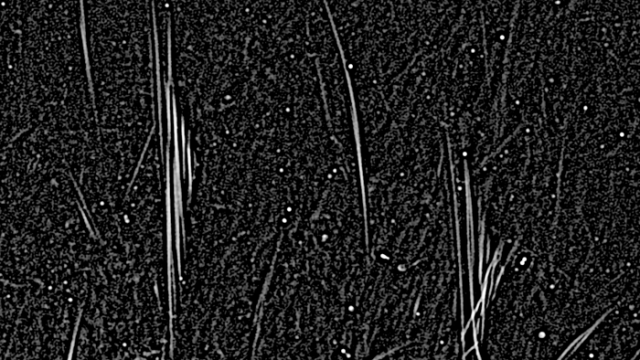
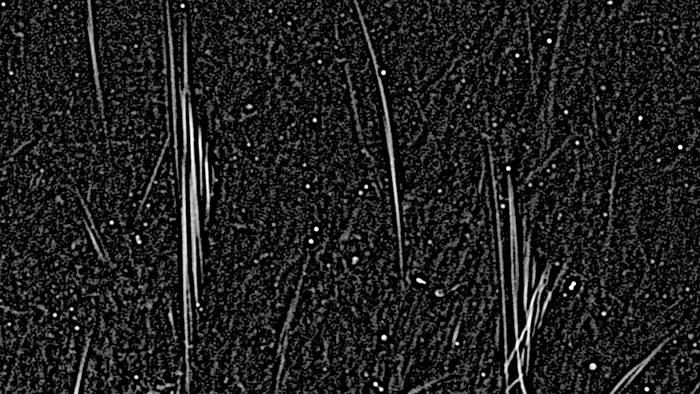
Close-up view of the string-like structures found at the center of the Milky Way. Magnetic filaments appear in pairs and clusters, side by side with equal spacing between them. (Farhad Yusef-Zadeh)


By Martin M Barillas

Unidentified filaments are inexplicably dangling at the turbulent center of the Milky Way, but a new study may have unlocked some of their secrets.


The one-dimensional strands are found in pairs or clusters, sometimes arranged in equally spaced stacks like the strings of a harp or guitar, stretching 150 light-years long. Astronomer Farhad Yusef-Zadeh of Northwestern University discovered these magnetic filaments in the 1980s and determined that they are made up of cosmic ray electrons gyrating in a magnetic field at nearly the speed of light.

Now, some 40 years later, Yusef-Zadeh and a team of researchers have captured new images that reveal 10 times more filaments than previously discovered. For the first time, this has allowed them to conduct statistical studies of the filaments and penetrate their dark mystery.
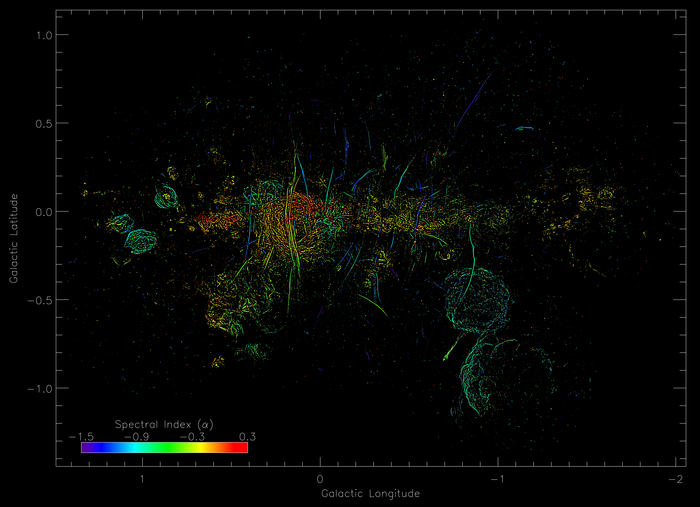
A mosaic image of the Milky Way’s center, showing the spectral index for the filaments. (Farhad Yusef-Zadeh)
A mosaic radio image of the Milky Way galaxy’s center with the background removed to isolate the magnetic filaments. The filaments are large, vertical slashes throughout the image. (Farhad Yusef-Zadeh)

“We have studied individual filaments for a long time with a myopic view,” said Yusef-Zadeh, co-author of the new study published in the journal The Astrophysical Journal Letters. “Now, we finally see the big picture — a panoramic view filled with an abundance of filaments. Just examining a few filaments makes it difficult to draw any real conclusion about what they are and where they came from. This is a watershed in furthering our understanding of these structures.”

The team of astronomers analyzed three years worth of data from the South African Radio Astronomy Observatory (SARAO). Using SARAO’s MeerKAT radio telescope, they cobbled together 20 separate observations of different sections of the cosmos some 25,000 light-years from Earth at the center of the Milky Way galaxy. The full image will be published in an accompanying paper led by Ian Heywood of Oxford University. The image also captured radio emissions from the remnants of supernovas, or exploding stars, and the birthplaces of stars.

The researchers explored the magnetic fields around the filaments and examined how cosmic rays illuminate them. Because the radiation emitted by the filaments is distinct from that of a recently discovered supernova remnant, they believe the two phenomena have different origins.

The filaments are probably a testimony to the remote past of the super-massive black hole at the heart of the Milky Way, rather than bursts of energy from supernovas. However, the filaments may also be linked to gigantic bubbles emitting radio waves, which Yusef-Zadeh discovered in 2019.

While it was already known that the filaments are magnetized, Yusef-Zadeh said the team members can now study the statistical characteristics of the filaments. “We can find the strength of [the] magnetic fields, their lengths, their orientations and the spectrum of radiation,” he said.

A radio image of the center of the Milky Way with a portion of the MeerKAT telescope array in the foreground. The plane of the galaxy is marked by a series of bright features, exploded stars and regions where new stars are being born and runs diagonally across the image from lower right to top center. The black hole at the center of the Milky Way is hidden in the brightest of these extended regions. The radio bubbles extend from between the two nearest antennas to the upper right corner. Many magnetized filaments can be seen running parallel to the bubbles. In this composite view, the sky to the left of the second-nearest antenna is the night sky visible to the unaided eye, and the radio image to the right has been enlarged to highlight its fine features. (SARAO/Oxford/NRAO)

Yusef-Zadeh is still mystified by how the filaments are structured. Within clusters, filaments are separated from each other at perfectly equal distances, approximately the distance from the Earth to the Sun.

“They almost resemble the regular spacing in solar loops,” he said. Solar, or coronal, loops are magnetic loops beginning and ending on the Sun’s surface that project into the corona or solar atmosphere. The glowing ionized gas or plasma trapped in the loops makes them visible.

“We still don’t know why they come in clusters or understand how they separate, and we don’t know how these regular spacings happen. Every time we answer one question, multiple other questions arise,” said Yusef-Zadeh.

Adding to the mystery, astronomers don’t know whether the filaments change or move or what causes their electrons to accelerate to near the speed of light. Yusef-Zadeh theorizes there may be “sources at the end of these filaments that are accelerating these particles.” He will next catalog each filament and later publish their angles, curves, magnetic fields, spectrums and intensities to provide more clues about their elusive nature.

Edited by Siân Speakman and Kristen Butler

Recommended from our partners


The post Fresh Images Shed New Light On Milky Way Mystery Strands appeared first on Zenger News.

Alamo Drafthouse Cinema announced as anchor tenant for Powell Steam Plant in Birmingham

0
This architectural rendering shows an inside view of the Alamo Drafthouse movie theater at the renovated Powell Avenue Steam Plant in downtown Birmingham. The theater is expected to open by fall 2023.

By Anthony Cook

Alabama News Center

A.G. Gaston’s Legacy Influences Annual Conference

0

BY ZT DUNN

Special to the Birmingham Times

Unbe-leaf-able: Thousands Of Tree Species Still Undiscovered

0

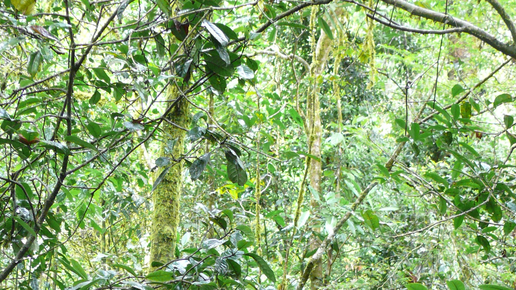
A forest of various variodendron tree species in Tanzania, which is a tropical area harboring yet undiscovered tree species. (Andrew Marshall)


By Martin M Barillas

A worldwide collaboration between scientists has yielded the largest forest database ever attempted, which estimates that Earth harbors about 73,000 tree species, of which 9,200 have yet to be described.


In a paper published in Proceedings of the National Academy of Sciences, the global team revealed an estimate of 64,000 known tree species, whereas previous estimates put the number at about 60,000. The undiscovered trees will probably be found in South America, have a limited range and are exceedingly rare.

“These results highlight the vulnerability of global forest biodiversity to anthropogenic changes, particularly land use and climate, because the survival of rare taxa is disproportionately threatened by these pressures,” said forest ecologist and study co-author Peter Reich, who holds joint appointments at the University of Michigan and University of Minnesota.

The undiscovered, undescribed species are endangered by climate change, deforestation and development, according to the research team. The study’s findings may aid in prioritizing conservation efforts.

“By establishing a quantitative benchmark, this study could contribute to tree and forest conservation efforts and the future discovery of new trees and associated species in certain parts of the world,” Reich said.

“Tree species diversity is the key to maintaining healthy, productive forests, and it is important to the economy and environment,” said co-author Jingjing Liang of Purdue University.

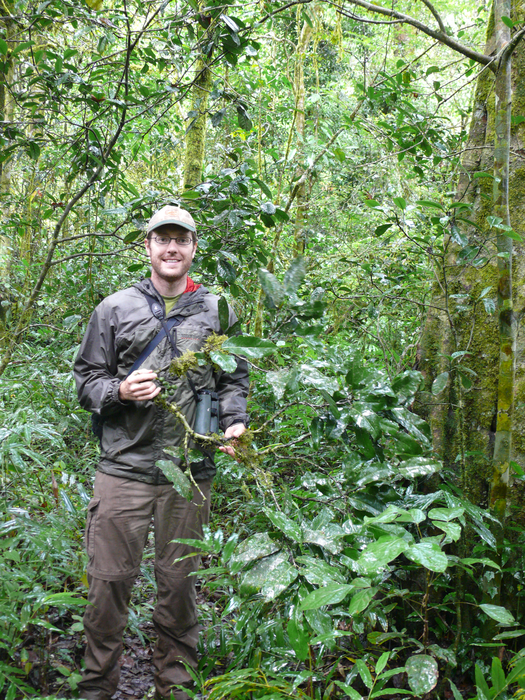
Study co-author Andy Marshall explores a Magombera vine thicket. (Ruben Mwakisoma)

It occurred to Liang, while working several years ago in Alaska, to formulate a global tree dataset. “I literally found a rich forest inventory dataset in someone’s drawer,” he said. Recognizing the value of the data, he realized that there “was no central repository for the valuable data people were collecting.” With help from other scientists, a global grassroots collection effort grew. The resulting dataset is the largest ever collected and includes in excess of 38 million trees in 90 countries and 100 territories.

To conduct the study, more than 100 scientists collected data in forests where they selected specific stands of trees, measuring and identifying every single tree, according to Liang. The researchers collected data about the species, sizes and other characteristics of the trees. “Counting the number of tree species worldwide is like a puzzle with pieces [spread] all over the world. We solved it together as a team, each sharing our own piece,” Liang said.

“Through this vast amount of data, we have a good picture of tree species diversity for different biomes and at the continental level, which is what we used to make this estimate,” said Liang.

Study co-author Andy Marshall identifies a species of variodendron in Tanzania. (University of the Sunshine Coast)

Because the dataset is so large, the researchers used Purdue’s computing facilities to crunch the numbers from datasets provided by the Global Forest Biodiversity Initiative and TREECHANGE, which uses ground-sourced forest-plot data. The combined databases yielded a total of 64,100 documented tree species worldwide, a total similar to a previous finding of about 60,000 tree species on the planet. The total number they estimated came to 73,274, which means about 9,200 tree species remain undiscovered.

According to the study, most of the undiscovered tree species likely exist in tropical or subtropical areas such as the Amazon rainforest. Some 43 percent of Earth’s tree species are found in South America, which has the highest number of rare species, according to Liang. “It is very possible we could lose undiscovered tree species to extinction before we even find them,” he said.

The continent is noted in the study as a place of global tree diversity and concern. There are about 8,200 rare tree species in South America, of which 49 percent are found only in that region. Undiscovered species in South America are probably located in the subtropical and tropical forests of the Amazon River basin and in the Andes’ forests, between 3,300 and 11,480 feet above sea level.

“Beyond the 27,000 known tree species in South America, there might be as many as another 4,000 species yet to be discovered there,” Reich said.

Edited by Siân Speakman and Kristen Butler

Recommended from our partners


The post Unbe-leaf-able: Thousands Of Tree Species Still Undiscovered appeared first on Zenger News.

Jim Peppler’s Photos From the Civil Rights Movement Captured Black History in Alabama

0
Southern Courier photographer Jim Peppler, pictured at a political rally during the mid-60's in Eufaula, Alabama. (Alabama Department of Archives and History)

By Ryan Michaels

The Birmingham Times

Inside ‘Little Korea’ – One of Birmingham’s Poorest Communities

0
Birmingham’s "Little Korea" in what is now Fountain Heights was inhabited mostly by some of the city’s most impoverished residents. (Alabama Department of Archives and History)

By Ryan Michaels

The Birmingham Times

Sharon Hill’s 3 Daughters: The Business of Grace, Faith, and Hope

0
Sharon Hill with daughters, from left; Jasmine Grace, Jewel Hope, Jade Faith. (PROVIDED PHOTO)

By Haley Wilson

The Birmingham Times