Home Blog Page 530

Self-Taught Artist Uplifts Women Through Her Multidimensional Paintings


0

“Art is the only thing that gets me out of myself, and my business, Art by Ash, allows me to quiet the noise and transfer everything I feel and think from my head and my heart to my canvas,” says Ashley Mudge. (Courtesy of Ashley Mudge)


By Lem Satterfield

Identity issues have long troubled Ashley Mudge, “due to my sister and I both having different fathers, and being the only person of color in my family.”


When Mudge was 26, she set out to find her biological father. When she met the man she thought was him, his response threw her. “He told me he knew the day I was born that I wasn’t his daughter.”

Mudge, now 35, says: “Art is the only thing that gets me out of myself, and my business, Art by Ash allows me to quiet the noise and transfer everything I feel and think from my head and my heart to my canvas.”

Mudge, who lives with her partner, Kimberly Mazzochi, in Silver Spring, Maryland, spoke with Zenger about her cathartic journey, in which creativity has led to a therapeutic and profitable business.

Zenger: What is the origin of and the name of your business?

Ashley Mudge: Art by Ash is the name of my business. Originally, I was going to call it Splash Of Color By Ashley. I started out by painting houses. I was getting and doing all of these jobs solo. There weren’t many females in the business, so I decided to publicize my name.

As painting houses turned into painting canvases, Splash Of Color By Ashley became Art by Ash. I had never drawn or painted artistically until after I entered an alcohol and drug rehabilitation program. It was there I found this gift three years ago.

During the Black Lives Matter movement, Ashley Mudge painted this piece. “I decided to leave the piece untitled,” Mudge says. “It speaks for itself.” (Courtesy of Ashley Mudge)

Zenger: What exactly does Art by Ash entail?

Mudge: I am a self-taught artist. I draw and paint mostly images of women. I have been commissioned for murals, tattoo drawings, animal portraits and collages.

I’m extremely passionate about creating multidimensional textured paintings that celebrate female liberation. I feel each woman is her own unique canvas.

I love being able to recreate the beauty of women through my own perception.

Zenger: Are there any projects you are most proud of?

Mudge: I am extremely proud of the  Heal art exhibition … through Jan. 8, 2022 …. in Washington, D.C., as well as a show I did in Brooklyn, New York … . The Heal art exhibition is curated by Marlon Powell … and the exhibit is open to the public. Private tours are also given.

Zenger: What activities did you participate in growing up?

Mudge: Growing up, I was always involved in sports. I ran track, was on the community swim team, rode horses, played basketball and participated in kung fu.  My mother and sister, Shannon, have always supported and had an influence on me.

My mom would sit at her easel and paint when Shannon and I were young.  Shannon went to art school and started sculpting. Each has been a major influence and tremendous support. My mom and her husband, Joe Spanolo, helped me drive a collection of mine from Maryland to New York on the weekend of Sept. 29.

Zenger: Do you care to discuss your ethnicity?

Mudge: I have dealt with identity issues, due to my sister and I having different fathers, and being the only person of color in my family.

Growing up as an adolescent, I was told I was part Native American and that was why my skin got dark in the sun and why my hair was curly. My mother, Liz, is of Caucasian descent.

My biological father was unknown most of my life. At the age of 26, in the hopes of finding him, I looked him up and found him. I talked to him, and he told me that he knew the day I was born that I wasn’t his daughter. He told me my father was a black man and that he was a good old white boy. His exact words. This was the catalyst that made me decide to explore my ancestry at the age of 29.

When my results came back, I discovered I am 47 percent African descent and 52 percent European descent. No trace of Native American. I am still on a mission to find my biological father.

Zenger: Did this factor into your motivation to begin painting, and has your work in any way served as a therapeutic method of channeling toward inner peace and serenity?

Mudge: Art is the only thing that gets me out of myself. I am able to quiet the noise and transfer everything I feel and think from my head and my heart to my canvas.  Art is a form of expression. I try to not make it a form of opinion.

The tree painting represents the bloodline of where I came from — and that our voices are finally being heard regarding the violence inflicted by law enforcement. I decided to leave the piece untitled. It speaks for itself.

This painting of Diana Ross is “near and dear to my heart,” Ashley Mudge says. (Courtesy of Ashley Mudge)

Another piece near and dear to my heart is a painting I’ve done on Dianna Ross. Everybody has their icon — Marilyn Monroe and Audrey Hepburn. They’re mainly white women. So where was my icon of color? Diana Ross. I actually began to style and pattern my hair after the way she did. I really appreciated her beauty. I truly admire her creativity and the impact she has had.

Zenger: How has your spiritual foundation influenced your decision to become an entrepreneur?

Mudge: Spiritually, I want to do what I love and get paid for it — and that is an artist. Paid because I need to make a living to survive. However, art for me is not about the money.

Painting my experiences and connecting with others through art has allowed me to discover who I am and what I want to be in my career. Spiritual healing is the benefit of the work I do.

Zenger: Has Kimberly been supportive?

Mudge: I can’t begin to tell you how much of an infinite inspiration and support my partner Kimberly has been. Kimberly is the voice of reason. Anytime I have been defeated or thought I should give up, she stepped in, telling me that it takes work to make dreams come true and to keep pushing forward.

Kimberly has been there by my side the entire time. Becoming the sole breadwinner, so I could pursue my dreams. I wouldn’t be where I am without Kimberly.

Mudge can be contacted on Ashley-Mudge.pixels.co , Instagram @ashm118 and Tik Tok @artbyash7. She also has a store on Etsy: BloodlineArtStudio.

Edited by Judith Isacoff and Fern Siegel

Recommended from our partners


The post Self-Taught Artist Uplifts Women Through Her Multidimensional Paintings appeared first on Zenger News.


4 Fraud-Fighting Technologies Make Online Shopping And Banking Safer

0

Riskified employees in front of the New York Stock Exchange. Riskified, which went public last July, works with clients including Acer, Trip.com and Ticketmaster. (CRC Media)


By Abigail Klein Leichman

Banking and shopping online have never been more popular as a result of the worldwide pandemic and the convenience of accomplishing these tasks 24/7 from home.


Unfortunately, the rise in transactions has come with an unwelcome companion: a rise in fraud.

Online fraud includes false or illegal transactions using stolen payment or identity information. There’s also “friendly fraud,” where a customer instructs the payment provider to cancel payment on a received item or service, resulting in costly chargebacks to the merchant.

Experts estimate that online retailers spend 7 percent of their annual revenue dealing with the average 10 percent of transactions that are fraudulent. The hardest-hit industries are airlines, computer/electronics retailers and money-transfer services.

Fraud also hurts consumers because anti-fraud measures can slow or even stop honest transactions. Residents of countries with a high percentage of fraudulent transactions may find themselves blacklisted from online retailers and financial institutions that got burned too often.

Several Israeli companies have developed sophisticated anti-fraud technologies to protect both sides and simplify weeding out bad actors. Here we review four of them.

Riskified

As mentioned above, friendly fraud occurs when consumers dispute charges for something they received, rather than returning the item. Maybe their kid bought it without their knowledge, or maybe it’s an impulse buy that they later regretted.

Either way, the merchant gets hit with a chargeback fee unless it can prove the purchase was legitimate. Last year, friendly fraud cost merchants some $125 billion.

Eido Gal and Assaf Feldman founded Riskified in 2013, offering a unique chargeback guarantee. Today it works with three of the 10 largest ecommerce companies and has processed more than a billion orders.

Elad Cohen, vice president of data science for Riskified (Sarale Gur Lavie)

“When order information comes to Riskified in real time, we decide in a second or two whether to accept or reject the order, using sophisticated machine-learning models,” said Elad Cohen, Riskified’s vice president of data science.

“We only get paid for the orders we accept. If we get it wrong, we pay the entire chargeback fee.”

Riskified’s service reduces fraud-related costs by as much as half, says Cohen. “Our fee is substantially lower than their chargeback fees, and they don’t have to pay someone to do it in-house.”

But the main benefit is that Riskified’s automated process increases order approval rates up to 20 percent. That’s because human risk assessors tend to err on the safe side, rejecting suspicious transactions or even blacklisting entire countries.

“For customers, we make e-commerce much more accessible,” says Cohen.

For merchants, additional services include using data to build a case for banks to dispute friendly fraud, determining if a customer is abusing free return or special-offer privileges, and more.

With more than 650 employees — two-thirds in Israel, the rest in New York and smaller branches across the globe — Riskified went public last July and works with clients including Acer, Trip.com and Ticketmaster.

Justt

Justt is another Israeli startup helping global merchants fight false chargebacks with smart technology.

Founded in 2019 as AcroCharge, Justt uses machine learning and domain-specific technology to flag incorrect chargebacks and builds tailored solutions to gather and submit evidence on merchants’ behalf.

The company says its customized, fully automated approach defeats 85 percent of friendly fraud while eliminating the need for in-house chargeback mitigation programs.

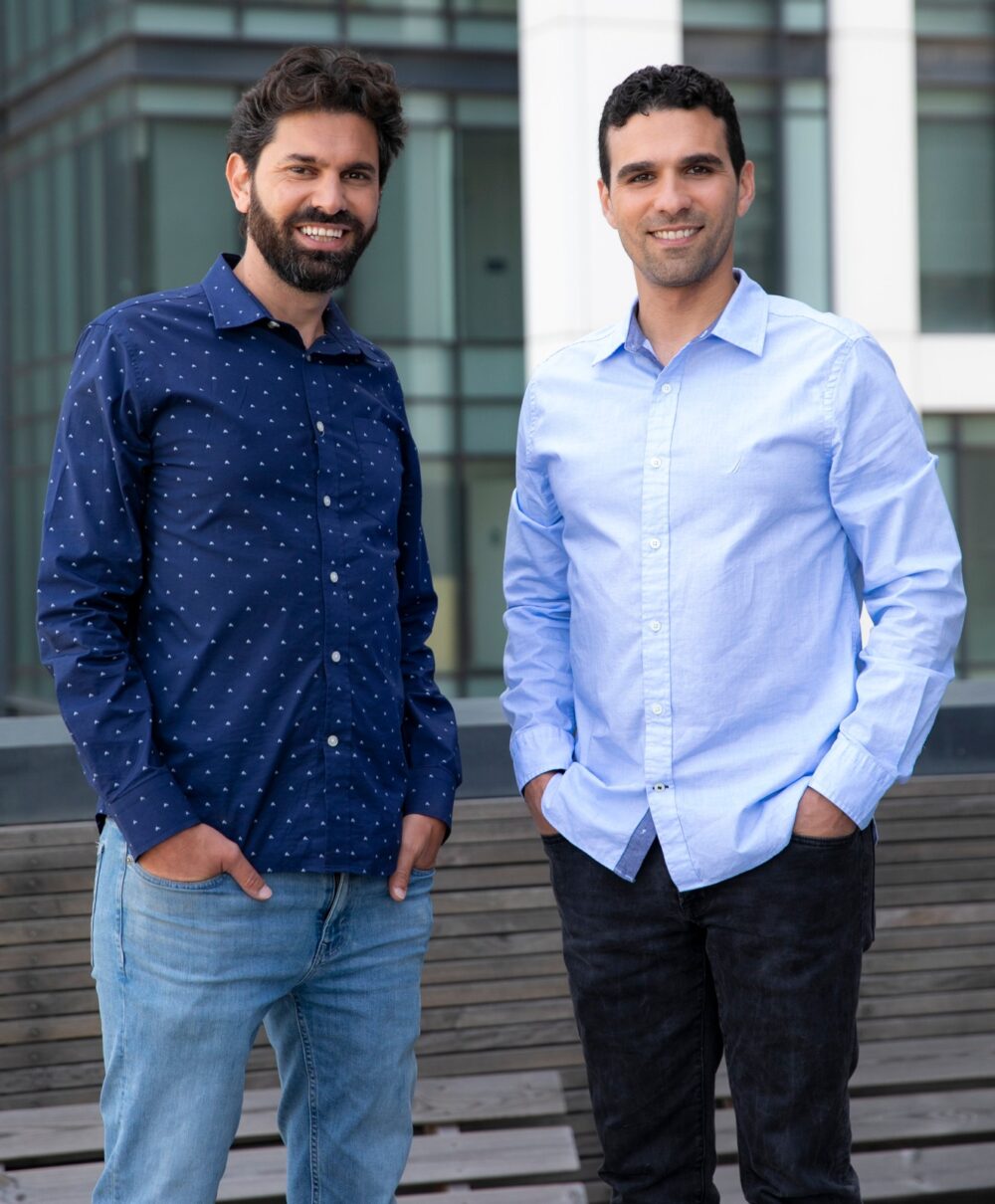
Justt co-founders Ofir Tahor and Roenen Ben-Ami (Courtesy of Justt)

Founded by Israeli tech industry veterans Roenen Ben-Ami and Ofir Tahor, Justt recently raised $70 million in funding as it expands, now encompassing about 110 employees.

One of Justt’s customers, digital payments giant Melio, reports that its mitigation team was able to reclaim about 30 percent of false chargebacks before implementing the automated solution. The success rate then increased threefold.

“Justt’s hands-off solution integrates with our card processor, allowing us to shift our focus from the never-ending task of fighting chargebacks to conquering our core business goals,” said Matana Soreff, Melio’s vice president of risk and compliance. Justt’s customers pay a fee only after funds are recovered.

“The chargeback system is fundamentally unjust, but many merchants view their losses as simply the cost of doing business. At Justt, we believe there’s a better way, and that ecommerce sellers need someone in their corner as they navigate this archaic system,” said Tahor, Justt’s CEO.

Biocatch

Cybercriminals increasingly try to bilk the elderly out of their life savings, taking advantage of seniors’ lower level of digital savvy.

Using phone calls or text messages (to hide unfamiliar voices) pretending to be a grandchild in need of emergency cash, they may steal identity info to open a new account or persuade the victim to log into their bank account and then take it over.

After determining that 40 percent of confirmed fraudulent credit-card applications involved a person with a declared age of 60 or older, BioCatch recently launched its Age Analysis fraud-prevention solution for the 50 big financial institutions among its 100 clients in 20 countries.

BioCatch was founded in 2011 based on military machine-learning technology to authenticate identities using behavioral biometrics — how you type, move the mouse or handle your smartphone. Even small differences in behavior suggest that a hacker, not the account holder, is at the keyboard.

BioCatch vice president of cyber, Oren Kedem (Courtesy of BioCatch)

“When you apply to open a bank account online you type in a lot of information. The rhythm of typing is different if you’re doing it from memory or looking at a piece of paper,” says BioCatch vice president of cyber, Oren Kedem.

“American Express — first our customer and later an investor — uses BioCatch to detect when users applying for a credit card are reading information from somewhere else, a common occurrence in fraud.”

Knowing that typical cybercriminals are much younger than their victims, BioCatch taught its Age Analysis software to flag behavioral biometrics that don’t match the purported age of the applicant.

“We know how a person born in 1949 behaves online and how a person born in 1989 behaves online. If there’s a mismatch, we alert the client. We see that age detection is quite accurate,” says Cohen, especially when someone tries to open a new account.

“We don’t actively stop anything. We don’t tip off the bad guys. We collect the data invisibly and provide insights that allow the client to make a decision whether to approve, decline, or ask the applicant to contact customer support.”

BioCatch has more than 200 employees, with research and development in Israel and offices in North and South America, Europe, Asia and Australia.

Identiq

Identiq was established in 2018 with the idea of creating a peer-to-peer network that allows merchants to validate the identities of new users.

Identiq chief marketing officer Shmuli Goldberg (Courtesy of Identiq)

“Let’s say you sign up for a ride-sharing service. They’re putting you in a car with a stranger and need to know that you are who you say you are,” said chief marketing officer Shmuli Goldberg.

“Aside from the risks of credit card fraud, account takeover and identity theft, it’s also an issue of trust and safety. If you can be assured it’s a real person, a huge amount of the problems of fraud and bad actors go away,” says Goldberg.

“We do that by enabling our clients to verify your identity with companies that already know and trust you and have your IP address and credit card number, such as your video streaming service or grocery delivery company.”

Identiq’s algorithm-powered solution keeps user details anonymous and is both GDPR (European Union privacy law) and CCPA (California Consumer Privacy Act) compliant.

“We use multiparty computation, a well-known branch of cryptography that makes sure we can run a computation on data we both have without either of us exposing that data to each other,” Goldberg said.

Working under the covers during the signup process, Identiq’s scalable solution can handle hundreds of millions of inquiries simultaneously and instantaneously.

“Trusted users get a perfectly seamless experience. They’re not treated as fraudsters, there’s no more validating numbers or one-time verification charges. In the 1 percent where something doesn’t match up, we alert the client that we never saw this person with a credit card before.”

Identiq is working primarily in large business-to-consumers sectors, such as ridesharing, financial services, retail, travel, gaming, dating sites and social media.

“We can be used not only at account creation, but also before a customer places a huge order, or reactivates an existing account. A good user would be expected to have a range of companies across industries that know this user’s name, email address and phone number,” Goldberg says.

Produced in association with  Israel21c.

Recommended from our partners


The post 4 Fraud-Fighting Technologies Make Online Shopping And Banking Safer appeared first on Zenger News.

Simone’s Kitchen ATL Brings Birmingham ‘Taste of Love’

0
Whitney “Simone” Generette owns Simone’s Kitchen ATL (A Taste of Love), a food truck she launched in 2020 under the same name of the catering company she established in 2017. (Simone's Kitchen ATL Facebook page)

By Haley Wilson

The Birmingham Times

Alabama quarterback Bryce Young wins Heisman

0
Alabama quarterback Bryce Young participates in a press conference for the Heisman Trophy, which was awarded to Young Saturday. (Kent Gidley / Alabama Athletics)

8-Man MMA Tournament Offers Glimpse Of Olympic Possibilities

0

Copa Combate features eight fighters from eight different countries competing for a winning prize of $100,000 Sunday night in Miami. (Combate Global)


By George A. Willis

Former UFC champion Khabib Nurmagomedov is campaigning to get mixed martial arts into the Olympic Games when it comes to Los Angeles in 2028.


Whether that happens remains to be seen, but Combate Global is offering an early glimpse of what the Olympic competition might look like by staging a single-elimination tournament Sunday Dec. 12 featuring eight fighters from eight different countries.

Fighters from the 135-pound bantamweight division representing Mexico, Spain, Peru, Chile, Argentina, France, Ireland, and the United States won’t be competing for a gold medal. But the winner will earn $100,000 if he can win three fights in one night.

“When you come into a tournament like this when you’re literally representing your country, it adds an extra spin,” Combate Global CEO Campbell McLaren told Zenger. “They’re all proud of their homeland.”

Martial arts were among the first sports featured in the Olympic Games beginning with wrestling as part of the 708 B.C. Olympics. Six martial arts were held at the 2021 Olympics in Tokyo: boxing, judo, karate, Taekwondo, wrestling, and fencing. Modern MMA is a mixture of all of them except fencing but has yet to be seriously considered as an Olympic sport. Some consider it too violent. That could change as MMA’s popularity continues to grow globally.

“I think it’s going to be an Olympic sport for three categories of reasons,” McLaren said. “It’s a legitimate sport because it already contains several disciplines already in the Olympics and is deserving from a sporting fashion to be in there. It also takes skill, technique, training, endurance, cardio … all the things world-class sports do, and from a popularity perspective it’s a sport that has a global following. It also has a historical perspective, dating back to when the Olympics were created in Greece.”

The camaraderie and respect commonly displayed in MMA are also consistent with Olympic values. “That’s particularly important in these acrimonious times,” McLaren said. “We’ve forgotten how to fight and make up. We’ve forgotten how to fight fair and respect our opponent. Everything in the world is a fight to the death these days. We don’t hug it out at the end anymore. Combat sports actually sets a good example.”

Consider Copa Combate a preview of what MMA might look like in the Olympics. The format set for Sunday night at La Jaula in Miami will begin with four five-minute one-round fights. Winners advance to the semifinals for another five-minute one-round battle. Victors there advance to the finale, which is three five-minute rounds.

Paramount Plus opens with a pre-show at 9:30 EST with competition to begin at 10 p.m. Univision begins it English and Spanish broadcasts along with Mexican network TUDN MX at 11 p.m.

Leo Muniz, who hails from the Bronx but now lives in Pennsylvania, will represent the United States. He was out of the sport for nearly six years due to injuries and a lack of opportunities but has fought twice, winning both bouts, since signing with Combate Global.

Leo Muniz delivers a kick to the head of Hector Fajardo in a recent fight. Muniz will represent the USA at Copa Combate in Miami on Dec 12, 2021. (Scott Hirano/Combate Global)

“I’m 2–0 with Combate and looking to make it 5–0,” Muniz told Zenger. “I have a huge opportunity to change my life, and I’m thankful for that.”

Training out of Gracie, New Jersey, Muniz frequently rotated fresh sparring partners to mimic the different styles he might face in the tournament. “You have to make adjustments on the fly,” he said. “It’s more mental. You have to forget the last fight and move on to the next one. I have to be ready and willing to fight anyone on any given night against however many opponents.”

To question Muniz’s courage would be a mistake. When he’s not fighting, he works in construction and rappels down for high-rise projects in New York City. “We go from the roof and deploy ropes and rappel down to solve the problem,” he said.

Muniz faces Pierre Daguzan of France in the opening round. The winner advances to face the victor between Kevin Cordero of Spain and Luciano Ramos of Argentina in the semifinals. On the other side of the bracket, Carlos Briseno of Mexico battles Cristian Barraza of Chile, and Frans Mlambo of Ireland faces Jose Zarauz of Peru in the quarterfinals.

Mlambo, the first fighter in history to represent Ireland in the Copa Combate tournament, would bet on himself. “It’s an unbelievable opportunity,” he said. “I feel so good. I came in underweight so I got to eat. I feel like I’ve got this in the bag, to be honest.”

Frans Mlambo, who trains out of Dublin, is the first fighter to represent Ireland at Copa Combate. (Scott Hirano/Combate Global)

With the uncertainty of whom he might face after the first round, Mlambo spent his training time in Dublin developing his own skills. “I’m trying to get as good as I can and let my opponent try to deal with me instead of me trying to deal with my opponent,” he said.

“My camp has been the best. I think I’ve trained like a professional for the very first time. I feel like I’m more prepared better than ever before. That’s where the confidence comes from. If anything goes wrong, it just wasn’t meant to be.”

Mlambo already has a gold medal, winning top honors at the International Mixed Martial Arts Federation world championships in 2015. Among the goals of the IMMAF is to gain recognition of the sport from the various national Olympic committees.

“The sport has grown by miles the last few years,” Mlambo said. “Countries you never heard of are coming out with some serious fighters. It’s booming globally and the skill level is amazing.”

Edited by Stan Chrapowicki and Kristen Butler

Recommended from our partners


The post 8-Man MMA Tournament Offers Glimpse Of Olympic Possibilities appeared first on Zenger News.

Stem-Cell Bank Could Help Preserve Disappearing Livestock Breeds

0

Almost all Holstein cattle in the U.S. today, which provide milk and beef products in North America and elsewhere, are descended from just two bulls. (Allison Usevage/Cornell University)


By Martin M Barillas

American Holstein cattle breeders rely on genetic traits from just two bulls, endangering genetic diversity and future milk and beef production, but the development of gene banking for cattle stem cells offers possible solutions.


In the 1990s, an Indian farmer imported Holstein semen to cross with native Sahiwal cattle, engendering a revolutionary mixed breed that promised Holsteins’ high milk production with Sahiwals’ heat tolerance and disease resistance.

After just a few years, the Holstein-Sahiwal cross exhibited more and more Holstein genetic traits. But the cows showed less and less resistance to disease such as mastitis while suffering from parasites that the native Sahiwal breed had tolerated. In just 10 years, the Indian farmer was bankrupt.

Today, Vimal Selvaraj, nephew of that farmer, is working to preserve the genetic diversity of fast-disappearing native cattle breeds via gene banking, and his lab has made a breakthrough that will enable long-term storage and reproduction of cattle stem cells. Those cells could be used in the future to clone breeds that have gone extinct or that have been so heavily crossed with other breeds that they’ve lost their strongest traits.

“This extreme focus on milk-production traits has had beneficial impacts, but it has had collateral damage as well,” Selvaraj, a Cornell University animal science professor, said. “Animal production is driven by industry, and industry is driven by profit. Many people are thinking two to three years ahead, not 20 years ahead.”

Sahiwal cows seen at dairy unit in Punjab, India. An effort to produce a Holstein-Sahiwal cross-breed failed. (Harvinder Chandigarh/CC BY-SA 4.0)

The United Nations has taken notice of the decline of native livestock breeds, reporting that nearly 100 livestock breeds went extinct between 2000 and 2014. And another 17 percent of livestock breeds are at risk of extinction. The loss of genetic diversity endangers milk and meat supplies should livestock face climate change and diseases they do not tolerate.

To preserve native cattle breeds via gene banking, Selvaraj and colleagues have uncovered technology, described in a study published in Biology Open, that allows long-term storage and reproduction of cattle stem cells. In the future, stem cells could be used to clone cattle breeds that have become extinct or so heavily crossed with other breeds that they’ve lost strong characteristic traits.

Dairy farmers traditionally kept bulls with desirable characteristics to impregnate cows, which must have calved to be milked. But for the last 40 years, American farmers switched to artificial insemination to choose semen from superior bulls from across the continent. Because farmers sought the same characteristics, 99 percent of Holstein cattle in the U.S. are now descended from just two bulls that were born in the 1960s.

“If a new disease or organism suddenly comes in and if the animals are extremely susceptible — and they are more or less homogeneous — then we have a very, very serious problem on our hands,” Selvaraj said.

For nearly a decade, Vimal Selvaraj of Cornell University has sought to develop stem cell preservation technology in order to preserve genetic diversity among cattle breeds that are in danger of extinction. Jason Koski/Cornell University)

Selvaraj wants to see a global livestock stem-cell repository established that would preserve essential genomes. Both the United Nations and the American Veterinary Medical Association support the idea.

While the United States and more than 60 other countries have genome banks of some kind, they are composed of frozen bull semen. Selvaraj applauds the effort but says that a stem cell bank is preferred. Stored semen provides only half the required genome and requires crossbreeding with a living cow while stem cells can clone a purebred native breed.

Even though previous attempts to generate cattle stem cells were less than successful, Selvaraj said, he and the study’s co-authors identified the best pathways for processing stem cell self-renewal and the conditions needed by sequencing gene expressions in approximately 400 cattle blastocyst embryos.

“Using stem cells, you can preserve the full genome and then regenerate the animal at any future point in time,” Selvaraj said. “Stem cells undergo self-renewal and are immortal, so you can use some and refreeze them. This provides an inexhaustible store that you can use into the future.”

Edited by Richard Pretorius and Kristen Butler

Recommended from our partners


The post Stem-Cell Bank Could Help Preserve Disappearing Livestock Breeds appeared first on Zenger News.

Pablo Valdez Continues To Turn His Boxing Dreams Into Reality 

0

With super middleweight boxing star and friend Edgar Berlanga at his side, Pablo “Pretty Boy” Valdez prepares to do battle. (Mikey Williams/Top Rank) 


By Percy Lovell Crawford

For most fighters, their careers are over or nearing the end at age 38. For New York’s Pablo Valdez, his career is just beginning, although the end is near. A complicated statement for a complicated life and career.


Valdez’s goal is to retire with a 10–0 record. From 2010 to 2018 Valdez was in prison. Admittedly, he got caught up with drugs that landed him an eight-year stay. Due to an altercation with a corrections officer while locked up, four of his eight years were served in solitary confinement. The only silver lining to being in “the box” was it allowed Valdez to train and stay in shape.

Using his mattress as a punching bag and building a strong mindset, Valdez came out of prison chasing a dream. He turned pro at age 35 in 2018 and has gone undefeated at 5-0 with 4 knockouts. On Saturday night, the dream continues as Valdez battles the 11–3 (with 6 knockouts) Julio Cesar Sanchez on the undercard of Vasiliy Lomachenko’s lightweight bout against Richard Commey. The card will be televised on ESPN and ESPN Plus live from Madison Square Garden.

Valdez shares his improbable journey from prison cell to Madison Square Garden with Zenger, along with his boxing goals his game plan on Saturday night.

Percy Crawford interviewed Pablo Valdez for Zenger.


Zenger: Did your training camp go smoothly for your fight against Julio Cesar Sanchez on Saturday night?

Valdez: Yes! It’s been good. Training hard. I just fought on Oct. 30, so I was already in shape, so it’s been good.

Zenger: You have a very set plan pertaining to your boxing career. Is the key to stay busy and fighting?

Valdez: I got about four more fights and then I’m going to retire. My goal is to be 10–0 and fight for a [regional] belt. And then retire and manage fighters and stay true to the game. If you know my story, you know I’m just living my dream and making my dream come true. Fighting on a big card and on the big stage, I train just like a world champion does. I bust my ass in the gym every day, and it’s serious to me.

Zenger: Being a New Yorker, do you get nervous fighting in Madison Square Garden?

Percy Crawford interviewed Pablo Valdez for Zenger. (Heidi Malone/Zenger)

Valdez: Not at all. I just wanna fight. I want to eat; I want to fight. That’s it.

Zenger: I like that you have a very realistic approach to what can be done in your career given that you had a late start from being incarcerated.

Valdez: The key that that life has taught me going away [to prison] and getting those bumps is you gotta be real to yourself. As long as you’re real to yourself and you got a real team around you, that’s the best way to describe being realistic.

Zenger: You did an eight-year bid. Any lessons you can convey from prison and apply it to your boxing career?

Valdez: Never give up! There is always a light at the end of that tunnel. Never give up. My first fight here in the United States… my first fight and pro debut was in the Dominican Republic. Then I fought here in the Kings Theater in New York, sold out the arena, I got dropped twice, and I came back and knocked the guy out. I won’t ever give up. Literally, you gotta kill me in there.

That has taught me a lot. Coming home, going to Andre Rozier and telling him that I wanted to fight, and getting my ass beat every day in sparring from these top boxers, Sadam Ali, Curtis Stevens, Marcus Browne. Getting beat up every time was not an easy task. I’m just not going to give up. Once I put my mind to something, this goal is what I want to accomplish.

Zenger: Would you say to a degree, boxing saved your life?

Valdez: Yes! It shows you how to be mentally strong. I did four years in solidary confinement. Straight I did 33 months, and what kept me sane was my mother sending me the Ringside Magazines. I was seeing my boy Marcus Browne going to the Olympics, Curtis Stevens fighting Triple G [Gennadiy Golovkin], seeing Luis Collazo knockout [Victor] Ortiz. These are all my friends. I knew all of these guys.

I would read the magazine and go train. I wrapped my mattress up with my sheets, anybody that was there with me in prison will tell you this. Especially when I was in solitary, the COs [Corrections Officers] would see me wrap up my mattress with sheets, and I would hang it up like a punching bag. I would hit it when they gave us an hour of rec [recreation time]. I put socks on my hands and punched the mattress.

Zenger: You got caught up with drugs and got sent away for a very long time. What lessons did you learn and how do you not repeat those mistakes again?

Valdez: Life is not granted. You gotta watch the people around you because there are bad influences out there. That’s what I tell the youth, don’t give up, and watch your surroundings. You might get caught up from nothing. You might not be involved and get caught up. So many people go down like that.

Zenger: Sanchez has only lost to undefeated fighters, obviously you’re trying to keep that streak going for him. Have you been able to watch film on him?

Valdez: Yeah, my team has studied him. A couple of people told me don’t take this fight. He’s got a lot of experience; you could fight somebody else. He is 11–3. But as you get to know me, you will understand that I am a risk-taker. I love the challenge and I like challenging myself. If you tell me not to do something, I’m going to do it. That’s just the person I am.

I’m always going to challenge my body. If you tell me not to do something bad, I’m not going to do it, but in the boxing game, if you tell me I’m not ready for somebody, that just makes me go harder. My team studied him. He’s tall, he switches from southpaw to orthodox, he’s a boxer. My game plan is to put the pressure on him and break him down to the body.

Zenger: Is that what we can expect from you, a two-fisted pressure fighter that is a volume body puncher?

Valdez: That’s the type of fighter I am. Last fight I started doing that and I got hurt a little. Guy hit me with a good shot, and I got hurt, and I had to listen to my corner and box. But all my fights end in knockout except my last one. That one went the distance. That’s what people can expect from me, a lot of pressure. He’s tall. He’s almost six feet, so I have to bring pressure.

Zenger: What does it mean to you to be included on a card headlined by Vasiliy Lomachenko and Richard Commey?

Valdez: Richard Commey is my stablemate, we have the same trainers. Edgar Berlanga is my best friend, Sergey Derevyanchenko is a good friend. We’ve been training together, so watching him spar, him seeing me spar is just history. It’s been an amazing feeling. It’s like, “Wow, I made it.” No matter what I made it to the Big Garden [Madison Square Garden]. The main event is crazy, and I’m a part of the card. It’s amazing.

Zenger: You did eight years in prison; you came home and now you are knocking on the door of fulfilling your dreams at 38 years old. What would you say to someone who may be on the brink of giving up on their dreams?

Valdez: You gotta stay strong mentally. If you’re a boxer and God forbid you go to jail, stay running. I was always running. I was doing 10 to 15 miles when I was not in solitary confinement. I was running in the yard. I always kept myself in shape in there. I always had a goal. You just can’t give up. They’re going to tell you that you can’t amount to nothing, you’re going to be a nobody, that’s what COs used to tell me. They really mentally screw you up. They say, “Why are you boxing? You’re a loser. You’re going to come right back here.” They really test you and they really break you down mentally.

Physically, it’s not that hard, but mentally, it breaks you down. To all the guys out there that if God forbid, they get in trouble and they were boxing before they went in, stay mentally strong. Focus is the most important thing. Staying focused and visualizing your dreams. I visualized all of this. I visualized myself fighting in The Garden. I was into really deep thought, and I visualized all this. I didn’t know how I was going to do it, but I visualized all of this.

Every time they came to me and starved me to death… they starved me for two weeks. They had me in “The Loaf.” That’s where they don’t give you no food. The guy told me my kids and my mother was getting violated by big black guys, but not in those words, and all hell broke loose. They beat me up. I fought them. I was getting pictures of my kids and my mother, and they were telling me that she was getting screwed by big black guys. Very disrespectful things, so I lost it. And they beat me.

Once you have anything against an officer, they treat you bad. They were just giving me bread. “The Loaf” is a whole roll of bread to last me a whole day for two weeks exactly. I’m sharing these stories with you to say, nothing can break me. My mental is on another level. It doesn’t matter who is in front of me. My mental is strong, and I will break you in there any type of way I could. That’s just the way it is.

Zenger: I can’t wait to watch you perform. Good luck Saturday night. Is there anything you want to add?

Valdez: @prettyboy_pablo on Instagram!

Edited by Matthew B. Hall and Kristen Butler

Recommended from our partners


The post Pablo Valdez Continues To Turn His Boxing Dreams Into Reality  appeared first on Zenger News.

We’re Going To Need A Bigger Shovel: Mammoth Task For Gravediggers

0

Excavation work on the skull of a 10,000-year-old mammoth that was found in Los Reyes de Juarez, Mexico is seen in progress. (Mexican National Institute of Anthropology and History/Zenger)


By Joseph Golder

Gravediggers preparing the ground for a new cemetery in Mexico were shocked to discover the 10,000-year-old remains of a mammoth.


The discovery took place in the municipality of Los Reyes de Juarez, in the southeastern Mexican state of Puebla, when the cemetery was being extended with new burial plots.

A nearly complete mammoth tusk has been found, along with a fragmented tusk and parts of the animal’s skull.

The Mexican National Institute of Anthropology and History (Instituto Nacional de Antropología e Historia; INAH) said in a statement that it was possible the animal had died while searching for water in a lake bed, which likely happened at least 10,000 years ago, in the Pleistocene era.

The expansion of a cemetery in Mexico led to the discovery of a mammoth, and the pelvis can be seen at the far right of the photo. (Mexican National Institute of Anthropology and History/Zenger)

The institute said the discovery took place in October when the municipal cemetery was being prepared for more burial plots. A worker’s digger ran into “what he believed to be a root, but when he pushed, dozens of fragments jumped out, which appeared to be bones of considerable size and weight.”

“Between the rows of tombs and the smell of chrysanthemums, an almost complete tusk was recovered” measuring 2.9 meters (9.5 feet), the institute said. The second tusk, which was broken by the backhoe, was also recovered, as were the mammoth’s “fragmented skull, 70 percent of the pelvis and some rib fragments.”

To avoid bone deterioration, the skull was “removed and immersed in a hardened sediment box and will be carefully cleaned in a laboratory for future analysis,” the institute said.

The 10,000-year-old mammoth’s remains, including skull and tusk, were found among chrysanthemums and graves. (Mexican National Institute of Anthropology and History/Zenger)

Biologist Ivan Alarcon Duran explained that after the bones have been cleaned they will be analyzed to confirm “basic data of the specimen” such as its age, gender and species.

Due to the size of the pieces, Duran believes it is a male, adult Columbian mammoth (Mammuthus columbi), which is believed to have been a hybrid species between the woolly mammoth and another type of mammoth whose ancestors were steppe mammoths.

Columbian mammoths are believed to have inhabited an area roughly corresponding to modern Mexico and the United States, while woolly mammoths lived further north in what is now Canada and Alaska. They likely went extinct about 11,500 years ago, at the end of the Pleistocene, due to habitat loss as a result of climate change and overhunting by humans.

The bone remains were transferred to the INAH Puebla Center’s laboratories, where they are being treated so they can be properly preserved and studied.

Edited by Richard Pretorius and Kristen Butler

Recommended from our partners


The post We’re Going To Need A Bigger Shovel: Mammoth Task For Gravediggers appeared first on Zenger News.

To Boldly Doze: How Vacuum Sleeping Bags Could Help Astronauts’ Sight

0

Volunteer James Leidner spent three nights in a high-tech sleeping bag that unloads pressure in the brain by suctioning fluids into the lower body. NASA hopes the sack can be used by astronauts in space to alleviate the vision and cardiovascular problems they commonly endure during longer missions. (UT Southwestern Medical Center)


By Martin M Barillas

Scientists may have found a way to address one of the most vexing problems for astronaut health posed by their weightless state in space — a vacuum-equipped sleeping bag.


A study published in JAMA Ophthalmology addressed vision problems space explorers experience, which are caused when body fluids float into the head and continually reshape the back of the eyeball. “We don’t know how bad the effects might be on a longer flight, like a two-year Mars operation,” said Benjamin Levine of University of Texas-Southwestern, who led the research team.

Apart from the risks of brain pressure and abnormal blood flow while astronauts are in space, Levine said “it would be a disaster if astronauts had such severe impairments that they couldn’t see what they’re doing, and it compromised the mission.” He and NASA hope to relieve the condition dubbed spaceflight-associated neuro-ocular syndrome (SANS), which causes progressive flattening of the eyeball and swelling of the optic nerve and results in blurred vision.

Cardiologist Benjamin Levine of UT Southwestern has researched the effects of space travel since the early 1990s, when he implanted the first catheter to monitor the heart pressure of an astronaut in space. He is now involved in research that could help relieve the symptoms of SANS for astronauts in space. (UT Southwestern)

The new research shows that by using a specialized, sealed, vacuum-equipped sleeping bag, body fluids can be drawn down, away from the head. The researchers determined that lying flat for just three days induces enough pressure to slightly alter the eyeball’s shape, but this change does not occur when the newly designed sleeping bag is used.

During the study, a volunteer lay in a bed continuously for 72 straight hours that were broken up at night when his lower body was put in the sleeping bag to draw down his fluids.

Previous research has shown that SANS is caused by the constant pressure applied to the eyes and optic nerves by increased body fluids in the brain. This isn’t an issue on Earth because gravity pulls down fluids when a person rises from their bed. But in space, where gravity is absent, the body’s process of unloading fluid from the head is forestalled, allowing more than two quarts of fluid to gather there and pressure the eyeballs.

The issue has been documented among more than half of the astronauts serving at least six months on the International Space Station, who reported difficulty reading, farsightedness and difficulty completing certain tasks unassisted. This has so far been remedied by glasses with adjustable lenses, but that does nothing to alleviate the concern that weightlessness can cause permanent damage to the eyeball and the cardiovascular system, resulting in heart attack, stroke, irregular heartbeat and blood clots.

Body fluids in zero gravity apply constant pressure behind the eyes, causing progressive flattening of the eyeball, swelling of the optic nerve and vision impairment. (UT Southwestern Medical Center)

Levine said astronauts make more mistakes than they think they should. “Whether that has anything to do with the inability to lower the pressure, we don’t know.” If it is related, this discovery could be crucial to NASA’s aspirations to launch Mars missions. The space-age sleeping bag may address these issues.

To examine the effects of brain pressure, Levine enrolled volunteer cancer survivors who had retained chemotherapy ports on their heads. This allowed researchers in 2017 to measure pressure directly within the brain. When the volunteers went on zero-gravity flights to the upper atmosphere, a neurosurgeon measured the resulting increased brain pressure through the port. That study demonstrated that even though brain pressure is higher on Earth while a subject is lying down, this pressure is relieved when the subject sits up from a supine position. In space, this doesn’t happen.

Working with an outdoor equipment retailer, Levine developed a sleeping bag that was used by astronauts every night to relieve pressure on their brains. Previous prototypes were not designed to relieve SANS or be used for long hours. Shaped like a space capsule, the bag is fitted onto subjects from the waist down.

Researchers need to determine how long users can spend in the bag each day before the new technology can be used on the space station. However, Levine is confident that this research will ensure SANS is no longer a problem by the time astronauts travel to Mars and back.

Edited by Siân Speakman and Kristen Butler

Recommended from our partners


The post To Boldly Doze: How Vacuum Sleeping Bags Could Help Astronauts’ Sight appeared first on Zenger News.

Ret. Judge Houston Brown and Attorney J. Mason Davis honored by law group

0
Attorney J. Mason Davis (left) and Retired Judge Houston L. Brown. (Ryan Michaels, The Birmingham Times)

By Ryan Michaels

The Birmingham Times