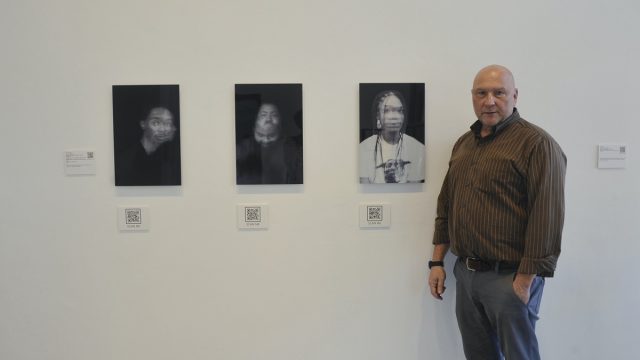
Photo exhibit shines light on Birmingham as city celebrates 150 years


The researcher who inspired the book and movie franchise “Jurassic Park” has found the first fossil evidence of rare precocious germination, which is when a seed sprouts before leaving the fruit.
The newly discovered pine cone, encased in Baltic amber during the Eocene Age some 40 million years ago, has several embryonic stems emerging from its seeds.
“Crucial to the development of all plants, seed germination typically occurs in the ground after a seed has fallen,” said George Poinar Jr. of Oregon State University.

Embryonic development, or viviparity, while still within the parent is typically associated with animals, but according to Poinar, it “does sometimes occur in plants,” typically appearing in angiosperms. Angiosperms are flowering plants that produce seeds within fruit and provide most of the food people eat.
“Seed germination in fruits is fairly common in plants that lack seed dormancy, like tomatoes, peppers and grapefruit, and it happens for a variety of reasons,” said Poinar. However, it is rare in gymnosperms and even rarer in pine cones.
Gymnosperm plants, such as ferns and pines, produce unencased seeds on scales, leaves or cones. According to Poinar, only one naturally occurring case of precocious germination in a modern pine has ever been recorded.
“That’s part of what makes this discovery so intriguing, even beyond that it’s the first fossil record of plant viviparity involving seed germination,” he said. “I find it fascinating that the seeds in this small pine cone could start to germinate inside the cone and the sprouts could grow out so far before they perished in the resin.”

Poinar’s findings have been published in the journal Historical Biology. His previous work inspired Michael Crichton, the author of the novel “Jurassic Park,” which was adapted into a major movie franchise, in which ancient DNA was injected into living organisms to recreate dinosaurs.
In his paper, Poinar pointed out that the seeds of the pine cone had produced embryonic stems. “Whether those stems, known as hypocotyls, appeared before the cone became encased in amber is unclear. However, based on their position, it appears that some growth, if not most, occurred after the pinecone fell into the resin,” he said, making a comparison to ancient insects ejecting their eggs upon being smothered in amber.
The fossilized cone may belong to the extinct pine species Pinus cembrifolia. Pine cones encased in Baltic amber are not common, Poinar said. Because the cones’ scales are hard, they are usually well-preserved and prized by collectors.

According to Poinar, plants show viviparity in two ways. Of the two, precocious germination is most common. The other is vegetative viviparity, such as when a bulbil, sometimes known as a “pup,” emerges directly from the flower head or stem of a parent plant.
Modern gymnosperms, including pines, are known for viviparity linked to winter frosts. In the case of the forest environment that produced Baltic amber, light frosts would have been possible in a humid, warm-temperate environment. The Eocene period, which lasted from about 55 million years ago to 33 million years ago, was noted for variations in climate that allowed even palm trees and reptiles to live at higher latitudes. It ended with colder temperatures and a mass extinction event.
“This is the first fossil record of seed viviparity in plants, but this condition probably occurred quite a bit earlier than this Eocene record,” Poinar said. “There’s no reason why vegetative viviparity couldn’t have occurred hundreds of millions of years ago in ancient spore-bearing plants like ferns and lycopods.”
Edited by Siân Speakman and Kristen Butler
The post Sprout Of The Past: Real-Life ‘Jurassic Park’ Doc Finds Rare Sprouting Pine Cone Preserved In Amber appeared first on Zenger News.
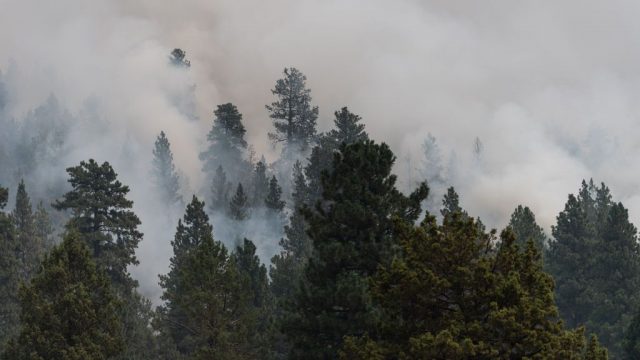
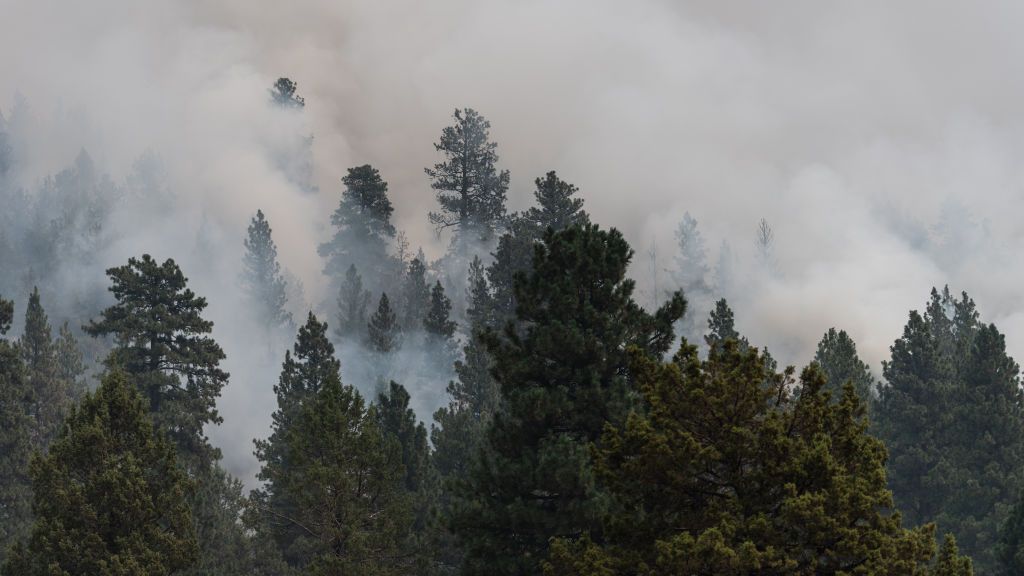
Trees are on the move, but not like the Ents and Huorns described in the “Lord of the Rings” trilogy. The ranges trees occupy in the western U.S. are indeed shifting amid climate change, especially toward wetter and cooler places, according to a new study published in the journal Nature.
Wildfires are accelerating the rate of tree movement, says the study by researchers at Stanford University, which also raised questions about methods used for managing forests.
“Complex, interdependent forces are shaping the future of our forests,” said study co-author Avery Hill, a doctoral student in biology at Stanford. By leveraging ecological data, Hill said that researchers hope to contribute more work directed at “managing these ecosystem transitions.” The administration of U.S. President Joseph R. Biden Jr. has promised to spend $5 billion on forest management as part of the recently signed infrastructure bill.

Previous research has shown that plant ranges are moving to more suitable environments at higher, cooler elevations at a rate averaging about five feet per year. These shifts are slower than the rate of climate change, which the researchers believe means that some species will become stranded in less-than-favorable habitats. The discrepancies have remained largely unresolved but are important for understanding how healthy dominant species can be maintained in western forests, the researchers say.
Hill and study co-author Chris Field sought to understand the rate, distance and direction of change by examining how it is affected by wildfire, which is increasingly common in the western U.S.
By examining U.S. Forest Service data from more than 74,000 plots in nine states, they identified tree species that are shifting their ranges toward cooler, wetter sites. The researchers then examined the rate of range shifts, comparing places burned by wildfire and those that were not.

Eight species were found to have seedlings growing in climates significantly different from mature trees. Of the species studied, Hill and Field found evidence that Douglas fir and canyon live oak had significantly larger range shifts in areas that burned than in areas that did not.
The researchers did not determine how wildfires hasten the shifting ranges for certain species but theorized that the resulting opened canopies and scorched undergrowth meant reduced competition from other plants.
They found that fire not only accelerates range shifting but that some species compete with others, slowing their growth. Low-intensity fires, both prescribed and natural, are increasingly important, the researchers determined.
“This study highlights a natural mechanism that can help forests remain healthy, even in the face of small amounts of climate change,” Field said. “It also illustrates the way that ecosystem processes often have several layers of controls, a feature that emphasizes the value of detailed understanding for effective management.”
Edited by Richard Pretorius and Kristen Butler
The post Forests Are On The Move To Higher, Wetter Habitats appeared first on Zenger News.

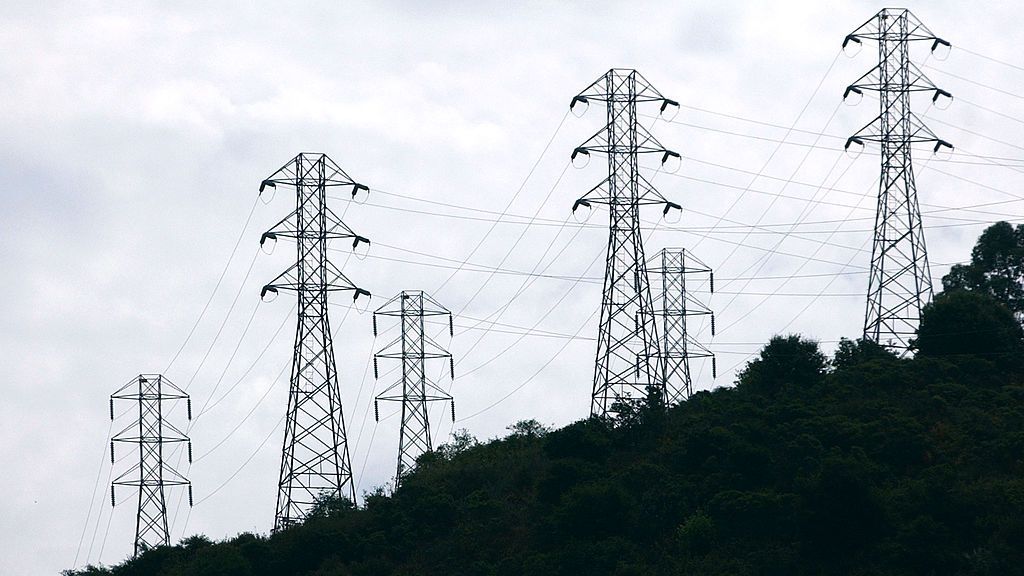
Better connections between U.S. electrical grids could form a costly but effective macrogrid to share power as needed across the country, researchers say, reducing outages during extreme weather and supplying more power during peak usage.
America’s eastern grid has a generating capacity of 700,000 megawatts, while the western grid generates 250,000 megawatts. Currently, seven high-voltage, direct-current transmission lines connect the country’s eastern and western grids, with a capacity of just 1,320 watts.
A seam separating the grids runs from Montana to the borders of Kansas, Nebraska and South Dakota and along the Oklahoma and Texas panhandles.
But what if the West Coast could supply power to the East Coast during its peak usage, and vice versa?
In the Interconnections Seam Study, part of the $220 million Grid Modernization Initiative announced by the Department of Energy in 2016, authors investigated whether better connections would meet peak demand, lower costs and improve grid resilience, reliability and adaptability.

Iowa State University engineers used a computer model to simulate 15 years of projected improvements to transmission and power generation facilities. The model included four designs for transmission across seams, as well as eight scenarios for power generation that account for variables including differences in transmission costs, renewable-electricity generation, gas prices and retirement of existing power plants.
Researchers took the grid-improvement model up to the year 2038. Then, the U.S. Department of Energy’s National Renewable Energy Laboratory in Colorado used the 2038 data to complete an hour-by-hour model of one year of power-sharing across the seam.
The research revealed that benefit-to-cost ratios reached “as high as 2.5,” suggesting that there is considerable value in increasing the transmission capacity between regions.
“So, for every dollar invested, you get up to $2.50 back,” said co-author James McCalley of Iowa State University. A macrogrid of transmission lines looping around the West and Midwest, McCalley said, would cost about $50 billion to build and would have branches in Texas and the Southeast. Currently, Texas operates its own grid largely separate from the rest.
Under conditions associated with a high-renewable future greater than 40 percent, cross-seam transmission benefits far exceed costs, the authors said. They drew this conclusion based on a 35-year period “to assess savings generated by generation investments and operational efficiencies.”
The proposed macrogrid is cost-effective in several ways, according to McCalley. For example, a macrogrid would allow the sharing of power, especially renewable wind and solar power, across the continent during peak demand at different times.
For weather events like the February 2021 ice-storm blackout in Texas and Iowa’s 2020 derecho wind outage, McCalley said a macrogrid would “deal with these kinds of resilience problems.”
“You could get electricity assistance from other regions very simply. Iowa and other states would be interconnected with other areas,” he said.
But there are a lot of political considerations to building a macrogrid, and in addition to the projected cost, there are objections to transmission lines and wind turbines.
“Every form of energy has negatives,” McCalley said. “Tell me a better alternative.”
Edited by Siân Speakman and Kristen Butler
The post Proposed Macrogrid Would Improve Reliability And Resilience Of US Electric Power, Study Says appeared first on Zenger News.
Alabama NewsCenter


CARACAS, Venezuela — After years of boycotts of the elections called by Nicolás Maduro’s government, the main Venezuelan opposition coalition is running candidates in the Nov. 21 regional elections.
Its candidates face competition not only from Maduro’s United Venezuela Socialist Party but also from the recently formed Fuerza Vecinal (Neighborhood Force), which has unexpectedly surged in popularity.
The Democratic Unity Roundtable (MUD) is a coalition of Venezuelan parties and political institutions that have led the opposition for more than a decade. It played a leading role in the disputed presidential election between Maduro and Henrique Capriles in 2013 (when it did not accept the results that gave Maduro the win by slightly more than 200,000 votes); the victory in the 2015 parliamentary elections; and Juan Guaidó’s parallel government since 2019. Guaidó was named interim president by the National Assembly, which considers Maduro’s mandate unconstitutional.
The decision to take part in elections again was made at one of the most complicated times for the opposition to Chavismo — the political regime that began with Hugo Chavez’s presidency and has governed Venezuela since 1999.

“In Venezuela, over the last 20 years, there has been a political polarization where people have taken extreme sides and nobody has focused on the citizens,” Ernesto Betancourt, a militant for Fuerza Vecinal told Zenger.
Caracas’s Francia de Altamira Plaza has historically been a symbolic place for the Venezuelan opposition, since a group of militants rose up in 2002, declaring the square a “liberated zone” and demanding Chavez’s resignation.
Though that movement failed, the Plaza continued to be a key spot for protests over the next two decades.
Two days before the regional elections, the landscape in east Caracas is very different. Fuerza Vecinal is the only political party campaigning there.
MUD has abandoned voters in many districts and other parties have emerged to fill the void. The evidence is in the streets.
“We decided to create a party that is not so extreme, that takes a real interest in the people,” said Betancourt.

In December 2017, MUD asked people not to participate in municipal elections, saying there had been fraud in the regional election in October of that year. MUD extended the boycott to the 2018 presidential and 2020 parliamentary elections.
Since there were no official opposition candidates for those municipal elections, a series of independent candidates were elected in key districts where Chavismo has historically been in the minority inside Caracas. They included Gustavo Duque in Chacao, Elías Sayegh in El Hatillo and Darwin González in Baruta, working together as part of the same political force.
“Fuerza Vecinal is a party that came out of the divided opposition, especially the Primero Justicia party, after the 2017 regional elections. … Some of its factions formed Fuerza Vecinal with the goal of running in the three municipalities where the opposition has always won,” said Enderson Sequera, a Venezuelan political scientist.
“Given the importance of the group in Venezuela, the fact that the party emerged from a division is already a reason for the traditional opposition voters not to trust it”, he said.
“In this context of austerity, Fuerza Vecinal is overspending on publicity and audiovisual propaganda, with motorcycle raffles, cable TV propaganda, and more, which makes voters ask where so much money came from and causes a good deal of mistrust,” Sequera said.
Duque, Sayegh and González, allied with other independent candidates from the rest of the country, created Fuerza Vecinal in June 2021, with a national reach. The party ran David Uzcátegui, the former councilman of the municipality of Baruta, in Venezuela’s second-largest state, Miranda.
With MUD back on the ballot, there were disputes among the opposition.
Even though Fuerza Vecinal and the MUD agreed on candidates in other parts of the country, they were unable to come to an agreement in the state of Miranda.
Carlos Ocariz, the former mayor of Sucre from 2008 to 2017, and the former candidate in Miranda in 2017, ran for governor with the support of the MUD and the traditional opposition sectors.
Me comprometí con los mirandinos en unificar candidaturas. A pesar de proponer todos los esfuerzos y de que ustedes me pusieran de primero en las encuestas, decidimos dar un paso al frente porque sabíamos que a 3 no ganábamos.
Elegí poner a Miranda primero
[Abro
]
— Carlos Ocariz (@CarlosOcariz) November 15, 2021
After months of failed negotiations, where Ocariz’s campaign accused Uzcátegui’s of not respecting the voting intention surveys, and the latter accused the former of not participating in the primaries, Ocariz finally pulled out on Nov. 11, 10 days before the election.
If Ocariz and Uzcátegui had both run, it could have helped Héctor Rodríguez, who has governed Miranda since 2017, and is a significant figure in Chavismo.
The public dispute between Ocariz and Uzcátegui was bad for the MUD’s image and good for Fuerza Vecinal’s.
Still, some people are suspicious of the new party’s motives.
“Let’s be very clear: Fuerza Vecinal is not an alternative to Chavismo. They say they are the opposition, but they just echo many of the vices of Chavismo in the eastern part of Caracas,” said Sequera.
“The big beneficiary [of the conflict between Ocariz and Uzcátegui] was Fuerza Vecinal”, Walter Molina, a Venezuelan political scientist, told Zenger.
“The MUD in Miranda did not react accordingly, beginning with the first big mistake, believing that David Uzcátegui wanted to unite to beat Héctor Rodríguez. After that, there were other mistakes, which led Carlos Ocariz to step down as a candidate.”
“People distrust this group of politicians, today members of a very new party, precisely due to their political intentions; they don’t seem to want change; they have a close relationship with the current governor of Miranda and member of the United Venezuela Socialist Party, Héctor Rodríguez; and the group’s members are financed with dubious funds,” said Molina.

Fuerza Vecinal’s main plan in these elections is to become a legitimate opposition force to Maduro’s regime. To do so, it hopes to take advantage of people’s disenchantment with traditional political parties.
“People needed there to be a party they can trust, that could guarantee that they won’t be abandoned. People want solutions, to be closer to the parties. That is essentially what Fuerza Vecinal wants to capture,” said Betancourt.
“Still, I don’t think [Fuerza Vecinal] is really going to do it [get more votes than the MUD]. On Sunday … we’ll see what happens in Sucre, where a MUD candidate is up against one from Fuerza Vecinal, or in Chacao, where the MUD has its own list for the Municipal Council,” said Molina.
He said that the creation of a fictitious opposition has not worked in the past and “this one created with the metropolitan mayors and the ex-councilman from Baruta won’t work either.”
Many voters opposed to the government, but still upset with the MUD, don’t plan to vote for the new party.
“I never believed in the MUD, but I supported them and voted for them because they were the only united opposition, and I was never going to vote for Chavismo,” María Pelayo, a Venezuelan citizen, told Zenger.
“In the 2017 election, I voted for the independent candidate because I think the regional elections are more representative than the national ones. But it wasn’t a vote for the Fuerza Vecinal candidate but rather a way to keep the Chavismo candidate from winning,” she said.
“If I vote this year in Miranda, I’ll do so for Ocariz because I’m more familiar with his record, and he has done work in every position he’s held. I hear Uzcátegui is corrupt and has spent a ton of money on his campaign, which is outlandish in our country’s economic situation,” Pelayo said.
On Sunday, Venezuelans will elect 335 mayors and 23 governors. Voting is not compulsory in Venezuela, and the highest turnout for elections of this type was in 2008, when 65 percent of voters participated.
Several organizations have sent international observers for the first time in several years. The European Union had not sent any since the 2006 presidential election.
Translated by Melanie Slone; edited by Melanie Slone and Gabriela Alejandra Olmos
The post New Party Hopes To Represent The Opposition In Venezuela’s Regional Elections appeared first on Zenger News.
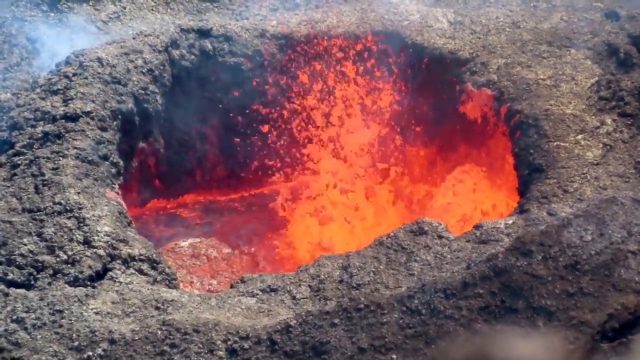
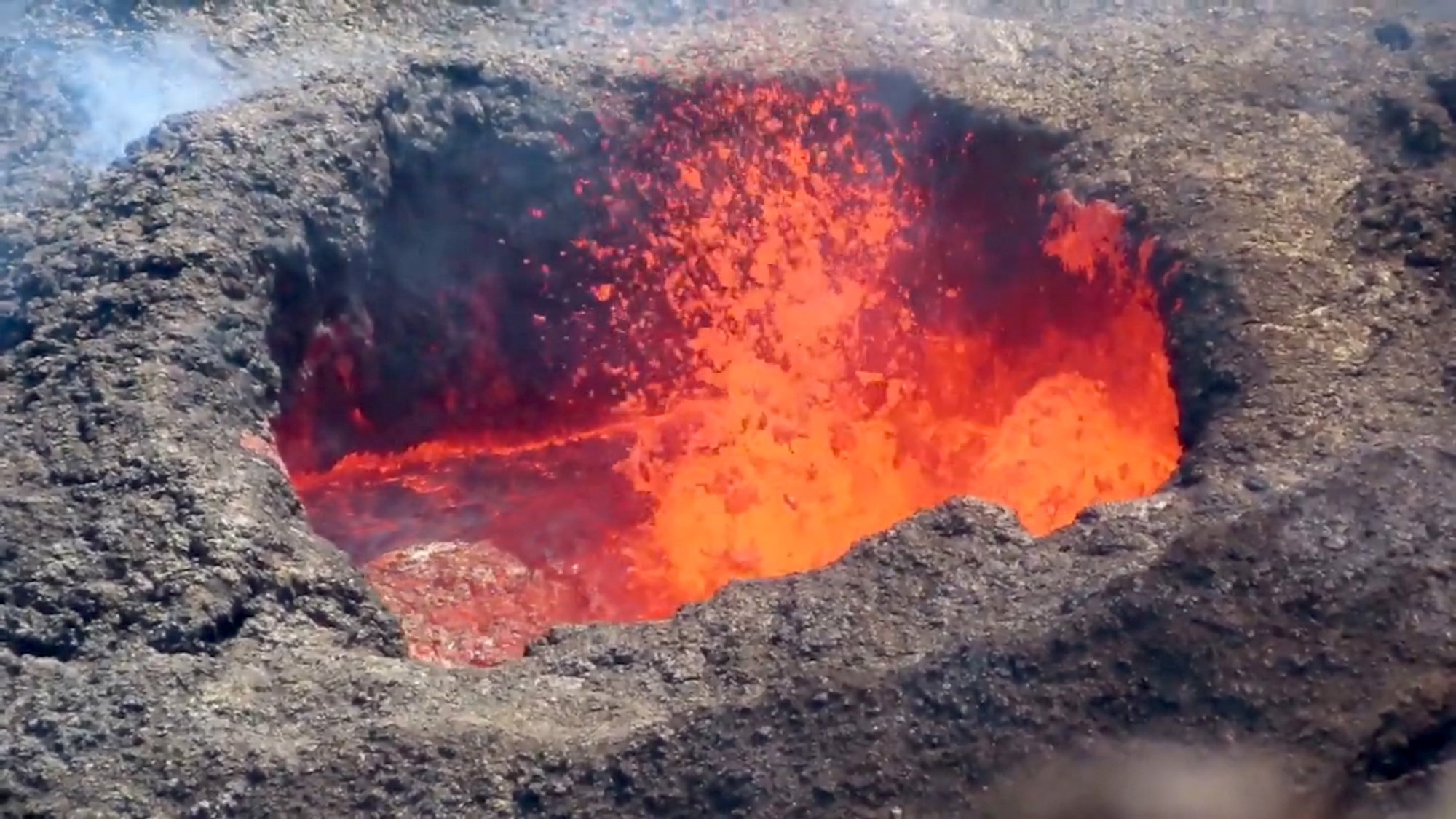
Hawaii’s Kīlauea volcano has been erupting since Sept. 29, and the latest video from the U.S. Geological Survey shows lava sloshing in the crater, still roiling and spilling over the edge nearly two months later.
A Nov. 18 report by the U.S. Geological Survey said lava activity is currently confined within the Halemaʻumaʻu pit crater, located within the Kīlauea Caldera. Footage shows the orange lava bubbling and pouring over the edge during an ongoing volcanic burst.
Commenting on both videos, the U.S. Geological Survey wrote: “Lava continues to erupt from the west vent in Halemaʻumaʻu and supply the lava lake through a spillway in the spatter cone.
“On Nov. 9, a close-up view of the west vent shows spatter bursting and sloshing within the cone. Spatter was thrown about 6 meters to 9 meters [20 feet to 30 feet] above the pond surface, occasionally depositing spatter onto the rim of the cone.”
The agency said of the second video: “On November 12, a small overflow of the perched lava lake levee was visible from the western crater rim.
“Overflows are an important process for building up perched levees, as they help add height and stability. The height of the levee in this video was measured at 1 meter [3.3 feet].”

As of Nov. 18, the agency wrote that seismic activity and gas emissions at the summit remained elevated.
The U.S. Geological Survey also reported the eruption was being monitored from “within the closed area of Hawaii‘i Volcanoes National Park” by Hawaiian Volcano Observatory field crews equipped with specialized safety gear.
The scientific agency hopes the detailed data collected by scientists will allow them to assess hazards and understand how the ongoing eruption at Kīlauea is evolving.
The scientists are sharing all information with emergency managers and the National Park Service.

Believed to be between 210,000 and 280,000 years old, the Kīlauea volcano emerged from the sea about 100,000 years ago. Kīlauea is located on Hawai’i, the official name of the largest island in the archipelago, also called the Big Island. (It’s not to be confused with Hawaii, the state.)
The Hawai’i island consists of five volcanoes, four of which are classified as active: Kīlauea, Mauna, Mauna Loa, Hualālai and Mauna Kea. Kīlauea is historically the most active.
The U.S. Geological Survey ranked it first among volcanoes in the U.S. in 2018 that was most likely to threaten lives and infrastructure.
Kīlauea’s last major eruption took place between May and September 2018 and led to thousands of local residents being displaced and the destruction of 716 homes. Previous eruptions have caused widespread damage, including the destruction of the towns of Kalapana and Kaimū in 1990.
Edited by Fern Siegel and Kristen Butler
The post VIDEO: Boiling Over: Lava Still Spilling In Hawaii’s 2-Month Eruption appeared first on Zenger News.


By Peter Barker
A state-of-the-art research boat named after a famed British broadcaster, nature historian and author has set off on its maiden voyage to Antarctica.
The RRS Sir David Attenborough was built by Cammell Laird in Birkenhead, England. After undergoing sea trials, it then traveled to Portsmouth, England, to fuel up before heading for the first time to the continent that’s home to the South Pole.
The U.K.’s most advanced polar research vessel’s maiden voyage follows weeks of testing anchoring, maneuvering and dynamic positioning, as well as other engineering systems, such as freshwater making, that cannot be evaluated while in port.
Commissioned by the United Kingdom’s Natural Environment Research Council and operated by the British Antarctic Survey, the new polar ship’s missions are critical for understanding and making sense of the changing climate, its owner/operators say. After the sea trials and refueling, the ship is now heading to the Antarctic for extensive ice trials on its maiden voyage.
“This multidisciplinary research platform will transform how ship-borne science is conducted in the polar regions and provide scientists with state-of-the-art facilities to research the oceans, seafloor, ice and atmosphere,” the Natural Environment Research Council said in a release.
The ship boasts scientific laboratories to support the study of the ocean, the ice, the atmosphere and more. Mission scientists also have access to a variety of robotics and remotely operated vehicles — including the famous autonomous underwater vehicle named Boaty McBoatface by an Internet poll.

The ship is registered in the Falkland Islands, part of a long tradition of registering British Antarctic Survey ships and aircraft there, and underpins the ship’s role in delivering scientific research results in the South-west Atlantic and Antarctic region.
In its science and logistics missions, the RRS Sir David Attenborough will regularly visit three British Overseas Territories: the Falkland Islands, South Georgia and the South Sandwich Islands, and British Antarctic Territory. Setting off on the maiden voyage marks a major milestone in the vessel’s five-year build program by British shipmaker Cammell Laird at its shipyard in Birkenhead.
From laying the keel in October 2016, to the hull launch in July 2018 and the Royal ceremonial naming in September 2019, more than 1,300 local personnel, 70 apprentices and many hundreds of specialist subcontractors and suppliers have been involved in constructing the 15,000-ton vessel.
The man the ship is named after (who is now 95) has been called “the undisputed father of the modern nature documentary.” Attenborough’s series for the British Broadcasting Corp. include “Zoo Quest” in the 1950s and “Life on Earth” in the 1970s.
Edited by Matthew B. Hall and Kristen Butler
The post VIDEO: Atts Last! Sir David Attenborough Research Ship Heads Off On Maiden Mission appeared first on Zenger News.


Jamar Williams’ 165-pound championship wrestling match in February was his life in microcosm.
Tied at 3–3 with 24 seconds left and rival Chase Morgan of West Liberty University on the attack, Williams countered a double-leg takedown attempt on the edge of the mat by spinning behind for a 5–3 victory.
Williams improved to 2–1 against Morgan, ended his season with a 6–1 record to lead Alderson Broaddus University to fourth place in the eight-team field, and became the Battlers’ first Mountain East Conference champion.
“It might have looked like he had me because he had my leg up in the air, but I’ve always had a bull’s-eye on my back,” said Williams, who was named the Battlers’ Athlete Of The Year for all sports. “I was familiar with the positioning because I had worked on it several times in practice. Plus, with everything I’ve been through, I’m built for moments like that.”
Born in an impoverished section of East Baltimore, a young Williams encountered financial difficulties while living with his mother and two older siblings. A self-proclaimed “problem child,” Williams was removed from school several times for fighting before he was 12, and he lived in at least four different homes by the time he was 15.
“My mom did her best to support us but would go on the corner and sell drugs. I was in trouble 24-7 and was basically told I would never succeed in life,” Williams said. “Sometimes our lights would be cut off. We had no hot water and had to boil water on a stove. The biggest thing is, I didn’t want my mom feeling like she ever had to deal with situations like that again.”
A 12-year-old Williams sounded the alarm — literally being “kicked out of school for pulling a fire alarm.”
“I wouldn’t call it a cry for help,” said Williams of his seventh-grade year. “It was more like me trying to be something I’m not, a fake gangster to impress older guys.”
Eleven years later, Williams has transformed into an altruistic warrior.
Now a 23-year-old senior at Alderson Broaddus University in Philippi, West Virginia, Williams has a 6–0 wrestling record at 157 pounds and was recently honored for his accomplishments at a home basketball game.
“Jamar became the first individual champion in the school’s history last year, and he did it wrestling at 80 percent on a bad knee,” said seventh-year coach Sam Gardner. “Jamar’s been in some of the worst possible situations in life, yet he continues to do the right thing, achieving success and setting an example to the rest of the team.”
Set to graduate in May with a 3.6 grade average, Williams has a double-major in sports management and accounting, a minor in business administration, and a goal to earn a master’s degree in education.
“I’ll hire Jamar to work for me after he graduates from college,” said Bryan Hamper, a sports agent for mixed martial artists and baseball players who was Williams’ wrestling coach at South Carroll High in Maryland. “By then, I’ll be working with NFL players. Jamar can get his [sports agent] license and start representing athletes. There’s a lot Jamar can share about being a good role model and human being.”

Williams graduated from high school in 2017, four years after Hamper became his legal guardian. On Williams’ right thigh is a tattooed map of Baltimore beneath the word “Built,” and on his left, one of Carroll County beneath “Different.”
“I say I’m ‘Built Different’ because my life would be 100 percent different if I hadn’t met coach Hamper in Carroll County and others in Baltimore City,” said Williams, who still lives with Hamper, his wife and four sons. “I want people to understand that a lot of us black men are often the first generation not only to succeed in school, but to go to college and advance beyond that.”
In addition to those at South Carroll and the McKim Center in Baltimore City, Williams mentors in programs at the Sykesville, Maryland-based Warhawks, Warriors and Winfield Cavs, as well as the Mount Airy-based Maniacs.
Ryan Herwig, a volunteer coach with the Warhawks in Sykesville, Maryland, sees Jamar “one day being a phenomenal wrestling and life coach.”
“Wrestling changed Jamar’s life, helping him to stay off the streets and away from drugs,” Herwig said. “Jamar is always giving back. He’s always talking to and inspiring kids with stories about when he struggled the most. He’ll never forget where he came from.”
Williams began playing football and wrestling at age 12 under coaches Kier Hicks and Gary Coleman for Charm City’s gridiron program and wrestling at Baltimore’s McKim Center.
“Jamar’s friend, Acoyea Ford, called me saying, ‘my friend, Jamar, is struggling and needs help.’ I said, ‘I’ll come get him and see what I can do,’” said Hicks, whose sons, Dequan and Kier Jr., befriended Williams. “Jamar’s mom was doing all she could to take care of him, but he got in trouble and locked up over something having to do with a stolen car. After that, I wouldn’t let him go back home.”
Williams moved in with Hicks, and, later, Acoyea’s parents, Floyd Ford and Nakia Phillips, and remained active in football and wrestling. Williams was a ninth-grader at the city’s Bluford Drew Jemison boys school when Hamper met him during a summer tournament.
“One of my wrestlers was a state champion as a freshman who didn’t have a close match in Maryland,” Hamper said. “But all of a sudden we go to a tournament and Jamar, wrestling for McKim, gives him all he can handle, losing, 1–0.”
After speaking with Williams’ mother and McKim coaches Ron Jackson and Wilbert Summers, Hamper completed “hardship transfer” paperwork with the Carroll County school system, facilitating Williams’ transfer to South Carroll.
“Our move was completely documented and legitimate with the county and state,” Hamper said. “Jamar has mild dyslexia and was able to participate in an IEP [Individualized Education Program.] He became an honor roll student, at one point achieving a 4.0.”
Williams was a member of three state tournament championship wrestling teams at South Carroll. Individually, he won three each in county and state titles as well as two regional crowns at 138, 160 and 170 pounds.
As a senior running back and defensive back with 4.35-second speed in the 40-yard dash, Williams rushed for more than 2,000 yards and 29 touchdowns, leading the Cavaliers to county titles as a sophomore and junior.
“My mom saw South Carroll as a good place for me to succeed,” Williams said. “Coach Hamper and his family welcomed me with open arms, helping me to succeed academically and become the man I am today.”

Williams’ success has attracted other Marylanders to the Battlers’ program, including freshman Josh Laubach (149 pounds), a graduate of Baltimore’s Archbishop Curley, and junior Justin Henry (165), a graduate of Baltimore’s Mount Saint Joseph.
A two-time Maryland private schools state champion, Henry spent two years at Ellsworth Community College in Iowa Falls, Iowa, where he was an Iowa Community College Athletic Conference runner-up as a 174-pound sophomore after missing his freshman season with an injured right knee.
“What really got me was seeing Jamar here,” said Henry, who has an 8–1 record. “Jamar was my practice partner in junior leagues. I‘ve known Josh since I started wrestling, and I also knew a lot of other guys on the team.”
Laubach transferred from Campbell University in Buies Creek, North Carolina, having “quit the team” before the start of his freshman season, suffered from depression, and “gained 35 pounds.” But last year for the Battlers, Laubach went 9–2 as a conference runner-up, and is currently 9–0 after winning last weekend’s Washington & Jefferson Invitational in Washington, Pennsylvania.
Like Williams, Laubach and Henry return to the Baltimore area to work with those in their former programs. Henry’s father, Lydell, co-founded Beat The Streets Baltimore in 2011. The nonprofit produced Henry and Williams, running primarily out of the Upton Boxing Club and using wrestling, tutoring and mentoring to academically engage young student-athletes.
“Before covid happened, we would go to Johns Hopkins and get tutoring from students or have small tutoring sessions before practice at Upton Boxing Center. During the summer, we had financial literacy classes,” said Laubach, a former Maryland private-schools state wrestling champion. “There are kids I’ve coached since they were 5-year-olds, and I plan on seeing them when I go home for holiday breaks. I want them to know they can do anything they set their minds to.”
Other Marylanders competing for the Battlers include former freshmen Sparrows Point wrestlers Lexx Car (184), Richard Davis (141) and Jake Rallo (174), who were first, second and third in the public schools’ state wrestling tournament.
Sophomore Armon Nettey (141) wrestled for Springbrook High, a Montgomery County and state tournament champion. Nettey placed third in each of the county and state tournaments with a regional championship earned between the two.
The Battlers’ roster also includes 157-pound freshman Jamaal Everett (Franklin of Baltimore), 197-pound freshman Dwayne Johnson (Dunbar of Baltimore) and 197-pound senior Gino Sita (Huntingtown of Calvert County), who as a junior became the fastest Battlers wrestler in history to reach the 100-career victories mark.
As for Williams, he has come a long way from the troubled 15-year-old who transitioned from Baltimore City to Carroll County.
“I’m always willing to go back and talk to kids, not only about wrestling and sports, but about life. I’m about giving back to other young men to help them to grow into better men than I was. I also want to bring awareness to mental health,” Williams said.
“I’ve had my troubles, and I still see a [therapist] today. A lot of athletes go into a shell and don’t talk about it, but it’s bigger than just being in sports. It’s about learning to live life on and off the mat. I want young men to know we’re bigger than what someone else labels us.”
Edited by Matthew B. Hall and Judith Isacoff
The post Wrestler Jamar Williams’ Experiences Help Young Men Pin Down Success appeared first on Zenger News.