This August, several Birmingham Public Library branches are offering a variety of free programs designed to help you manage stress. (Adobe Stock)
By Roy L. Williams | Birmingham Public Library
Feeling overwhelmed by daily stress? Searching for new ways to prioritize your mental and physical health? The Birmingham Public Library (BPL) is here to help.
This August, several libraries across Birmingham are offering a variety of free programs designed to help you manage stress, practice self-care, and make informed health choices. These events are part of BPL’s ongoing commitment to support the well-being of the community, showing that libraries offer so much more than books.
Whether you’re interested in journaling, group support, learning new wellness habits, or exploring reliable medical information, there’s something for everyone.
What’s Happening in August
Tuesday, August 12 | 10:30 – 11:30 AM Learn how Medic Alert’s database can help keep you or a loved one safe during medical emergencies. Free informational materials will be provided; 2 6th Avenue SW, Birmingham, AL 35207 | (205) 322-1140
Exploring MedlinePlus: A Resource for Reliable Health Information – Virtual
Wednesday, August 20 | 11:00 AM – 12:00 PM Discover how to navigate MedlinePlus, the National Library of Medicine’s trusted health site (available in English & Spanish). Presented by Megan Bell, Consumer Health and Community Engagement Librarian at UAB. Online via Zoom – register here to receive the link | (205) 226-3640
UAB Mobile Wellness – North Birmingham Regional Library
Saturday, August 23 | 10:00 AM – 12:00 PM Free health resources and wellness information in partnership with UAB Mobile Wellness, designed especially for adult and senior patrons; 2501 31st Ave. North, Birmingham, AL 35207 | (205) 226-4025
Why it matters: At BPL, we know life can be stressful, and that taking care of your health isn’t always easy. That’s why we’re creating spaces to relax, learn, and connect, right in your neighborhood.
All events are free and open to the public. See the full calendar of upcoming events: https://www.cobpl.org/calendar/. Join us this August and discover how your library can support your journey to a healthier, calmer you. We hope to see you soon!
Now, she’s the one in ICE custody facing the very same fate she’s dedicated her career to helping others avoid.
Her family says they’re doing everything they can to bring her home.
What began as an ordinary Tuesday morning in Leeds quickly became the fight of the Hernandez family’s life.
Inside their home, the walls are lined with photographs — birthdays, holidays, moments of laughter and love. Those pictures tell the story of a family’s journey from Mexico to Alabama, a life built over 17 years. But today, those images feel different.
That closeness is being tested after a traffic stop in Leeds on Tuesday morning.
“She’s not the type to do that. If you know my sister, she doesn’t even speed. She never goes over the limit,” said her brother, Dilan Hernandez.
According to Leeds Police and local immigration officials, Hernandez was clocked driving 80 miles per hour in a 70 zone and weaving in and out of traffic.
The stop would change everything.
“In other cases where it’s happened to many of us that are undocumented, they usually just give us simply two tickets. One for either speeding or whatever you’re getting pulled over for and then the no license, which most of the time is usually what happens. But unfortunately this time, the second officer that came up behind my sister was an ICE agent,” Dilan explained.
In that moment, the focus shifted from a traffic citation to deportation.
For the Hernandez family, who crossed into the U.S. from Mexico in 2008, it’s the nightmare they’ve always feared.
“My sister was seven years old when we came. I was four,” Dilan said.
Seventeen years of building a life in America are now threatened in a matter of minutes. Dilan says over the last several years, the family has tried to obtain legal status to no avail.
Adding to the family’s heartbreak is disappointment in the organization where Giovanna has worked for the past year.
“When everything happened, they actually reached out to my mom on the first day and they were like don’t worry about any of the legal fees and everything. We’re already sending lawyers basically to help Giovanna. After not even trying to do a lot for her they told her to go ahead and sign her deportation papers so she could be sent back to Mexico and they told her that’s the best chance and then after two years she would be eligible to apply for a visa,” Dilan said.
WBRC reached out to ¡HICA! for a response. In a statement, President Carlos Alemán said: “We understand the family wants their daughter safe and home. We also want the same for Giovanna. We will continue to advocate on her behalf.”
Now, the Hernandez family is raising money for her legal defense and asking for help from anyone who can give it. They hope their GoFundMe will be the lifeline that keeps Giovanna here in the place she has called home since she was a little girl.
According to ICE, Giovanna has been transferred from Alabama to a detention facility in Louisiana.
The Reinvest initiative focusing on childcare is helping with the city’s Cradle to Career framework, which focuses on setting up children for success in Birmingham. (Adobe Stock)
As many children get ready to return to school, they are experiencing a variety of exciting changes. While change can be beneficial, the exposure to new germs can pose a challenge to your child’s immune system.
Most parents know that when your child is sick, it’s only a matter of time before you and the rest of the house get it too. I know I don’t only speak for myself when I say, with over half of the year already behind us, sick days are getting scarce, so ain’t nobody got time for that!
Although the common cold might catch up with your child eventually, there are a few things you can do to keep the spread of those back-to-school germs to a minimum.
1. Front door decontamination
While at daycare or school, and during after-school activities, your children come into contact with many different people and their germs. A good way to keep those germs as close to the outside world as possible is to do some decontamination as soon as your kids enter your home.
The simplest thing you can do is have them remove their shoes and wash their hands before eating or lounging around the house.
Changing into clean, house clothes or even pajamas right away can also slow the spread of germs left on uniforms or school clothes that have been worn and played in all day. I would also suggest implementing a schedule for keeping backpacks, lunch bags, and smart devices clean. All types of germs can live inside these bags and on these surfaces, so it’s best to clean them regularly. Try Lysol or a full wash of the bags weekly. A daily wipe-down of cell phones and tablets can also be beneficial to keep away cold-causing germs.
2. Daily multi-vitamins
Multivitamins are a great way to make sure your child gets all of the nutrients they might miss during the day, but they also can help support a healthy immune system. Taking a multivitamin every morning became a part of my morning routine with my daughter when she started daycare, and so far, the coughs and sniffles have been kept at bay.
For younger children, you might have an easier time with liquid multivitamins. Zarabee’s makes a few natural vitamin supplements for babies and toddlers. For older children, I would suggest gummy or chewable vitamins. These are sold in a variety of flavors at pretty much every major retailer.
Check with your pediatrician before starting anything, but for the most part, these over-the-counter supplements can do wonders for your child’s overall health and wellness. I also love the fact that they help my notoriously picky eater get all of the nutrients she may miss from her strict diet.
3. Healthy before and after-school snacks
Even if you give your child a vitamin each day, you should still try to make sure they are getting as much nutrition as possible from their meals. This can be a challenge since kids, especially toddlers, are notoriously picky eaters.
Luckily, there are a lot of healthy before and after-school snacks that boost the immune system. If you can’t get your child to eat things like Kale or mushrooms, you can always keep things simple by offering them oatmeal or yogurt at breakfast.
These foods are rich in probiotics and antioxidant qualities that fight against the Flu. If those options don’t work, most children love apples and oranges. Easy to prepare and even pack with lunch, apples and oranges are full of fiber and vitamins that help your child’s overall health daily.
4. Setting a bedtime
Children thrive with a consistent routine in their daily lives. Adding a designated nap time and a set bedtime can also do wonders for your child’s health. Making sure they get a good night’s rest will ensure that their bodies have enough energy to fight off germs they may come into contact with, so these germs won’t progress into colds.
Setting a bedtime for your kids can also do wonders for parents. The time in between your child’s bedtime and your own can be a really great opportunity to decompress from the day, do some last-minute cleaning, and just be unbothered!
5. Getting a flu shot
With back-to-school season also comes the flu season, the contagious virus that can be very dangerous for children. The CDC recommends that children over the age of 6 months get vaccinated every year. This can be very important to children who are in daycare, preschool, or grade school as they are exposed to many different germs from their classmates, teachers and other parents.
I know from my own experiences and research online that many Black people simply do not trust the flu shot and avoid it each year. I have only been vaccinated while pregnant, but I generally do not go out for a flu shot each year. Now that I have a young child in daycare, I plan to vaccinate her. The benefits of avoiding the dangerous sickness far outweigh whatever social stigma or paranoia I’m currently operating under.
The flu shot doesn’t protect your child against the common cold, but it will help fight off the sickness that could leave them feeling crummy for weeks.
We parents are facing an uphill battle as far as germs go this fall, but at least we know that there are some things we can do to arm ourselves. Our main goal should be being proactive about preventing the colds, and if we cannot avoid them, at least be proactive about treating them while stopping the spread to other people.
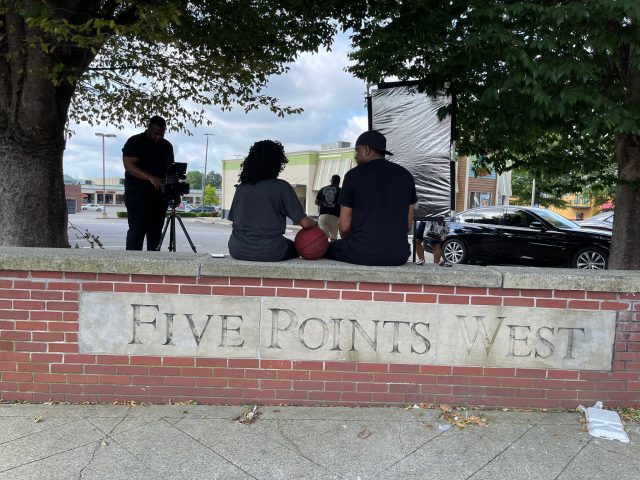
On location at 5 Points West Business District for "As Goes the South." (Provided)
By Don Rhodes II | The Birmingham Times
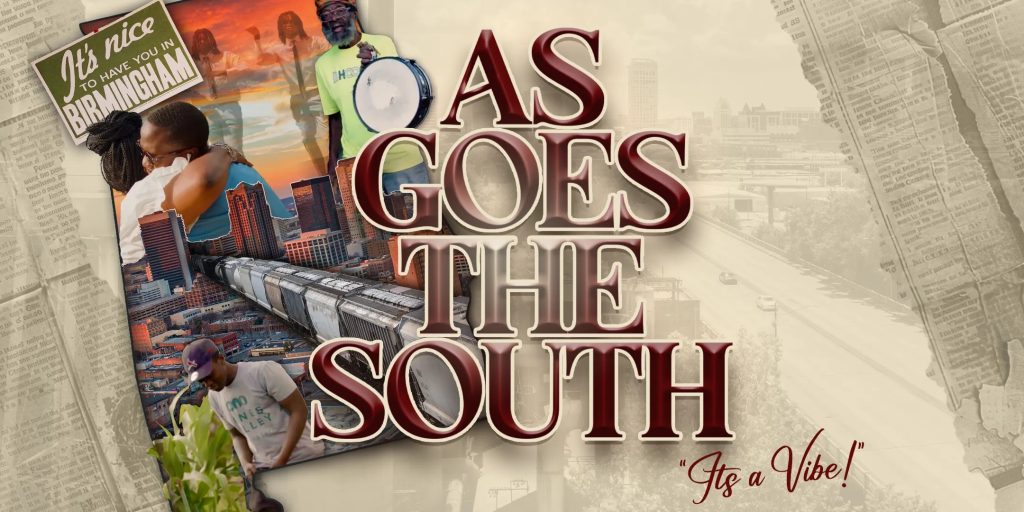
Historic A.H. Parker High School will transform into a cultural hub on Sunday, August 10, as the premiere of the film “As Goes the South” comes to Birmingham. Produced by Ed Fields, poet, essayist and civic strategist, the film is more than a cinematic experience; it’s a call to reframe how the South, and Birmingham specifically, is seen, heard, and understood, according to Fields.
“I want people to see Birmingham the way those of us who live here do in full color,” Fields told The Birmingham Times this week. “We’ve been stuck in a national narrative that only shows us in black and white and not just visually, but in how people view our complexity.”
The film, created under the Southern Futures Project, is the result of years of collaboration, local engagement, and passion for reclaiming the South’s future through bold storytelling. It centers Birmingham as a modern, youthful, and vibrant Southern city challenging stereotypes and bringing forth underrepresented voices.
Asked what inspired the film, Fields was candid.
“This film was born out of a bit of frustration,” he explained. “Too often when people talk about Birmingham, it’s either stuck in the past the Civil Rights trauma, the hoses and dogs or people don’t know us at all. They treat us like we’re a place that time forgot, a city that’s still running on dirt roads. That’s just not the truth.”
According to Fields, who also serves as senior advisor and chief strategist in the Mayor Randall Woodfin administration, the project seeks to change the narrative not by ignoring the past but by expanding on it elevating stories of growth, resilience, creativity, and leadership that are unfolding right now.
“If we’ve done our job right,” he said, “this film allows us to talk about who Birmingham is today without needing to rely on overused footage of Black trauma. We’re telling a new story … one where Black joy is front and center.”
Left: Mayor Randall Woodfin is interviewed for “As Goes the South.” Center: Titusville artist Joe Minter. Right: On location at Nu Deal Barbershop. (Provided)
Standout Elements
One of the standout elements of As Goes the South is its score, created by Birmingham-native Pink Siifu, a celebrated underground musician known for blending genres and disrupting expectations.
“Pink Siifu was the perfect choice,” Fields said. “He’s born and bred in Birmingham from Ensley and he represents what we’re about: soulful, rooted, and forward-thinking.”
The music, much like the visuals, serves a greater purpose in storytelling. “The music is everything,” Fields said. “People have told us when they watch the film, it feels like a vibration. It’s more than just a documentary, it’s a vibe. It’s immersive. It’s familiar, yet surprising.”
He added that many of the artists and cultural contributors featured in the film are not household names, but they are well-known within their circles the kind of creatives who influence culture from the ground up.
Celebrating Creativity, Youth, and Leadership
Throughout the film, Birmingham’s transformation is revealed through the eyes and work of its people from sculptors to youth leaders, educators to organizers. Fields made it a point to highlight creative forces who’ve made global impact but remain rooted in the city.
“We shine a light on artists like Joe Minter, Lonnie Holley, and Sun Ra all of whom shaped global art movements but have ties to this soil,” Fields said. “Birmingham isn’t lacking talent or vision. We’ve been exporting brilliance for decades.”
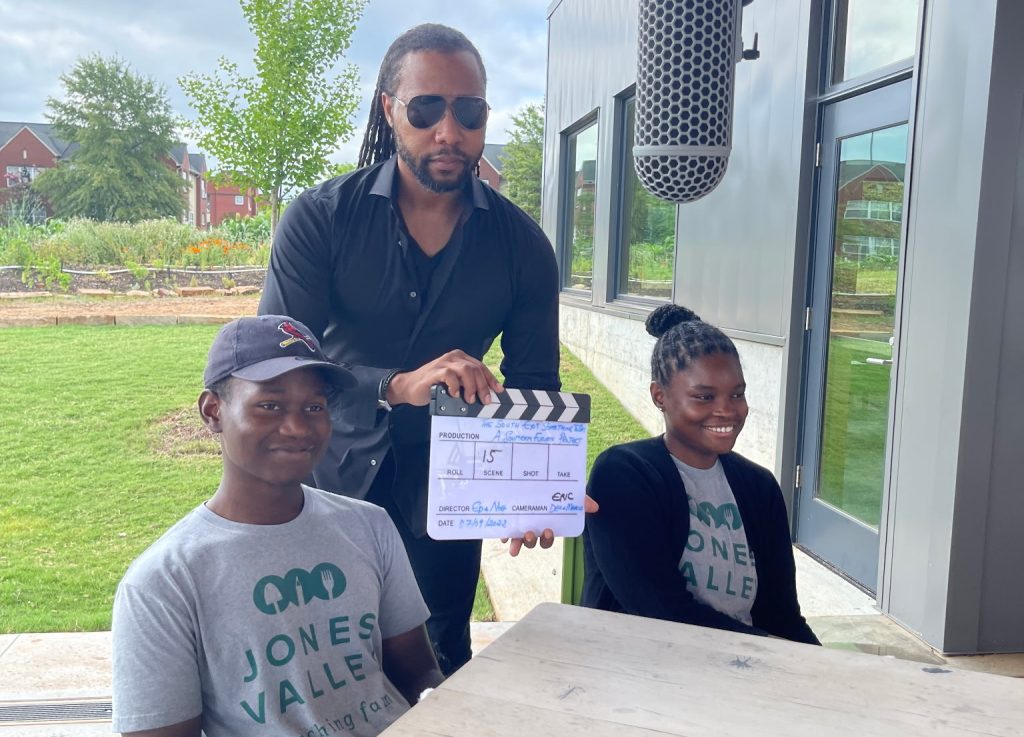
Youth at Jones Valley Teaching Farm are interviewed for “As Goes the South.” (Provided)
Another major theme of the film is youth and the future of the city.
“We cover everything from the Skate Park at City Walk to the Jones Valley Teaching Farm,” Fields said. “We’re showing how Birmingham’s young people are leading in food justice, arts, tech, and more. Even the Youth Detention Center is part of this story because real change includes everyone.”
The film is a signature initiative of the Southern Futures Project, a policy and narrative movement co-founded by Fields and Noel Didla, who is based in Jackson, Mississippi.
“Our work is two-fold,” Fields explained. “First, we want to highlight bold, progressive policies happening across the South, like how Birmingham is paying high school students to learn farming, distribution, and entrepreneurship through urban agriculture. That’s transformative.”
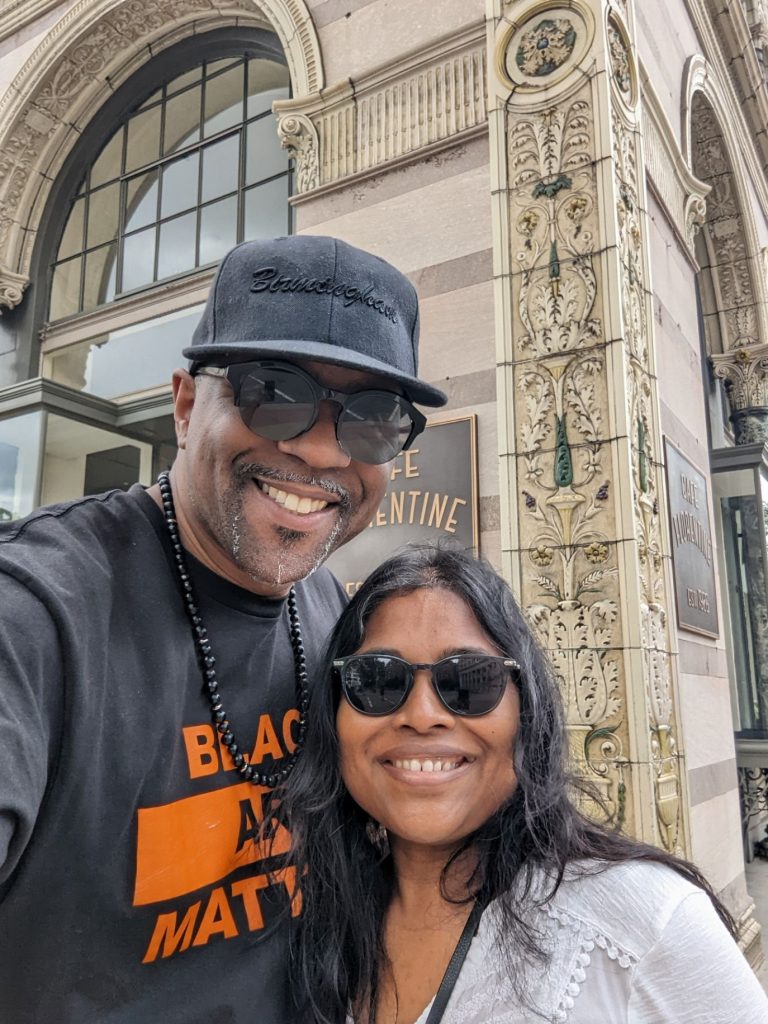
The documentary is a signature initiative of the Southern Futures Project, a policy and narrative movement co-founded by Ed Fields and Noel Didla. (Provided)
Second, Fields said, the project is committed to narrative change.
“This country isn’t always what we think it is. And the South, in particular, isn’t a monolith,” he said. “We’re building a movement where people can say, ‘Oh wow, I didn’t know Birmingham was doing that.’”
The premiere event on August 10 at 3 p.m. is free and open to the public, and Fields insists it’s more than a screening it’s an experience. “We’ve invited artists, students, elders, activists, people from every corner of Birmingham. It’s not just about watching the film. It’s about being in community together.”
The event will include a red-carpet experience, food trucks, complimentary drinks, and opportunities to connect with local organizations. Guests are encouraged to dress up and be camera-ready.
Birmingham’s Poet Laureate, Salaam Green, will be present, as well as youth leaders from Jones Valley. Following the screening, Mayor Randall Woodfin will join Fields for a live discussion on the film’s themes and the future of the city.
The screening of As Goes The South will be held at A.H. Parker High School, 400 Reverend Abraham Woods Junior Boulevard Birmingham, AL 35204. Doors open at 2 p.m. and the film begins at 3 p.m.
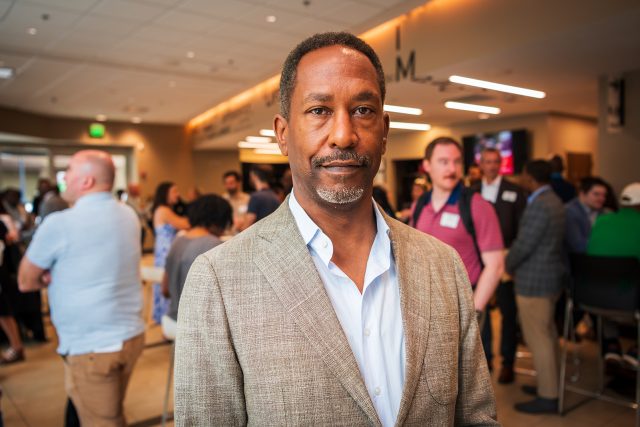
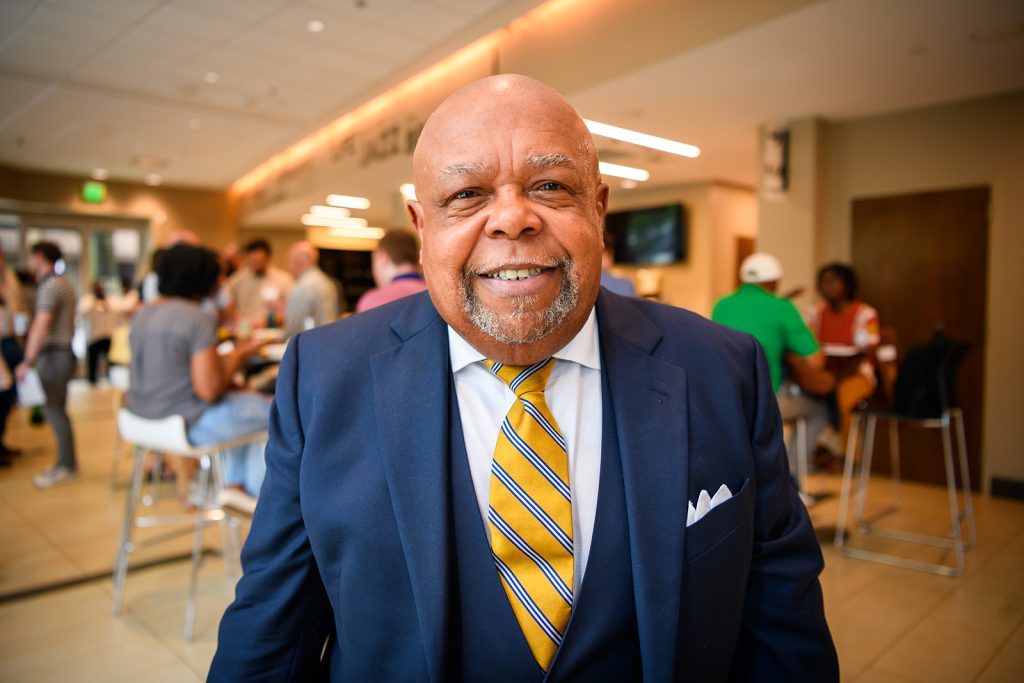
Brent Leggs, Executive Director of the African American Cultural Heritage Action Fund and Senior Vice President, National Trust
for Historic Preservation in Birmingham for a seminar on the historic Masonic Temple. (Amarr Croskey, For The Birmingham Times)
Not only is Leggs known worldwide for his work saving important landmarks in African American history like the estate of Madam C. J. Walker in New York and Nina Simone’s birthplace in North Carolina, but he’s also played a key role in creating the Birmingham Civil Rights National Monument, which President Barack Obama designated in January 2017.
For Leggs, whose organizations have raised $150 million to support over 400 projects nationwide, the Masonic Temple is personal. His connection to Birmingham began a decade ago, when he helped lead the national effort to preserve the A.G. Gaston Motel, restored on June 30, 2022, which former President Barack Obama ultimately designated a National Monument in 2017.
“It was clear that Birmingham’s Civil Rights legacy was unrecognized. That felt like an injustice we could rectify through preservation,” said Leggs, who is also Senior Vice President, National Trust for Historic Preservation.
Reflecting on the A.G. Gaston campaign, Leggs called it a turning point: “What was so powerful was the way the local Black community organized around the motel. They showed their exceptional stewardship capacity.”
Asked what he loves most about Birmingham, Leggs said, “The kindness of the people. I’m from Paducah, Kentucky, and I know Southern warmth when I feel it. Birmingham has always welcomed me with open arms. That’s what makes this place so special.”
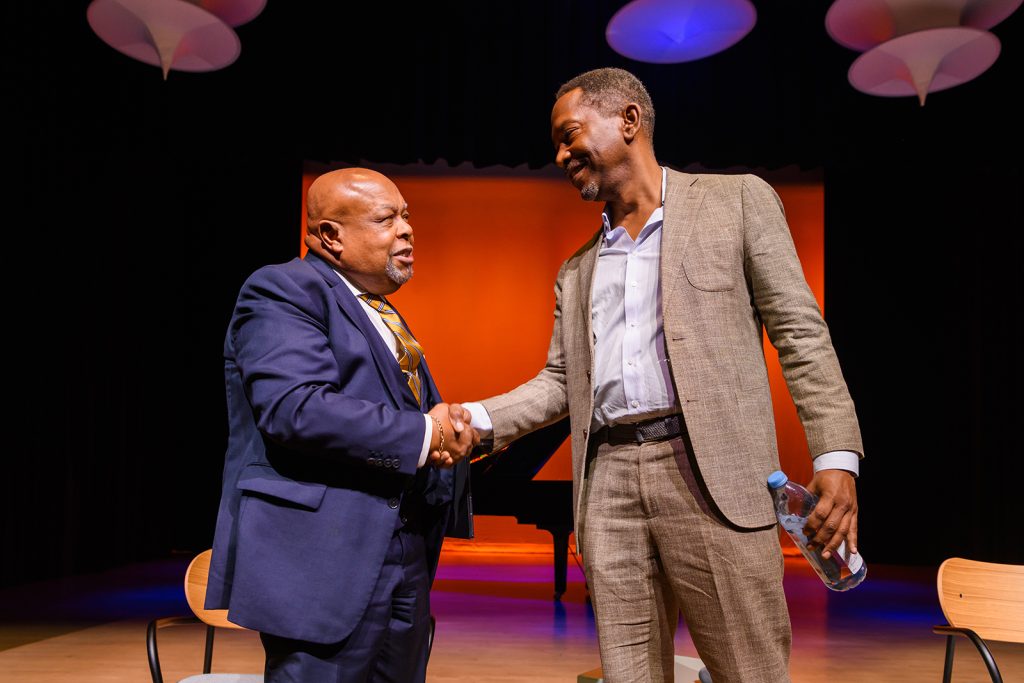
Irvin M. Henderson, president and CEO, of Henderson & Company, left, and Brent Leggs, Executive Director of the African American Cultural Heritage Action Fund in Birmingham for a seminar on the historic Masonic Temple. (Amarr Croskey, For The Birmingham Times)
“There’s a sadness when I see this building. It’s like a body suffering from disease. It’s been neglected for far too long,” Leggs said during a seminar in Birmingham last month. “But this temple deserves to be treated with the same reverence as Monticello or the National Cathedral.”
A former Harvard University Loeb Fellow and author of Preserving African American Historic Places, which is considered the “seminal publication on preserving African American historic sites” by the Smithsonian Institution, Leggs is a national leader in the U.S. preservation movement and the 2018 recipient of the Robert G. Stanton National Preservation Award. His passion for elevating the significance of Black culture in American history is visible through his work, which elevates the remarkable stories and places that evoke centuries of Black activism, achievement, and community.
Over the past decade, he has developed the Northeast African American Historic Places Outreach Program, and its theme, the Business of Preservation, to build a regional movement of preservation leaders saving important landmarks in African American history.
He has taught at Harvard, Boston Architectural College, and the University of Maryland. He was a senior advisor and adjunct associate professor at the University of Pennsylvania’s Center for the Preservation of Civil Rights Sites (CPCRS) and held an adjunct professorship at Columbia University’s graduate program in Historic Preservation.
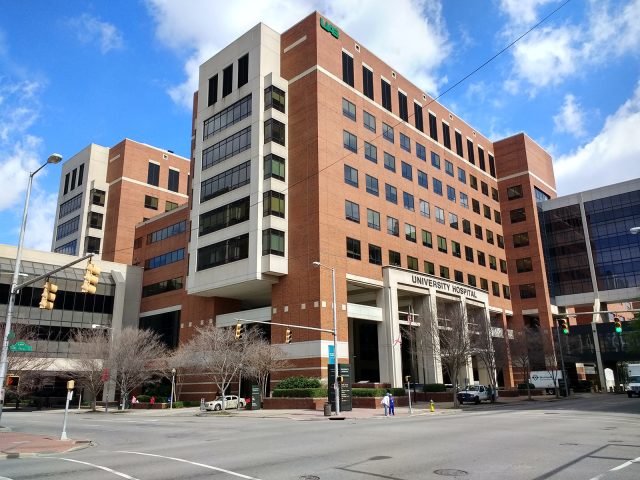
UAB Hospital has once again earned the distinction of being the No. 1 hospital in both Alabama and the Birmingham metro area, according to the 2025-2026 U.S. News & World Report Best Hospitals rankings released this week.
“Being recognized as the top hospital in the state and metro area is a testament to the dedication and expertise of our physicians, nurses and staff,” said Dawn Bulgarella, CEO of the UAB Health System. “These rankings reflect our unwavering commitment to delivering exceptional care and advancing innovative treatments across a wide range of specialties.”
With an additional seven specialties rated as high-performing, UAB Hospital earned high-performing ratings in 19 adult procedures and conditions, underscoring its comprehensive excellence in patient care.
UAB’s leadership in health care is further highlighted by the strong performance of its other Birmingham-area hospitals, with UAB St. Vincent’s Birmingham ranking at No. 4 in Alabama and No. 2 in the Birmingham metro area, continuing to provide high-quality care to the community.
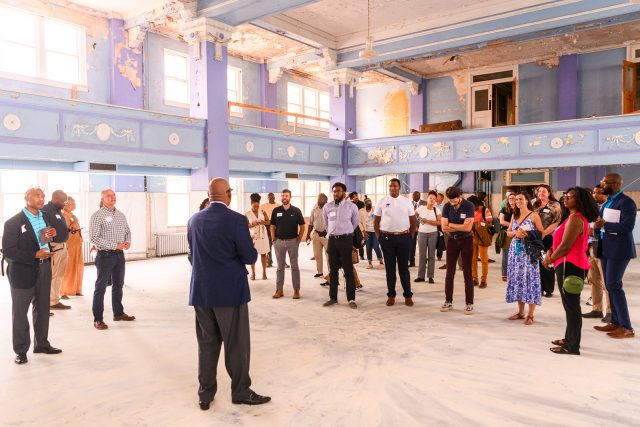
Llevelyn Rhone, blue jacket, Project Manager, Historic District Developers, speaks to visitors inside the historic Masonic Temple in downtown Birmingham. (Amarr Croskey, For The Birmingham Times)
By Don Rhodes II | The Birmingham Times
In a city with a rich Civil Rights legacy and cultural heritage, Birmingham’s historic Prince Hall Masonic Temple stands as a towering reminder of Black ingenuity, entrepreneurship, and civic pride.
Recently, preservationists, city leaders, and community advocates gathered in the Magic City for a landmark summit focused on restoring and revitalizing this iconic structure. The event featured a dialogue between national preservation leaders Brent Leggs, executive director of the African American Cultural Heritage Action Fund, and Irvin Henderson, principal, historic developer, and longtime advocate for historic Black institutions. All at the seminar were looking for ways to preserve one of the nation’s architectural marvels.
“We will continue to build local supporters throughout the Southeast for the restoration and rehabilitation of the building,” Henderson said. “We will have another event this fall to talk about the search for support and the regulatory process. We will also continue to try to protect the structure from vandalism and advocate for the redevelopment and protection of the Civil Rights National Monument structures, including the Masonic Temple.”
Irvin M. Henderson, president and CEO, of Henderson & Company, a company with expertise in the areas of community development and historic preservation. (Amarr Croskey, For The Birmingham Times)
“For a 100-year-old building, it is in great condition. … The building provides an opportunity to research what type of message the masonic lodge wanted to communicate to everyone who visited the building,” he explained. “The building has a lot to teach us — from the rationale for its architectural style to how the layout supported economic development, it is a time capsule of the consciousness of the Black Birmingham community.”
For Leggs, whose organization at the National Trust for Historic Preservation has raised $150 million to support more than 400 projects nationwide, the mission is personal. His connection to Birmingham began a decade ago, when he helped lead the national effort to preserve the A.G. Gaston Motel, which President Barack Obama ultimately designated a National Monument in 2017.
“It was clear that Birmingham’s Civil Rights legacy was unrecognized, and that felt like an injustice we could rectify through preservation,” Leggs said.
Reflecting on that journey, Leggs called the A.G. Gaston campaign a turning point: “What was so powerful was the way the local Black community organized around the motel. They showed their exceptional stewardship capacity.”
Now, Leggs and his team are back in the Magic City to help revive the Prince Hall Masonic Temple, which was designed by Robert R. Taylor, the first licensed Black architect in America. Unlike the Gaston project, however. this one carries a sobering note.
“There’s a sadness when I see this building. It’s like a body suffering from disease. It’s been neglected for far too long,” Leggs said. “But this temple deserves to be treated with the same reverence as Monticello or the National Cathedral.”
Brent Leggs, Executive Director of the African American Cultural Heritage Action Fund and Senior Vice President, National Trust for Historic Preservation in Birmingham for a seminar on the historic Masonic Temple. (Amarr Croskey, For The Birmingham Times)
Landmark Building
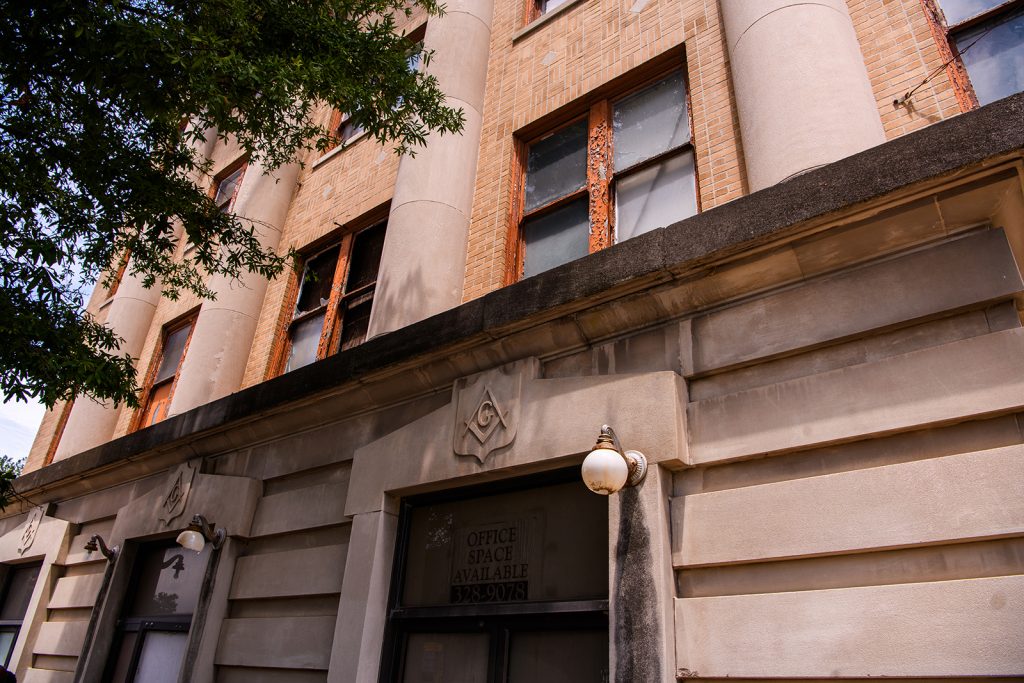
The Most Worshipful Prince Hall Grand Lodge, Free and Accepted Masons (F & AM) of Alabama, Temple Building, a seven-story structure on the corner of 17th Street North and 4th Avenue, is an architectural marvel, as described by The Birmingham Times in a 2017 article. The Renaissance-Revival style building was designed by Taylor, who was the main campus architect of Tuskegee University. Construction began in 1922, and the building opened in 1924.
The auditorium and grand ballroom on the second and third floors seats up to 2,000 and is where legendary acts — Dizzy Gillespie, Duke Ellington, Count Basie, Birmingham native Erskine Hawkins, and many others — performed at the start of their celebrated careers. Besides well-preserved floors, the ballroom features elegant décor, such as Renaissance Revival–style columns with ornate capitals. Also housed throughout the landmark building were the offices of numerous Black doctors, dentists, lawyers, and other professionals, as well as the National Association for the Advancement of Colored People (NAACP).
The Temple anchors Birmingham’s 4th Avenue Historic District, which stretches along three blocks of 4th Avenue North, from 15th to 18th Street, and is notable as a center for businesses that served Black residents during the city’s long period of enforced segregation.
Preservationists, city leaders, and community advocates gathered for a landmark summit focused on restoring and revitalizing the historic Prince Hall Masonic Temple. (Amarr Croskey, For The Birmingham Times)
“Radical Act of Love”
Last month’s summit at the Carver Theatre brought together a mix of developers, preservationists, city officials, and concerned citizens to build momentum and outline a vision for the Temple’s restoration. Henderson, who helped lead past revitalization efforts and has been instrumental in national Black preservation work, spoke passionately about the broader economic and cultural impact of these projects.
“Preservation has always been a jewel for Birmingham, but it’s also an economic development engine,” he said. “It’s about connecting the past and the future. These buildings can provide services and opportunities, and they can power downtown for decades to come.”
For Henderson, the Masonic Temple’s legacy is more than symbolic — it’s a blueprint for Black excellence.
“These were men making $5 to $10 dollars a week, and yet they pooled nickels and dimes to build a $900,000 building — in cash, no debt. That’s a miracle of financial empowerment, of African American entrepreneurism.”
After last month’s summit, Daniels made his first visit to the building and described his visit as “awe-inspiring, because it allowed me to have a deeper insight into the architectural mind of Robert R. Taylor, the namesake of architecture program and father of Black Architecture.”
As the summit closed, both Leggs and Henderson left the audience with a challenge.
“We are stewards of this history, not just spectators,” said Henderson. “And we must work hand in hand with developers, preservationists, city officials, and, most importantly, community members to preserve the past in a way that empowers our future.”
Leggs added, “This work is a radical act of love, and Birmingham has everything it needs —history, talent, community — to lead the nation in a new preservation movement rooted in justice and possibility.”
Kweisi Daniels, Ph.D, Department Head, Associate Professor, Taylor School of Architecture and Construction Science, Tuskegee University inside the historic Masonic Temple in downtown Birmingham. (Amarr Croskey, For The Birmingham Times)
By Barnett Wright | The Birmingham Times
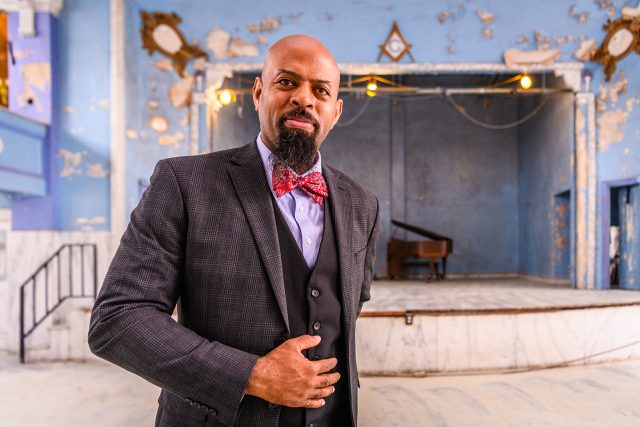
Kwesi Daniels, Ph.D. Head of the Architecture Department at Tuskegee University in Tuskegee, Alabama, is used to studying vintage buildings near and far and many can be lost to time. But that was not the case last month when he made his first visit to the historic Masonic Temple in downtown Birmingham.
The Most Worshipful Prince Hall Grand Lodge, Free and Accepted Masons (F & AM) of Alabama, Temple Building, a seven-story structure on the corner of 17th Street North and 4th Avenue, is an architectural marvel. The Masonic Temple began construction in 1922 and was opened in 1924.
Daniels, currently a tenured associate professor at Tuskegee University and an adjunct professor at New York University, described his site visit, which came part of a seminar, as “awe-inspiring … We rarely have the opportunity to be inside a building they designed that is still intact.”
During the seminar, he said, “Every time you walk into a historic building, you’re stepping into a story. You can’t do work in that space without understanding who touched those grounds and how that place helped shape the world around it.”
Here’s what else Daniels had to say about the Masonic Temple in emailed questions submitted last week.
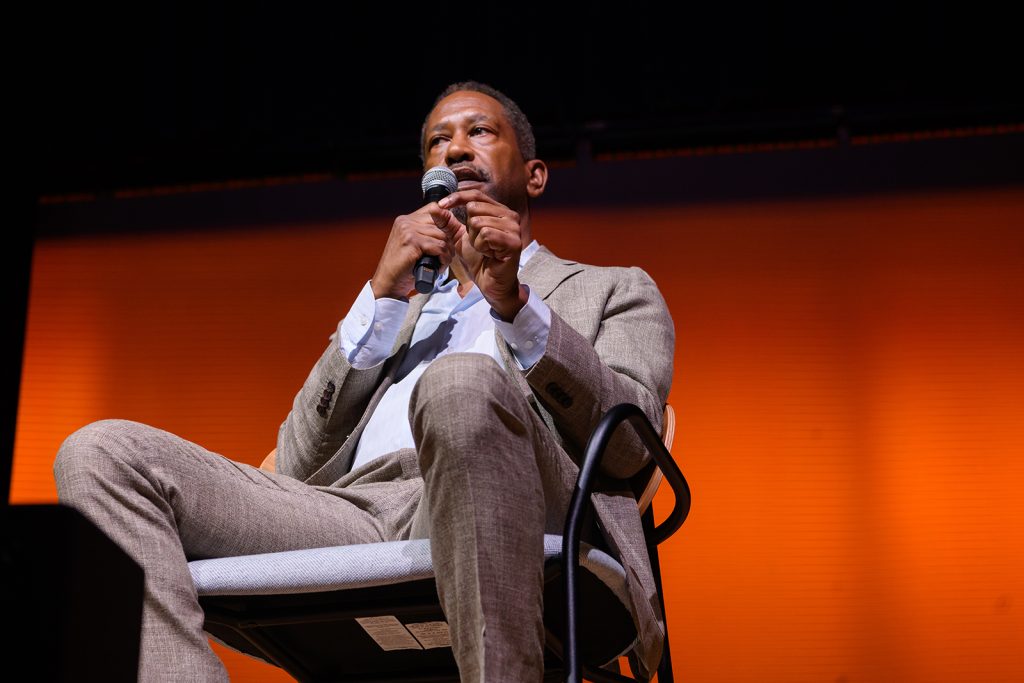
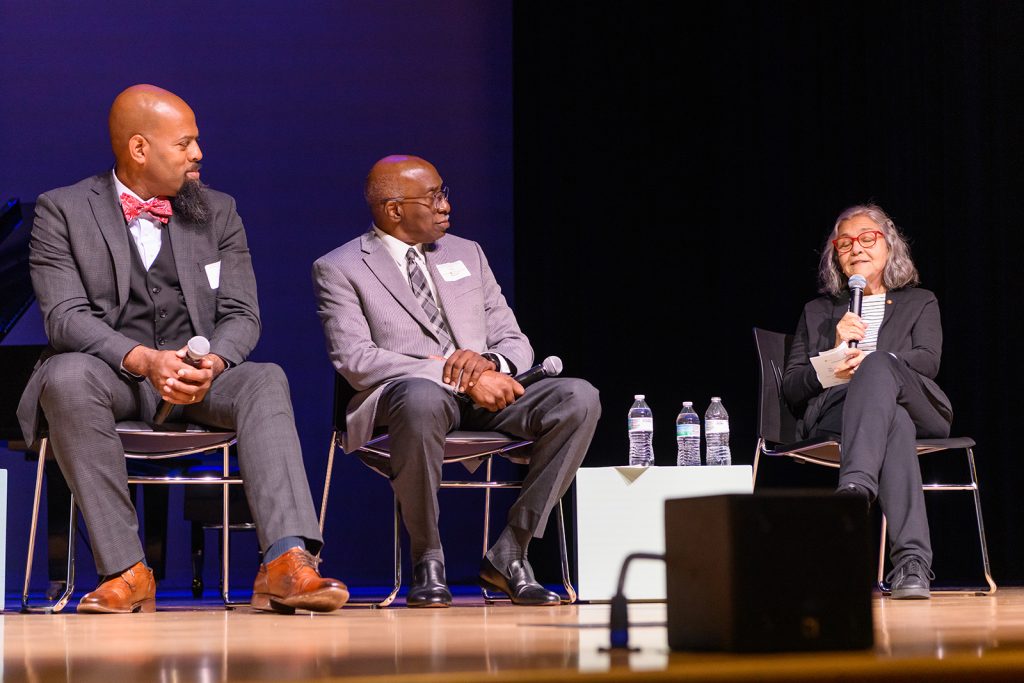
From left, Kwesi Daniels, Ph.D. Head of the Architecture Department at Tuskegee University in Tuskegee, Alabama: Orville Ifill, Vice President, Alabama Jazz Hall of Fame / Carver Theatre with moderator, during a panel discussion on the historic Masonic Temple. (Amarr Croskey, For The Birmingham Times)
In what ways could the Masonic Temple be described as a “laboratory for learning”?
For a one-hundred-year-old building it is in great condition. It is a great illustration of a mixed use facility that served as an economic hub for professional businesses and community organizations. It epitomizes the idea of cooperative economics. The building provides an opportunity to research what type of message the masonic lodge wanted to communicate to everyone who visited the building. The building has a lot to teach us, from the rationale for its architectural style, to how the layout supported economic development, it is a time capsule of the consciousness of the Black Birmingham community.
The building was designed by African American architects. As one of the preeminent Black architecture professors of our time how would you describe the feeling of walking in that space?
It was awe inspiring. As the Department Head of Architecture at Tuskegee University, I am often interacting with the physical environment that Robert R. Taylor, Louis Persley, and other Tuskegee architects created on the Tuskegee campus. Unfortunately, due to multiple interior renovations, many of the design decisions employed by our early architects are lost to time. We rarely have the opportunity to be inside a building they designed that is still intact. One of the highlights of the seminar was the tour of the Masonic Lodge, because it allowed me to have a deeper insight into the architectural mind of Robert R. Taylor, the namesake of architecture program and father of Black Architecture.
How is preservation more than just about “saving” the building?
Preservation is more than just “saving” the building, because it allows us to learn about the stories that are associated with it. The building is the anthology of the community that developed in and around it. People often say, “if these walls could talk”, when they discuss buildings. In my experiences, this phrase is more than a conjecture, it is the reality of historic spaces. Every recorded event, photograph, oral history, and experience people share about a building help us understand its biography. Through the process of preserving a building, we gain insight into the power of the place. Every experience shared about the building and its impact on the community reveals its soul. The building becomes alive and we learn that “saving” it equals “saving” our own humanity.
What must be done to restore it to past grandeur?
As I understand it they are in the process of raising funding to restore the building into retail and office space, with an intentional focus on sustainability. The Masonic Temple came into existence through collective effort. Its grandeur still exists and every window that is restored, wall that is painted, and relic within it that is preserved recovers its grandeur. As noted earlier, through learning about the building and how it came into existence, we will learn about ways we can move forward to return the economic power to the overlooked areas of our community. The building’s grandeur never became dull, only our vision for its purpose in community.
Jefferson County District Attorney Danny Carr said Wednesday that body camera footage and other evidence showed Jabari Peoples had a gun in his right hand when an ewood officer shot him. (File)
A district attorney said Wednesday that an Alabama police officer who fatally shot a teenager in the back was justified in his use of deadly force because the youth grabbed a gun after struggling with the officer.
But the teen’s family questioned that conclusion and said they have many unanswered questions about what had happened.
District Attorney Danny Carr
Jefferson County District Attorney Danny Carr announced that no charges will be brought against the officer who shot and killed Jabari Peoples, 18. Peoples was shot on June 23 by a police officer in a parking lot in Homewood, an affluent suburb near the city of Birmingham.
Peoples and a friend had been parked in the parking lot. Carr said an officer had approached the car at about 9:30 p.m. and attempted to detain Peoples because of suspected marijuana in the car. The officer attempted to put handcuffs on Mr. Peoples “for officer safety” after noticing a gun in the car door but a struggle ensued, Carr wrote. He said Peoples then ran back to his vehicle and grabbed a gun.
“At the time of the shooting, Mr. Peoples had the gun in his right hand and the officer fired one shot, hitting Mr. Peoples in the left side of the back causing injury that ultimately caused his death,” Carr wrote in a statement. Carr made the announcement immediately after showing the family body camera footage of the shooting. The footage has not been released to the public.
But a family member said they were only shown a short clip that was hard to see and want additional information.
“I have so many unanswered questions, still. Today, what I saw on this video, my brother was afraid. He was scared. He was running for his life,” Angel Smith, People’s sister, said.
Smith said her brother could be heard saying, “Sir, I promise I’m not trying to resist.”
Ben Crump, an attorney representing the family, said they want full transparency. He said the police department should release all of the available video.
“We want exactly what you would want if this was your son that was shot in the back running away from the police,” Crump said.
Homewood Police Chief Tim Ross did not immediately return an email seeking comment.Groups have staged regular protests in Homewood since the shooting, criticizing the police department’s refusal to show the video to family members.
Carr made the decision to show the video to family members after the Alabama Law Enforcement Agency turned its findings over to his office.
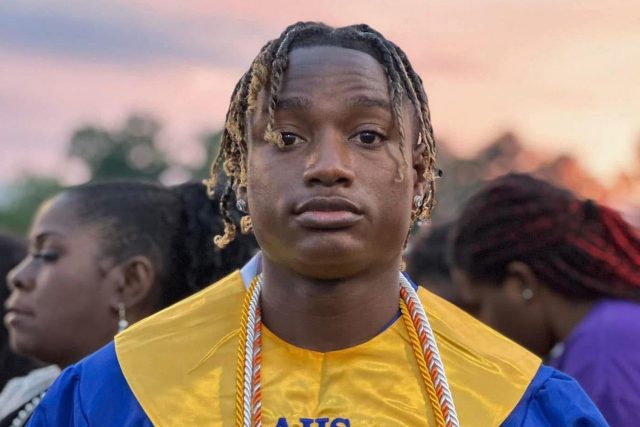
Peoples was a 2024 graduate of Aliceville High School in the city of the same name, about 100 miles (160 kilometers) west of Homewood.
A doctor from UAB has a few tips and recommendations for parents and guardian for a happy, healthy, and safe school year. (Adobe Stock)
By Sym Posey | The Birmingham Times
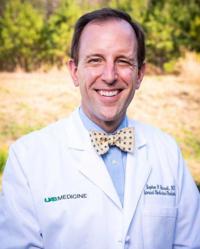
Schools open today across the Birmingham metro area and Stephen Russell, M.D., at University of Alabama at Birmingham has a few tips and recommendations for parents and guardian for a happy, healthy, and safe school year.
“To get ready to go back to school, one of the things that we like to review is to make sure that any specific health related issues that children have are being managed and taken care of,” said Russell, a double-board certified physician of internal medicine and pediatrics and an expert in primary and preventive care.
Stephen Russell, M.D.
Also make sure that all the paperwork is in line for the school so that they’re able to administer medicines if that’s part of the medical plan, he said. “We do a lot of evaluation of that for starters just to make sure that we’ve done our part to provide the school, the paperwork that they need.”
In addition, Russell continued, “we also want to make sure that students are up to date on their age appropriate and recommended vaccinations.”
For most children going into sixth grade, there’s a recommendation to get a tetanus booster, which will protect children, both from tetanus, which is less common, but also from pertussis, which is much more common, especially during the cold and winter season.
“We want to make sure that you’re up to date with that, and for most of our offices, starting around Labor Day, we offer the flu shot, which we encourage all children to get the,” Russell said.
Russell stressed the importance of general hygiene health.
“It’s very common for us to see a spike of calls and concerns about children’s sick visits, either with upper respiratory issues or even sometimes strep throat, because we know that when kids get back together and start sharing their summer experiences and enjoying time with their friends, they’re also sharing not just those stories, but they’re sharing the germs that they may have picked up as well,” he said.
And, “we emphasize washing hands before lunch and washing hands after going to the bathroom both with the parents and with the kids, because our experience has been that they can’t hear it enough,” he said.
Getting to school means riding in a car or riding a school bus so “we review … wearing seat belts in the car on the way to school for age-appropriate children, making sure that they’re in the proper seat protection, such as a car seat, if appropriate for their age. And then, of course, wearing a helmet from children that might bike to school or bike while at school,” he said.
Medical action plans should also include allergies and asthma.
“For allergies, we want to make sure that parents have an updated injector … in terms of asthma, a lot of these children are going to be spending time playing outside doing physical education. In August and September and it’s hot [that] can be a trigger for some people with their asthma. Fresh cut grass is another trigger and then sometimes as the leaves change into the fall, we’ll see that as an asthma trigger.
“We want to make sure that if families have a rescue inhaler they share that information with the school nurse,but also making sure that that we’re providing updated prescriptions for of that.”


 The film, created under the Southern Futures Project, is the result of years of collaboration, local engagement, and passion for reclaiming the South’s future through bold storytelling. It centers Birmingham as a modern, youthful, and vibrant Southern city challenging stereotypes and bringing forth underrepresented voices.