Retail gasoline prices are moving lower in some parts of the country, but don’t expect the announcement to tap strategic reserves to work any long-term magic, analysts said.
Motor club AAA listed a national average retail price of $3.40 per gallon of regular unleaded for Tuesday. That national average is skewed higher because of California, which because of higher taxes and other factors, had a state average of $4.70 per gallon. On the low end, Oklahoma averaged $2.97 per gallon on Tuesday.
Higher energy prices have become a growing concern for the White House (U.S. Energy Information Administration)
National prices are moving lower in some markets, though broad-based inflationary concerns are a mounting issue for a White House worried about slumping poll numbers and the general health of the U.S. economy.
Matthew Kohlman, an associate director for refined products pricing at S&P Global Platts, said the market was probably working given the notion that the solution to high prices is usually high prices. Demand would theoretically start to decline at a certain point and, assuming no supply disruptions, prices would respond.
The only issue, Kohlman said, is that it doesn’t always work overnight. And particularly with the upcoming long Thanksgiving Day holiday, it’s unlikely that demand would evaporate this week.
TSA checkpoint travel numbers show we’re close to pre-pandemic levels for air travel ahead of the long Thanksgiving holiday. (U.S. Transportation Security Administration)
Wholesale prices are already on the decline as broader markets react to the return of tight social restrictions in Europe, where Austria has already returned to lockdown in an effort to control a surge in new cases of COVID-19. Additionally, the U.S. Department of State has issued a do not travel warning for Germany and Belgium.
Meanwhile, in the domestic market, the U.S. federal government reported last week that gasoline demand dropped from 9.26 million barrels per day to 9.24 million barrels per day.
“But prices at the pump seem to be backing down more slowly, as there is still strong gasoline and diesel demand in the U.S. for this time of year and flying demand has also returned,” Kohlman said.
U.S. President Joe Biden speaks on the economy during an event at the South Court Auditorium at Eisenhower Executive Office Building on November 23, 2021, in Washington, D.C. President Biden announced the release of 50 million barrels of oil from the Strategic Petroleum Reserve of the Department of Energy to combat high energy prices which are at a seven-year high across the nation prior to the holiday travel season. (Alex Wong/Getty Images)
Phil Flynn, a senior market analyst at The PRICE Futures Group in Chicago, said the higher prices adage is a two-sided coin.
“Our expectations are that demand will rise faster than expected because of the lower price,” he said.
President Joseph R. Biden Jr. took to the podium Tuesday to discuss the health of the economy, expressing concern that taxpayers will be forced to pay “an arm and a leg” for goods and services moving into the holiday season. On gasoline and broader commodities, the president announced he was tapping into the nation’s Strategic Petroleum Reserve in parallel with China, India, Japan, the Republic of Korea and the United Kingdom.
The Department of Energy under the provision will release 50 million barrels of oil from the Strategic Petroleum Reserve in an effort to curb prices. In a fit of irony, perhaps, crude oil prices actually ticked higher on the news. Biden acknowledged from the podium that prices won’t move overnight, but they should move lower eventually with more oil on the market.
The price of crude oil is among the largest factors behind what consumers see at the pump.
But for much of the day, market watchers were skeptical.
“I frankly think the White House release is a bit weak,” said Patrick DeHaan, the senior petroleum analyst at GasBuddy. “Still, gas stations are dragging their feet on the huge drop in wholesale over the last week and that’s also frustrating.”
Israeli renewable energy company HomeBiogas, whose system converts organic waste into clean cooking gas and biofertilizer, recently won a United Nations tender to supply refugee camps in several African countries.
HomeBiogas products channel food leftovers or toilet waste into a tank where bacteria digest and convert them into biogas that flows to the stovetop or is turned into a green fertilizer.
The solution being implemented in the refugee camps treats food leftovers and other organic waste. It is off-grid and requires zero human intervention.
The large quantities of organic waste produced at refugee camps cause not only sanitary and environmental issues but also are expensive to dispose of. The HomeBiogas system allows for disposing of some waste onsite, reducing costs and providing a renewable energy source.
Prince Charles speaks with Oshik Efrati about the Homebiogas device at the British Ambassador’s residence on January 23, 2020, in Jerusalem. HomeBiogas (LTD) produces small and medium-scale, off-grid biogas systems that offer a comprehensive solution for waste management, renewable energy creation, clean-cooking, natural fertilizer production and sanitation for households and farms in per-urban and rural areas. (Julian Simmonds – Pool/Getty Images)
“We are proud that the UN selected HomeBiogas to take on this important project that will have an immense impact on the environment in the refugee camps,” says HomeBiogas cofounder and CEO Oshik Efrati.
“We are now an official supplier of the UN and believe that this tender is the first of many to come that will seek to treat waste in a sustainable way and improve the lives of hundreds of thousands of people living in refugee camps around the world,” he added.
The company soon will begin distributing around a dozen systems to refugee camps in several African countries in an arrangement expected to grow over time.
“The Little Mestiza Devils of Hondzonot” is a Mexican softball team that has attracted attention from all over the world.
These 18 Mayan women play barefoot and in hand-embroidered dresses they made themselves. They say they play because they love the sport and because they want to break with the region’s stereotypes.
The women range in age from 14 to 40. Their love of softball was born three years ago, when local authorities launched a program to teach women sports. The government support eventually dried up, but these women used their wits to keep playing, even though they had no equipment, using tennis balls, until they finally decided on softball.
“The Little Devils” play wearing a typical regional huipil and no shoes, which they say is more comfortable. (Courtesy of Fabiola Maychulim)
They turned the huipil, a light dress typical of the Mayan region in southern Mexico, into their uniform, as a way to show off their roots and put up with the high temperatures. They decided to run barefoot or in huaraches because they say it’s more comfortable.
“We’re very proud to wear this outfit that our grandparents handed down to us, family members who have passed. We stand out more that way. We’re proud to wear it, and we’ll keep playing in it; we don’t want other uniforms. We’re comfortable in our huipils, and we play barefoot because it’s faster to run with no shoes,” Alejandra Tuzmay, the team’s 16-year-old catcher, told Zenger.
Hondzonot is a town of 400 inhabitants in the Mexican state of Quintana Roo. Women there say they are surrounded by machismo. (Courtesy of Alejandra Tuzmay)
When the Little Devils gained some popularity through videos on social media, the Mexican Baseball League team Red Devils of Mexico, based in Mexico City, donated some bats and gloves to them.
“We used to play with no gloves. We caught balls with our hands. Nobody had given us a second look, and we had no equipment. Usually, it was borrowed, and sometimes we couldn’t play because it wasn’t ours, but thanks to [the Red Devils], we each got our own glove, and we are so grateful for that,” said Fabiola Maychulim, the teams’ 30-year-old captain.
The team grew to such fame that in Sept, Stefanía Aradillas, a member of the Mexican Olympic women’s softball team and the 2020 winner of the National Sports Award, visited them and joined them in a game. That led Tuzmay to keep fighting and to follow in Aradillas’ footsteps.
“Her story really touched me,” Tuzmay said. “When she was young, she was discriminated against for being a woman in a league, and they wouldn’t let her play, even though she was very good.”
Hondzonot is a town located 125 miles from Chetumal, the capital of the southeastern Mexican state of Quintana Roo. Its 400 inhabitants speak Mayan, the language used by one of the region’s pre-Hispanic cultures.
The machismo attitude in the region has meant that many women do not reach their goals. Tuzmay says there are cases of women who leave school because they get no support, which makes it difficult for them to have employment opportunities later. Women are not encouraged to be seen outside, especially not playing sports, she said.
“People from around here are not used to seeing women playing sports. Here, as they say, ‘only men can or have a right to go out.’ Since they’re men, they’re free and can go outside to play. Women’s chores include housekeeping and caring for children, that’s all. They’re macho,” Tuzmay told Zenger.
The panorama has changed since the women started playing softball. They say they have inspired other women to follow their dreams.
Mirna May Tuyub is the team’s shortstop. She’s a 25-year-old housewife and huipil embroiderer. She says it hasn’t been easy to break with these stereotypes.
“When I play, I can’t deny that most men don’t like it, but we’re hoping they’ll change their attitude and see that, as women, we’re also brave, we can play sports,” said Tuyub.
The “Little Devils” practice in the afternoon. They play exhibition games because there is no professional softball league in Mexico. (Courtesy of Fabiola Maychulim)
The women’s softball team gets together in the afternoon to practice and have fun. They play exhibition games because Mexico has no professional softball league, but that doesn’t hold them back from chasing their other goals.
“Our dream is to meet the Red Devils, travel all over, go to other countries, show that, barefoot and in our huipils, we can play this beautiful sport. A lot of people want to play with us. We’re traveling to Querétaro. We’re very happy; it’ll be our first time on a plane,” said Tuzmay.
They never lose sight of the goal of inspiring other women to go after their dreams.
“We’re proud to be women, so we want to tell all women, ‘ma’ cha’ka suulak kintaaj menu’unpi’it u muuk’ xiib’ [in Mayan, ‘don’t let a man’s efforts put you down’]. They shouldn’t be limited by barriers,” Tuzmay said.
Translated by Melanie Slone; edited by Melanie Slone and Kristen Butler
In good news for garlic lovers worldwide, a new allium species was recently discovered in the Judean Hills. The bad news: It’s been observed in only three sites and is already in danger of extinction.
“I first found the garlic 10 years ago, and I didn’t exactly identify it. I thought it was a different garlic species. But it stayed with me; it bothered me because I wasn’t completely satisfied with my identification,” said botanist Ori Fragman-Sapir, the scientific director of the Jerusalem Botanical Gardens.
Botanist Dar Ben-Natan recently found more sites where the garlic was growing. (Yuval Sapir)
“But then a promising young botanist called Dar Ben-Natan found it in two more sites in recent years and contacted me. Suddenly we realized that we have something new in hand that is unlike anything else that we know.”
Their discovery was recently published in Curtis’s Botanical Magazine, the longest-running botanical magazine in the world, dating to the 18th century.
“Regarding its properties, it’s very different from other alliums. But by the way, it’s not a very impressive-looking plant. It has these greenish flowers, but it’s not this big and beautiful plant,” Fragman-Sapir said.
The allium boasts greenish flowers and blooms unusually late in the year. (Ori Fragman-Sapir)
Unusually, the new allium species flowers rather late in the year, in May and June. It is also yet unclear whether it’s edible. The two researchers called it Allium judaeumin honor of the three Judean Hills spots where it was found, and are working to conserve it.
Since it is endemic to three locations, each with a limited number of plants, the new species is already understood to be endangered.
Rare but not impressive
“When we talk about the conservation of the variety of plants in Israel, we usually talk about the conservation of beautiful flowers, or of plants with economic value. But then there are also all types of plants that are very rare but not that impressive, like the Allium judaeum,” Fragman-Sapir said.
“A lot of people ask why we’re conserving such an unimpressive plant. The answer is that we aren’t yet familiar with the new plant’s genes. It might be that the plant will end up contributing to the growing of cultivated garlic and onion,” he said.
The new allium’s properties are not yet known but could impact cultured onions and garlics and even have uses in medicine. (Ori Fragman-Sapir)
“Or it might be that the plant has properties that are resistant to disease or drought that can be utilized for cultivated species, or it might be that other chemicals will be found and utilized for different purposes such as medicine. First of all, we conserve the variety and then over the years discover the properties.”
Furthermore, he said, “You can also approach the question of preserving plant varieties from a moral perspective: What right do we have to obliterate the creatures upon this earth?”
Extinction, Fragman-Sapir said, usually occurs because of the destruction of the plants’ natural habitat. In Israel, that often happens because of development and construction.
Grown in buckets
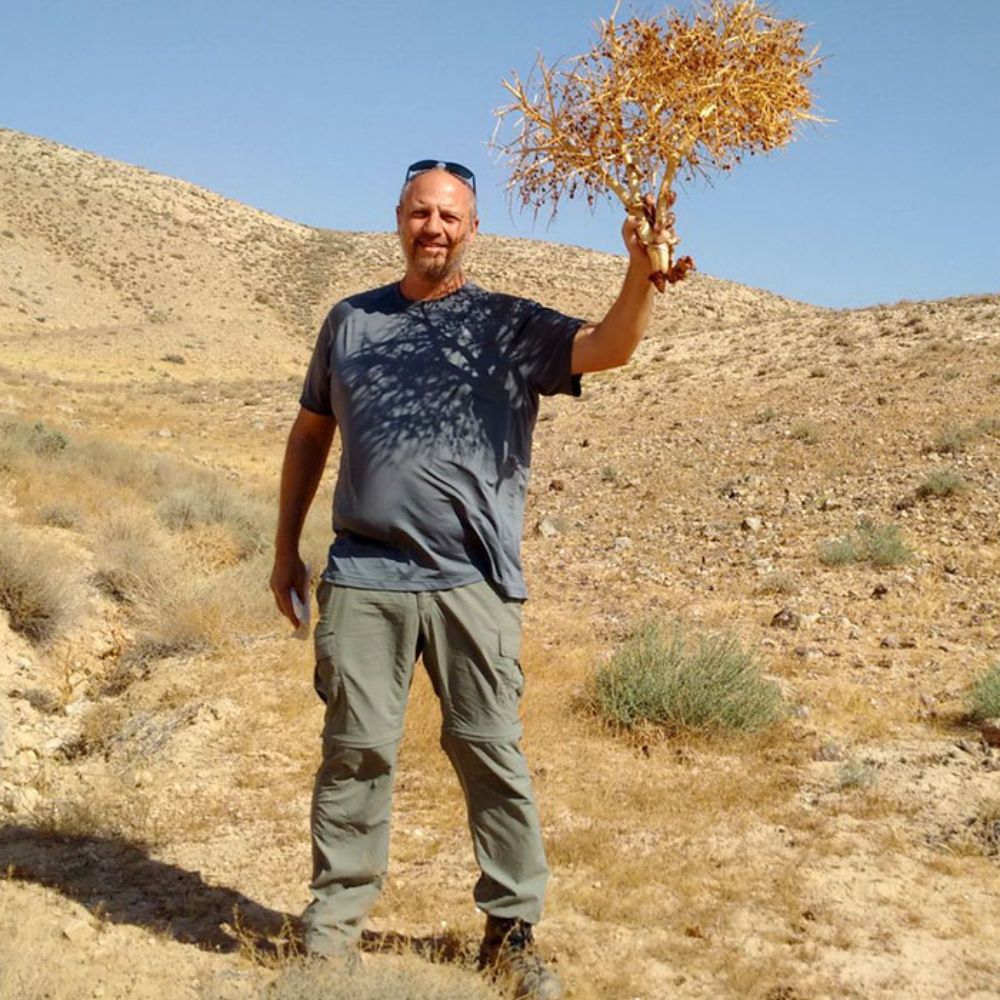
Dr. Ori Fragman-Sapir, scientific director of the Jerusalem Botanical Gardens (Courtesy of Flora of Israel Online)
Efforts are now being made to conserve the new allium species both in its natural habitat and at the Jerusalem Botanical Gardens, where the plants are being grown in buckets.
“We’re creating a backup for the small number of plants that can be found in nature,” Fragman-Sapir explains.
Discovering new plant species in Israel is uncommon but not unheard of.
“Certainly, we’re conducting research on more plants and we’re currently writing all sorts of articles on other species. Generally speaking, Israeli flora has been researched, but once in a while we discover something new,” Fragman-Sapir concludes.
What is the recipe for meat and dairy without cows? Snacks and sauces with less sugar and salt? Long-lasting fresh produce and compostable food wrappers?
A fast-growing, climate-threatened world is hungry for such recipes. Appropriately enough, the search began in the kitchen — or rather, The Kitchen.
“This doesn’t exist elsewhere,” said The Kitchen’s vice president of business development, Amir Zaidman, in 2016.
Today, The Kitchen has 19 portfolio companies cooking up innovations to feed the world more efficiently, sustainably and securely.
But The Kitchen is no longer alone: Governmental, corporate and academic food-tech labs and incubators are opening across Israel. The number of food-tech startups has risen to approximately 400.
Food-tech (increasingly referred to as agri-food-tech) combines two of Israel’s best assets, says Nisan Zeevi, head of business development at Margalit Startup City #Galilee.
“Our agricultural knowhow, which is one of the wonders of the world, and our technological knowhow that we have built in the past 40 to 50 years. Put them together and you’ve got breakthroughs on a global scale.”
Success is sticky
The Israeli Economy and Industry Ministry reports that food-tech investment nearly doubled between 2013 ($52 million) and 2018 ($100 million) with input from multinationals including Coca-Cola, Mars, Tyson Foods, Nestle, Danone, AB inBev, Starbucks, PepsiCo, McDonalds, Heineken and Unilever.
Tel Aviv research firm IVC found food-tech garnered $432 million in investments in 2020, less than sectors such as cyber and fintech, but growing fast.
“Israel is a very entrepreneurial country and both new and serial entrepreneurs are always thinking about the next big thing. They see food-tech is an impact area on environment and health,” said Zaidman.
“Maybe they were hesitant before when looking at the money going into sectors like cyber, but now they see they can get capital investment in food-tech that can be game-changing.”
Zaidman predicts major financing rounds for Israeli food-tech in 2022.
“Startups like [cultivated steak pioneer] Aleph Farms don’t even have products in the market yet. But what they are doing is so amazing they get a lot of attention.”
Salt enhanced with mineral-rich seaweed is an innovation created at Tel-Hai College. (Courtesy of Salt of the Earth)
Breakthroughs on a global scale
One of the Israeli companies already making inroads in the global market is InnovoPro. Its proprietary process transforms chickpeas – the humble nourishing basis of hummus — into a neutral-tasting protein concentrate for foods and beverages.
InnovoPro has factories in Canada and Germany, and a new subsidiary in Chicago as it launches a chickpea TVP (texturized vegetable protein) for plant-based burgers, nuggets and meatballs. Migros, Switzerland’s largest retailer and supermarket chain, uses InnovoPro’s product in a dairy-free yogurt.
“Hummus is a Middle East product. You take the technology and combine it with Israeli knowhow and – boom — you’ve got a successful food-tech company,” Zeevi said.
Hoping to create similar successes, Jerusalem-based Margalit Startup City inaugurated its Galilee branch in September.
The Kiryat Shmona campus encompasses a food-tech accelerator, institute, executive park and Fresh Start early-stage incubator supported by food giants Tnuva and Tempo along with Finistere Ventures and OurCrowd.
“Five years ago we came to the Galilee and wrote a plan to transform this area into a food-tech and ag-tech center with the involvement of municipalities, service providers, investors, academies and research institutes across the Galilee. The government gave it a budget of 500 million shekels,” said Zeevi.
One portfolio company, DynaFresh, was established by Migal post-harvest experts to optimize the shelf life of fresh produce.
“Margalit Startup City is where everything converges at a physical hub and meets the international and business sector,” Zeevi said.
Unlike cyber and fintech, a food-tech company not only needs skilled scientists and technicians but also, after scaleup, factory workers.
This makes food-tech a promising equal-opportunity employment driver for Israel’s northern and southern periphery, said Zeevi.
Hearty investments
Not only existing VCs are investing in food-tech. Israel also has Millennium Food-Tech, an R&D partnership started in June 2020 and traded on the Tel Aviv Stock Exchange.
“There was no specialized vehicle in Israel for the post-seed food-tech startup with proven technology waiting to be piloted and commercialized,” VP Business Development Yossi Halevy tells ISRAEL21c.
“So we built a VC dedicated to food-tech. This is a sector that is untouched.”
Among Millennium’s portfolio companies are SavorEat (alternative protein), Tipa (compostable packaging), TripleW (lactic acid and other upcycled products from food waste), Aleph Farms, and Phytolon (natural food colors).
Halevy, a certified public accountant formerly with E&Y in Tel Aviv, became interested in venture creation in food and agriculture four years ago, when “the ecosystem was in diapers,” he said.
So he jumped at the chance to join his old friend, former Fresh Start director Chanan Schneider, in Millennium Food-Tech.
‘We work with Nestlé and other major food companies,” Halevy told ISRAEL21c. “It’s a triangle relationship: We use their knowledge for our due diligence, and they use ours for investment and proof of concept.”
Halevy sees ingredient development as one of Israel’s strongest capabilities because it maximizes the country’s well-honed, well-connected multidisciplinary talents.
“Israel is unique from many aspects, but most significant is that everyone knows everyone,” he said.
“That’s very helpful in food-tech because it has so many disciplines that need to be combined — innovation, entrepreneurship, biotech, physics, chemistry, robotics, computer vision, artificial intelligence. You can easily assemble a team and cross-mine ideas and development.”
The team of Alfred’s, a new Israeli B2B startup offering an innovative platform for producing plant-based whole cuts for the meat, poultry, meat analog and cultivated meat industry. (Courtesy of Alfred’s)
Corporations get in on food-tech
The food-tech scene in Israel is expanding like a yeasty bread dough into many sectors, from corporate to academic to nonprofit, with governmental participation sprinkled in.
International Flavors & Fragrances, a U.S.-based multinational with operations in Migdal HaEmek in northern Israel, runs the FoodNxt incubator in partnership with the Israel Innovation Authority.
IFF shares its knowledge about industry processes and technologies, international regulations and general food science expertise. The incubator also provides funding and helps portfolio startups build business plans, develop patent strategies and test products.
Salt of The Earth, a global Israeli company in the North founded in 1922, has teamed up with Tel-Hai College for multiple projects, such as testing ingredients at the college’s analytical lab.
Tel-Hai students recently were challenged to create innovations emphasizing sodium reduction and flavor enhancement. They were guided by Salt of The Earth R&D technologist and application manager Rakefet Rosenblatt, a food science graduate of Tel-Hai.
“We always think about what we can make better,” she said. “Salt is a known product; how can we help the industry use it in a smarter way? Students have great ideas and it’s good to invest in them.”
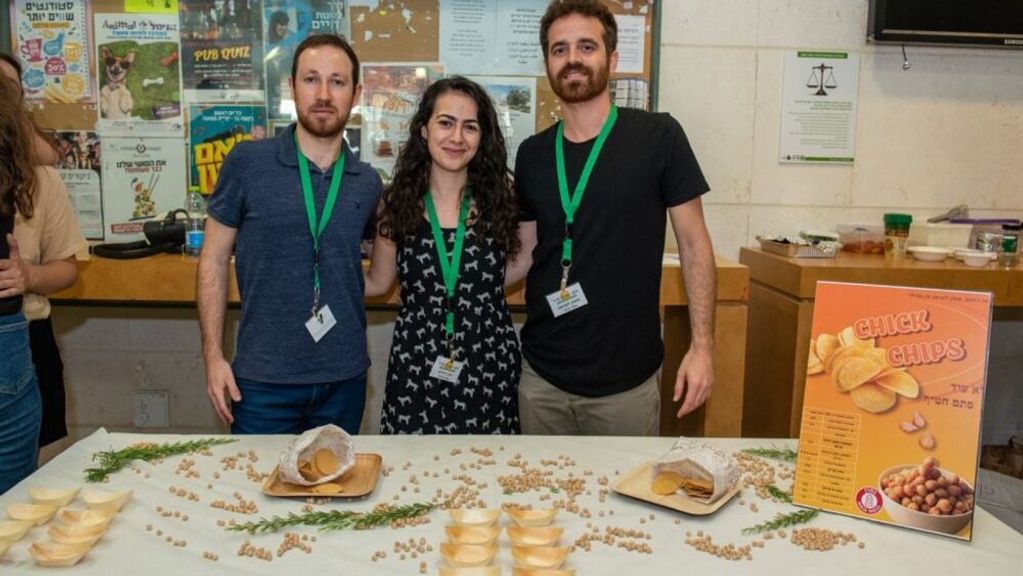
One group proposed a salt product enhanced with mineral-rich seaweed, using a special process to neutralize the seaweed’s strong flavor and color. Another group developed a savory vegan snack based on chickpea flour and Salt of the Earth’s Mediterranean Umami Bold flavor enhancer.
At the opposite end of Israel, down south in the Negev town of Rahat, seven major companies with a regional presence, such as SodaStream, Netafim and Dolav Plastic Products, joined with academic and VC partners in the IIA’s InNegev incubator for food-tech, ag-tech, clean-tech and Industry 4.0.
“This is our first year of operation. We’re mostly doing venture creation now, utilizing the capabilities of our partners in the Negev,” said Amir Tzach, InNegev’s VP Business Development & Investments.
Among food-tech innovations under consideration at InNegev are post-harvest sensors – one that detects bacteria and another that detects soft rot in potatoes early enough so that the bad potato(es) can be removed before the rot spreads.
In the hot field of alternative protein, InNegev is looking at companies in the South engaged in algae production, and may assist local meat-processing facilities in converting space for alt-protein production.
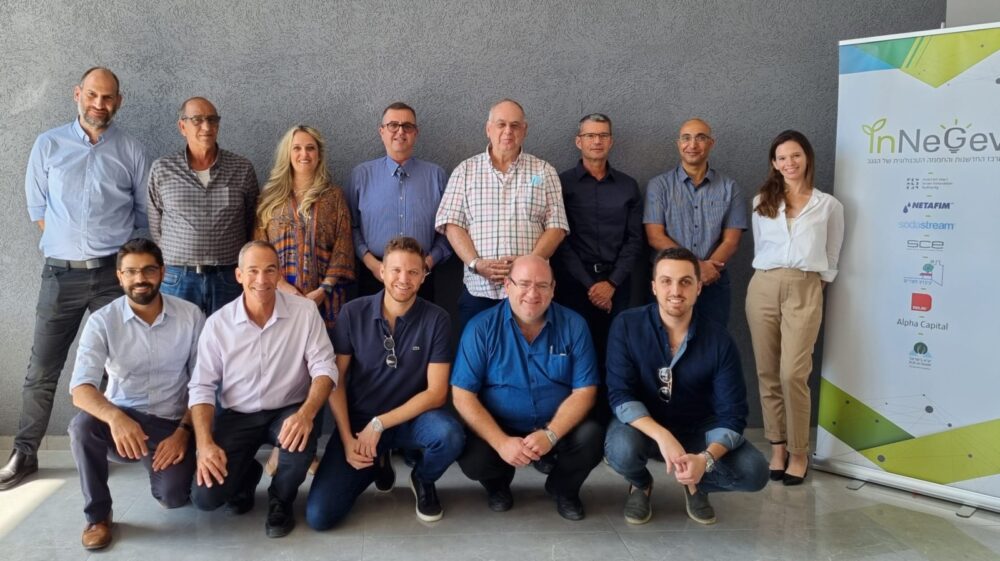
InNegev’s board of directors and team. Top from left: Yuval Lazi, Dror Karavani, Lilach Shushan, Zeev Miller, Dror Green, Ophir Golan, Noa Isralowitz; bottom: Assaf Yerushalmi, Kobi Liberman, Udi Arev, Amir Tzach. (Anat Levi Tzvi/courtesy InNegev)
Academic and nonprofit food-tech
Going back up north, the Carasso FoodTech Innovation Center was inaugurated in September at the Technion-Israel Institute of Technology in Haifa.
The center will house R&D for industrial production, a startup hub, packaging laboratory, industrial kitchen, tasting and evaluation units, and an educational visitor area.
Prof. Marcelle Machluf, dean of the Technion Faculty of Biotechnology and Food Engineering, said that the Covid-19 pandemic “has only emphasized the importance of food and biotechnology in maintaining our existence and meeting future existential challenges. To address the many challenges in this field, including access to healthy, affordable food and innovative medical treatments, we need advanced infrastructure that will enable the integration of new engineering and scientific tools.”
Yoel Carasso, chairman of Carasso Motors and Prof. Marcelle Machluf, dean of the Technion Faculty of Biotechnology and Food Engineering. (Rami Sheloush/Technion Spokesperson’s Office)
In Tel Aviv, the Israeli not-for-profit Start-Up Nation Central joined forces with global entrepreneur network TiE to advance Israeli and Indian food- and ag-tech solutions for novel foods, post-harvest storage, alternative protein, food safety and packaging.
Israeli startups selected for the mentorship program so far include multiple award-winning grasshopper protein company Hargol, automated cooking manufacturer Kitchen Robotics, vision-based robotic controller Deep Learning Robotics and produce storage humidity control solution UmiGo.
Fighting food scarcity for the future
Start-Up Nation Central CEO Avi Hasson noted that farmers face increasingly harsher weather conditions, environmental pollutants and soil depletion.
Coupled with population growth and increased product demand, these issues increase global concerns about food security.
“Technologies that have the potential to either improve crop yields or transform, preserve, and tailor foods with improved functional and nutritional values will ensure a stable supply of food in the future,” said Hasson.
The Kitchen’s Zaidman predicts that as the sector matures, we’ll see more segmentation.
“For example, Aleph Farms started working on cultivated meat before there was any existing technology. A lot of the innovation we’ll see in the next two to three years will be much more specialized in certain aspects that support this industry,” he explained.
“In terms of global trends, alternative proteins will continue as a strong trend because we’re just scratching the surface of consumer interest. There’s a lot of potential in alternative dairy, seafood and eggs.”
Aviv Oren, business engagement and innovation director of the Israeli branch of the Good Food Institute, says Israel hosts about 100 alt-protein startups and 28 alt-protein research labs in academic institutions.
“Israel now ranks second in the world behind the United States in its total number of fermentation and cultivated meat companies,” Oren noted.
GFI Israel Managing Director Nir Goldstein sees Israel’s role as potentially monumental.
“With governmental support in this industry, Israel, which currently exports only five percent of the food it produces, could become a global supplier of raw materials and advanced production technologies for alternative proteins,” he said.
In the tense skies over Central Europe, where Russian and U.S. planes patrol opposite sides of the Belarus–Poland border, Russian military video shows their pilots using slide rules — raising the risk of accidental collisions or other midair tragedies.
Slide rules, which perform multiplication and division, and can calculate different logarithmic scales, largely disappeared from U.S. military bases and college classrooms in the early 1970s, replaced by pocket calculators. That’s why it’s surprising to see the Russians using them in 2021 while traveling hundreds of miles per hour, thousands of feet above a violent border dispute.
In the video, shot aboard a Tupolev Tu-160 strategic bomber and released by the Russian Ministry of Defense, a crew member appears to operate a slide rule for a calculation. The incident took place on Nov. 11 during “patrols” in which the nuclear bombers were escorted by a pair of Su-30SM fighters of the Belarusian Air Force, the ministry said in a statement.
First produced in 1984, the Tu-160 is the largest and heaviest combat aircraft in use by any air force in the world today. It’s also the fastest bomber of its type, capable of speeds surpassing Mach 2.
“[Slide rules are] long replaced my modern technology — IPads, computers, calculators, as well as other technology,” says Dean J. Miller spokesmen for the U.S. Air Force Academy. “However, each cadet is required to take an Airmanship course as part of their experience as a cadet. One of those Airmanship courses leads to the possibility of joining the Academy’s Cessna Aircraft Flying Team. That team trains for an annual competition where flight planning must be completed using a slide rule.”
Miller says the E6B slide rule is used in these circumstances for calculations of the flight path, speed and altitude. A retail listing for the E6B on the Aviation Supplies and Academics (ASA) website describes it as “the best slide-rule-style flight computer on the market, with solid aluminum construction and easy-to-read lettering.”
The E6B slide rule is sometimes used by American cadets for calculations of the flight path, speed and altitude. (Dave Faige/CC BY-SA 3.0)
Slide-rule aficionados who examined the video noted on social media that the E6B is much more advanced than the linear slide rule used by the crew of the Tu-160.
“There are several reasons for using slide rulers,” says Yarl Qman, a former civilian on-board technician who worked with Soviet aircraft. “The calculations are sufficiently accurate and quick. It is easy to use special templates. For example, fuel consumption as a function of humidity and pressure. They also don’t need electric power and are therefore nuclear explosion-proof.”
A detonation of a nuclear weapon creates an electromagnetic pulse (EMP), and if they continue the use of a slide rule aboard Russian aircraft, it would not be the first time.
A member of the U.K.’s Women’s Auxiliary Air Force using a slide rule for mathematical calculations in 1941. (Keystone Features/Getty Images)
Colonel Viktor Belenko was on a routine training flight in 1976 with his MiG-25 out of an airbase in the Soviet Far East when he suddenly dived his plane toward the sea and headed to nearby Japan. In an aircraft capable of speeds over Mach 3, he easily evaded Japanese aircraft scrambled to intercept him and landed in a civilian airport and ultimately defected. It was the first time American officials had a chance to inspect a MiG-25.
In addition to the aircraft’s high speed, what most marveled U.S. investigators was its use of vacuum tubes long after the United States had switched to semiconductors. Was the Soviet Union really that far behind? Investigators realized the use of vacuum tubes was intentional, as the aircraft would still be able to operate after an EMP. A sobering thought, given that it implied the Soviet military thought a nuclear exchange with NATO was likely.
Such Cold War thinking may still predominate in the Russian military as the sighting of the slide rule aboard the Tu-160 “Blackjack” suggests. Even the plane’s mere presence is a throwback — the Russian Air Force only operates 16 of the heavy aircraft.
Edited by Kristen Butler and Fern Siegel
Visuals produced and edited by Claire Swift and John Diaz