Home Blog Page 115

How James Giles Jr., 18, Became Birmingham’s Most Gifted Tennis Star

0
Last week, James Giles Jr., 18, a senior and standout tennis player from Ramsay International Baccalaureate High School, signed to play at Webster University in St. Louis, Missouri. (Marika N. Johnson, Special to the Birmingham Times)

By Barnett Wright | The Birmingham Times

Even before James Giles Jr. could hit a ball over a tennis net, Coach Nathan Echoles knew he had a star on his hands.

“I have been coaching [Giles] since he played 10 and under,” said Echoles, who coaches at Birmingham’s George Ward Tennis Center. “I recognized his natural ability before he could hit the ball over the net. He had great hand-eye coordination [and] footwork, and he could track the ball even at 8 years old. I knew he would make a great tennis player one day.”

Last week, Giles, 18, a senior and standout tennis player from Ramsay International Baccalaureate High School, signed to play at Webster University in St. Louis, Missouri, after narrowing the list from dozens of institutions. [UPDATE — Giles decommitted from Webster in March and signed with Methodist University in Fayetteville, NC.]

“Hustle”

Like many young people who grew up in the Smithfield Estates neighborhood in Birmingham’s Pratt community, Giles wanted to be a football or basketball player.

“[Those were the sports] I was exposed to,” he said. “When I was introduced to tennis, I really wasn’t as interested as I am now. At first, I continued to play soccer and basketball before concentrating on tennis. [Eventually], I started to excel at tennis and became passionate about it.”

He also worked hard on the tennis court.

“I gave [Giles] the nickname ‘Hustle,’” said Coach Echoles. “There is not a ball that he will not go for. He hustles no matter what. He was also given the nickname due to his work ethic on and off the court.”

It was his powerful serve—which Giles describes as “a blend of power and precision”—that set him apart.

That part of his game allows him “to dictate points from the very start,” the teen said.

“What makes [my serve] effective is my ability to mix up speeds, spin, and placement, keeping my opponents guessing,” he explained. “Over time, I’ve worked hard on my toss consistency and fluid motion, which have helped me generate both pace and accuracy.”

Throughout his young career, Giles has earned numerous accolades and recognition at both the state and national levels. His resume includes playing on the United States Tennis Association (USTA) Team, where he led the 12 and Under (12U) Intermediate Junior State Championship Team playing No. 1 singles and doubles. At age 14, he led the 18U Beginner Runner Up for the Alabama Junior State Championship Team, playing No. 1 boys singles. Giles also played boys doubles and mixed doubles for the Alabama High School Athletic Association (AHSAA) North-South All-Star tennis squad — where he was the only Birmingham City Schools student, the only Black male, and one of two Black students invited to compete.

A lot of his success came against older competition, said Giles.

“Playing against older, stronger opponents forced me to elevate my game much faster than I would have otherwise. Their experience and physicality pushed me to improve my shot selection, mental toughness, and overall strategy. It also taught me how to handle pressure and stay composed in difficult situations, which has been invaluable throughout my career.”

JLast week, Giles announced his decision to play at Webster University in St. Louis, Missouri, after narrowing the list from dozens of institutions. (Provided).

Tennis Beginnings

Giles started playing tennis at age 8, while attending after-school care at the YMCA Youth Center in downtown Birmingham. A graduate student intern arranged for weekly tennis lessons at the Mountain Brook YMCA, and Giles, who had fallen in love with the sport, asked his mom if she would let him take additional lessons.

While practicing at George Ward Park, the pro shop manager noticed Giles’s enthusiasm and invited him to play rally ball, which is on a 42-foot tennis court (service line to service line) and is usually for kids from 4 years old to 10 years old that are learning forehand and backhand.

After just two weeks, Vila Fischer, a tennis coach at George Ward, had Giles evaluated for USTA Team Tennis. His prior experience in youth soccer had already equipped him with good footwork, and it was just a matter of refining his tennis skills.

As part of the George Ward teams, he contributed to two state championships in the 12U category. At age 14, he played in the 18U division with Top Notch Tennis (TNT), led by Coach Gerald Henderson. Although his team finished as runners-up, Giles’s sportsmanship earned him a prestigious award that year. In 2024, he returned to play with TNT and was a key member of the 18U intermediate championship team.

Stellar High School Career

Giles gained even more interest in tennis while he attended Birmingham’s Ramsay International Baccalaureate High School. In 2024, he was invited to join the AHSAA North-South All-Star tennis team.

“High school tennis introduced me to a more competitive and team-oriented environment, which made the sport even more exciting. I started dedicating more time to training, refining my technique, and studying the game to gain an edge. Competing for my school and striving to set records motivated me to push myself harder than ever before.”

His most satisfying tennis victory was breaking the all-time-wins record for Ramsay, he said.

Giles, who is currently 12-0 in singles matches, broke the existing record of 53 wins last year against Leeds, which got him to 54. That number is now at 71 overall wins, with 56 of them being singles and the overall count including doubles.

“That’s a goal I had set early in my career,” he said. “That match represented years of dedication, sacrifice, and perseverance, proving to myself that my hard work had paid off. Knowing that I left my mark on the program and inspired future players made the moment even more special.”

He continued to excel outside of school, as well. He was selected to represent George Ward Park at four-day Leadership Camp at the USTA National Campus in Orlando, Florida; he was among several young people, ages 12 to 16, chosen from 12 different National Junior Tennis and Learning (NJTL) chapters. Additionally, he received a scholarship to train at the National Junior Tennis Championship Center in College Park, Maryland, home to tennis phenom Frances Tiafoe.

“Tennis is unique because it challenges both your physical and mental abilities. It requires strategy, endurance, and quick thinking,” Giles said. “Unlike many other sports, it’s a lifelong game that can be played at any age, making it accessible and rewarding for years to come. The thrill of competing, the satisfaction of improving, and the friendships built along the way make it truly special.”

Coach

And the teen is more than just a tennis player. His experience as the pro shop manager at George Ward and coaching at George Ward and Learning Excellence Through Tennis, as well as his participation in the USTA coaching apprenticeship program have enabled him to become certified as a Level I Professional Tennis Coach.

“I became a coach because, as I was playing tennis, I found that I really enjoyed playing and mentoring other players. I started helping other players in the community and at school,” he said.

As a coach, Giles wants beginners to understand the importance of footwork, consistency, and patience in developing their skills.

“Tennis is as much a mental game as it is physical, so I emphasize staying positive and learning from mistakes rather than getting frustrated. Most importantly, I encourage [beginners] to enjoy the process and find their own style, making the game fun and rewarding,” he said.

He added that there’s more to the game than just winning all the time. There are no losses, just lessons.

“One of the toughest matches I ever played was against a top-seeded player who exposed the weaknesses in my game,” he said. “I struggled with consistency under pressure and realized that I needed to improve my mental focus and adaptability. That match changed my approach to training, making me prioritize mental toughness and strategic adjustments.”

As for the future, he can’t wait to begin his collegiate career.

“Tennis has shaped me in so many ways, teaching me discipline, resilience, and the value of hard work. I’m grateful for the opportunities the sport has given me, and I’m excited for the next chapter, whether it’s playing, coaching, or pursuing my passion for sports communication. No matter where life takes me, tennis will always be part of who I am.”

Updated on 4/26/2025 to show where Giles will now be attending college. 

Alabama State University’s Road to the 2025 Men’s NCAA Tournament

0
For the first time in 14 years, Alabama State University basketball is going to the NCAA Tournament. (AP)

The Birmingham Times

For the first time since 2011, the Alabama State University Hornets are in the Men’s NCAA Tournament. The Hornets are the No. 16 seed in March Madness. They will play in the first four against Saint Francis in Dayton.

The Hornets would advance to the Round of 68 against No. 1 overall seed Auburn in the South Region if they can win.

The Hornets (19-15) finished fifth in the SWAC before going on a magical conference tournament run that ended with a 60-56 win over Jackson State, and former ASU head coach Mo Williams, on Saturday night. It is the first NCAA tournament appearance for third-year coach Tony Madlock, who won just eight games in his first season.

It is the fifth tournament appearance since 2001 for the Hornets, but they are still looking for their first win. They have been a 16-seed each time, falling in the first round in 2009 and 2011 and to one-seeds Michigan State and Duke in 2001 and 2004, respectively.

Following a thrilling victory over Jackson State in the 2025 SWAC Tournament title game, ASU won the automatic bid.

To reach the 2025 NCAA Tournament, the Hornets beat Texas Southern. Grambling State, and Jackson State over a three-day period in Atlanta to clinch the SWAC’s lone entry into the NCAA Tournament.

In the SWAC Tournament final, CJ Hines scored a team-high 20 points including going 4-for-6 from 3-point range.

Alabama State will look to become the fourth team in the last five seasons to give the SWAC a victory in the NCAA Tournament.


Severe Weather Threat in Alabama: When to Expect Storms to Arrive Where You Live

0

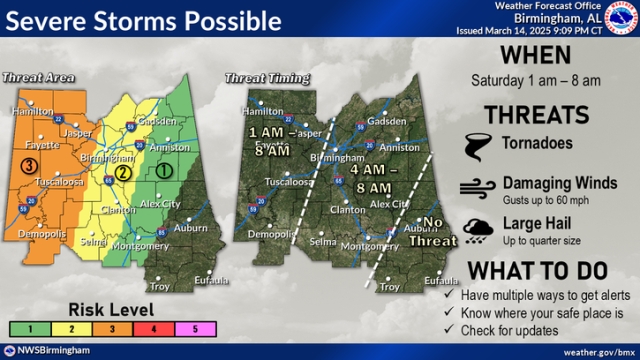
Alabama is facing storms today that have the potential to be significant, and a Level 5 out of 5 risk has been added for part of the state in the latest update from NOAA’s Storm Prediction Center.

Saturday’s storms could come in two forms — individual supercell storms in the afternoon and then a squall line of storms later in the evening.

Here is full coverage of Alabama’s severe weather threat

Below is the severe weather outlook for Saturday — now with areas in a Level 5 risk in pink:

Saturday severe weather outlook update

Severe weather is increasingly likely for the entire state of Alabama on Saturday. A rare, Level 5 out of 5 risk has been added for part of the state in the latest update on Friday afternoon. Most of the rest of the state is in a Level 4 of 5 risk, which means that numerous severe storms are expected. Storm Prediction Center

NORTH ALABAMA

Saturday: Severe weather is more likely on Saturday. Severe storms could get going as early as 11 a.m. Saturday in north Alabama and track eastward through the afternoon.

North Alabama Saturday

Here’s the north Alabama outlook for Saturday. NWS

The northern and eastern part of the region will have a Level 3 risk, and the southern part will have a Level 4 risk.
Multiple rounds of storms will be possible Saturday.
A strong, long-track tornado will be possible as well as straight-line winds and hail.
Storms could last through midnight Saturday night.
CENTRAL ALABAMA

Saturday: Part of central Alabama has also been upgraded to a Level 5 risk on Saturday, including the Birmingham and Tuscaloosa areas. All of the rest of central Alabama will have a Level 4 risk on Saturday.

Strong, long-track tornadoes, large hail and damaging winds will all be possible with Saturday’s storms.
Storms could reach the western part of central Alabama by noon on Saturday and head eastward through the nighttime hours, exiting the state early Sunday morning.
SOUTH ALABAMA
Saturday: A Level 5 risk has been added for the northern part of southwest Alabama as of Friday afternoon. Nearly all of south Alabama will have a Level 4 risk for severe weather on Saturday.
The weather service said isolated storms or supercells will be possible through the afternoon.
Then forecasters expect a squall line to enter the state later Saturday afternoon into early Sunday morning.
Tornadoes, including some strong ones, damaging winds and hail will all be possible on Saturday.
SOUTHEAST ALABAMA
Storms may not reach that area until Saturday evening. Nearly all of southeast Alabama will have a Level 4 risk for severe storms on Saturday.
Storms are expected to exit the state during the morning on Sunday, and calmer weather is expected through the first half of next week.
So far no severe weather is in the forecast for Alabama after Saturday.

UAB Professor Shares Trends and Tips for First-Time Homebuyers

0
A UAB professor in the Department of Accounting and Finance shares whether 2025 will be any easier for homebuyers and provides advice for first-time homebuyers. (Adobe Stock)

By Tehreem Khan | UAB News

Homebuying for first-timers can be a daunting financial decision, given complex negotiations and financial mazes. But it does not have to be.

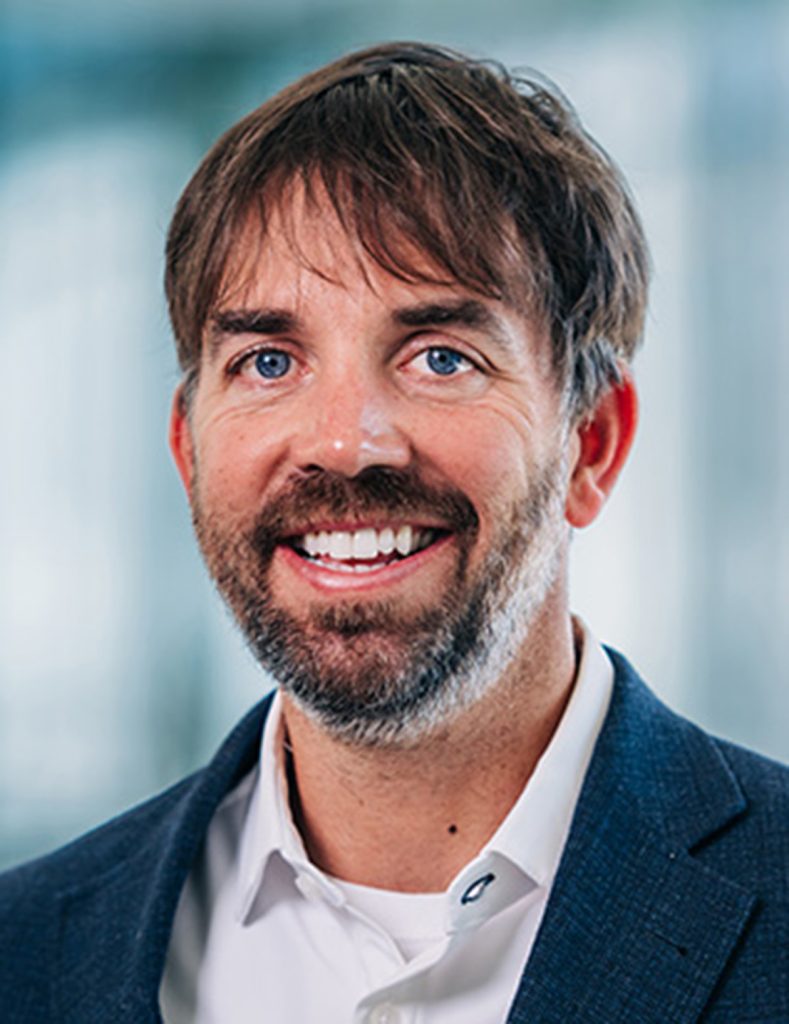
Chris Edmonds, Ph.D.

Christopher Edmonds, Ph.D., professor in the Department of Accounting and Finance at the University of Alabama at Birmingham Collat School of Business, shares whether 2025 will be any easier for homebuyers and provides advice for first-time homebuyers. 

Trends

Edmonds says housing is not as expensive as it seems. He urges first-time buyers not to be discouraged by headlines proclaiming housing unaffordability. In reality, the current market is more accessible than many believe.

“The perception of unaffordability stems largely from comparing today’s rates and prices to the unusually low levels we experienced in the last decade,” Edmonds said. “The Housing Affordability Index, which measures this balance, currently reads 100.7, just over the 100 benchmark that indicates a median-income family can secure a mortgage for a median-priced home.”

However, local market conditions can vary significantly, and in some areas, rising prices have pushed homes into an unaffordable territory despite the overall national balance. In these areas, Edmonds says, affordability will remain a challenge in 2025. He predicts prices to remain high and mortgage rates to slightly decline but remain higher than pre-pandemic levels. Inventory is slowly recovering from the bottom level hit in 2022 but remains considerably low compared to historical averages.

In response to these challenges is a growing new strategy ­­–– co-buying. Co-buying is when two or more people purchase and own a property together, making homeownership more affordable and accessible. According to Edmonds, this practice can help first-time homebuyers afford a better home by splitting the down payment, mortgage and other ongoing costs while building equity together.

“With rising home prices, high mortgage rates and strict lending requirements, many single homebuyers with one source of income are finding it difficult to afford a home on their own,” Edmonds said. “Co-buying can provide shared responsibility for maintenance and expenses, reducing financial strain.”

However, when co-buying, it is essential to have a clear legal agreement outlining ownership shares, exit strategies and responsibilities to avoid future disputes.

Another useful strategy for individuals with limited cash is sweat equity ­­­­–– the value added to a house through hard work, rather than financial investment. Edmonds says this investment can yield substantial returns.

“Buying a fixer-upper, meaning a house in need of repairs in a desirable area within budget, can be a smart investment, as strategic renovations can significantly increase a home’s value,” Edmonds said.

Chris Edmonds' HeadshotLoan choices

According to Edmonds, the choice between fixed- and adjustable-rate mortgages for first-time homebuyers largely depends on their comfort with risk and plans.

“Fixed-rate loans offer predictable monthly payments and steady interest rates, ideal for people who plan to stay in the house long term or prefer financial consistency,” Edmonds said. “Adjustable-rate mortgages typically start with lower rates but can increase after an initial period, which works well for people planning to move or refinance before any rate adjustments occur.”

Another common trend in today’s first-time homebuyer market is private mortgage insurance, or PMI, which allows first-time homebuyers to purchase a home with a less than 20 percent down payment.

According to Edmonds, PMI enables homeownership and equity building sooner rather than waiting years to save. However, it comes at an extra cost ­­–– increasing monthly housing costs.

“PMI typically adds 0.3 percent to 1.5 percent of the loan amount annually, and removing it can take years unless home values rise significantly or extra payments are made,” Edmonds said.

To minimize the impact of PMI, Edmonds recommends exploring loan options like the Veteran Affairs or the United States Department of Agriculture loans that do not require these payments.

“PMI can be a useful tool for getting into a home sooner, but buyers should have a strategy to eliminate it as quickly as possible,” Edmonds said. “Some lenders offer lender-paid PMI in exchange for a slightly higher interest rate, but this can be more expensive over time. If PMI is necessary, request cancellation as soon as 20 percent equity is reached.”

15-year versus 30-year mortgage

A person’s current financial situation and long-term goals are key considerations when deciding between a 15-year or 30-year mortgage, Edmonds says.

“A 15-year mortgage allows you to build equity faster and save significantly on interest, but it comes with higher monthly payments,” Edmonds said. “On the other hand, a 30-year mortgage offers lower monthly payments and more flexibility, although the buyer will pay more interest over time.”

Documents checklist for first-time homebuyers 

  • Proof of income (W-2, tax returns and pay stubs)
  • Credit reports
  • Bank statements
  • Proof of employment
  • List of debts and assets
  • Pre-approval documents from a lender
  • If receiving financial help from family, a gift letter confirming no repayment is required.

Edmonds recommends starting by assessing financial health, setting a budget and getting pre-approved for a mortgage to understand borrowing limits, researching neighborhoods, and working with a trusted real estate agent. Following are some additional tips:

  • Know your “true” budget. Consider property taxes, insurance, homeowners association fees, maintenance and utility costs along with mortgage. Use a mortgage calculator to estimate monthly expenses realistically.
  • Improve your credit score. A higher credit score gets better interest rates, saving thousands over the life of the loan. Pay down debts, avoid new loans and check credit report for errors before applying.
  • Get the home inspected. Even if a home looks perfect, unseen issues like foundation problems, plumbing issues or outdated electrical systems can become costly.
  • Shop around for mortgages. Compare rates from multiple lenders including banks, credit unions and online lenders to find the best terms. Focus on the annual percentage rate, which provides a holistic view of the interest rate.
  • Be prepared for the unexpected. Set aside extra funds for repairs and emergencies. Homeownership often comes with surprise costs, so having an emergency fund can prevent financial strain.
  • Negotiate and understand the offer. Negotiation is key — discuss the price, closing costs or necessary repairs. A skilled real estate agent can help you craft a competitive yet reasonable offer while ensuring you understand all contract terms before signing. However, in today’s tight real estate market, expect competition from multiple buyers, which may limit negotiating power.
  • Think long-term. Consider how long you plan to stay in the home and whether it fits your future lifestyle and financial goals.
  • Avoid major financial changes before closing. Lenders check financial status again before finalizing the loan. Avoid taking on new debt, changing jobs or making large purchases like a new car before closing, as it can impact your loan approval.

Tornado Season is Here. UAB Emergency Management Shares Tips on How You Can Be Prepared.

0
A home that was damaged in a tornado that affected north Jefferson County areas a few years ago. (File)

Spring marks the beginning of severe weather season in the South. While tornadoes can happen at any time of the year, peak tornado season in Alabama is March through May, according to the National Weather Service. Therefore, experts at the University of Alabama of Birmingham are encouraging everyone to take steps now to prepare for the threat of severe weather.

“As we head into tornado season, this is the time to ensure you have all the items on your severe weather checklist ready to go,” said Eddie Coar, director of Emergency Management at UAB. “Severe weather can be unpredictable. It is important for everyone to know their risk and create an emergency plan, so they are prepared when severe weather hits.”

Watch vs. warning

A tornado watch is issued when tornadoes are possible in or near the watch area. During a tornado watch, it is important to do a quick refresh on the emergency plan in place and be prepared to act quickly if a warning is issued or a tornado is suspected. A tornado warning means a tornado has been sighted or is indicated by the weather radar, and there is an imminent threat of danger to life and property. In the event of a tornado warning, individuals should immediately seek refuge in the safest location possible away from windows. This could be an interior room or the lowest floor of a sturdy building. If located in a mobile home, vehicle or outdoors, find the closest, sturdiest shelter possible. Additionally, know the signs of a tornado, including a rotating, funnel-shaped cloud, an approaching cloud of debris or a loud roar like a freight train.

Before a tornado

Have a family tornado plan in place, including knowing the safest place to take shelter in the event of a tornado and deciding on a predetermined meeting place after a disaster. Additionally, prepare an emergency supply kit that is easily accessible, and ensure important documents are stored in a water- and fire-proof safe.

UAB Emergency Management has prepared checklists of items to stock an emergency kit in preparation for the onset of severe weather. This checklist is meant to be a guide only. Personal needs may vary.

  • Helmets (such as bike, motorcycle, athletic) for every member of the family
  • Sturdy shoes, to safely walk through glass and debris
  • First aid kit, with extra prescription and nonprescription medications
  • Battery-powered flashlight and extra batteries
  • Battery-powered radio, weather radio
  • Three-day supply of food items containing protein such as nut and energy bars, canned food, manual can opener
  • Three-day supply of bottled water for each person and pet
  • ID such as driver’s license; cash and credit cards
  • Cellphone charger
  • Baby supplies, if a small child is in the household
  • Copy of family emergency and communication plan
  • Emergency Financial First Aid Kit
  • Any other essential personal items

During a tornado

During a tornado, individuals should immediately get to a safe location that they have identified. Those living in a mobile home should get to the nearest permanent structure they can find. Andrew Edwards, M.D., executive vice chair and vice chair of Education in the UAB Department of Emergency Medicine, says it is important for individuals to know where their safe space is ahead of time, so they can quickly get there in the event of a tornado.

“The best safe location for most people will be in the basement,” Edwards said. “If there is no basement, go to an interior room on the ground floor of the house away from windows, such as a bathroom, closet or hallway. Do not go outside to try to see if the tornado is close as patients have sustained significant injuries from trying to do that in the past. Take shelter as soon as you hear the warning.”

While in their safe space, everyone should take the necessary steps to protect themselves from injuries.

“Blunt force trauma is the most common type of injury we see in the emergency department after a tornado, with the majority of the injuries coming from being struck by flying objects or from buildings that collapse,” Edwards said. “Focus on protecting your head and neck with your arms and a helmet if available.”

Individuals should surround themselves with materials such as blankets, mattresses and furniture.

While there is no safe option when caught in a tornado in a car, there are less dangerous options, according to Ready.gov.

  • If the tornado is visible but far enough away, individuals may be able to drive out of the tornado’s path by moving at right angles to the tornado.
  • If someone is caught in extreme winds or flying debris, they should park the car quickly outside of the traffic lanes and stay in the car with the seat belt on. Individuals should put their head down below window level and cover their head and neck with their hands and a blanket, clothing or other cushion if possible.
  • If there is a nearby area that is noticeably lower than the level of the roadway, get out of the car and lie in the lowest area possible and cover your head with your arms.
  • Avoid seeking shelter under bridges, which can create deadly traffic hazards while offering little protection against flying debris.

“When a tornado touches down, downed trees and power lines block off roads, making access to many injured patients extremely difficult for EMS,” Edwards said. “In addition to the difficulty of getting to the hospital, the emergency departments become overwhelmed, and there are delays in care for those not critically injured. The best solution for anyone is to try to prevent injuries ahead of time.”

After a tornado

After a tornado, families should meet in their predetermined meeting place and wait for instructions from emergency personnel. Try to conserve phone batteries by saving calls for emergencies and using text messages or social media to communicate with family and friends. For updated information, listen to emergency alert systems, weather radios and directions from local officials. Contact first responders for individuals who may need medical attention. Stay clear of fallen power lines and broken utility lines, and avoid stepping on broken glass, nails and other sharp objects. Stay out of heavily damaged buildings as they could collapse. During cleanup, wear appropriate gear such as thick-soled shoes, pants and work gloves.

UAB Emergency Management has a full list of ways you can prepare for the threat of severe weather here.

Birmingham’s LaDarrius ‘LHUT’ Hutcherson Presents ‘Boldy Black’ Eat & Greet 

0
LaDarrius "LHUT" Hutcherson and V94.9's Lady Woo on stage during the Second Annual Eat & Greet. (Provided)

By Sym Posey | The Birmingham Times

For his Second Annual Eat & Greet event this year, Birmingham’s LaDarrius Hutcherson, aka LHUT, wanted to focus on Black excellence.

The popular social media influencer has 61,000 followers on TikTok, and is known for his reviews of local Birmingham restaurants and activities. LHUT said he wanted an event that brought in more than just those in his circle.

With V 94.9’s Lady Woo as moderator, LHUT titled his event “Boldly Black” and assembled a panel that included judges; real estate broker; television personality; financial adviser and social worker … “people that are in our community that are trailblazers within their industry,” he said.

“Last year I had a panel of different influencers. It went really well, but this year I wanted to diversify the panel a little bit more because I feel like everyone doesn’t want to be an influencer. I wanted people to hear from others that are outside of what I do,“ he said.

Hutcherson said his inspiration for this event came from his social media.

“A lot of my followers were writing and saying, ‘I want to go eat with you,’” Hutcherson said. “When I initially came up with the idea, I was thinking of something where I would have a long table and I could invite 35-40 people, and we would chitchat and talk. But that wasn’t enough for me. I think highly of myself, but I think that something like that is too dramatic.”

Hutcherson said he wanted something that would allow him to walk boldly in his Blackness.

“That’s why the theme this year was ‘Boldly Black,’” he said. “People thought that meant the attire. I left it up to them and their interpretation, but what I meant [was] I’m walking perfectly in my Blackness, and I don’t deviate away from that. I don’t try to make people feel uncomfortable with it, but it is what it is. I’m Black and I wanted the event to represent that in the very best way. That’s why everyone that was there, whether they are a panelist, or a sponsor was either Black or minority.”

The influencer said he was pleased with the program.

“This event showed me that no matter what is going on in the world, we still have so much power. It was so much power in that room. Not just in my panelist but people that were in the audience that were there,” he said. “They are powerful as well. They came and they left full.”

To see more from LaDarrius Hutcherson, visit his sites on Facebook (LaDarrius Hutcherson), Instagram (@lhut­_), TikTok (@lhut_), and YouTube (@LHUTTV).

Birmingham Water Works Announces Fix a Leak Week Dates

0
Streamline Plumbing and Drain said a few simple steps like dripping a faucet can help save thousands of dollars when it gets cold out. (Adobe Stock)

Birmingham Water Works (BWW) has announced its annual partnership with the Environmental Protection Agency for Fix a Leak Week.

The public awareness campaign is held for customers to learn about potential leaks in their home and how to repair them.

Officials say from March 17-24, customers of BWW are encouraged to visit the Customer Service Center, talk with staff to learn about common leaks in their home, and make an appointment for a BWW technician to visit and inspect portions of their plumbing.

BWW says household leaks contribute significantly to serious water waste and increase customer bills year after year. It is estimated that about 10% of homes have leaks that waste 90 gallons or more a day due to common causes like worn toilet flappers, dripping faucets and other leaking valves. BWW staff and leadership hope that with greater awareness of these issues and a helping hand, customers can save themselves time, money and the hassle of having to hire a plumber to repair small leaks for them.

“Fix a Leak Week is something our staff looks forward to all year long, as it’s a terrific way to directly impact our customers and help them with issues they may not know they’re having,” said Michael Parker, Interim Senior Manager of Customer Care. “At BWW, we take customer care very seriously and Fix a Leak Week is one of the many ways that we help customers avoid additional costs that can come with faulty plumbing.”

While Fix a Leak Week has been occurring for many years, BWW discontinued the practice of visiting customers at their homes due the COVID-19 pandemic. Now that the practice is being reinstated, BWW says teams are excited about helping customers directly again, as well as providing them with free toilet flapper kits (while supplies last).

“Fix a Leak Week is a cornerstone of our customer outreach efforts and is such an exciting week because it helps us be proactive with customer issues, rather than reactive,” said Mac Underwood, General Manager of Birmingham Water Works. “We hope to see customers from all five counties we serve and encourage everyone to join us to learn how to save water at home.”

Customers can schedule their free in-home consultation by calling 205-244-4000, or by visiting customer service representatives at BWW. To learn more about identifying leaks in your home and easy ways to address them, visit this website.

Jefferson County’s Dr. Walter B. Gonsoulin Jr. Named National Superintendent of the Year

0
Jefferson County Schools Superintendent Dr. Walter B. Gonsoulin Jr. has been selected by U.S. News & World Report as one of its 2025 Best Leaders in public service, business, healthcare and education. (File)

jefcoed.com

Jefferson County Schools’s Dr. Walter B. Gonsoulin Jr. has been named the National Superintendent of the Year by AASA The School Superintendents Association, the first from Alabama to win the award. The announcement was made last week during the National Conference on Education in New Orleans, Louisiana.

AASA, The School Superintendents Association, is the premier association for school system leaders and serves as the national voice for public education and district leadership on Capitol Hill.

“To me, this is one of the greatest honors of my life.  As a child growing up in New Iberia, Louisiana, I never could have imagined achieving this honor,” said Gonsoulin. “However, I want to be clear, while my name is on the award, I am only one part of it.  I would not be in this position if it were not for the hard work of the teachers, administrators, support personnel, board members, students, and parents.  They are the heartbeat of Jefferson County Schools.”

A $10,000 check was presented to Gonsoulin, which will go to a student in the high school from which the superintendent graduated or the school now serving the same area.

“This is a great day for Alabama,” said Dr. Eric Mackey, Alabama State Superintendent. “It’s a way for us to shine the light on our very best, who does so much for children on a daily basis.  Of course it’s big for Jefferson County.  It’s big for Dr. Gonsoulin.  But this is big for Alabama because it tells the whole country that we’ve got great people doing the right thing for kids every day.  I couldn’t be more proud.  I remember the day he came to Alabama, and I’m so glad he stayed.”

Dr. Gonsoulin received his award this week in New Orleans. (Provided)

Gonsoulin was named the superintendent of Jefferson County Schools in November 2019.  Under his leadership, JEFCOED has developed high school Signature Academies.  This model led to a 357 percent increase in the number of students that earned industry credentials, indicating that those students possess the qualifications for entry-level employment.

College and Career Readiness rates have steadily increased during Gonsoulin’s tenure, including a four percent jump last year.  The amount of scholarships offered to JEFCOED seniors has also continually grown.  The class of 2024 set a new district record with over 108 million dollars.  The district now also funds dual enrollment classes for all students making higher education more accessible.  Participation in those courses has more than doubled since the initiative began.

“There are going to be other districts all over the country that are going to say, ‘what is going on in Jefferson County?  We need to know!’  The initiatives, the programs, the hard work that we all do, we already knew that it was important.  And we already knew that we were doing the right thing. But this seals the deal.  It makes it legitimate, that not only the district and the people that we serve know it, not even the state, but the country knows it as well,” said Gonsoulin.

“We are so excited!  Dr. Gonsoulin is the one who leads the charge on ‘this is a family’ and this is a family affair.  From the deputy superintendents, the board, teachers, custodians, all of us are celebrating for what he is representing us for,” said Ronnie Dixon, Jefferson County Board of Education President.

Amid Violent Crime, Hope Found in a Birmingham Hospital Program: How it Works

0
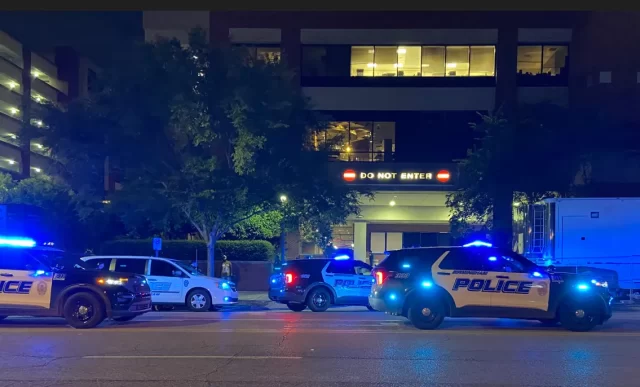
UAB hospital's violence intervention program begins in the emergency room, offering mental health and case management in an effort to prevent re-injury and retaliatory violence. (Carol Robinson, AL.com)

By Alaina Bookman | AL.com

In 2025, AL.com’s “Beyond the Violence” project, in partnership with The Birmingham Times, examines whether Birmingham can grow beyond its crime problem and become safer, healthier and happier.

Two years ago, Amiriya Rowser was lying in a hospital bed with a gunshot wound, wondering who she could trust.

Initially, Rowser didn’t want to talk to the stranger who approached her and offered support services, so she was released from the hospital with little support. But when Rowser was shot again, she said, she was all in.

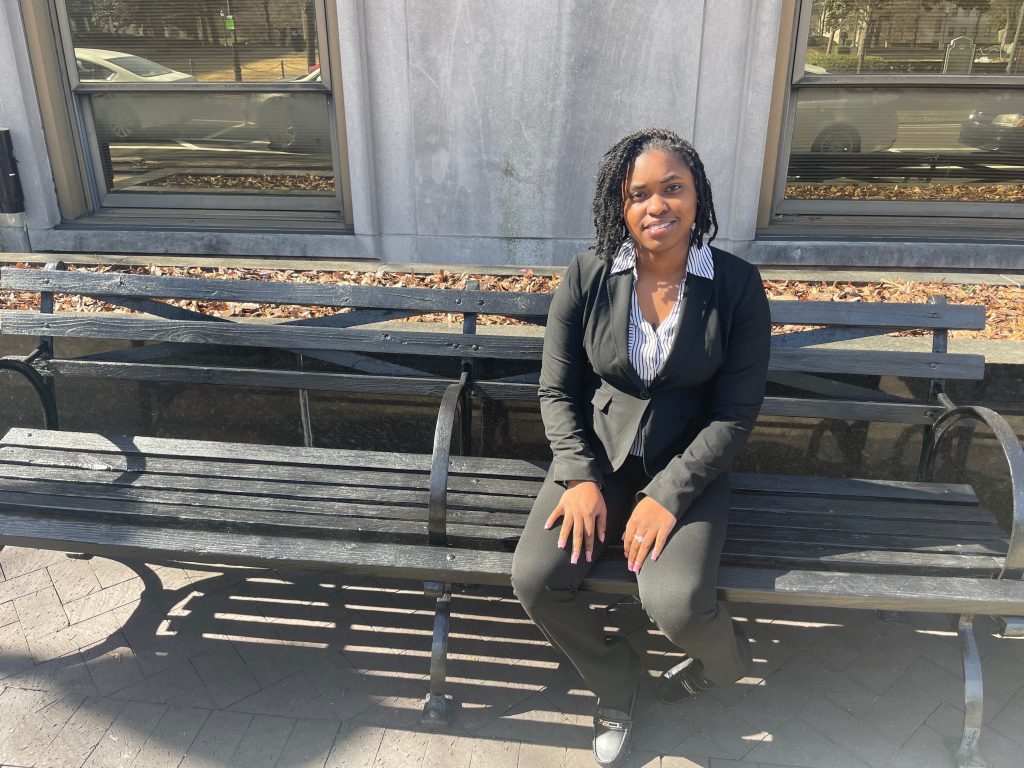
Amiriya Rowser sits outside Birmingham City Hall, after a council meeting. A two-time survivor of gun violence, Rowser works now as a violence prevention specialist with the Offender Alumni Association. She’s an advocate for violence intervention programs that could save lives. (Ruth Serven Smith, AL.com)

That’s when members of Birmingham’s Offender Alumni Association stepped in: Violence intervention specialists checked in on Rowser and helped her pay for expensive medication after she went through 16 surgeries, bills when she was unable to work and transportation when she could not walk. Rowser said members of the association are like her family now.

Rowser herself now works with the association as a violence intervention specialist. She looks forward to using her experience to help others.

Gunshot survivors often have lifelong physical and mental scars. If released from the hospital without support and resources, experts say, some may be tempted to retaliate or solve future conflict with more violence.

“The first time, I didn’t really go through with it, so I was re-injured. And the second time is when I really got active with the program, because I wanted to change for myself. I didn’t want to go through the same thing anymore,” Rowser said. “I want to make a change and show people that I’ve been through it too, and it gets better. I want them to know that someone cares.”

Rowser is a living example of a successful violence prevention tactic: Talking to gunshot victims soon after they are injured. Expanding that same Birmingham program, experts say, could save more lives.

What is a Hospital Violence Intervention Program?

Birmingham saw a devastating, record-breaking year of homicides in 2024.

In January, a new Crime Commission made a series of recommendations to stop violent crime in the city and make it “the safest city in America.” One suggestion? Expand the University of Alabama at Birmingham Hospital Violence Intervention Program, started in 2023, to local emergency departments.

The program engages gunshot victims at their bedside while they are hospitalized, offering mental health services and case management to prevent reinjury and retaliatory violence.

The city followed through with additional funding of $297,582 to create an emergency department violence intervention team that will provide services to even more gunshot victims and their families.

“They wanted to expand to the emergency department because they knew that there was a gap, that we were missing people,” Offender Alumni Association Executive Director Deborah Daniels said.

The program currently works through a partnership with the UAB Division of Trauma and Acute Care Surgery and the Offender Alumni Association, whose members were once justice-involved and now use their experiences to work with youth and adults in need. The Jefferson County Department of Health and the city of Birmingham provide financial and administrative support.

“If we’re talking about making Birmingham safer, then we need to engage with those who are being released, who are more likely to go back into a compromising situation than those who have been in the hospital and really have had time to think about and process the impact that the incident has had on their lives,” Daniels said.

Maurice Webb, 31, said members of the Offender Alumni Association helped him to navigate life’s challenges. Now, he has the chance to help others in the emergency department.

“I could apply that same knowledge and leadership into helping others and make a difference in people’s lives,” said Webb, who is now a violence intervention specialist.

“Our whole goal is breaking cycles of violence…It’s critical that we show these patients that there’s people that can help, that they can be here for you, that’s not against you. The expansion gives everyone the opportunity to know about the program. It opens up doors and resources for people. It’s empowering, and I feel like everyone should have that opportunity.”

Members of the Offender Alumni Association include (from left, first row) Deborah Daniels, Amiriya Rowser, Lisa Guss, (back row) Danny Dandridge, Cardell Jones and Maurice Webb. (Ruth Serven Smith, AL.com)

The Hospital Violence Intervention Program’s impact: ‘Love’

Since the program’s launch, the Hospital Violence Intervention Program has taken on 144 clients. Violence specialists provide wrap-around services to victims and their families including mentoring, emergency relocation, transportation and financial aid for medicine, groceries, rent and utilities.

“We come in and we try to wrap around an individual with love. We let them know that they are important, valued. They have worth. We want them to know that their situation is just temporary and that they can move forward, past that,” Daniels said.

The violence intervention specialists said they go through life with their clients.

“When you get there, you constantly have a fear. So you have to bring them out of that anxiety. You have to really walk with them after that trauma, because they’re not the same person. Once you get in that hospital and you’re traumatized, you go through this metamorphosis of ‘Who am I? What’s going on? Why have I come to this?’” Timothy Lanier, violence intervention professional with the Offender Alumni Association, said.

“When we walk in, we can talk you through everything because we’ve been through the trauma. That’s where we bring you out, we open up that door and show you that there’s light on the other side.”

In two years, of the 144 clients they served and kept off the street, three were reinjured and one person was killed. That’s a high level of success, advocates say.

“Although successful in individual cases, the program is currently limited in scope due to funding constraints,” the Crime Commission’s report reads.

Violence prevention specialists say their work saves lives, but they could do even more with additional resources. Program coordinators say the new emergency department violence intervention program is still in its planning stages.

The violence intervention specialists, Webb and Rowser, are currently going through training. They said they are excited to help others on their road to recovery and healing.

“That will allow us to connect with those individuals that are not admitted to the hospital, who come to the emergency department to get care for their gunshot wounds, but are released,” Daniels said. “That way we can help those individuals also navigate on a better path, not return and be re-injured, and help reduce any retaliation.”

What else is Birmingham doing to stop the violence?

Mayor Randall Woodfin formed the independent Birmingham Crime Commission in October 2024, made up of residents and leaders from business, community, criminal justice, healthcare and nonprofit sectors to identify strategies to address the city’s high homicide rate.

In December, the Birmingham city council approved $2 million to support the Mayor’s Office of Community Safety Initiatives strategy.

The commission’s report, published in January, is the most recent step in the effort to combat gun violence in Birmingham. The report stressed the importance of expanding the hospital violence intervention program.

Dr. David Hicks, Jefferson County health officer. (Provided)

Gun violence rates can be curbed through hospital violence intervention, according to David Hicks, Jefferson County health officer and member of the Crime Commission.

“Who else can we potentially impact their lives that are not able to meet the eligibility criteria of the current program?” Hicks said. “We know that we have this program that we’re currently doing that’s very, very successful. If you can cover more lives and meet people where they are, it’s really ideal. So it’s a continuum.”

Birmingham recently released an update on the city’s progress in implementing the Crime Commission’s recommendations. And Woodfin committed to providing status updates throughout the implementation process including meeting with members of the Crime Commission.

Of more than 80 recommendations made by the Crime Commission, 23 are in the planning and development phase, the mayor said. Another 23 are in pre-launch or in progress, including the hospital violence intervention program’s expansion to UAB’s emergency departments.

“That’s the promise of what comes out from this Crime Commission report, is that if we do these things in a certain fashion and learn from the successes of others around the country, then we truly can reduce the gun violence, injuries, victimization in Birmingham,” Hicks said.

The expanded Hospital Violence Intervention Program, along with other city of Birmingham violence prevention programs, should start in March.

“We are saving lives. We are helping families become healthy and whole in spite of the situation and the circumstances that the injury has caused,” Daniels said. “We will always be here to serve and work with our allies in the community, with the city, to make Birmingham safer.”

For more from this project visit here and here 

Trump Takes Steps to Dismantle Education Dept. What It Means for High-Poverty Schools in Alabama

0

Times staff report

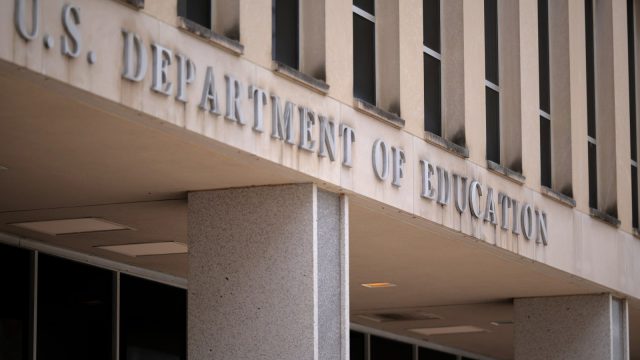
The Education Department plans to lay off more than 1,300 of its employees as part of an effort to halve the organization’s staff — a prelude to President Donald Trump’s plan to dismantle the agency.

Department officials announced the cuts Tuesday, raising questions about the agency’s ability to continue usual operations.

The Trump administration had already been whittling the agency’s staff, though buyout offers and the termination of probationary employees. After Tuesday’s layoffs, the Education Department’s staff will sit at roughly half of its previous 4,100, the agency said.

Alabama receives a total of about $2.6 billion in revenue from the U.S. Department of Education for K-12 schools and colleges, according to an AL.com analysis of the most recent federal data.

No matter what happens, state leaders are encouraging schools and colleges to brace for changes.

“In the short run, I encourage all those currently supported by the Department of Education’s funding and services to prepare for disruption,” Jim Purcell, of the Alabama Commission on Higher Education, told AL.com last week. He said he believes it’s likely that the department will be dissolved.

That funding currently is mandated by Congress. If the Education Department closes, another agency would be in charge of distributing those funds. The Education Department also plays an important regulatory role in services for students, ranging from those with disabilities to low-income and homeless kids.

“The most concerning scenario would be one in which the regulations remain in place with reduced funding,” State Superintendent Eric Mackey said in a statement. “So far, we have no indication that might be the case. Nevertheless, we are closely monitoring developments.”

How much federal funding for Alabama schools and colleges?

Public colleges and universities in the state rely the most heavily on federal funds, with about a quarter of revenue, $1.98 billion, coming from government grants and contracts in fiscal year 2023.

In 2021-22, Alabama colleges received the 10th highest allocation of federal funds in the country, according to a study by the National Center for Education Statistics. 

In Alabama’s K-12 schools, federal funding accounted for about $615 million, or 9 percent of the total $6.7 billion allocated in fiscal year 2024.

Funding varies widely by institutions’ missions, locations and the students they serve.

Community colleges typically rely the most on federal funds, with some earning more than half of their revenue from the federal government.

On the K-12 side, rural, high-poverty districts like Perry County can get as much as $8,000 per pupil in federal funds, while Mountain Brook and Orange Beach spend under $1,000.

What will happen to programs for high-poverty schools, special education?

In discussions with state and federal officials, Mackey said leaders were committed to keeping IDEA and Title I funding in place, which support special education programs and high-poverty schools. Alabama received $193 million in IDEA funding and $301 million in Title I funding for fiscal year 2024.

State lawmakers said the shifts would possibly give the state more power to determine how funds are spent.

“The funds will continue to come, it’s just I think we would have more flexibility,” Danny Garrett, R-Trussville, told reporters in February. “The money’s not going to go away.”

Mackey, meanwhile, said he plans to stay focused on reading and math improvements, as well as graduation outcomes. The state has put record amounts of funding into reading and math reforms, and is currently working to reconfigure its school funding model to better serve students with disabilities, English learners and low-income students.

“As we focus on these core issues, we do rely heavily on federal funding for our schools to maintain specialized supports, especially special education, Title I, required assessments, English Language Learners, and child nutrition,” Mackey said “Our schools depend on these funds, and as long as the funds continue to be made available for our schools, less federal regulation and burdensome paperwork we would welcome.”

State higher education support has dwindled over the years, making Alabama one of the most expensive states to attend college, according to recent reports. Purcell said state officials need to work to make institutions less dependent on federal funds.

Federal support for K-12 schools and colleges was in place prior to the creation of the Department of Education in 1979, and Purcell said he expects many of its components, such as student financial aid, to remain in some form.

The biggest impact, he said, could come from non-department contracts such through the National Science Foundation and the National Institute for Health. Some estimate that Alabama could lose as much as $46 million in indirect support from NIH for research initiatives from recent rate cuts, Purcell said.

The Trump Administration has already eliminated thousands of federal positions, including at the department for Civil Rights and Institute of Education Sciences, which collects data on academic progress.

“The effort to cut the National Center for Education Statistics is also a major concern,” Purcell added. “Data collected from colleges and universities helps campuses and state leaders in managing and planning higher education efforts.”

Can Trump close the Department of Education?

A draft of the executive order circulated last week recognizes that the president does not have the power to shutter the Education Department, according to reporting from The Washington Post. It would take an act of Congress and 60 “yes” votes in the Senate, which is unlikely given that Republicans hold only 53 seats.

“That takes 60 votes in the Senate, and it takes the majority of the House, and we just haven’t heard that the Congress really wants to do that and completely reorganize the cabinet,” Mackey told reporters in February.

Rather, the draft calls on Education Secretary Linda McMahon to “take all necessary steps” to facilitate the closure of the department “to the maximum extent appropriate and permitted by law.”

Officials including McMahon have suggested that might include trying to shift some of the agency’s functions to other parts of government – though that would also face legal hurdles because the agency’s major programs are assigned by law to the Education Department.

More likely is a continuation of what has already begun at the agency: deep cuts to staff, programs and grants. The department has already warned of a “very significant” reduction in force in the short term.

AL.com, The Associated Press contributed reporting.