Home Blog Page 1254

Birmingham City Council President Pro Tem Jay Roberson to host Nonviolence Leaders of Camp NOW with Elder Bernice King

0

BIRMINGHAM, AL- As summer swings into full throttle, many youth are taking proactive measures to stay engaged in constructive activities that build their educational and leadership skills far beyond the average classroom. On Wednesday, July 15, Council President Pro Tem Jay Roberson will join Elder Bernice King to host the 4th Annual Summer Camp NOW (Nonviolence Opportunity Watch) at the 16thStreet Baptist Church at 3:45 p.m.

Camp NOW, a youth symposium that originated from the King Center, draws youth from the Greater Atlanta area to develop and enhance their leadership and team building skills all in the course of one week. In the latter part of the week, groups will participate in a historical Civil Rights pilgrimage to Montgomery and Birmingham, Alabama. Stops will include the Birmingham Civil Rights Institute; 16th Street Baptist Church; Dexter Avenue King Memorial Baptist Church and The Dexter Parsonage Museum. During Camp NOW’s visit to Birmingham, Councilor Roberson will be bring remarks and speak with the youth about their role as change agents when steering their peers to make the right choices.

“Our youth help build the core of our communities. It is our responsibility as leaders to keep them in the forefront of change,” Councilor Roberson said. “As they show up in large numbers to learn of the struggles of our ancestors and translate those characteristics into their own actions, it speaks volumes to the entire Civil Rights movement, I’m beyond honored to be a part of this forum.”


AG CHOOSES SYLACAUGA POLICE CHIEF TO BE AG LAW ENFORCEMENT COORDINATOR

0

(MONTGOMERY)—Attorney General Luther Strange today announced he has selected Sylacauga Police Chief Chris Carden to serve as his office’s new law enforcement coordinator. Carden is a long-time law enforcement veteran with more than 25 years of experience.  He will begin work in the Attorney General’s Office on July 27.

       “I am extremely pleased that Chief Carden is coming to the Attorney General’s Office to serve the citizens of Alabama,” said Attorney General Strange. “His outstanding performance for the people of Sylacauga and Talladega County demonstrates a deep and abiding commitment to law enforcement and to public service.  We are fortunate that he will now share his professional skill and dedication to help this office and law enforcement officers throughout Alabama.”

       Carden will work with law enforcement agencies across the state to develop training programs, to notify officers of changes in criminal law, to work with a law enforcement advisory committee, and to facilitate communication and cooperation between the Attorney General’s Office and law enforcement officers statewide.

“I’m extremely excited and honored to be offered an opportunity to work with the Alabama Attorney General’s Office,” said Carden. “I am looking forward to serving the law enforcement community across the State of Alabama in my new position.”

Law enforcement service is a long-standing family tradition for Carden: his grandfather was a Sylacauga police officer, and his father served the department as a dispatcher.

After graduating from Sylacauga High School Carden began his law enforcement career with the United States Army Military Police in 1989. During his enlistment he was assigned as a military police officer, military police investigator, and served in operations Desert Shield/Desert Storm in 1991.

He began his civilian law enforcement career in 1993 with the Talladega County Sheriff’s Department, where he served as a dispatcher and corrections officer. He was hired by the Sylacauga Police Department in 1994 and attended the 101st Session of the Northeast Alabama Police Academy at Jacksonville that same year. Since beginning his career at the c Police Department, Carden has been assigned to nearly every post within the department including patrol, general and narcotics investigations, crime prevention, patrol supervisor, public housing unit supervisor, watch commander and chief investigator. After being promoted to captain in 2009, he was given the assignment of directing all operations of the department. In December of 2011, Carden was appointed as the interim police chief for Sylacauga, and in May of 2012 he was sworn in as Sylacauga’s police chief.

Carden is a graduate of the 215th Session of the FBI National Academy, and is a former Vice President of Fraternal Order of Police Lodge 8.  He is a member of the Alabama Association of Chiefs of Police, and the International Association of Chiefs of Police, and also serves as an adjunct instructor at the Northeast Alabama Law Enforcement Academy. 

Carden replaces another former Sylacauga police chief, Louis Zook, as the Attorney General’s law enforcement coordinator. 


Krystal® Company Celebrates the Hot Dog All Summer Long

0

Krystal® Company Celebrates the Hot Dog All Summer Long
$0.99 and FREE Krystal® Pups make this summer special

ATLANTA, GA – Hot doges are one of the classic tastes of summer and, this year. The Krystal Company® is ensuring every hot dog comes at a hot deal. The brand famous of rite’s signature Krystals, Pups and Chiks are celebrating with special “Add a Pup for $0.99” pricing on Krystal® Pups when combined with any combo meal. For just $0.99, guests can enjoy one of the popular mini dogs alongside their favorite menu items all through July and August.

“Our bite-size pips are the perfect treat,” said Alice Crowder, Vice President of Marketing at The Krystal Company. “We want everyone to have a chance to enjoy this delicious menu item whenever they visit their local Krystal this summer.” There are no limits to the number of Pups that can be  added to each combo for $0.99 each, allowing guests to fill up on a favorite.

In addition to the 0.$99 pricing on Krystal Pups® during the months of July and August, guests can also revive a free Pup every Tuesday in July. “Free Pup” coupons will be distributed to members of Club Krystal, the company’s loyalty club (Available in email and SMS formats). There will be a limit of one free Pup per guest each Tuesday through July. The offer is valid at participating restaurants, while supplies last.

“Summer may come and go quickly, but we’re proud to feature Pups on the Kyrstal menu every month of the year,” continued Crowder. “This is the perfect time to try Pups for the first time, or take advantage of a great deal on a longtime fan favorite.”

About The Kyrstal Company®

Founded in Chattanooga, Tennessee, in 1932, The Krystal Company is the oldest quick service restaurant chain in the South. Its hamburgers are still served fresh and hot off the grill on the ionic square bun at more than 350 restaurants in 11 states. Krystal’s Atlanta-based Restaurant Support Center serves a team of 6,000 employees. For more information, visit http://www.Krystal.com or http://www.facebook.com/Krystal of follow the bran on twitter and Instagram @Krystal.

###

My Networking Testimony

0

By: Chris Ruffin Jr.

Christopher Ruffin

As a senior in high school, playing basketball I never would have thought that networking could play a vital role in my life.
It wasn’t until the summer of 2012 when I traded my jersey in for a dress shirt and a tie and started taking my journey to becoming a news reporter serious. As an intern at the Birmingham Municipal Court under Randall Woodfin, who is now the Birmingham Board of Education President, I had no choice but to network.
Networking as an 18 year old is what landed me my first internship at WVTM 13 in Birmingham.
Being able to master networking at a young age has prepared me for not only my career, but also life lessons. In order to network I learned that you have to be able to keep an open mind, steer away from being in your comfort zone and always remain approachable.
I learned that keeping an open mind, steering away from your comfort and remaining approachable was important because you never know what opportunity you’ll stumble across. I also learned that if you master these three components networking would be your best friend and you could carry it anywhere.
If it weren’t for me learning how to network I wouldn’t have had an internship every summer of my college tenure. I wouldn’t have connections with people in various positions in the city of Birmingham if it weren’t for me learning how to network. If it were not for me learning how to network you wouldn’t be reading this column.


Local Musician Gives Other Artists Outlet for “Creative Freedom”

0

By Ariel Worthy

11720620_10205730831642311_941713620_n

For artists who want to be known for senseless music, they call Young Money. For artists that want their true creativity and talent to show, they call JazzMine JaNis.

JazzMine JaNis is a 26 year-old Birmingham native who has been doing music her entire life. JaNis started in radio, and from radio she decided it was time to take her passion for music serious. She then started her own record label called Artistic Intelligence.

Artistic Intelligence is a platform for people to be who they are musically.

“I started it simply from being an independent artist and being frustrated with what main stream wanted.” JaNis said. “As an artist I’ve had record deals on the table and big opportunities but the main thing that made me say no to a lot of things was the creative freedom. Artistic Intelligence is all about the creative freedom.” Artistic Intelligence develops and produces for their artists, as well as push their talent through podcasts.“It’s a platform for independent artists to be who they are, to have someone to support them and appreciate their creative freedom.”

Artistic Intelligence is housed in Birmingham.

Who inspires you musically?: I wouldn’t say someone, I would say a bit of everything. The thing that motivates me musically is life. Everything I write and produce comes from a life situation and I think that’s why people can relate to a lot of my music because it’s true.

What got you into music?: What got me taking it seriously was situations in life. I always used to fight with people and I hate confrontation. So music was a way for me to just say what I wanted to say and not feel bad for what I said.

How would you describe your musical style?: I really don’t give my music a genre because genres to me are like cages. A lot of people put me in the categories of soul, R&B and new soul.

When do you know you are most satisfied with your work?: You’re the first one to know this secret. When I’m done and I’ll sit back and listen to it, I search for truth and authenticity. If I cry, I’m done.

What is your purpose for singing?: I most certainly feel that the gifts that were given to me are bigger than what I can understand. In this society in this world there are so many negatives. I love sociology and psychology and understanding what the core is can be misunderstood. I was in those shoes once upon a time. All it takes is for someone to listen. The gift that we (as artists) have, have healing and breakthrough.

If you weren’t singing what would you be doing?: I’d probably be a veterinarian.

What’s one instrument you can’t do without on a track?: That’s a hard one because I love so many of them. I would have to say the bass because the bass holds it all together.

On your website there is a video of you performing “Eyes Open.” It’s kind of poetic. Is there a poetry side of you?: I did a lot of poetry, and not only poetry, but freestyling. That’s music anyway. It’s nothing but poetry.

There’s something in your music that keeps people hooked. What would you say that “something” is?: It’s the truth in the music. Nothing is generic about what I do. I come from a real place. I put myself right in the moment, so a lot of people feel the truth in what I say.

What’s your next move?: I’ll be releasing my next project, “Starting Over.” I want to network more and travel more. Touring, meeting beautiful people, traveling, and music.

JaNis is one that is definitely for supporting people in their dreams.

“Speak it into existence; don’t be ashamed of it. Say what you want to do. Work hard towards it and don’t let anybody pull you down from your drive.”

North Alabama OCDETF Earns National Recognition for Group Fighting Heroin Supply

0
  BIRMINGHAM — The Organized Crime Drug Enforcement Task Force for the federal Northern District of Alabama earned national recognition for the focused effort it launched in 2012 to stem the flow of heroin into Birmingham by prosecuting some of the largest heroin distributors in the city, on down to street-level dealers, announced U.S. Attorney Joyce White Vance.
 
        OCDETF Regional Director Michael F. Smith today presented a 2014 National OCDETF Award to an interagency Heroin Initiative Group of investigators and prosecutors working with Assistant U.S. Attorneys Gregory R. Dimler and L. James Weil. Dimler leads the OCDETF section in the U.S. Attorney’s Office. The bi-annual awards recognize outstanding investigations from the OCDETF Regions, as well as individuals who best exemplify the mission and spirit of the OCDETF Program, said national Organized Crime Drug Enforcement Task Forces Director Bruce Ohr.
 
        “The initiative launched in 2012 was a major strike at the supply of heroin into Birmingham, which significantly interrupted the flow of the drug into our community and shut down some major suppliers,” Vance said. “Of course, there are always new sources, new traffickers and new street dealers, so the fight continues,” she said. “We have an ongoing commitment to working with federal, state and local law enforcement partners to interdict the heroin supply, while working with our community-based initiative and partners in the medical community to prevent and treat addiction,” she said. “I am grateful we have groups like this, committed to protecting the community.”
 
During today’s award presentation, Ohr thanked the interagency Heroin Initiative Group for developing a unified approach to address the heroin epidemic threatening the Birmingham area. “Your contributions and achievements have bolstered the OCDETF Program’s efforts to fight heroin and positively impact our communities,” he said.
               
        The OCDETF Program is a partnership between federal, state and local law enforcement agencies. The principal mission of the OCDETF Program is to identify, disrupt, and dismantle the most serious drugtrafficking organizations primarily responsible for the nation’s illegal drug supply.
 
        Participants in the 2012-2013 Heroin Initiative Group that received the award, along with Dimler and Weil, are: Hattie French and Jude Washington, Jefferson County Sheriff’s Office; Gregory S. Gauger and M. Wayne Gerhardt, FBI; Jason Green, Pelham Police Department; M. Ezra Heath, Internal Revenue Service, Criminal Investigation; Scott Holmes, Tuscaloosa County District Attorney’s Office; Alan Miller, Shelby County District Attorney’s Office; John Walker, Birmingham Police Department, and Patrick Wilson and Troy Wilson, Drug Enforcement Administration.
 
        A spike in heroin overdose deaths in the Greater Birmingham Metro Area spurred the group’s formation. The U.S. Attorney called law enforcement together in July 2012 to develop a unified approach to reduce the spread of the deadly drug. Heroin deaths had almost doubled in Jefferson County from 2011 to 2012, climbing from 30 to 58. The number of heroin deaths also soared, from 15 to 82, between 2008 and 2012 in Jefferson, Shelby and Tuscaloosa counties. The rise in heroin deaths leveled off for a year after the law enforcement push, but took off again in 2014, with 137 in Jefferson County alone.
 
        The 2012 initiative saw federal, state and local law enforcement combine to share intelligence and work within the framework of two OCDETF investigations to disrupt the supply of heroin and dismantle the organizations distributing it. While the investigations were under way, the U.S. attorney and law enforcement leaders began a media outreach to educate the community about the growing presence and deadly nature of heroin.
 
        On the supply side, the OCDETF investigation called, “King of the Hill,” focused on the heroin trafficking activities of Billy “Champ” Williams Jr., and his associates. The work dismantled Williams’ organization and included the seizure of two kilograms of nearly pure heroin and a kilogram and a half of cocaine. Williams and 10 members of his organization were convicted of drug trafficking or money laundering and the government seized more than $500,000 in cash, jewelry, furs and luxury vehicles. Williams was sentenced to 22 years in prison.
 
        In a second OCDETF operation, called “Blue Magic,” the DEA, and multiple local and state agencies, simultaneously targeted lower-level heroin dealers and their sources of supply. The office wanted drug dealers and the community to know that federal authorities are serious in tackling the heroin problem at the street level and up the supply chain.
 
        Of the 49 defendants indicted on federal charges in Blue Magic, 40 pleaded guilty and one was convicted at trial. One of those defendants pleaded guilty to distributing heroin that caused a death and was sentenced to the mandatory minimum of 20 years in prison. The remaining sentences ranged from probation for the first-time offenders to 12 ½ years for the dealers who qualified as career offenders under Federal Sentencing Guidelines. As part of the initiative, more than 30 individuals were charged in state courts with trafficking small amounts of heroin.
 
###


NATIONAL BLACK PROGRAMMING CONSORTIUM RELEASES STATEMENT

0

New Executive Director Makes Push to Advance the Dialogue 
on Race in America in Wake of Recent Attacks

image003-1

NEW YORK (July 7, 2015)—Leslie Fields-Cruz, executive director of the National Black Programming Consortium (NBPC), the nation’s primary presenter of stories on the black experience on public television, has released the following statement in the wake of recent attacks against black Americans:
 
It’s been 21 days since the terrorist attack in Charleston, South Carolina.  You’ve watched the news clips, listened to the experts. You’ve checked your social media sites regularly, liking, sharing and commenting. You’ve signed online petitions, attended marches and joined prayer circles. You explain to your child—yet again—what systemic racism is about and why someone would shoot innocent people in a church, why a government would disenfranchise 250,000 black Dominicans of Haitian descent, why a police officer would deliberately throw an African-American teenage girl to the ground at a pool party, why another unarmed black man has been shot by the police, and why news agencies avoid reporting on the series of black church burnings, even when there’s a historic precedence that relates such burnings to acts of hate and racism. As the words pour out of your mouth, you recognize this as an age-old conversation had between a black parent and their child—a talk that is at least 400 years old.
       “OH, MAKE ME WANNA HOLLER AND THROW UP BOTH MY HANDS.”
Never have the words of Marvin Gaye’s song “Inner City Blues rung so true. For the millions upon millions of black people who consciously and unconsciously defy racial stereotypes on a daily basis, watching the events of the Charleston Massacre play out is like being in a wind tunnel. The forces of the winds pummel your body, as you struggle to take each step forward. Suddenly, a wind ten times stronger than the others causes you to lose your footing. You’re flying through the air, reaching for anything that will stop your backward trajectory.  You finally grab hold of something, steady yourself, and look up. You have traveled so far back, and still, the wind blows.  Why continue the walk? You are tired, after all.
If we are honest with ourselves, systemic racism is not likely to end in our lifetimes, our child’s lifetime or even our grandchild’s lifetime. But it’s when the media trucks have rolled out of town and the social media users are back to commenting about the Kardashians, that we must draw upon the resilience of the ancestors, gather our reserves, renew our partnerships, stand together with our allies and move forward. No, it’s not to continue the dialogue, but to advance it.


The National Black Programming Consortium has engaged in a dialogue about race and discrimination for more than 35 years. We have done so by funding documentary programs
that enlighten Americans about the black experience—on public television and beyond. Below is a short list of titles that explore how many Americans have confronted race and discrimination—from the Freedom Riders of the civil rights era, to the black photographers whose pictures of everyday African-Americans served as a form of self-affirmation. To advance the dialogue, I have invited my colleagues of the National Minority Consortia to provide additional titles that will broaden the dialogue about race in America beyond the black-white dichotomy. If we are sincere in our efforts to change how we address race and discrimination in our country, it will take the efforts of all Americans, black, white, brown, red, yellow, gay, straight, trans, Christian, Jewish, Muslim and atheist.
My charge is for you to use this list and become active viewers.  Parents, if you sit at home with your child to watch a program, keep a laptop or tablet close by so that you can search for answers as soon as the questions come to you. Educators, work with your parent-teacher associations to set up public screenings at your school followed by a group discussion. Many films on this list include discussion or curriculum guides to help you facilitate a dialogue.  Teens and young adults, get together with your friends, decide on what to stream, watch it, and then hold a Twitter discussion. Politicians, screen a film to discover topics from which you can connect legislative policies that have helped or harmed the battle to end discrimination in your community. Share that information with your constituencies. The best solutions to a problem occur when people engage in dialogue.
For our part, NBPC will continue to add titles to this list and, whenever possible, make a program available for streaming on our website, blackpublicmedia.org. The more we understand our collective pasts, the better equipped we are to find the solutions that will bring all Americans closer to a just and more equal society.

NAACP Ends Boycott of South Carolina

0

(PHILADELPHIA, PA) – Today, at the NAACP 106th National Convention, the National Board of Directors voted to end the 15 year economic boycott of South Carolina. The NAACP is looking forward to the membership body of delegates casting an affirmative vote for this emergency resolution, Tuesday, July 14, 2015.  You may read the emergency resolution here.

In light of these developments, the NAACP has released the following statement:

th-1

From Roslyn M. Brock, Chairman, NAACP National Board of Directors:

Today is a historic day as 15 years ago we waged an economic boycott against the state of South Carolina. While the conclusion of our boycott is a proud moment, we will continue to demand more. All across the country, vestiges of hatred and oppression remain.  Removal of the flag is a symbolic victory, but we must not lose sight of the systemic challenges including discrimination in our criminal justice system, economic system, employment, education, housing, health care, or other barriers to full and equal protection under law and full first-class citizenship. The NAACP will continue to move onward in the fight for justice until equality is achieved for all Americans.  

From Cornell William Brooks, NAACP President & CEO:

The NAACP’s decision to lift its economic boycott on the state of South Carolina comes 15 years after exerting consistent and aggressive economic pressure on state lawmakers to bring the well known symbol of racial oppression down. The removal of this emblem of hate is not only a victory for the state of South Carolina and the families of the nine students of scripture who lost their lives in a historic church, but it is a victory for the NAACP and the nation as we all work together to a forge a more perfect union. In no way does removing the Confederate flag in South Carolina fix the problems of our nation that are rooted in racism and bigotry, but the flag’s removal is a very important step in ceasing to glorify a bygone era in which African Americans were treated as second class citizens. This is a vindication of the grassroots advocacy of the NAACP.

###

Founded in 1909, the NAACP is the nation’s oldest and largest nonpartisan civil rights organization. Its members throughout the United States and the world are the premier advocates for civil rights in their communities.  You can read more about the NAACP’s work and our five “Game Changer” issue areas here.


Personal Assistant Needed

0

Personal Assistant Needed

Personal assistant needed to help reduce our work loads. Computer skills needed good with organization. You will be well paid. Salary/Weekly Rate: $457. Interested person(s) should contact: (guntersusan634@gmail.com) for more info and wages.

BT07/09/2015
(HZline)

The Latest: Confederate Flag Is Removed in South Carolina

0

Nikki Haley, Dick Riley, Jim Hodges, Gilda Cobb Hunter, David Beasley
South Carolina Gov. Nikki Haley signs a bill into law as former South Carolina governors and officials look on Thursday, July 9, 2015, at the Statehouse in Columbia, S.C. The law enables the removal of the Confederate flag from the Statehouse grounds… View Full Caption The Associated Pressna

The latest on the Confederate flag in South Carolina (all times local):

———

10:30 a.m.

President Barack Obama says taking down the Confederate flag is “a sign of good will and healing and a meaningful step toward a better future.”

Obama posted his reaction on Twitter on Friday, minutes after the flag was removed from a flagpole on the grounds of the South Carolina Statehouse, where it had been for 54 years.

The removal followed last month’s killing of nine black parishioners at a Charleston church. A white man has been charged in what authorities have called a racially motivated killing.

Obama delivered a eulogy at one of the funerals, for state Sen. Clementa Pinckney, who also was pastor of the church where the killings took place.

———

10:20 a.m.

Republican Gov. Nikki Haley didn’t show any emotion as the Confederate flag was lowered and removed from the South Carolina Statehouse grounds until someone in the crowd yelled “Thank you, governor!”

Then, as the flag was taken down Friday morning, Haley nodded in the direction of the cheering and smiled.

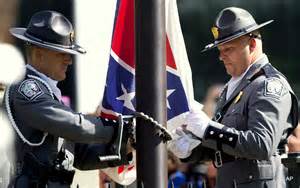
The flag was taken down by a state Highway Patrol honor guard. One trooper took the flag down, and then he and another trooper rolled it up. They handed it a third trooper. Then, when the flag was given to an archivist, Haley clapped.

Haley called for the flag’s removal after the June 17 massacre of nine black parishioners at a Charleston church. A white man is charged, and authorities say the killings were racially motivated. The shootings reignited calls to remove Confederate symbols across the country.

She signed into law a bill to remove the flag on Thursday.

———

10:09 a.m.

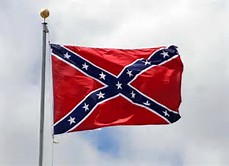
The Confederate flag has been removed from a flagpole on the grounds of the South Carolina Statehouse, where it has had a presence for 54 years.

The rebel banner was taken down Friday morning by a Highway Patrol honor guard in a ceremony attended by thousands who cheered at the removal, many yelling “USA, USA” and “Hey, hey, hey, goodbye!”

A van will take the flag to a nearby museum, where it will be housed.

The reversal seemed unthinkable just a month ago. It comes after the June 17 massacre of nine black parishioners at a Charleston church. A white man is charged, and authorities say the killings were racially motivated. The shootings reignited calls to remove Confederate symbols across the country.

The Confederate flag was raised over the Capitol dome in 1961 to protest integration. It was moved in 2000 to a flagpole in front of the Statehouse.

The flagpole, too, will be torn down, but no timetable is set.

———

10:07 a.m.

A ceremony has begun to remove the Confederate flag from the grounds of the South Carolina Statehouse, where it has flown for 54 years.

The rebel banner will be taken down Friday morning by a state Highway Patrol honor guard. Thousands of people gathered at the Statehouse, many cheering and some chanting “take it down.”

After the flag is removed, a van will take it to a nearby museum, where it will be housed.

The ceremony and flag removal come after the June 17 massacre of nine black parishioners at a Charleston church. A white man is charged, and authorities say the killings were racially motivated. The shootings reignited calls to remove Confederate symbols nationwide.

The Confederate flag was raised over the Capitol dome in 1961 to protest integration. It was moved in 2000 to a flagpole in front of the Statehouse.

———

9:55 a.m.

An honor guard from the South Carolina Highway Patrol has arrived on the grounds of the Statehouse and the officers are standing stoically as they wait to take down the Confederate flag.

The group is standing near the flag with their hands behind their backs. They are wearing white gloves.

The honor guard will bring the flag down during a ceremony at 10 a.m.

The flag has flown either on the Statehouse dome or grounds since the civil rights moment. It is being brought down after nine black church members were killed during a shooting last month.

———

9:35 a.m.

The leader of the South Carolina chapter of the Sons of Confederate Veterans says he is not at the ceremony to take down the rebel flag because he honors the memories of his seven ancestors who fought for the South in the Civil War.

Leland Summers said by phone Friday ahead of the ceremony that: “I’m not going down there to watch them be dishonored and defamed.”

He says his organization was not asked to participate in the Statehouse ceremony, unlike in 2000 when the flag was moved from the Capitol dome to a monument in front of the building.

Summers says that at some point today, he will pause, reflect on his Southern relatives and pray for the future of the country.

At the Statehouse on Friday morning, flag supporters were vastly outnumbered, but some were present. Cindy Lampley clutched a poster showing photos of ancestors who fought for the Confederacy. Lampley says she is a historical re-enactor who fears that removing symbols such as the flag dishonors her relatives who fought for the Southern cause.

———

9:10 a.m.

An honor guard from the South Carolina Highway Patrol will take down the Confederate flag that has flown on the grounds of the Statehouse for more than 50 years.

The flag will be taken down Friday during at 10 a.m. ceremony.

Gov. Nikki Haley signed the bill Thursday calling for the flag’s removal from the Statehouse grounds.

Opposition to the Confederate flag gained momentum after the killings of nine people, including a state senator, at a historic black church in Charleston.

Authorities say they believe the killings were racially motivated and the suspect, Dylann Storm Roof, was seen in photos posing with the Confederate flag as a symbol of hatred.

———

8:20 a.m.

About two hours before the Confederate flag was set to be removed Friday from the South Carolina Statehouse, Gov. Nikki Haley walked out on the Capitol steps to take a look at the scene and to talk to officers providing security.

The governor spent just over five minutes looking over the crowd, which quickly turned and began taking pictures.

Afterward, she and her staff headed back to her first-floor office.

Haley signed the bill Thursday calling for the flag’s removal from the Statehouse grounds.

Opposition to the Confederate flag gained momentum after the killings of nine people, including a state senator, at a historic black church in Charleston.

Authorities say they believe the killings were racially motivated and the suspect, Dylann Storm Roof, was seen in photos posing with the Confederate flag as a symbol of hatred.

———

8:15 a.m.

Members of the news media far outnumber spectators outside the South Carolina Statehouse on Friday morning as officials prepare to take down a Confederate flag that has flown there for more than 50 years.

About 50 people have gathered and the crowed is about equally divided between blacks and whites. Some people are carrying Confederate flags, but more are carrying signs saying the flag should come down.

The 10 a.m. ceremony to take down the flag comes weeks after nine people were killed in a shooting at a historic black church in Charleston, South Carolina.

————

7:40 a.m.

South Carolina Gov. Nikki Haley says she’s proud of how her state responded to the shooting deaths of nine people at a historic black church in Charleston last month, a shooting that led to Friday’s removal of the Confederate flag flying in front of the Statehouse.

Haley told NBC’s “Today” show Friday morning that she’ll be thinking of the shooting victims as the flag is removed at a 10 a.m. ceremony.

Haley said South Carolinians honor tradition and history but the Confederate flag belongs in a museum where people can honor it appropriately.

Haley said: “No one should ever drive by the Statehouse and feel pain. No one should ever drive by the Statehouse and feel like they don’t belong.”

———

7:10 a.m.

Police have roped off the Confederate flag and the area immediately behind it stretching back to the South Carolina Statehouse, where the flag is to be removed in a 10 a.m. ceremony that’s expected to be brief.

Barricades have been put up on either side of the flag where people can gather to watch the ceremony. The busy street that runs in front of the Statehouse is still open, but police plan to close it before the ceremony.

Reporters and videographers outnumbered the crowd. A number of law enforcement officers were scattered about the grounds and nearby streets.

Columbia City Council on Thursday night approved a temporary ordinance banning weapons from nearby streets around the Statehouse for the next 30 days.

The Ku Klux Klan has said it will meet at the Statehouse later this month.